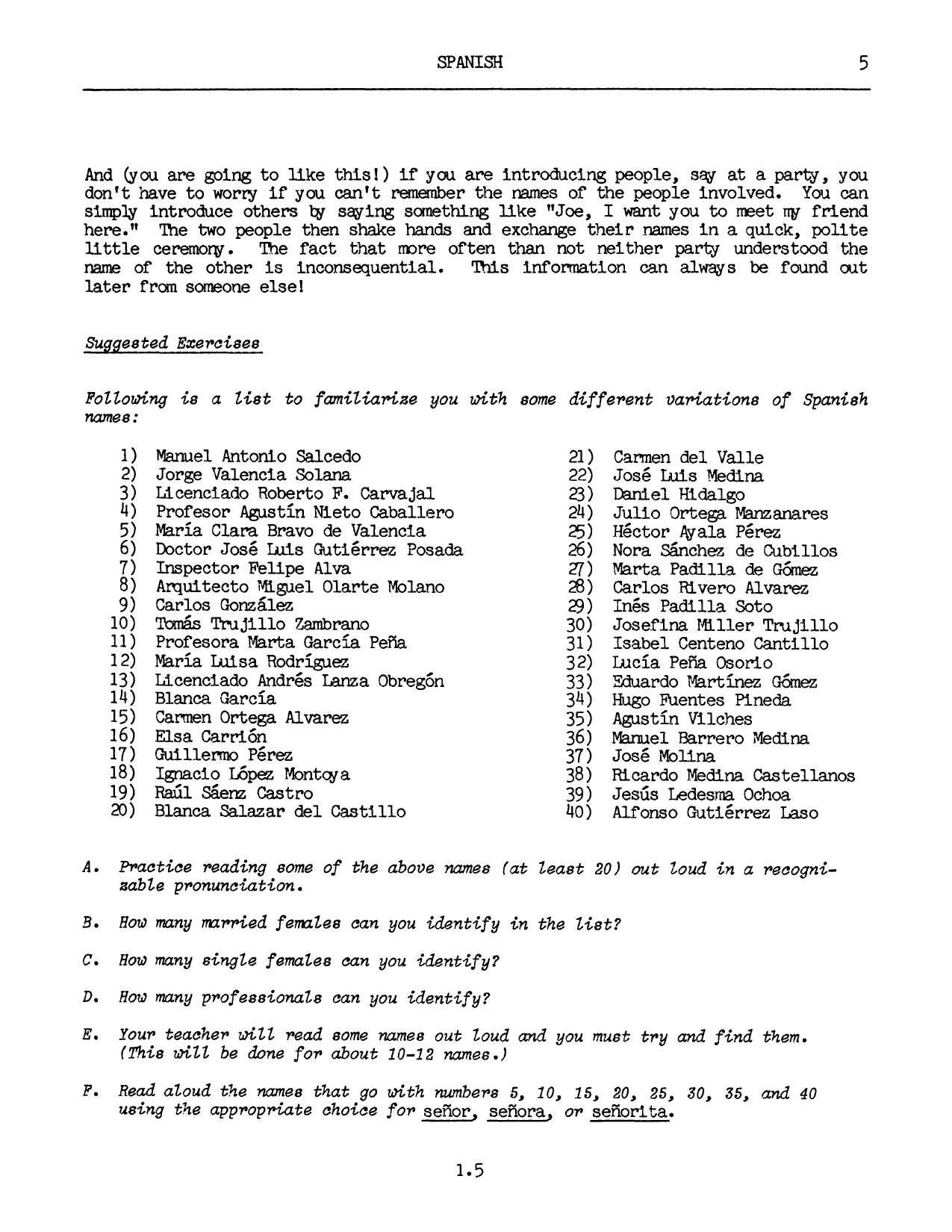
CYCLE 1
GETTING STARTED
THE ALPHABET (El alfabeto)
Suggested procedure:
Letters a to 2 are drilled first with the whole class repeating in chorus, then individually, as many times as ie necessary to obtain satisfactory pronunciation and fluency.
First step - Review all letters from a through 2.
Second step - Introduce the new key words such as: to spell, capital letter, small letter, etc.
Third step - Have students prepare, in Spanish, the spelling of their own names as well as the names listed at the end of Cycle 1.
Note the pronunciation of the following letter combinations: ca, co, cu; ce, ci; fA, 0, BU; ge, gl; gue, gui; gue, gui; ha, he, hi, ho, hu; que and q gui.
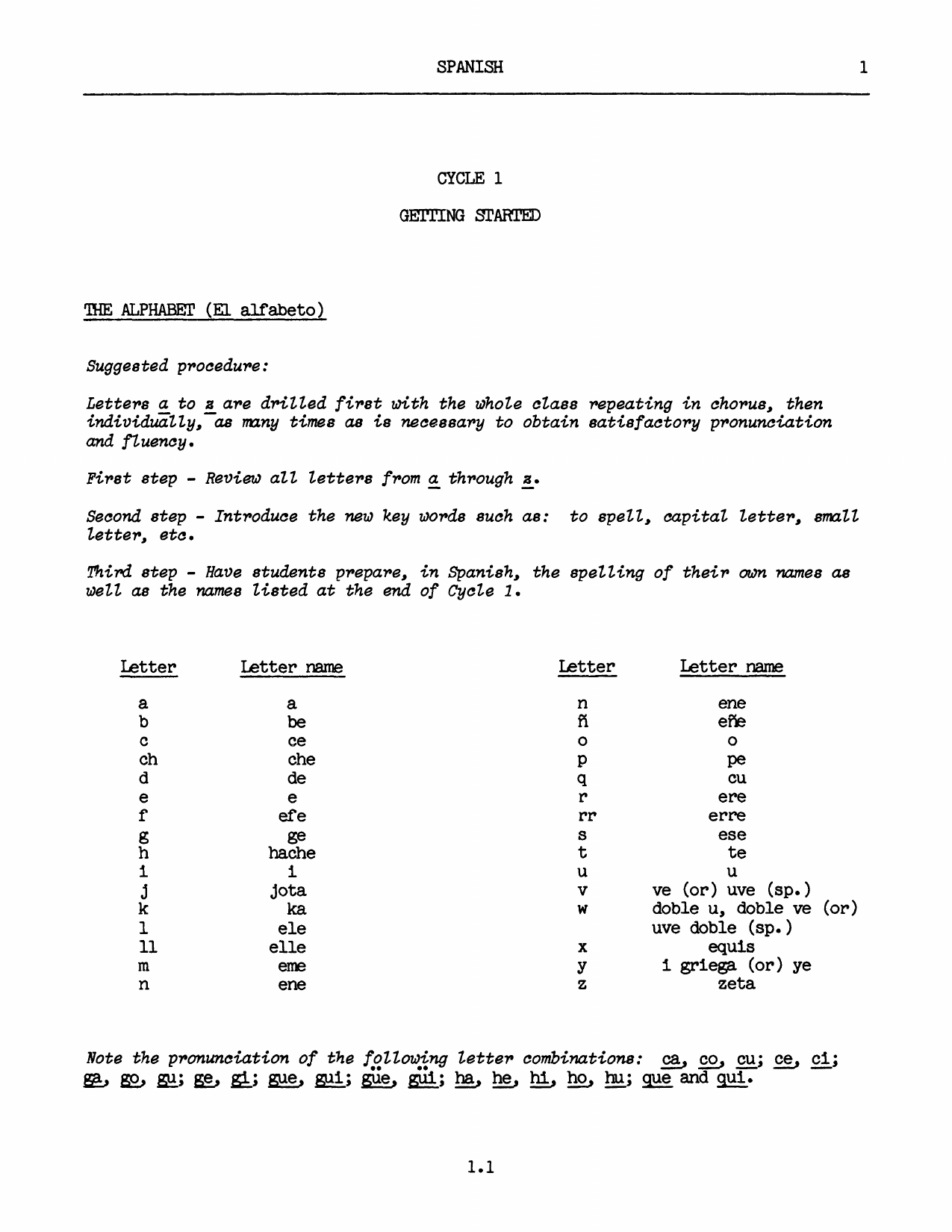
Useful Words and Phrases:
¿Cómo se escribe su apellido?
¿Cómo se escribe su nombre completo?
NAMES
Christenings
If you are invited to a christening you should consider this an honor, since christenings are family affairs and someone thought enough of you to have extended an invitation. Don't forget to take a gift for the child; it does not have to be expensive. Religious artifacts, by the way, are handled by the padrinos (Godparents).
Christenings are normally held on weekends. The ceremony is at a church and the baptismal (bautizo) get-together is usually at the parents' home following the cere-mory « Food is almost always served.
When a child is given a name, not only does family tradition play a role in the name selection, but there is often a religious tradition involved as well: the Saint's Day (Día del Santo). It is not uncommon for a name to be determined by the saint's day on which the child was born or ly the saint the parents venerated or felt a spe-cial devotion to. For example, this tradition is reflected in the very popular Mexican song, "Las Mañanitas," an equivalent of "Happy Birthday": hoy por ser día de tu santo te venimos a cantar. Translation: "today being your Saint's Day, we come to praise you."
Names like Jesús, Angel, María del Rosario, Guadalupe, Jesús María, and so forth, are common and by no means considered sacrilegious.
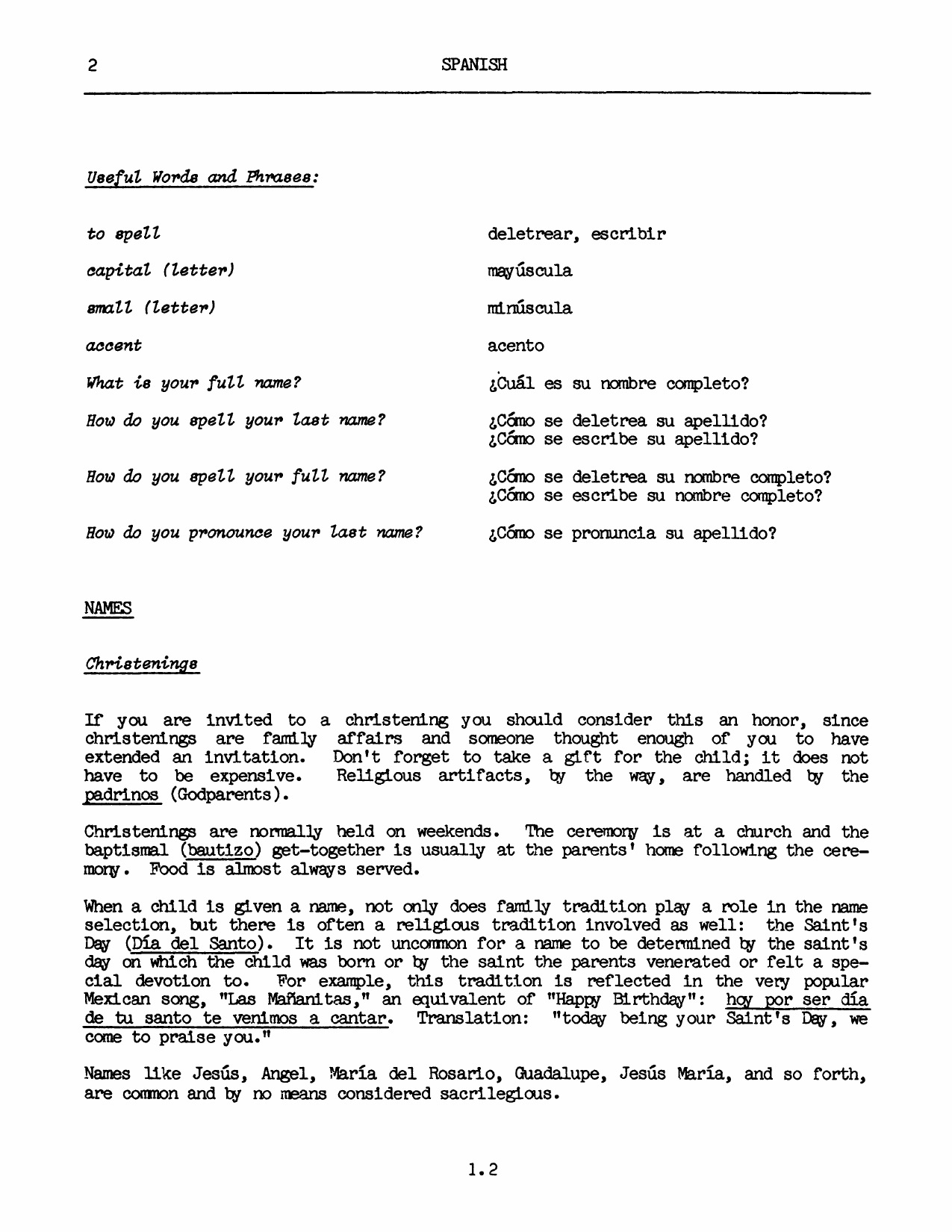
Composition of Names
The traditional name consists of three parts:
given name(s) + father's surname + mother's surname (or initial)
The idea of having a "middle name" is more a part of the Anglo-American culture. In Spanish, there are names that appear to be made up of a first and a middle name, but more often than not these are compound names; that is, you mst use both names together, not one or the other separately (e.g., this is much the same as the English "Billy Joe"). These are examples of compound Spanish given names:
Miguel Angel (compare "Michelangelo" )
Since a majority of names, especially male ones, contain only one given name, it is easy for an American to think that the second part is also a given or middle name when, in fact, it is the father's surname. Here are same examples of Spanish names:
Pablo Cuéllar Calderón
Miguel Olarte Molano
Jorge Valencia Solana
José Luis Gutiérrez Posada
María Clara Bravo Bernal
When addressed, the above would be señor (Sr.) Cuéllar, Sr. Olarte, Sr. Valencia, Sr. Gutiérrez, Señorita (Srta.) Bravo. If you wish, you may use both surnames: Srta. Bravo Bernal, Sr. Gutiérrez Posada, etc. It is not always easy to identify which 1s the paternal surname when you are looking at a name in print, since some of the names may be strange to you and, therefore, difficult to identify as a given or a surname. When in doubt, don't hesitate to ask someone.
When a woman marries, she will normally replace her mother's surname with her husband's surname, but she will NOT drop her own family name.
Tms, if:
de wi: Will be placed in front of Valencia, and her legal name will be:
Maria Clara Bravo de Valencia.
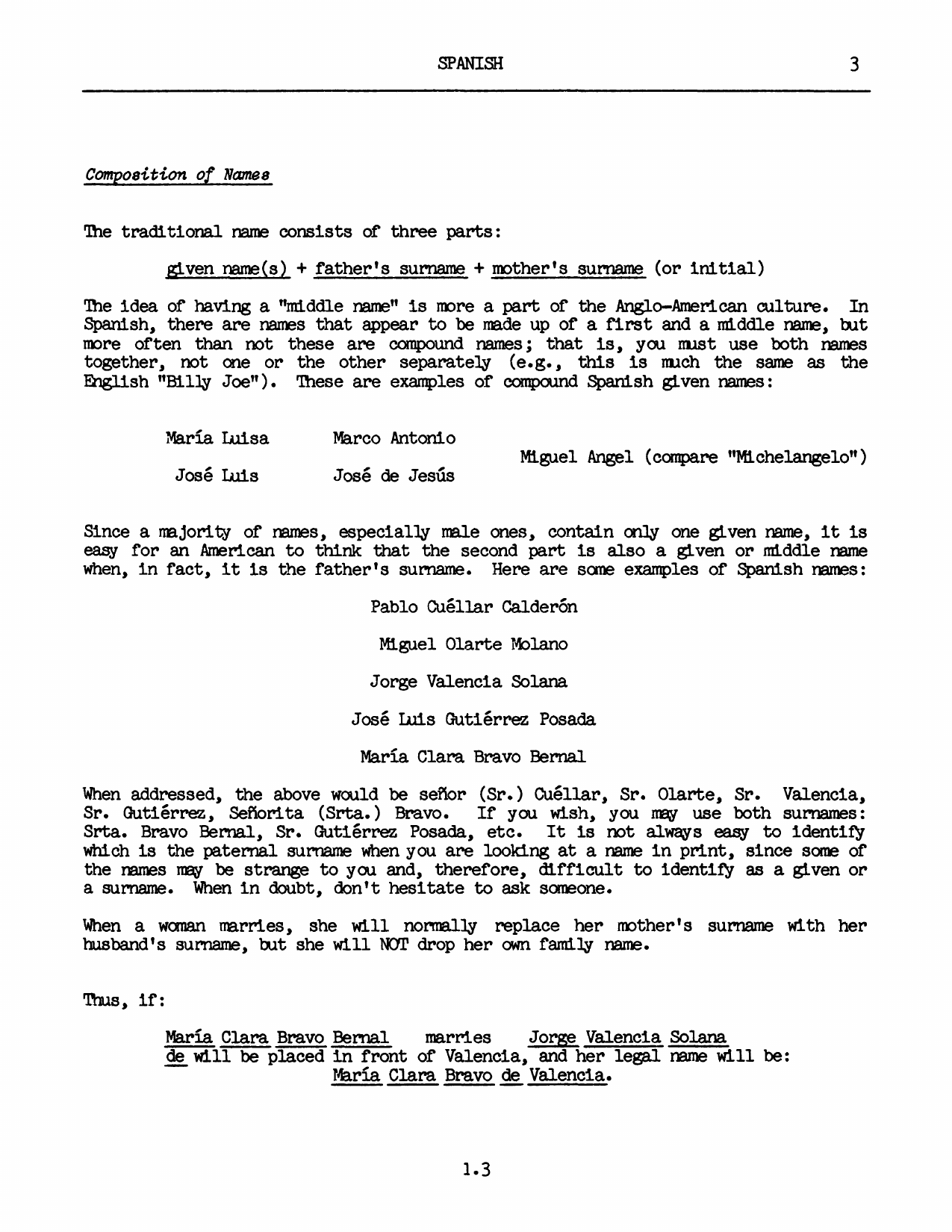
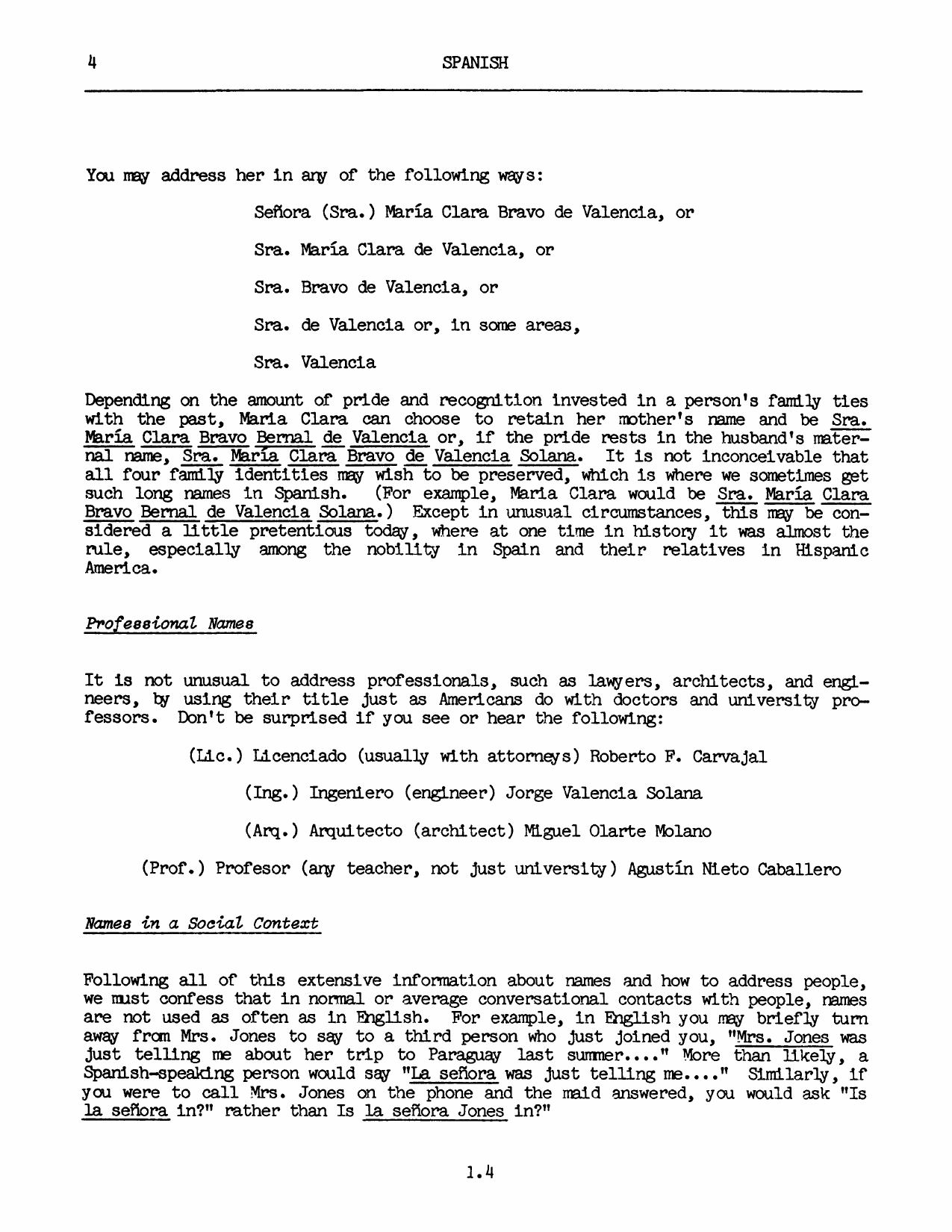
You may address her in any of the following ways:
Señora (Sra.) Maria Clara Bravo de Valencia, or
Sra. Maria Clara de Valencia, or
Sra. Bravo de Valencia, or
Sra. de Valencia or, in some areas,
Sra. Valencia
Depending on the amount of pride and recognition invested in a person's family ties with the past, Maria Clara can choose to retain her mother's name and be Sra. María Clara Bravo Bernal de Valencia or, if the pride rests in the husband's mater-nal name, Sra. Maria Clara Bravo de Valencia Solana. It is not inconceivable that all four family identities may wish to be preserved, which is where we sometimes get such long names in Spanish. (For example, Maria Clara would be Sra. Maria Clara Bravo Bernal de Valencia Solana.) Except in unusual circumstances, this may be con-sidered a little pretentious today, where at one time in history it was almost the rule, especially among the nobility in Spain and their relatives in Hispanic America.
Professional Names
It is not unusual to address professionals, such as lawyers, architects, and engi-neers, by using their title just as Americans do with doctors and university pro-fessors. Don't be surprised if you see or hear the following:
(Lic.) Licenciado (usually with attorneys) Roberto F. Carvajal
(Ing. ) Ingeniero (engineer) Jorge Valencia Solana
(Arq.) Arquitecto (architect) Miguel Olarte Molano
(Prof.) Profesor (any teacher, not just university) Agustin Nieto Caballero
Names in a Social Context
Following all of this extensive information about names and how to address people, we mist confess that in normal or average conversational contacts with people, names are not used as often as in English. For example, in English you may briefly tum away from Mrs. Jones to say to a third person who just joined you, "Mrs. Jones was just telling me about her trip to Paraguay last sunmer...." More than likely, a Spanish-speaking person would say "La señora was just telling me...." Similarly, if you were to call Mrs. Jones on the phone and the maid answered, you would ask "Is la señora in?" rather than Is la señora Jones in?"
And (you are going to like this!) if you are introducing people, say at a party, you don't have to worry if you can't remember the names of the people involved. You can simply introduce others by saying something like "Joe, I want you to meet my friend here." The two people then shake hands and exchange their names in a quick, polite little ceremony. The fact that more often than not neither party understood the name of the other is inconsequential. This information can always be found out later from someone else!
Suggested Exercises
Following ts a list to familiarize you with some different variations of Spanish names:
A. Practice reading some of the above names (at least 20) out loud in a recogni-
zable pronunciation.
B. How many married females can you identify in the list?
C. How many single females can you identify?
D. How many professionals can you identify?
E. Your teacher will read some names out loud and you must try and find them.
(This will be done for about 10-12 names.)
F. Read aloud the names that go with numbers 5, 10, 15, 20, 25, 30, 35, and 40
using the appropriate choice for señor, señora, or señorita.