CYCLE 3
GETTING STARTED IN COUNTRY
| AUTO USES Y TAXIS |
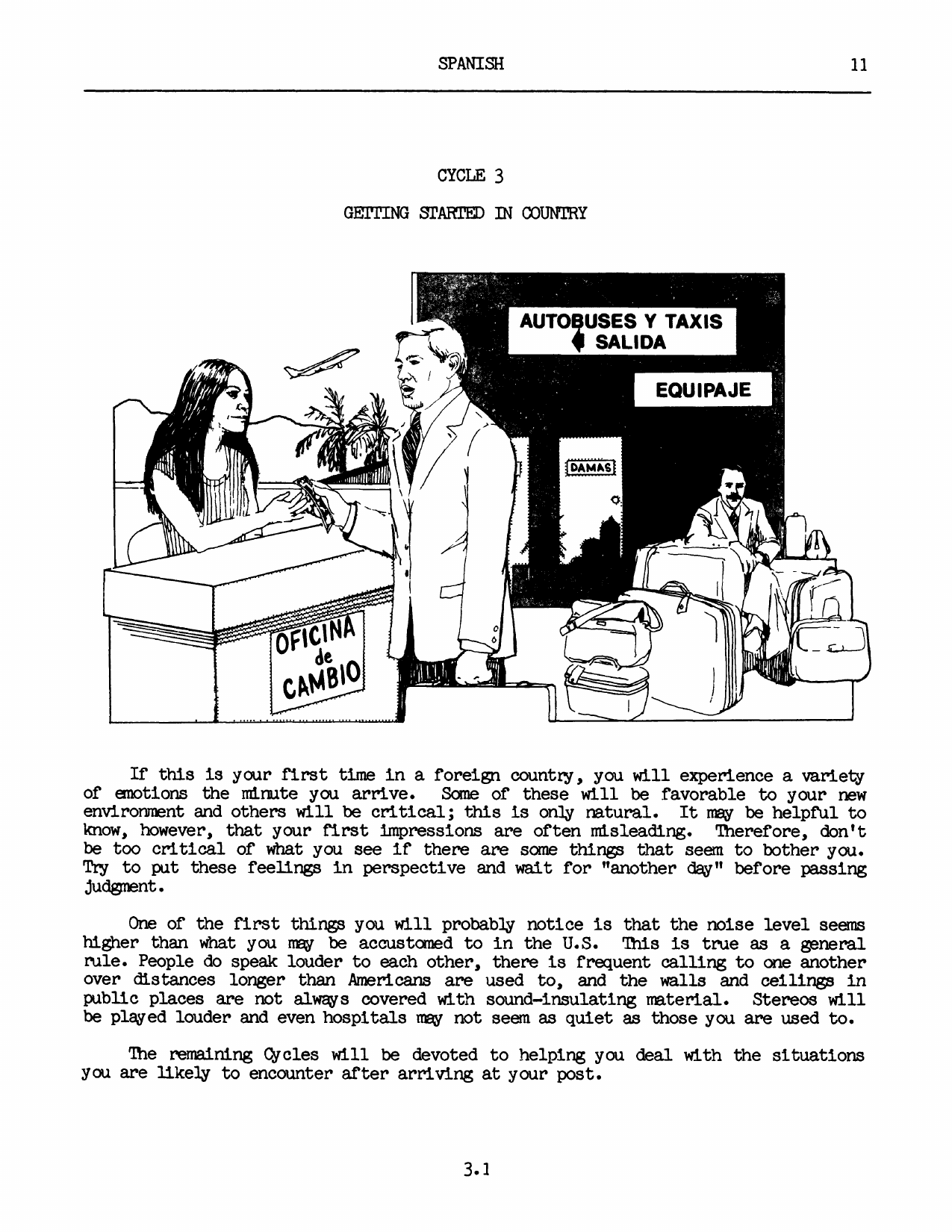
If this is your first time in a foreign country, you will experience a variety
of emotions the mimite you arrive. Some of these will be favorable to your new environment and others will be critical; this is only natural. It may be helpful to know, however, that your first impressions are often misleading. Therefore, don't be too critical of what you see if there are some things that seem to bother you. Try to put these feelings in perspective and wait for "another day" before passing judgment.
One of the first things you will probably notice is that the noise level seems
higher than what you may be accustomed to in the U.S. This is true as a general rule. People do speak louder to each other, there is frequent calling to one another over distances longer than Americans are used to, and the walls and ceilings in public places are not always covered with sound-insulating material. Stereos will be played louder and even hospitals may not seem as quiet as those you are used to.
The remaining Cycles will be devoted to helping you deal with the situations
you are likely to encounter after arriving at your post.
This page has a drawing, chart, or fill-in layout — original page
IN THE BEGINNING
Let us start by assuming that your first need for using Spanish ie at the airport. More than likely you will be met by someone from the Embassy or Consulate, be it one of your colleagues or a driver who speaks English, in which case you will clear the airport fairly quickly.
But what if something happened and nobody was there to meet you? The following information should help you get through on your own.
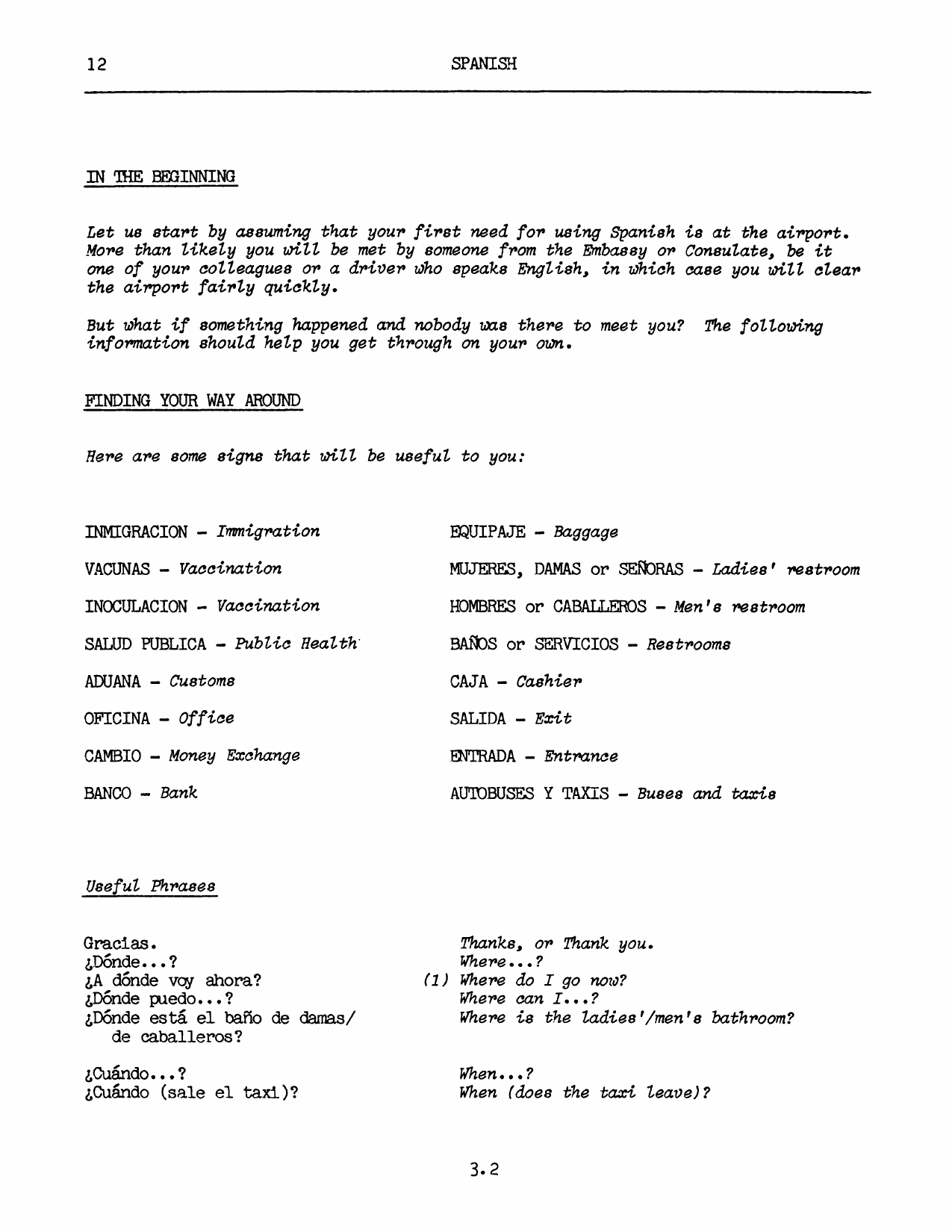
FINDING YOUR WAY AROUND
Here are some signe that will be useful to you:
Useful Phrases
de caballeros?
Tengo visa diplomática (visado
dólares )?
taxi)?
médico)?
enfermera)?
Model Conversation: Changing Money
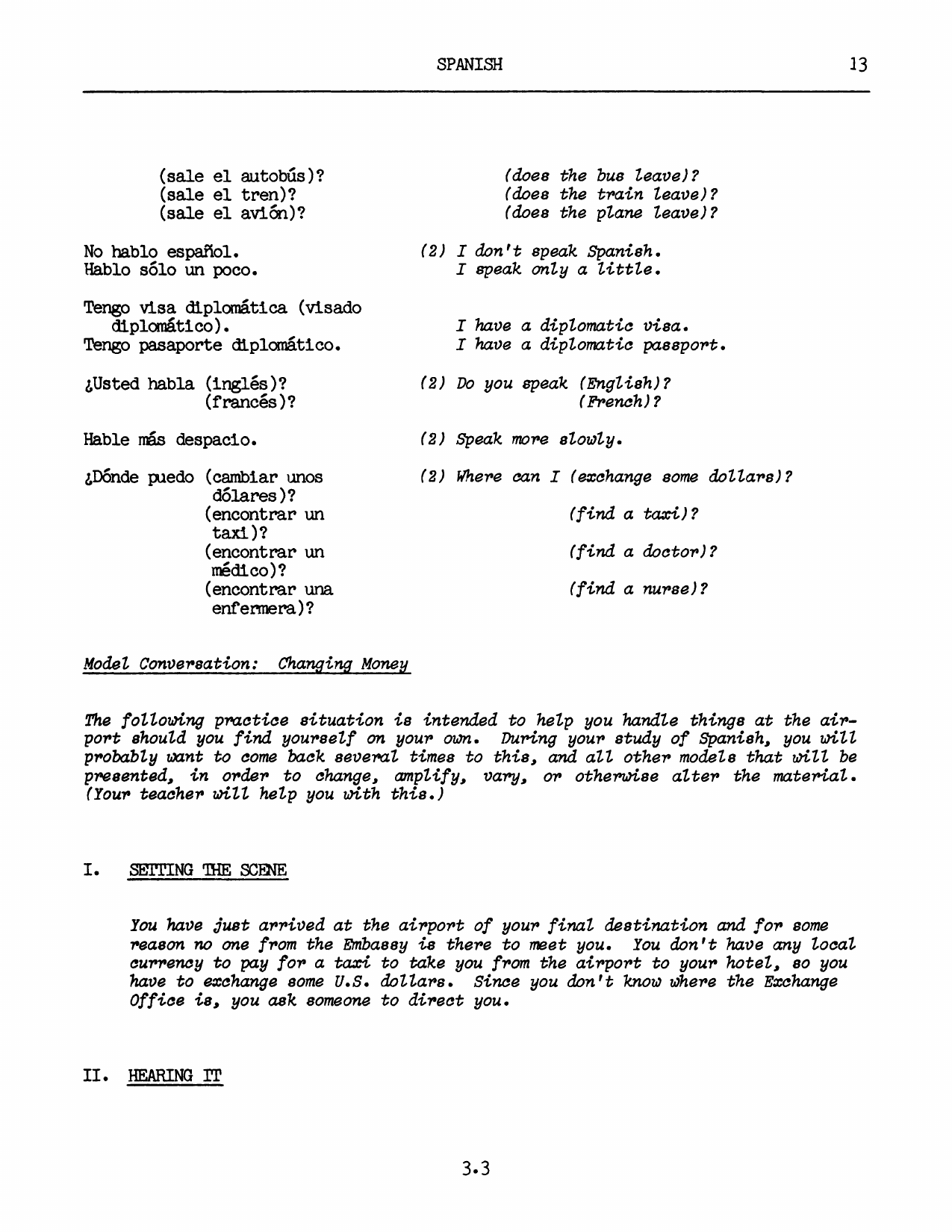
The following practice situation te intended to help you handle things at the air-port should you find yourself on your own. During your study of Spanish, you will probably want to come back several times to this, and all other models that will be presented, in order to change, amplify, vary, or otherwise alter the material. (Your teacher will help you with this.)
I. SETTING THE SCENE
You have just arrived at the airport of your final destination and for some reason no one from the Embassy ta there to meet you. You don't have any local currency to pay for a taxi to take you from the airport to your hotel, so you have to exchange some U.S. dollars. Since you don't know where the Exchange Office is, you ask someone to direct you.
II. HEARING IT
III. SEEING IT
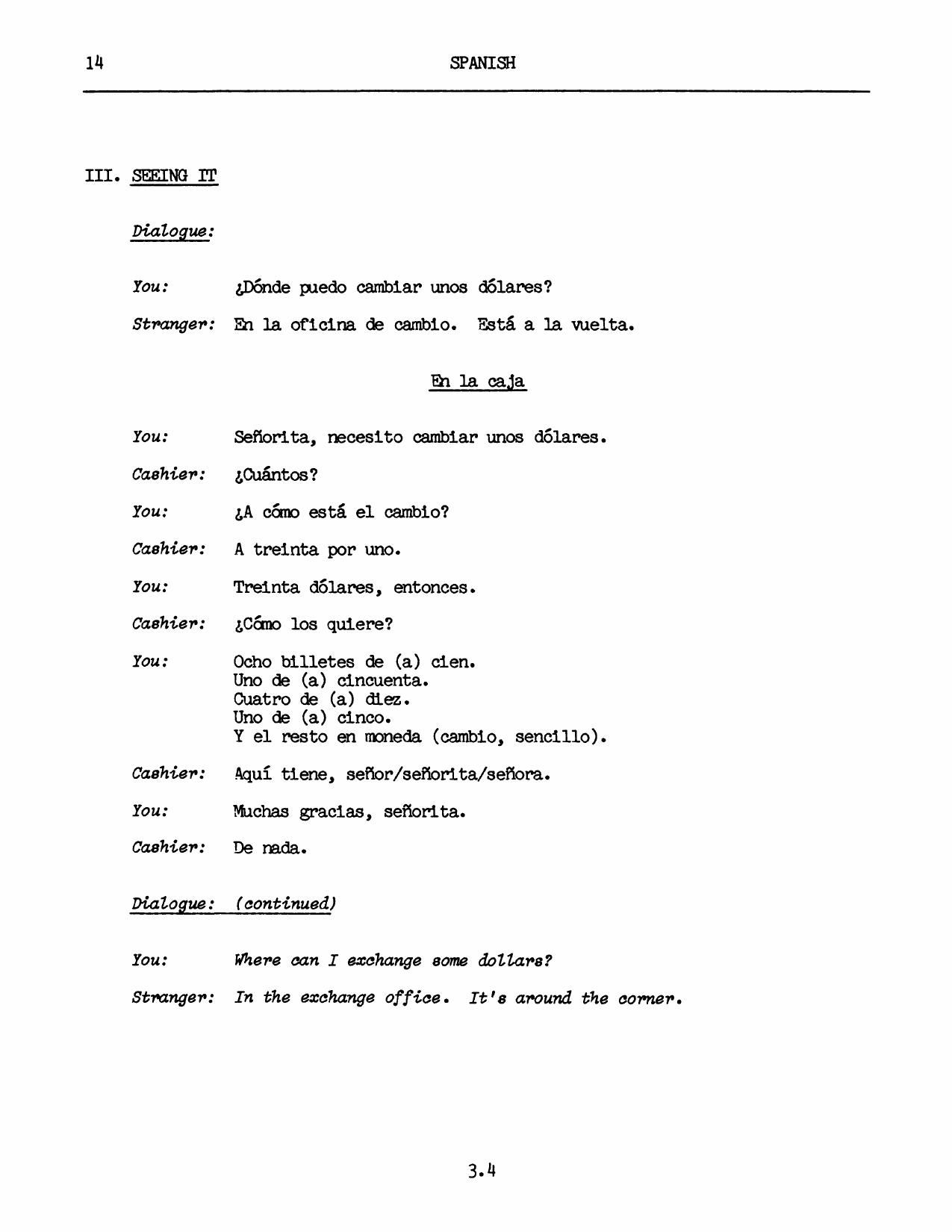
Dialogue:
Stranger: En la oficina de cambio. Está a la vuelta.
En la caja
Cashier: ¿Cuántos?
Cashier: A treinta por uno.
Cashier: ¿Cómo los quiere?
Uno de (a) cincuenta.
Cuatro de (a) diez.
Uno de (a) cinco.
Y el resto en moneda (cambio, sencillo).
Cashier: Aqui tiene, sefior/sefiorita/sefiora.
Cashier: De nada.
Dialogue: (continued)
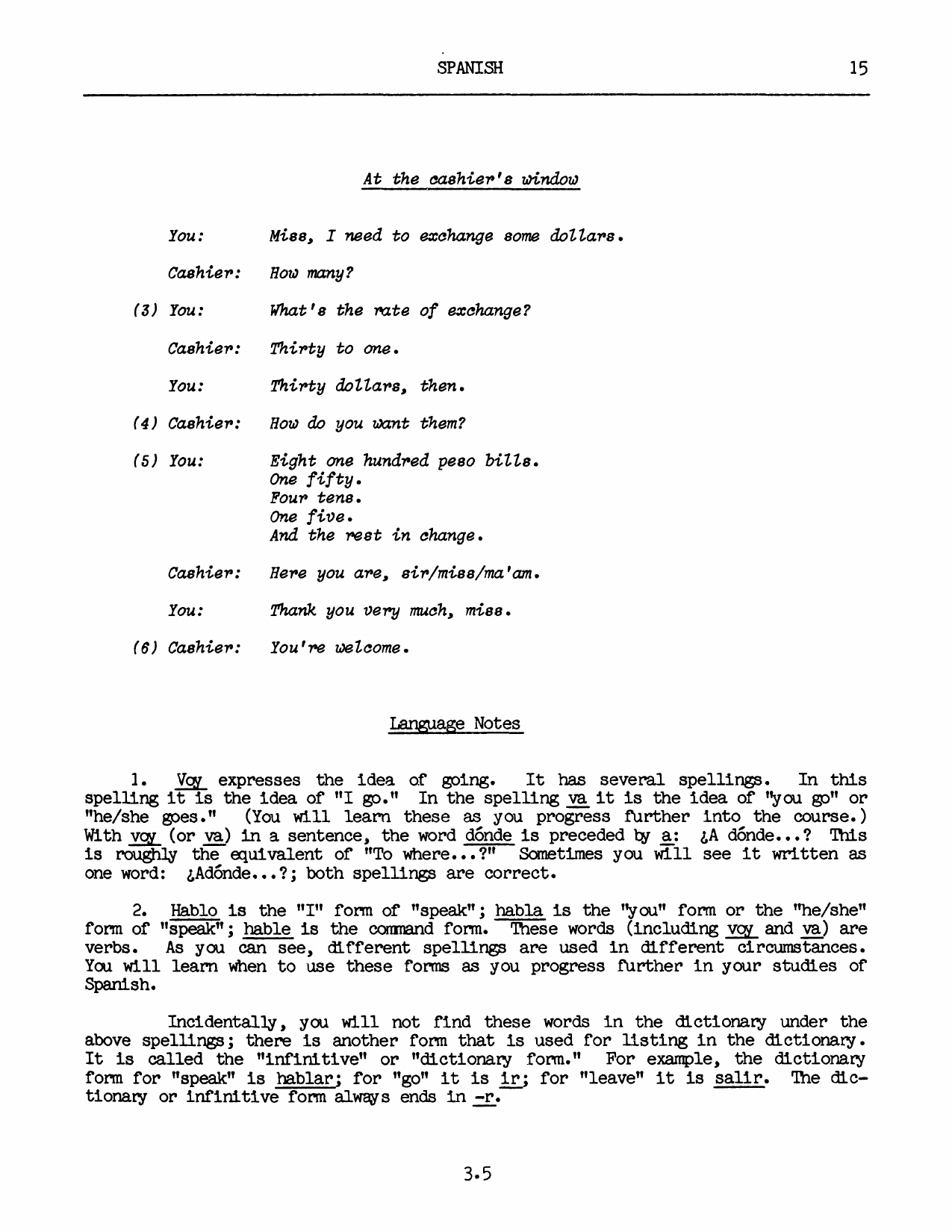
Stranger: In the exchange office. It's around the corner.
At the cashier's window
Cashier: How many?
Cashier: Thirty to one.
(4) Cashier: How do you want them?
One fifty.
Four tens.
One five.
And the rest in change.
Cashier: Here you are, sir/mise/ma'am.
(6) Cashier: You're welcome.
Language Notes
1. Voy expresses the idea of going. It has several spellings. In this
spelling it is the idea of "I go." In the spelling va it is the idea of "you go" or "he/she goes." (You will learn these as you progress further into the course.) With voy (or va) in a sentence, the word dónde is preceded by a: ¿A dónde...? This is roughly the equivalent of "To where...?" Sometimes you will see it written as one word: ¿Adónde...?; both spellings are correct.
2. Hablo is the "I" form of "speak"; habla is the "you" form or the "he/she"
form of "speak"; hable is the command form. These words (including voy and va) are verbs. AS you can see, different spellings are used in different circumstances. You will learn when to use these forms as you progress further in your studies of Spanish.
Incidentally, you will not find these words in the dictionary under the
above spellings; there is another form that is used for listing in the dictionary. It is called the "infinitive" or "dictionary form." For example, the dictionary form for "speak" is hablar; for "go" it is ir; for "leave" it is salir. The dic-tionary or infinitive form always ends in -r.
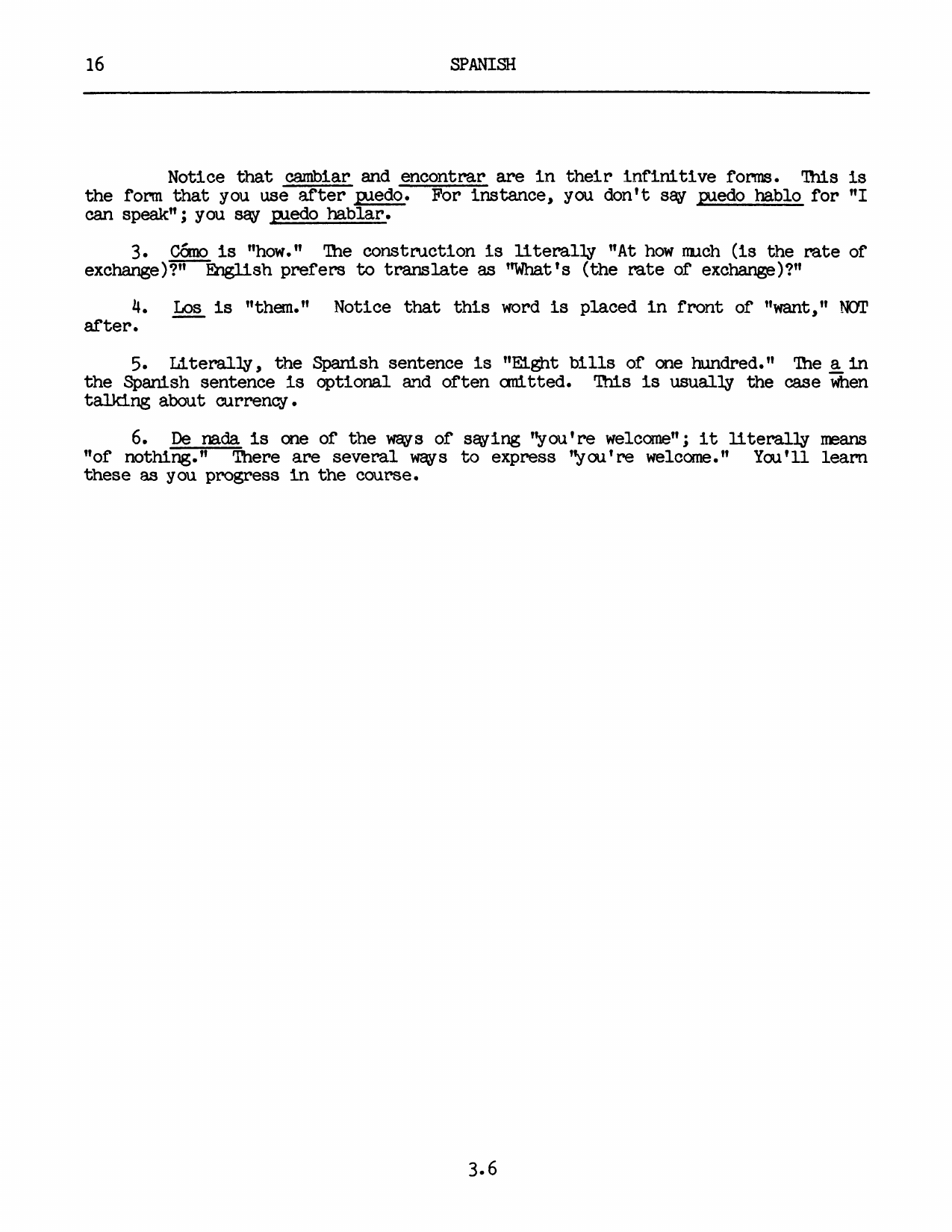
Notice that cambiar and encontrar are in their infinitive forms. This 1s
the form that you use after puedo. For instance, you don't say puedo hablo for "I can speak"; you say puedo hablar.
3. Cómo is "how." The construction is literally "At how mich (is the rate of
exchange)?" English prefers to translate as "What's (the rate of exchange)?"
4. Los is "them." Notice that this word is placed in front of "want," NOT
after.
5. Literally, the Spanish sentence is "Eight bills of one hundred." The a in
the Spanish sentence is optional and often omitted. This is usually the case when talking about currency.
6. De nada is one of the ways of saying "you're welcome"; it literally means
"of nothing." There are several ways to express "you're welcome." You'll learn these as you progress in the course.
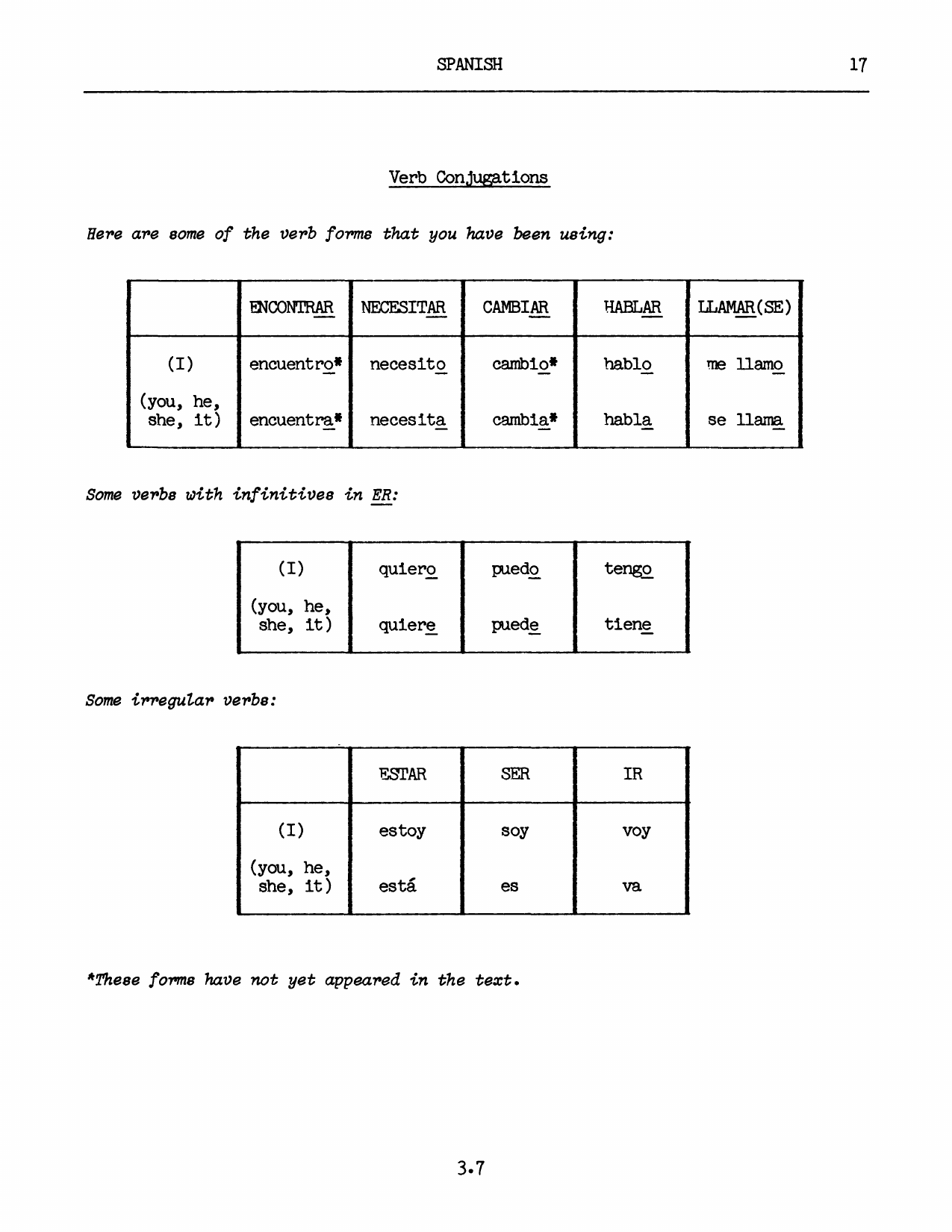
Verb Conjugations
Here are some of the verb forms that you have been using:
(you, he,
she, 1t) encuentra* | necesita
Some verbe with infinitives in ER:
(I)
(you, he,
she, it)
Some irregular verbs:
(you, he,
*These forms have not yet appeared in the text.
This page has a drawing, chart, or fill-in layout — original page
Narrative:
En la oficina de cambio
Usted necesita cambiar unos dólares. La oficina de cambio está a la vuelta. El cambio está a treinta por uno. Usted cambia treinta dólares y quiere ocho billetes de cien pesos, un billete de (a) cincuenta, cuatro de (a) diez, uno de (a) cinco y el resto en moneda.
Questions:
1 = ¿Qué necesita cambiar usted?
What do you need to exchange?
2 — ¿Dónde puede cambiar usted unos dólares?
Where can you exchange some dollars?
3 = ¿A cómo está el cambio?
What ts the rate of exchange?
4 — ¿Cuántos dólares necesita cambiar usted?
How many dollars do you need to exchange?
5 - ¿Cuántos billetes de (a) cien, de (a) cincuenta, de (a) diez, y de (a)
cinco quiere usted?
How many hundreds, fifties, tens, and fives do you want?
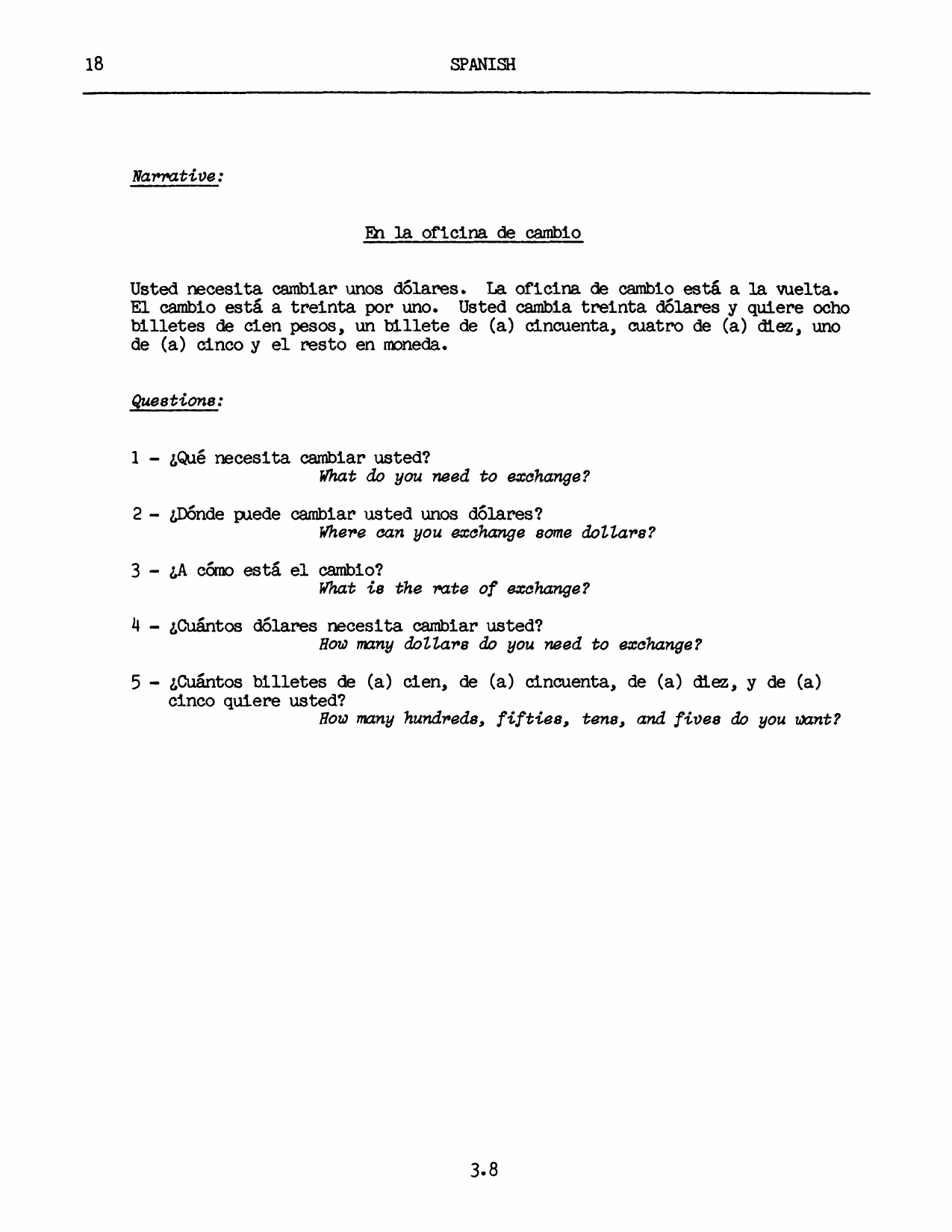
Fill in the Blanks - No. 1:
En la oficina de cambio
En la caja
¿Cuántos?
o. _____ los quiere?
This page has a drawing, chart, or fill-in layout — original page
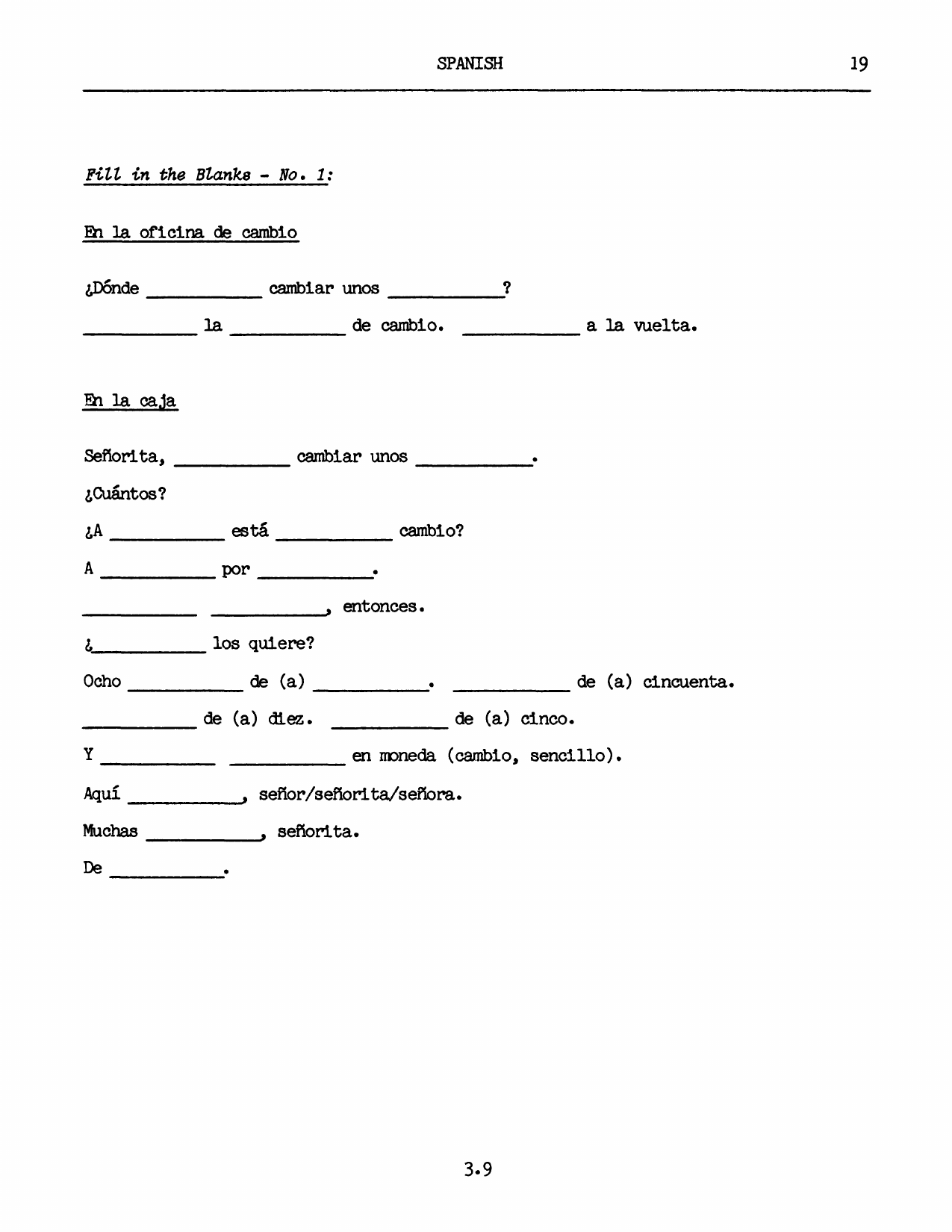
Fill in the Blanks - No. 2:
En la oficina de cambio
En la caja
(cambio, sencillo).
tiene, sefior/sefiortta/sefiora.
gracias, señorita.
nada.
This page has a drawing, chart, or fill-in layout — original page
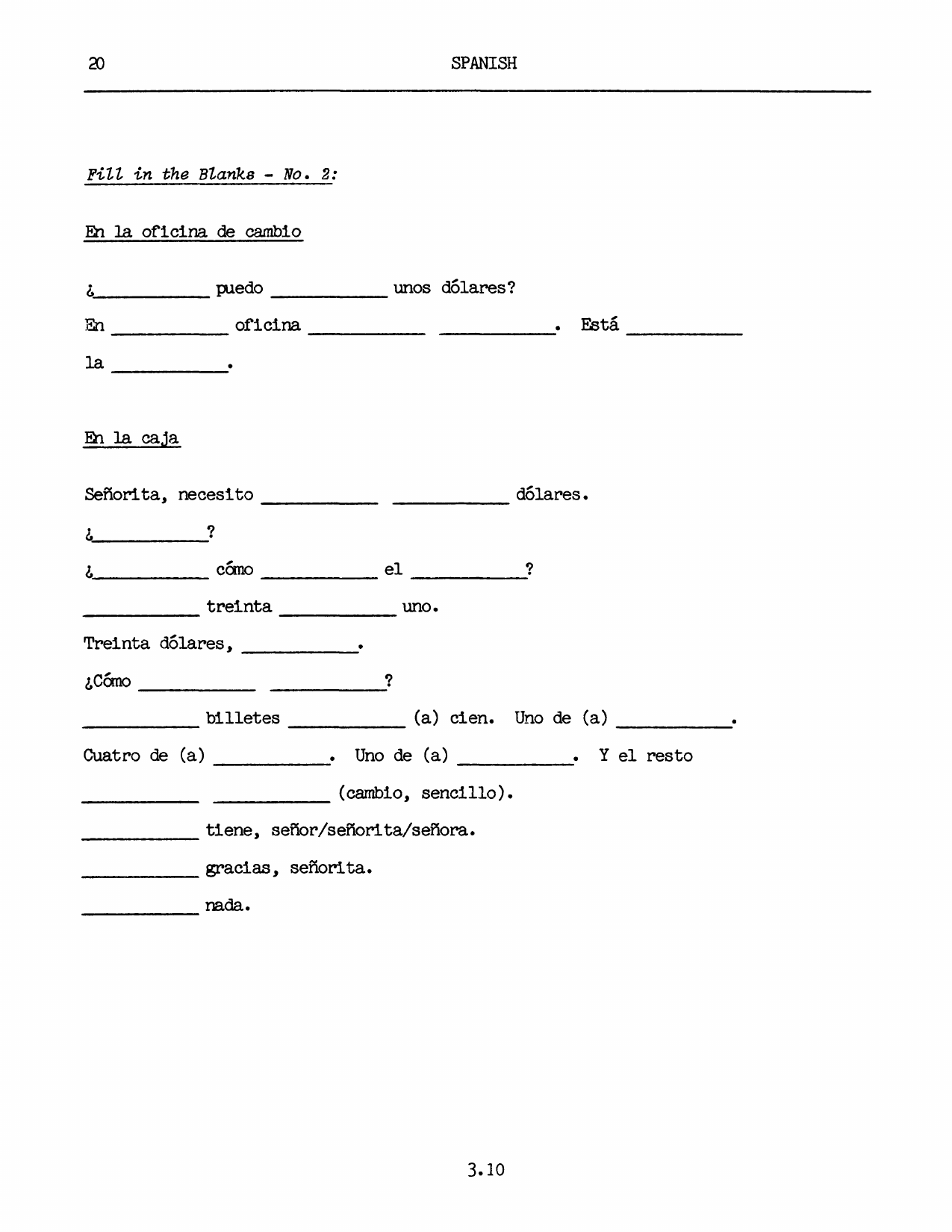
IV. TAKING IT APART
Vocabulary:
diez
ten
Cardinal Numbers — Los números cardinales:
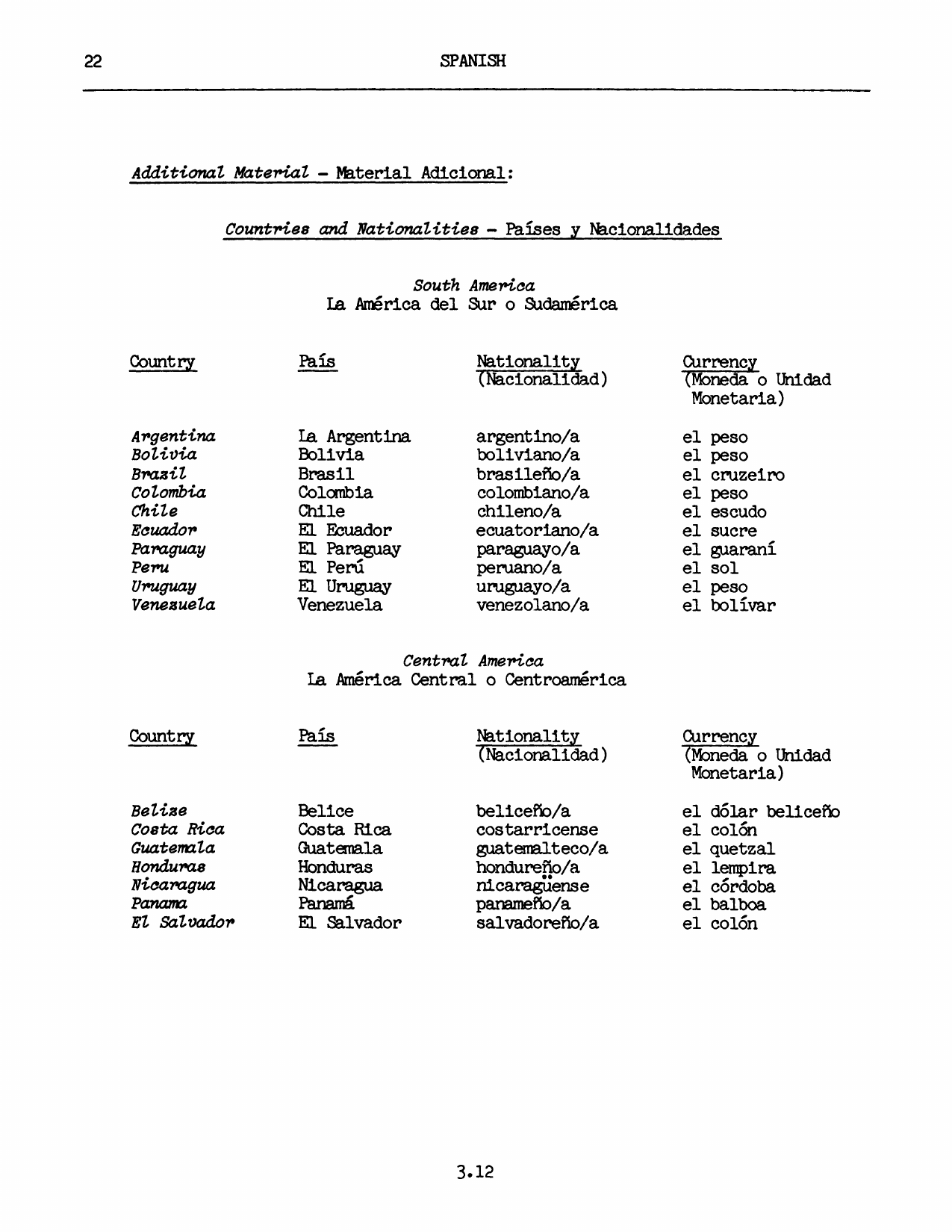
Additional Material - Material Adicional:
Countries and Nationalities - Países y Nacionalidades
South America
La América del Sur o Sudamérica
Monetaria)
Central America
La América Central o Centroamérica
Monetaria)
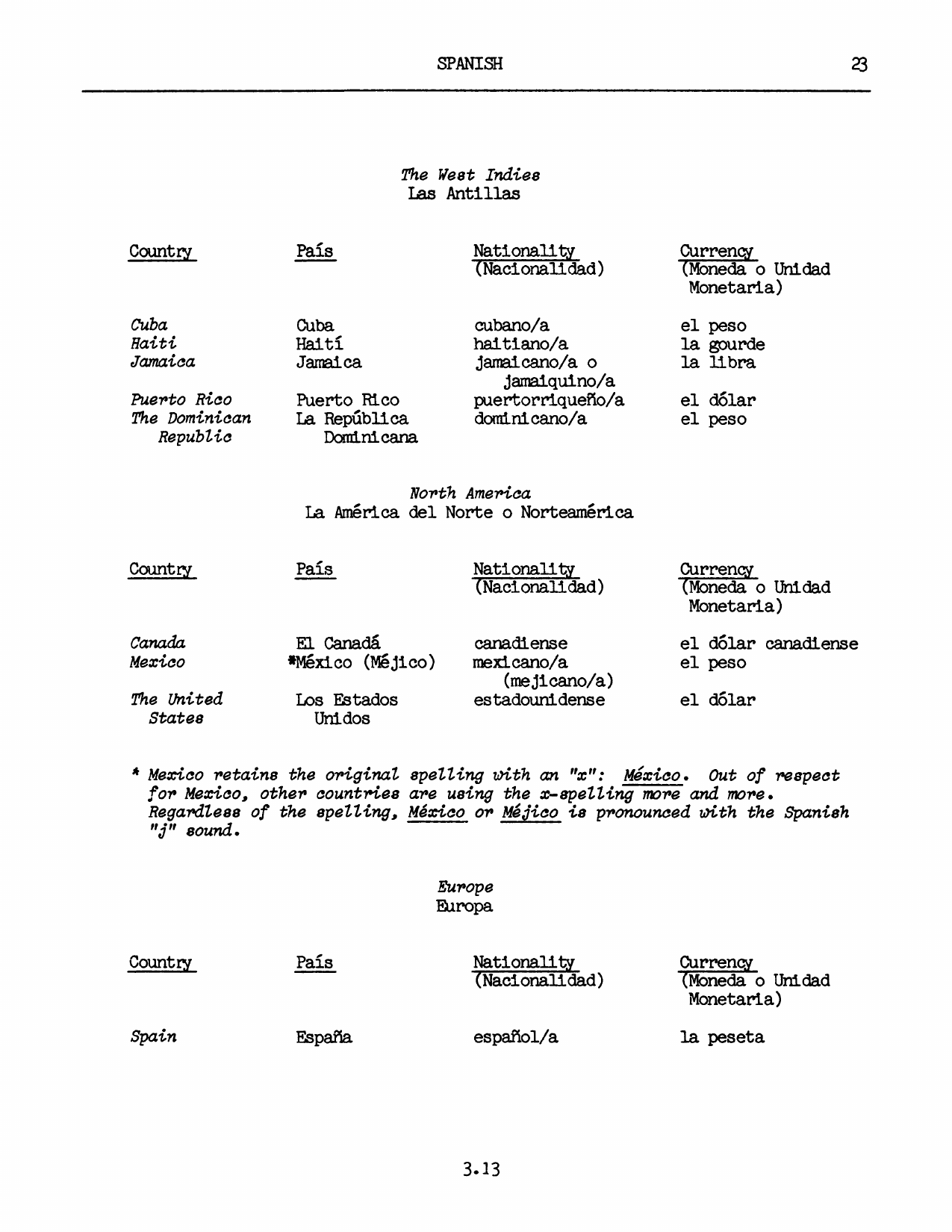
The West Indies
Las Antillas
Monetaria)
jamaiquino/a
North America
La América del Norte o Norteamérica
Monetaria)
(me jicano/a)
* México retains the original spelling with an "x": México. Out of respect for Mexico, other countries are using the x-spelling more and more. Regardless of the spelling, México or Méjico is pronounced with the Spanieh
Europe
Europa
Monetaria)
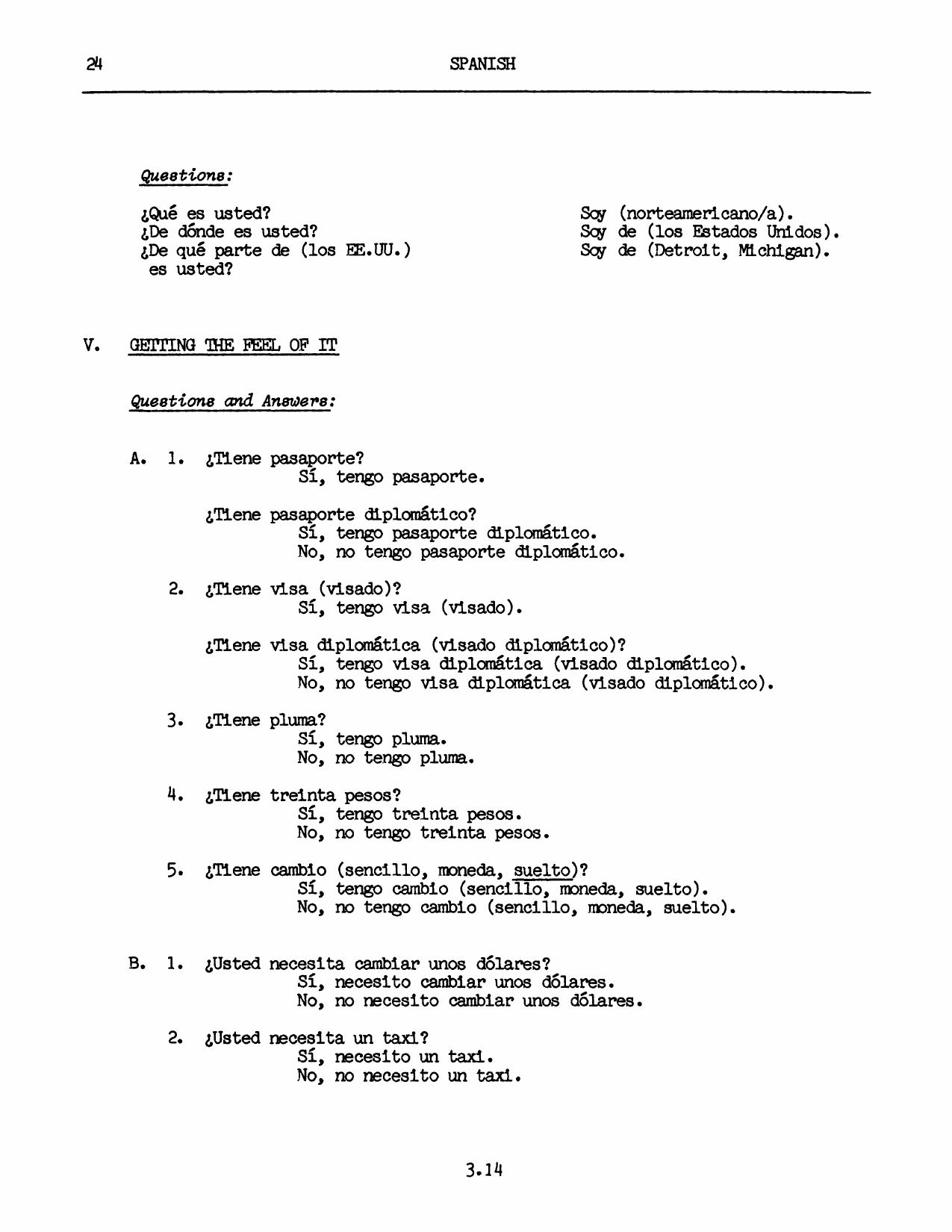
Questions:
es usted?
V. GETTING THE FEEL OF IT
Questions and Answers:
A. 1. ¿Tiene pasaporte?
Si, tengo pasaporte.
¿Tiene pasaporte diplomático?
Sí, tengo pasaporte diplomático.
No, no tengo pasaporte diplomático.
2. ¿Tiene visa (visado)?
Si, tengo visa (visado).
¿Tiene visa diplomática (visado diplomático)?
Si, tengo visa diplomática (visado diplomático). No, no tengo visa diplomática (visado diplomático).
3. ¿Tiene pluma?
Si, tengo pluma.
No, no tengo pluma.
4, ¿Tiene treinta pesos?
Si, tengo treinta pesos.
No, no tengo treinta pesos.
5. ¿Tiene cambio (sencillo, moneda, suelto)?
Sí, tengo cambio (sencillo, moneda, suelto).
No, no tengo cambio (sencillo, moneda, suelto).
B. 1. ¿Usted necesita cambiar unos dólares?
Sí, necesito cambiar unos dólares.
No, no necesito cambiar unos dólares.
2. ¿Usted necesita un taxi?
Si, necesito un taxi.
No, no necesito un taxi.
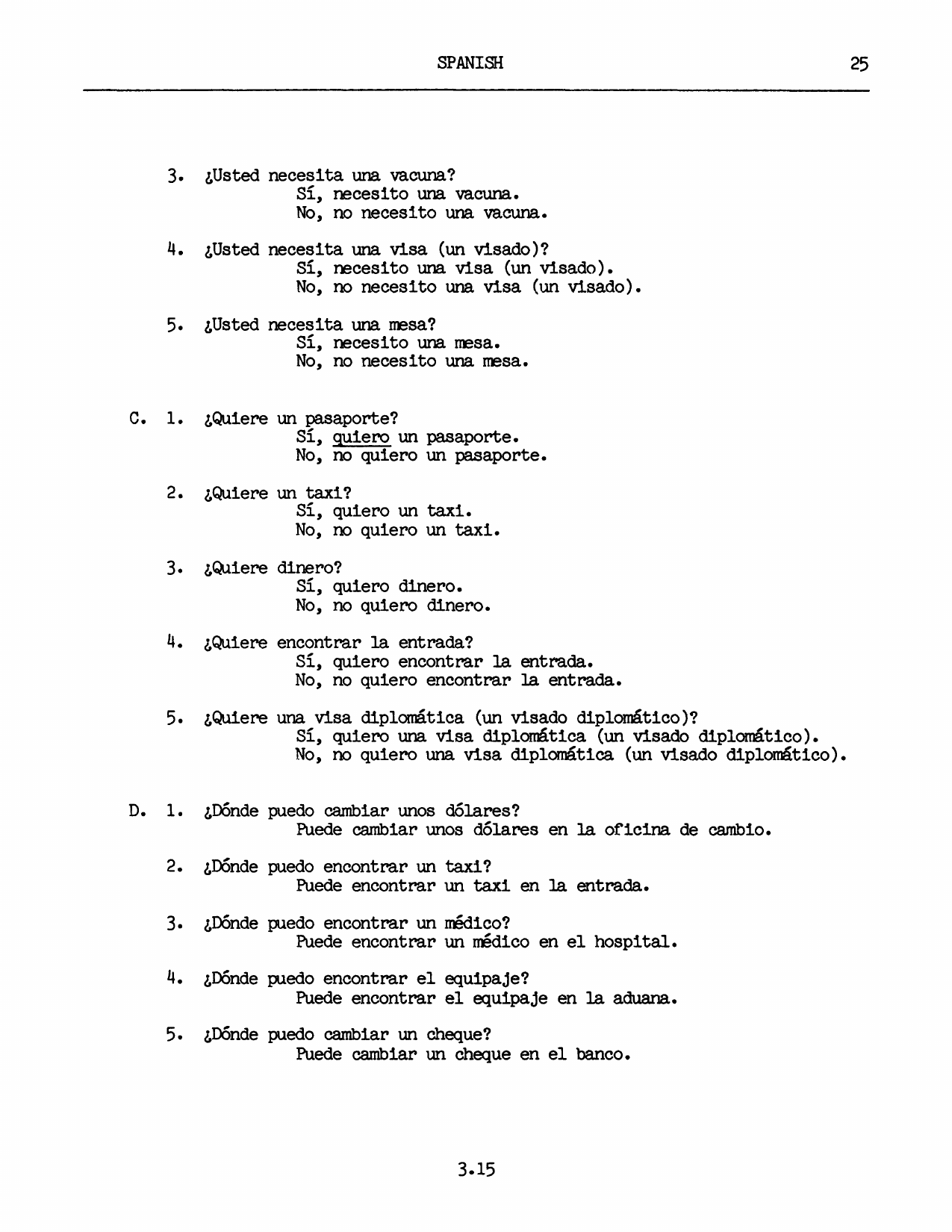
3. ¿Usted necesita una vacuna?
Sí, necesito una vacuna.
No, no necesito una vacuna.
4, ¿Usted necesita una visa (un visado)?
Sí, necesito una visa (un visado).
No, no necesito una visa (un visado).
De ¿Usted necesita una mesa?
Sí, necesito una mesa.
No, no necesito una mesa.
1. ¿Quiere un pasaporte?
Sí, quiero un pasaporte.
No, no quiero un pasaporte.
26 ¿Quiere un taxi?
Sí, quiero un taxi.
No, no quiero un taxi.
3. ¿Quiere dinero?
Sí, quiero dinero.
No, no quiero dinero.
4, ¿Quiere encontrar la entrada?
Sí, quiero encontrar la entrada.
No, no quiero encontrar la entrada.
5. ¿Quiere una visa diplomática (un visado diplomático)?
Sí, quiero una visa diplomática (un visado diplomático). No, no quiero una visa diplomática (un visado diplomático).
D. l. ¿Dónde puedo cambiar unos dólares?
Puede cambiar unos dólares en la oficina de cambio.
2. ¿Dónde puedo encontrar un taxi?
Puede encontrar un taxi en la entrada.
3. ¿Dónde puedo encontrar un médico?
Puede encontrar un médico en el hospital.
4, ¿Dónde puedo encontrar el equipaje?
Puede encontrar el equipaje en la aduana.
5. ¿Dónde puedo cambiar un cheque?
Puede cambiar un cheque en el banco.
Questions and Answers: (continued)
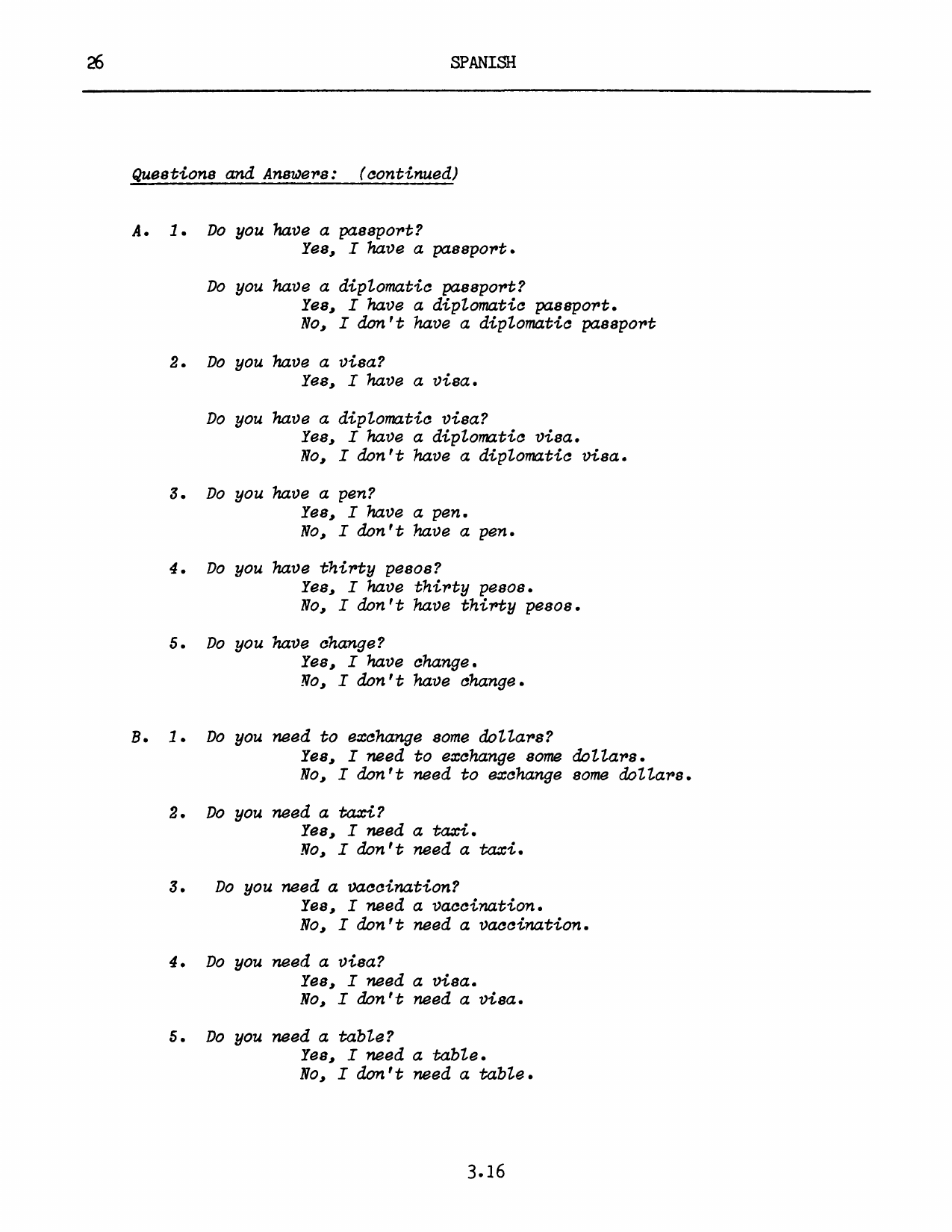
A. 1. Do you have a passport?
Yes, I have a passport.
Do you have a diplomatic passport?
Yes, I have a diplomatic passport.
No, I don't have a diplomatic passport
2. Do you have a visa?
Yes, I have a visa.
Do you have a diplomatic visa?
Yes, I have a diplomatic visa.
No, I don't have a diplomatic visa.
3. Do you have a pen?
Yes, I have a pen.
No, I don't have a pen.
4, Do you have thirty pesos?
Yes, I have thirty pesos.
No, I don't have thirty pesos.
De Do you have change?
Yes, I have change.
No, I don't have change.
B. 1. Do you need to exchange some dollars?
Yes, I need to exchange some dollars.
No, I don't need to exchange some dollars.
ae Do you need a taxi?
Yes, I need a taxi.
No, I don't need a taxi.
3. Do you need a vaccination?
Yes, I need a vaccination.
No, I don't need a vaccination.
4. Do you need a visa?
Yes, I need a visa.
No, I don't need a visa.
be Do you need a table?
Yes, I need a table.
No, I don't need a table.
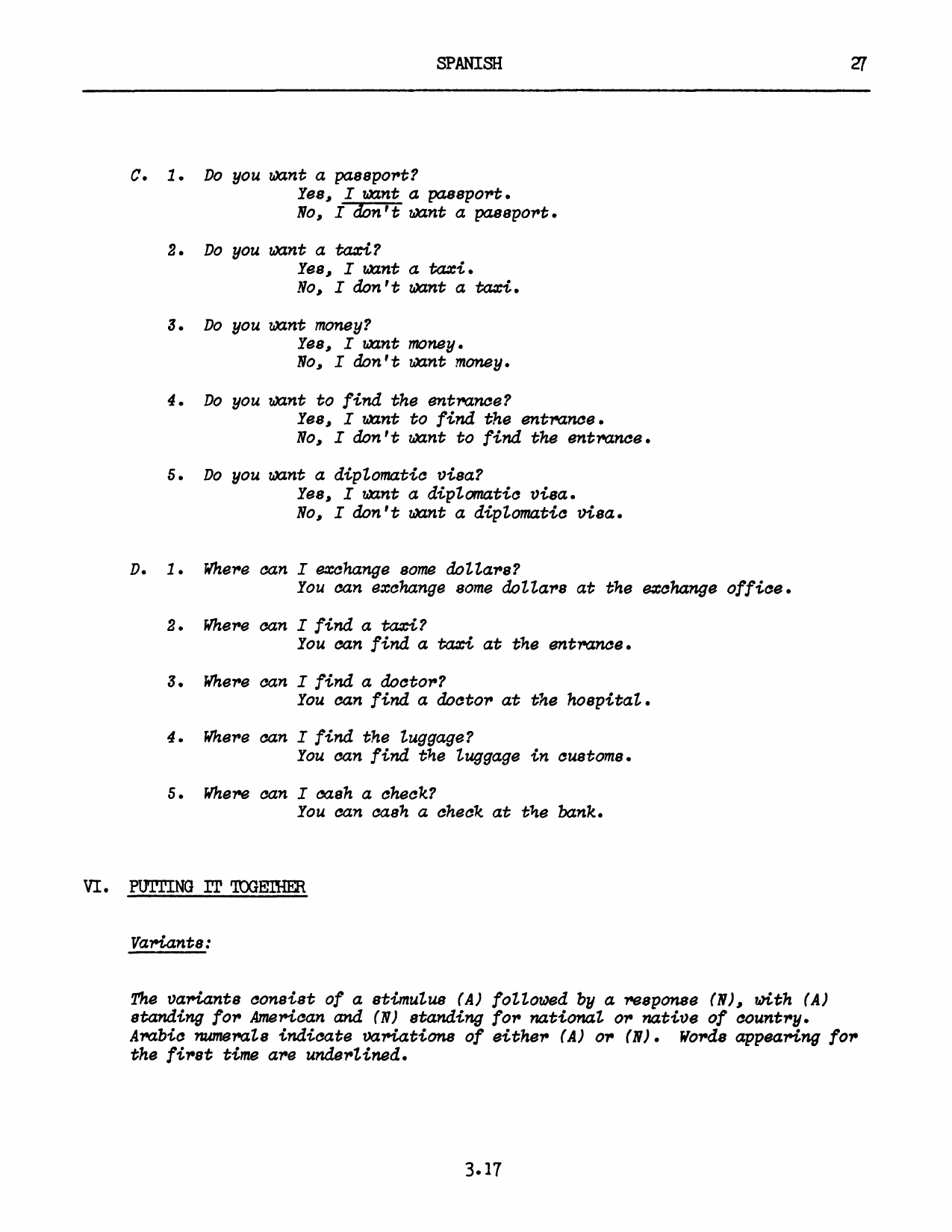
Co. 1. Do you want a passport?
Yes, I want a passport.
No, I don't want a passport.
2. Do you want a taxi?
Yes, I want a taxi.
No, I don't want a taxi.
3. Do you want money?
Yes, I want money.
No, I don't want money.
4. Do you want to find the entrance?
Yes, I want to find the entrance.
No, I don't want to find the entrance.
5. Do you want a diplomatic visa?
Yes, I want a diplomatic visa.
No, I don't want a diplomatic visa.
D. 1. Where can I exchange some dollars?
You can exchange some dollars at the exchange office.
2. Where can I find a taxi?
You can find a taxi at the entrance.
3. Where can I find a doctor?
You can find a doctor at the hospital.
4. Where can I find the luggage?
You can find the luggage in customs.
5. Where can I cash a check?
You ean cash a check at the bank.
VI. PUTTING IT TOGETHER
Variante:
The variante consist of a stimulus (A) followed by a response (N), with (A) standing for American and (N) standing for national or native of country. Arabic numerals indicate variations of either (A) or (N). Words appearing for the first time are underlined.
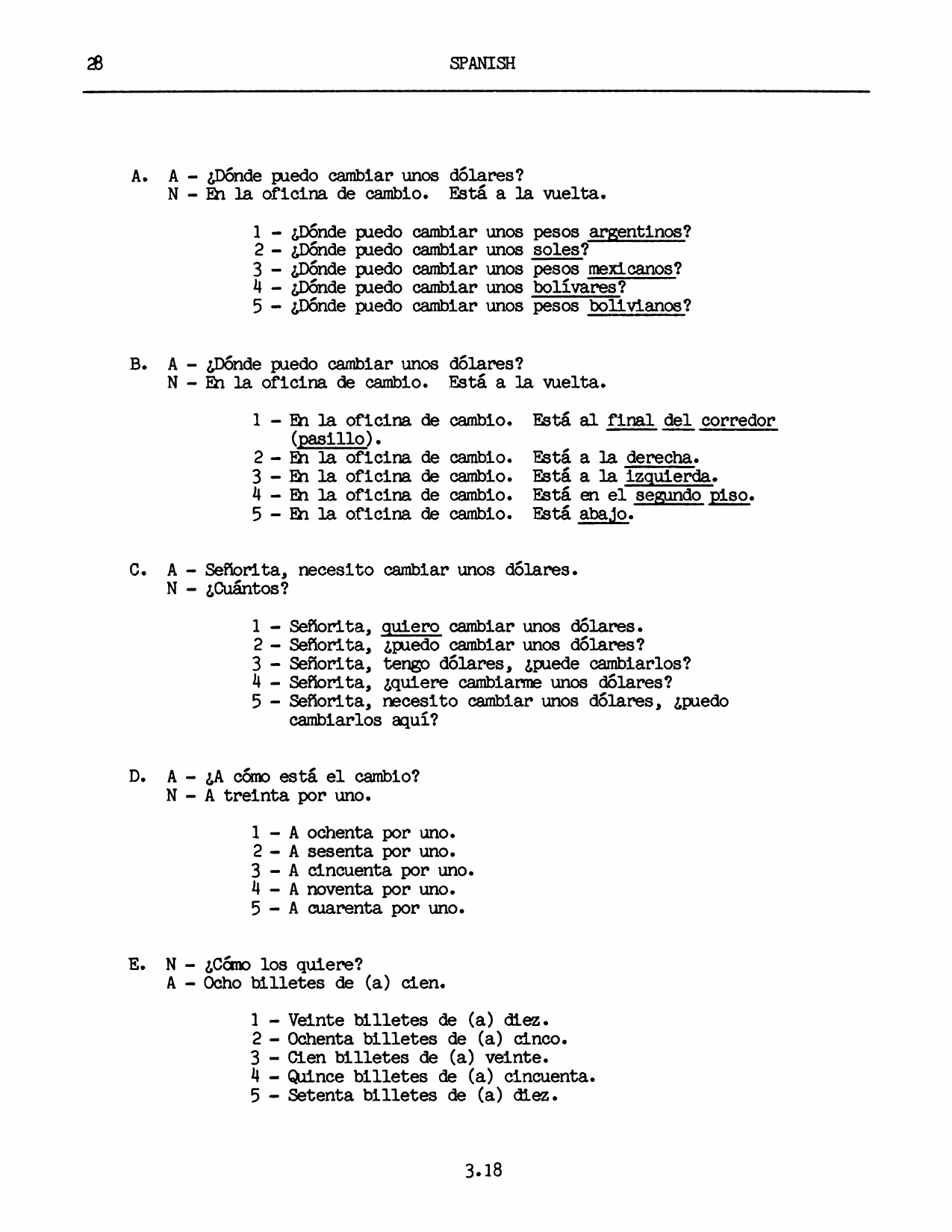
A. A - ¿Dónde puedo cambiar unos dólares?
N - En la oficina de cambio. Está a la vuelta.
1 - ¿Dónde puedo cambiar unos pesos argentinos?
2- ¿Dónde puedo cambiar unos soles?
3 - ¿Dónde puedo cambiar unos pesos mexicanos?
4 - ¿Dónde puedo cambiar unos bolívares?
5 = ¿Dónde puedo cambiar unos pesos bolivianos?
B. A - ¿Dónde puedo cambiar unos dólares?
N - En la oficina de cambio. Está a la vuelta.
1 - En la oficina de cambio. Está al final del corredor
(pasillo).
2 —- En la oficina de cambio. Está a la derecha.
3 - En la oficina de cambio. Está a la Izquierda.
4 — En la oficina de cambio. Está en el segundo piso. 5 - En la oficina de cambio. Está abajo.
C. A — Señorita, necesito cambiar unos dólares.
N = ¿Cuántos?
1 - Señorita, quiero cambiar unos dólares.
2 - Señorita, edo cambiar unos dólares?
3- Señorita, tengo dólares, ¿puede cambiarlos?
4 — Señorita, ¿quiere cambiarme unos dólares?
5 - Señorita, necesito cambiar unos dólares, ¿puedo
cambiarlos aquí?
D. A = ¿A cómo está el cambio?
N - A treinta por uno.
1 - A ochenta por uno.
2 - A sesenta por uno.
3 - A cincuenta por uno.
4 = A noventa por uno.
5 - A cuarenta por uno.
E. N = ¿Cómo los quiere?
A = Ocho billetes de (a) cien.
1 - Veinte billetes de (a) diez.
2 = Ochenta billetes de (a) cinco.
3 - Cien billetes de (a) veinte.
4 - Quince billetes de (a) cincuenta.
5 - Setenta billetes de (a) diez.
Variante: (continued)
A. A = Where can I exchange some dollars?
WN - At the exchange office. It's around the corner.
1 - Where can I exchange some Argentine pesos?
2 - Where can I exchange some soles?
3 - Where can I exchange some Mextcan pesos?
4 - Where can I exchange some boltvares?
5 - Where can I exchange some Bolivian pesos?
B. A - Where can I exchange some dollars?
N - At the exchange office. It's around the corner.
1 - At the exchange office. It's at the end of the hall. 2 - At the exchange office. It's to the right.
3 - At the exchange office. It's to the Taf E.
4 - At the exchange office. It's on the second floor. 5 - At the exchange office. It's downstairs.
C. A - Mise, I need to exchange some dollars.
N - How many?
1 - Mise, I want to exchange some dollars.
2 - Miss, can T exchange some dollars?
3 - Miss, I have dollars; can you exchange them?
4 - Miss, would you (do you want to) exchange some dollars
for me?
5 - Miss, I need to exchange some dollars; can I exchange
them here?
D. A - What's the rate of exchange?
N - Thirty to one.
1 - Eighty to one.
2 - Sixty to one.
3 - Fifty to one.
4 - Ninety to one.
5 - Forty to ome.
E. N- How do you want them?
A - Eight one hundred (peso) bills.
1 - Twenty ten (peso) bills.
2 - Eighty five (peso) bills.
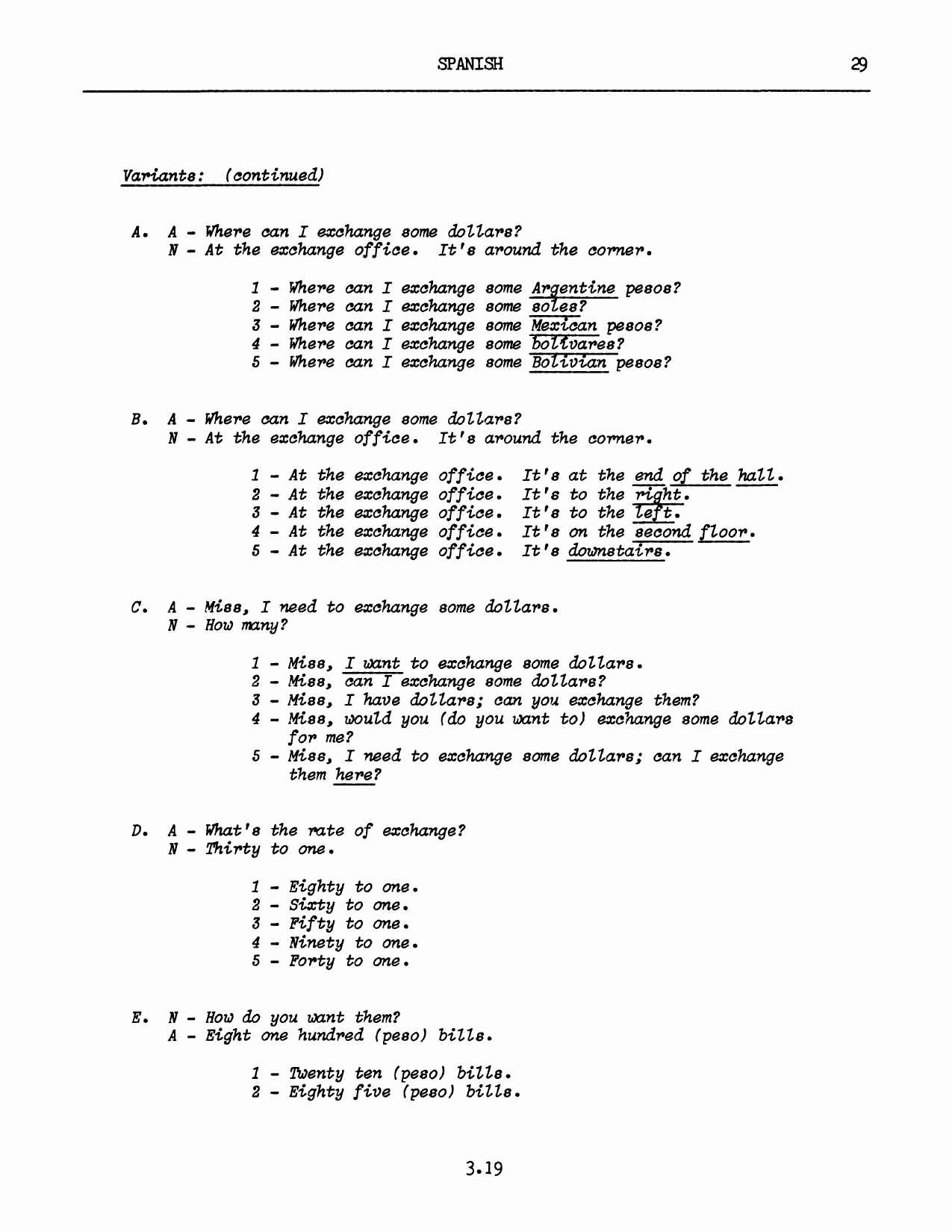
3 - One hundred twenty (peso) bills.
4 - Pifteen fifty (peso) bills.
5 - Seventy ten (peso) bills.
VII. MAKING IT WORK
VIII. USING IT