CYCLE Y
GETTING STARTED IN COUNTRY
At Hotel the
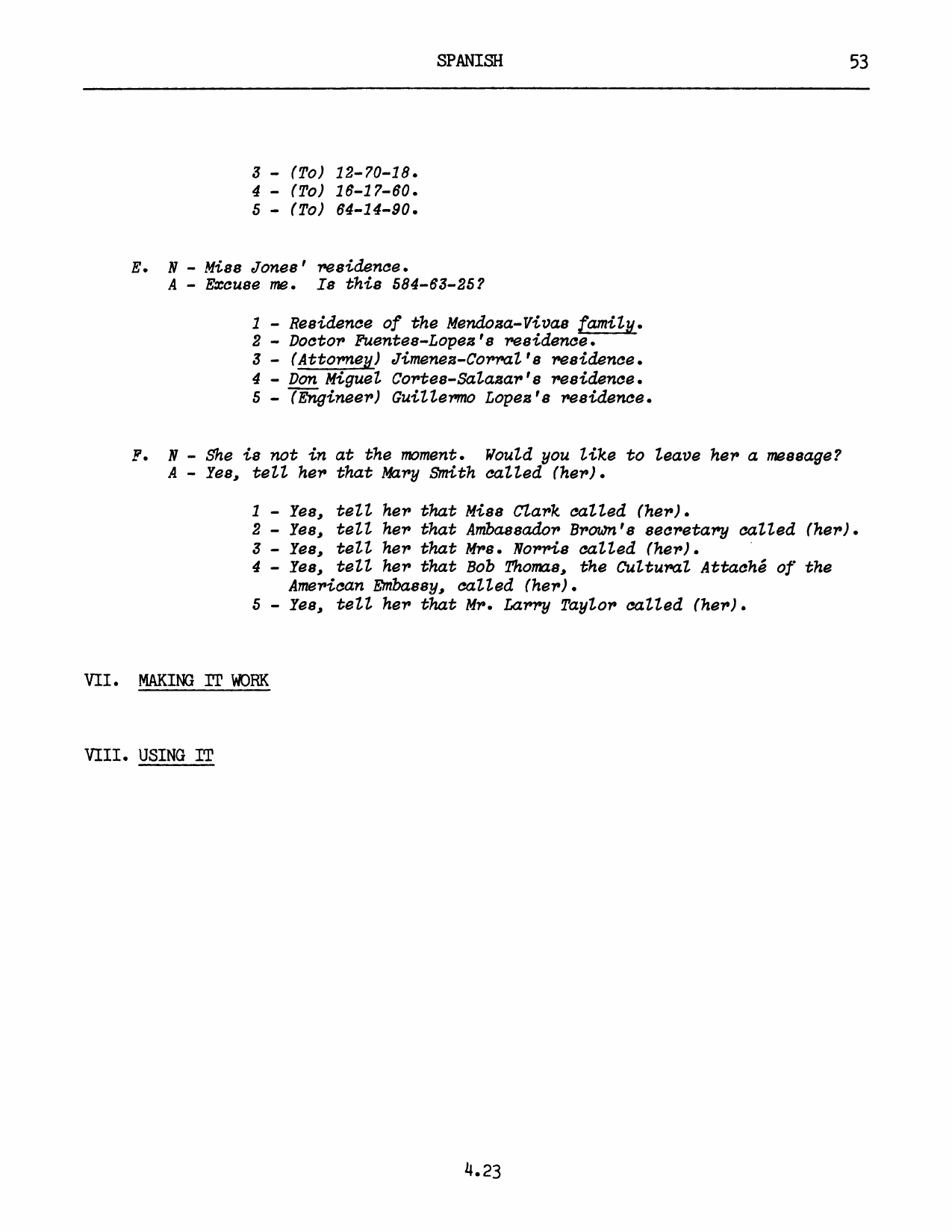
You will probably want to use the phone when you arrive at your hotel. Tele-
phone numbers differ from place to place. Notice that the rumber of digits depends on the number of inhabitants and/or telephone lines present in a given area. Large metropolitan areas such as Caracas or Mexico City may have seven digits, smaller cities like Guadalajara may have six, and smaller areas may have fewer digits.
example: 5-84-63-25 (even if 1t may be written differently) 23-17-50, 3-60-78, etc.
Experienced travelers often avoid drinking tap water, showing preference for
bottled water. In public places like hotels and restaurants the water may not be
4,1
This page has a drawing, chart, or fill-in layout — original page
potable, especially in tropical regions during the dry season, when the public water supply runs dry in some cities. In such cases, water is brought in by truck and pumped into large holding tanks on the rooftops of houses and other buildings, with little consideration given to its hygienic handling. However, a drinking water home delivery service that provides water in large, five-gallon glass jars is generally available on certain contracted days of the week.
If you are going to be in the hotel for a few days, you can wait with tipping
until the last day of your stay. At that time, have a sum of money (local currency, of course) in separate envelopes, one for each person that you plan to tip. The amount is about the same as it is in the States. Don't forget to leave something at the front desk for the chambermaids; label this camarera ("chambermaid") and put your room number on the outside.
The following dialogue will help you handle certain situations that may
occur at a hotel. Observe that in our second situational dialogue, the maid answers the phone. Maids will often do so unless instructed otherwise.
I. SETTING THE SCENE (A)
Upon reaching your room, the bellhop asks you if everything is satisfactory. You notice that you need certain things and you ask the bellhop to bring them to you.
IT. HEARING IT (A)
ITI. SEEING IT (A)
Dialogue No. 1:
Hablando con el botones
N = ¿Dónde pongo las maletas, señor/señorita/señora?
A - Póngalas ahí, por favor.
N - ¿Está todo bien? ¿Necesita algo más?
A - A ver...Si, necesito más jabón, una toalla más, y agua (potable, de beber,
para beber) o agua mineral.
N - En seguida le traigo todo.
A = Gracias.
Dialogue No. 1: (continued)
Speaking with the bellhop
WN - Where shall I put the suitcases, str/mise/ma'am?
(1) A - Please put them there.
N - Is everything all right? Do you need anything else?
A - Let me see...Yes, I need more soap, another towel, and (drinking)
water or mineral water.
4,3
N - I'tt bring everything to you right away.
A - Thanks.
I. SETTING THE SCENE (B)
You wish to place an outgoing call to a friend. Some operators speak English well enough to help you, yet others speak only Spanish. In this situation, the operator only speaks Spanish. When you are connected with your friend's house, a person whom you do not know answers the phone. At first you do not understand what this person is saying to you, so you ask for a clarification.
IT. HEARING IT (B)
III. SEEING IT (B)
Dialogue No. 2:
Llamada telefónica a una amiga
N — ¡Aló!
A - Señorita, quisiera hacer una llamada.
N - ¿A qué número va a llamar?
A - Al 584-63-25.
N - Un momento, por favor. Yo puedo marcarle el número.
(Poco después )
N - Residencia de la señorita Jones.
A - Perdone, ¿hablo con el 584-63-25?
N - Sí.
A = ¿Está la señorita Jones?
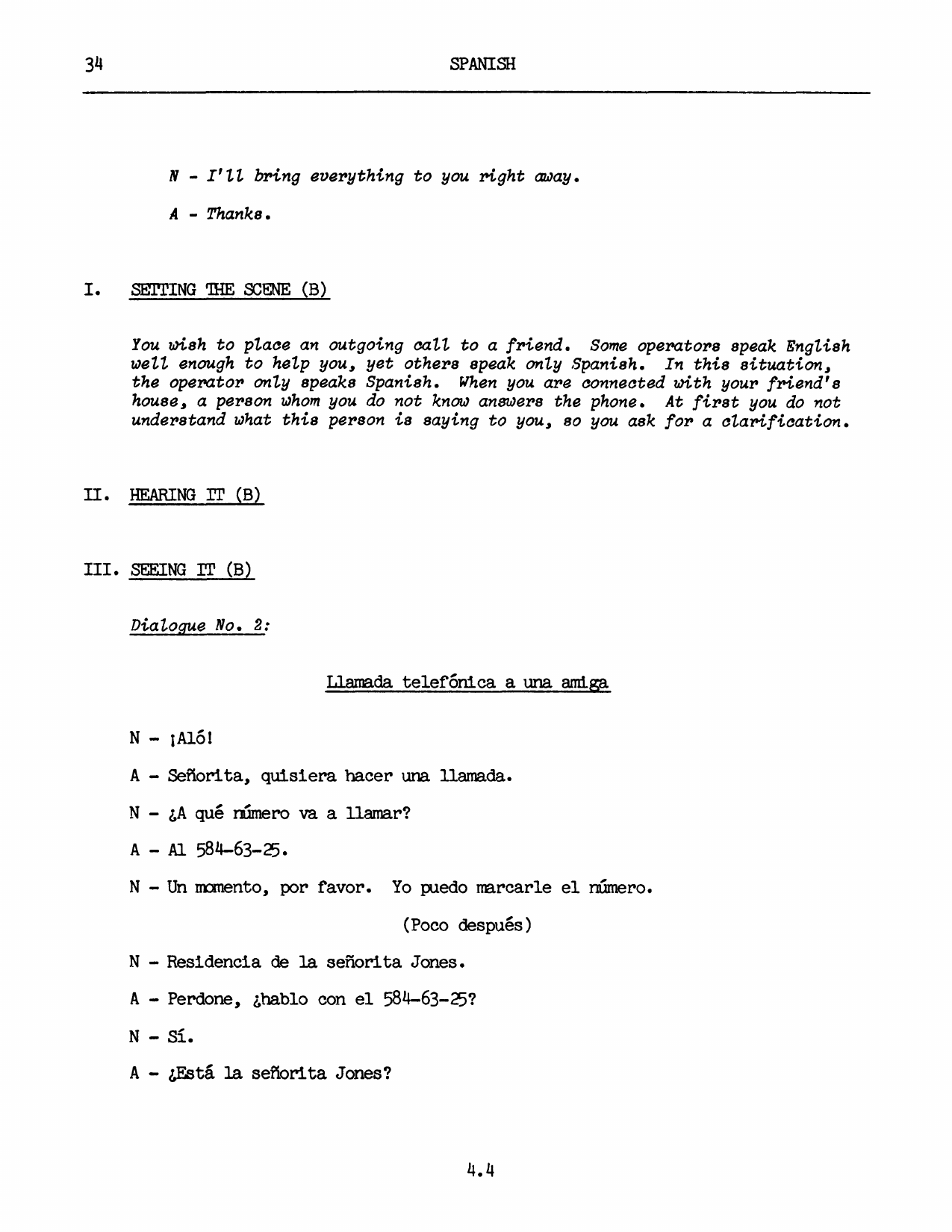
N = No está en este momento. ¿Quiere dejarle un recado (mensaje)? A - Sí, dígale que Mary Smith la llamó. Estoy en el Hotel Caribe, cuarto
(habitación, pleza) número 428.
N - My bien, señorita Smith. Se lo diré en cuanto llegue.
A - Muchas gracias.
Dialogue No. 2: (continued)
Telephone call to a (female) friend
N - Hello!
A - Miss, I would like to mke a call.
N - What number are you going to call?
A - 584-63-25,
N - One moment, please. I can dial it for you.
(A little while later)
N - Miss Jones' residence.
A - Excuse me, ts this 584-63-25?
WN - Yes.
(2) A - Is Miss Jones in?
(3) N - She is not tn at the moment. Would you like to leave her a message? (4) A - Yes, tell her that Mary Smith called (her). I am staying at the
Caribe Hotel, room number 428.
(5) N - Very well, Miss Smith. I'll tell her as soon as she gets in
(arrives).
A - Thank you very much.
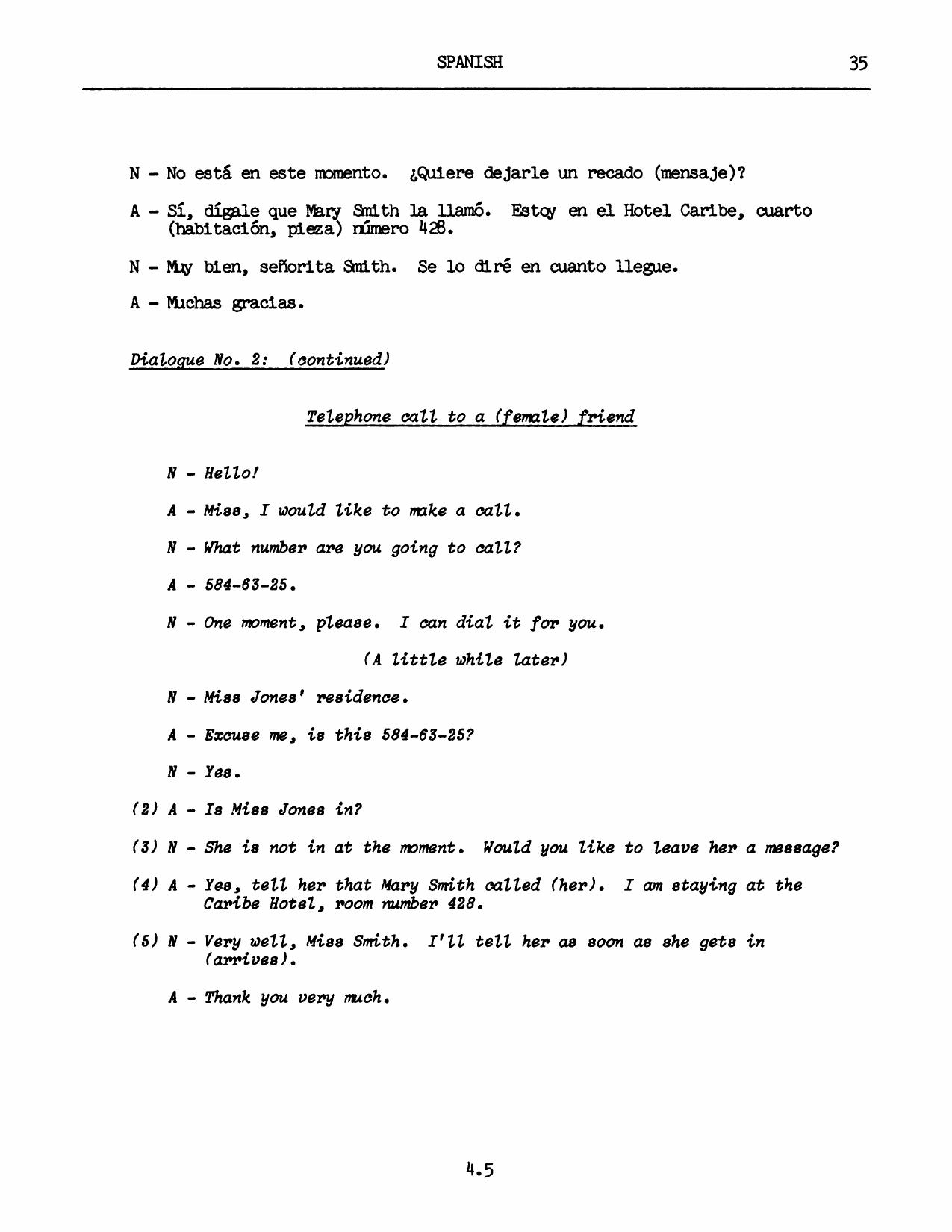
Language Notes.
1. In the previous cycle you heard "them" as los in ¿Cómo los quiere? In
that sentence the cashier was talking about dólares, a masculine noun.
In this conversation, the an is talking about maletas, a feminine
noun, when speaking to the bellhop: Póngalas ahí.
Notice that las is attached to ponga and is written as one word.
Placement of las or los is rigorously controlled by the internal grammar of Spanish. You will be “learning t these controls as you go along. For now, try and remember where the articles were placed in the models you have learned.
2. Está is used in the sense of "is" and also (as in this sentence) in the
sense of "is in."
3. The "le" in dejarle means "her." As with póngalas, it is attached to the
infinitive. As you will learn later, these little words are often attached when an infinitive is present.
4, Again, le is attached to diga in the word dígale. The la in la llamó
means "her." There are times when you will say le for "her" and other times when you will say la. This may bother you until you a learn the difference, but don't worry ; you will learn to control this feature as you progress further in the course. For now, we can simply say that le is used for indirect objects and la for direct objects. English speakers usually have a hard time learning to use these words, since this distinction is not as apparent in English. So don't worry if you're having a difficult time ~ you're definitely not alone!
5. In Spanish, one says "I tell it to her" rather than "I'll tell her." The
word order is "to her it I will tell," with se meaning "her" and lo meaning "it." So you now have three words meaning "her": le, la, and sel
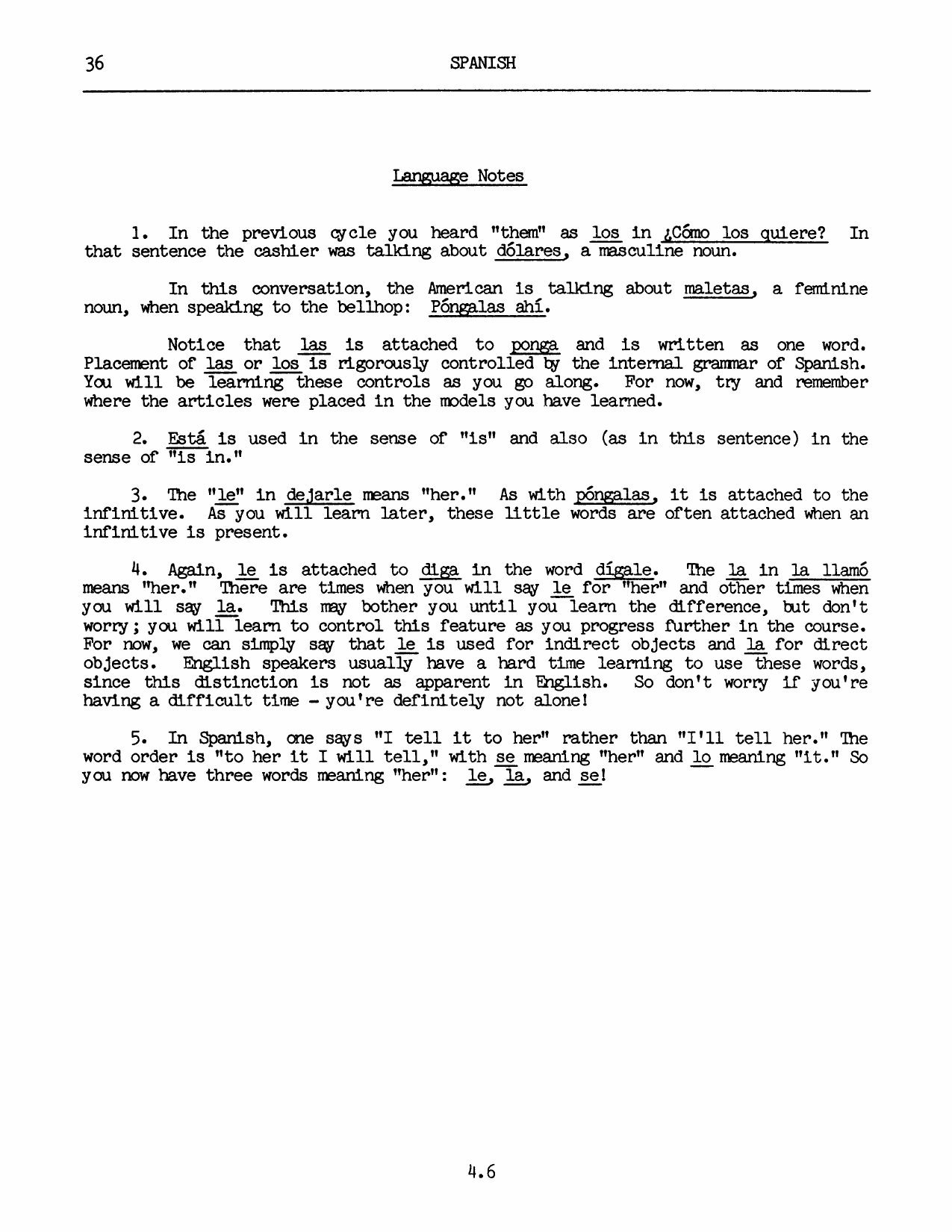
Verb Conjugations
More
she, 1t)
she, it)
she, it)
le diré = 1'11 tell you (him, her)
4,7
This page has a drawing, chart, or fill-in layout — original page
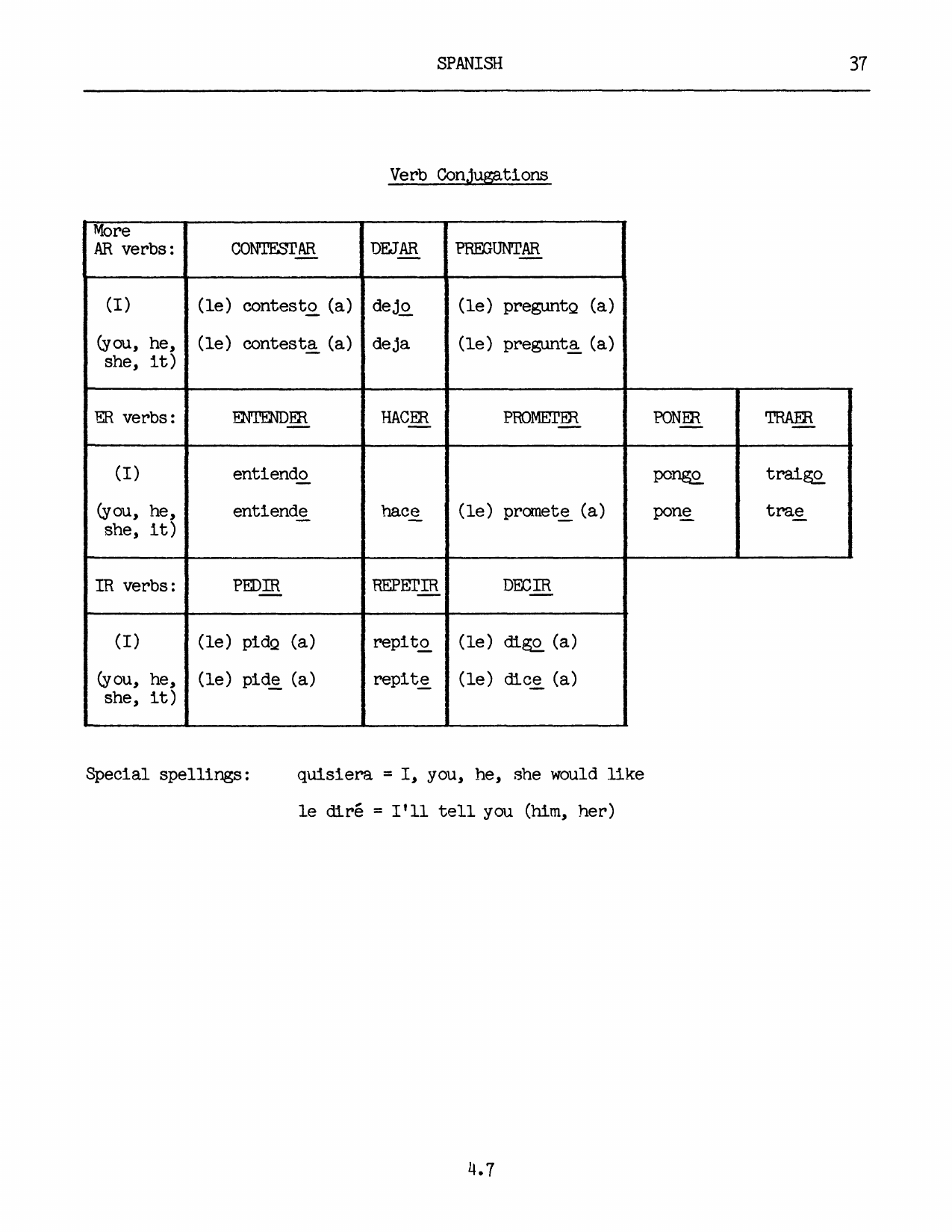
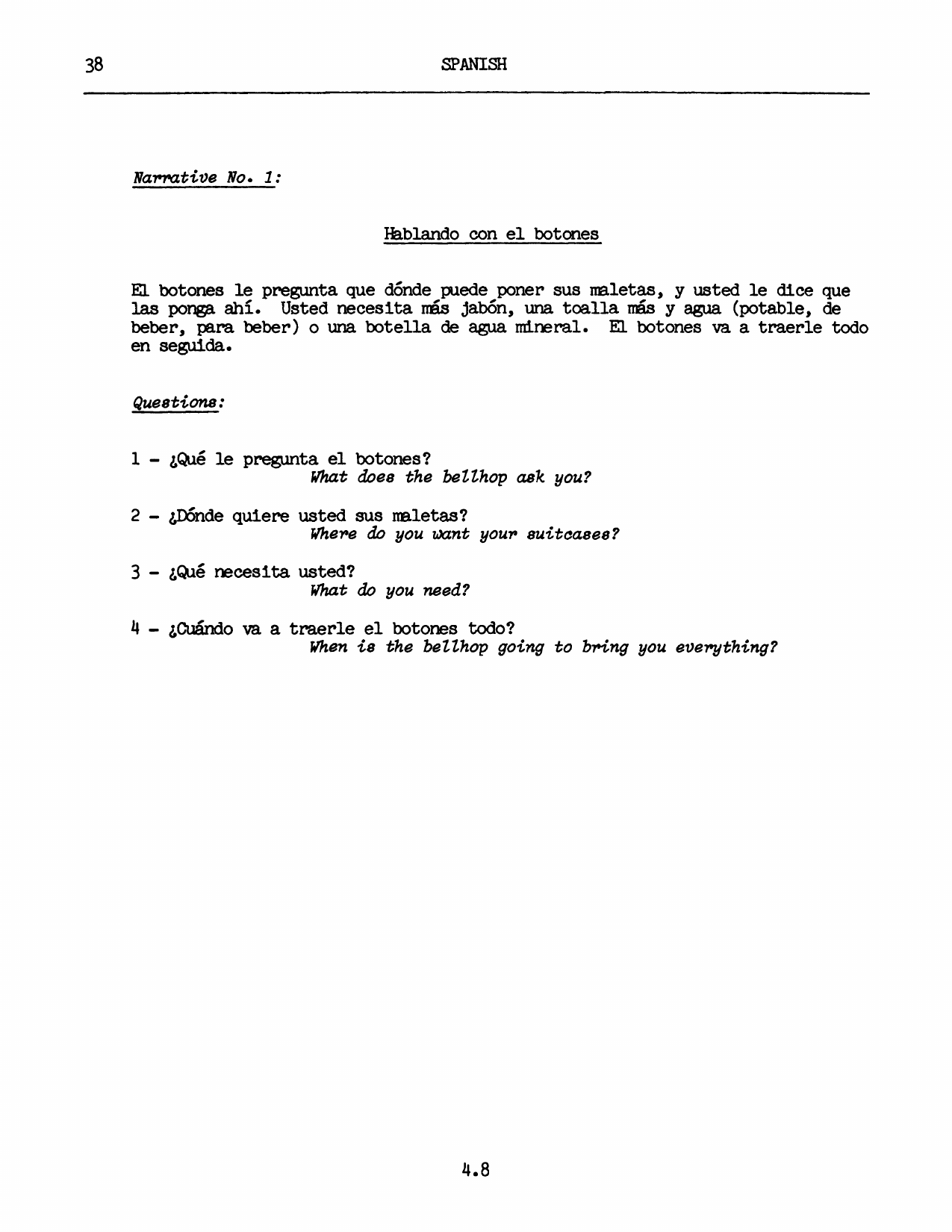
Narrative No. 1:
Hablando con el botones
El botones le pregunta que dónde puede poner sus maletas, y usted le dice que las ponga ahí. Usted necesita más jabón, una toalla más y agua (potable, de beber, para beber) o una botella de agua mineral. El botones va a traerle todo en seguida.
Questions:
1 = ¿Qué le pregunta el botones?
What does the bellhop ask you?
2 — ¿Dónde quiere usted sus maletas?
Where do you want your suitcases?
3 = ¿Qué necesita usted?
What do you need?
4 — ¿Cuándo va a traerle el botones todo?
When is the bellhop going to bring you everything?
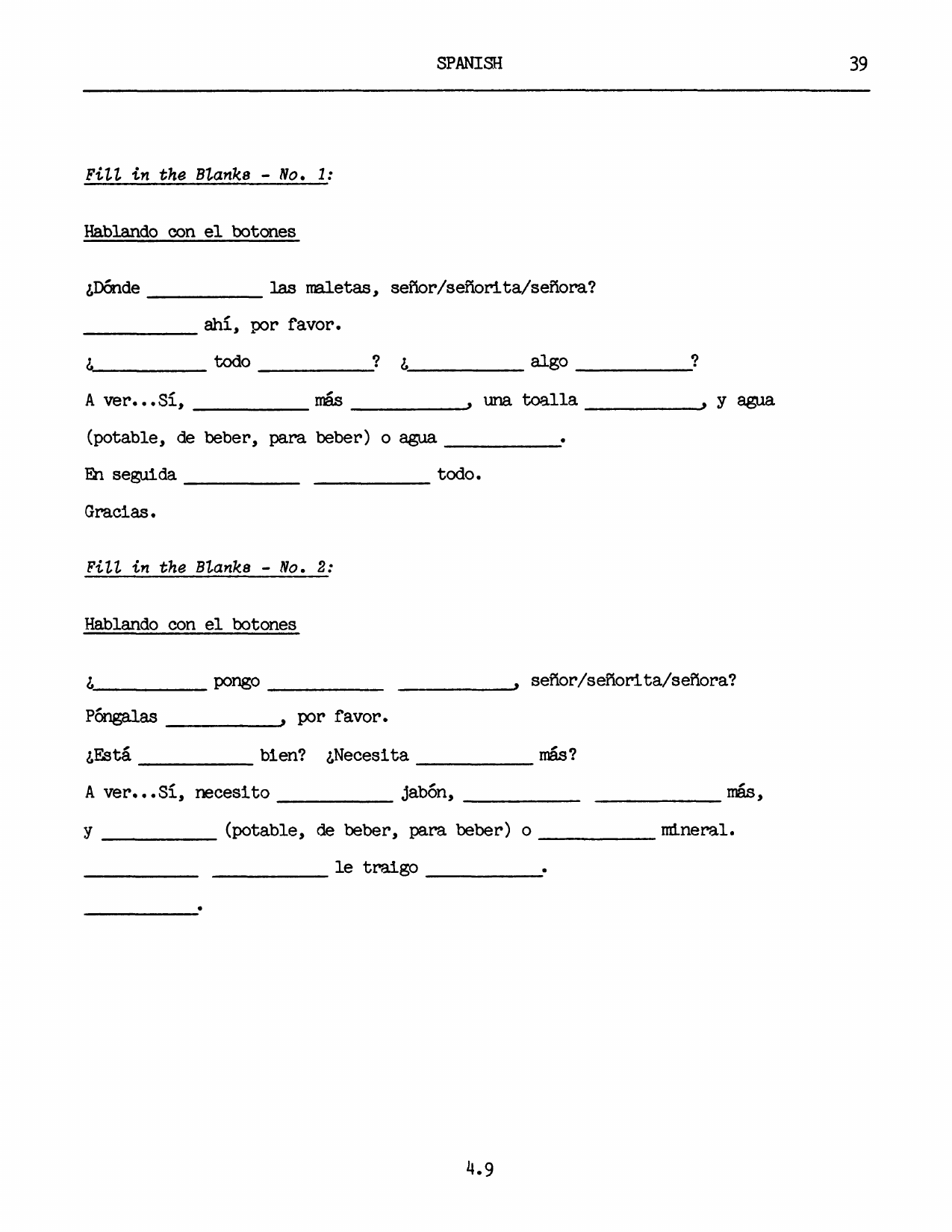
Fill in the Blanka - No. 1:
Hablando con el botones
ahí, por favor.
Gracias.
Fill in the Blanka - No. 2:
Hablando con el botones
This page has a drawing, chart, or fill-in layout — original page
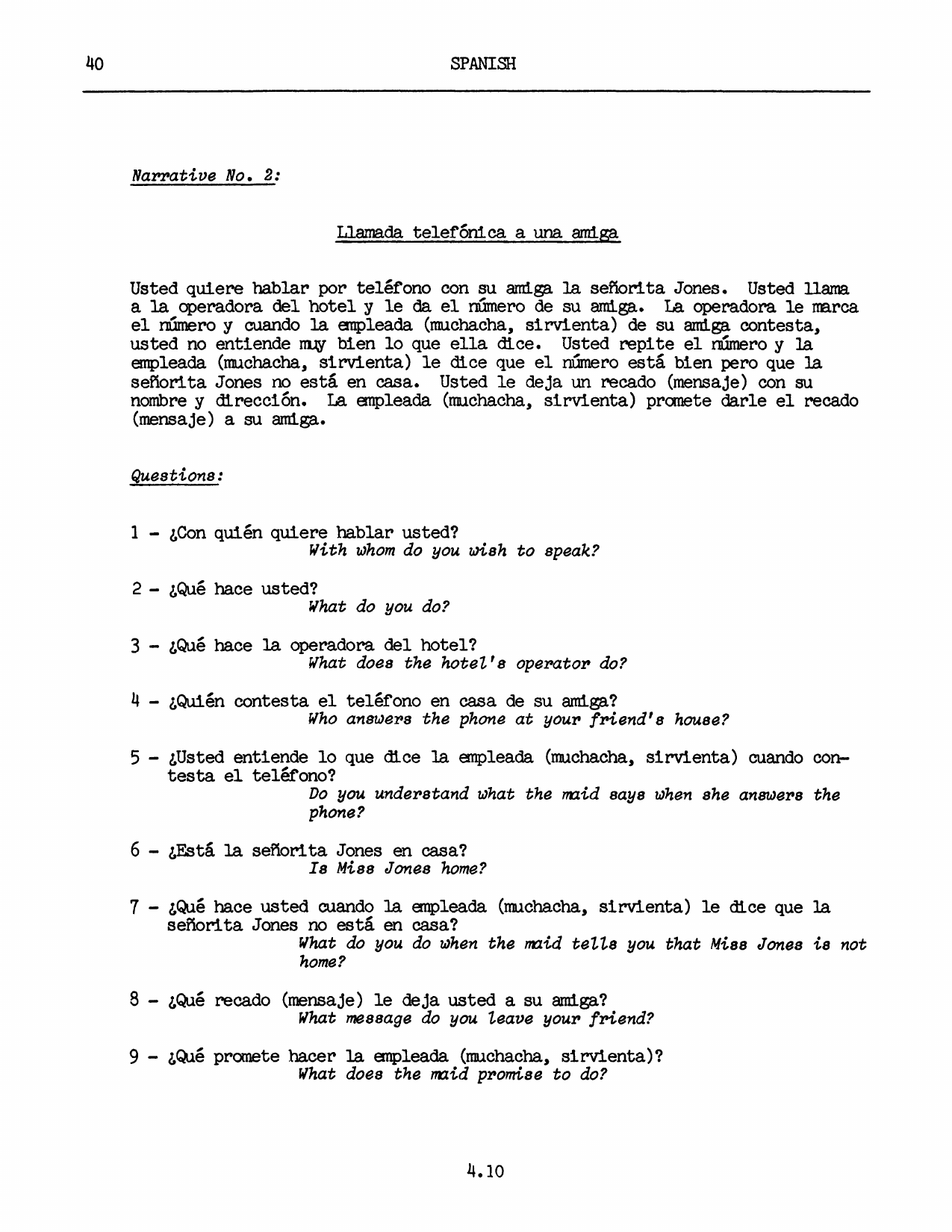
Narrative No. 2:
Llamada telefónica a una amiga
Usted quiere hablar por teléfono con su amiga la señorita Jones. Usted llama a la operadora del hotel y le da el número de su amiga. La operadora le marca el número y cuando la empleada (muchacha, sirvienta) de su amiga contesta, usted no entiende my bien lo que ella dice. Usted repite el número y la empleada (muchacha, sirvienta) le dice que el número está bien pero que la señorita Jones no está en casa. Usted le deja un recado (mensaje) con su nombre y dirección. La empleada (muchacha, sirvienta) promete darle el recado (mensaje) a su amiga.
Questions:
1 - ¿Con quién quiere hablar usted?
With whom do you wish to speak?
2 — ¿Qué hace usted?
What do you do?
3 - ¿Qué hace la operadora del hotel?
What does the hotel's operator do?
4 — ¿Quién contesta el teléfono en casa de su amiga?
Who answers the phone at your friend's house?
5 - ¿Usted entiende lo que dice la empleada (muchacha, sirvienta) cuando con=
testa el teléfono?
Do you understand what the maid says when she answers the phone?
6 - ¿Está la señorita Jones en casa?
Is Miss Jones home?
7 = ¿Qué hace usted cuando la empleada (muchacha, sirvienta) le dice que la
señorita Jones no está en casa?
What do you do when the maid tells you that Miss Jones te not home?
8 - ¿Qué recado (mensaje) le deja usted a su amiga?
What message do you leave your friend?
9 - ¿Qué promete hacer la empleada (muchacha, sirvienta)?
What does the maid promise to do?
4, 10
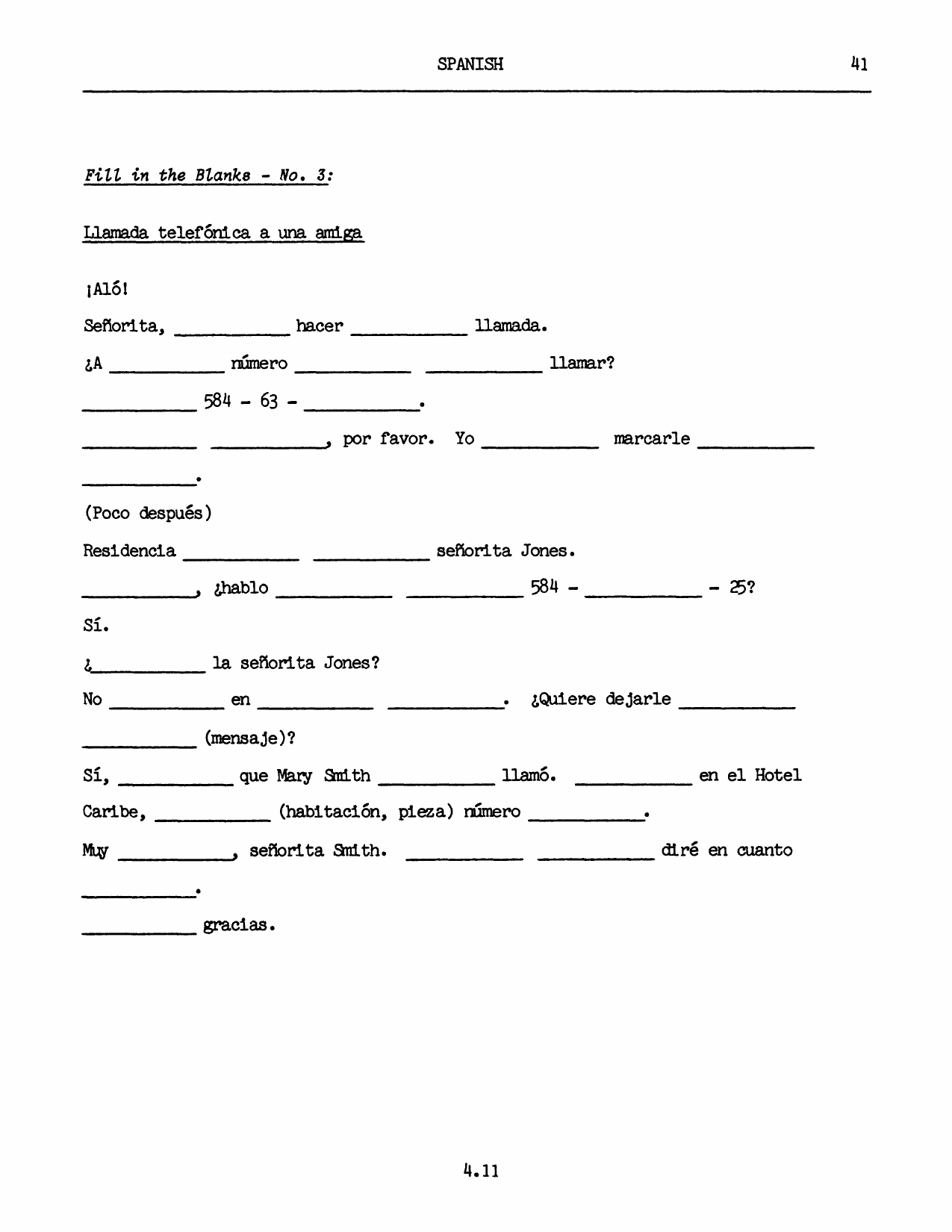
Fill in the Blanke - Wo. 3:
Llamada telefónica a una amiga
¡A1Ó1
(Poco después )
» ¿hablo
Si.
gracias.
This page has a drawing, chart, or fill-in layout — original page
Fill in the Blanks - No. 4:
Llamada telefónica a una amiga
(Poco después )
Hotel Caribe, cuarto (habitación, pieza)
This page has a drawing, chart, or fill-in layout — original page
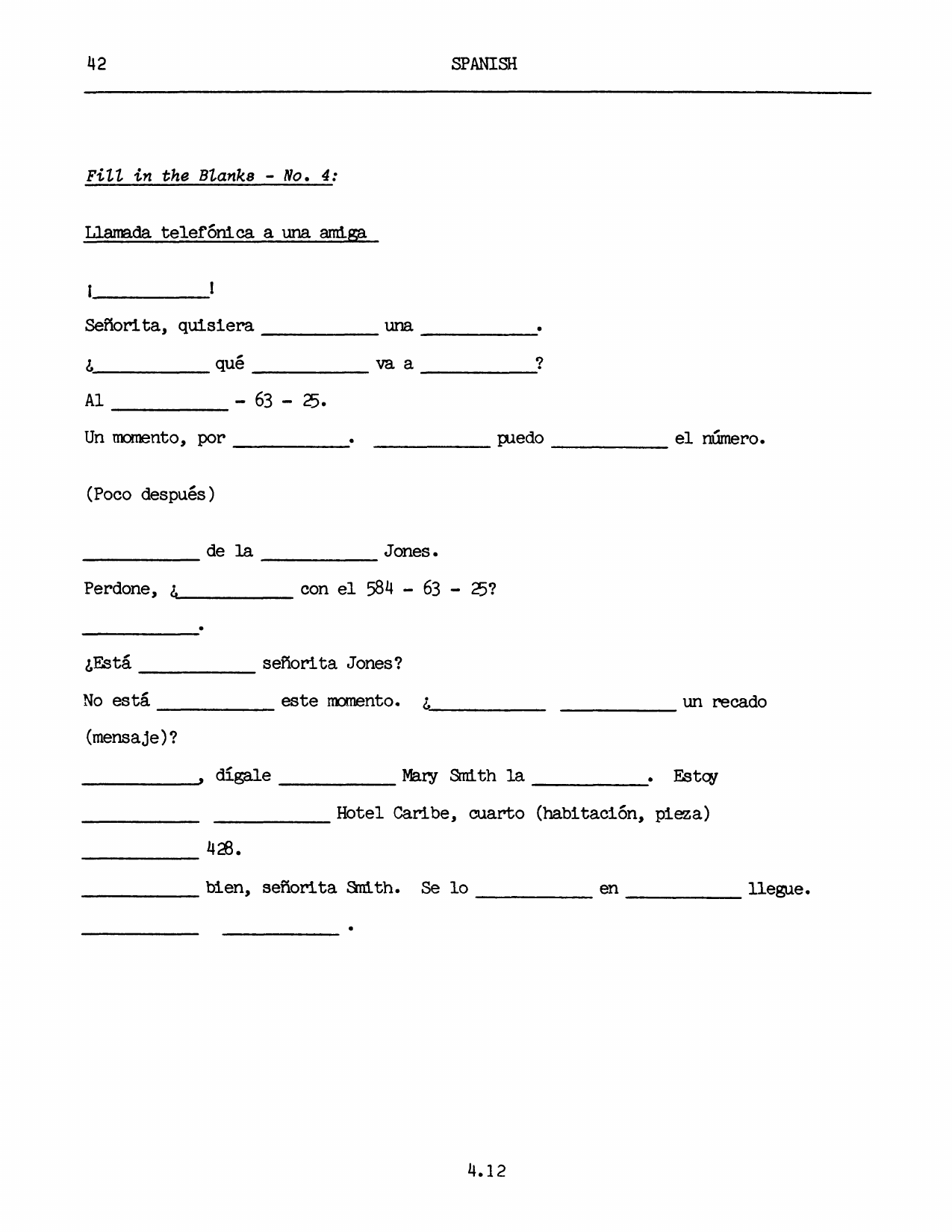
IV. TAKING IT APART
Vocabulary:
Narrative No. 1
la botella
todo
Narrative No.
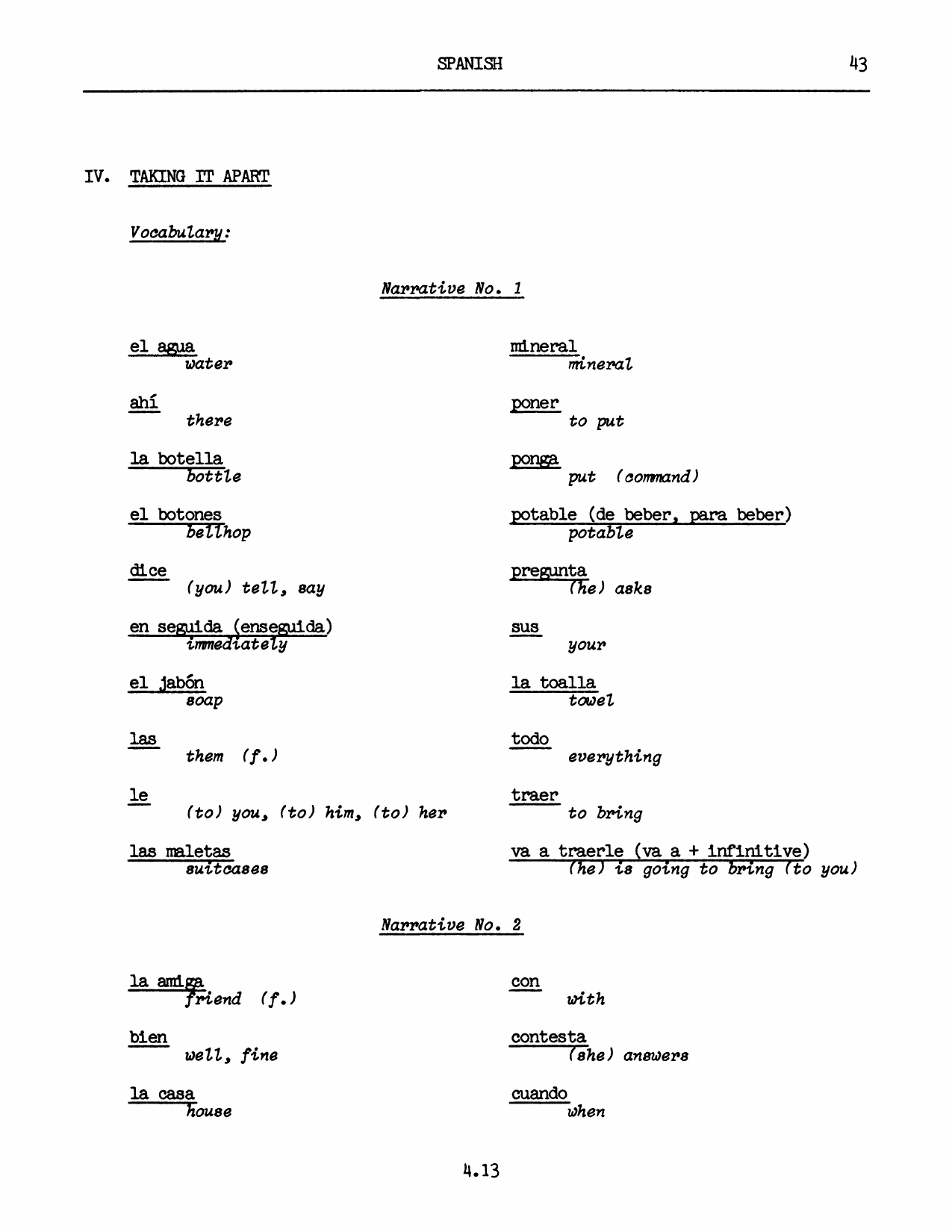
el mensaje
marca
(she) dials
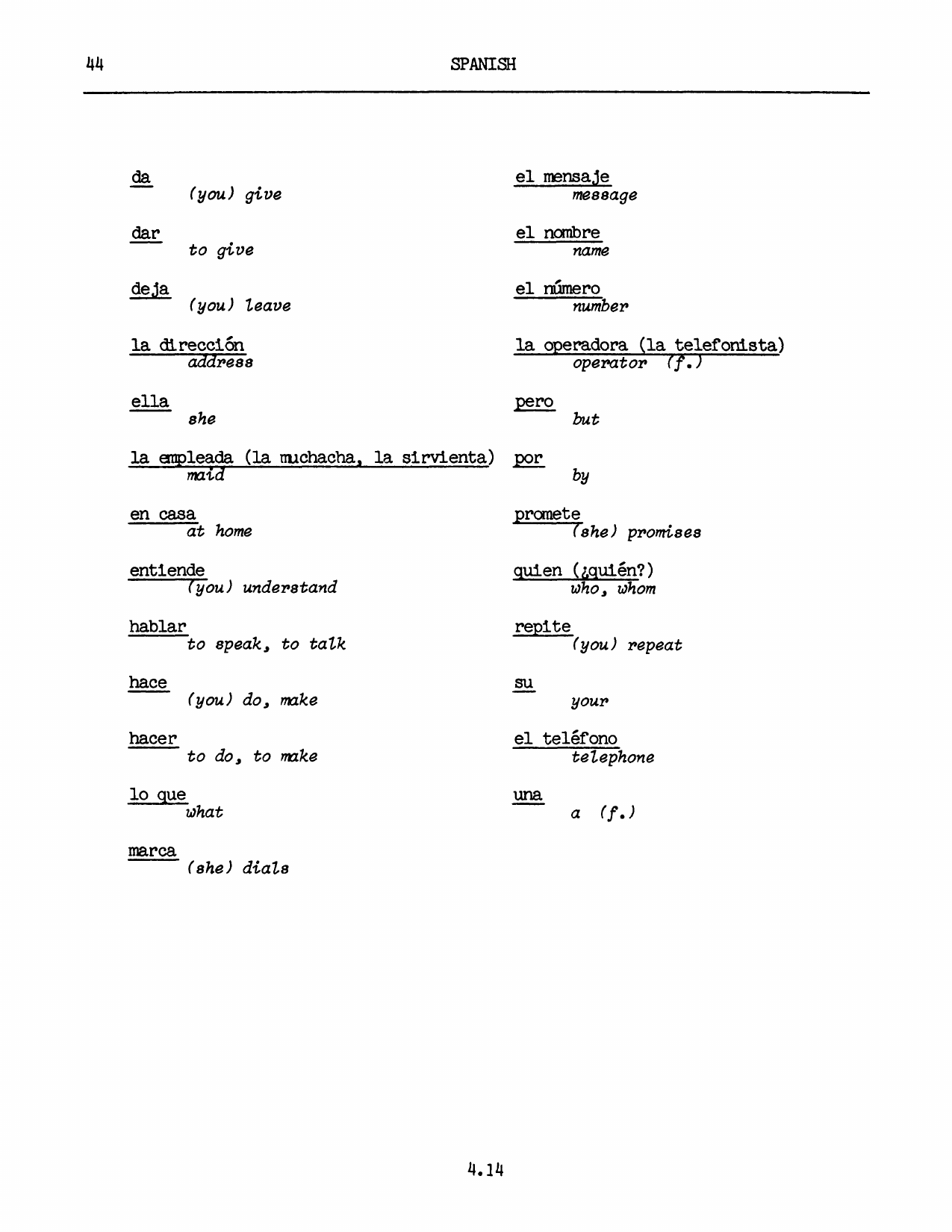
Additional Material - Material Adicional
Months of the Year - Los meses del año
Days of the Week - Los días de la semana
ueves
ursday
Seasons - Las estaciones
4,15
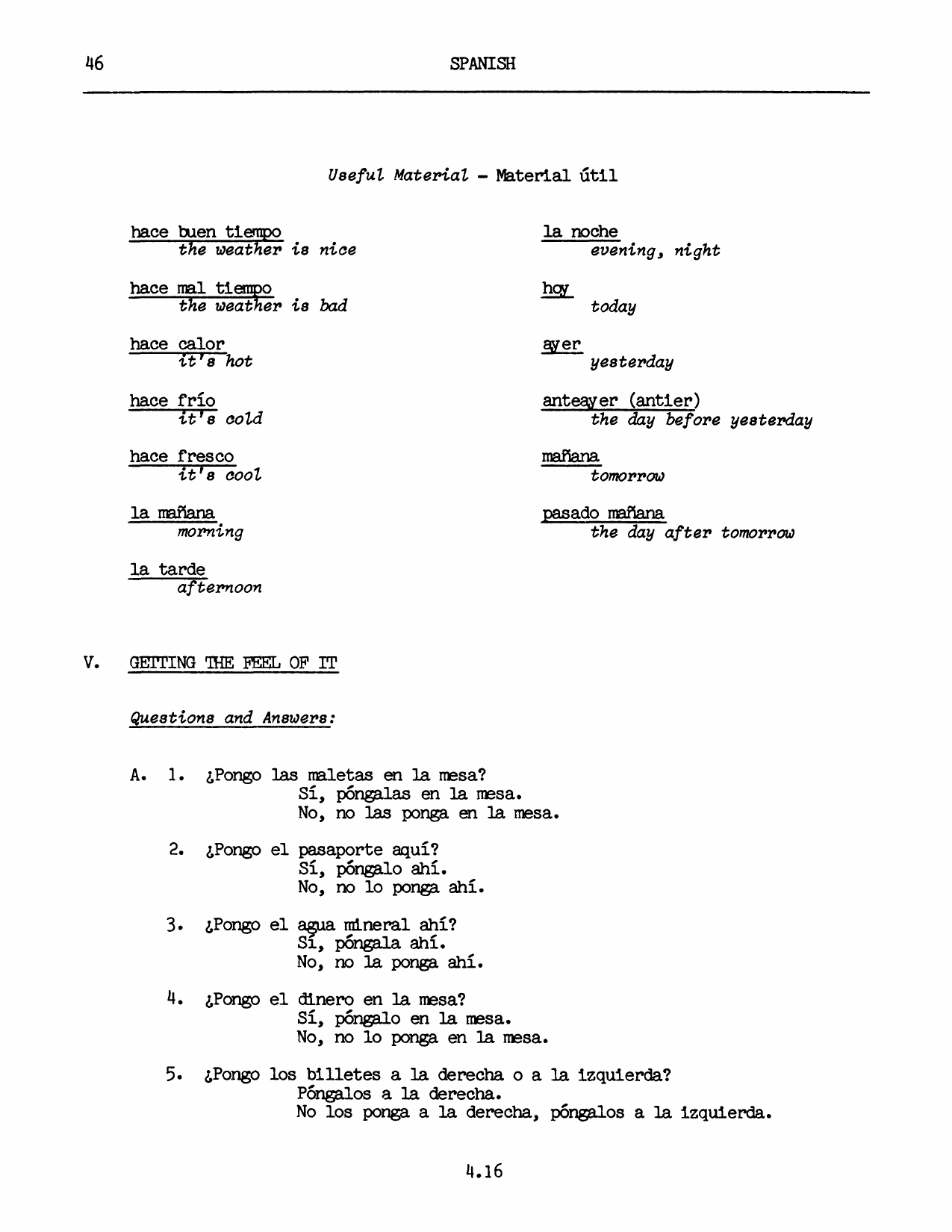
Useful Material - Material útil
la tarde
afternoon
V. GETTING THE FEEL OF IT
Questions and Anawers:
A. 1. ¿Pongo las maletas en la mesa?
Sí, póngalas en la mesa.
No, no las ponga en la mesa.
2. ¿Pongo el pasaperte aquí?
» pongalo ahí.
Ne no lo ponga ahí.
3. ¿Pongo el agua mineral ahí?
Si, póngala ahí.
No, no la ponga ahí.
4. ¿Pongo el dinero en la mesa?
Sí, póngalo en la mesa.
No, no lo ponga en la mesa.
5. ¿Pongo los billetes a la derecha o a la izquierda?
Póngalos a la derecha.
No los ponga a la derecha, póngalos a la izquierda.
4,16
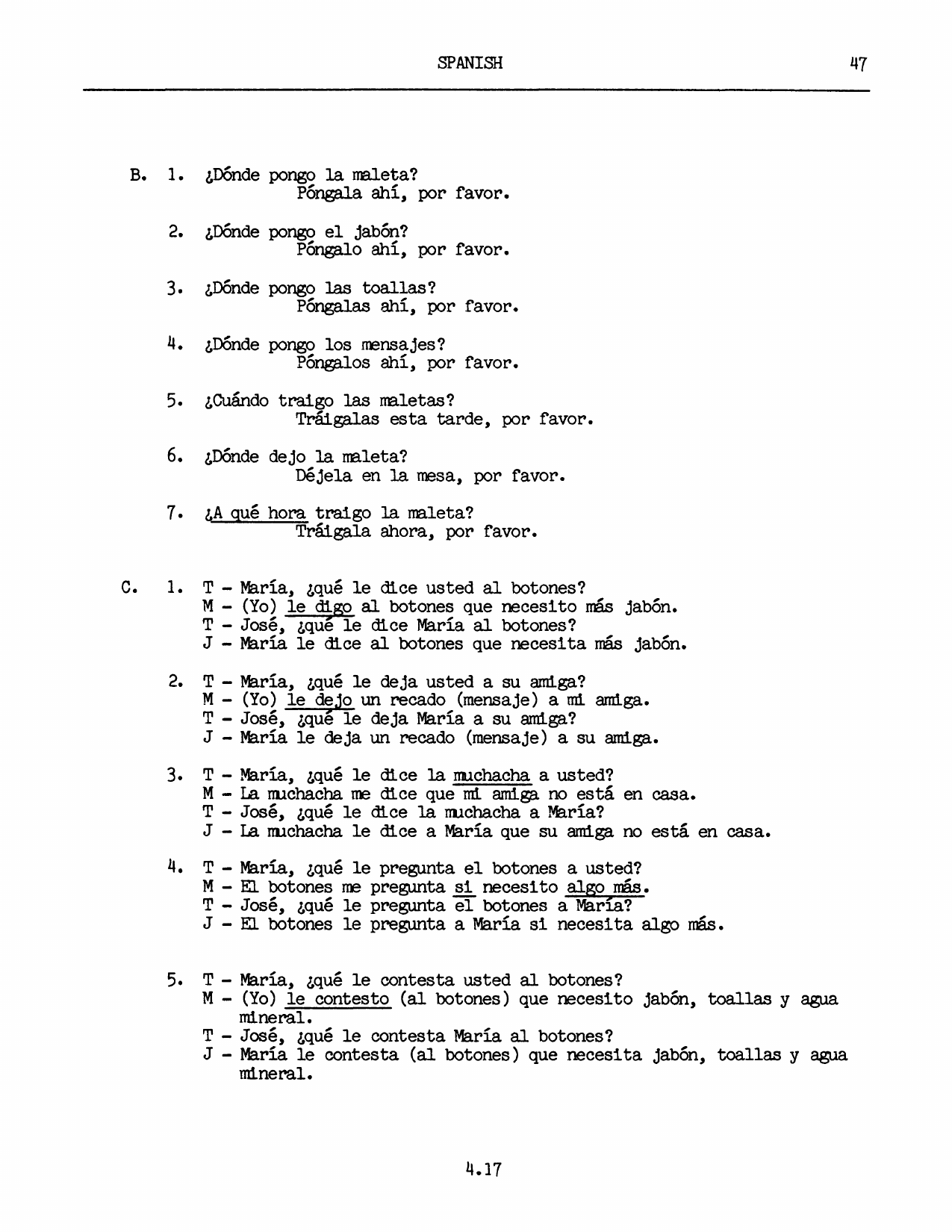
1. ¿Dónde pongo la maleta?
Póngala ahí, por favor.
2. ¿Dónde pongo el jabón?
Póngalo ahí, por favor.
3. ¿Dónde pongo las toallas?
Póngalas ahí, por favor.
4 ¿Dónde pongo los mensajes?
Póngalos ahí, por favor.
5. ¿Cuándo traigo las maletas?
Tráigalas esta tarde, por favor.
6. ¿Dónde dejo la maleta?
Déjela en la mesa, por favor.
T. ¿A qué hora traigo la maleta?
Tráigala ahora, por favor.
C. l. T — María, ¿qué le dice usted al botones?
M - (Yo) le digo al botones que necesito más jabón.
T - José, ¿qué le dice María al botones?
J — María le dice al botones que necesita más Jabón.
2. T - María, ¿qué le deja usted a su amiga?
M - (Yo) le dejo un recado (mensaje) a mí amiga.
T - José, ¿qué le deja María a su amiga?
J - Maria le deja un recado (mensaje) a su amiga.
3. T — María, ¿qué le dice la muchacha a usted?
M - La muchacha me dice que mi amiga no está en casa.
T ~ José, ¿qué le dice la muchacha a María?
J - La michacha le dice a María que su amiga no está en casa.
4, T - María, ¿qué le pregunta el botones a usted?
M - El botones me pregunta si necesito algo más.
T - José, ¿qué le pregunta el botones a Maria?
J - El botones le pregunta a María si necesita algo más.
5. T - Maria, ¿qué le contesta usted al botones?
M - (Yo) le contesto (al botones) que necesito jabón, toallas y agua
mineral.
T - José, ¿qué le contesta María al botones?
J - Maria le contesta (al botones) que necesita jabón, toallas y agua
mineral.
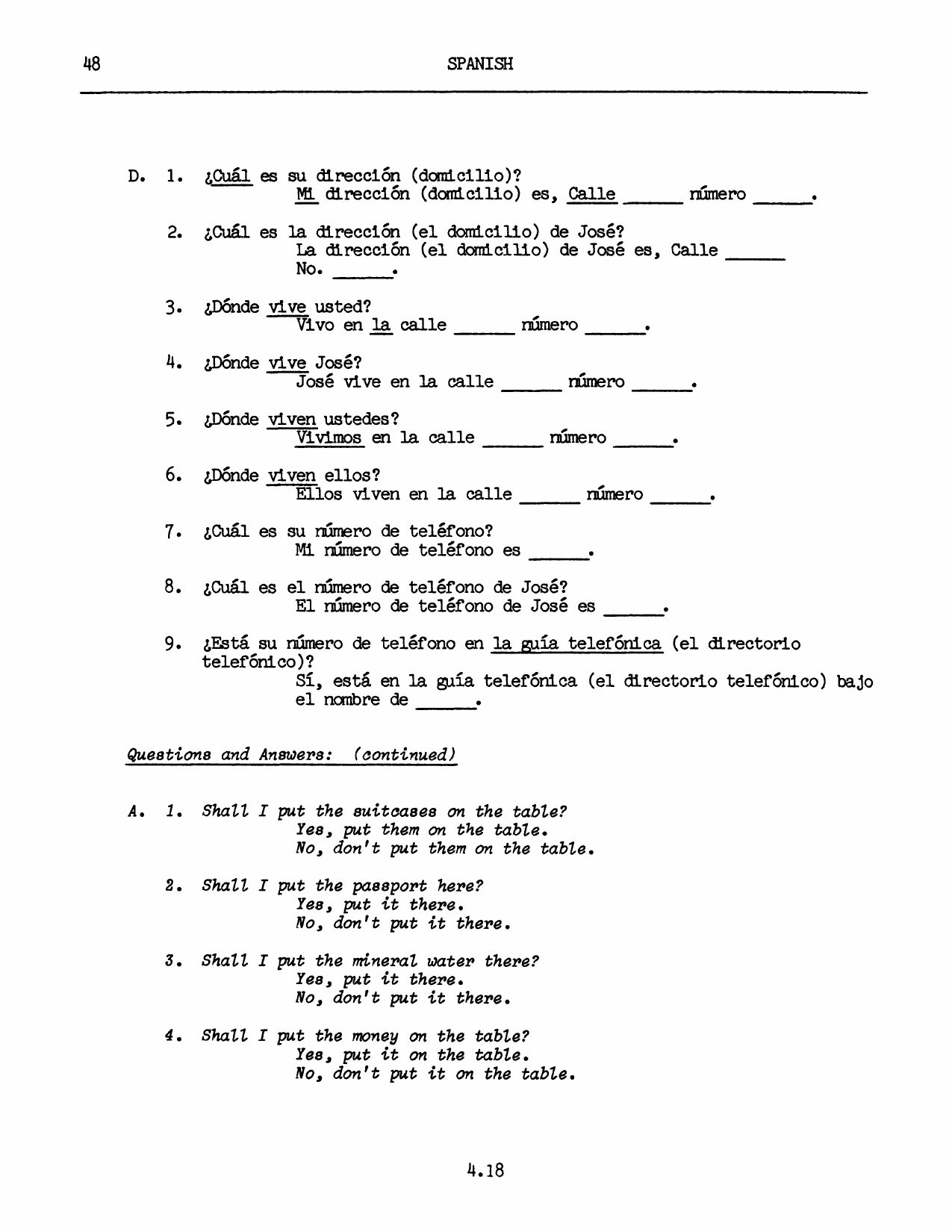
D. 1. ¿Cuál es su dirección (domicilio)?
2. ¿Cuál es la dirección (el domicilio) de José?
La dirección (el domicilio) de José es, Calle
3. ¿Dónde vive usted?
4. ¿Dónde vive José?
5. ¿Dónde viven ustedes?
6. ¿Dónde viven ellos?
7. ¿Cuál es su número de teléfono?
8. ¿Cuál es el número de teléfono de José?
9. ¿Está su número de teléfono en la guía telefónica (el directorio
telefónico)?
Sí, está en la guía telefónica (el directorio telefónico) bajo
Questions and Answers: (continued)
A. 1. Shall I put the suttcases on the table?
Yes, put them on the table.
No, don't put them on the table.
2. Shall I put the passport here?
Yes, put it there.
No, don't put it there.
3. Shall I put the mineral water there?
Yes, put it there.
No, don't put it there.
4. Shall I put the money on the table?
Yes, put it on the table.
No, don't put it on the table.
4,18
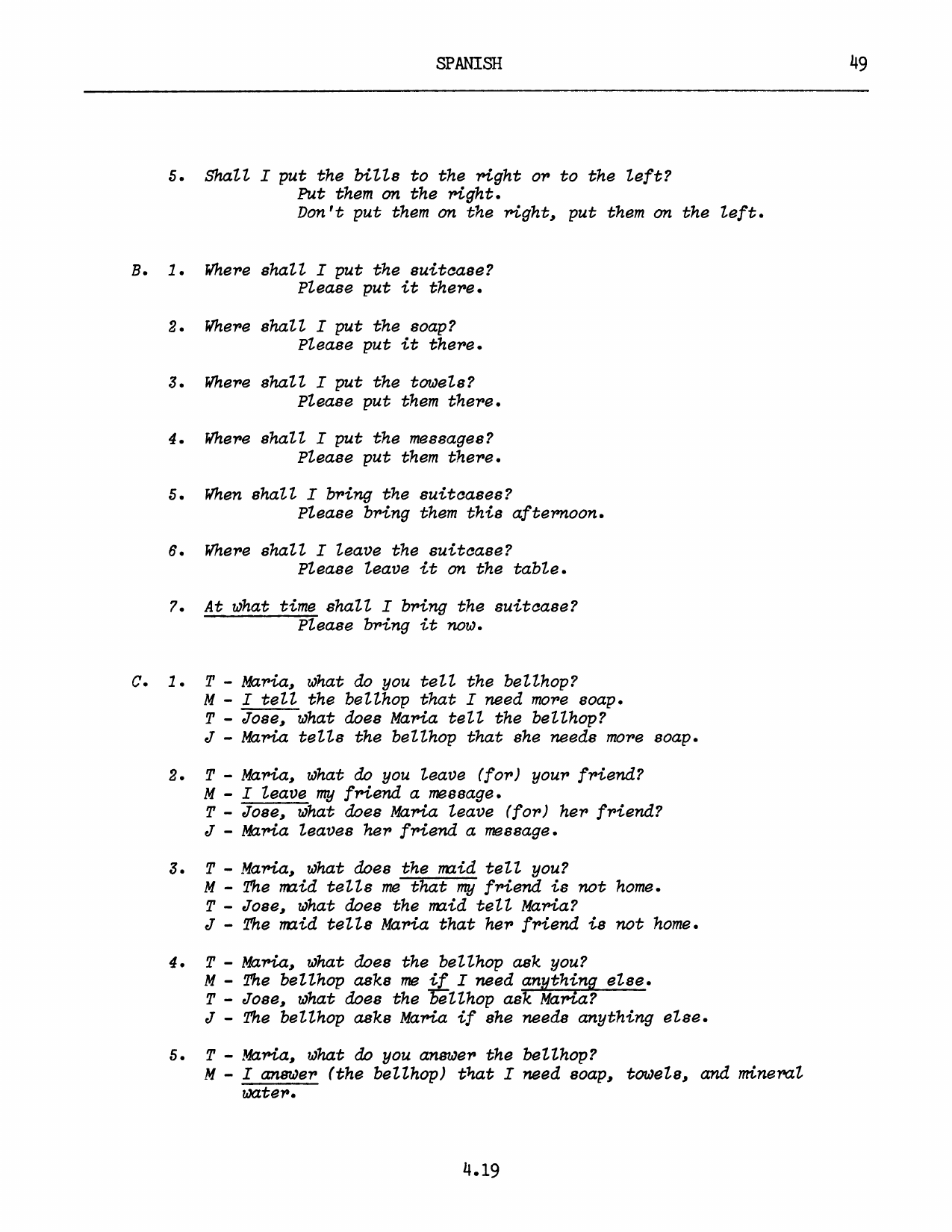
5. Shall I put the bills to the right or to the left?
Put them on the right.
Don't put them on the right, put them on the left.
Bo 1. Where shall I put the suttease?
Please put it there.
2. Where shall I put the soap?
Please put it there.
3. Where shall I put the towels?
Please put them there.
4. Where shall I put the messages?
Please put them there.
5-6 When shall I bring the suitcases?
Please bring them this afternoon.
6. Where shall I leave the suitcase?
Please leave it on the table.
7. At what time shall I bring the suitcase?
Please bring it now.
Co 1. T - Maria, what do you tell the bellhop?
M - I tell the bellhop that I need more soap.
T - José, what does Maria tell the bellhop?
J - Maria tells the bellhop that she needs more soap.
26 T - María, what do you leave (for) your friend?
M - I leave my friend a message.
T - José, what does Maria leave (for) her friend?
J - Maria leaves her friend a message.
3. T ~ Maria, what does the mid tell you?
M - The maid tells me that my friend is not home.
T - José, what does the maid tell Maria?
J - The mid tells Maria that her friend ie not home.
d. T - Maria, what does the bellhop ask you?
M - The bellhop asks me if I need anything else.
T - José, what does the bellhop ask Maria?
J - The bellhop asks Maria tf she needs anything else.
Se T - Maria, what do you answer the bellhop?
M - I answer (the bellhop) that I need soap, towels, and mineral
water.
T - José, what does Maria answer the bellhop?
J - Maria answers (the bellhop) that she needs soap, towels, and
mineral water.
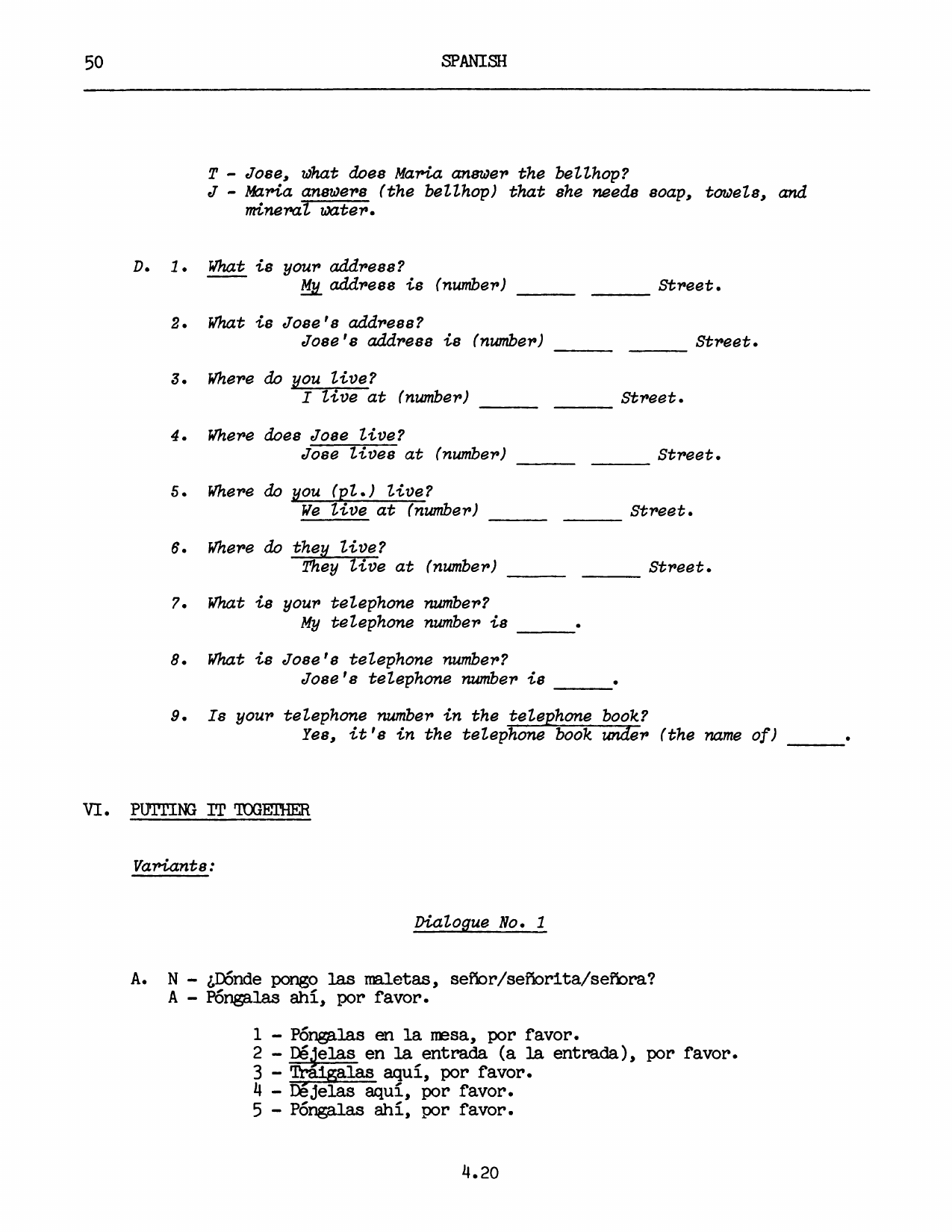
D. 1. What is your address?
2. What te Jose's address?
3. Where do you live?
4. Where does Jose live?
5. Where do you (pl.) live?
6. Where do they live?
7. What ls your telephone number?
8. What is Jose's telephone number?
9. Is your telephone number in the telephone book?
Yes, it's in the telephone book under (the name of)
VI. PUTTING_IT TOGETHER
Variante:
Dialogue No. 1
A. N - ¿Dónde pongo las maletas, señor/señorita/señora?
A — Póngalas ahí, por favor.
1 - Póngalas en la mesa, por favor.
2- Déjelas en la entrada (a la entrada), por favor.
4 - Déjelas aquí, por favor.
5 - Póngalas ahí, por favor.
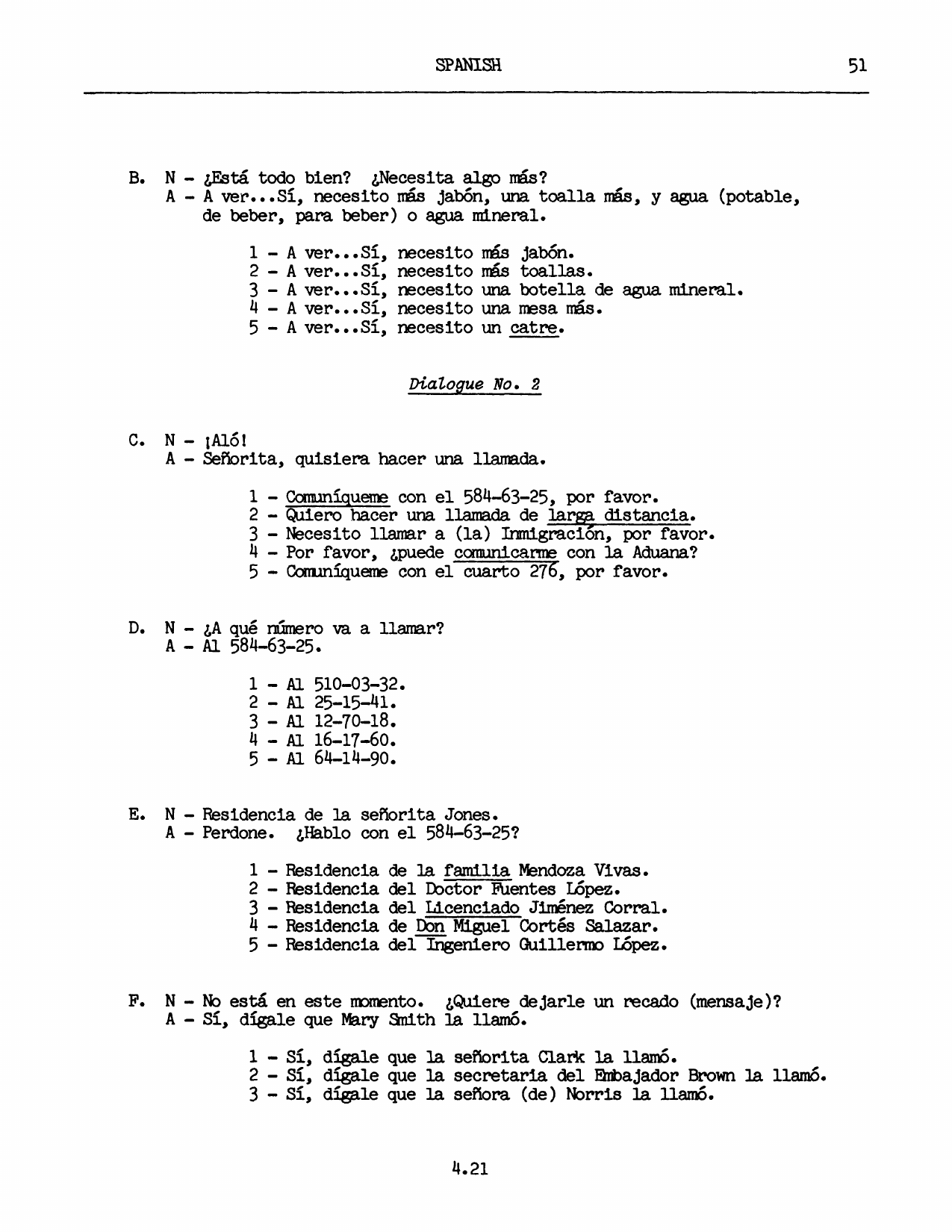
B. N = ¿Está todo bien? ¿Necesita algo más?
A - A ver...Si, necesito más jabón, una toalla más, y agua (potable,
de beber, para beber) o agua mineral.
1 - A ver...Si, necesito más jabón.
2 - A ver...Si, necesito más toallas.
3 - A ver...Si, necesito una botella de agua mineral. 4 — A ver...Si, necesito una mesa más.
5 - A ver...Si, necesito un catre.
Dialogue No. 2
C. N - ¡Aló!
A - Señorita, quisiera hacer una llamada.
1 - Comuníqueme con el 5814-63-25, por favor.
2 - Quiero hacer una llamada de larga distancia.
3 - Necesito llamar a (la) Inmigración, por favor.
4 - Por favor, ¿puede comunicarme con la Aduana?
5 - Comuníqueme con el cuarto 276, por favor.
D. N — ¿A qué número va a llamar?
A — Al 584-63-25.
1 - Al 5110-03-32.
2- AL 25-15-41,
3 - Al 12-70-18.
4 — Al 16-17-60.
5 - Al 64-14-90.
N ~ Residencia de la señorita Jones.
A - Perdone. ¿Hablo con el 584-63-25?
1 - Residencia de la familia Mendoza Vivas.
2 - Residencia del Doctor Fuentes López.
3 - Residencia del Licenciado Jiménez Corral.
4 — Residencia de Don Miguel Cortés Salazar.
5 - Residencia del Ingeniero Guillermo López.
F, N — No está en este momento. ¿Quiere dejarle un recado (mensaje)?
A - Sí, dígale que Mary Smith la llamó.
1 - Sí, dígale que la señorita Clark la llamó.
2 - Sí, dígale que la secretaria del Embajador Brown la llamó. 3 - Sí, dígale que la señora (de) Norris la llamó.
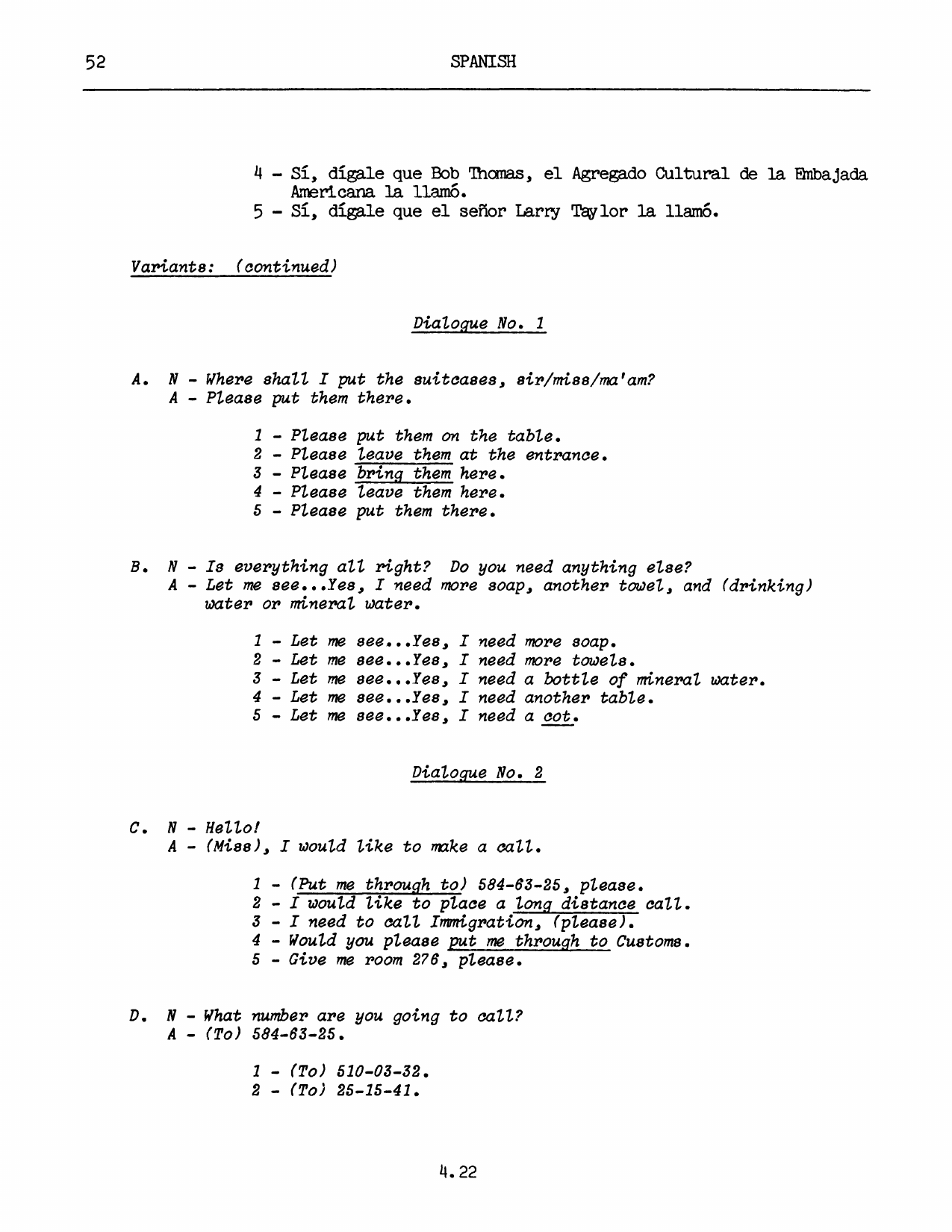
4 — Sí, dígale que Bob Thomas, el Agregado Cultural de la Embajada
Americana la llamó.
5 - Sí, dígale que el señor Larry Taylor la llamó.
Variants: (continued)
Dialogue No. 1
A. N - Where shall I put the suitcases, sir/miss/ma'am?
- Please put them there.
1 - Please put them on the table.
2 - Please leave them at the entrance.
3 - Please bring them here.
4 - Please leave them here.
5 - Please put them there.
- Let me see...Yes, I need more soap, another towel, and (drinking) water or mineral water.
1 - Let me see...Yes, I need more soap.
2 - Let me see...Yes, I need more towels.
3 - Let me see...Yes, I need a bottle of mineral water. 4 - Let me see...Yes, I need another table.
5 - Let me see...Yes, I need a cot.
Dialogue No. 2
- Hello!
- (Miss), I would like to make a call.
1 - (Put me through to) 584-63-25, please.
2 - I would like to place a long distance call.
3 - I need to call Immigration, (please).
4 - Would you please put me through to Customs.
5 - Give me room 276, please.
- (To) 584-63-25.
1 - (To) 510-03-32.
2 - (To) 25-15-41.
3 - (To) 12-70-18.
4 - (To) 16-17-60.
5 = (To) 64-14-90.
E. N Miss Jones' residence.
Excuse me. Is this 584-63-25?
1 - Residence of the Mendoza-Vivas family.
2 - Doctor Fuentes-Lopez's residence.
3 - (Attorney) Jimenez-Corral's residence.
4 - Don Miguel Cortes-Salazar's residence.
5 - (Engineer) Guillermo Lopez's residence.
FP. N She ta not in at the moment. Would you like to leave her a message?
Yes, tell her that Mary Smith called (her).
1 - Yes, tell her that Miss Clark called (her).
2 - Yes, tell her that Ambassador Brown's secretary called (her). 3 - Yes, tell her that Mrs. Norris called (her).
4 - Yes, tell her that Bob Thomas, the Cultural Attaché of the
American Embassy, called (her).
5 - Yes, tell her that Mr. Larry Taylor called (her).
VII. MAKING IT WORK
VIII. USING IT