CYCLE 5
GETTING STARTED IN COUNTRY
At the Restaurant
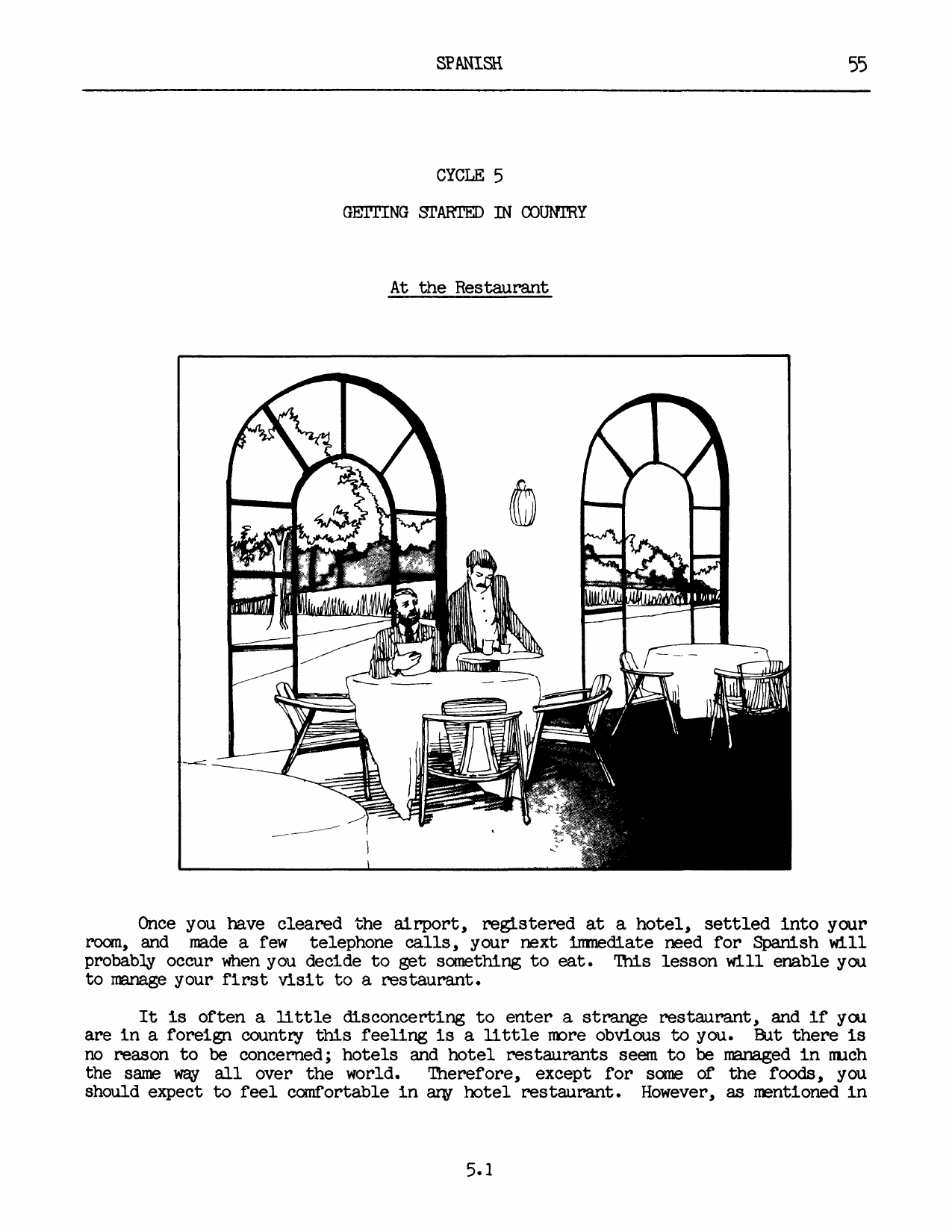
Once you have cleared the airport, registered at a hotel, settled into your
room, and made a few telephone calls, your next immediate need for Spanish will probably occur when you decide to get something to eat. This lesson will enable you to manage your first visit to a restaurant.
It is often a little disconcerting to enter a strange restaurant, and if you
are in a foreign country this feeling is a little more obvious to you. But there is no reason to be concerned; hotels and hotel restaurants seem to be managed in mich the same way all over the world. Therefore, except for some of the foods, you should expect to feel comfortable in any hotel restaurant. However, as mentioned in
This page has a drawing, chart, or fill-in layout — original page
Cycle 4, unless you are assured otherwise, it is a good idea to avoid drinking water in public places. Bottled water is usually safe all the time; if in doubt, and especially in a restaurant, order mineral water (agua mineral), such as Perrier. Agua mineral is available almost universally.
Food is always very good or excellent in all major hotels and the menus are
almost identical to those you find in the States. However, steaks are generally cooked less than they are in the U.S. Therefore, if you order medio crudo ("medium rare"), you will probably get crudo ("rare"). If you order crudo, you will probably get bloody rare. If you like "well done" (no pink coloring at all), order bien
One of the first things you want to do when you are at a restaurant is learn
how to attract the waiter's/waitress's attention. In the U.S. one often manages to do so simply by establishing eye contact. In the Spanish-speaking world, such subtlety might not work. You will probably have to be more obvious. Ask your teacher about this. Find out, too, whether certain signals may be appropriate in some restaurants but not in others.
When addressing the waiter or waitress it is better to use señor or señorita
than to use the Spanish equivalent of "waiter."
Tipping at a restaurant is handled in mich the same way that it is in the
States. The amount will usually be 15 percent of the bill, though 1t may vary. At some restaurants the amount will be specified on the mem and may already be included in the bill. When you are not sure, inquire whether this is the case.
Be advised that if you pay the waiter/waitress directly rather than paying the
cashier and give him/her more money than the total amount of the check, you may find that the waiter/waitress will thank you and not bring you any change, thinking that you have included the tip in the amount. If that was not what you intended, it is a good idea to tell the waiter/waitress when you pay the check that you would like the change to be brought back to you. You might say something like ¿Puede traerme el cambio, por favor? Once you get the change, you can then leave la propina ("tip" on the table.
Some restaurants and nightclubs routinely add a cover charge, which will show
up on your bill as cubierto or derecho de mesa. This is NOT a tip. In addition, some nightclubs may also require you to pay a "minimum" (consumo mínimo) for drinks.
The dialogue that follows will help you to get started.
I. SETTING THE SCENE
You have cleared the airport and are now at your hotel. Since you are hungry, you decide to go downstairs and try the hotel's restaurant. The restaurant has a typical Latin-American décor: wrought iron windows and chandeliers, lovely tablecloths, and so forth. It is a very nice restaurant and you are looking forward to trying out both the food and your Spanish.
II. HEARING IT
III. SEEING IT
Dialogue:
En el restaurante (restorán)
N - ¿Espera a alguien?
A - No, estoy solo/a.
N - ¿Dónde quiere (quisiera) sentarse?
A - Cerca de la ventana.
N - ¿Quiere (desea) tomar algo antes de pedir?
A = Si, tráigame una cerveza fría (helada), por favor.
(Después de unos minutos)
N - ¿Qué desea comer?
A - Sopa de legumbres. Un bistec (filete) con puré de papas...
y ensalada de lechuga y tomate (Méx. jitomate).
Pan y matequilla.
N - ¿Cómo quiere su bistec (filete)?
A - Medio crudo. (Jugoso, término medio, medio hecho).
(Más tarde)
N — De postre, ¿qué quiere?
A - Nada, pero trálgame otra cerveza y la cuenta, por favor.
Dialogue: (continued)
At the restaurant
N - Are you waiting for someone?
A - No, I'm alone.
(1) N - Where would you like to sit?
A - Near the window.
(1) N - Would you like to have something to drink before you order? (2) A - Yes, bring me a cold beer, please.
(After a few minutes)
N - What would you like to eat?
A - Vegetable soup. Steak, mashed potatoes...and a lettuce and tomato
salad. Bread and butter.
N - How do you want your steak?
A - Medium rare.
(Later)
N - For dessert...what would you like?
A - Nothing, but bring me another beer and the check, please.
Language Notes
l. "Want" is literally quiere. You will often find the form quisiera (called
past subjunctive) instead of quiere. The use of quisiera makes the request softer and warmer; however, this does not mean that quiere is abrupt or cold. Feel free to use either form.
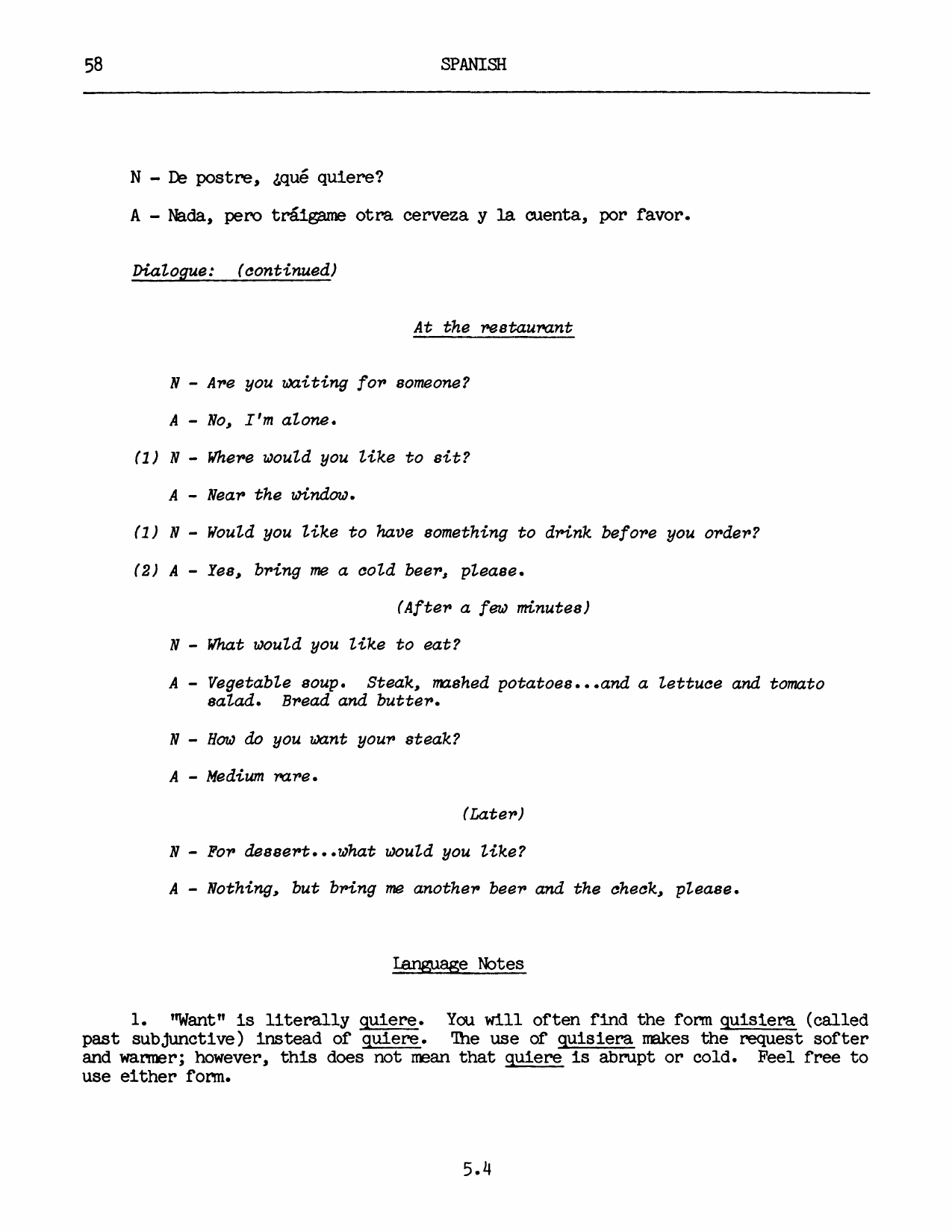
Desea (notice the resemblance to the English word "desire") can also be
used to express want or desire. In fact, this word could have been used in every sentence in our dialogue where quiere or quisiera is used.
Notice that the English language prefers to use the word "like" in almost
every instance where quiere or quisiera appears. Somehow, to English ears, the phrasing "Where would you like to sit?" coming from a waiter sounds more appropriate than "Where do you want to sit?" For this reason, we chose "like" and "would like" over "want" for our English translation.
2. Notice that -me is attached to traiga. If you need to say "Don't bring
me...", you mist say No me traiga with me in front of traiga. If you are writing this, you should phrase it as three words.
Narrative:
En el restaurante (restorán)
Usted entra al restorán y le dice al mesero (mozo, camarero) que (usted) no espera a nadie, que está solo/a, y que quiere sentarse cerca de la ventana.
Antes de comer usted ordena (pide) una cerveza fría. Después de unos minutos, (usted) pide un bistec (filete) medio crudo, puré de papas y ensalada de lechuga y tomate. También pide sopa de legumbres, pan y mantequilla. Por último, usted le pide al mesero (mozo, camarero) otra cerveza y la cuenta.
Questions:
1 = ¿A dónde entra usted?
Where do you go in (enter)?
2 - ¿Qué le dice usted al mesero (mozo, camarero)?
What do you tell the waiter?
3 - ¿Dónde quiere sentarse usted?
Where would you like to sit?
4 — ¿Qué quiere tomar usted antes de comer?
What would you like to drink before eating?
5 - ¿Qué pide usted después de unos minutos?
What do you order after a few minutes?
6 — ¿Cómo quiere su bistec (filete)?
How do you want your steak?
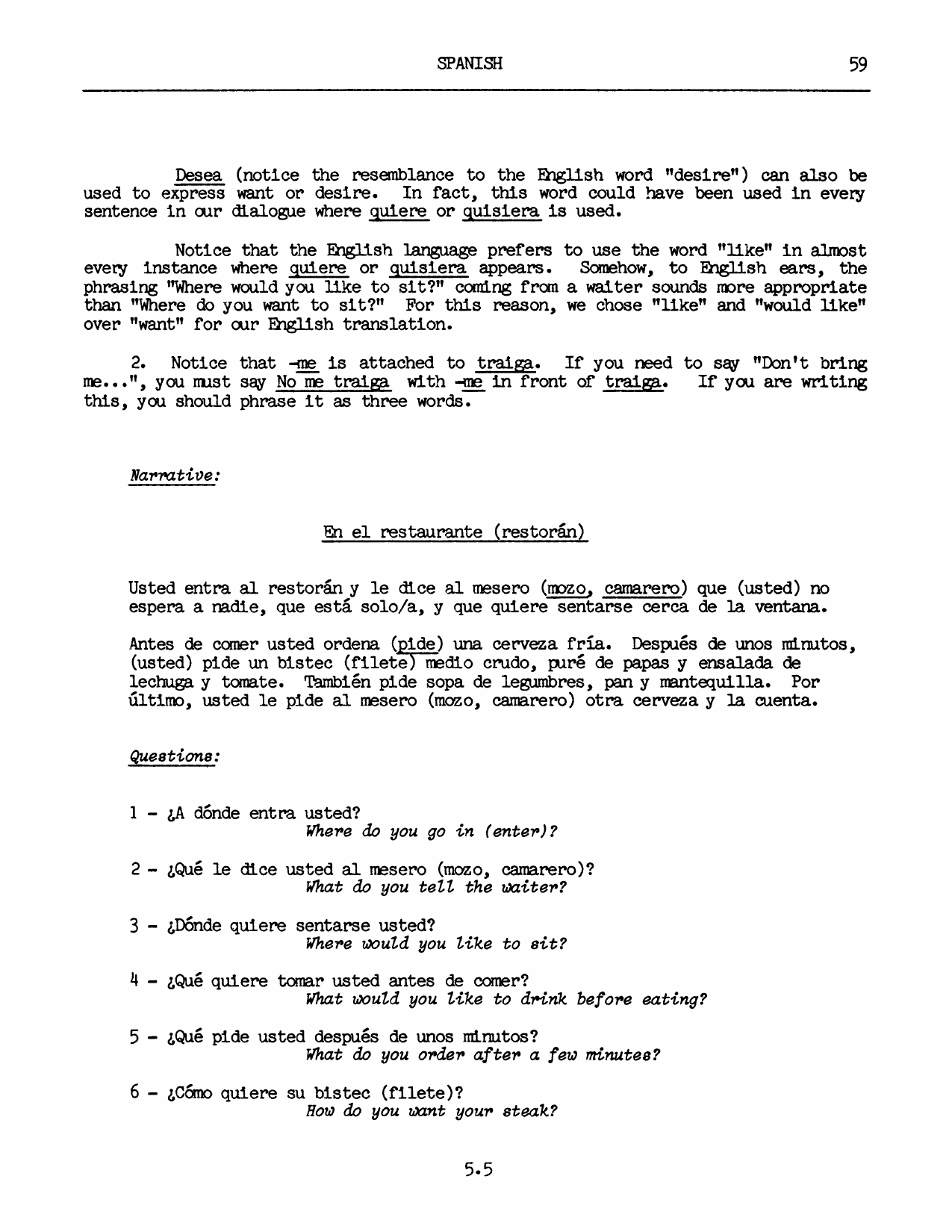
7 - ¿Qué quiere usted comer con el bistec (filete)?
What do you want to eat with your (the) steak?
8 = ¿Cuándo pide usted otra cerveza y la cuenta?
When do you ask for another beer and the check?

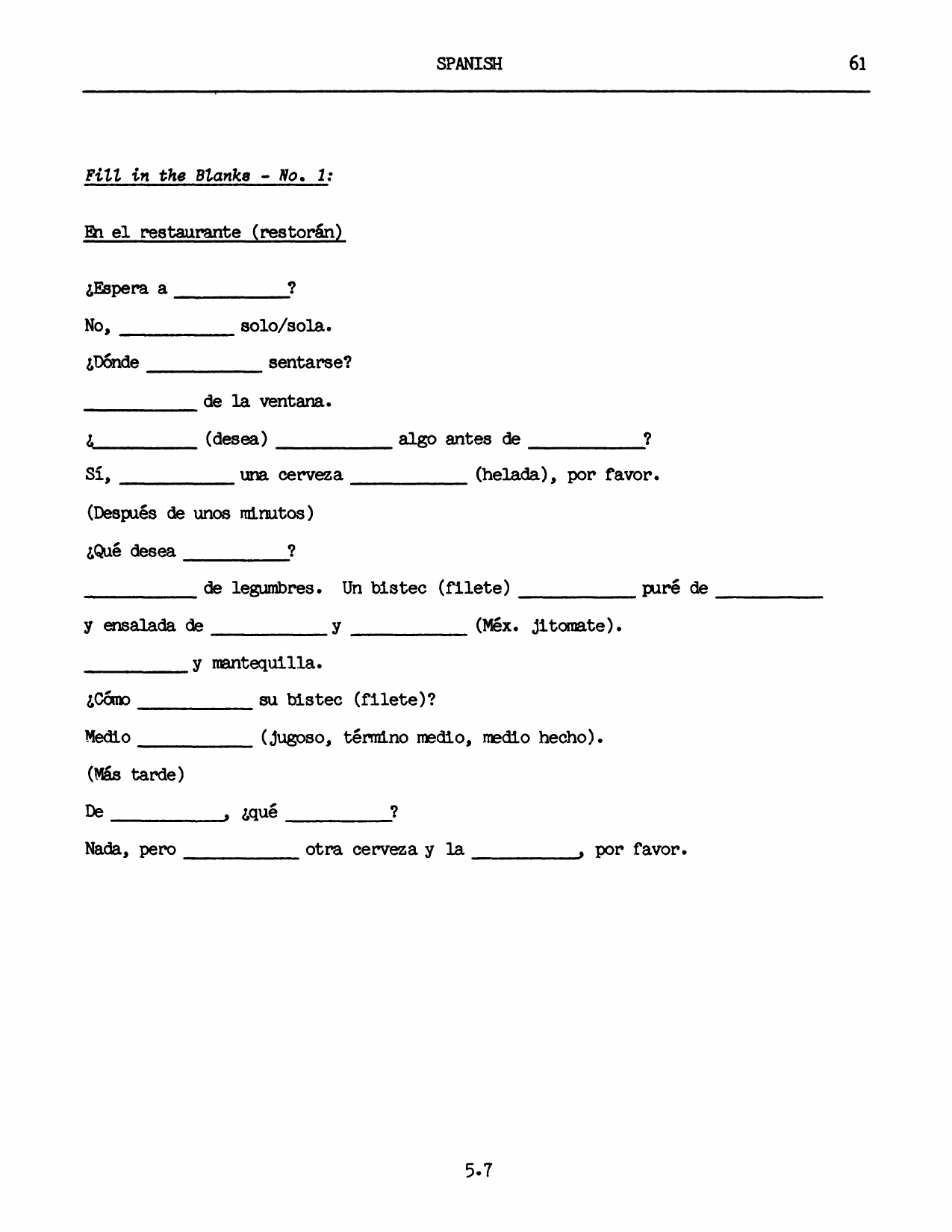
Fill in the Blanks - No. 1:
En el restaurante (restorán)
de la ventana.
(Después de unos minutos)
y mantequilla.
(Más tarde)
This page has a drawing, chart, or fill-in layout — original page
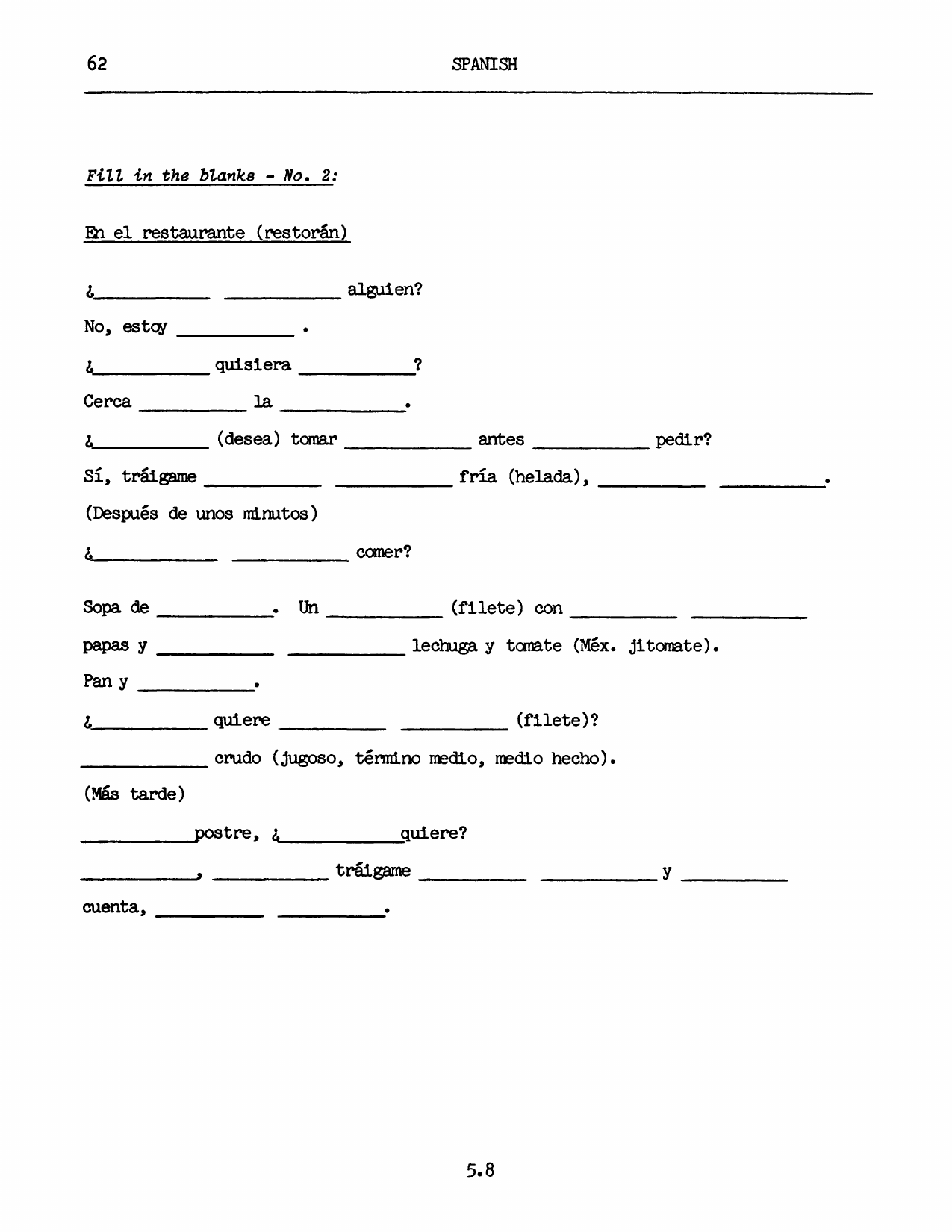
Fill in the blanks - No. 2:
En el restaurante (restorán)
AO alguien?
(Después de unos minutos)
crudo (jugoso, término medio, medio hecho).
(Más tarde)
This page has a drawing, chart, or fill-in layout — original page
IV. TAKING IT APART
Vocabulary:
finally
8ala
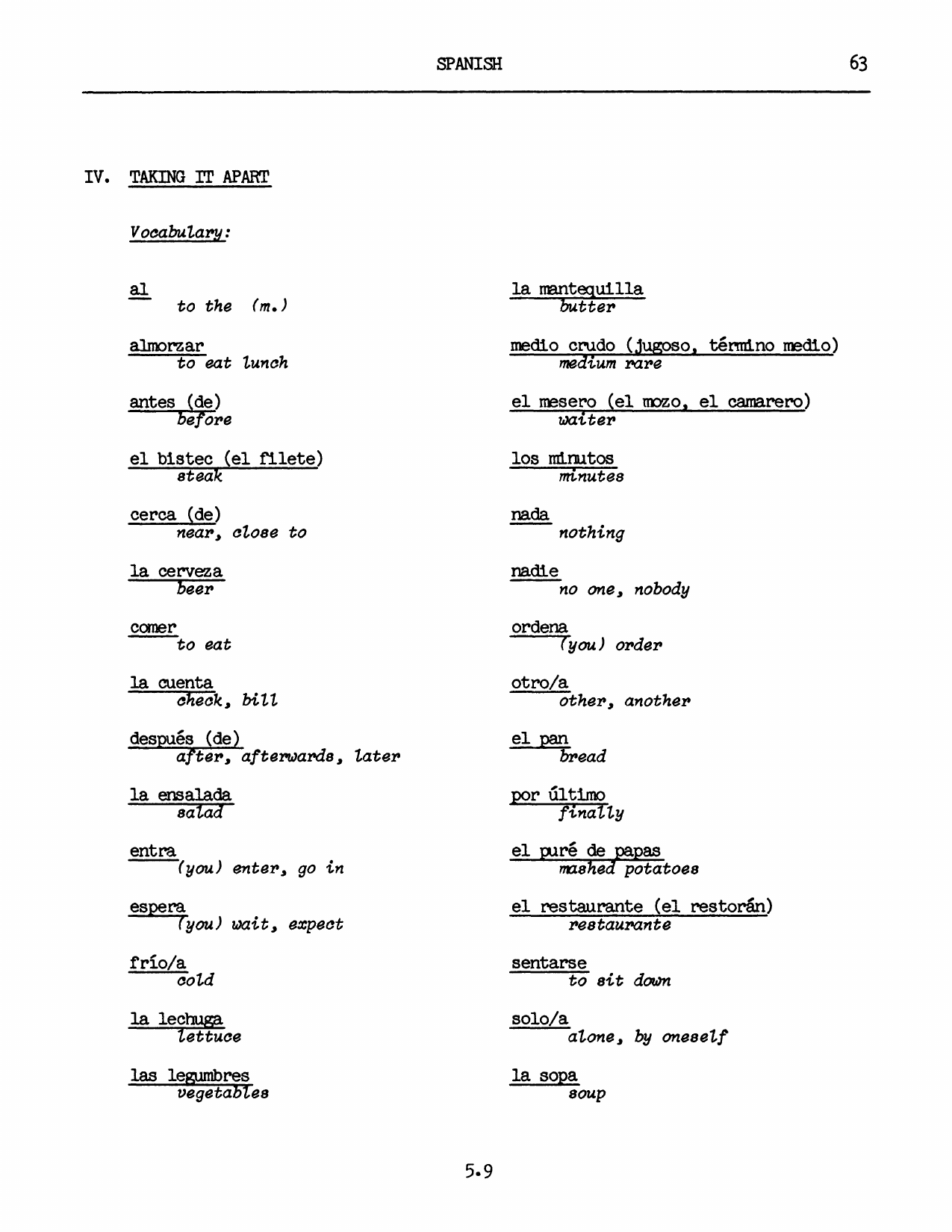
el tomate (Méx. el jitomate)
tomato
V. GETTING THE FEEL OF IT
Questions and Answers:
A. 1. ¿Usted habla español?
Sí, hablo español.
No, no hablo español.
2. ¿Ustedes hablan español?
Si, hablamos español.
No, no hablamos español.
3. ¿Ellos hablan español?
Si, ellos hablan español.
No, no hablan español.
4. ¿Ella habla español?
Sí, habla español.
No, no habla español.
5. ¿El habla español?
Sí, habla español.
No, no habla español.
B. 1. ¿Ud. necesita algo?
Si, necesito algo.
No, no necesito nada.
(José, María y Ud., él, ustedes)
C. 1. ¿Ud. siempre ordena un bistec (filete) con papas?
Sí, slempre ordenó un bistec (filete) con papas. No, no siempre ordenó un bistec (filete) con papas.
(Ella, nosotros, tú, ellos)
D. 1. ¿Tú esperas a José?
Sí, espero a José.
No, no espero a José.
(Nosotros, tú, ella, ustedes)
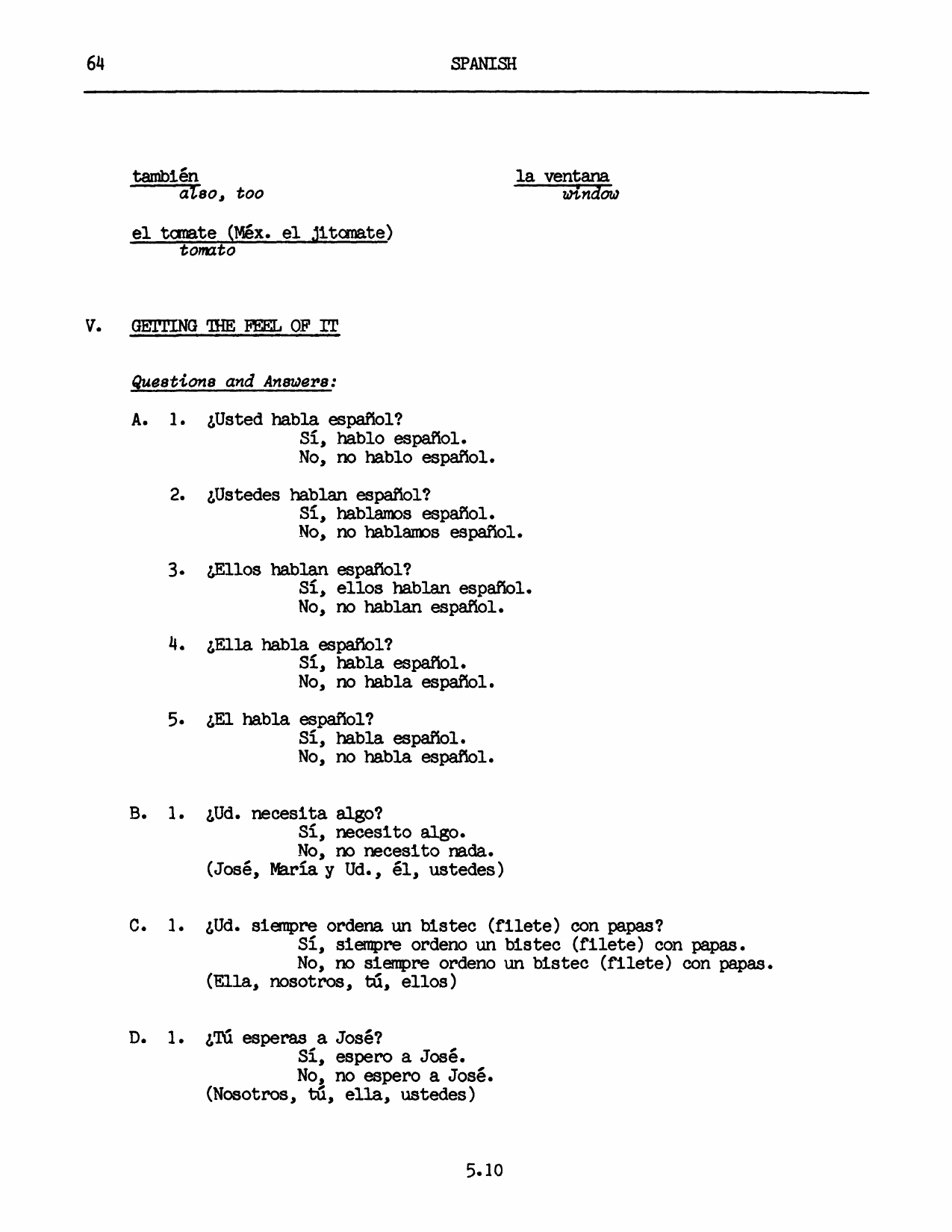
Pronouns
Questions and Answers: (continued)
A. 1. Do you speak Spanish?
Yes, I speak Spanish.
No, I don't speak Spanish.
2. Do you (pl.) speak Spanish?
Yes, we speak Spanish.
No, we don't speak Spanish.
3. Do they speak Spanish?
Yes, they speak Spanish.
No, they don't speak Spanish.
4. Does she speak Spanish?
Yes, she speaks Spanish.
No, she doesn't speak Spanish.
5. Does he speak Spanish?
Yes, he speaks Spanish.
No, he doean't speak Spanish.
B. 1. Do you need something?
Yes, I need something.
No, I don't need anything.
(José, Maria and you, he, you (pl.))
C. 1. Do you always order steak and potatoes?
Yes, I always order steak and potatoes.
No, I don't always order steak and potatoes.
(She, we, you (familiar), they)
D. 1. Are you waiting for (expecting) Jose?
Yes, I'm waiting for (expecting) Jose.
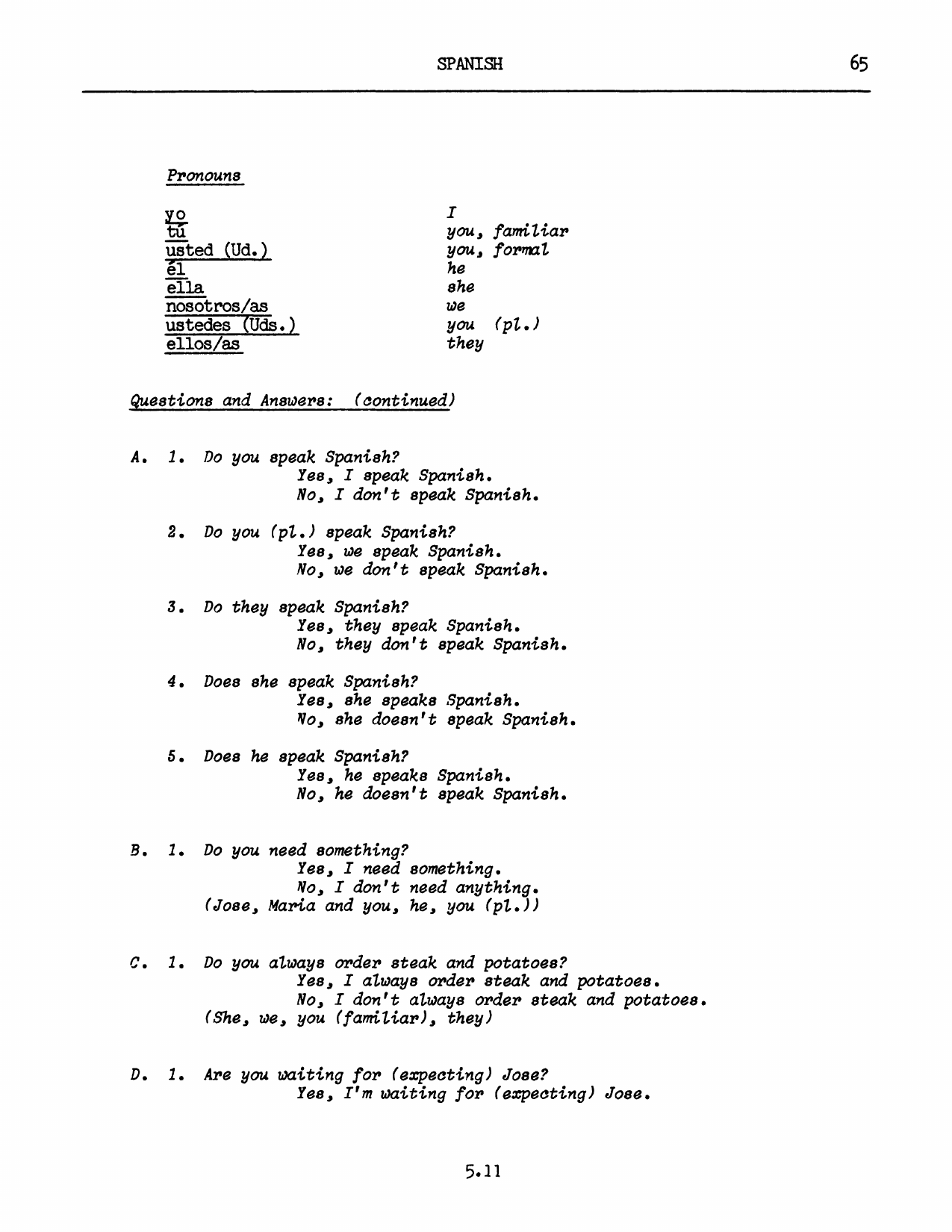
No, I am not waiting for (expecting) Jose.
(We, you (familiar), she, you (pl.))
VI. PUTTING IT TOGETHER
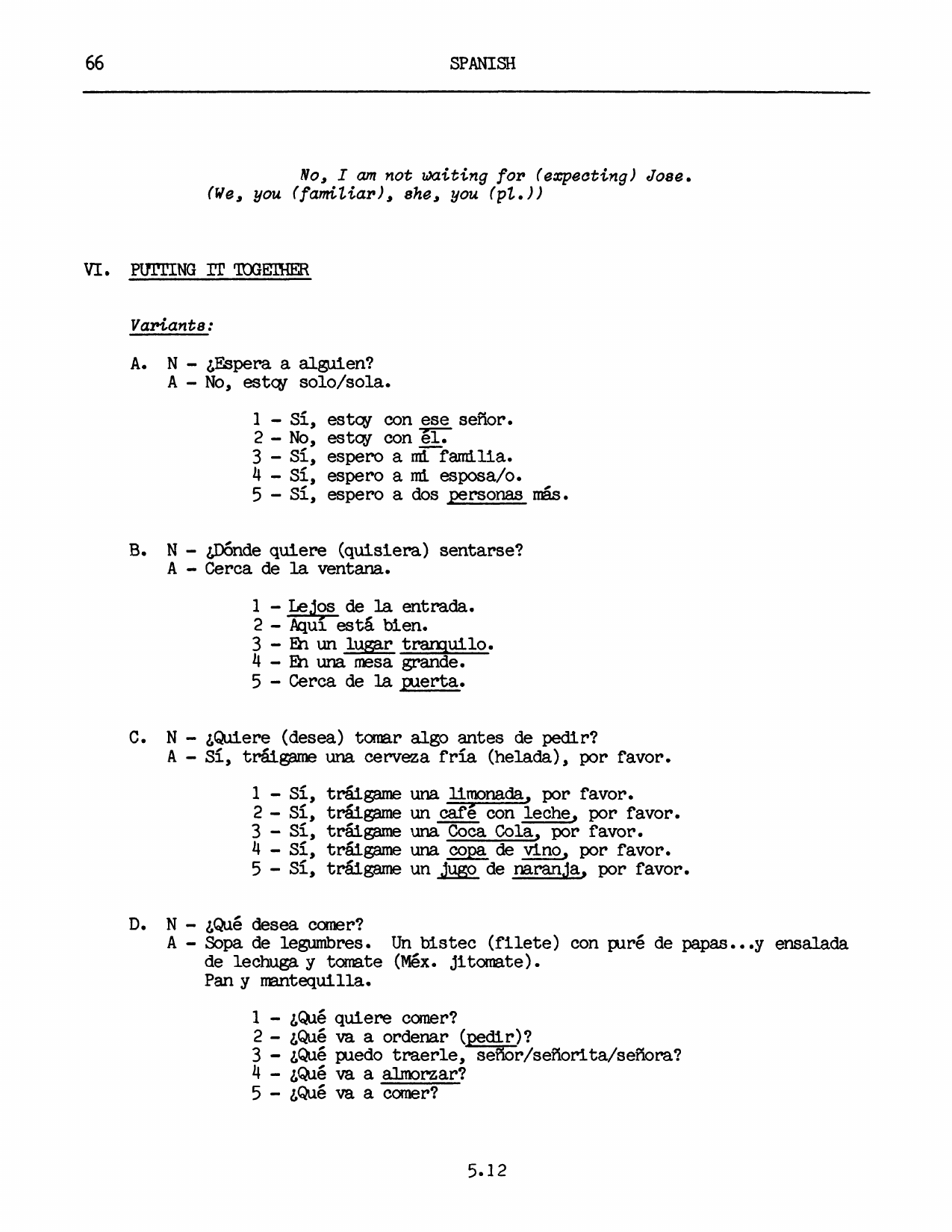
Variante:
A. N — ¿Espera a alguien?
A - No, estoy solo/sola.
1 - Si, estoy con ese señor.
2 —- No, estoy con él.
3 - Sí, espero a mí familia.
4 — Si, espero a mi esposa/o.
5 - Si, espero a dos personas más.
B. N = ¿Dónde quiere (quisiera) sentarse?
A - Cerca de la ventana.
1 - Lejos de la entrada.
2 - Aquí está bien.
3 - En un lugar tranquilo.
4 — En una mesa grande.
> - Cerca de la puerta.
C. N- ¿Quiere (desea) tomar algo antes de pedir?
A - Si, trálgame una cerveza fría (helada), por favor.
1 - Sí, trálgame una limonada, por favor.
2 - Sí, trálgame un café con leche, por favor.
3 - Si, tráigame una Coca Cola, por favor.
4 — Si, tráigame una copa de vino, por favor.
5 - Si, trálgame un jugo de naranja, por favor.
D. N- ¿Qué desea comer?
A - Sopa de legumbres. Un bistec (filete) con puré de papas...y ensalada
de lechuga y tomate (Méx. jitomate).
Pan y mantequilla.
1 = ¿Qué quiere comer?
3 - ¿Qué puedo traerle, sefior/sefiorita/sefiora?
4 — ¿Qué va a almorzar?
5 - ¿Qué va a comer?
E. N - De postre, ¿qué quiere?
A = Nada, pero trálgame otra cerveza y la cuenta, por favor.
1 - Un helado de vainilla.
2 - Un pastel de manzana.
3 - Nada, pero trálgame una taza de café y la cuenta, por favor. 4 - Un pastel de cereza con helado.
5 - Una torta (Méx. un pastel) de chocolate.
Variante: (continued)
A. WN - Are you waiting for someone?
A - No, I'm alone.
1 - Yes, I'm with that gentleman.
2 - No, I'm with him.
3 - Yes, I'm waiting for my famly.
4 - Yes, I'm waiting for my wife/husband.
5 - Yes, I'm waiting for two more people.
B. N - Where would you like to sit?
A - Near the windov.
1 - Away from the entrance.
2 - Here will be fine.
3 - In a quiet place.
4 - At a large table.
5 - Near the door.
C. N - Would you like to have something to drink before you order?
A - Yes, bring me a cold beer, please.
1 - Yee, bring me a lemonade, please.
2 - Yes, bring me coffee with milk please.
3 - Yes, bring me a Coca Cola, please.
4 - Yes, bring me a glass of wine, please.
5 - Yes, bring me an orange juice, please.
D. N - What would you like to eat?
A - Vegetable soup. Steak, mashed potatoes...and a lettuce and tomato
salad. Bread and butter.
1 - What do you want to eat?
2 - What are you going to order?
3 - What can I bring you, str/mise/ma'am?
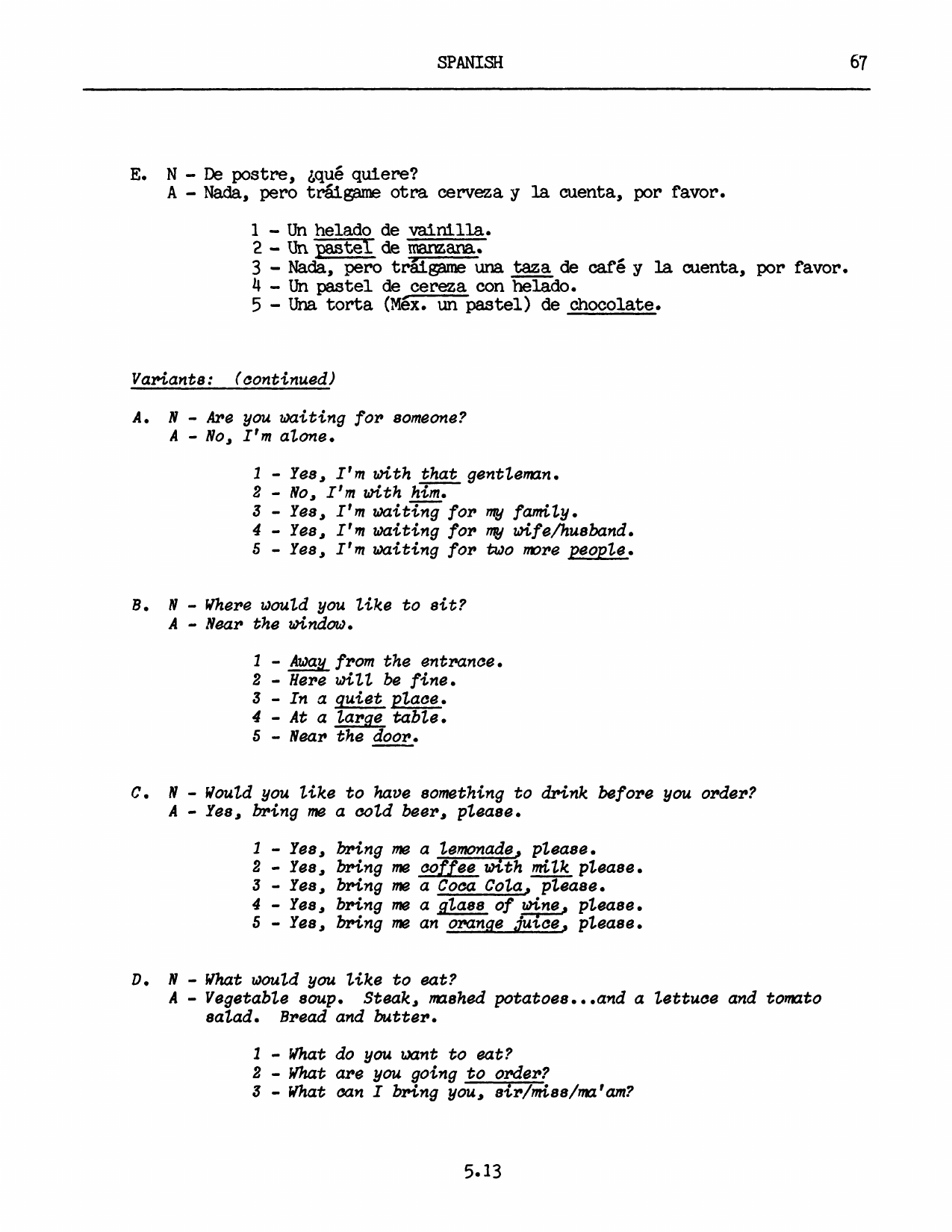
4 - What are you going to have for lunch?
5 - What are you going to eat?
E. N - For dessert...what would you like?
A - Nothing, but bring me another beer and the check, please.
1 - Vanilla ice cream.
2 - Apple pie.
3 - Nothing, but bring me a cup of coffee and the check, please. 4 - Cherry pie d la mode.
5 - Chocolate cake.
VII. MAKING IT WORK
VIII. USING IT