CYCLE 6
GETTING STARTED IN COUNTRY
Giving Instructions to the Baby-Sitter
PAUTA Nal
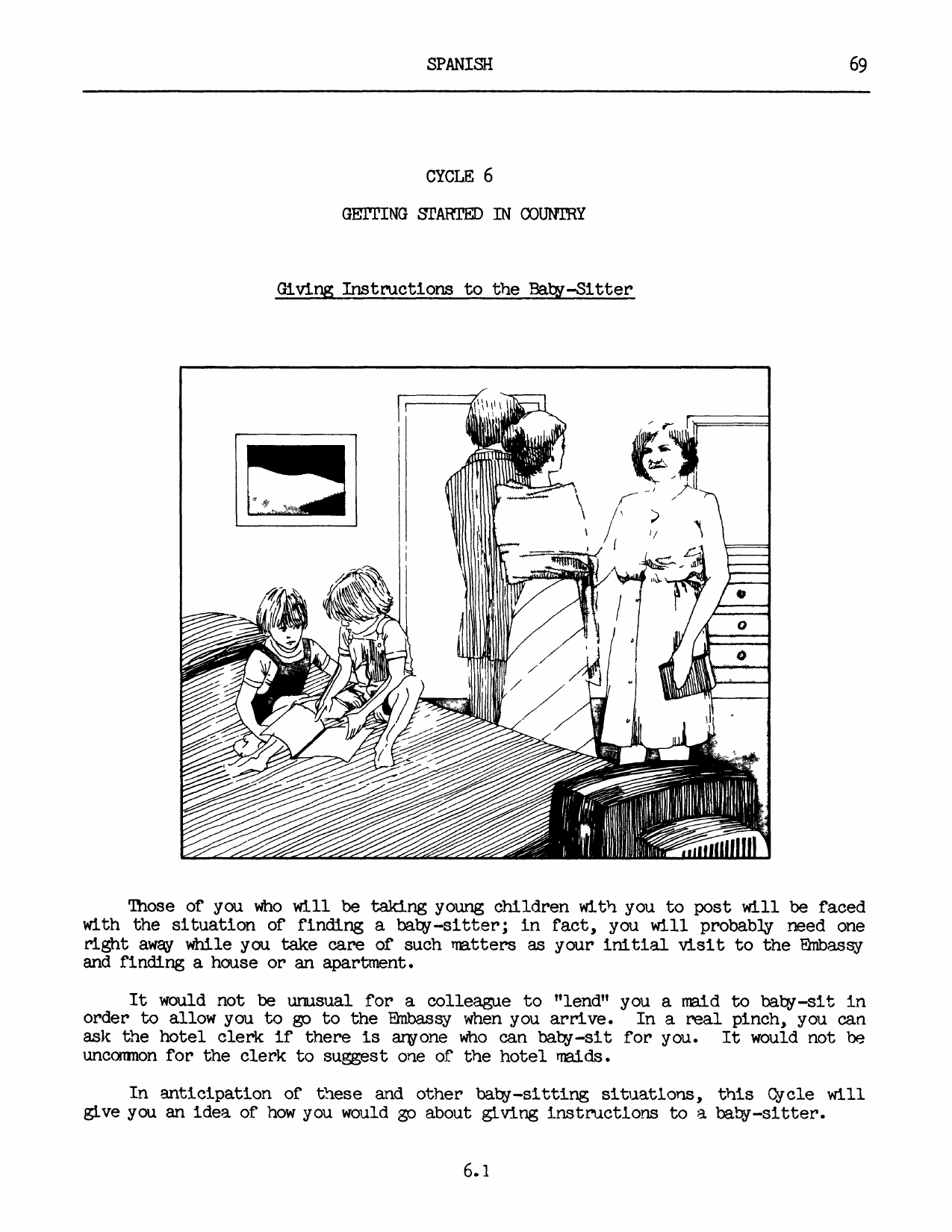
Those of you who will be taking young children with you to post will be faced
with the situation of finding a baby-sitter; in fact, you will probably need one right away while you take care of such matters as your initial visit to the Embassy and finding a house or an apartment.
It would not be unusual for a colleague to "lend" you a maid to baby-sit in
order to allow you to go to the Embassy when you arrive. In a real pinch, you can ask the hotel clerk if there is anyone who can baby-sit for you. It would not be uncommon for the clerk to suggest one of the hotel maids.
In anticipation of these and other baby-sitting situations, this Cycle will
give you an idea of how you would go about giving instructions to a baby-sitter.
This page has a drawing, chart, or fill-in layout — original page
I. SETTING THE SCENE
You have been invited to attend an Embassy function this evening. The baby-sitter has just arrived and you give last minute instructions before you leave for the Embassy.
II. HEARING IT
III. SEEKING IT
Dialogue:
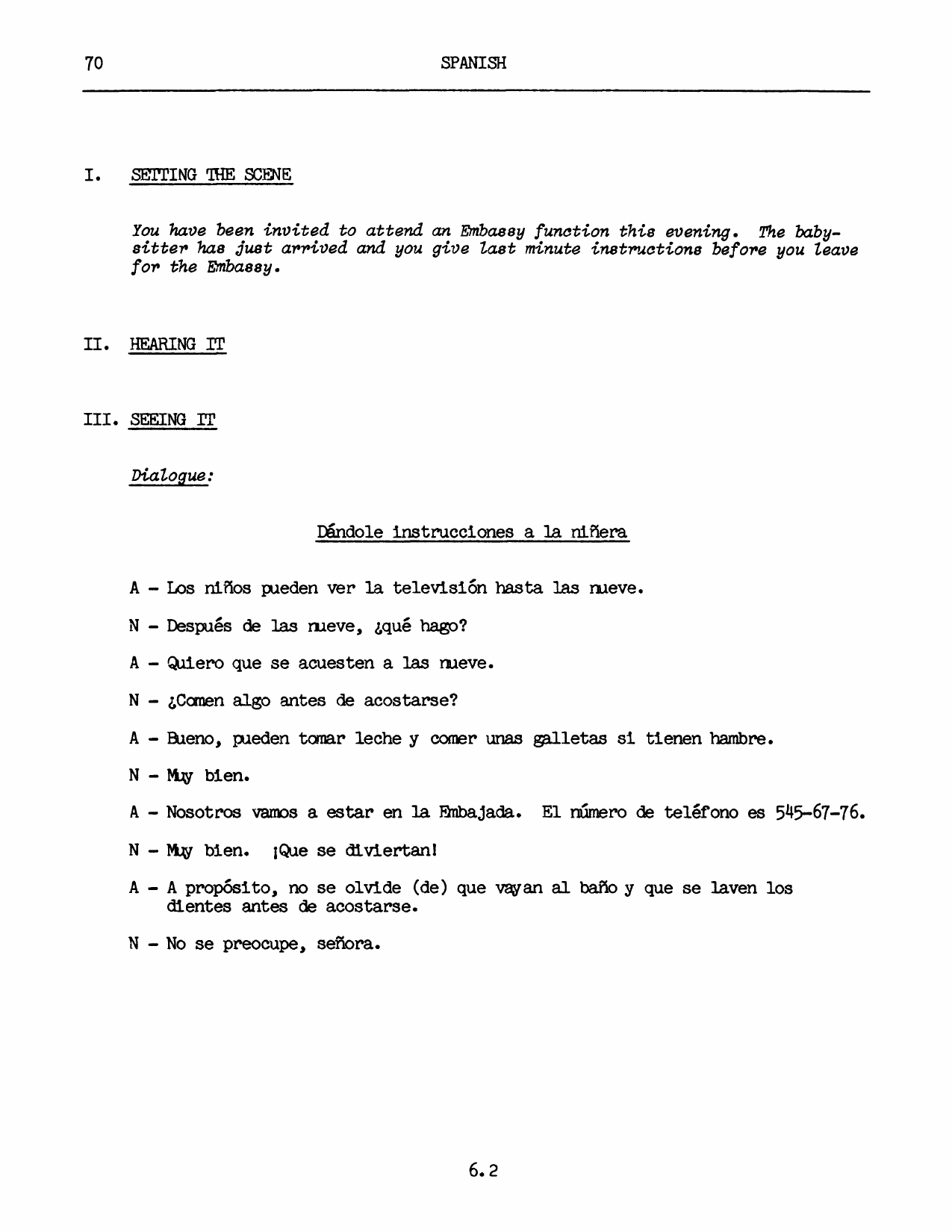
Dándole instrucciones a la niñera
A - Los niños pueden ver la televisión hasta las nueve.
N - Después de las meve, ¿qué hago?
A — Quiero que se acuesten a las mueve.
N = ¿Comen algo antes de acostarse?
A — Bueno, pueden tomar leche y comer unas galletas sil tienen hambre. N - My bien.
A ~ Nosotros vamos a estar en la Embajada. El número de teléfono es 545-67-76. N - My bien. ¡Que se diviertan!
A - A propósito, no se olvide (de) que vayan al baño y que se laven los
dientes antes de acostarse.
N — No se preocupe, señora.
Dialogue: (continued)
Giving instructions to the baby-sitter
(1) A - The children are allowed to watch television until 9:00.
N - What shall I do after 9:00?
A - I want them to go to bed at 9:00.
N - Do they eat anything before going to bed?
(2) A - Well, they may have some milk and cookies if they are hungry.
N - Very well.
A - We will be at the Embassy. The telephone number is 545-67-76. WN - Very well. Have a good time!
A - By the way, don't forget to have them go to the bathroom and brush
their teeth before going to bed.
N - Don't worry, ma'am.
Language Notes
1. Verb Forms
In addition to the dictionary form (1.e., the infinitive), each verb has
numerous forms. These forms project two basic meanings: (a) the tense (present, past, future, etc.) and (b) the person or persons performing the action.
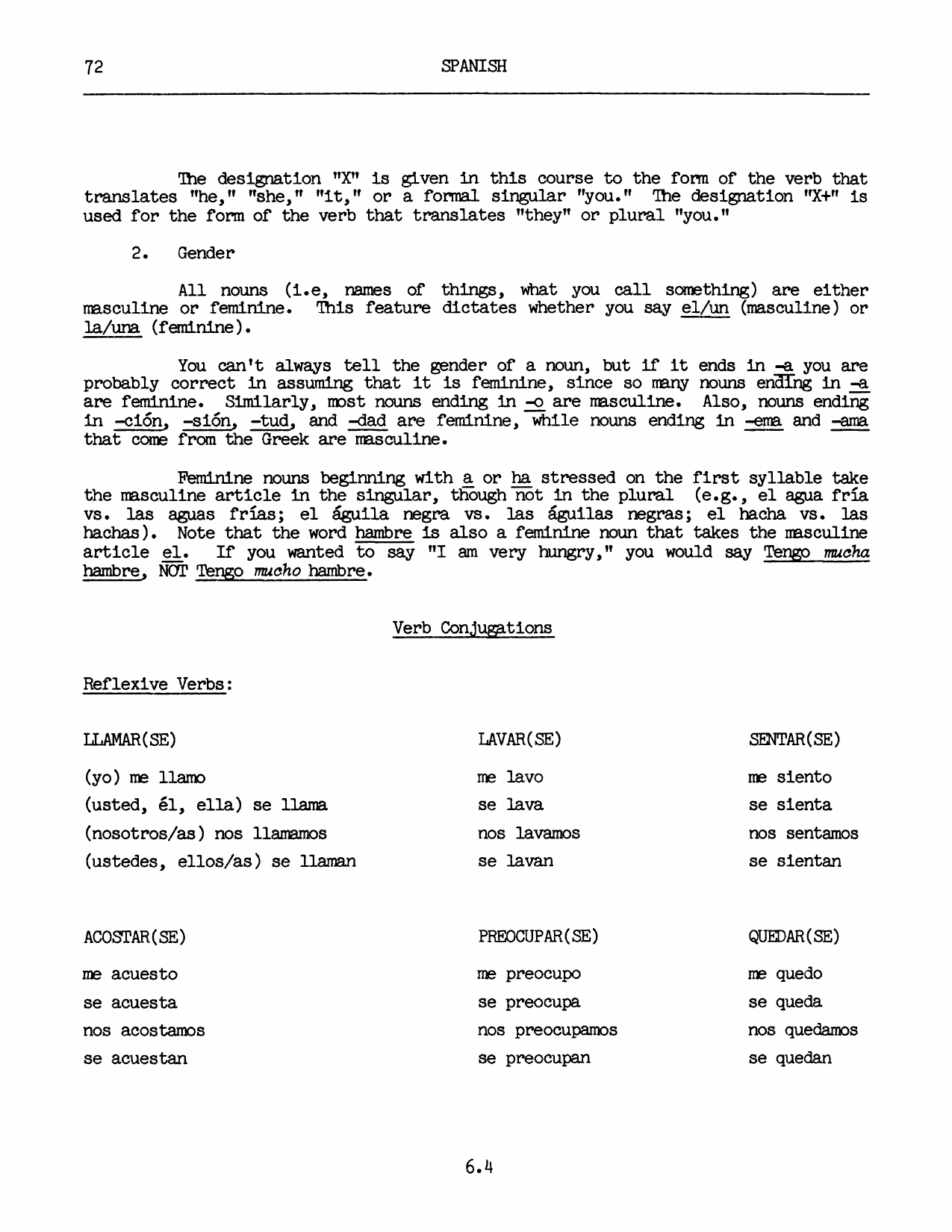
Here is a list of the four most common forms, in the Present Tense, of
some of the verbs that you have been using:
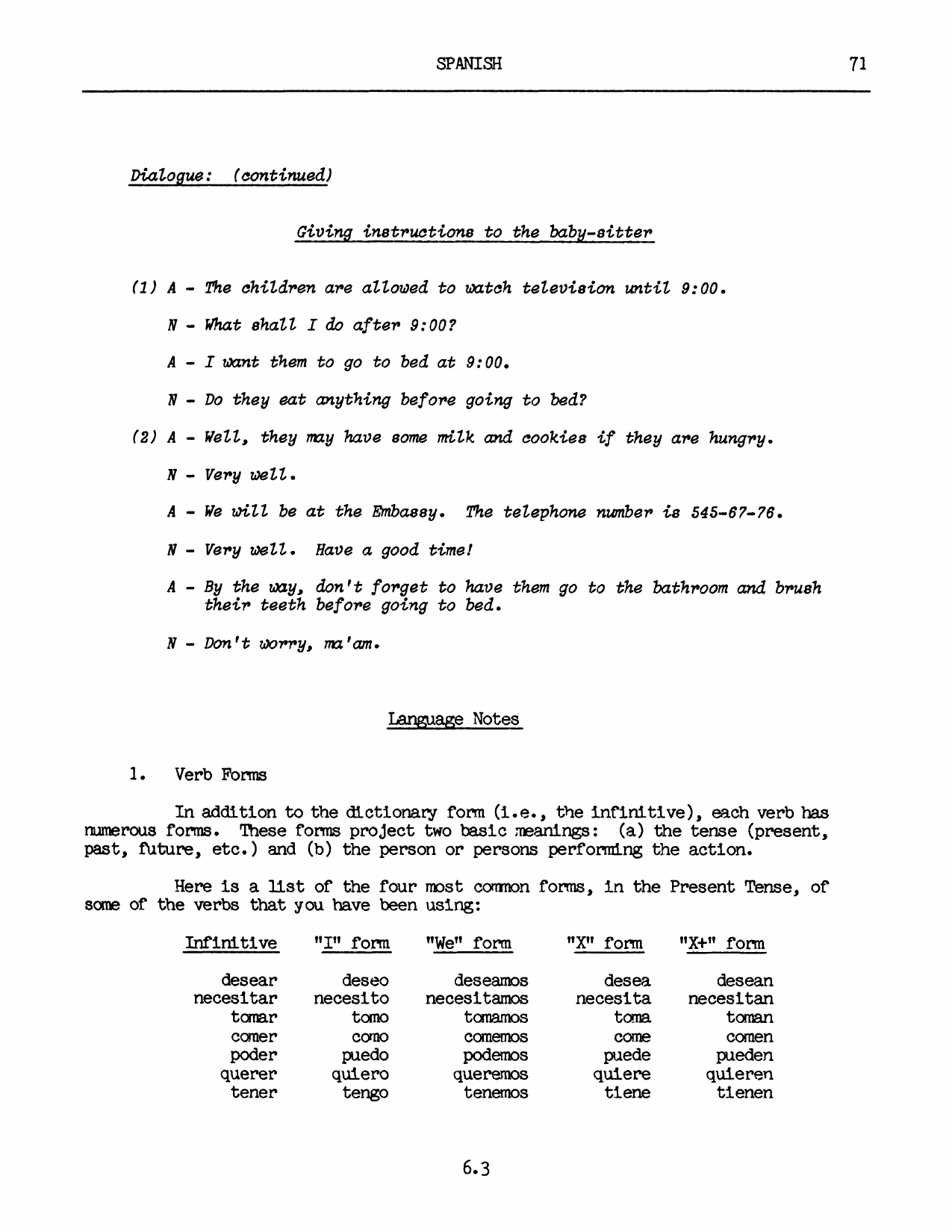
The designation "X" is given in this course to the form of the verb that
translates "he," "she," "it," or a formal singular "you." The designation "X+" is used for the form of the verb that translates "they" or plural "you."
Qe Gender
All nouns (i.e, names of things, what you call something) are either
masculine or feminine. This feature dictates whether you say el/un (masculine) or la/una (feminine).
You can't always tell the gender of a noun, but if it ends in -a you are
probably correct in assuming that it is feminine, since so many nouns ending in -a are feminine. Similarly, most nouns ending in -o are masculine. Also, nouns ending in -cién, -sión, -tud, and -dad are feminine, while nouns ending in -em and -ama that come from the Greek are masculine.
Feminine nouns beginning with a or ha stressed on the first syllable take
the masculine article in the singular, though not in the plural (e.g., el agua fría vs. las aguas frías; el águila negra vs. las águilas negras; el hacha vs. las hachas). Note that the word hambre is also a feminine noun that takes the masculine article el. If you wanted to say "I am very hungry," you would say Tengo mucha hambre, NOT Tengo mucho hambre.
Reflexive Verbs:
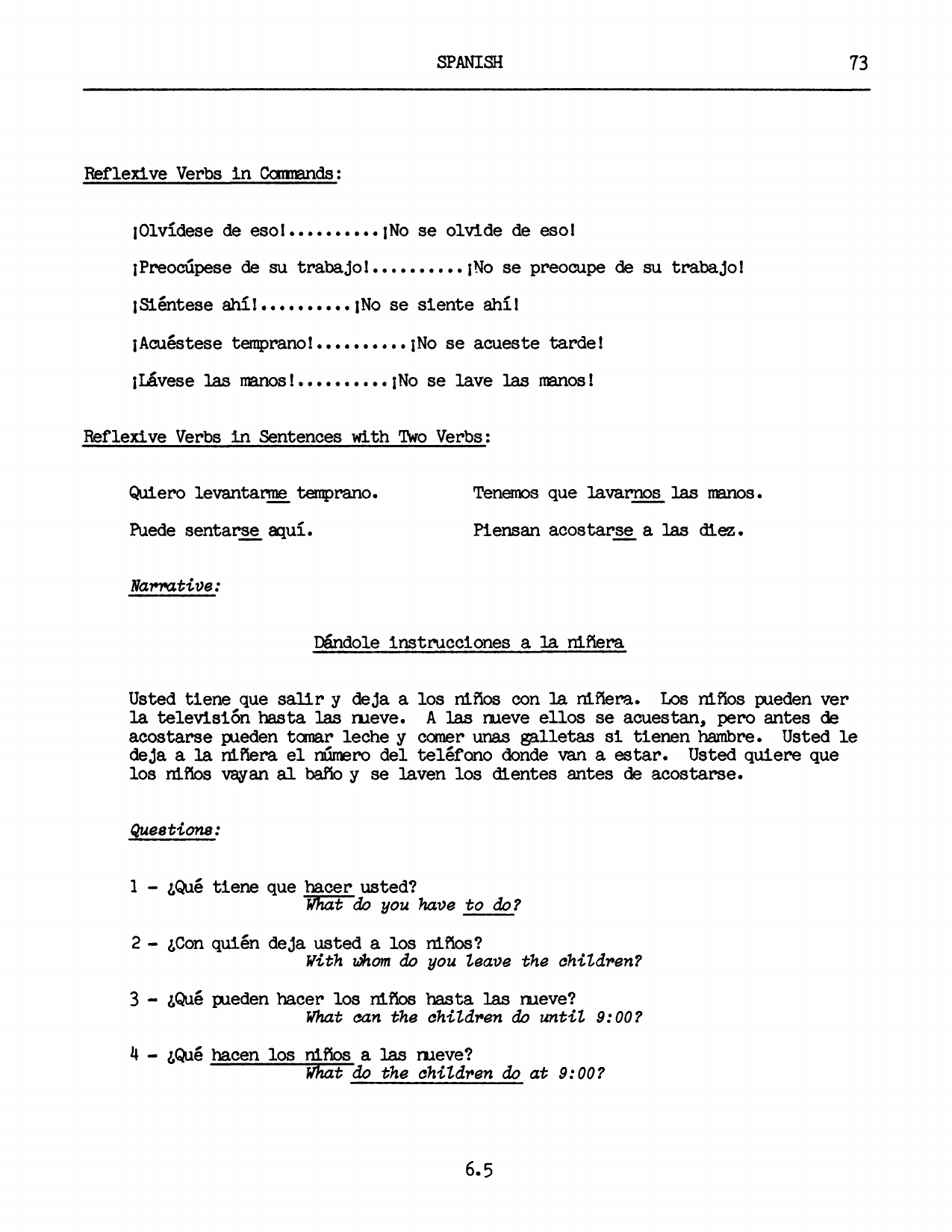
Reflexive Verbs in Commands:
¡Olvídese de esol..........¡No se olvide de eso!
¡Preocúpese de su trabajo!..........jNo se preocupe de su trabajo! ¡Sléntese ahi!l..........j{No se silente ahí!
¡Acuéstese temprano!l.......... ¡No se acueste tarde!
¡Lávese las manoS!l.......... ¡No se lave las manos!
Reflexive Verbs in Sentences with Two Verbs:
Narrative:
Dándole instrucciones a la niñera
Usted tiene que salir y deja a los niños con la niñera. Los niños pueden ver la televisión hasta las meve. A las meve ellos se acuestan, pero antes de acostarse pueden tomar leche y comer unas galletas si tienen hambre. Usted le deja a la nifiera el número del teléfono donde van a estar. Usted quiere que los niños vayan al baño y se laven los dientes antes de acostarse. Questions:
1 = ¿Qué tiene que hacer usted?
What do you have to do?
2 = ¿Con quién deja usted a los niños?
With whom do you leave the children?
3 - ¿Qué pueden hacer los niños hasta las mueve?
What can the children do until 9:00?
4 - ¿Qué hacen los niños a las nueve?
What do the children do at 9:00?
5 — ¿Qué pueden hacer los niños si tienen hambre?
What can the children do if they are hungry?
6 = ¿Qué quiere usted que los niños hagan antes de acostarse?
What do you want the children to do before going to bed?

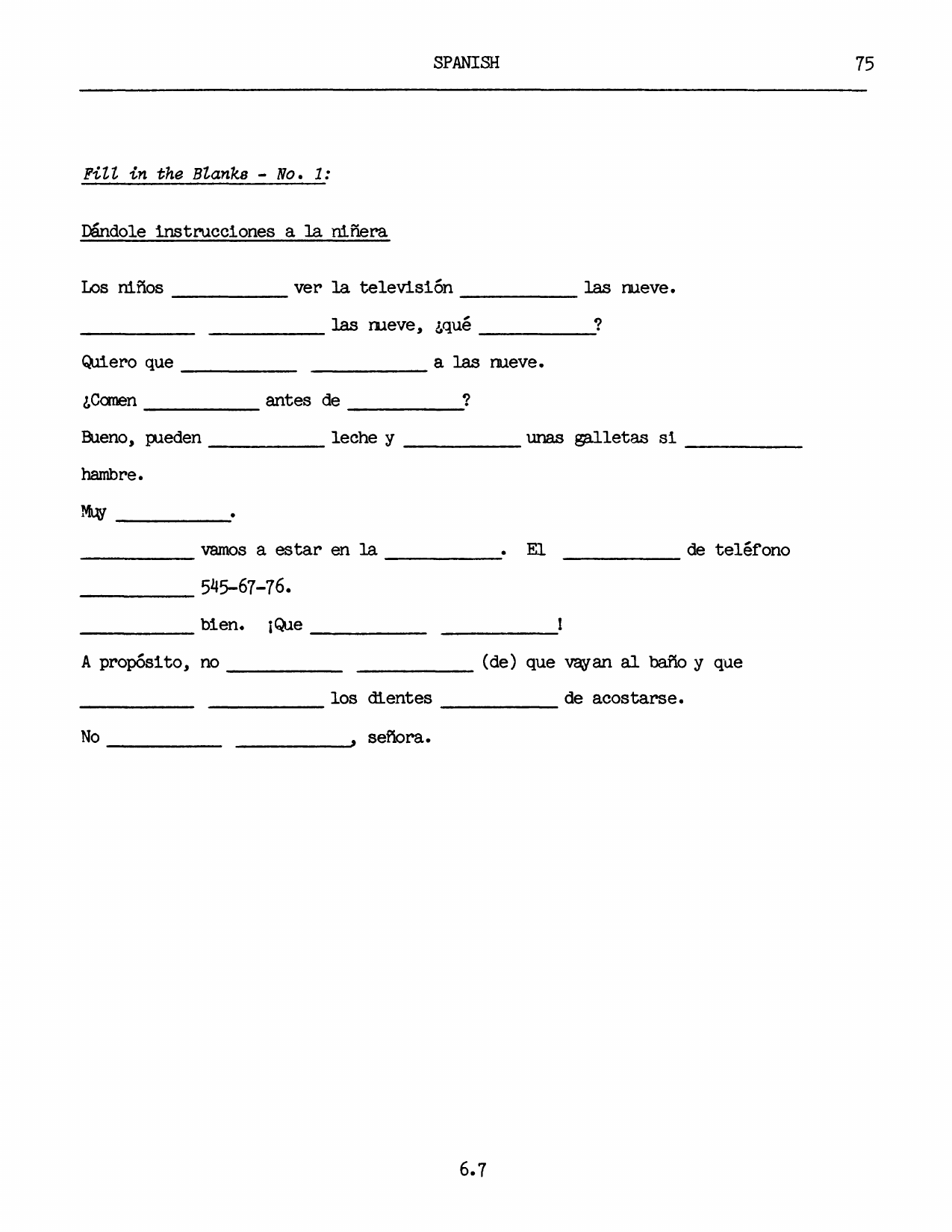
Fill tn the Blanks - No. 1:
Dándole instrucciones a la nifiera
hambre.
545-67-76.
No
, señora.
This page has a drawing, chart, or fill-in layout — original page
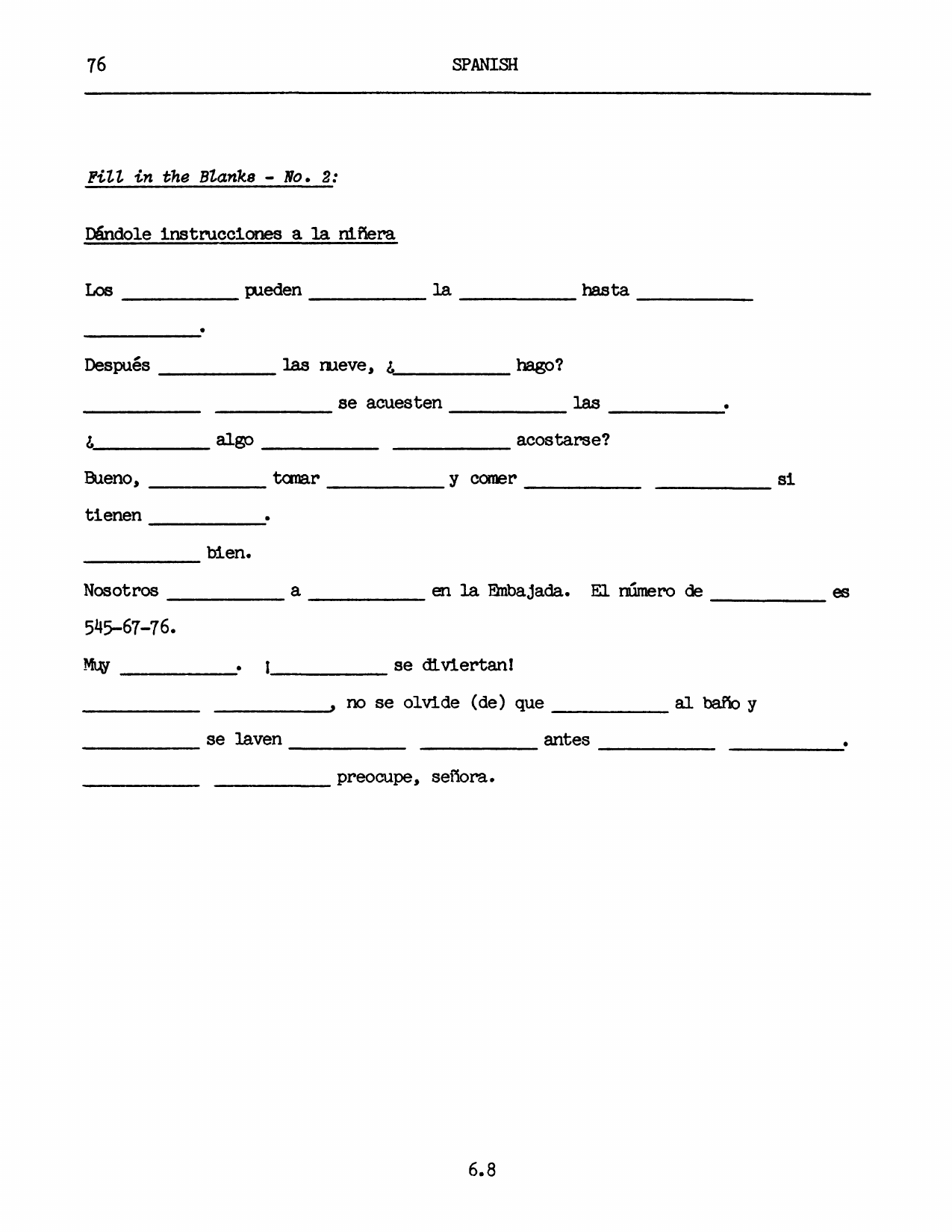
Fill in the Blanks - No. 2:
Dándole instrucciones a la nifiera
bien.
545-67-76.
preocupe, señora.
This page has a drawing, chart, or fill-in layout — original page
IV. TAKING IT APART
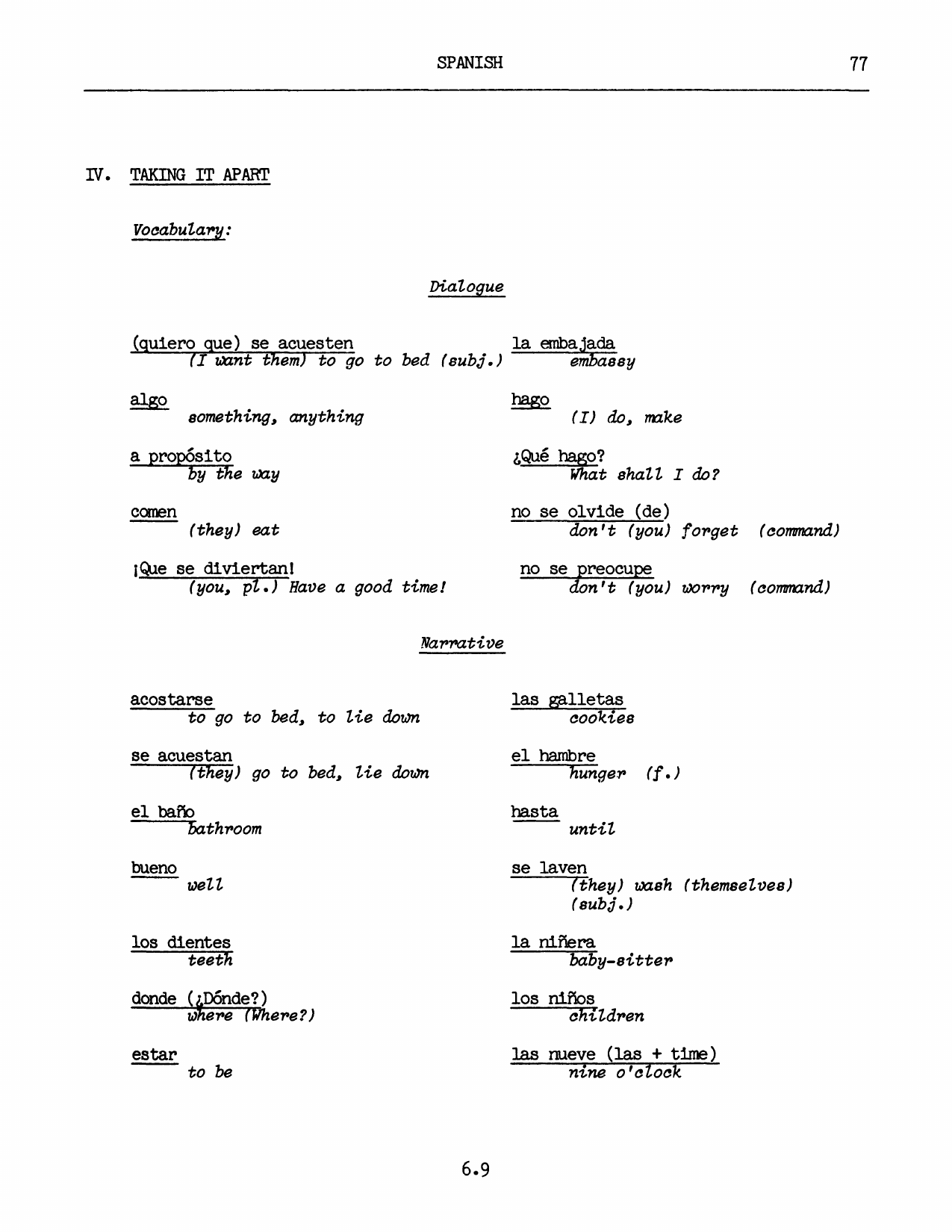
Vocabulary:
Dialogue
Narrative
(subj .)
GETTING THE FEEL OF IT
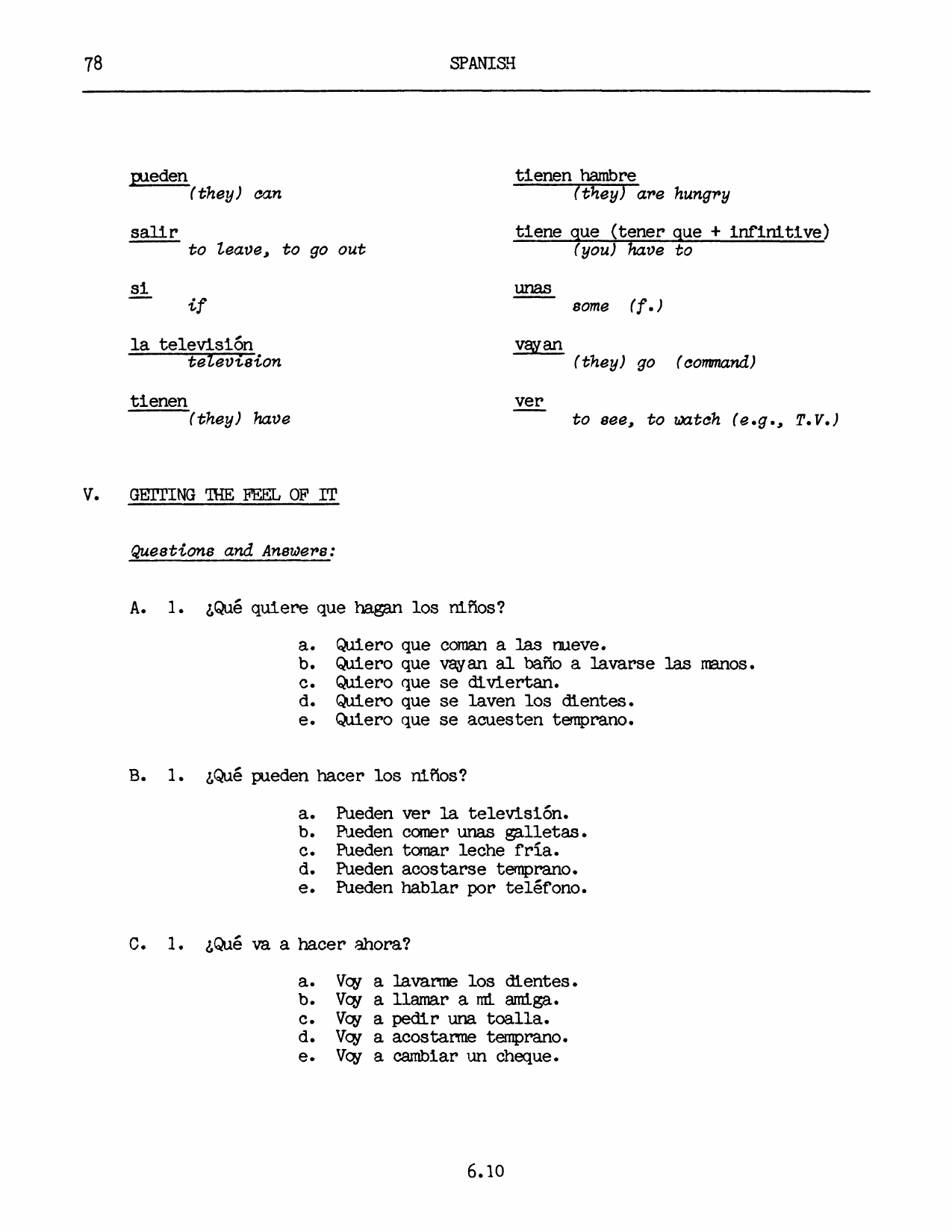
Questions and Anewers:
A. 1. ¿Qué quiere que hagan los niños?
a Quiero que coman a las meve.
b. Quiero que vayan al baño a lavarse las manos. C. Quiero que se diviertan.
d. Quiero que se laven los dientes.
e. Quiero que se acuesten temprano.
B. 1. ¿Qué pueden hacer los niños?
a. Pueden ver la televisión.
b. Pueden comer unas galletas.
ce Pueden tomar leche fría.
d. Pueden acostarse temprano.
e. Pueden hablar por teléfono.
C. 1. ¿Qué va a hacer ahora?
a. Voy a lavarme los dientes.
b. Voy a llamar a mi amiga.
C. Voy a pedir una toalla.
d. Voy a acostarme temprano.
e. Voy a cambiar un cheque.
D. 1. ¿Cuándo va a ir a Chile?
ae El próximo martes.
b. El lunes por la tarde.
Ce Mañana por la mañana.
d. El primero de marzo.
€. El quince de enero.
E. 1. ¿Cuándo se quedó en ese hotel?
ae La semana pasada.
b. Anteayer (antier).
Ce El invierno pasado.
d. El domingo pasado.
e. Ayer.
Questions and Answers: (continued)
A. 1. What do you want the children to do?
Ae I want them to eat at 9:00.
b. I want them to go to the bathroom to wash their hands. Ce I want them to have a good time.
d. I want them to brush their teeth.
le I want them to go to bed early.
B. 1. What can the children do?
a. They can watch television.
b. They can have some cookies.
C. They can have some cold mitk.
d. They can go to bed early.
le. They can talk on the phone.
C. 1. What are you going to do now?
Ae I am going to brush my teeth.
b. I am going to call my friend (f.)
Ce I am going to ask for a towel.
d. I am going to bed early.
e. I am going to cash a check.
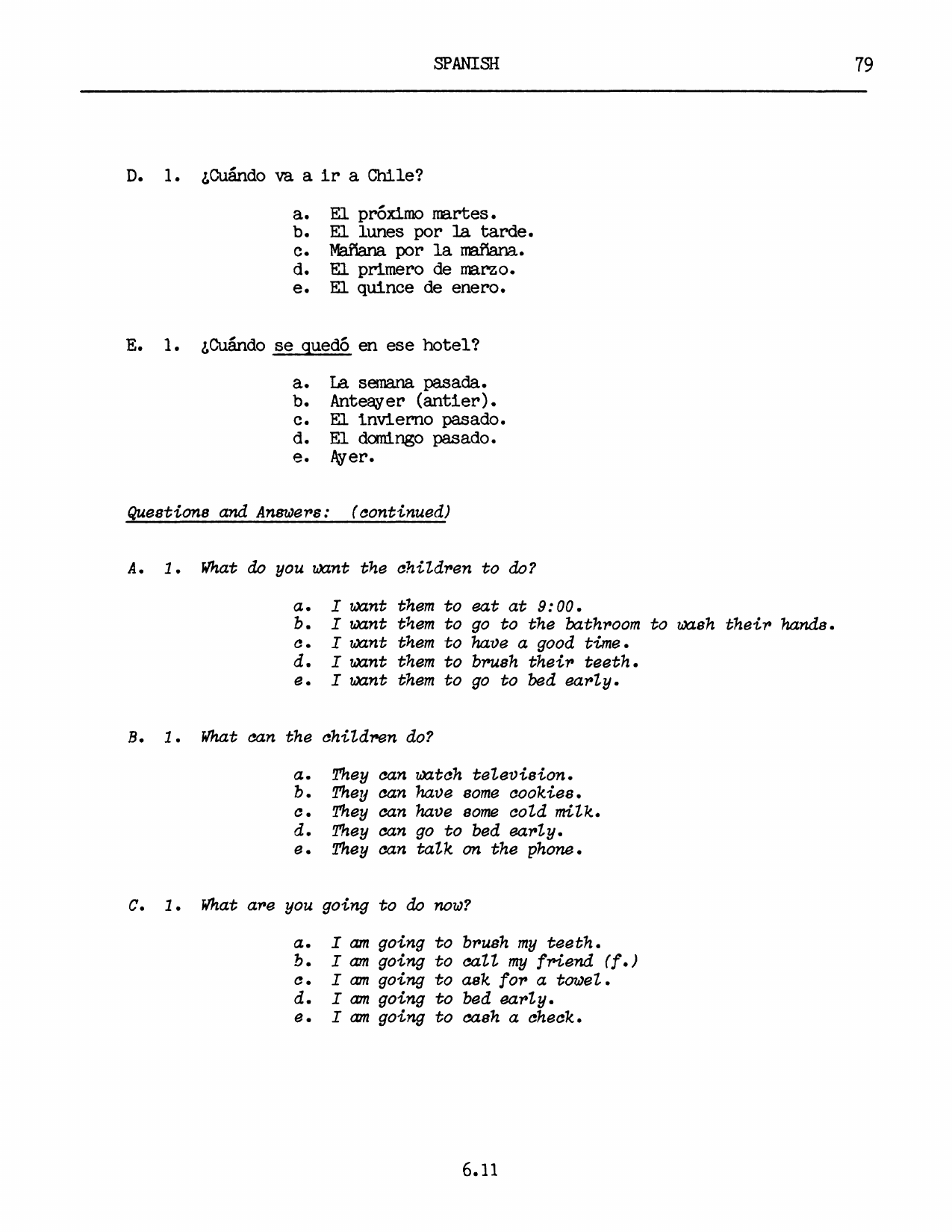
D. 1. When are you going to Chile?
a. Next Tuesday.
b. Monday afternoon.
ce. Tomorrow morning.
d. Om the first of March.
e. On the 15th of January.
E. 1. When did you stay at that hotel?
a. Last week.
b. The day before yesterday.
Cc. Last winter.
d. Last Sunday.
e. Yesterday.
VI. PUTTING IT TOGETHER
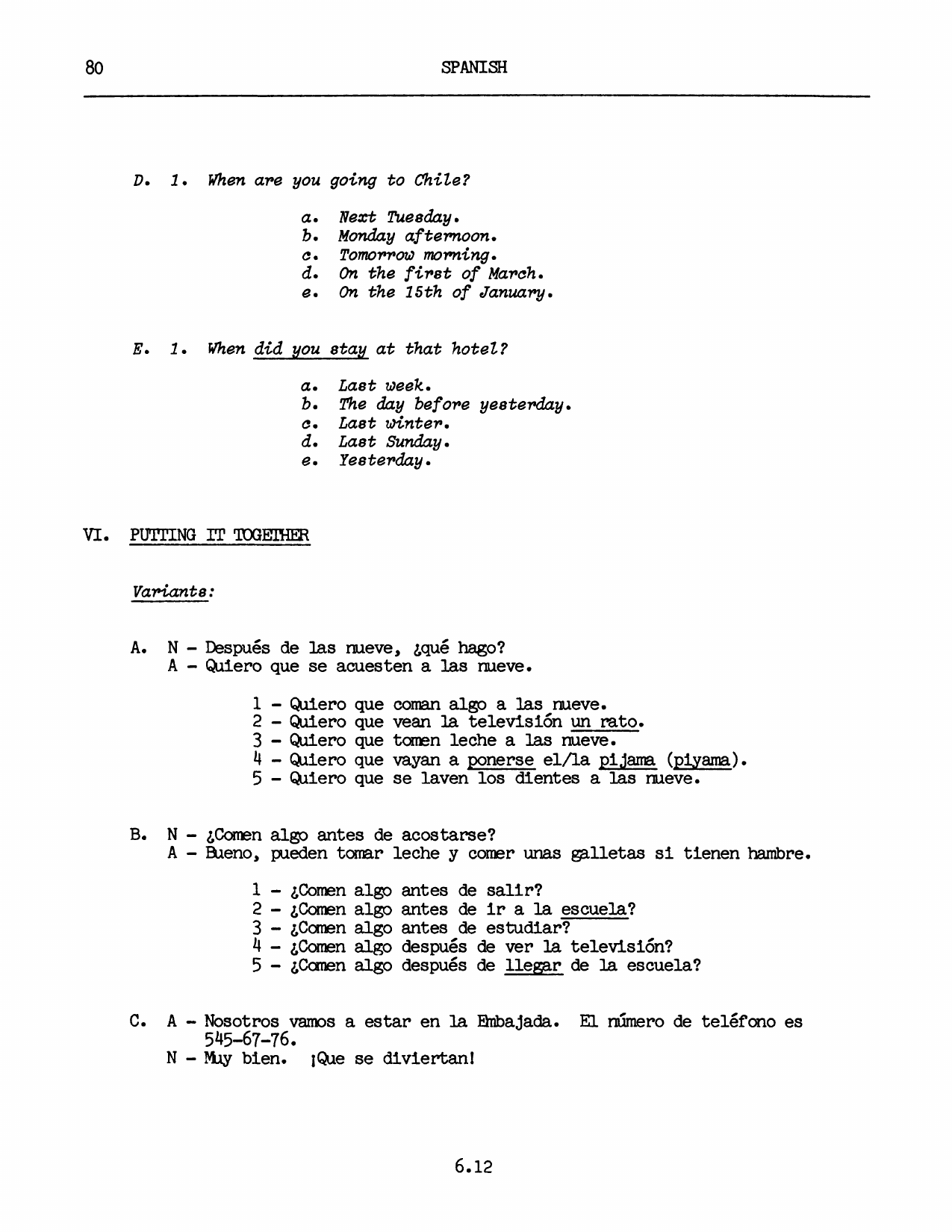
Variante:
A. N — Después de las nueve, ¿qué hago?
A — Quiero que se acuesten a las mueve.
1 = Quiero que coman algo a las mueve.
2 - Quiero que vean la televisión un rato.
3 - Quiero que tomen leche a las nueve.
4 — Quiero que vayan a ponerse el/la pijama (piyama). 5 - Quiero que se laven los dientes a las nueve.
B. N — ¿Comen algo antes de acostarse?
A — Bueno, pueden tomar leche y comer unas galletas si tienen hambre.
1 - ¿Comen algo antes de salir?
2 - ¿Comen algo antes de ir a la escuela?
3 - ¿Comen algo antes de estudiar?
4 — ¿Comen algo después de ver la televisión?
5 — ¿Comen algo después de llegar de la escuela?
C. A - Nosotros vamos a estar en la Embajada. El número de teléfono es
N — Muy bien. ¡Que se diviertan!
1 - Nosotros vamos a estar en el Hotel Caribe. El rúmero de
teléfono es 678-4367.
2 - Nosotros vamos a estar en la casa de la señorita Jones. El
número de teléfono es 584-63-25.
3 - Nosotros vamos a estar en el Teatro Nacional. El número
de teléfono es 347-89-58,
4 — Nosotros vamos a estar en la Oficina de Salud Pública. El
número de teléfono es 263-28-89.
5 - Nosotros vamos a estar en la Embajada Mexicana. El número
de teléfono es 765-03-47.
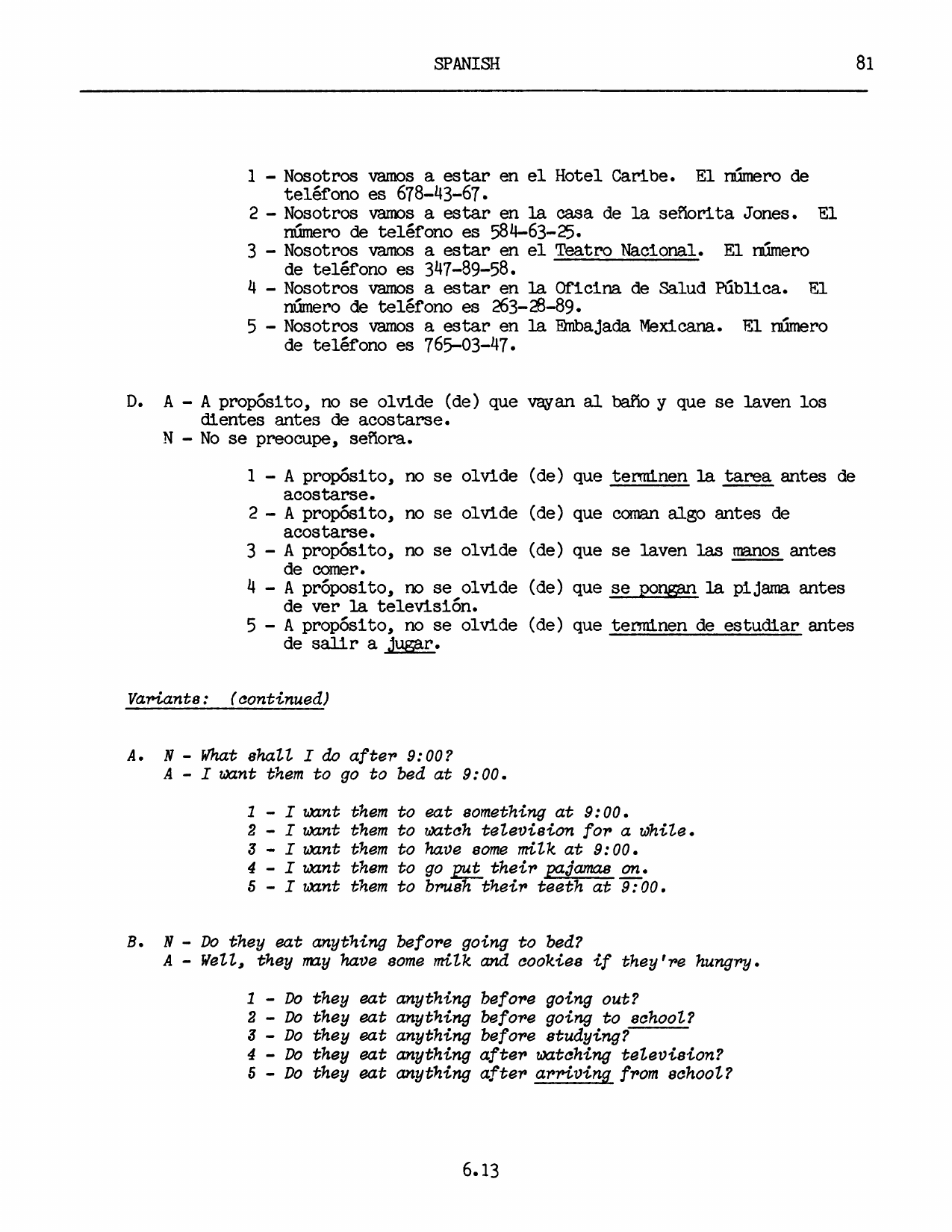
D. A - A propósito, no se olvide (de) que vayan al baño y que se laven los
dientes antes de acostarse.
N - No se preocupe, señora.
1 = A propósito, no se olvide (de) que terminen la tarea antes de
acostarse.
2 - A propósito, no se olvide (de) que coman algo antes de
acostarse.
3 - A propósito, no se olvide (de) que se laven las manos antes
4 — A próposito, no se olvide (de) que se pongan la pijama antes
de ver la televisión.
5 - A propósito, no se olvide (de) que terminen de estudiar antes
de salir a jugar.
Variante: (continued)
A. WN - What shall I do after 9:00?
A - I want them to go to bed at 9:00.
1 - I want them to eat something at 9:00.
2 - I want them to watch television for a while.
3 - I want them to have some milk at 9:00.
4 - I want them to go put their pajamas on.
5 - I want them to brush their teeth at 9:00.
B. N - Do they eat anything before going to bed?
A - Well, they may have some milk and cookies if they're hungry.
1 - Do they eat anything before going out?
2 - Do they eat anything before going to school?
3 - Do they eat anything before studying?
4 - Do they eat anything after watching television? 5 - Do they eat anything after arriving from school?
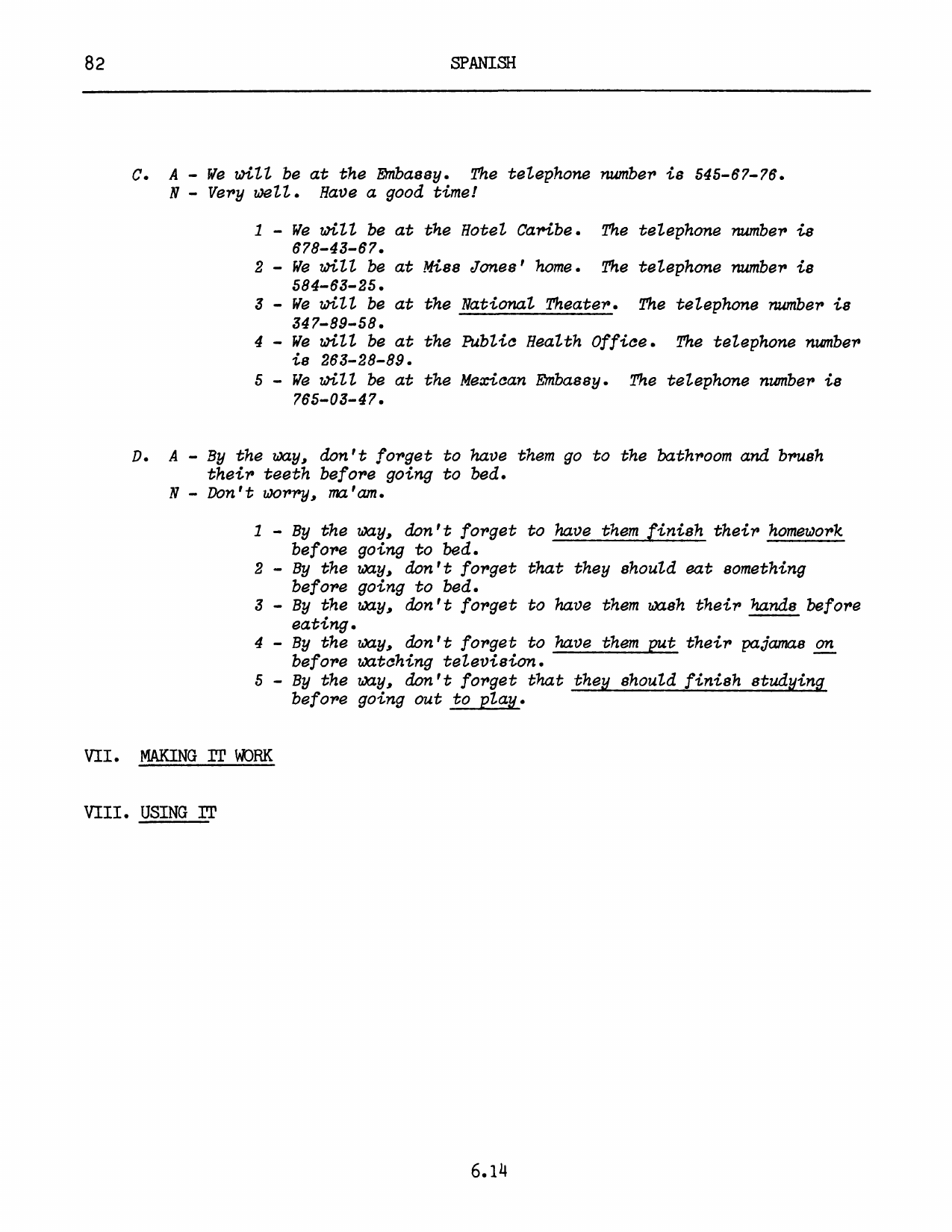
C. A - We will be at the Embassy. The telephone number is 545-6776.
N - Very well. Have a good time!
1 - We will be at the Hotel Caribe. The telephone number ie
678-43-67.
2 - We will be at Mise Jones' home. The telephone number ie
584-63-=25.
3 - We will be at the National Theater. The telephone number te
347-89-58.
4 - We will be at the Public Health Office. The telephone number
te 263-28-89.
5 - We will be at the Mexican Embassy. The telephone number is
765-03-47.
D. A - By the way, don't forget to have them go to the bathroom and brush
their teeth before going to bed.
N ~ Don't worry, ma'am.
1 - By the way, don't forget to have them finish their homework
before going to bed.
2 - By the way, don't forget that they should eat something
before going to bed.
3 - By the way, don't forget to have them wash their hands before
eating.
4 - By the way, don't forget to have them put their pajamas on
before watching television.
5 - By the way, don't forget that they should finish studying
before going out to play.
VII. MAKING IT WORK
VIII. USING IT