CYCLE 7
TALKING ON THE TELEPHONE
Managing a Conversation
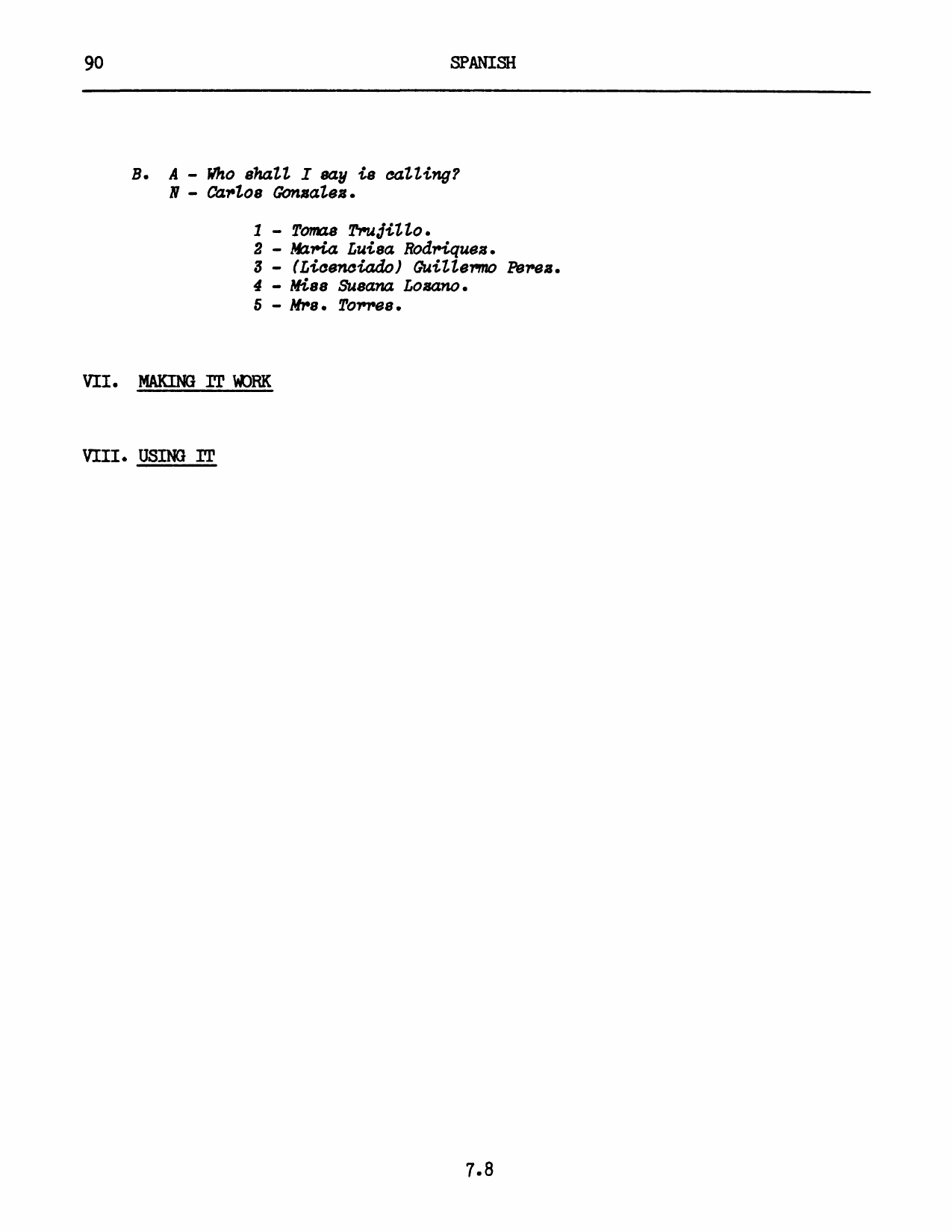
Perhaps one of the hardest things to do in a foreign country is talk on the
telephone. Those of you who have traveled overseas will recall that moment of sheer panic when you were telephoned by a non-English speaker. It is one thing to carry on a face-to-face conversation with a native speaker where the spoken language is complemented by facial expressions and other gestures, but it is an entirely dif-ferent matter in a telephone conversation, where one has to rely solely on the abil-ity to speak and comprehend a foreign tongue.
This (ycle will help you deal with precisely this kind of situation. You will
observe that there are certain variations on how to answer the telephone, depending on the country where you happen to be.
This page has a drawing, chart, or fill-in layout — original page
I. SETTING THE SCENE
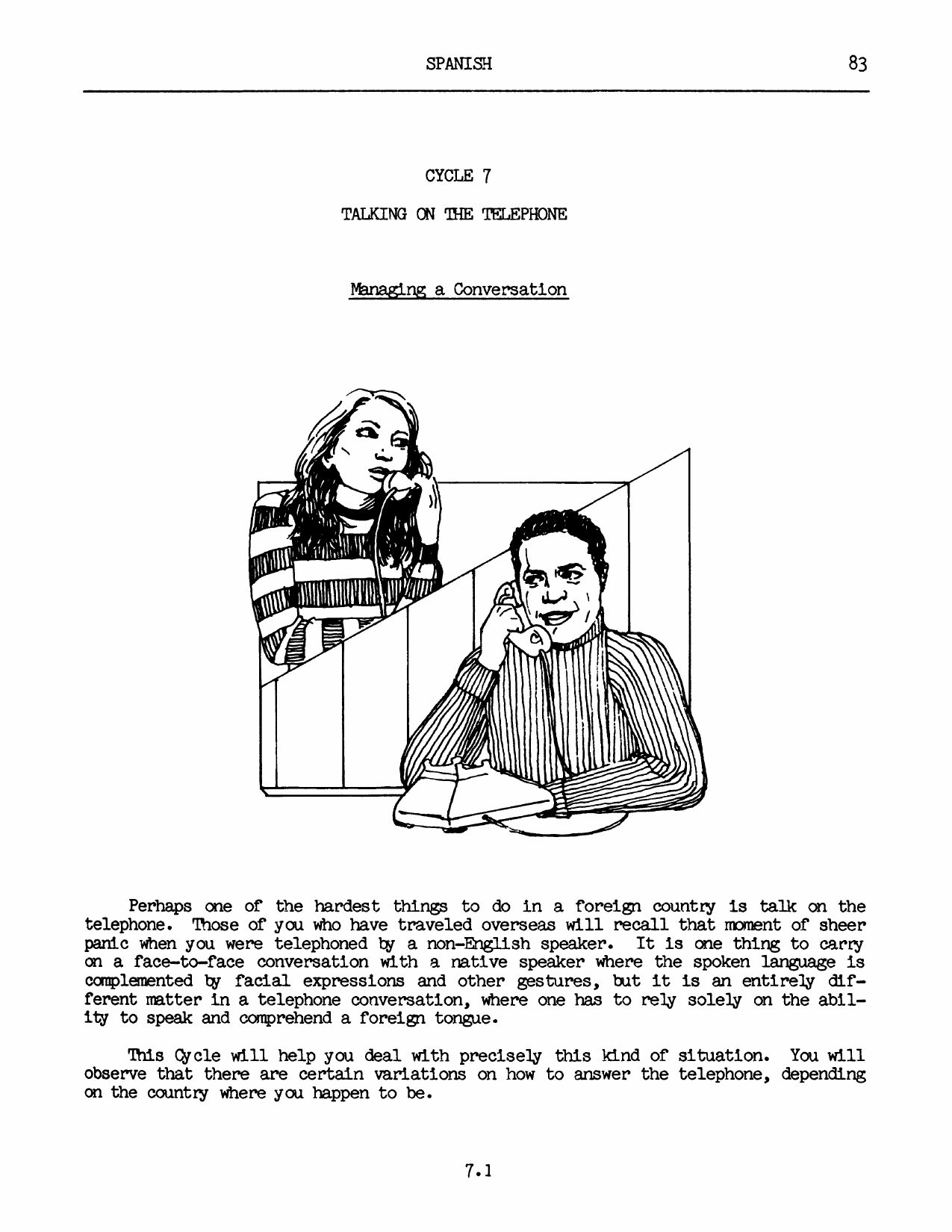
You receive a telephone call at tne Economic Section from someone who wishes to speak with Mr. Johnson. You ask the caller to give you his/her name and to please hold on.
II. HEARING IT
III. SEEING IT
Dialogue:
Recibiendo una llamada telefénica
A —- ¡Dígame! (Spain)
¡Diga! (Dominican Republic, Spain)
¡Hola! (Argentina, Paraguay, Uruguay)
jAl6! (Bolivia, Chile, Colombia, Costa Rica, Ecuador, El Salvador, Guatemala, Honduras, Perú, and Panama)
¡Bueno! (México)
jA ver! (Colombia)
¡A la orden! (Venezuela)
¡Sí! (Venezuela)
¡Holá! (Ecuador and Nicaragua)
¡Oigo! (Cuba)
Embajada Americana. Sección Económica. ¿En qué
puedo servirle? (A sus Órdenes, a la orden)
N - ¿Está el señor Johnson?
A —- ¿De parte de quién?
N — De parte de Carlos González.
A - Un momento, por favor.
N - Muchas gracias.
A — De nada.
Dialogue: (continued)
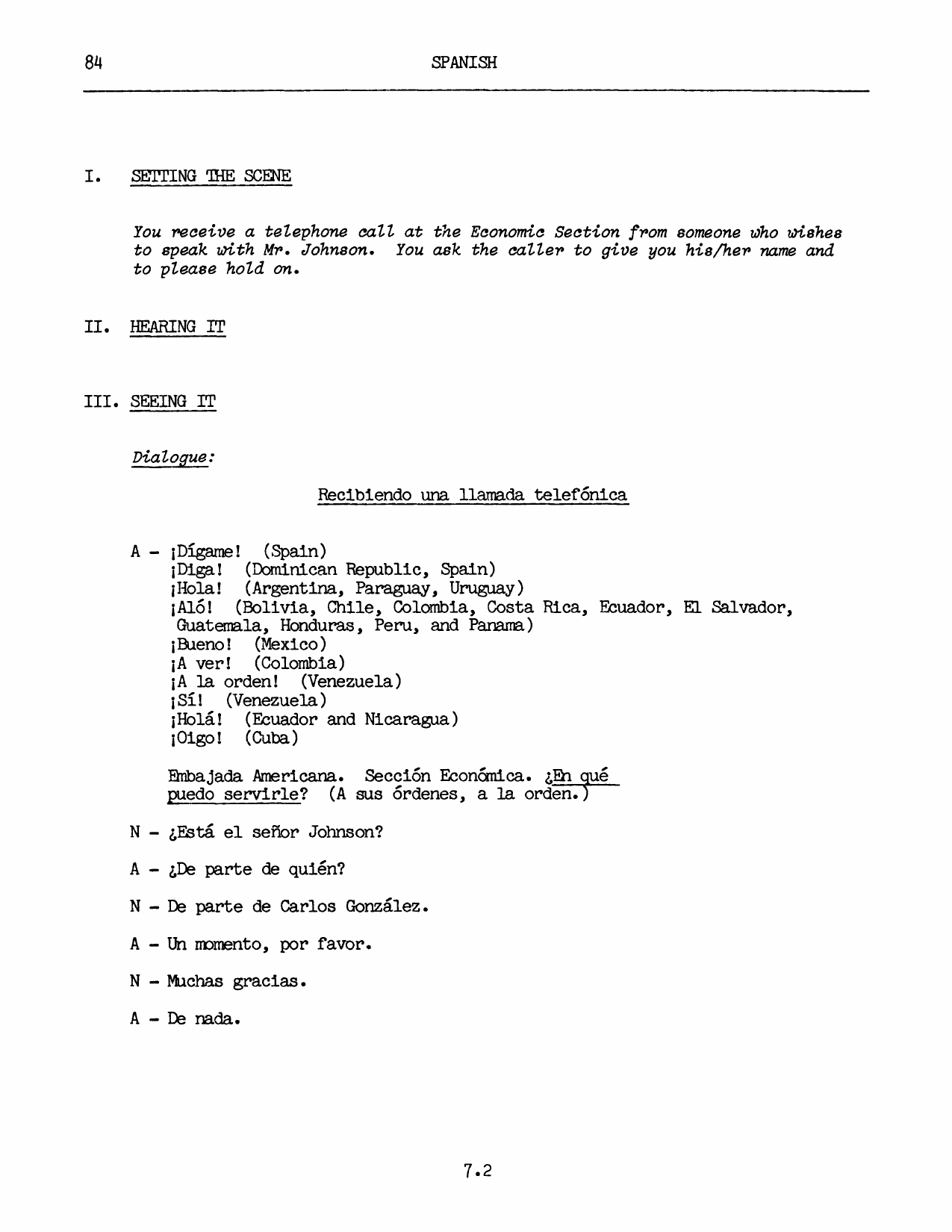
Receiving a telephone call
A - Hello!
American Embassy. Economic Section. May I help you?
N - Is Mr. Johnson in?
A - Who shall I say is calling?
N - Carlos González.
A - Just a moment, please.
N - Thank you very much.
A - You're welcome.
Narrative:
Recibiendo una llamada telefónica
Alguien llama a la Sección Económica y dice que quiere hablar con el señor Johnson. El señor Johnson sí está en la oficina. Usted contesta el teléfono y quiere saber el nombre de la persona que llama al señor Johnson y le pre-gunta que ¿de parte de quién?
Questions:
1 - En esta conversación, ¿quién llama a la Sección Económica?
In this conversation, who calls the Economic Section?
2 - ¿Con quién quiere hablar la persona que llama?
With whom does the caller wish to speak?
3 = ¿Está el señor Johnson?
Ie Mr. Johnson in?
4 — ¿Quién contesta el teléfono y qué quiere saber?
Who answers the phone and what does he/she want to know?
5 - Si usted quiere saber cómo se llama la persona que llama al señor Johnson,
¿qué le pregunta?
If you want to know the name of the person who te calling Mr. Johnson, what do you ask?
6 - Sí una persona le dice a usted, "muchas gracias," ¿qué le contesta usted?
If a person saye to you, "muchas gracias," what do you answer?
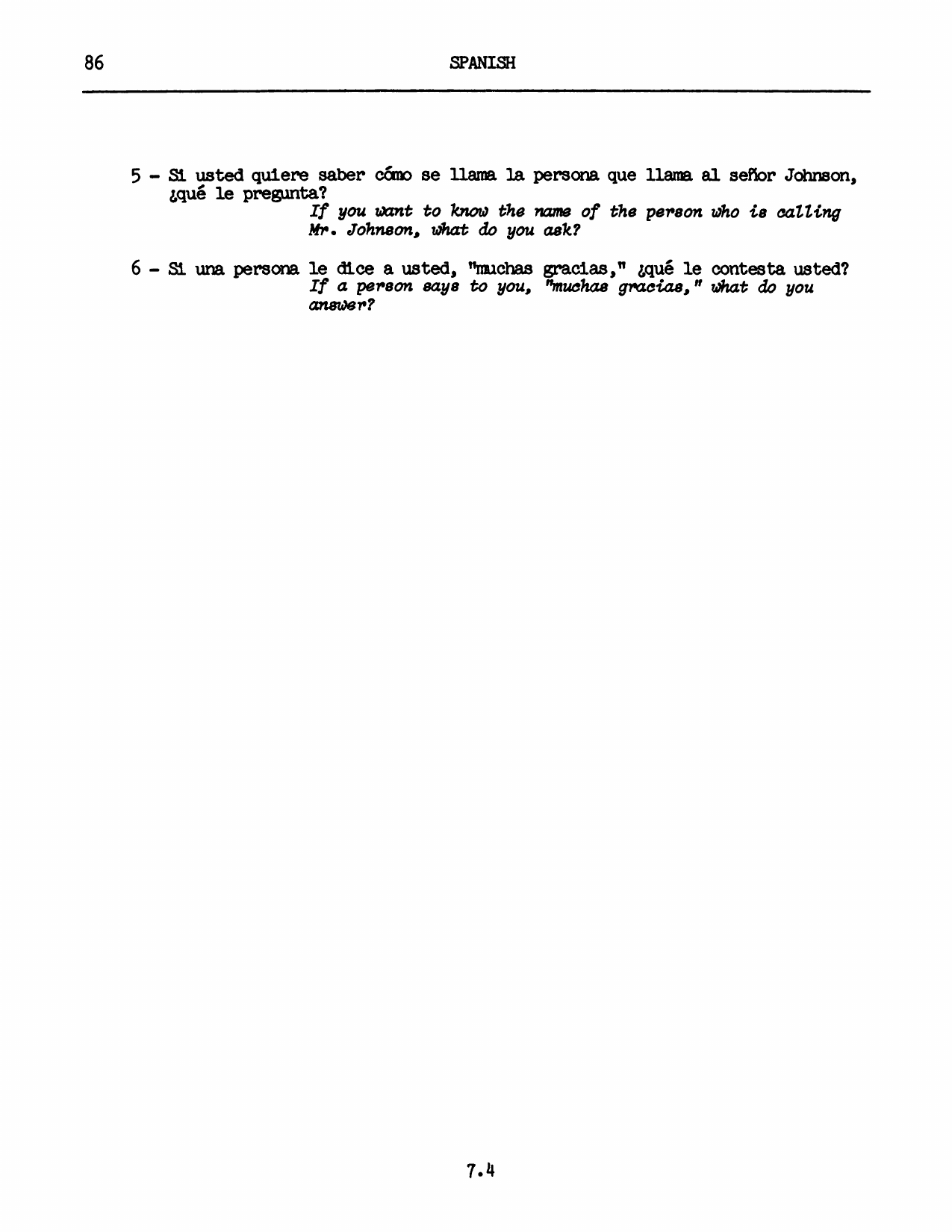
Fill in the Blanks - No. 1:
Recibiendo una llamada telefónica
servirle? (A sus órdenes, a la orden.)
Fill in the Blanks - No. 2:
Recibiendo una llamada telefónica
(A sus Órdenes, a la orden.)
This page has a drawing, chart, or fill-in layout — original page
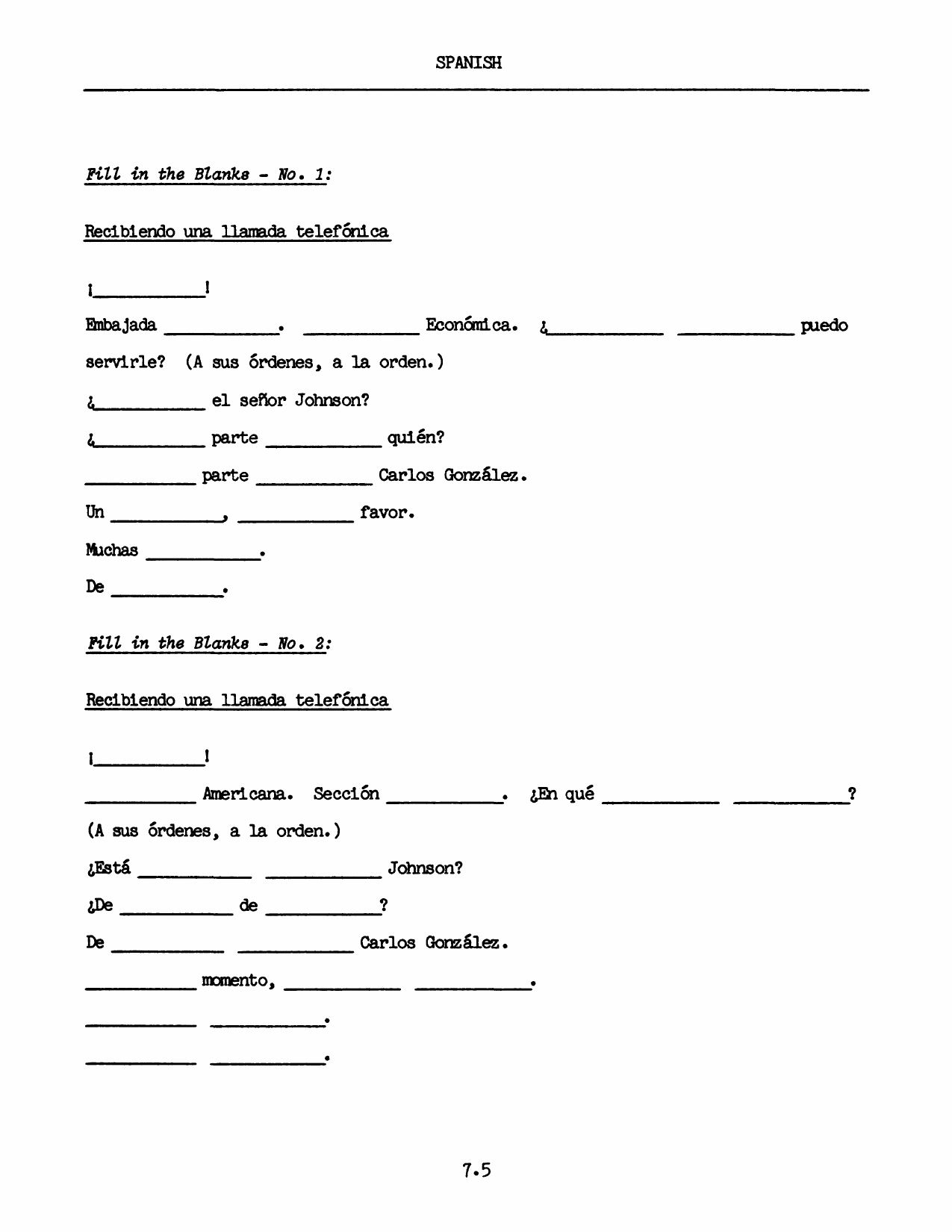
IV. ‘TAKING IT APART
Vocabulary:
Dialogue
Colombia, Ecuador, El Salvador,
Guatemala, Honduras, Perú, Panama)
Uruguay)
Narrative
llama
(he) calls
V. GETTING THE FEEL OF IT
VI. PUTTING IT TOGETHER
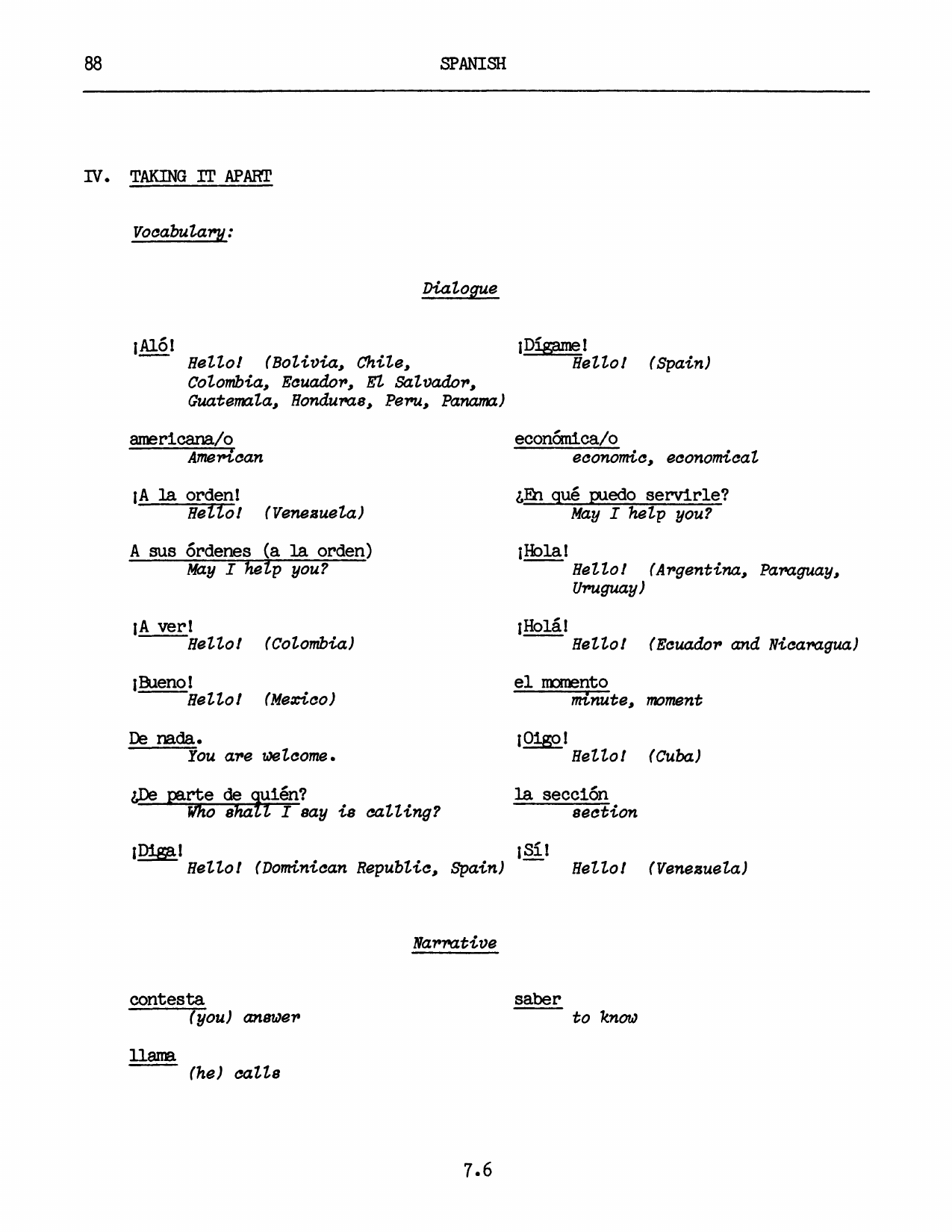
Variante:
A. N- ¿Está el señor Johnson?
A - ¿De parte de quién?
1 - ¿Está el Sr. Embajador?
2 - ¿Está el Cónsul?
3 - ¿Está el Ministro Consejero?
¿Está el Encargado de Negocios?
4 — ¿Está la Srta. Smith?
5 - ¿Está la Sra. (de) Jones?
B. A - ¿De parte de quién?
N - De parte de Carlos González .
1 - De parte de Tomás Trujillo.
2 - De parte de María Luisa Rodríguez.
4 — De parte de la Srta. Susana Lozano.
5 — De parte de la Sra. (de) Torres.
Variante: (continued)
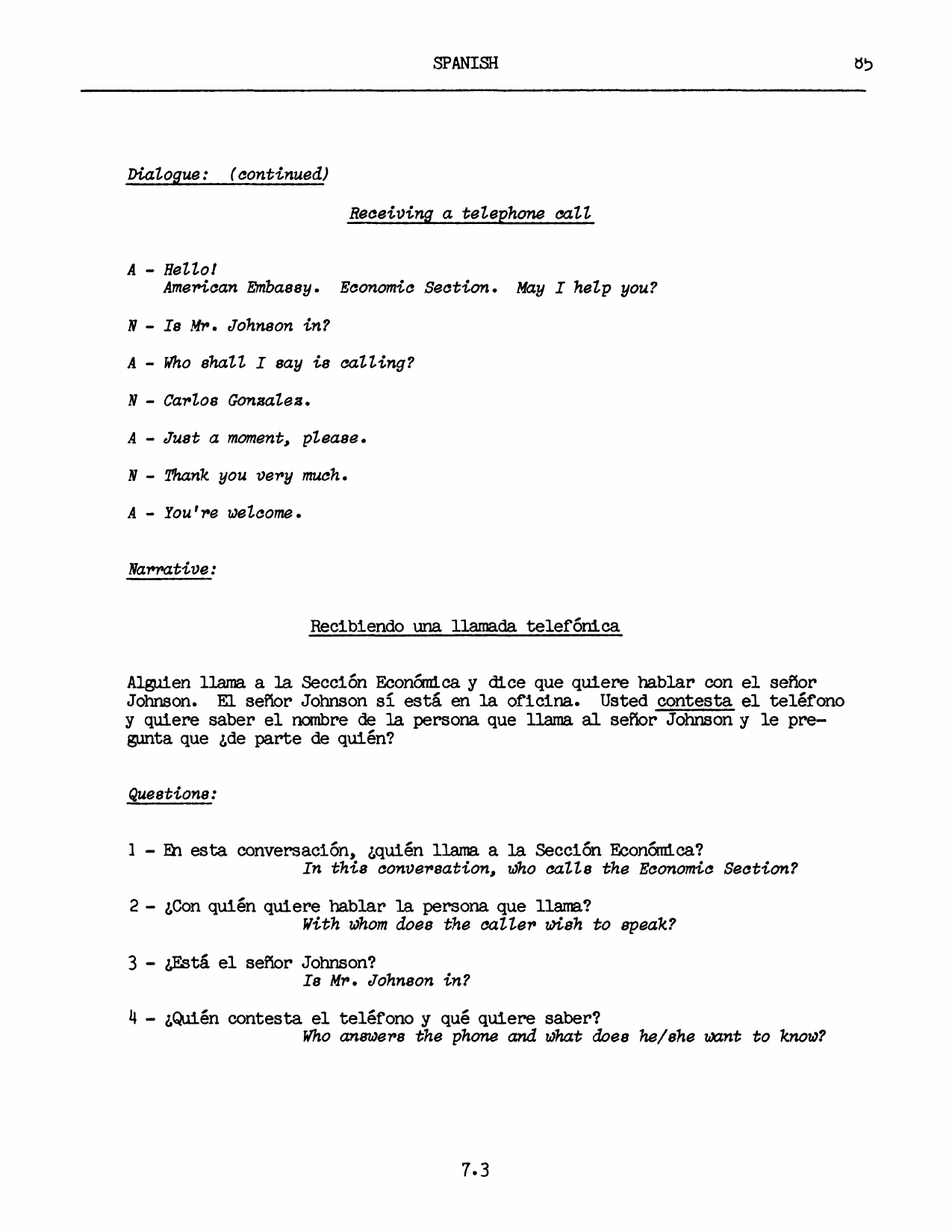
A. N- ls Mr. Johnson in?
A - Who shall I say te calling?
1 - Ie the Ambassador in?
2 - Is the Consul in?
3 - Is the DCM tn?
Ie the Charge d'affaires in?
4 - Ie Mise Smith in?
5 - Is Mrs. Jones in?
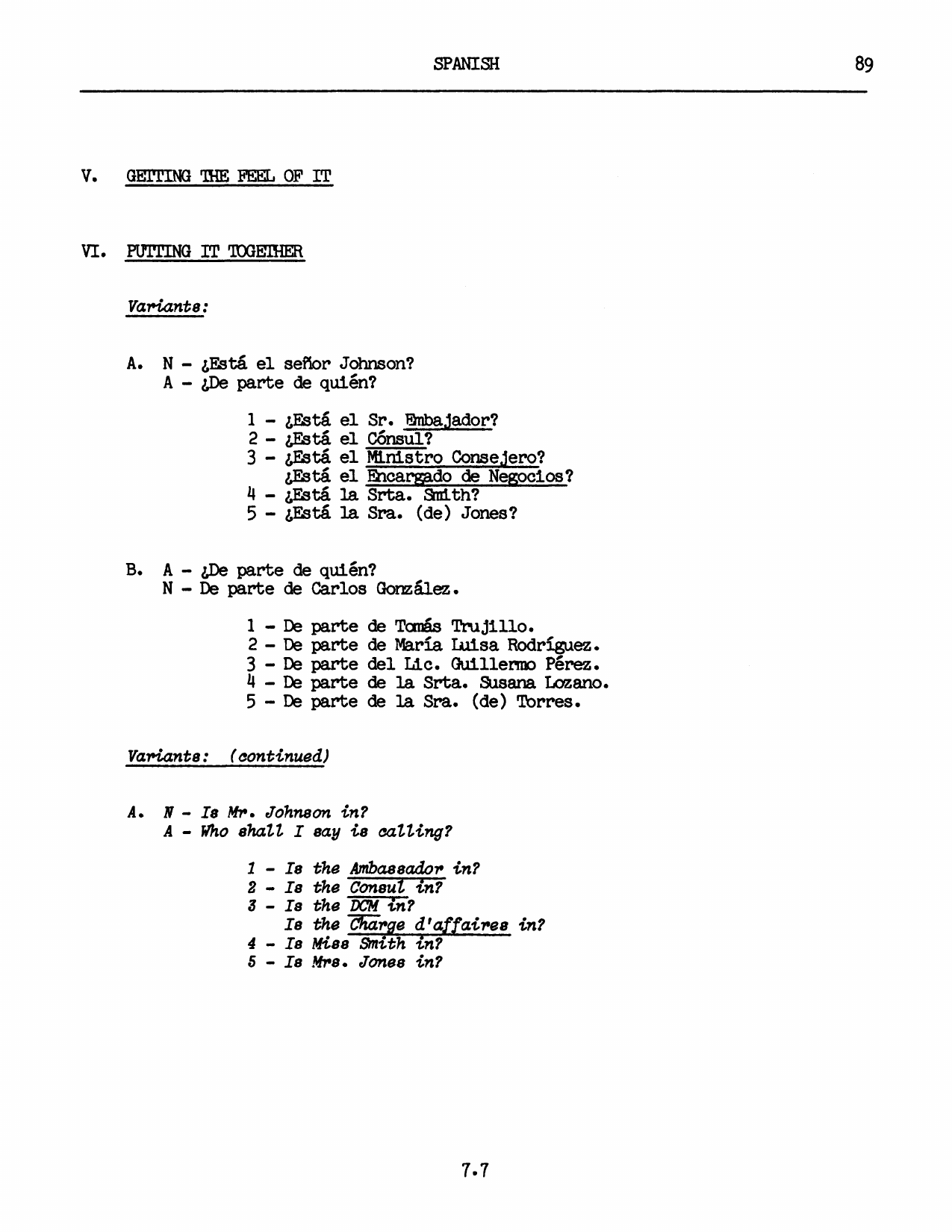
B. A - Who shall I say te calling?
N - Carlos Gonsalez.
1 - Tomas Trujillo.
2 - Maria Luisa Rodriquez.
3 - (Licenciado) Guillermo Pérez.
4 - Miss Susana Lozano.
5 - Mrs. Torres.
VII. MAKING IT WORK
VIII. USING IT