CYCLE 12
GETTING AROUND
Public Transportation
The question of whether or not to bargain is one that many Americans ask them-
selves when faced with the prospect of having to buy something or employ the ser-vices of someone while traveling or living in a Spanish-speaking country. If the thought of bargaining conjures up the classic scene of the seller and the buyer frantically haggling over the price of a piece of merchandise, you'll be surprised to find that such a scene will not be as commonplace as you might think. For example, you should not expect to bargain for a price when riding public transportation or when shopping in department stores, drugstores, or shops where fixed prices exist. True bargaining, as denoted by the Spanish term regatear, will be limited, for the most part, to some marketplaces and perhaps to dealing with individual merchants,
This page has a drawing, chart, or fill-in layout — original page
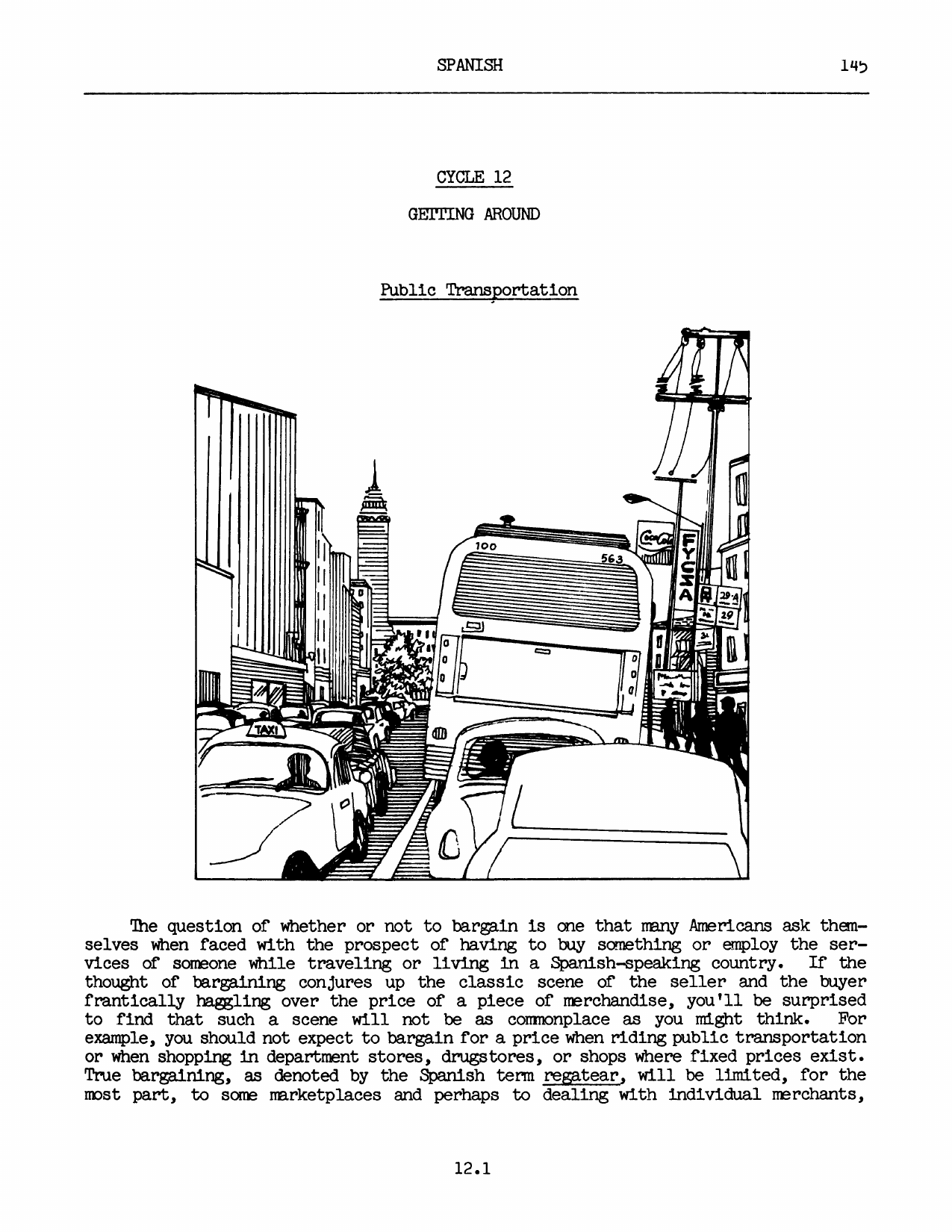
such as street vendors. All in all, the best thing to do is to shop around and com-pare prices. Whenever possible, try to find out the price range for a certain item ahead of time. You should always make a point of establishing a price before com mitting yourself to anything. Avoid being literally "taken for a ride" by a taxi driver, for example, by finding out the fare to your final destination before taking the taxi. You will find that metered taxis are not as common as they are in the U.S., so prices will vary. Ask your teacher about el regateo in his or her country so that you can get a better idea of what it involves.
Taxicabs are unquestionably the easiest way to get around, but they are more
expensive than buses and hard to find in some cities. If for some reason you are unable to flag down a taxicab, you might have to go to a taxi stand (sitio, parada de taxis) or call radio taxi in order to get one. If all else fails, many cities have buses, microbuses, and fixed-run taxis, such as the peseros in Mexico City, that will pick you up and drop you off at any point along their specified route, just as regular buses do. In some cities there will be taxis that operate between airports and central locations, such as hotels, in the downtown area of a city. There may not be a visual way to identify such taxis, for they often look exactly the same as regular taxis. We have referred to them as taxis de "carrera larga" ("long run' taxis").
The situations that follow will introduce you to some of the conventions of using
public transportation.
I. SETTING THE SCENE (A)
You and three friends have tickets for the theater, and you decide to take a taxi. You walk to the nearest intersection and flag one down.
IT. HEARING IT (A)
ITI. SEEING IT (A)
Dialogue No. 1:
Tomando un taxi
A - Taxi, ¿está libre?
N - Sí. ¿A dónde quiere ir?
A = ¿Por cuánto nos lleva al Teatro Municipal?
N - ¿Cuántos pasajeros?
A = Somos cuatro.
N - Lo que marque el taxímetro, más doscientos pesos por los cuatro. A - Lo que marque el taxímetro, más cien.
N - Ciento cincuenta y los llevo.
A - No señor, cien.
N - ¡Bueno! Para usted, cien.
A — ¡Vamos, pues!
Dialogue No. 1: (continued)
Teking a taxi
A - Taxi, are you free?
N - Yes. Where do you want to go?
(1) A - How much will it cost to take us to the Municipal Theater? (2) N - How many passengers?
A - There are four of us.
(3) N - Whatever the meter reads, plus two hundred pesos for the four of you.
A - Whatever the meter reads, plus one hundred.
WN - One hundred and fifty and I'll take you.
A - No str, one hundred.
N - ALL right! For you, one hundred.
A - Let's go, then!
I. SETTING THE SCENE (B)
You want to go to the International Hotel, but you are not sure 1f this par-ticular bus will take you. In order to find out, you ask the bue driver.
II. HEARING IT (B)
III. SEEING IT (B)
Dialogue No. 2:
Tomando el autobús (Méx. camión)
A - ¿Usted pasa cerca del Hotel Internacional?
N - Sí, paso por la entrada principal.
A = ¿Cuánto es?
N - Veinte pesos.
A = Aquí tiene.
N — Péngalos en la máquina, por favor.
Dialogue No. 2: (continued)
Taking a bue
A - Do you go by the International Hotel?
WN - Yes, I pass by the min entrance.
A - How much is it?
N - Twenty pesos.
A - Here you are.
N - Put them in the machine, please.
I. SETTING THE SCENE (C)
You have to go to the airport, so you go to a taxi stand in front of a local hotel to get a cab.
Il. HEARING IT (C)
III. SEEING IT (C)
Dialogue No. 3:
El taxi de "carrera larga"
A - ¿Cuánto cuesta de aquí al aeropuerto?
N — Mil pesos.
A - ¿Por qué tan caro?
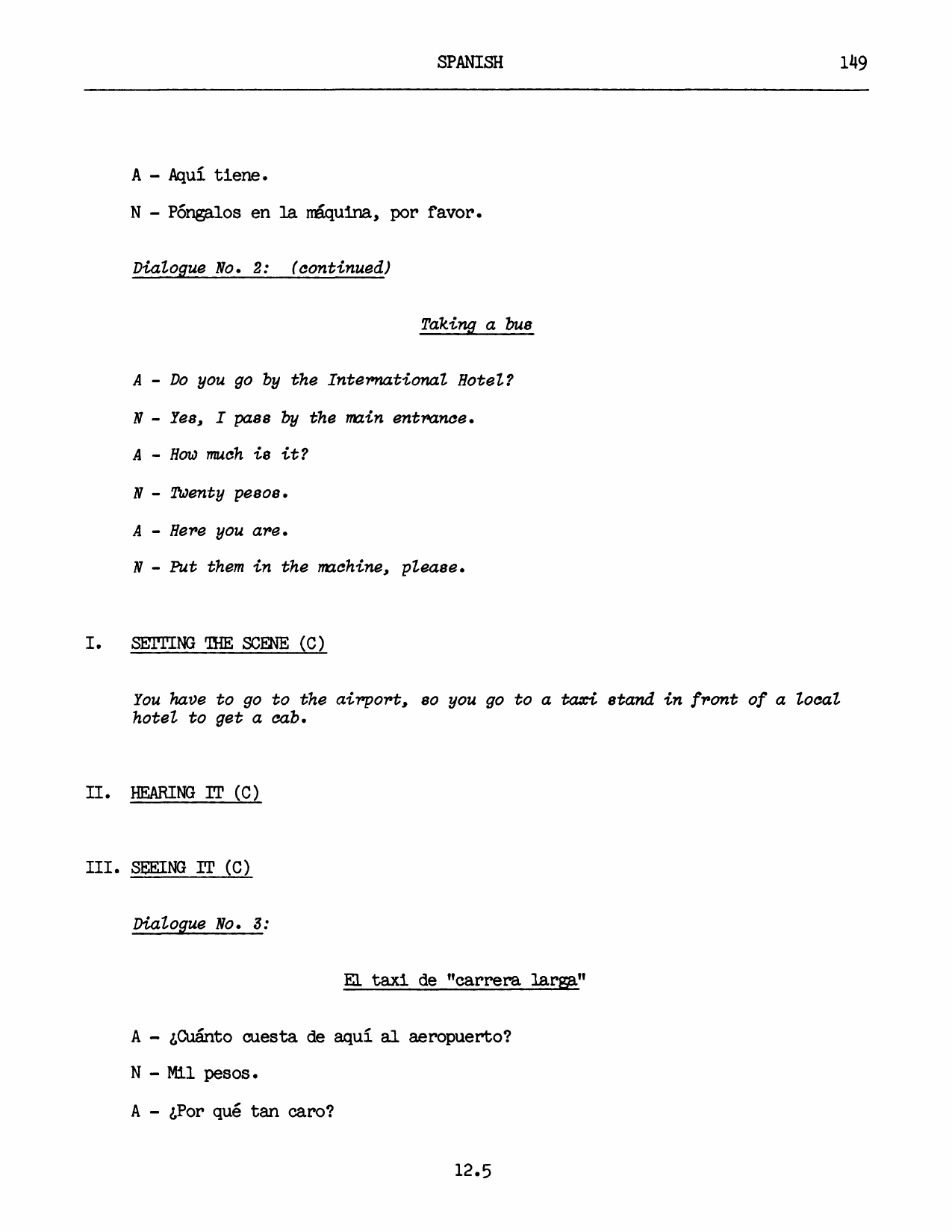
N - Señor/señorita/señora, está my lejos. A veinte kilómetros de distancia. A - Le doy ochocientos pesos si me lleva.
N - Lo siento, sefior/seflorita/sefiora. Mil pesos es el precio regular (normal,
ordinario).
A - Muy, bien. Lléveme, pues.
Dialogue No. 3: (continued)
"Long run" tact
A - How much is it from here to the airport?
N - One thousand pesos.
A - Why 80 expensive?
N - Sir/mies/ma'am, it's very far away. Twenty kilometers.
A - I'll give you eight hundred pesos if you take me.
N - I'm sorry, eir/miss/ma'am. One thousand pesos ts the going rate. A - All right. Take me, then.
Language Notes
1. The phrase ¿Por cuánto nos lleva...? means "For how much will you take
US. +..?, which may strike you as a little too direct, but it isn't. That's why it is translated here using the impersonal, American way of inquiry, "How much will it cost...?"
2. Cuántos (how many) vs. Cuánto (how much)
' Cuánto reflects gender, quantity (cuánto or cuánta), and mumber (cuántos or
cuántas).
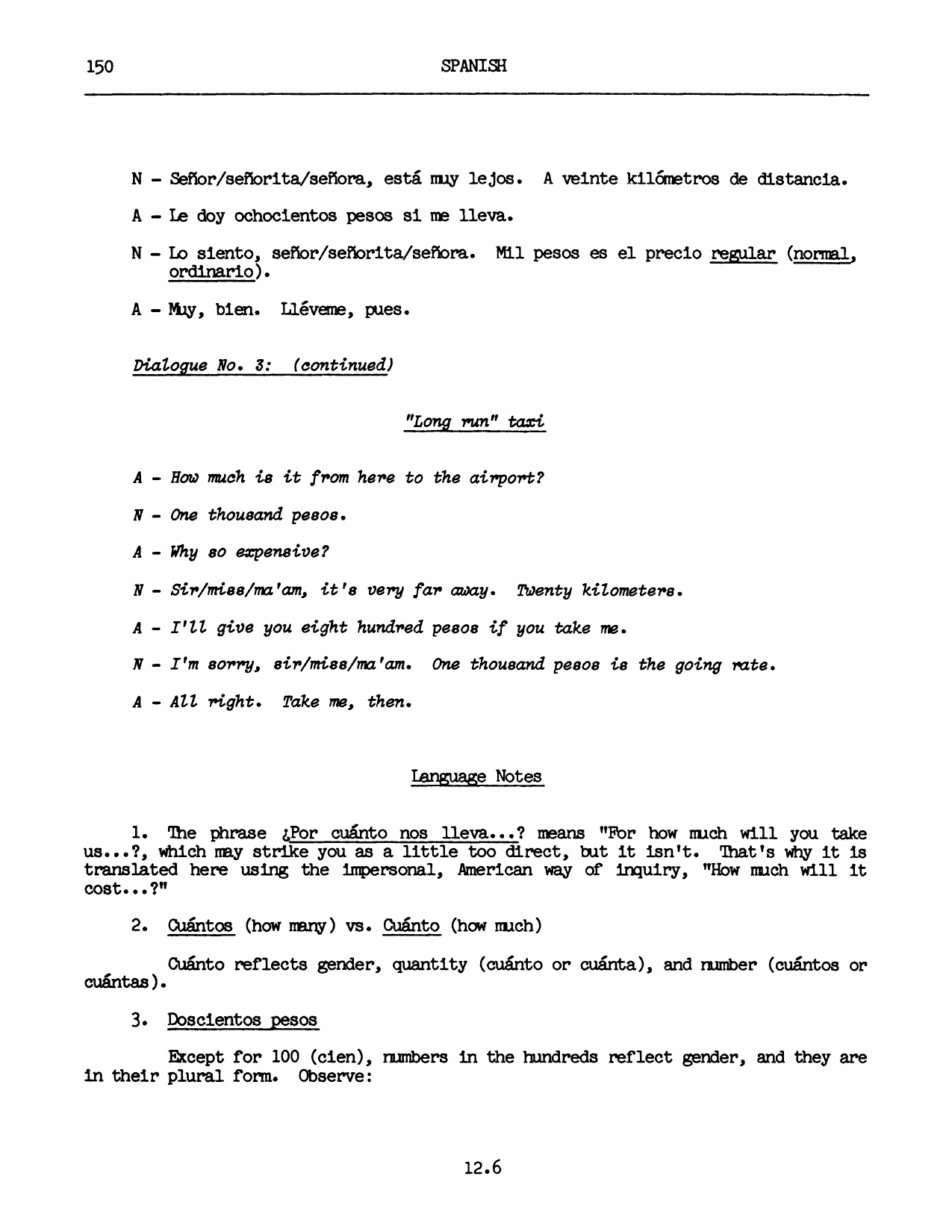
3. Doscientos pesos
Except for 100 (cien), numbers in the hundreds reflect gender, and they are
in their plural form. Observe:
Narrative No. 1:
Tomando un taxi
Usted y tres personas más quieren ir al Teatro Municipal. Usted le pregunta a un chofer de taxi (taxista) que por cuánto los lleva. El le contesta que por lo que marque el taxime tro, más doscientos pesos por los cuatro. Usted ofrece darle lo que marque el taxímetro, más cien pesos. El chofer le dice que él los puede llevar por ciento cincuenta, más lo que marque el taxímetro. Finalmente, el taxista acepta su oferta.
Questions:
1 - ¿A dónde quieren ir usted y sus amigos?
Where do you and your friends want to go?
2 - ¿Qué le pregunta usted al chofer de taxi (taxista)?
What do you ask the taxi driver?
3 - ¿Cuánto le cobra el taxista?
How much does the taxi driver charge you?
4 — ¿Cuánto le ofrece usted?
How much do you offer him?
5 - Finalmente, ¿cuánto acepta el chofer?
Finally, how much does the driver accept?
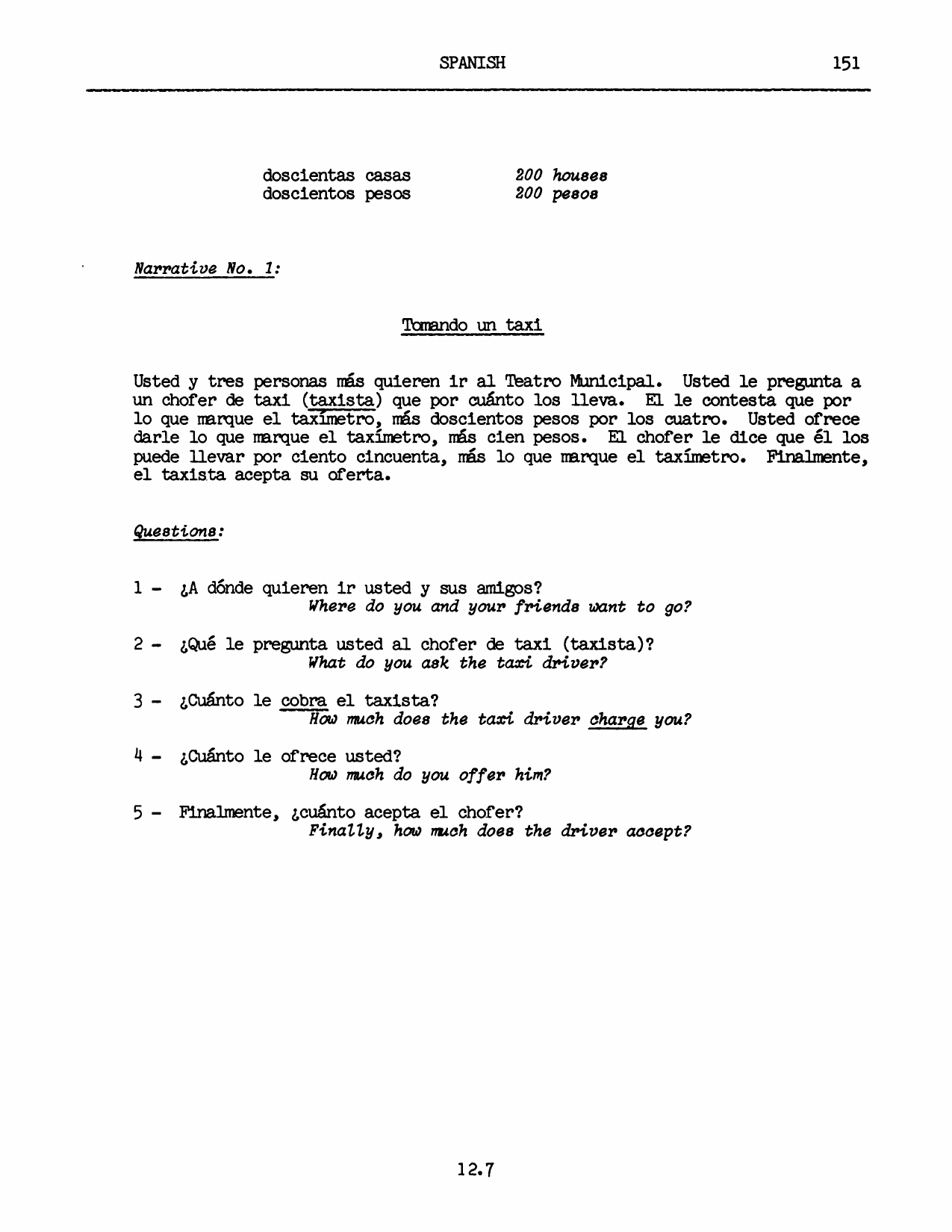
Fill in the Blanks ~ No. 1:
Tomando un taxi
2. pasajeros?
This page has a drawing, chart, or fill-in layout — original page
Fill in the Blanks - No. 2:
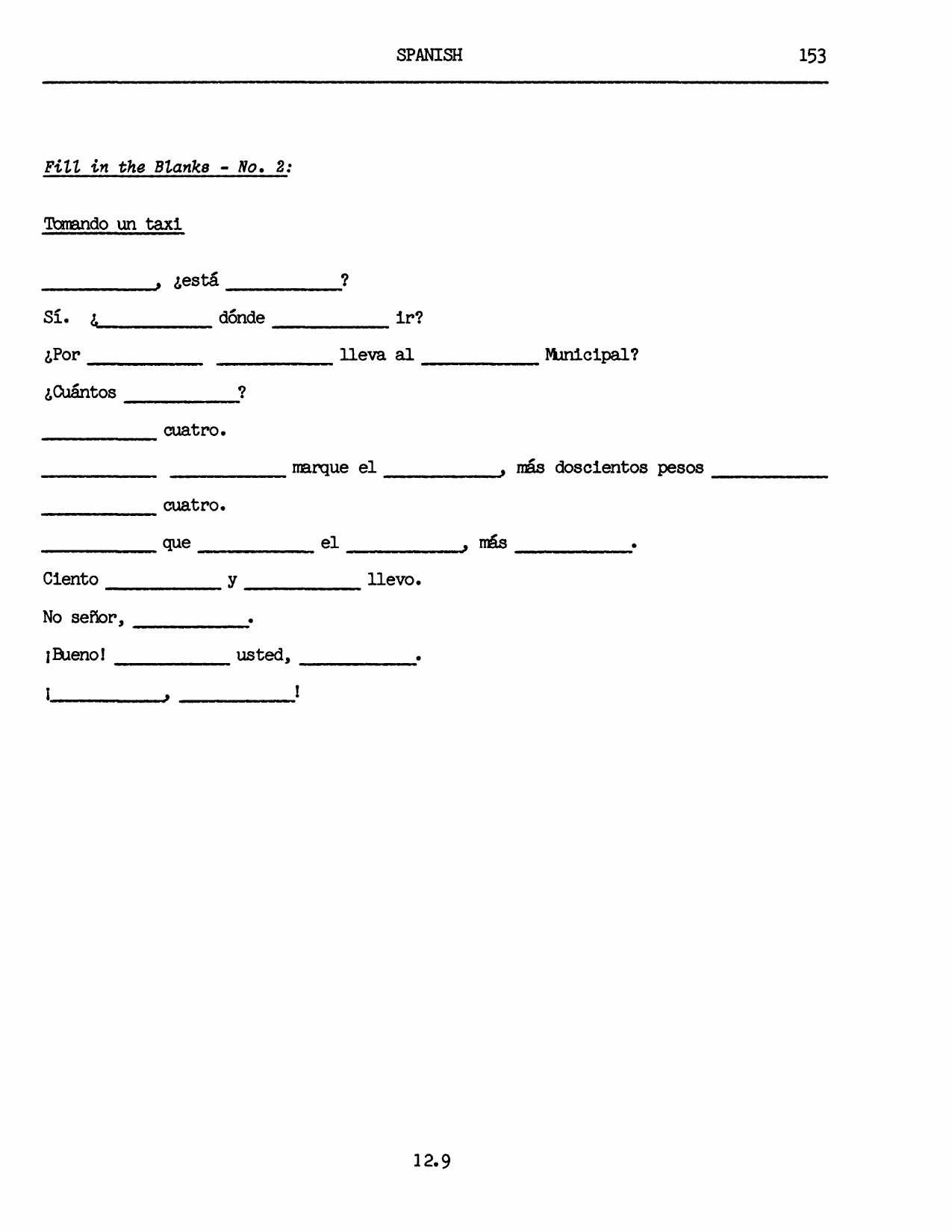
Tomando un taxi
cuatro.
cuatro.
This page has a drawing, chart, or fill-in layout — original page
Narrative No. 2:
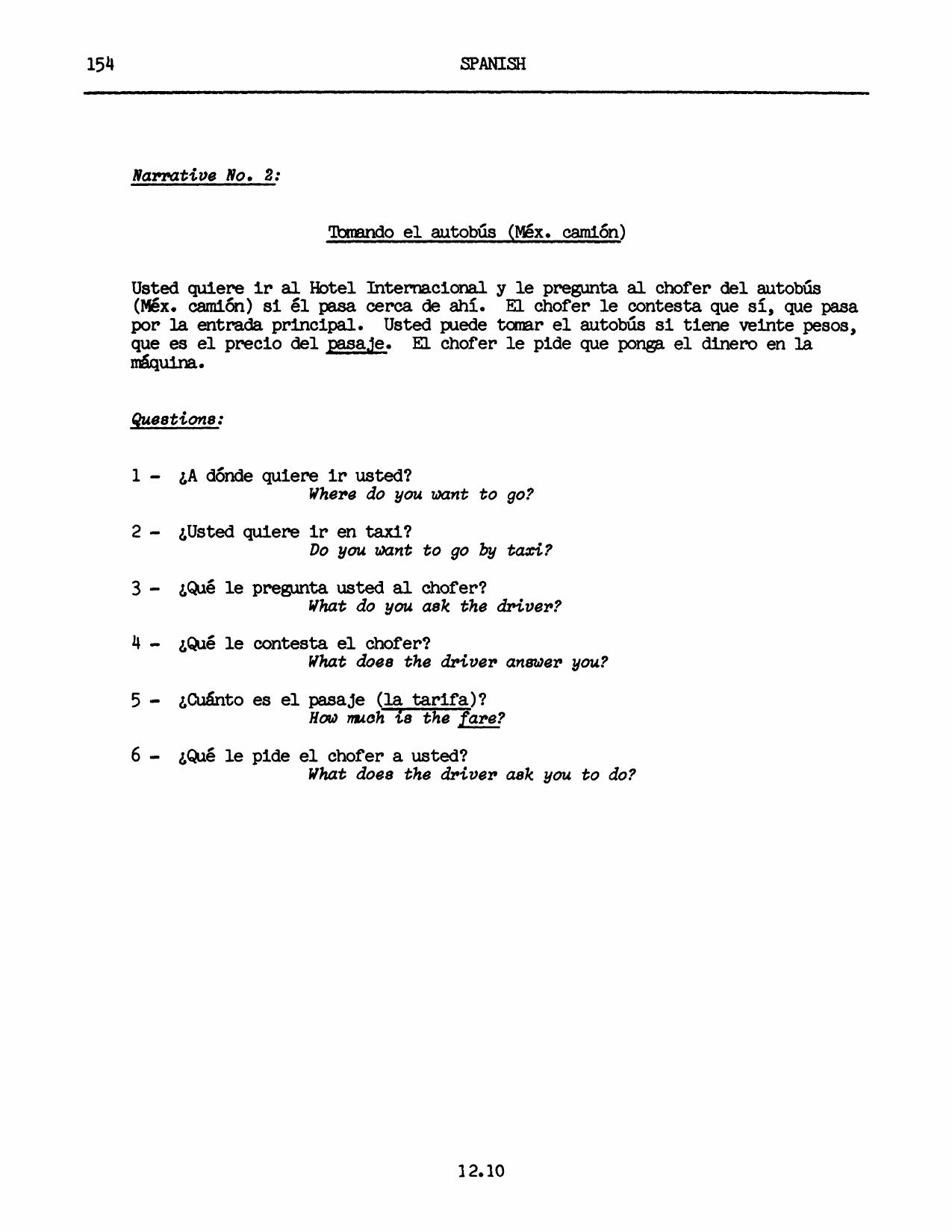
Tomando el autobús (Méx. camión)
Usted quiere ir al Hotel Internacional y le pregunta al chofer del autobús (Méx. camión) si él pasa cerca de ahí. El chofer le contesta que sí, que pasa por la entrada principal. Usted puede tomar el autobús si tiene veinte pesos, ve es el precio del pasaje. El chofer le pide que ponga el dinero en la
uina.
Questions:
1 - ¿A dónde quiere ir usted?
Where do you want to go?
2 - ¿Usted quiere ir en taxi?
Do you want to go by taxi?
3 - ¿Qué le pregunta usted al chofer?
What do you ask the driver?
4 - ¿Qué le contesta el chofer?
What does the driver answer you?
5 - ¿Cuánto es el pasaje (la tarifa)?
How much 18 the fare?
6 - ¿Qué le pide el chofer a usted?
What does the driver ask you to do?
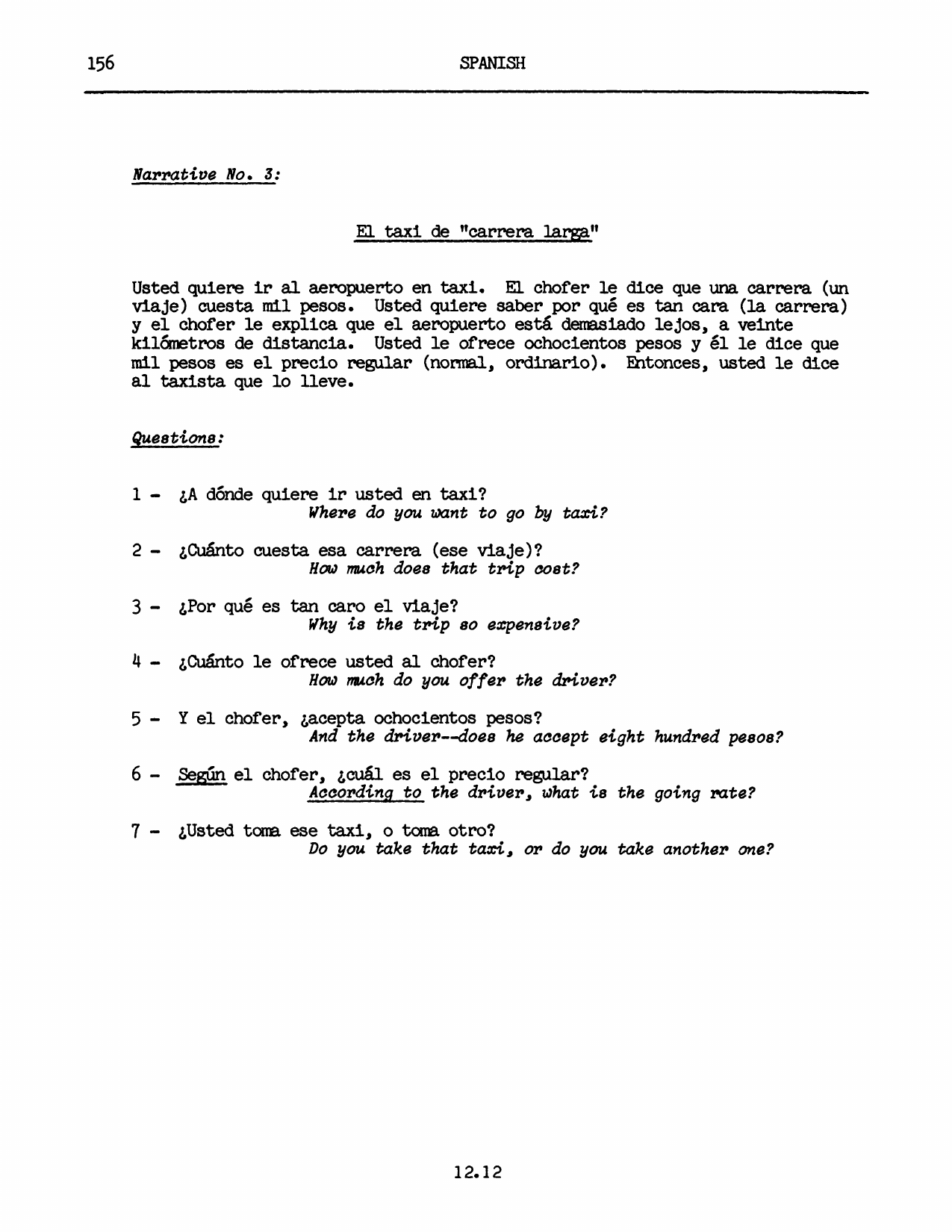
Fill in the Blanka - No. 3:
Tomando el autobús (Méx. camión)
pesos.
tiene.
Fill in the Blanks - No. 4:
Tomando el autobús (Méx. camión)
This page has a drawing, chart, or fill-in layout — original page
Narrative No. 3:
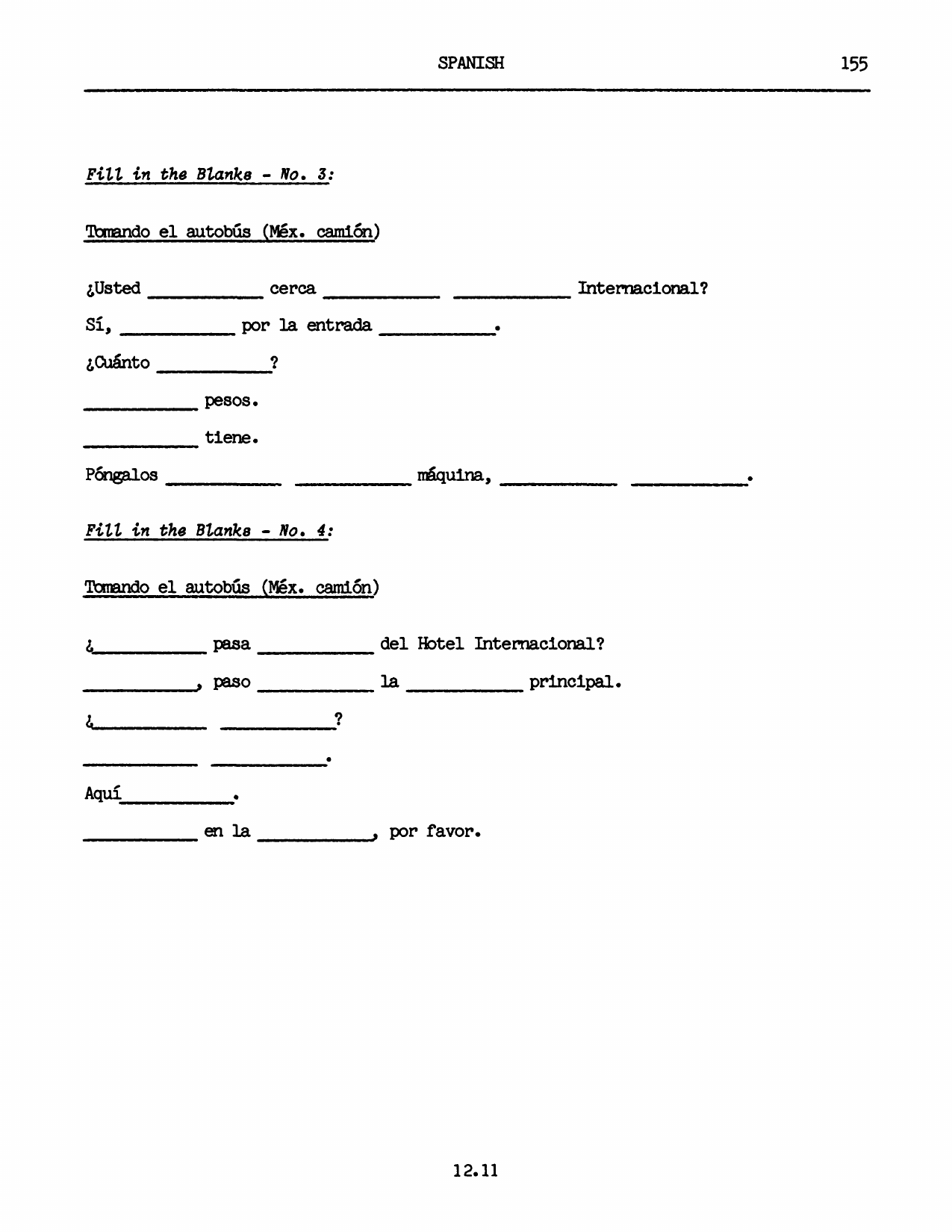
El taxi de "carrera larga"
Usted quiere ir al aeropuerto en taxi. El chofer le dice que una carrera (un viaje) cuesta mil pesos. Usted quiere saber por qué es tan cara (la carrera) y el chofer le explica que el aeropuerto está demasiado lejos, a veinte kilómetros de distancia. Usted le ofrece ochocientos pesos y él le dice que mil pesos es el precio regular (normal, ordinario). Entonces, usted le dice al taxista que lo lleve.
Questions:
1 - ¿A dónde quiere ir usted en taxi?
Where do you want to go by taxi?
2 - ¿Cuánto cuesta esa carrera (ese viaje)?
How much does that trip cost?
3 - ¿Por qué es tan caro el viaje?
Why is the trip so expensive?
Y — ¿Cuánto le ofrece usted al chofer?
How much do you offer the driver?
5 - Y el chofer, ¿acepta ochocientos pesos?
And the driver--does he accept eight hundred pesos?
6 - Según el chofer, ¿cuál es el precio regular?
According to the driver, what ta the going rate?
7 - ¿Usted toma ese taxi, o toma otro?
Do you take that taxi, or do you take another one?
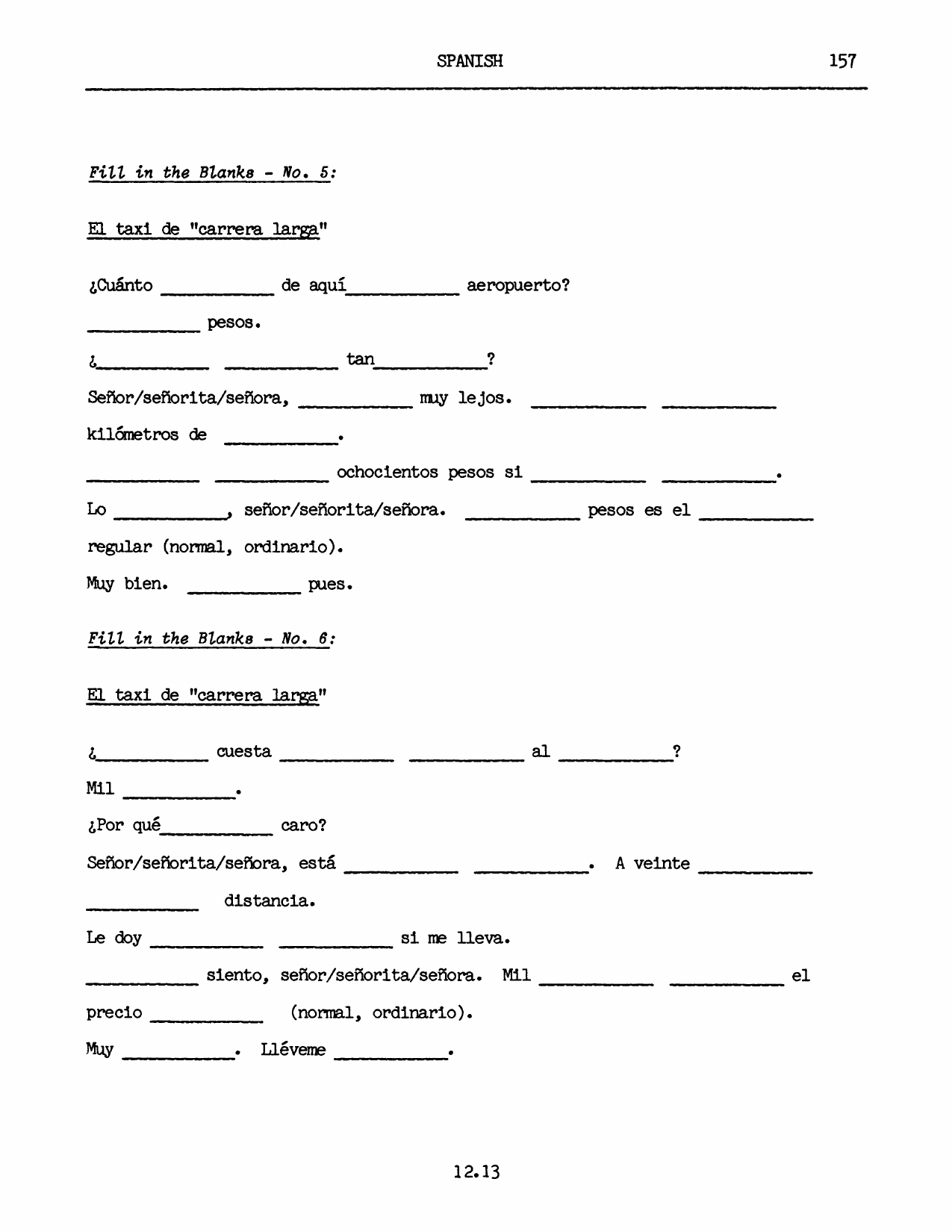
Fill in the Blanks - No. 5:
El taxi de "carrera larga"
pesos.
regular (normal, ordinario).
Fill in the Blanks - No. 6:
El taxi de "carrera larga"
distancia.
This page has a drawing, chart, or fill-in layout — original page
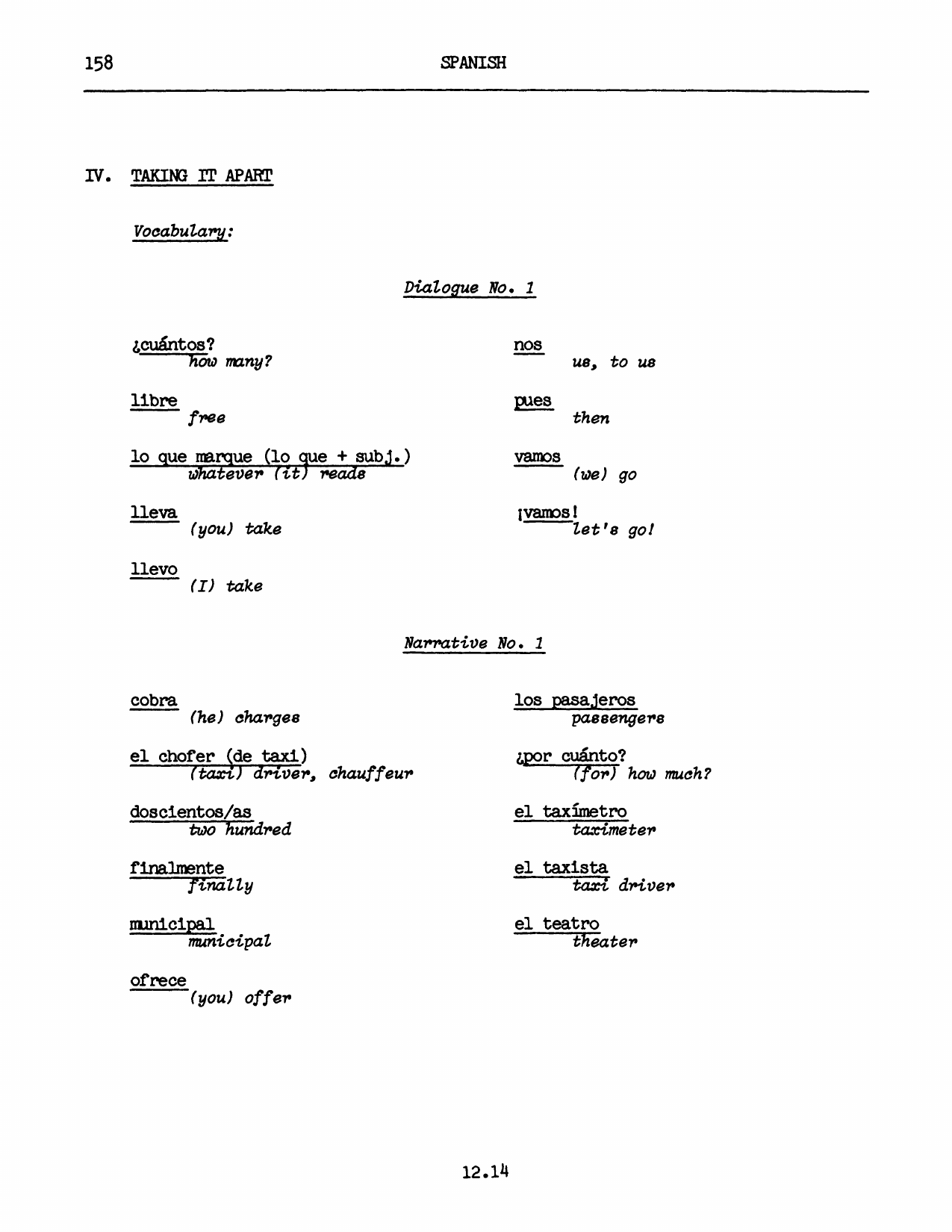
IV. ‘TAKING IT APART
Vocabulary:
Dialogue No. 1
llevo
(I) take
Narrative No. 1
ofrece
(you) offer
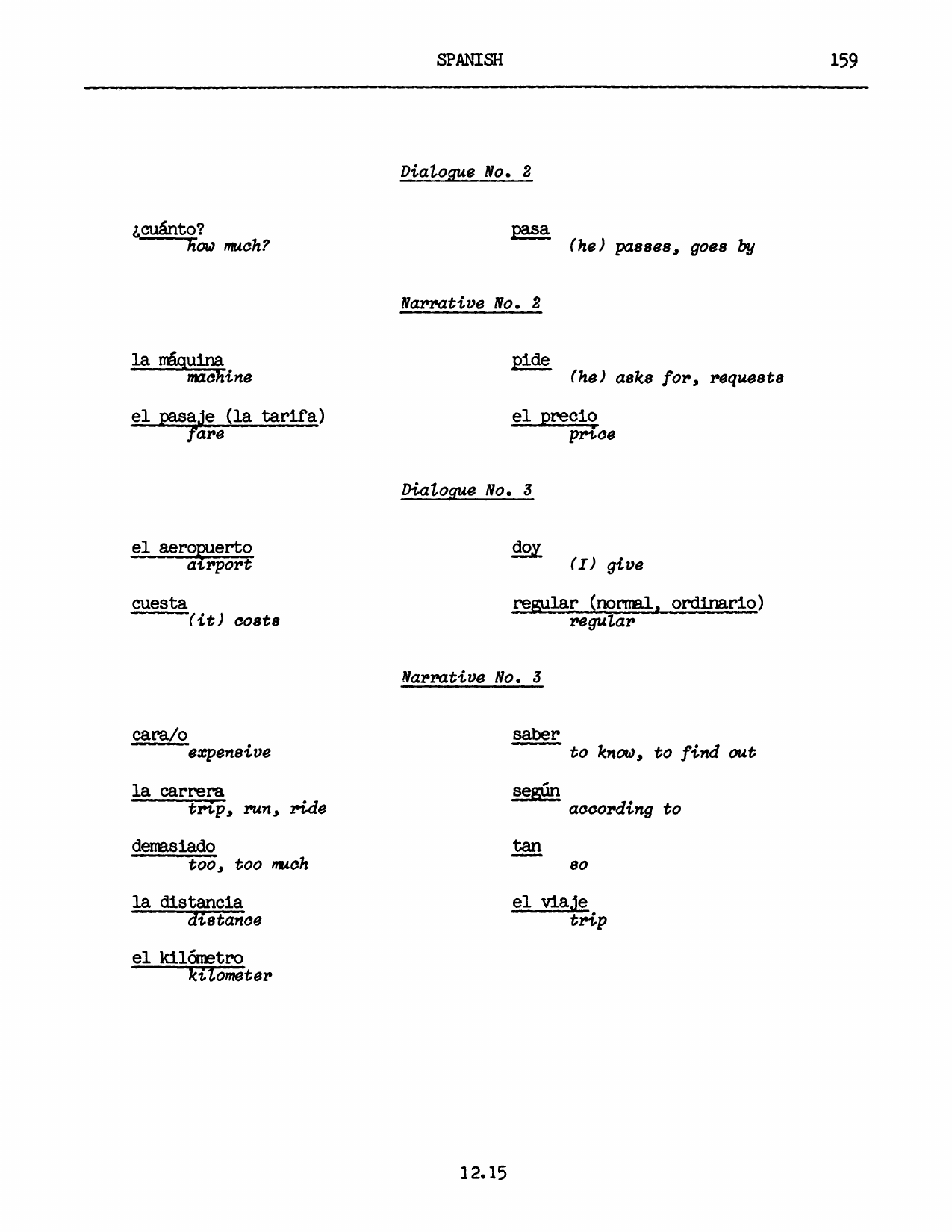
Dialogue No. 2
Narrative No. 2
Dialoque No. 3
Narrative No. 3
el kilómetro
1Lometer
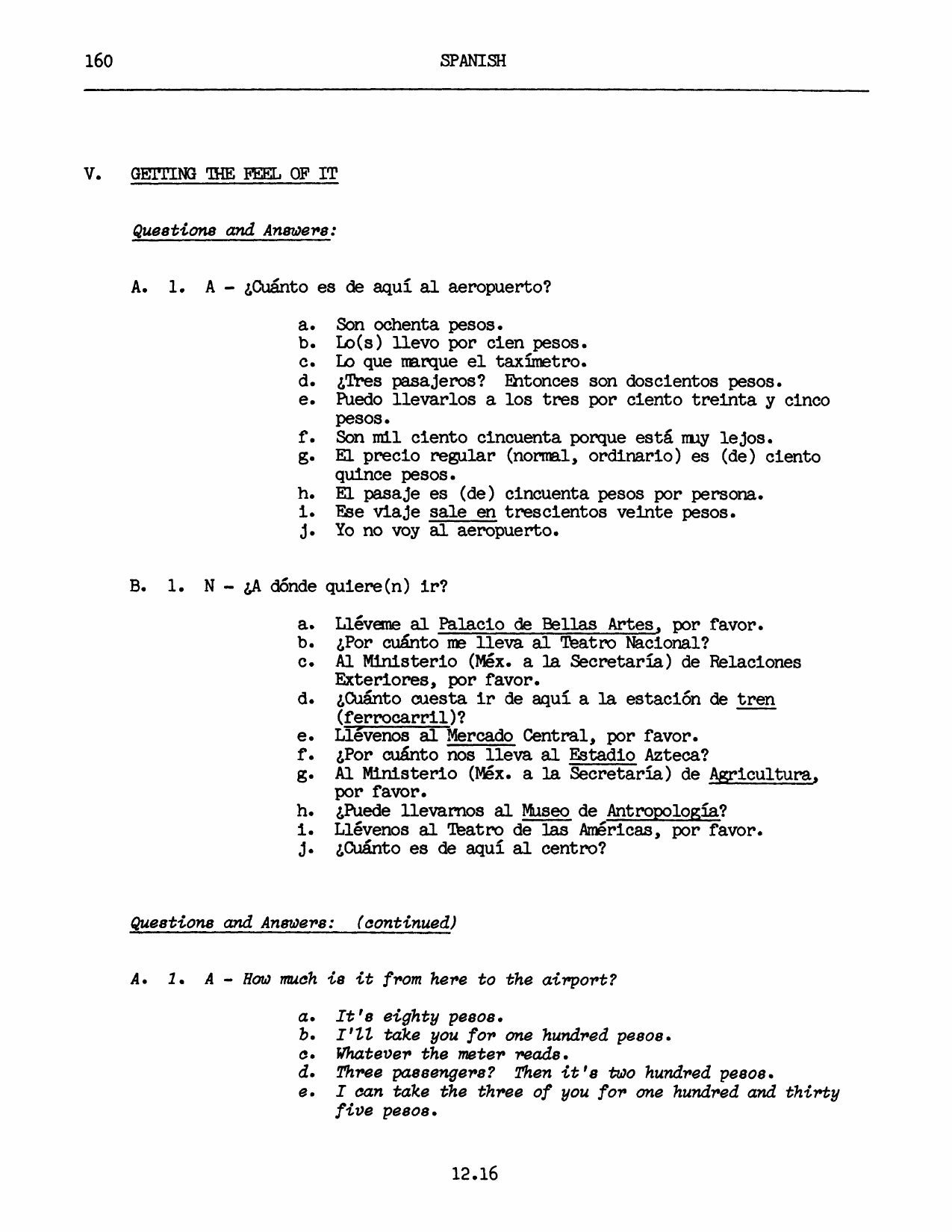
V. GETTING THE FEEL OF IT
Questions and Answers:
A. 1. A = ¿Cuánto es de aquí al aeropuerto?
a. Son ochenta pesos.
b. Lo(s) llevo por cien pesos.
C. Lo que marque el taxímetro.
d. ¿Tres pasajeros? Entonces son doscientos pesos. €». Puedo llevarlos a los tres por ciento treinta y cinco
pesos.
f. Son mil ciento cincuenta porque está muy lejos. g- El precio regular (normal, ordinario) es (de) ciento
quince pesos.
h. El pasaje es (de) cincuenta pesos por persona. i. Ese viaje sale en trescientos veinte pesos. j. Yo no voy al aeropuerto.
B. 1. N = ¿A dónde quiere(n) ir?
a. Lléveme al Palacio de Bellas Artes, por favor. b. ¿Por cuánto me lleva al Teatro Nacional?
C. Al Ministerio (Méx. a la Secretaría) de Relaciones
Exteriores, por favor.
d. ¿Cuánto cuesta ir de aquí a la estación de tren
(ferrocarril)?
e. Llévenos al Mercado Central, por favor.
f. ¿Por cuánto nos lleva al Estadio Azteca?
g. Al Ministerio (Méx. a la Secretaría) de Agricultura,
por favor.
h. ¿Puede llevarnos al Museo de Antropología? í. Llévenos al Teatro de las Américas, por favor. j- ¿Cuánto es de aquí al centro?
Questions and Answers: (continued)
A. 1. A - How much te it from here to the airport?
a. It's eighty pesos.
b. I'll take you for one hundred pesos.
ce. Whatever the meter reads.
d. Three passengers? Then it's two hundred pesos. e. I can take the three of you for one hundred and thirty
five pesos.
f. It's one thousand one hundred and fifty because it's very
far away.
ge The going rate is one hundred and fifteen
pesos.
h. The fare is fifty pesos per person.
t. That trip comes out to three hundred and twenty pesos. j. I don't go to the airport.
B. 1. N - Where do you want to go?
a. Take me to the Palace of Fine Arts, please. b. How much will it cost to take me to the National Theater? C. To the Ministry of Foreign Affairs, please. d. How much will it cost to go from here to the railway
station?
e. Take us to the Central Market, please.
f. How much will it cost to take us to the Aztec Stadium? g» To the Ministry of Agriculture, please.
h. Can you take us to the Museum of Anthropology? t. Take us to the Theater of the Americas, please. j. How mich ia it from here to the center of town?
VI. PUTTING IT TOGETHER
Variante:
Dialogue No. 1
A. N- ¿Cuántos pasajeros?
A = Somos cuatro.
1 = Somos dos.
2 = Sólo yo.
3 —- Mi esposa/o y yo.
4 — Somos tres con cuatro maletas.
5 - Somos cinco.
B. N- Ciento cincuenta y los llevo.
A - No señor, cien.
1 = No señor, es demasiado.
2 - No señor, no tengo (tenemos) tanto dinero.
3 - No señor, cincuenta.
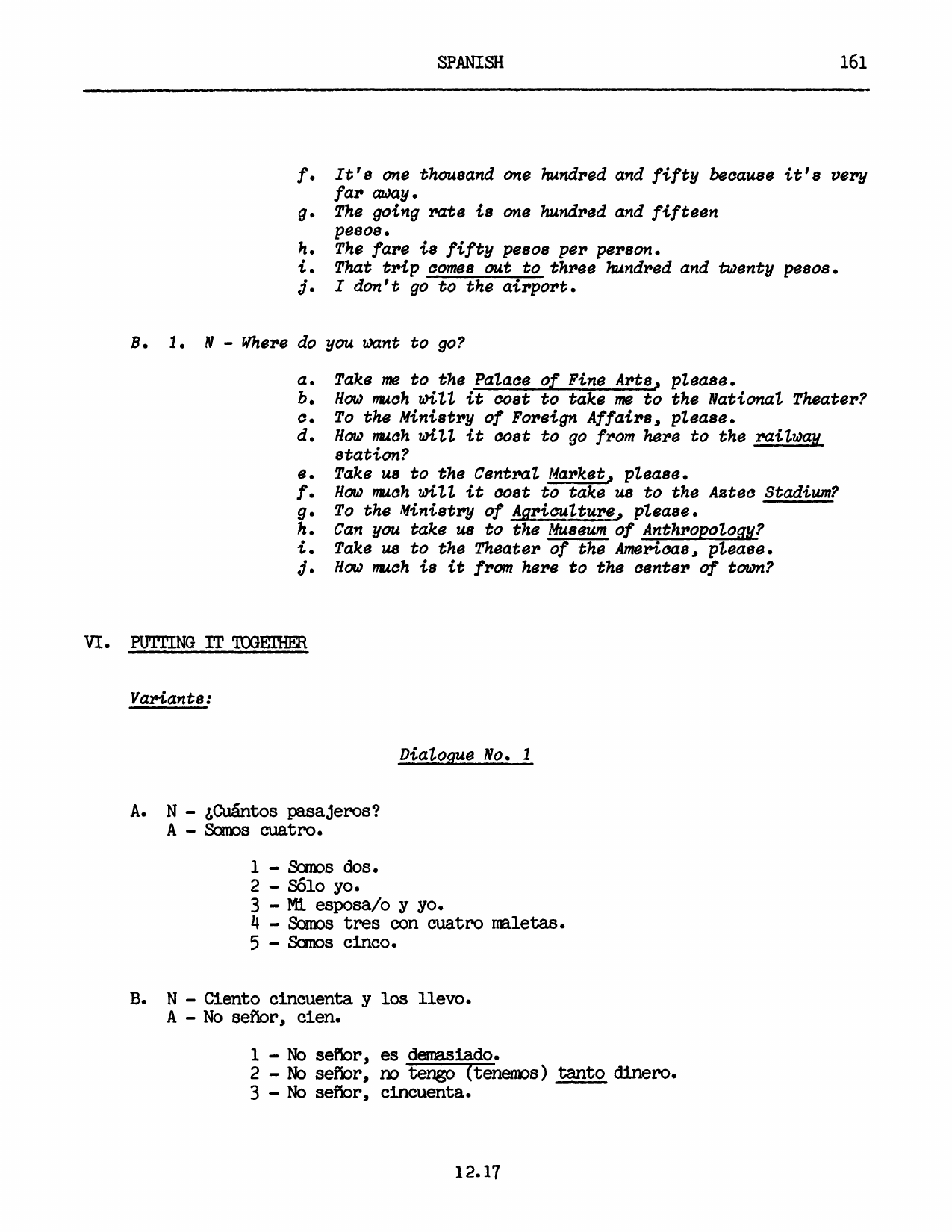
4 — No señor, no estoy loco/a (estamos locos/as).
5 - No señor, vamos a pie.
Dialogue No. 2
C. A = ¿Usted pasa cerca del Hotel Internacional?
N - Si, paso por la entrada principal.
1 - ¿Usted pasa cerca del Cine Diana?
2 - ¿Usted pasa cerca de la Escuela Militar?
3 = ¿Usted pasa cerca del Hospital Santa Clara?
Y — ¿Usted pasa cerca de la Universidad Nacional?
5 - ¿Usted pasa cerca del Banco Central?
Dialogue No. 3
D. A= ¿Por qué tan caro?
N - Señor, está my lejos. A veinte kilómetros de distancia.
1 - Es demasiado.
2 = ¿Por qué tanto?
3 - Es demasiado caro.
4 - Es mucho dinero.
5 = ¿Por qué cobra tanto?
E. A - Le doy ochocientos pesos si me lleva.
N - Lo siento señor. Mil pesos es el precio regular (normal, ordinario).
1 - Le doy novecientos (pesos) si me lleva.
2 - Le doy seiscientos (pesos) si me lleva.
3 - Le doy quinientos (pesos) si nos lleva.
4 - Le doy setecientos (pesos) si me lleva.
5 - Le doy cuatrocientos (pesos) si nos lleva.
Variante: (continued)
Dialogue No. 1
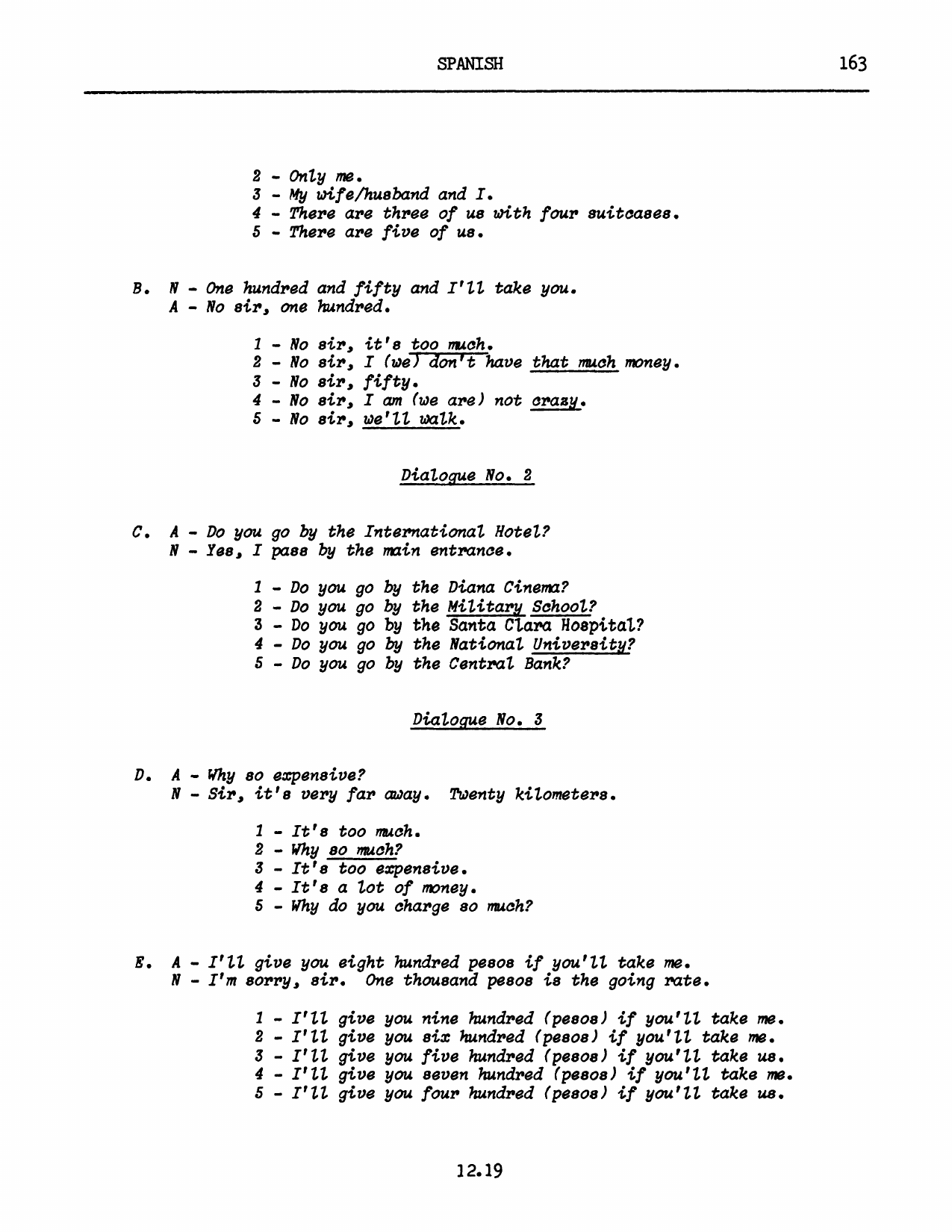
A. N - How many passengers?
A - There are four of us.
1 - There are two of us.
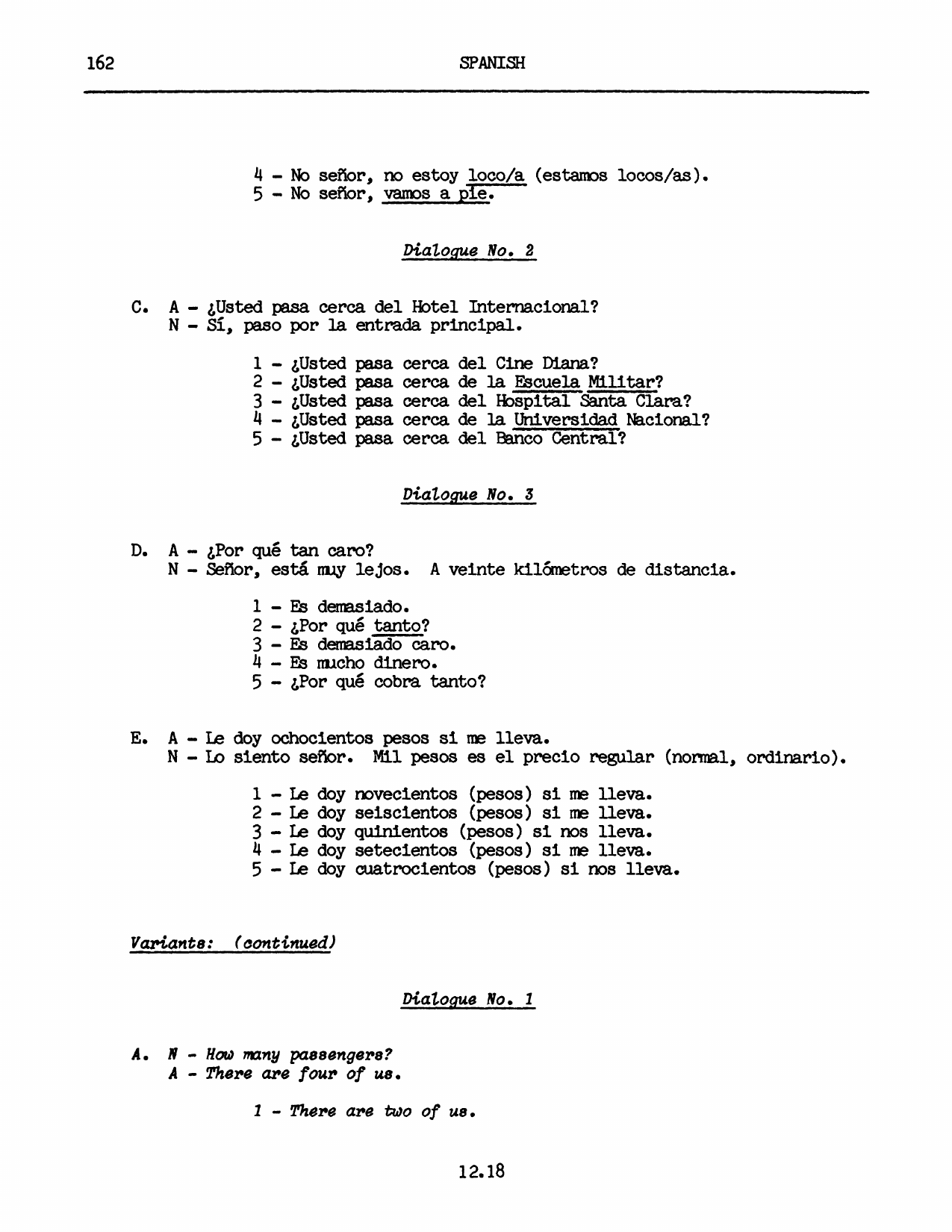
2 - Only me.
3 - My wife/husband and I.
4 - There are three of us with four suttcases.
5 - There are five of us.
B. WN - One hundred and fifty and I'11 take you.
A - No sir, one hundred.
1 - No sir, it's too mich.
2 - No sir, I (we) don't have that much money.
3 - No sir, fifty.
4 - No sir, I am (we are) not crazy.
5 - No sir, we'll walk.
Dialogue No. 2
C. A - Do you go by the International Hotel?
N - Yes, I pass by the main entrance.
1 - Do you go by the Diana Cinema?
2 - Do you go by the Military School?
3 - Do you go by the Santa Clara Hospital?
4 - Do you go by the National University?
5 - Do you go by the Central Bank?
Dialogue No. 3
D. A ~ Why so expensive?
N - Sir, it's very far away. Twenty kilometers.
1 - It's too much.
2 - Why 80 mich?
3 - It's too expensive.
4 - It's a lot of money.
5 - Why do you charge so much?
E. A-I'tl give you eight hundred pesos if you'll take me.
N - I'm sorry, sir. One thousand pesos is the going rate.
1 - I'll give you nine hundred (pesos) if you'll take me. 2 - I'll give you six hundred (pesos) if you'll take me. 3 - I'll give you five hundred (pesos) if you'll take us. 4 - I'll give you seven hundred (pesos) if you'll take me. 5 - I'll give you four hundred (pesos) if you'll take us.
VII. MAKING IT WORK
VIII. USING IT