CYCLE 14
GETTING ACQUAINTED
The Familiar Form
| iii
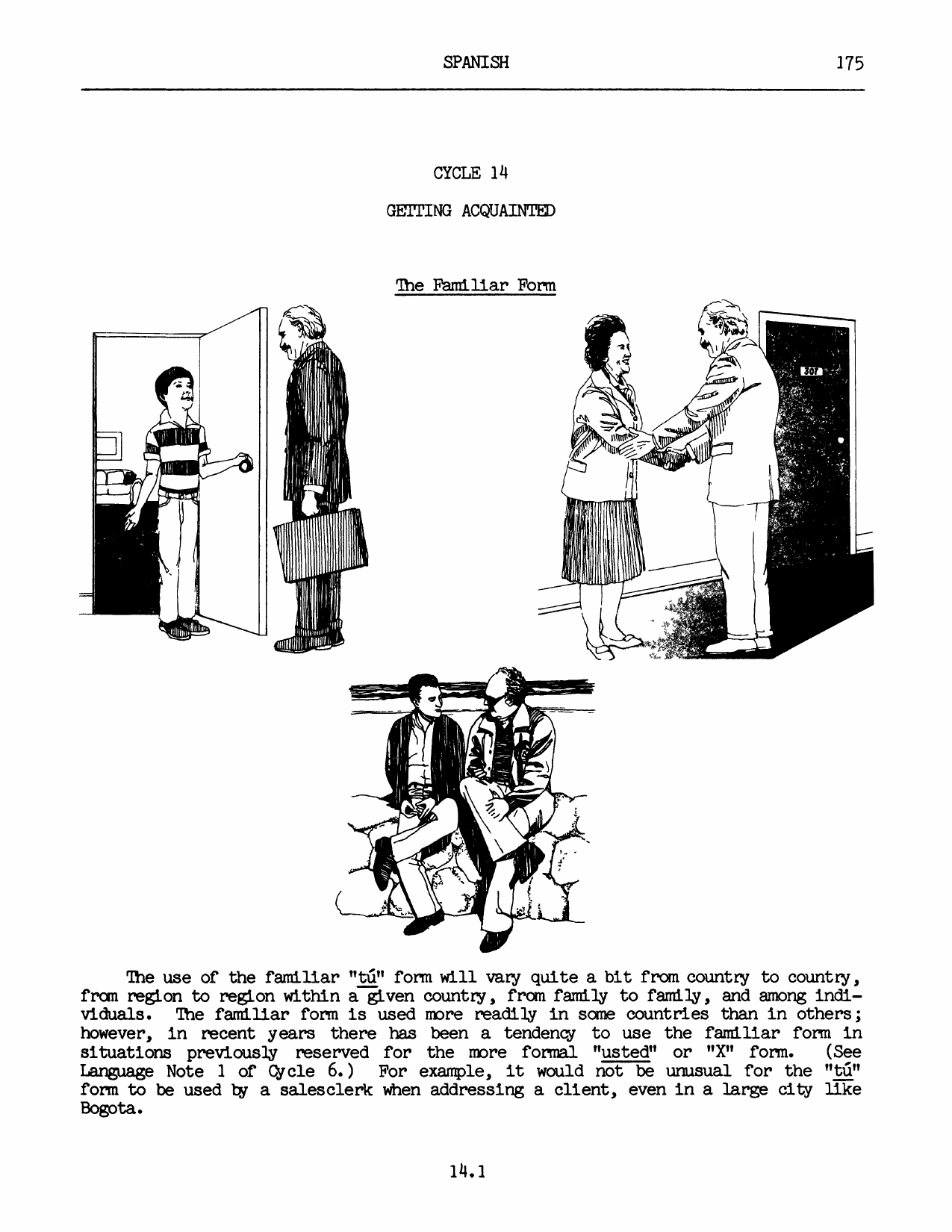
The use of the familiar "tú" form will vary quite a bit from country to country,
from region to region within a given country, from family to family, and among indi-viduals. The familiar form is used more readily in some countries than in others; however, in recent years there has been a tendency to use the familiar form in situations previously reserved for the more formal "usted" or "X" form. (See Language Note 1 of Cycle 6.) For example, it would not be umusual for the "tán form to be used by a salesclerk when addressing a client, even in a large city like Bogotá.
14,1
This page has a drawing, chart, or fill-in layout — original page
The familiar "tú" form has traditionally been used to denote familiarity, thus
establishing an informal atmosphere between speakers who address each other on a first name basis. On the other hand, the "X" form has generally been used to indicate a certain formality, thus establishing a "distance" between people indi-eating respect, social standing, and/or lack of familiarity. An example of this is when a younger person addresses an older person using the "X" form (perhaps using the older person's first name preceded by the title of Don or Doña), while the older person addresses the younger person by his/her first name, using the familiar "tú" form. In short, the use of the familiar form is influenced by such factors as age, rank or social standing, the length of time two people have known each other, whether the speakers are in a work-related or a social setting, and family and regional customs.
The first dialogue in this Cycle illustrates the way to ask someone to change
from the formal to the familiar form of address. Sometimes the change will be less obvious: one person will begin by using the "ta" form; if the other person picks up on it and also starts using the "tú" form, the change takes place with no further ceremony. However, if the second person feels that it is not yet time to make the change, he or she will indicate this by continuing to use the formal "X" form. When this happens, the first person will usually revert back to the formal, not pressing the issue. It is advisable to let the host country national be the one to make the change from the formal to the familiar.
It is both flattering and gratifying to be invited by a host country national
to tutearse (to address one another with the familiar form, "tú"). When this hap-pens, you will know that you have "arrived." Nevertheless, once you have been in the country long enough to feel comfortable with this aspect of the language, there is no reason why you should not feel free to do the "inviting."
I. SETTING THE SCENE (A)
One morning you greet Manuel, a national employee at the American Embaesy with whom you have become friends, and he proposes that the two of you start addressing each other with the familiar "tú" form.
II. HEARING IT (A)
III. SEEING IT (A)
Dialogue No. 1:
¡Vamos a tratarnos de ti!
A - Hola, Manuel. ¿Cómo está?
N - Bien, pero ¿por qué no nos tratamos de tú?
A — De acuerdo, pero tiene que ayudarme.
N - ¿Por qué?
A - Porque nunca aprendí a tutear en español.
N - Es my fácil; sólo tienes que decir estás en vez de está.
A - Voy a tratar de hacerlo. Corrijame (familiar, corrígeme) si me equivoco. N - Sí, tienes que practicarlo con todos tus amigos.
A = Bueno, pero no se ría de mí (familiar, no te rías de mí) si me equivoco. Dialogue No. 1: (continued)
L et's address each other with the familiar form, "tú "1
A - Hello, Manuel. How are you?
N - Fine, but why don't we address each other with the familiar form, "tú"?
(1) A - Agreed, but you'll have to help me.
N - Why?
(2) A - Because I never learned to use the familiar form in Spanish.
WN - It's very easy, you only have to say estás instead of está. (familiar) A - I'll try to do it. Correct me if I make a mistake.
WN - Yes, you have to practice with all your friends. (familiar)
(3) A - Good, but don't laugh at me if I make a mistake.
I. SETTING THE SCENE (B)
You go to the home of a friend who ts a host country national and you are greeted at the door by his/her young son.
II. HEARING IT (B)
III. SEEING IT (B)
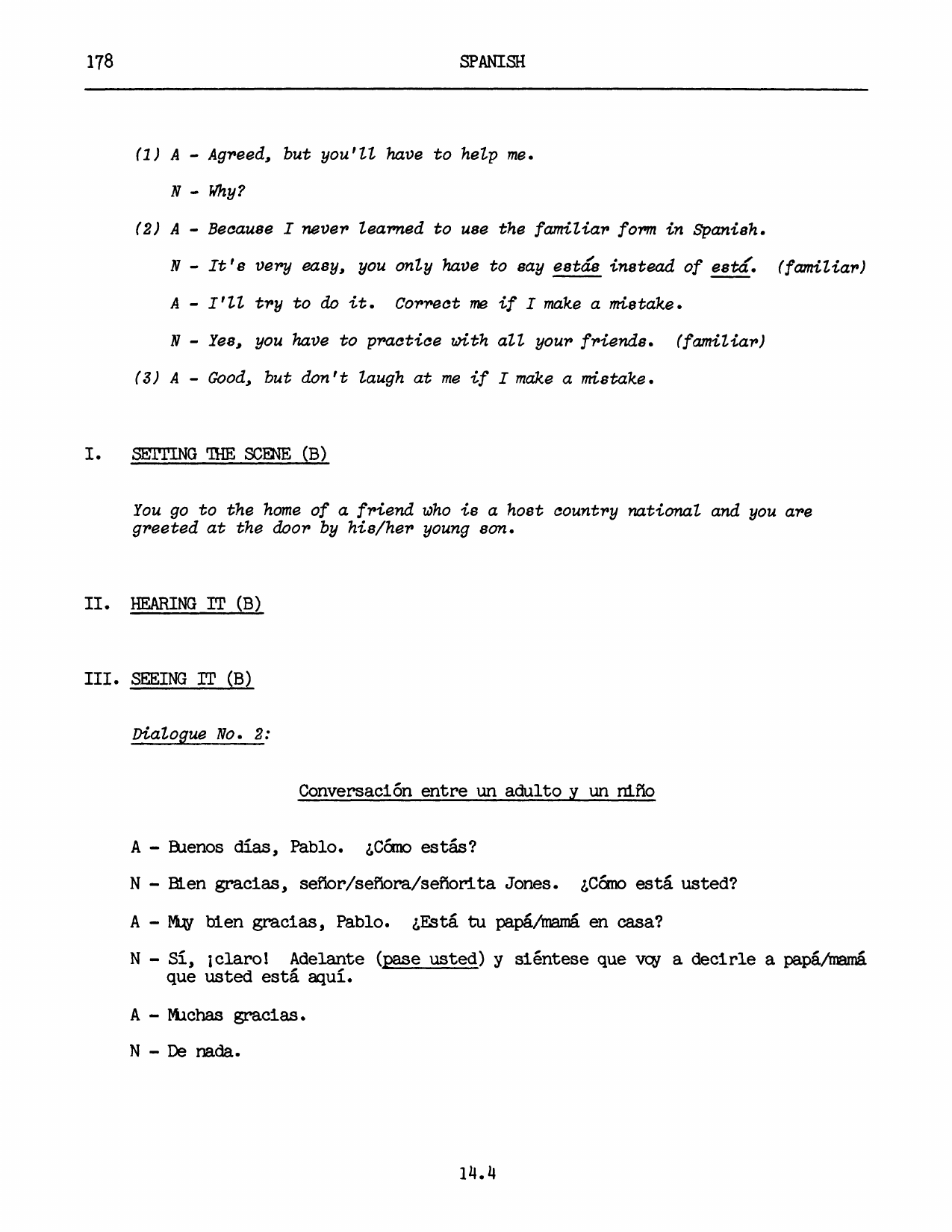
Dialogue No. 2:
Conversación entre un adulto y un niño
A —- Buenos días, Pablo. ¿Cómo estás?
N - Bien gracias, señor/señora/señorita Jones. ¿Cómo está usted? A - My bien gracias, Pablo. ¿Está tu papá/mamá en casa?
N - Sí, ¡claro! Adelante (pase usted) y siéntese que voy a decirle a papá/mamá
que usted está aquí.
A —- Muchas gracias.
N — De nada.
Dialogue No. 2: (continued)
Conversation between an adult and a child
A - Good morning, Paul. How are you? (familiar)
N - Fine, thanks, Mr./Mrs./Miss Jones. How are you?
A - Very well, thank you, Paul. Is your dad/mom at home?
(4) N - Yes, of course! Come in and sit down...I'm going to tell Dad/Mom that
you're here.
A - Thanks a lot.
N - You're welcome.
I. SETTING THE SCENE (C)
You meet one of your neighbors and after greeting each other you inquire about your respective families.
II. HEARING IT (C)
III. SEEING IT (C)
Dialogue No. 3:
Saludando a la vecina/al vecino
N — ¡Hola, Mikel ¿Cómo estás?
A - My bien Margarita, ¿y tú?
N - My bien, gracias. ¿Cómo están en tu casa?
A - Todos bien gracias, y tu familia, ¿qué tal?
N - Así así. Tenemos a Luisito en cama con fiebre.
14,5
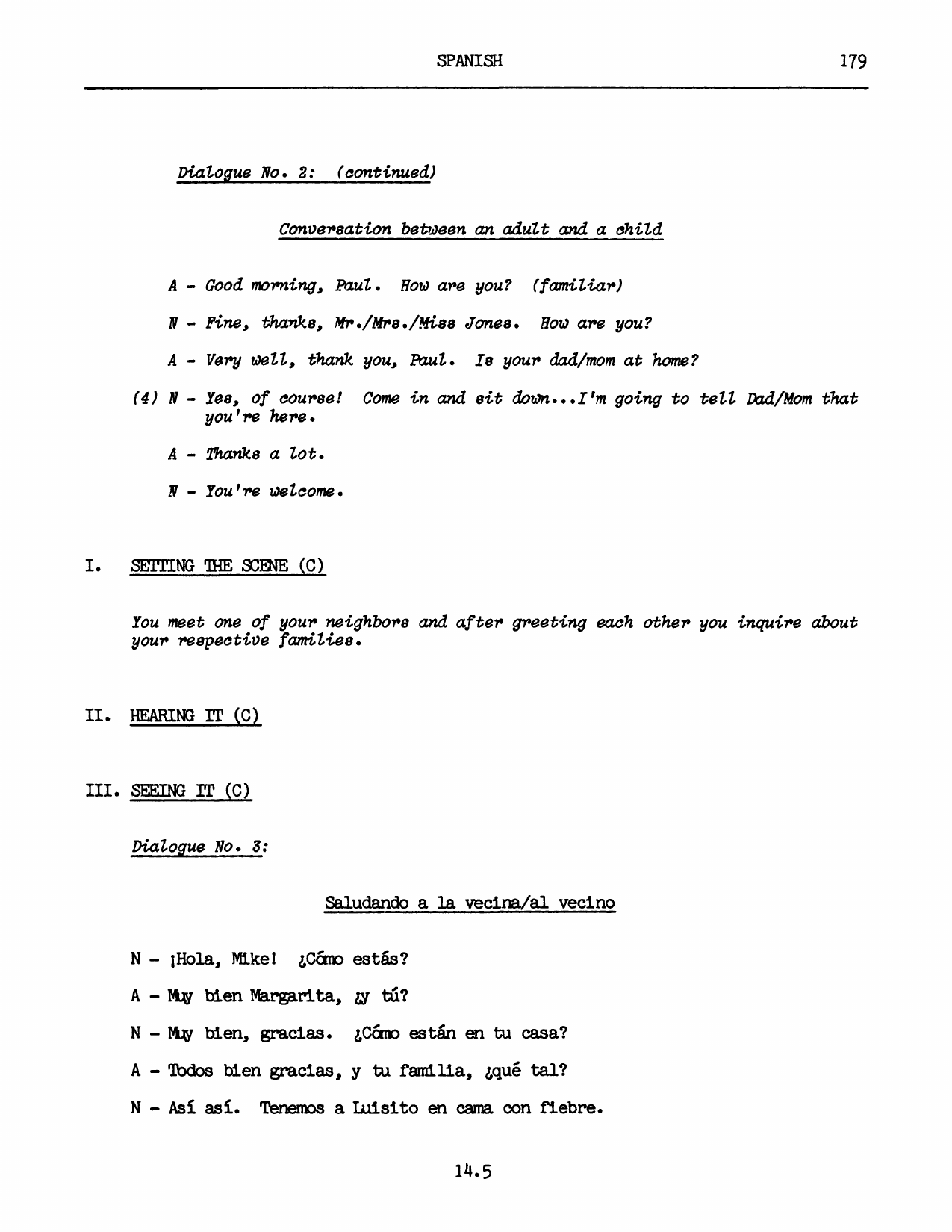
A - ¡An! Lo siento mucho (cuánto lo siento). Espero que se mejore pronto. N - Muchas gracias, Mike. Hasta luego.
A - Hasta luego, Margarita.
Dialogue No. 3: (continued)
Greeting a neighbor
N - Ht, Mike! How are you? (familiar)
A - Fine, Margarita, and you? (familiar)
N - Very well, thanks. How's everybody at your home?
(5) A - They are all well, thank you. And your family? How are they doing? (6) N- So-80. Luisito ts in bed with a fever.
A - Oh! I'm very sorry. I hope he gets well soon.
N - Thank you very much, Mike. So long.
A - So long, Margarita.
Language Notes
l. Me, le(s), se, and other object pronouns, such as nos, la(s), lo(s), and
te, are attached to the infinitive or "neutral" form of the verb, as in ayudarme.
2. Tutear is the verb that describes the act of addressing someone in the
familiar voice, as do hablarse de tú, tratarse de tú, or tutearse, all of which mean "to address one another with the familiar "tú" form."
Usted becomes tú in the familiar. Su and sus ("your") become tu and tus
(without an accent mark).
An -s is added to the "X" form of the verb to indicate that the familiar
"ta" form is being used.
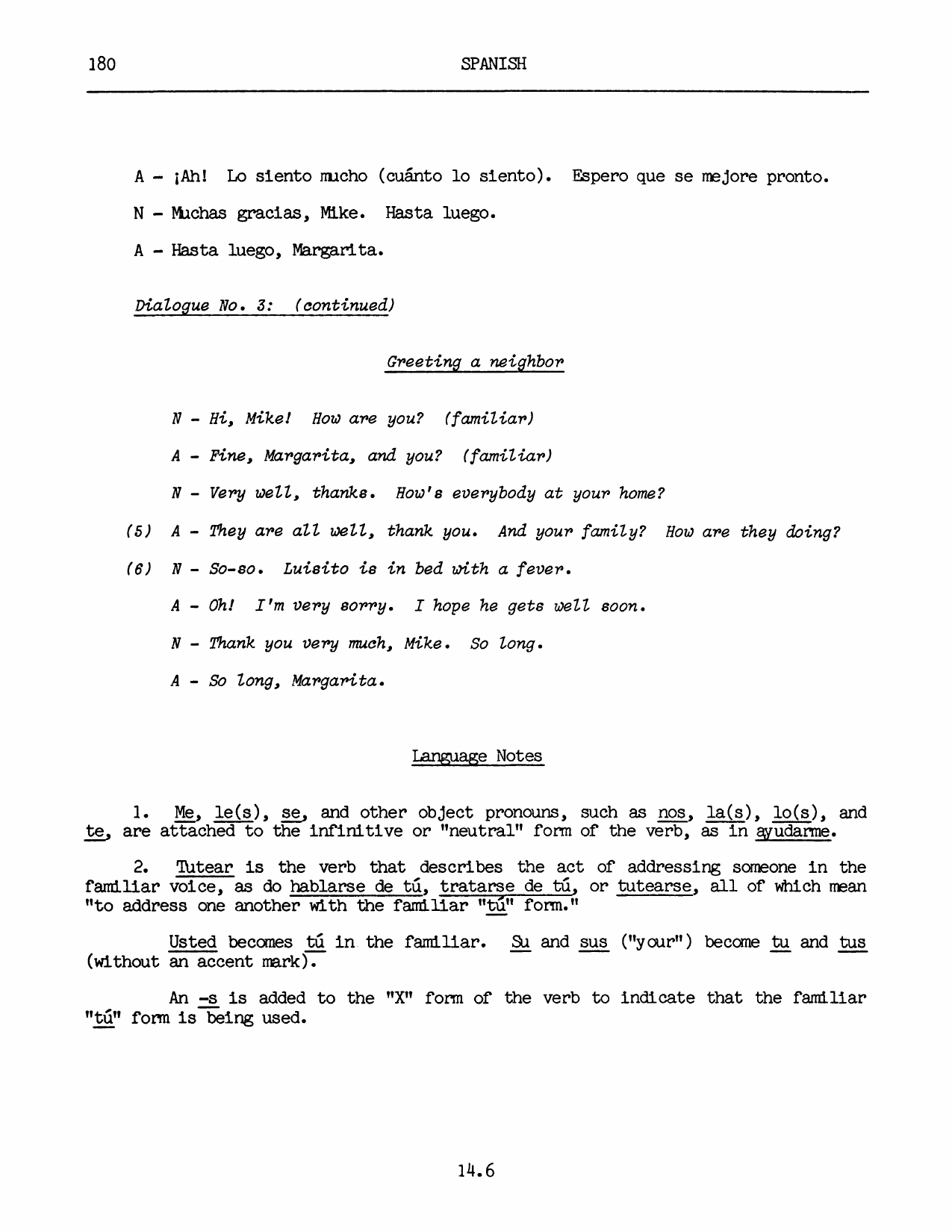
Examples:
3. No se ria de mi comes from the verb reirse ("to laugh").
Familiar:
4, Adelante, pase (usted), or pasen (ustedes)
The word adelante can be used to tell one or more persons to "come in." It
literally means "forward," "ahead," or "onward." The verb pasar can also be used to tell someone to "come in." When addressing one person, you would use the "X" form
5. ¿Qué tal? is an abbreviation for ¿Qué tal está/n (estás)? (meaning "How
are you (they)?" or "How are you (they) doing?"). It can also take on the meaning of "How about (you)?" as in ¿Qué tal (usted/tú)? or "How was the (party)?" as in ¿Qué tal (la fiesta)?
6. Luisito is the dimimutive of Luis. The dimimitive -ito/-ita adds an affec-
tionate or familiar quality to the word.
Narrative No. 1:
¡Vamos a tratarnos de tú!
Manuel le pregunta a usted que por qué no se tratan de tú. Usted le contesta que nunca aprendió a tutear en español, pero que va a tratar de hacerlo. Según Maruel, es my fácil, pues sólo tiene que decir "estás" en vez de "está." Usted no quiere que Manuel se ría si usted se equivoca.
Questions:
1 - ¿Qué le pregunta Manuel a usted?
What does Manuel ask you?
2 - ¿Cuándo aprendió usted a tutear en español?
When did you learn to use the familiar form in Spanish?
3 - ¿Qué va a tratar de hacer usted?
What are you going to try to do?
4 - Según Mamel, ¿qué es muy fácil?
According to Manuel, what's very easy?
5 - ¿Usted quiere que Maruel se ría?
Do you want Manuel to laugh?
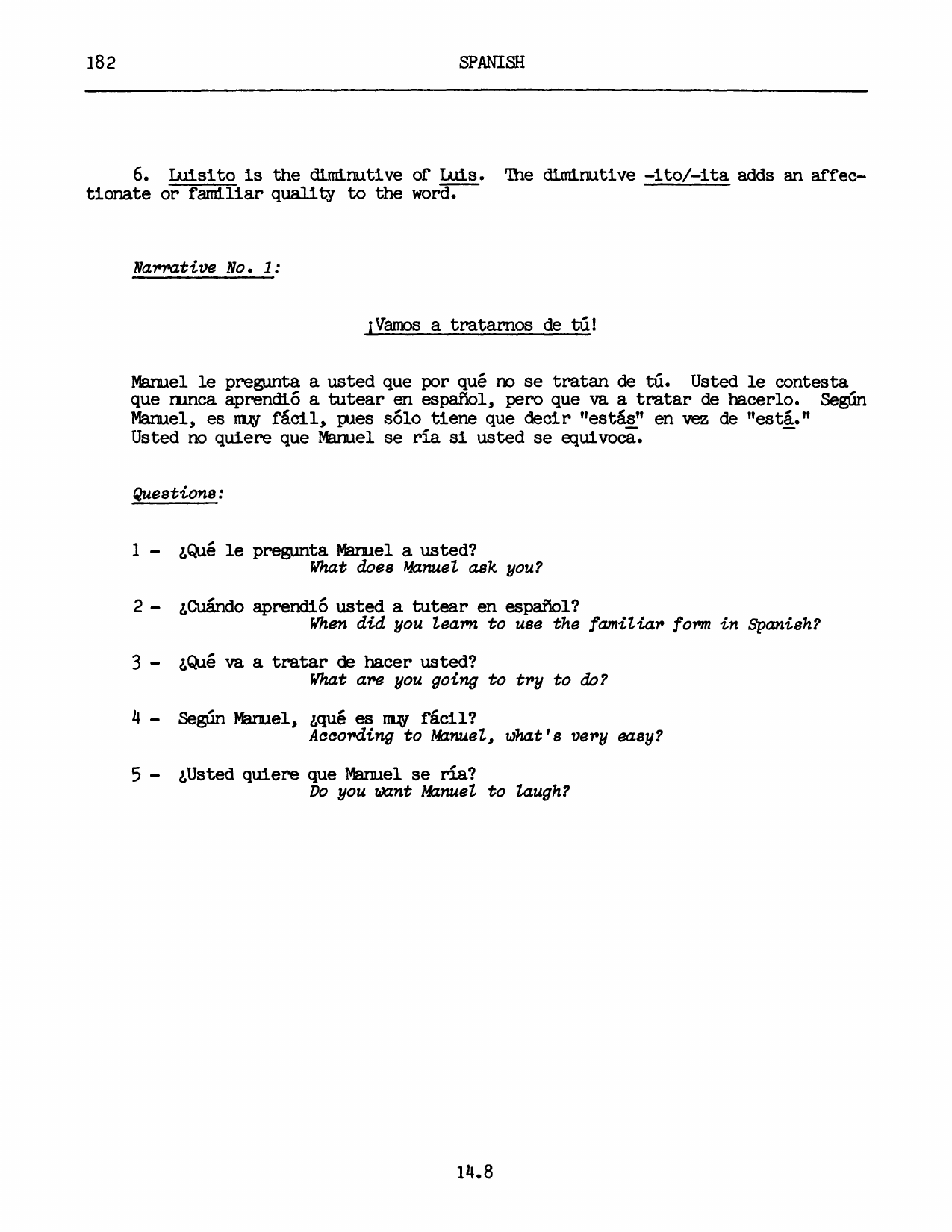
Fill in the Blanke - No. 1:
¡Vamos a tratarnos de ti!
de esta.
This page has a drawing, chart, or fill-in layout — original page
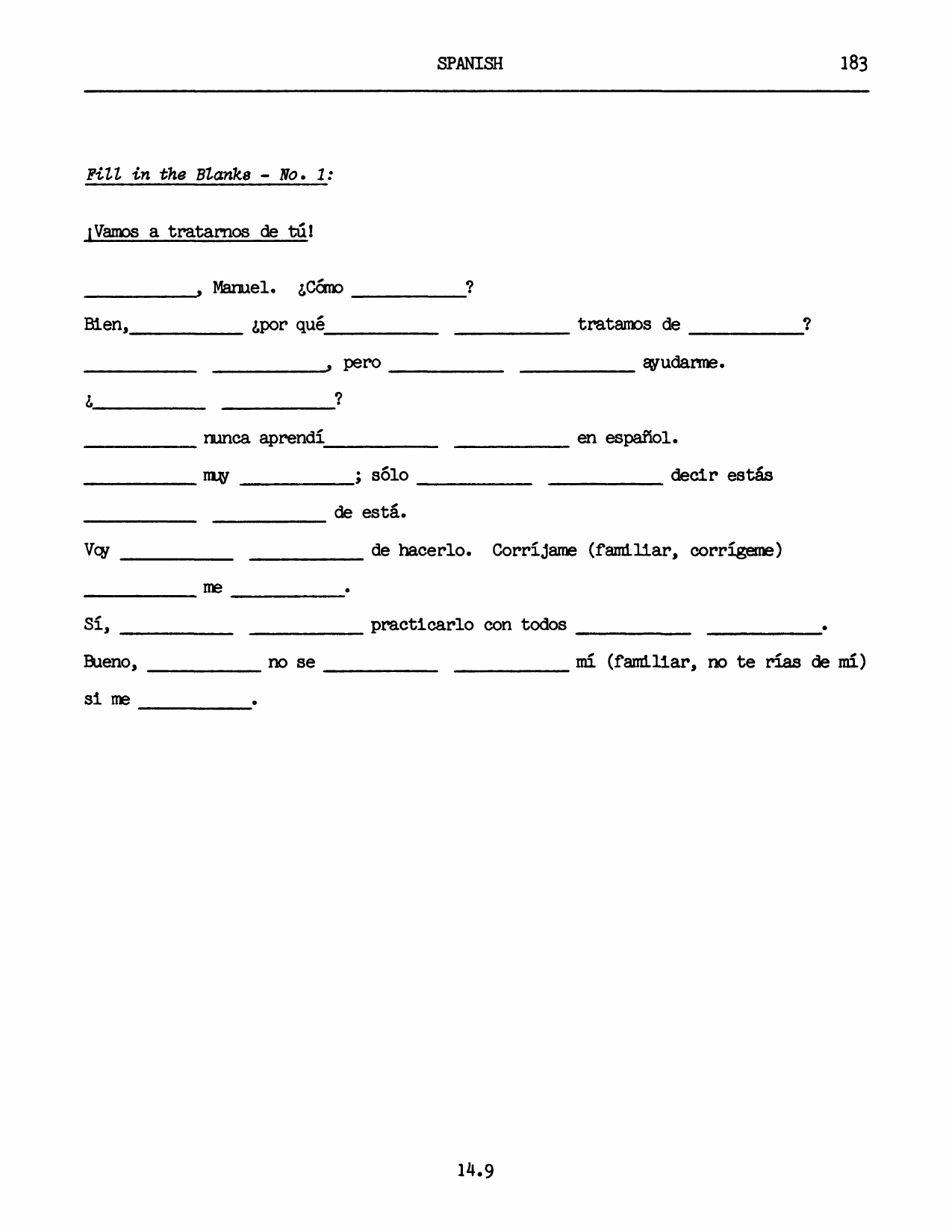
Fill in the Blanks - No. 2:
¡Vamos a tratarnos de ti!
¿Por qué?
(familiar, corrigeme) si me equivoco.
equivoco.
This page has a drawing, chart, or fill-in layout — original page
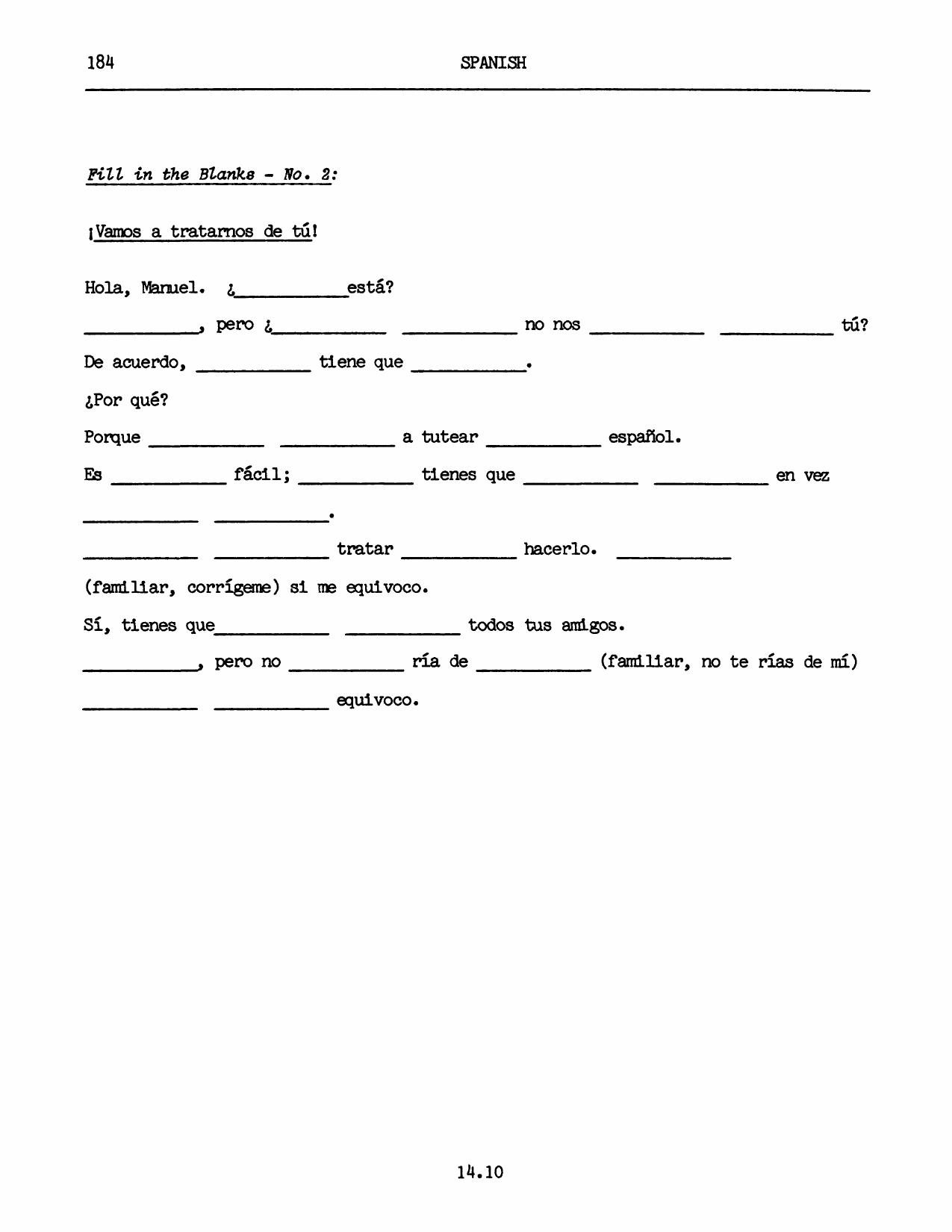
Narrative No. 2:
Conversación entre un adulto y un niño
El Sr./la Sra./la Srta. Jones y el niño Pablo se saludan con frases de cor-tesía. El Sr./la Sra./la Srta. Jones le pregunta a Pablo si su papá/mamá está en casa. El niño le dice que sí, y lo/la invita a pasar y a sentarse mientras él va a llamar a su papá/mamá. El Sr./la Sra./la Srta. Jones tutea a Pablo, pero el nifío lo/la trata de usted.
Questions:
1 - ¿Cómo se llaman las personas de esta narración?
What are the names of the persons in this narrative?
2 - ¿Esta conversación tiene lugar en la casa de Pablo o en la del Sr./de la
Sra./de la Srta. Jones?
Does this conversation take place in Pablo's house or in Mr./Mrs./Mise Jones'?
3 - ¿Qué quiere el Sr./la Sra./la Srta. Jones?
What does Mr./Mre./Miss Jones want?
y - ¿Qué va a hacer Pablo?
What is Pablo going to do?
5 - ¿Cómo se tratan el Sr./la Sra./la Srta. Jones y Pablo?
How do Mr./Mre./Miss Jones and Pablo address one another?
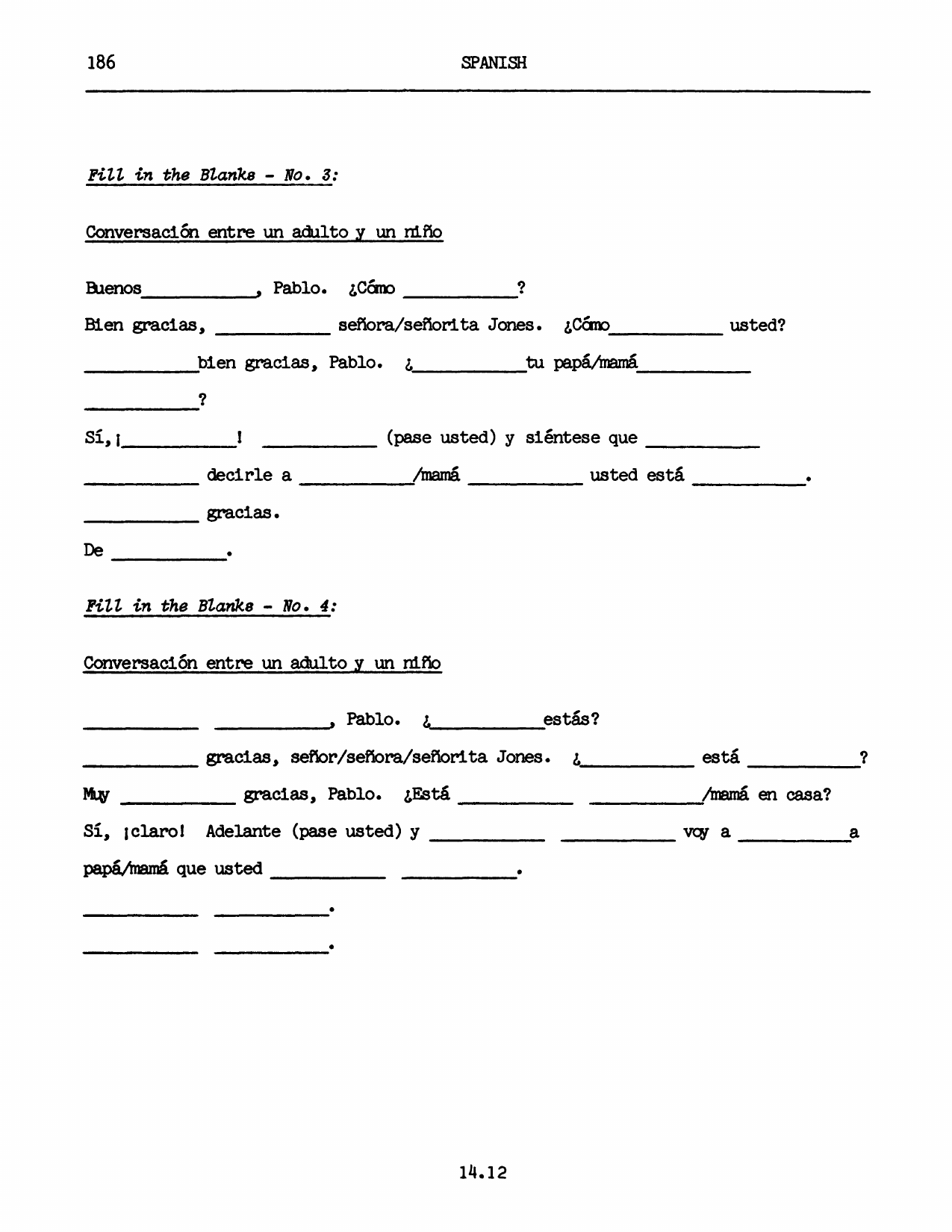
Fill in the Blanke - No. 3:
Conversación entre un adulto y un niño
?
gracias.
Fill in the Blanke - No. 4:
Conversación entre un adulto y un niño
papá/mamá que usted tC
14,12
This page has a drawing, chart, or fill-in layout — original page
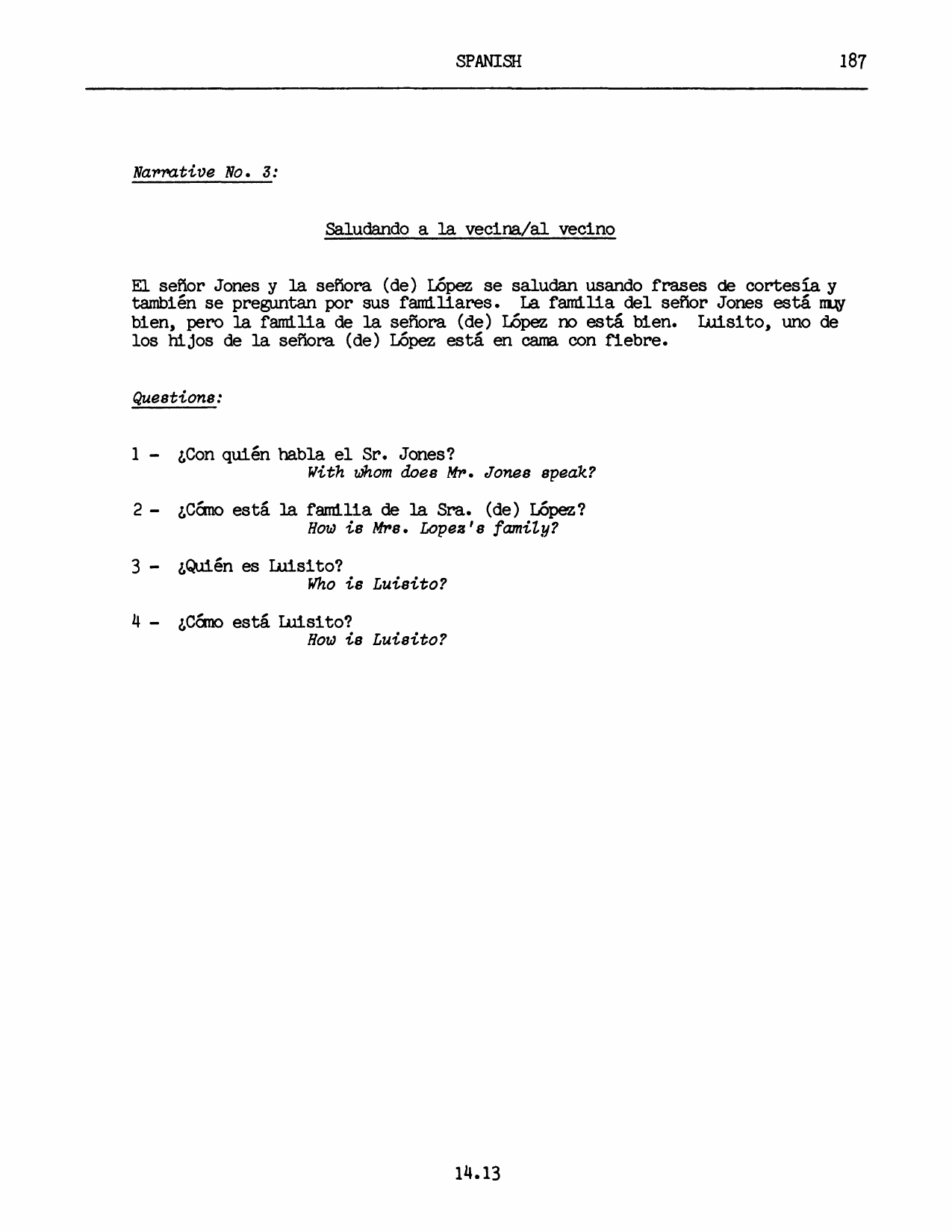
Narrative No. 3:
Saludando a la vecina/al vecino
El señor Jones y la señora (de) López se saludan usando frases de cortesía y también se preguntan por sus familiares. La familia del señor Jones está my bien, pero la familia de la señora (de) López no está bien. Luisito, uno de los hijos de la señora (de) López está en cama con fiebre.
Questions:
1 = ¿Con quién habla el Sr. Jones?
With whom does Mr. Jones speak?
2 - ¿Cómo está la familia de la Sra. (de) López?
How ts Mrs. Lopes's family?
3 - ¿Quién es Luisito?
Who ts Luisito?
4 — ¿Cómo está Luisito?
How te Lutsito?
14,13
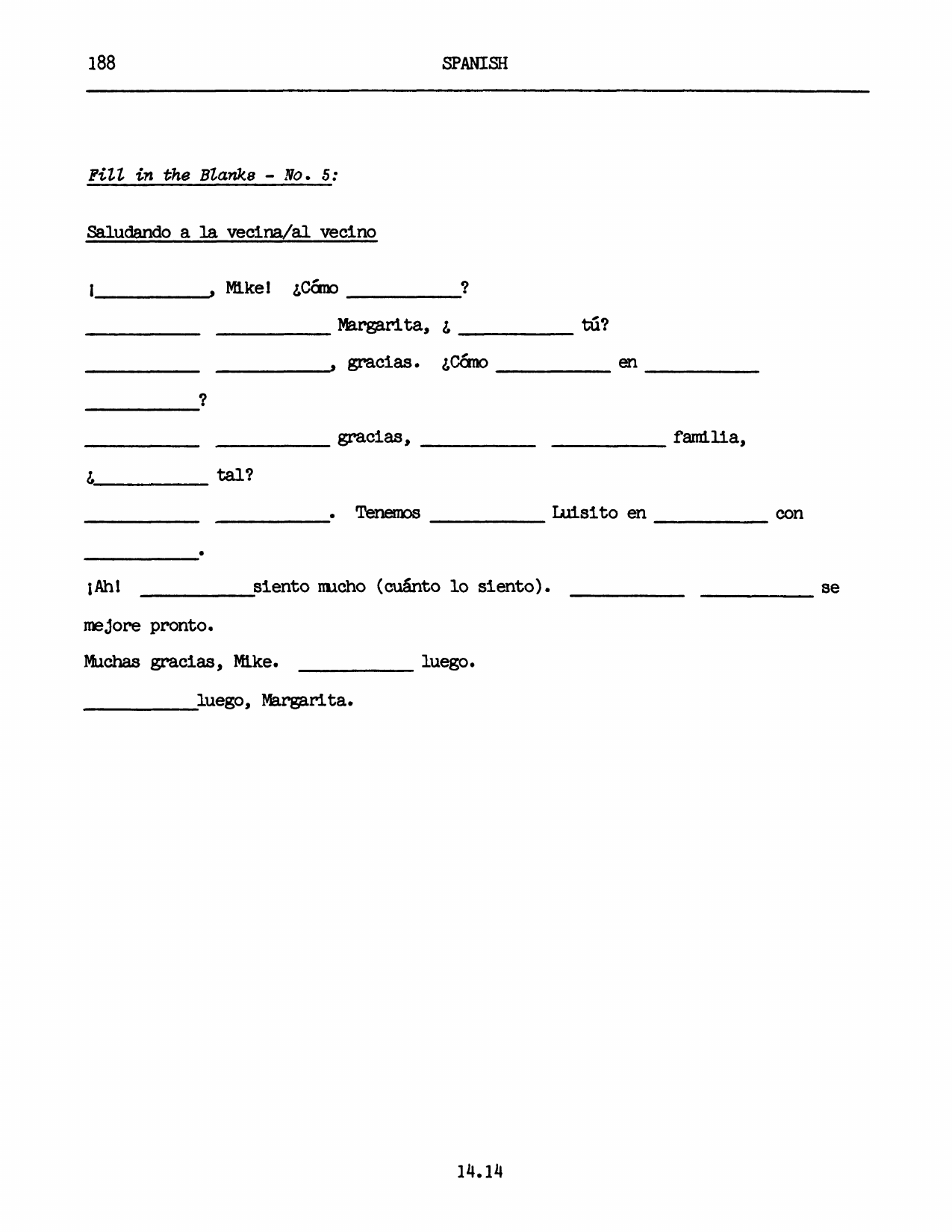
Fill in the Blanks - No. 5:
Saludando a la vecina/al vecino
, gracias. ¿Cómo
mejore pronto.
luego, Margarita.
This page has a drawing, chart, or fill-in layout — original page
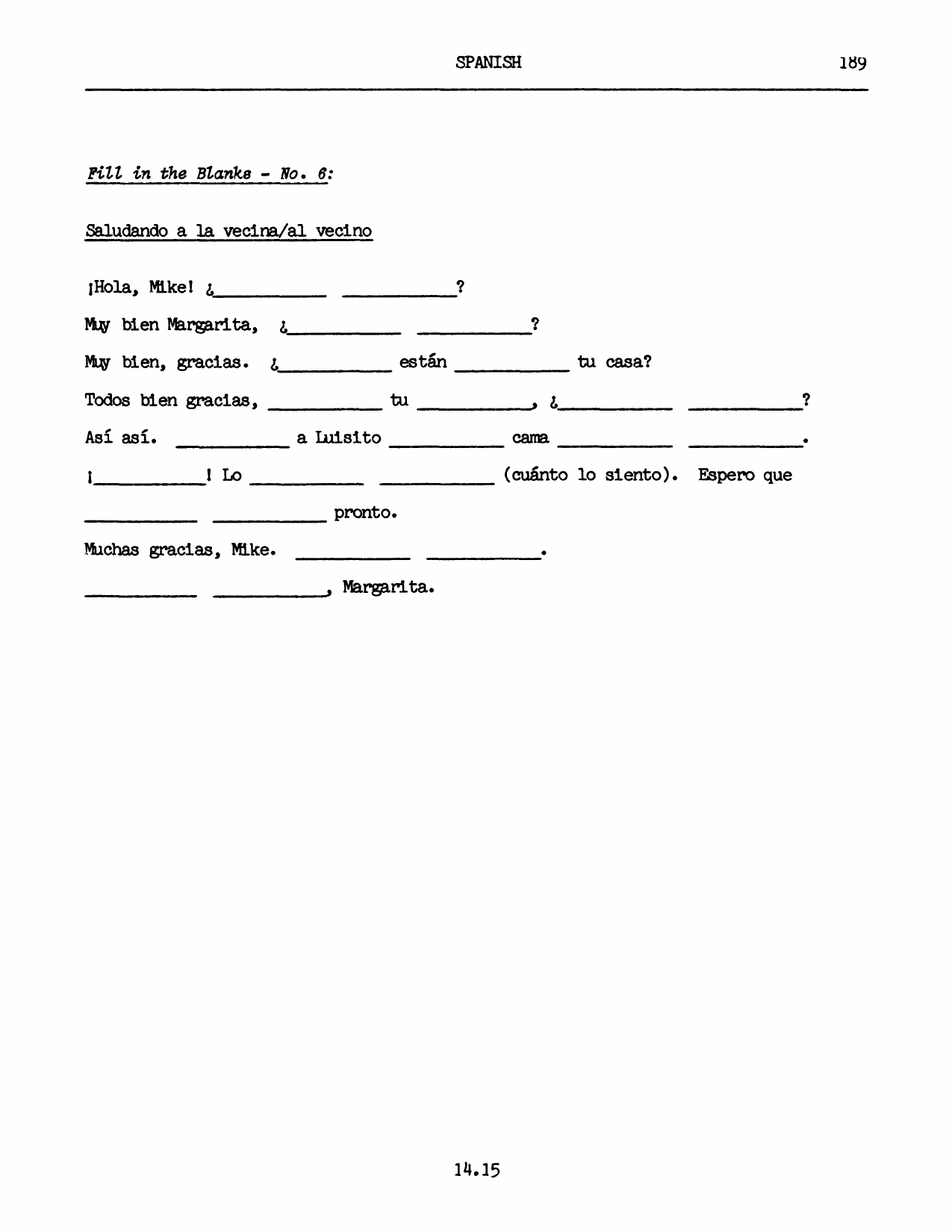
Fill in the Blanks - No. 6:
Saludando a la vecina/al vecino
pronto.
, Margarita.
14,15
This page has a drawing, chart, or fill-in layout — original page
IV. TAKING IT APART
Vocabulary:
Dialogue No. 1
command)
Let's address each other with the familiar form, "tú"!
me equivoco
(I) make a mistake
Narrative No. 1
form, "gr
Dialogue No. 2
estás
(you) are (familiar)
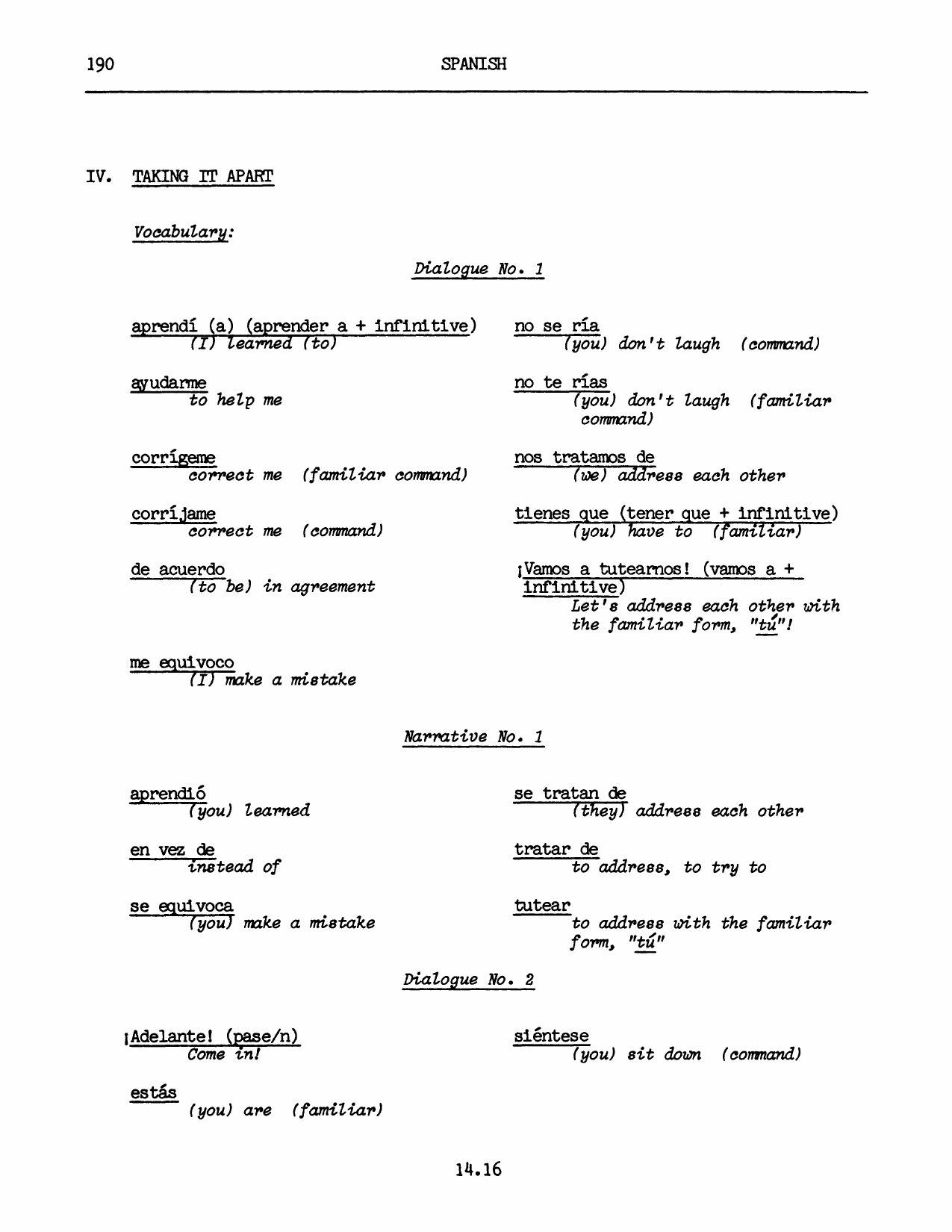
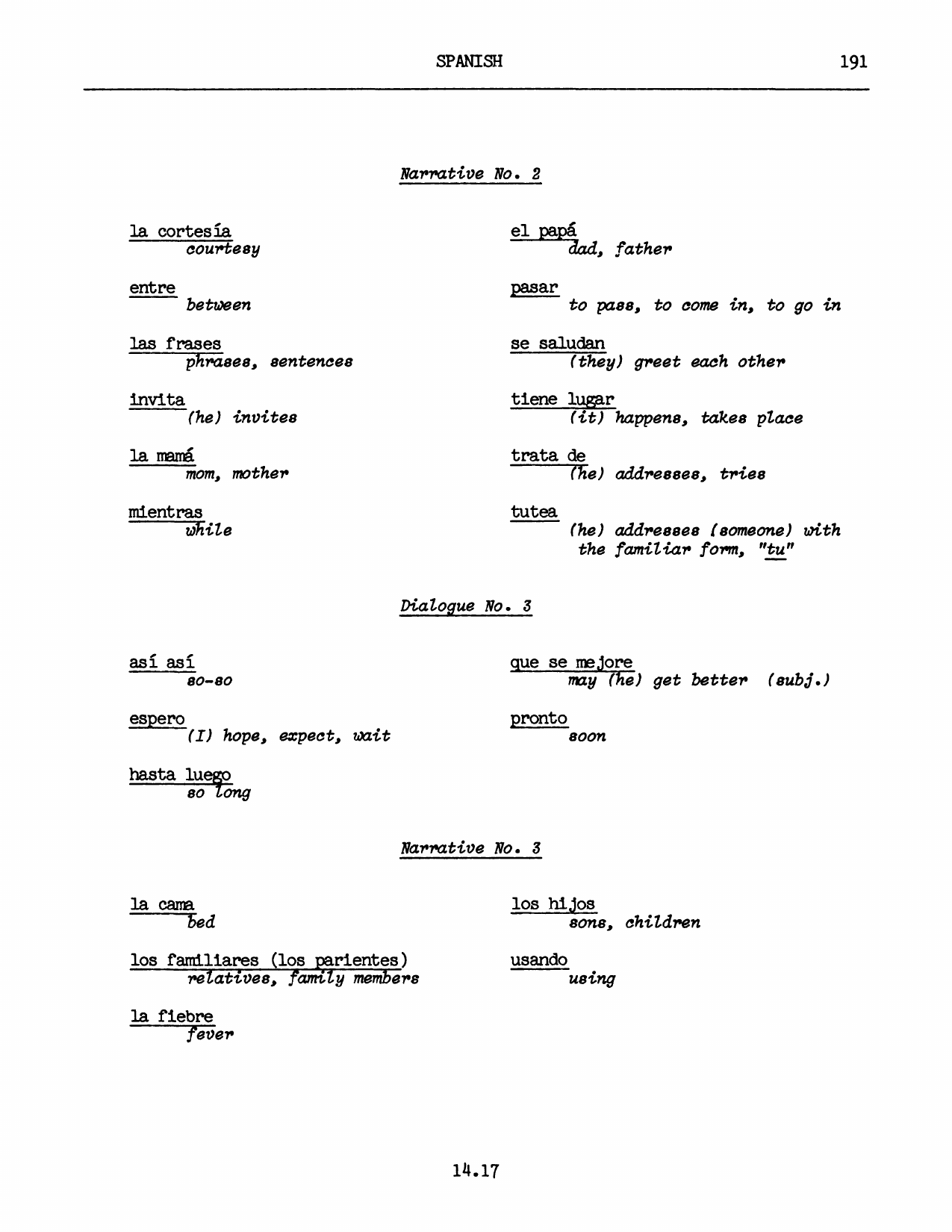
Narrative No. 2
the familiar form, "tu"
Dialogue No. 3
me
Narrative No. 3
la fiebre
ever
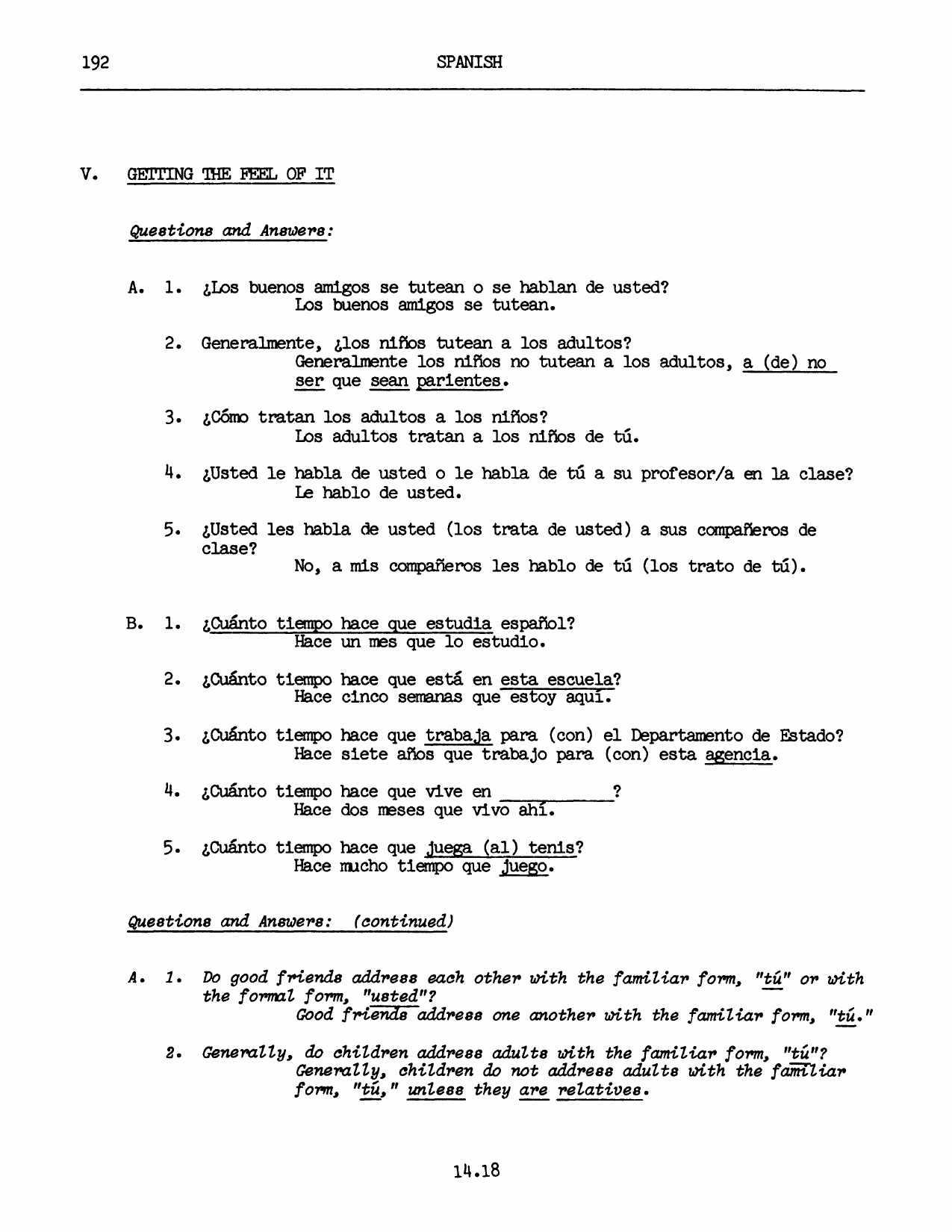
V. GETTING THE FEEL OF IT
Questions and Answers:
A. 1. ¿Los buenos amigos se tutean o se hablan de usted?
Los buenos amigos se tutean.
2. Generalmente, ¿los niños tutean a los adultos?
Generalmente los niños no tutean a los adultos, a (de) no ser que sean parientes.
3. ¿Cómo tratan los adultos a los niños?
Los adultos tratan a los niños de tú.
4, ¿Usted le habla de usted o le habla de tú a su profesor/a en la clase?
Le hablo de usted.
5. ¿Usted les habla de usted (los trata de usted) a sus compañeros de
clase?
No, a mis compañeros les hablo de tú (los trato de tú).
B. 1. ¿Cuánto tiempo hace que estudia español?
Hace un mes que lo estudio.
2. ¿Cuánto tiempo hace que está en esta escuela?
Hace cinco semanas que estoy aquí.
3. ¿Cuánto tiempo hace que trabaja para (con) el Departamento de Estado?
Hace siete años que trabajo para (con) esta agencia.
Hace dos meses que vivo ahí.
5. ¿Cuánto tiempo hace que juega (al) tenis?
Hace mucho tiempo que juego.
Questions and Answers: (continued)
A. 1. Do good friends address each other with the familiar form, "ti" or with
the formal form, "usted"?
Good friends address one another with the familiar form, "ti."
2. Generally, do children address adults with the familiar form, "tú"?
Generally, children do not address adults with the familiar form, "tú," unless they are relatives.
3. How do adults address children?
Adults address children with the familiar form, "tu."
4. In class, do you address your teacher with the formal form, "ueted" or
with the familiar form, "tú"?
I address him/her with the formal form, "usted."
5. Do you address your clasematee with the formal form, "usted"?
No, I address my clasematee with the familiar form, "tú."
B. 1. How long have you been studying Spanish?
(Literatly, "How Tong does i make that you study Spanish?")
I have been studying it for one month.
2. How long have you been in this school?
I have been here for five weeks.
3. How long have you been working for the Department of State?
I've been working for this agency for seven years.
I've been living there for two months.
5. How long have you been playing tennis?
I've been playing for a long time?
VI. PUTTING IT TOGETHER
Vartante:
Dialogue No. 1
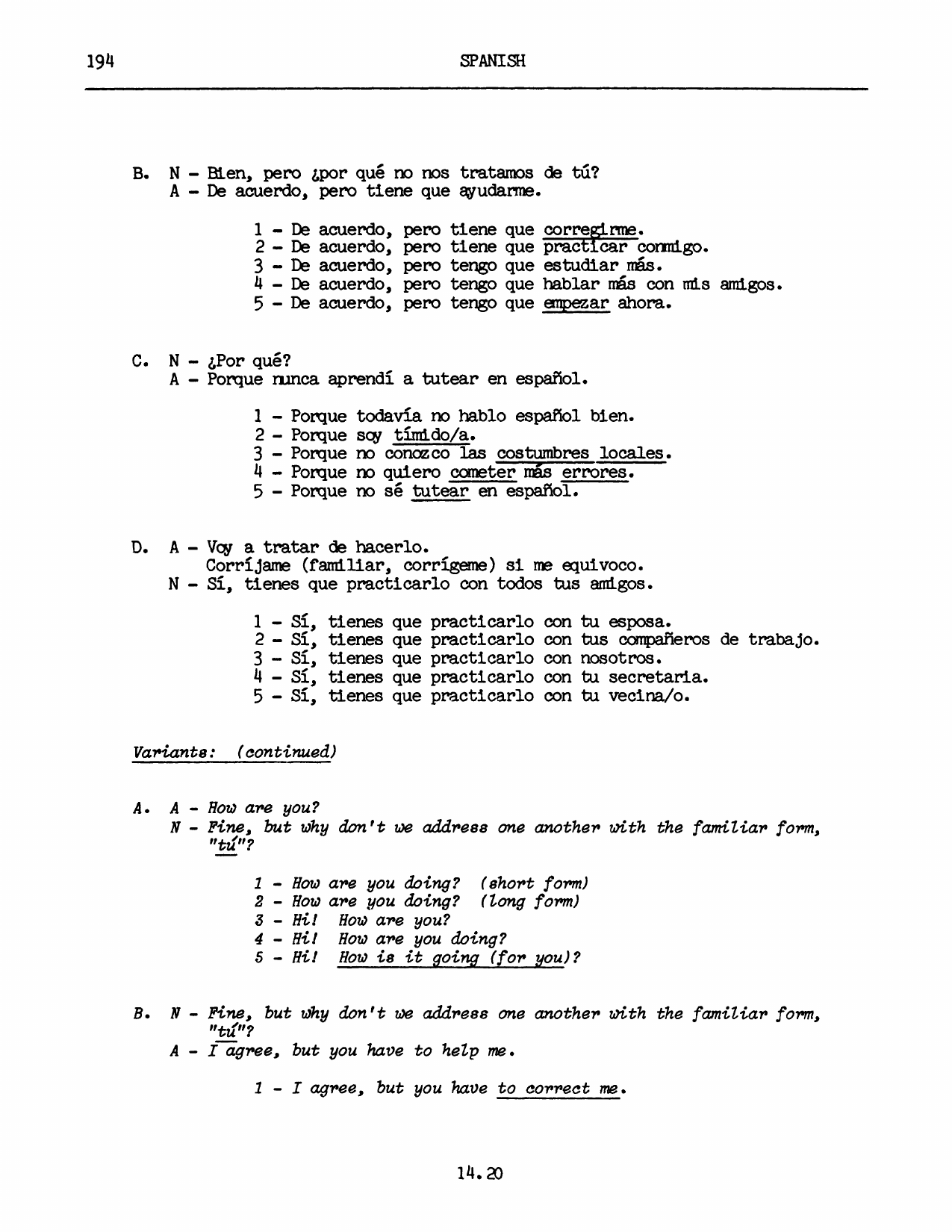
N - Bien, pero ¿por qué no nos tratamos de tú?
1 - ¿Qué tal?
2 - ¿Qué tal está? (familiar: ¿Qué tal estás?)
3 - ¡Hola! ¿Cómo está? (familiar: ¡Hola! ¿Cómo estás?) Y — ¡Hola! ¿Qué tal?
5 - ¡Hola! ¿Cómo le va? (familiar: ¡Hola! ¿Cómo te va?)
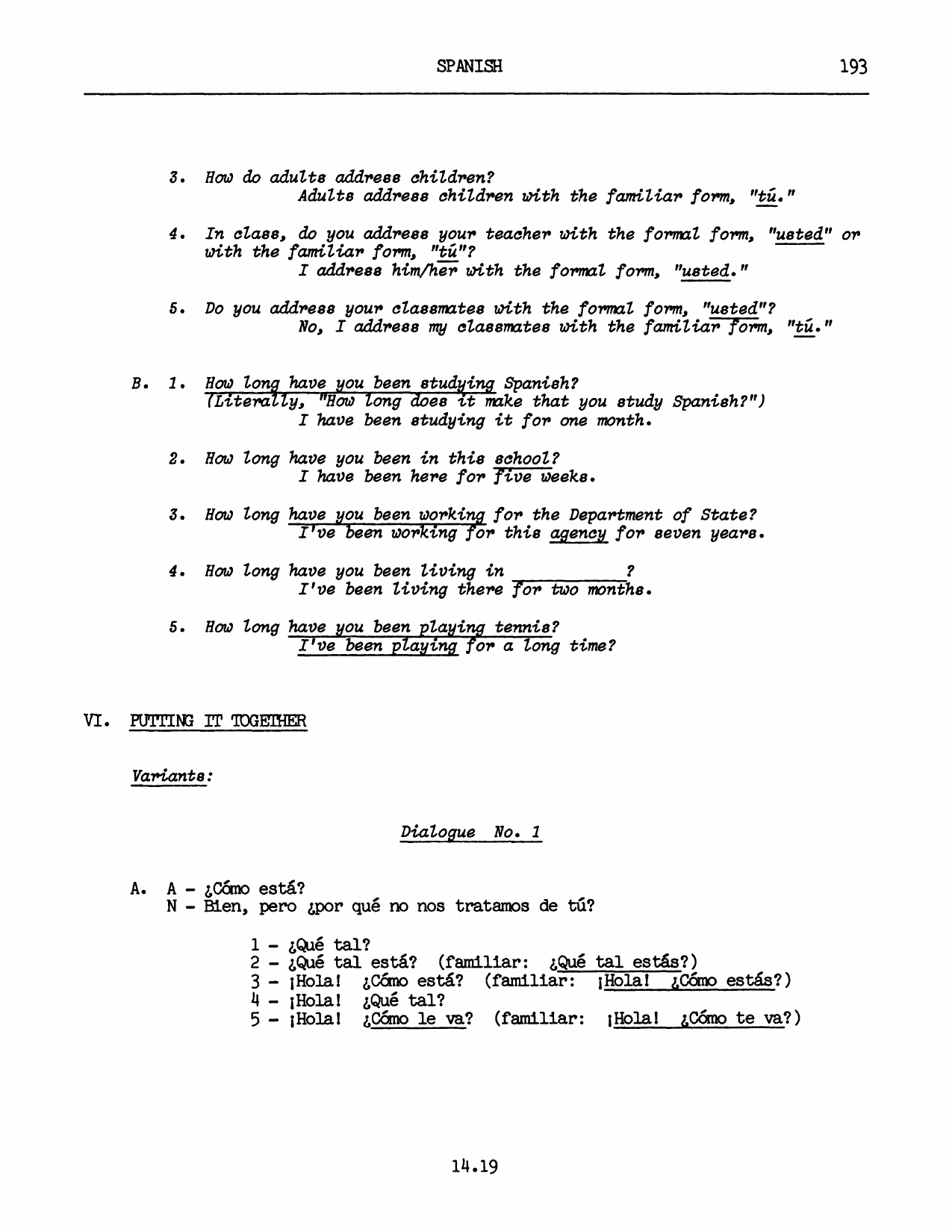
B. N — Bien, pero ¿por qué no nos tratamos de tú?
A - De acuerdo, pero tiene que ayudarme.
1 - De acuerdo, pero tiene que ore me.
2 - De acuerdo, pero tiene que practicar cormigo.
3 - De acuerdo, pero tengo que estudiar más.
4 - De acuerdo, pero tengo que hablar más con mis amigos. 5 - De acuerdo, pero tengo que empezar ahora.
C. N= ¿Por qué?
A —- Porque runca aprendí a tutear en español.
1 - Porque todavía no hablo español bien.
2 - Porque soy tímido/a.
3 - Porque no conozco las costumbres locales.
4 — Porque no quiero cometer más errores.
5 - Porque no sé tutear en español.
D. A — Voy a tratar de hacerlo.
Corríjame (familiar, corrígeme) si me equivoco.
N - Sí, tienes que practicarlo con todos tus amigos.
1 - Sí, tienes que practicarlo con tu esposa.
2 - Sí, tienes que practicarlo con tus compañeros de trabajo. 3 - Sí, tienes que practicarlo con nosotros.
4 - Sí, tienes que practicarlo con tu secretaria.
5 - Sí, tienes que practicarlo con tu vecina/o.
Variants: (continued)
A. A - How are you?
N- Fine, but why don't we address one another with the familiar form,
1 - How are you doing? (short form)
2 - How are you doing? (long form)
3 - Hi! How are you?
4 - Hil How are you doing?
5 - Hi! How is it going (for you)?
Bo N- Fine, but why don't we address one another with the familiar form,
”n "o
A - I agree, but you have to help me.
1 - I agree, but you have to correct me.
14,20
2 - I agree, but you have to practice with me.
3 - I agree, but I have to study more.
4 - I agree, but I have to talk more with my friends. 5 - I agree, but I have to start now.
C. N- Why?
A - Because I never learned to use the familiar form in Spanish.
1 - Because I still don't speak Spanish well.
2 - Because I am bashful.
3 - Because I'm not acquainted with local customs.
4 - Because I don't want to make more mistakes.
5 - Because I don't know how to use the familiar form in Spanish.
D. A- I'll try to do it.
Correct me if I make a mistake.
N. Yes, you have to practice it with all your friends. (familiar)
1 - Yes, you have to practice it with your wife. (familiar) 2 - Yes, you have to practice it with your co-workers. (familiar) 3 - Yes, you have to practice it with us. (familiar) 4 - Yes, you have to practice it with your secretary. (familiar) 5 - Yes, you have to practice it with your neighbor. (familiar)
VII. MAKING IT WORK
VIII. USING IT