CYCLE 15
MEETING PEOPLE
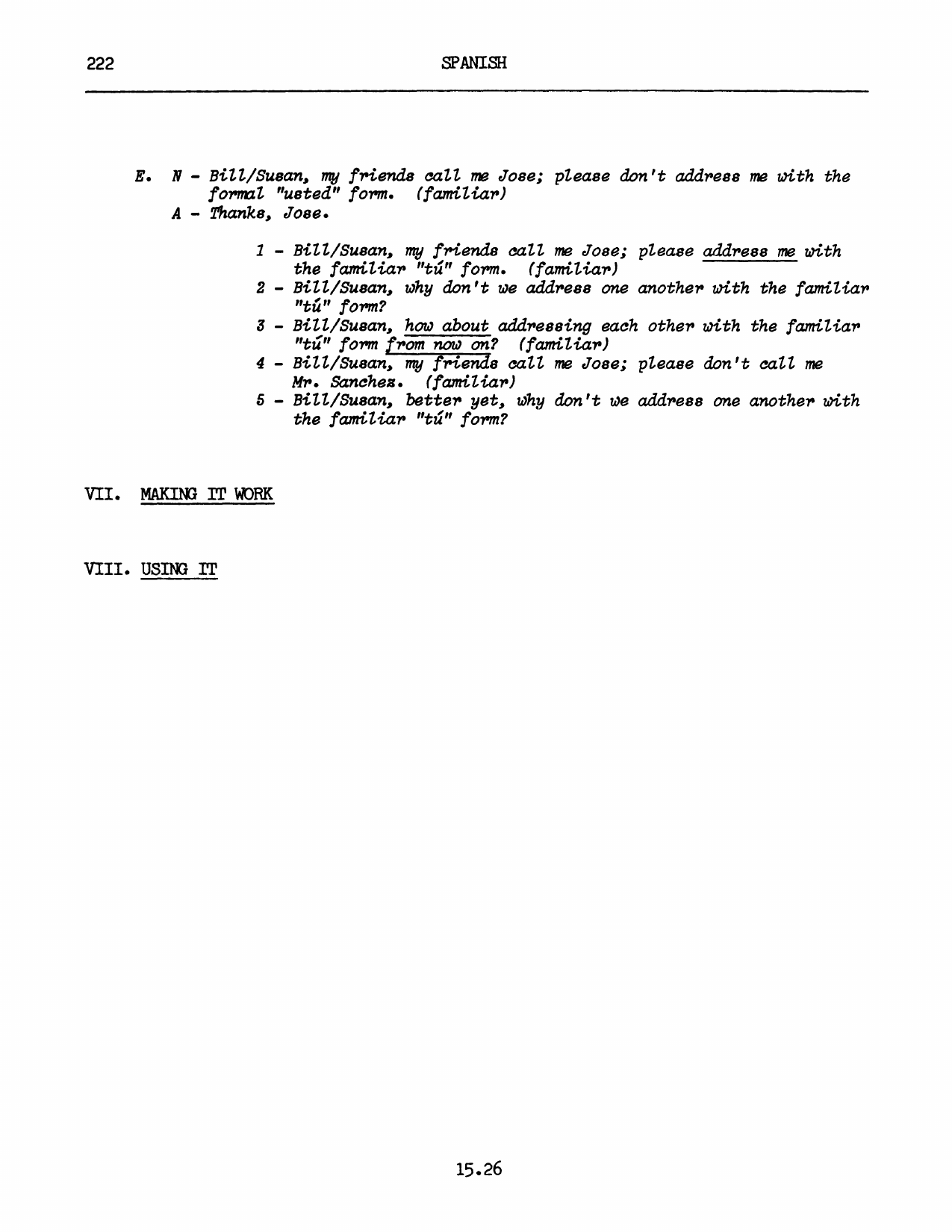
Knowing how to introduce people will give you added confidence, both
professionally and socially, when dealing with host-country nationals. One advantage that Spanish-speaking people enjoy in making introductions is that they do not need to remember the name of the person who is being introduced. They can simply say "un amigo," thus avoiding the embarrassment of forgetting someone's name; it is then up to the person being introduced to give his/her name. When introducing two people, it is customary to introduce the younger person to the older person, the man to the woman, and the person of lower rank to the one of higher rank. Upon intro-duction, it is also customary with both men and women to shake hands. When giving their names, some people may add polite phrases, such as a sus Órdenes or para
This page has a drawing, chart, or fill-in layout — original page
servirle ("at your service"), or su servidor or un servidor ("your (humble) ser-vant"—used by men). Ask your teacher about usage in his/her country.
This (ycle will introduce you to the social conventions involved when meeting
people in the Spanish-speaking world.

I. SETTING THE SCENE (A)
A new Vice-consul has just arrived from the United States and Jose Sánchez, one of the national Embassy employees, has not yet met the Vice-consul. It will be up to you to introduce them.
II. HEARING IT (A)
III. SEEING IT (A)
Dialogue No. 1:
El mevo/la meva vicecónsul
A - José, ¿tú conoces a Bill/Susan?
N - A B111/Susan. .. ¿qué?
A - A B111/Susan Jones, el/la mevo/a vicecónsul que llegó ayer de (los)
«UV.
N - No, no lo/la conozco y quiero conocerlo/a.
A - Sí tú quieres, yo puedo presentártelo/a a las cinco.
N - My bien. ¿Dónde, aquí o en la oficina?
A - En la oficina a las cinco.
N - Hasta las cinco, entonces.
Dialogue No. 1: (continued)
The new Vice-consul
A - José, have you met Bill/Susan? (familiar)
N - Bill/Susan who?
(3) A - Bill/Susan Jones, the new Vice-consul who arrived yesterday from the
United States.
N - No, I haven't met him/her and I'd like to meet him/her.
(1) A - If you'd like, I can introduce him/her to you at five o'clock.
(familiar)
WN - Very well. Where, here or at the office?
A - At the office at five.
N - Until five, then.
TI. SETTING THE SCENE (B)
You have agreed to meet Jose at the office at five o'clock to introduce him to the new Vice-consul. It te now five o'clock. Let's see what happens.
II. HEARING IT (B)
III. SEEING IT (B)
Dialogue No. 2:
La presentación
A - José, quiero presentarte a Bill/Susan, el/la mevo/a vicecónsul que
piensa quedarse un año con nosotros.
N - Mucho gusto de conocerte, B111/Susan. José Sánchez, a tus Órdenes. A - El gasto es mío, señor Sánchez .
N - Bill/Susan, mis amigos me llaman José, por favor no me hables de usted. A - Gracias, José.
N - De nada, Bi11/Susan.
Dialogue No. 2: (continued)
The introduction
(1) A - José, I'd like you to meet Bill/Susan, the new Vice-consul who is
(1) N - Very pleased to meet you. Jose Sánchez, at your service. (familiar)
A - The pleasure is mine, Mr. Sanchez.
N - Bill/Susan, my friends call me José; please don't address me with the
formal "usted" form. (familiar)
A - Thanks, Jose.
N - You're welcome, Bill/Suean.
I. SETTING THE SCENE (C)
A friend of yours, who is a host-country national, wants you to meet a friend of hie.
II. HEARING IT (C)
III. SEEING IT (C)
Dialogue No. 3:
Fn una flesta
N - ¡Hola, Bill/Susan! ¿Cómo estás?
A = Bastante bien, Tomás. ¿Y tú?
N - Bien gracias. Ven, quiero presentarte a un amigo mío, el doctor Juan
Guzmán Arteaga.
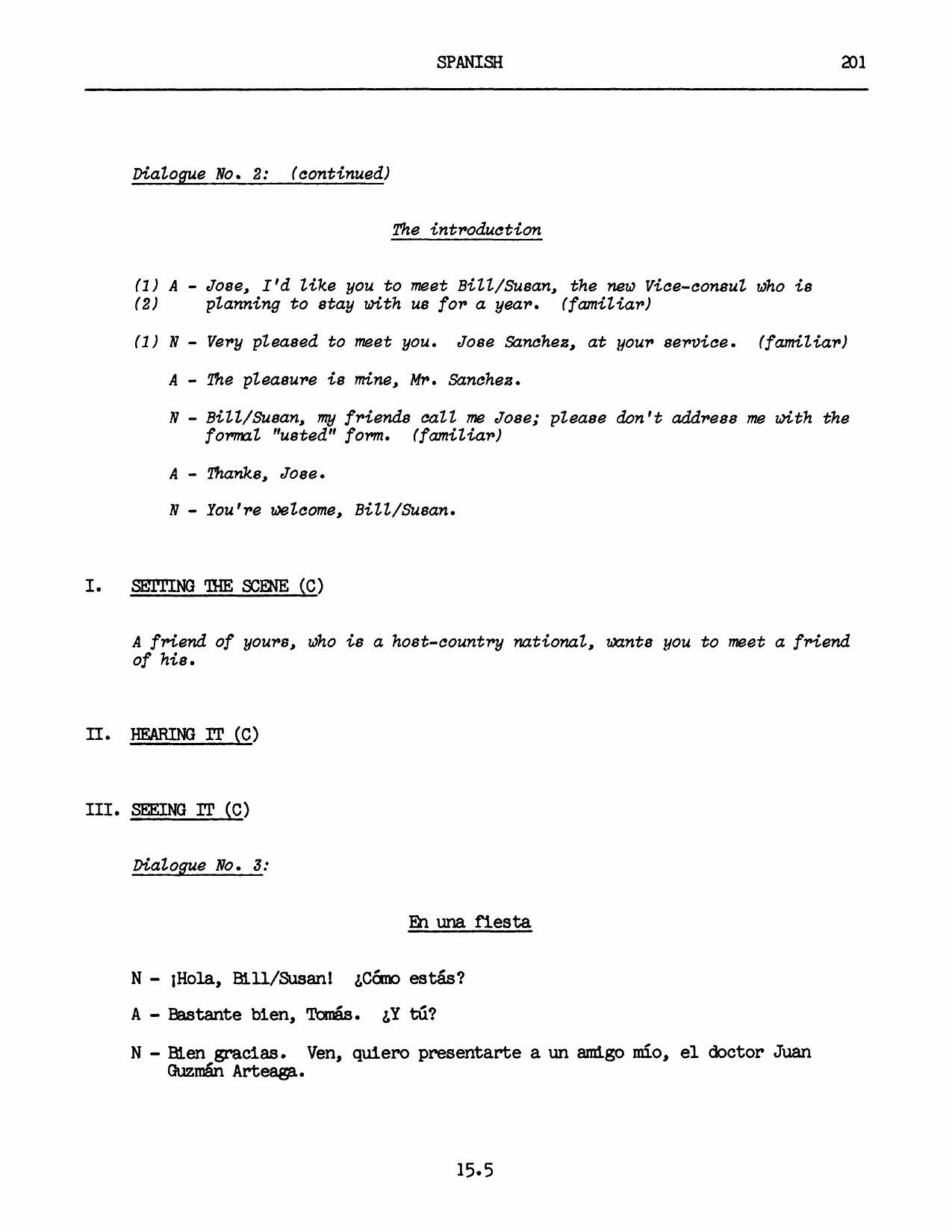
(Después de un rato)
N - Juan, quisiera presentarte a un/una amigo/a mío/a, B111/Susan Jones. N = Mucho gusto de conocerte, Bill/Susan. Los amigos de Tomás son amigos míos
también.
A - El gusto es mío, Juan, y muchas gracias.
Dialogue No. 3: (continued)
At a party
N - Hello, Bill/Susan! How are you? (familiar)
A - Pretty well, Tomas. And you? (familiar)
(1) N - Fine, thanks. Come, I'd like you to meet a friend of mine, Dr. Juan
Guaman Arteaga. (familiar)
(After a white)
W - Juan, I'd like you to meet a friend of mine, Bill/Susan Jones.
(familiar)
N - Glad to meet you, Bill/Susan. A friend of Tomas' is also a friend of
mine. (familiar)
A - The pleasure is mine, Juan, and thank you very much.
Language Notes
1. Notice the use of the familiar form: estás, conoces, quieres, tú, te, etc.
The familiar presentarte corresponds to the more formal presentarle; that is, the object pronouns for "you" are different. Compare:
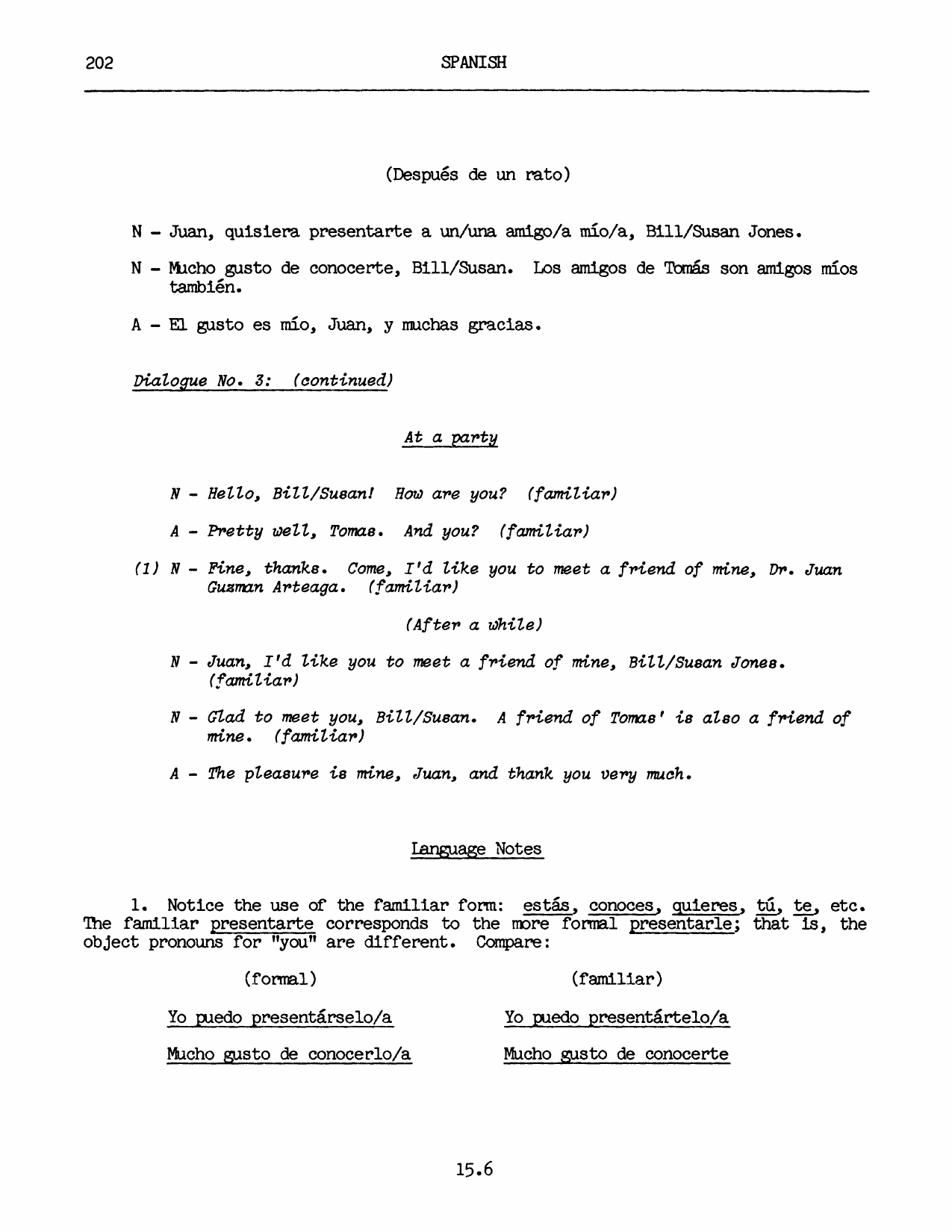
Ven is the familiar direct command form of the verb ir; vengas, as in
Quiero que vengas or No vengas, is the familiar "soft" command form of the verb ir.
2. Pensar (piensa) is another useful verb for you to learn. It means roughly
the same thing as "to think about," or "to plan to."
Here are the forms of the verb pensar:
"I" form "We" form "X" form "X+" form "Tú" form
Pd
3. The abbreviation for (los) Estados Unidos that you will often see, par-
ticularly when reading the newspaper, 1s EE.UU. The double letters denote that a plural is being abbreviated. In recent years other abbreviations for "United States," such as E.U. and E.U.A., have gained acceptance.
Narrative No. 1:
El/La mevo/a vicecónsul
Usted le pregunta a José si conoce a Bi11/Susan Jones, el/la nuevo/a fun-cionario/a que llegó ayer de (los) Estados Unidos, y que piensa trabajar en la Embajada por un año. José le contesta a usted que él no lo/la conoce y que quiere conocerlo/a. Usted le dice que puede presentárselo/a hoy a las cinco de la tarde en la oficina.
Questions:
1 - ¿Qué le pregunta usted a José?
What do you ask Jose?
2 - ¿Quién llegó ayer?
Who arrived yesterday?
3 - ¿De dónde llegó el/la mevo/a funcionario/a?
Where did the new officer come from?
4 — ¿Dónde y por cuánto tiempo piensa trabajar el/la mevo/a funcionario/a?
Where and for how long does the new officer plan to work?
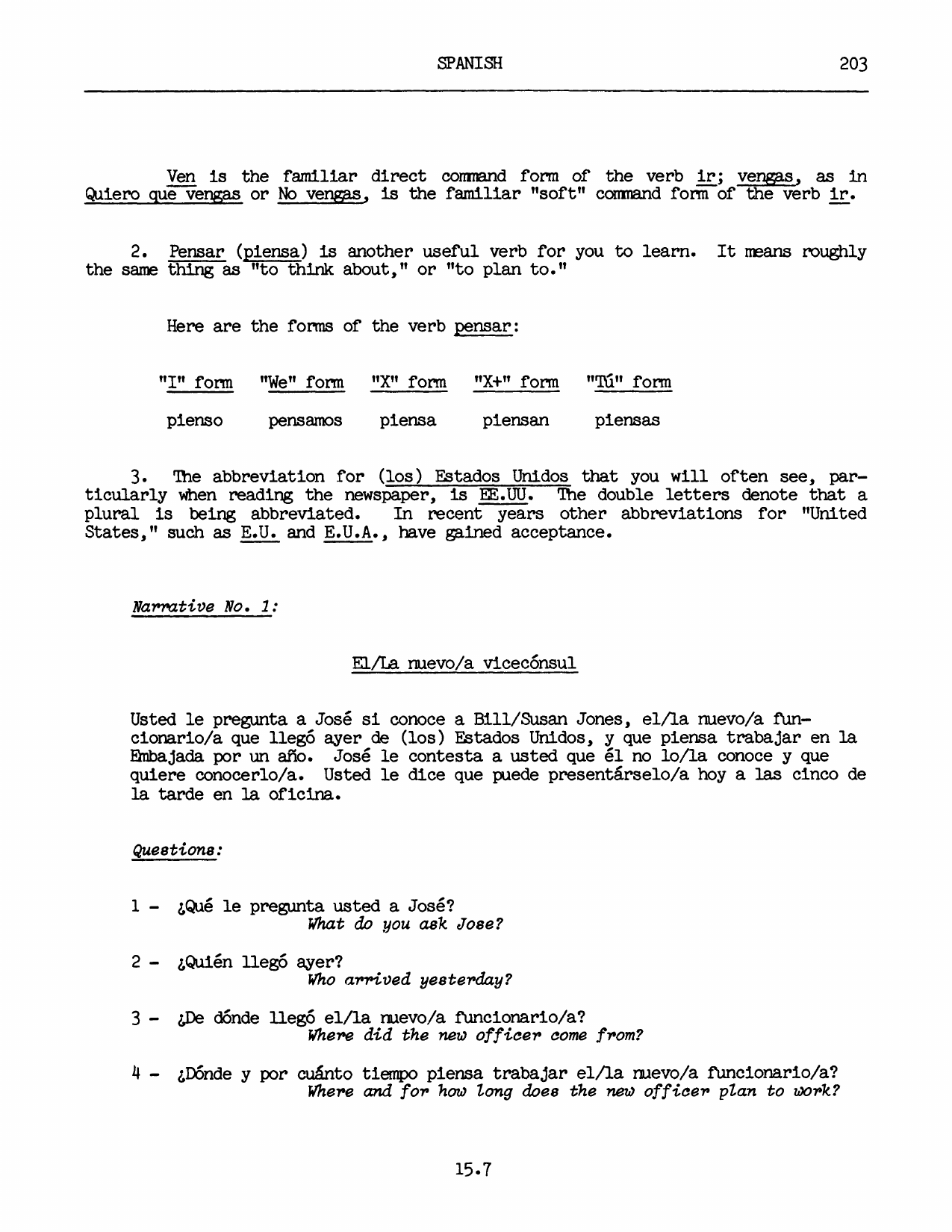
¿Conoce José al/a la mevo/a funcionario/a?
5 -
Does Jose know the new officer?
6 - ¿José quiere conocerlo/a?
Does Jose want to meet him/her?
¿Quién puede presentárselo/a a José?
7 -
Who can introduce him/her to Jose?
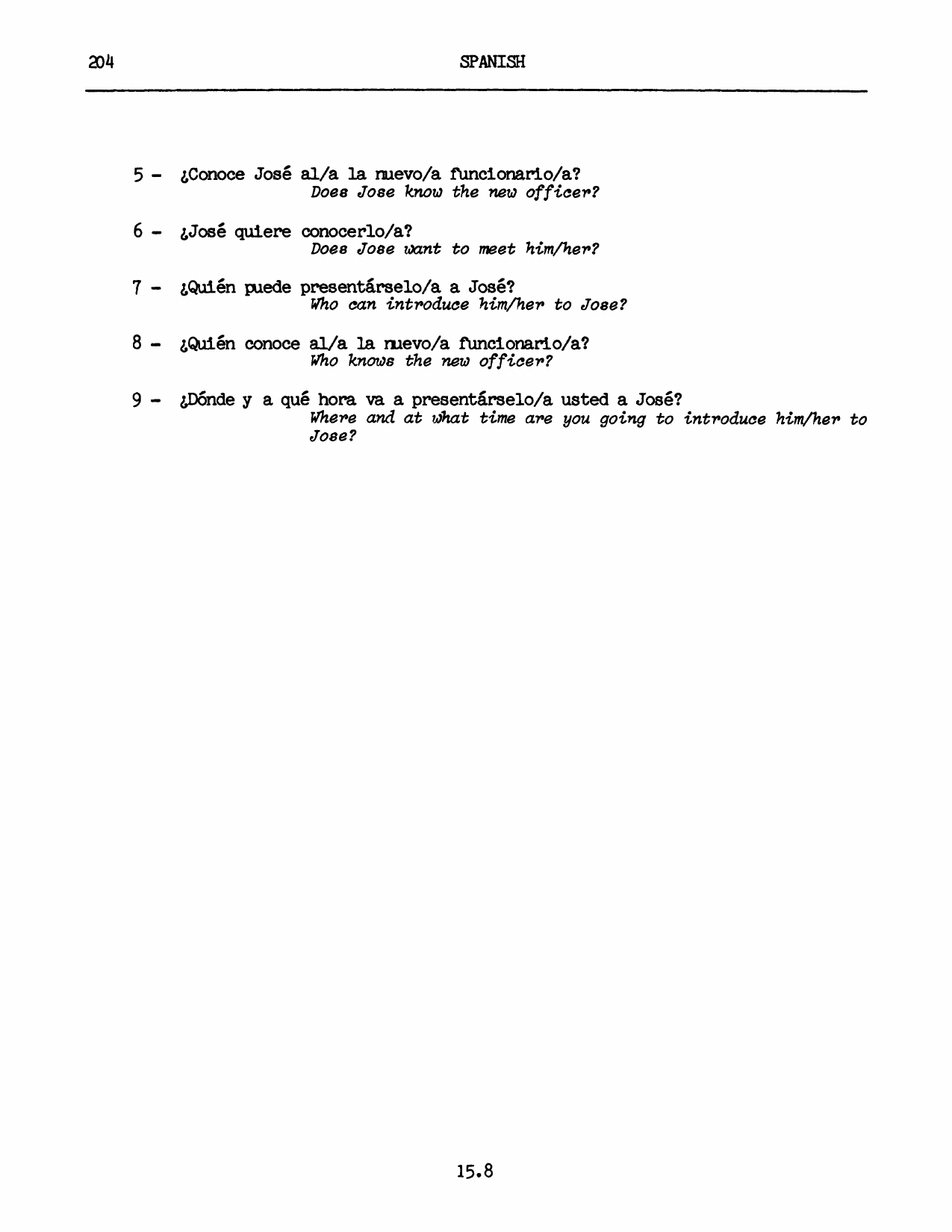
8 - ¿Quién conoce al/a la mevo/a funcionario/a?
Who knows the new officer?
9 - ¿Dónde y a qué hora va a presentárselo/a usted a José?
Where and at what time are you going to introduce him/her to José?
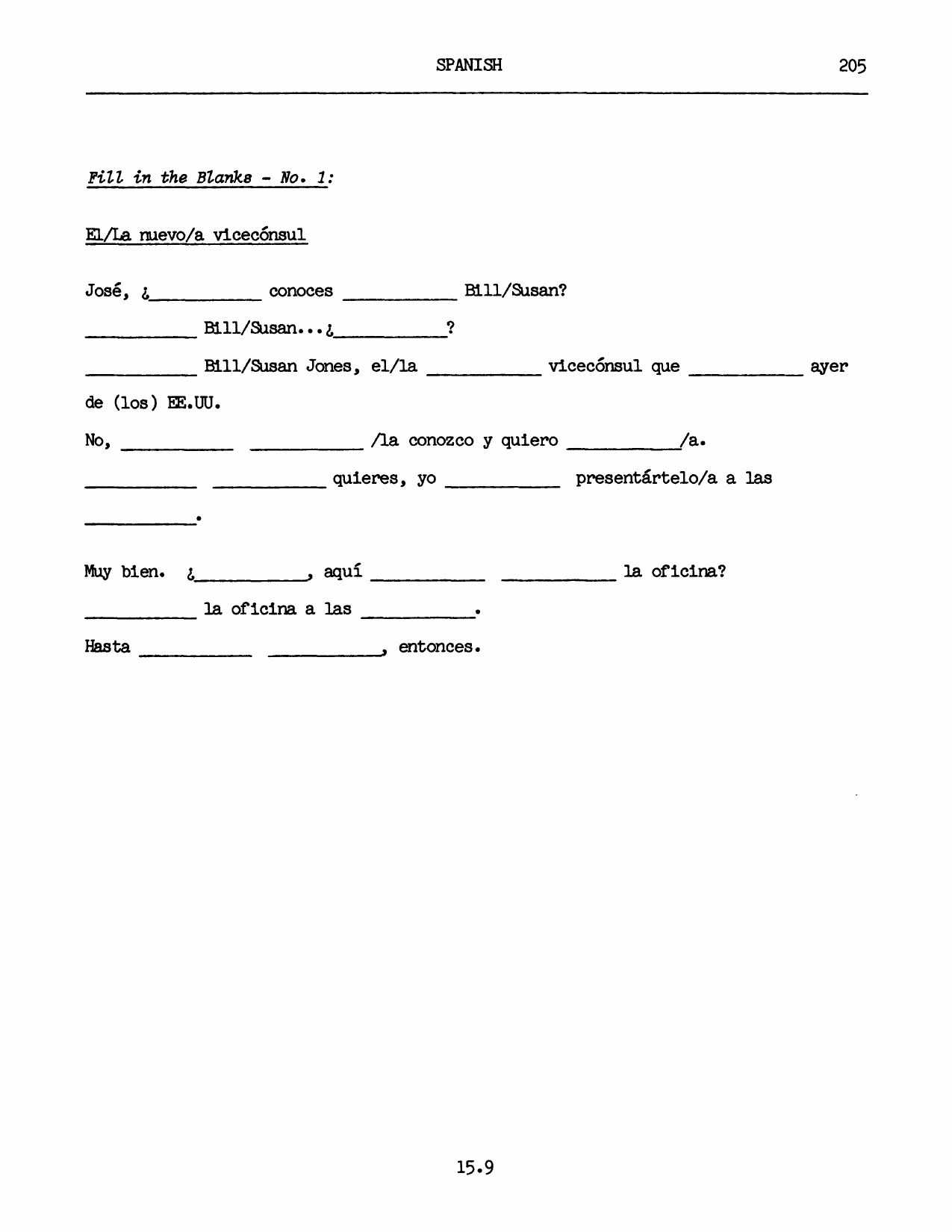
Fill in the Blanke - No. 1:
El/La mevo/a vicecónsul
de (los) EE.UU.
This page has a drawing, chart, or fill-in layout — original page
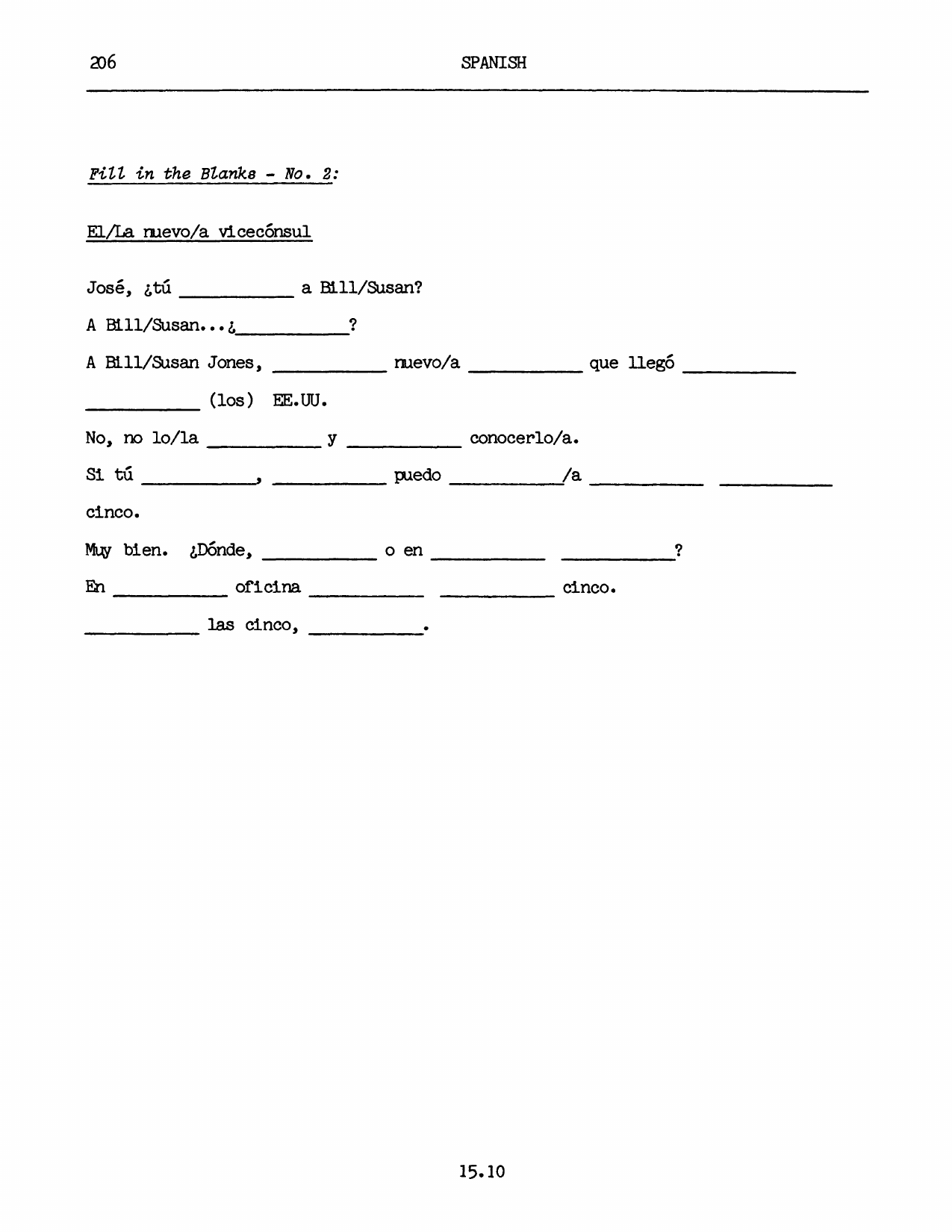
Pill in the Blanke - No. 2:
El/La mevo/a vicecónsul
(los) EE.UU.
cinco.
This page has a drawing, chart, or fill-in layout — original page
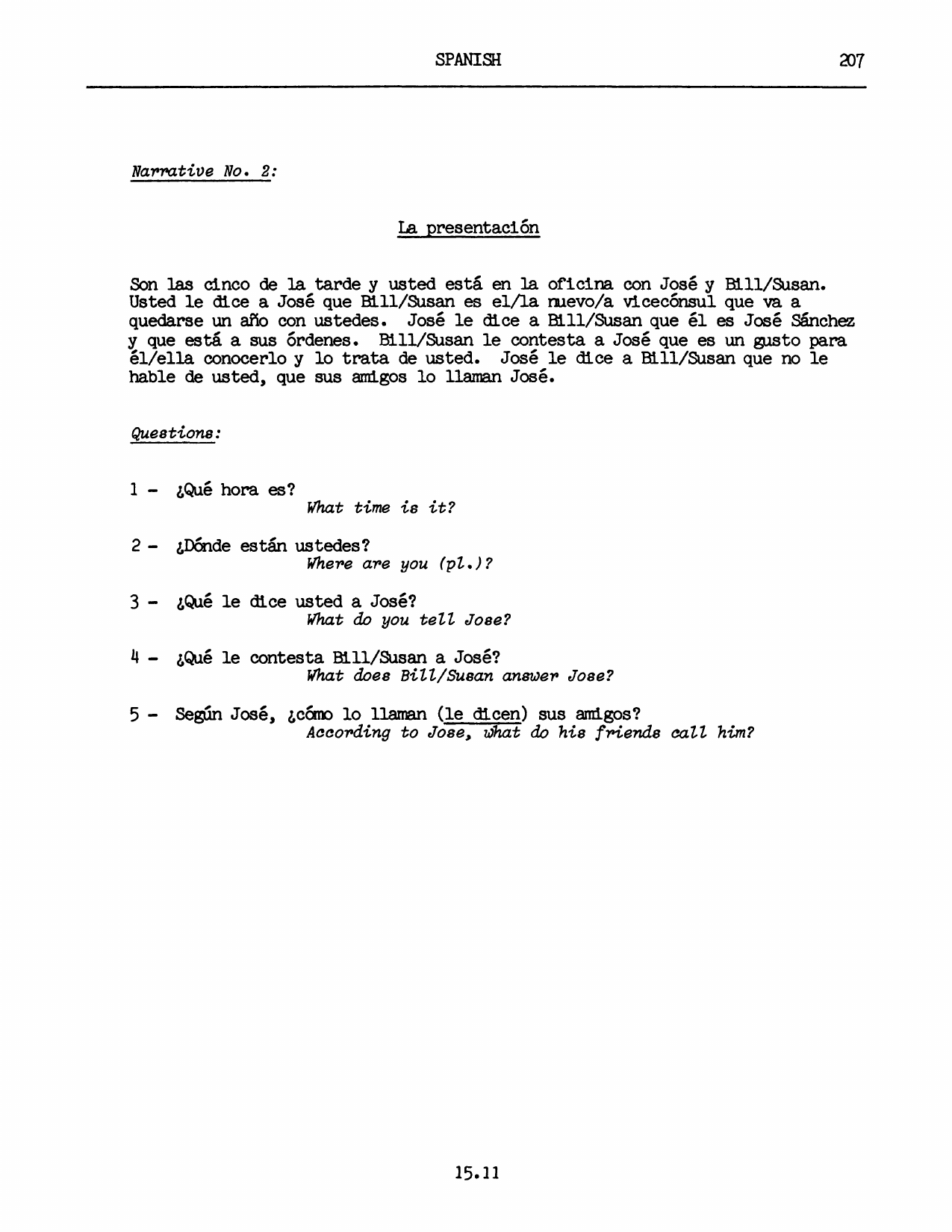
Narrative No. 2:
La presentación
Son las cinco de la tarde y usted está en la oficina con José y Bill/Susan. Usted le dice a José que Bill/Susan es el/la mevo/a vicecónsul que va a quedarse un año con ustedes. José le dice a B111/Susan que él es José Sánchez y que está a sus Órdenes. Bill/Susan le contesta a José que es un gusto para él/ella conocerlo y lo trata de usted. José le dice a Bill/Susan que no le hable de usted, que sus amigos lo llaman José.
Questions:
1 = ¿Qué hora es?
What time is it?
2 - ¿Dónde están ustedes?
Where are you (pl.)?
3 - ¿Qué le dice usted a José?
What do you tell Jose?
Y - ¿Qué le contesta Bill/Susan a José?
What does Bill/Susan answer Jose?
5 - Según José, ¿cómo lo llaman (le dicen) sus amigos?
According to Jose, what do his friends call him?
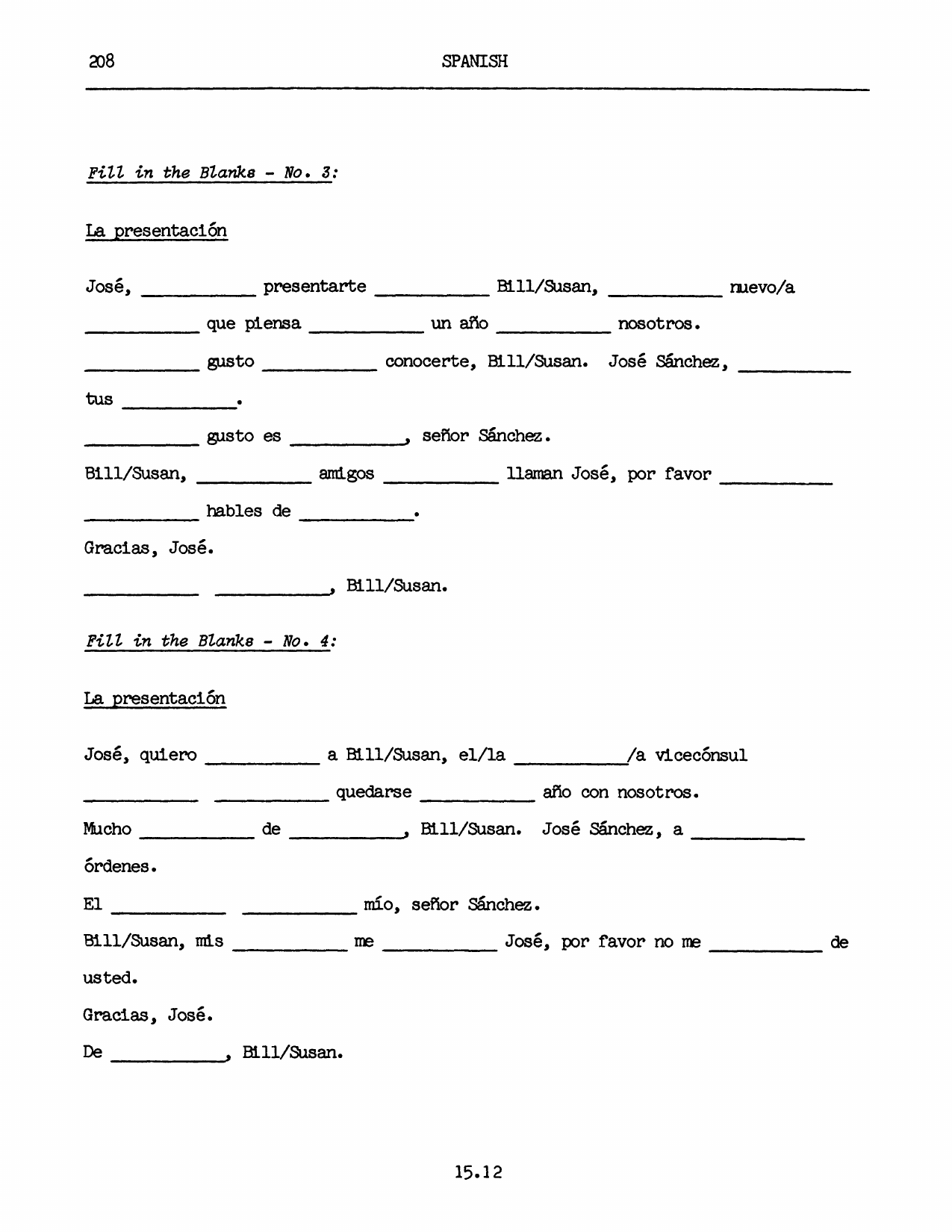
Fill in the Blanke - No. 3:
La presentación
Gracias, José.
, Bill/Susan.
Fill in the Blanks - No. 4:
La presentación
órdenes.
usted.
Graclas, José.
This page has a drawing, chart, or fill-in layout — original page
Narrative Wo. 3:
En una fiesta
No estamos en la sala de clase, estamos en una fiesta. Tomás lo/la saluda a usted y le dice que vaya con él porque quiere presentarle a un amigo suyo, el doctor Juan Guzmán Arteaga. Después de la presentación, el doctor le dice a usted que los amigos de Tomás son amigos de él (suyos) también.
Questions:
1 - ¿Dónde estamos?
Where are we?
2- ¿Qué quiere hacer Tomás?
What does Tomas want to do?
3 - ¿Cómo se llama el amigo de Tomás?
What te the name of Tomas' friend?
4 - ¿Qué le dice el doctor Guzmán Arteaga a usted después de la presentación?
What does Dr. Guzmán Arteaga say to you after the introduction?
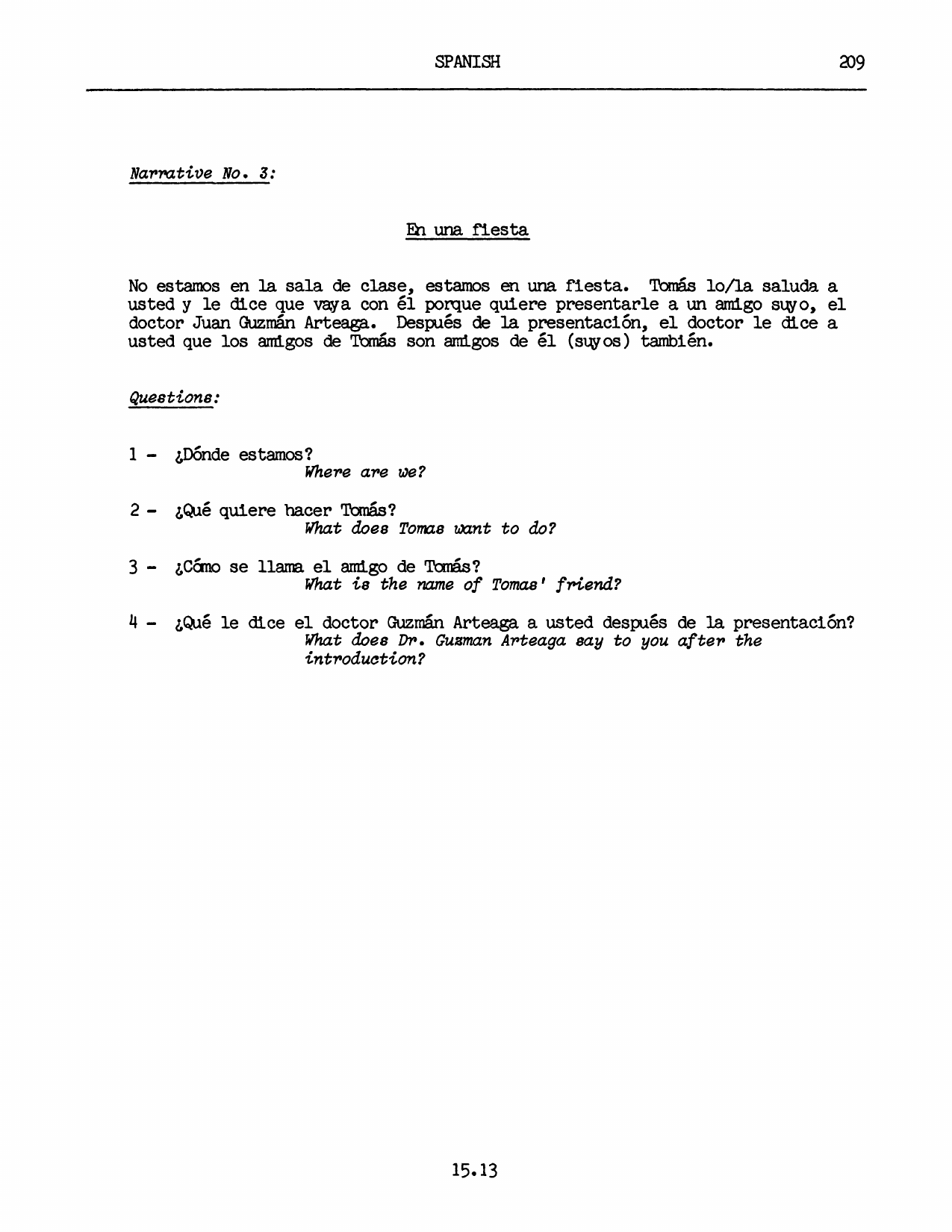
Fill in the Blanke - No. 5:
En una fiesta
, el doctor Juan Guzmán Arteaga.
(Después de un rato)
míos también.
This page has a drawing, chart, or fill-in layout — original page
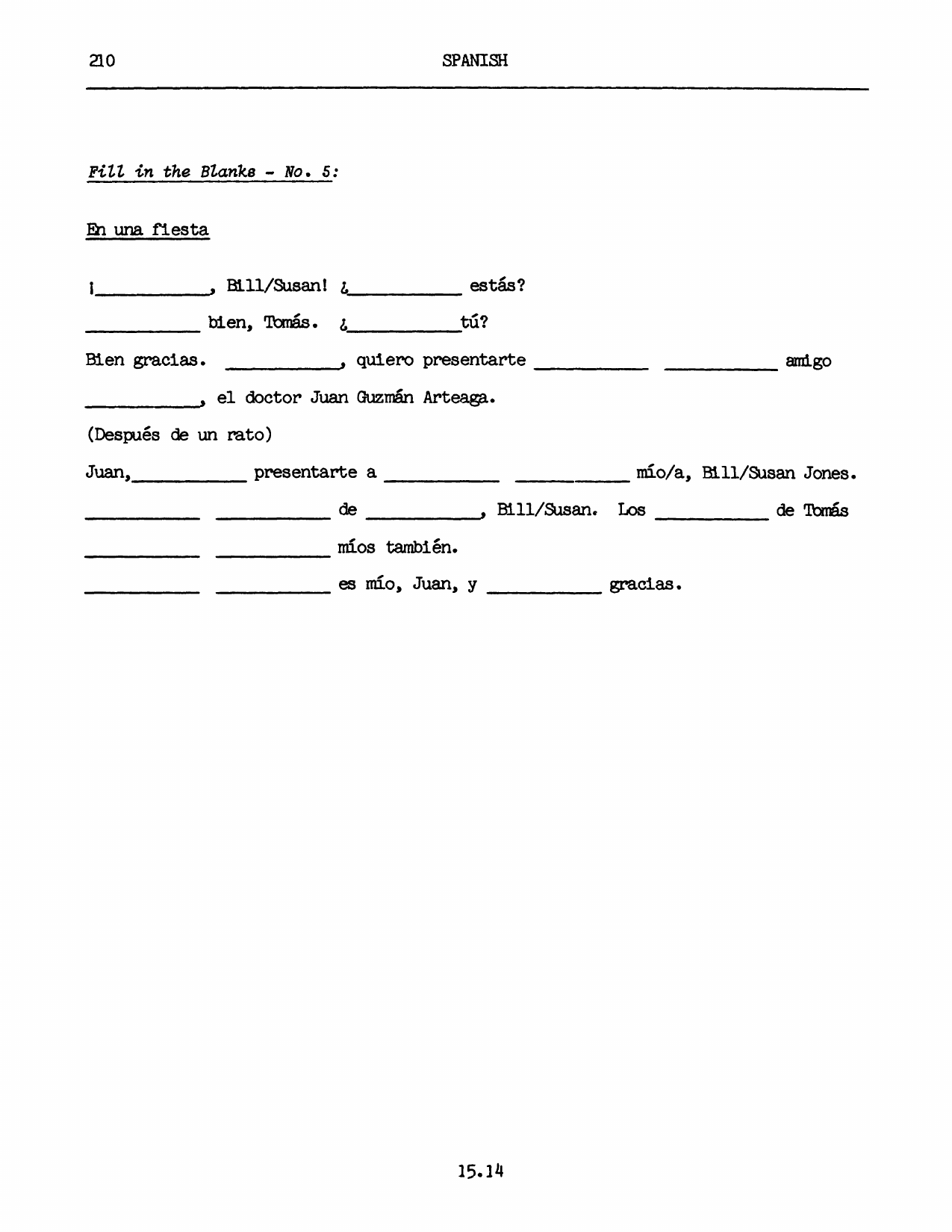
Fill in the Blanks - No. 6:
En una fiesta
doctor Juan Guzmán Arteaga.
(Después de un rato)
B111/Susan Jones.
ami gos
This page has a drawing, chart, or fill-in layout — original page
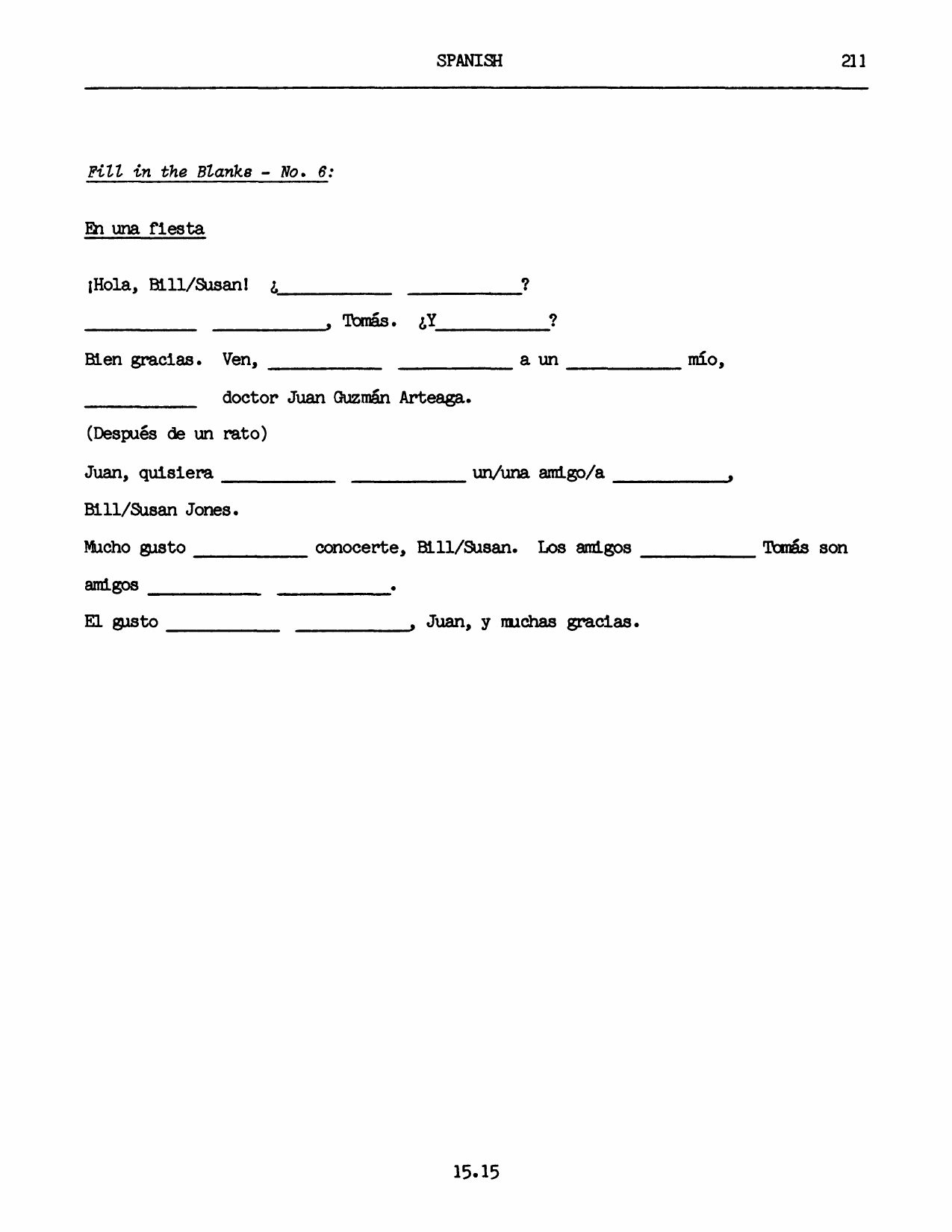
IV. ‘TAKING IT APART
Vocabulary:
Dialogue No. 1
(familiar)
resentárselo/a
to introduce him/her to you
Narrative No. 1
another)
muevo/a
new
Dialogue No. 2
(familiar)
presentarte
to introduce to you (familiar)
Narrative No. 2
la hora
hour, time
Dialogue No. 3
command)
mios/mias
mine (pl.)
Narrative No. 3
la sala de clase
classroom
GETTING THE FEEL OF IT
Questions and Answers:
A. 1. ¿Usted come mucho?
Si, como mucho.
No, no como mucho.
2. ¿Ustedes comen mucho?
Sí, comemos mucho.
No, no comemos mucho.
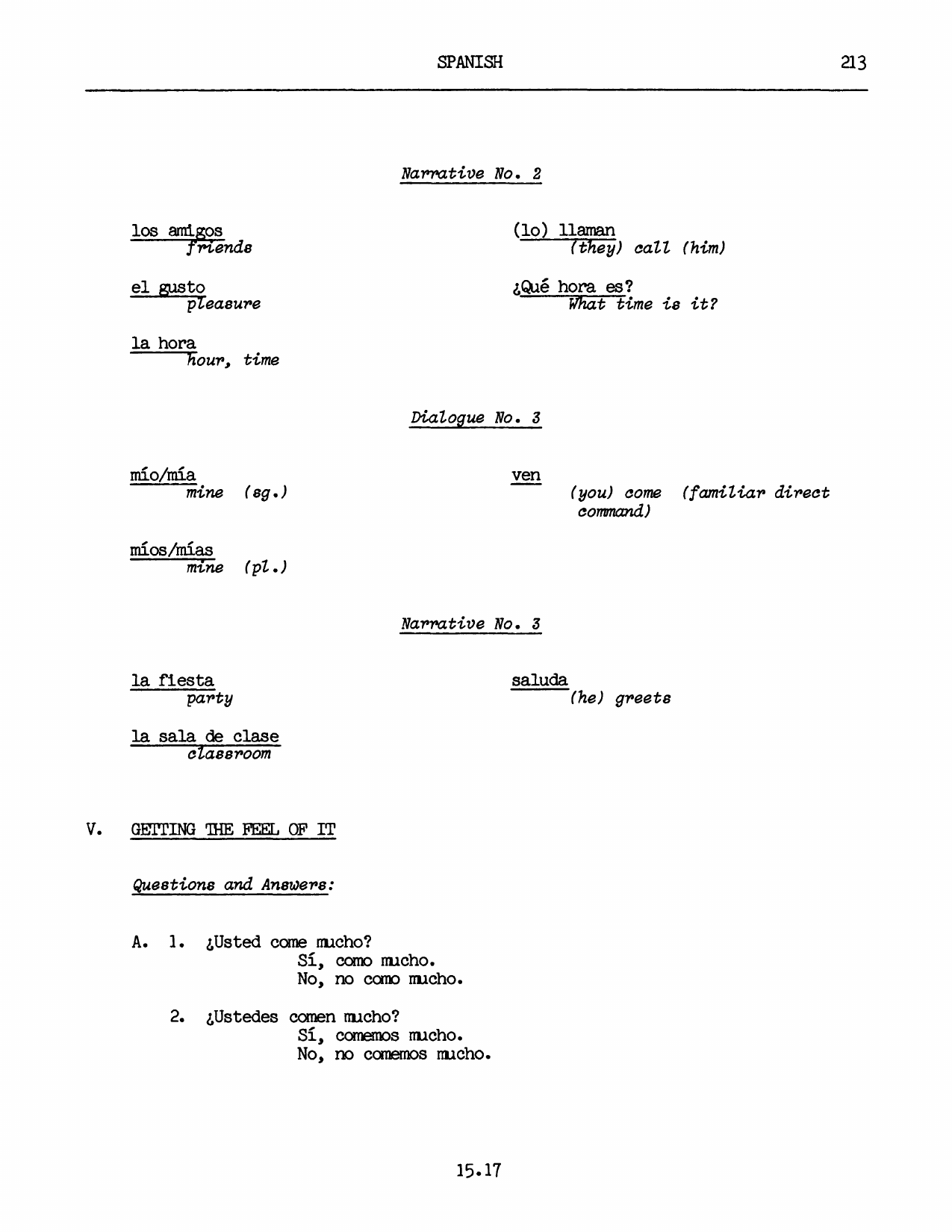
3. ¿Tú comes mucho?
Si, como mucho.
No, no como mucho.
4. ¿José come mucho?
Si, come mucho.
No, no come mucho.
5. ¿José y Anita comen mucho.
Si, comen mucho.
No, no comen mucho.
B. 1. ¿Usted vende el carro (coche)?
Sí, vendo el carro (coche).
No, no vendo el carro (coche).
2. ¿Ustedes venden el carro (coche)?
Sí, vendemos el carro (coche).
No, no vendemos el carro (coche).
3. ¿Tú vendes el carro (coche)?
sí, vendo el carro (coche).
No, no vendo el carro (coche).
4. ¿José vende el carro (coche)?
Sí, vende el carro (coche).
No, no vende el carro (coche).
5. ¿Ellos venden el carro (coche)?
Sí, venden el carro (coche).
No, no venden el carro (coche).
C. 1. ¿Usted aprende español?
Si, aprendo español.
No, no aprendo español.
2. ¿José aprende español?
Sí, aprende español.
No, no aprende español.
3. ¿María y Ana aprenden español?
Sí, aprenden español.
No, no aprenden español.
Y. ¿Ustedes aprenden español?
Sí, aprendemos español.
No, no aprendemos español.
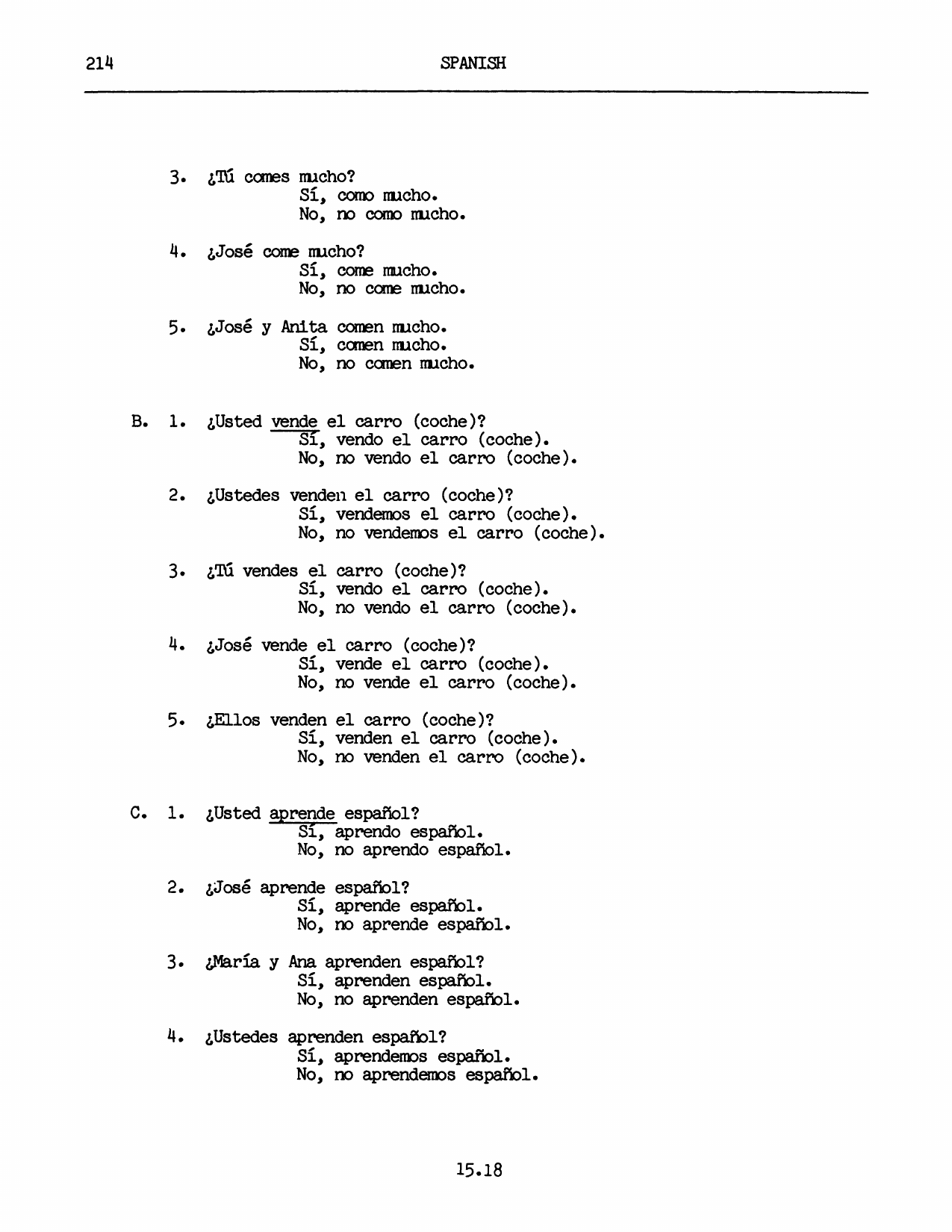
5. ¿Tú aprendes español?
Si, aprendo español.
No, no aprendo español.
D. 1. ¿Usted cree eso?
Í, creo eso.
No, no creo eso.
2. ¿El cree eso?
Si, cree eso.
No, no cree eso.
3. ¿Tú crees eso?
Si, creo eso.
No, no creo eso.
4, ¿Tú y Maria creen eso?
S1, creemos eso.
No, no creemos eso.
5. ¿Ustedes creen eso?
S1, creemos eso.
No, no creemos eso.
Si, la conozco.
No, no la conozco.
2. ¿Ustedes conocen a la nueva funcionaria?
Sí, la conocemos.
No, no la conocemos.
3. ¿El conoce a la nueva funcionaria?
sí, la conoce.
No, no la conoce.
4, ¿Tú conoces a la nueva funcionaria?
Sí, la conozco.
No, no la conozco.
5. ¿Ellos conocen a la mueva funcionaria?
sí, la conocen.
No, no la conocen.
F. 1. A - Quiero conocer a María. ¿Usted puede presentármela?
N - Si, venga. Yo puedo presentársela.
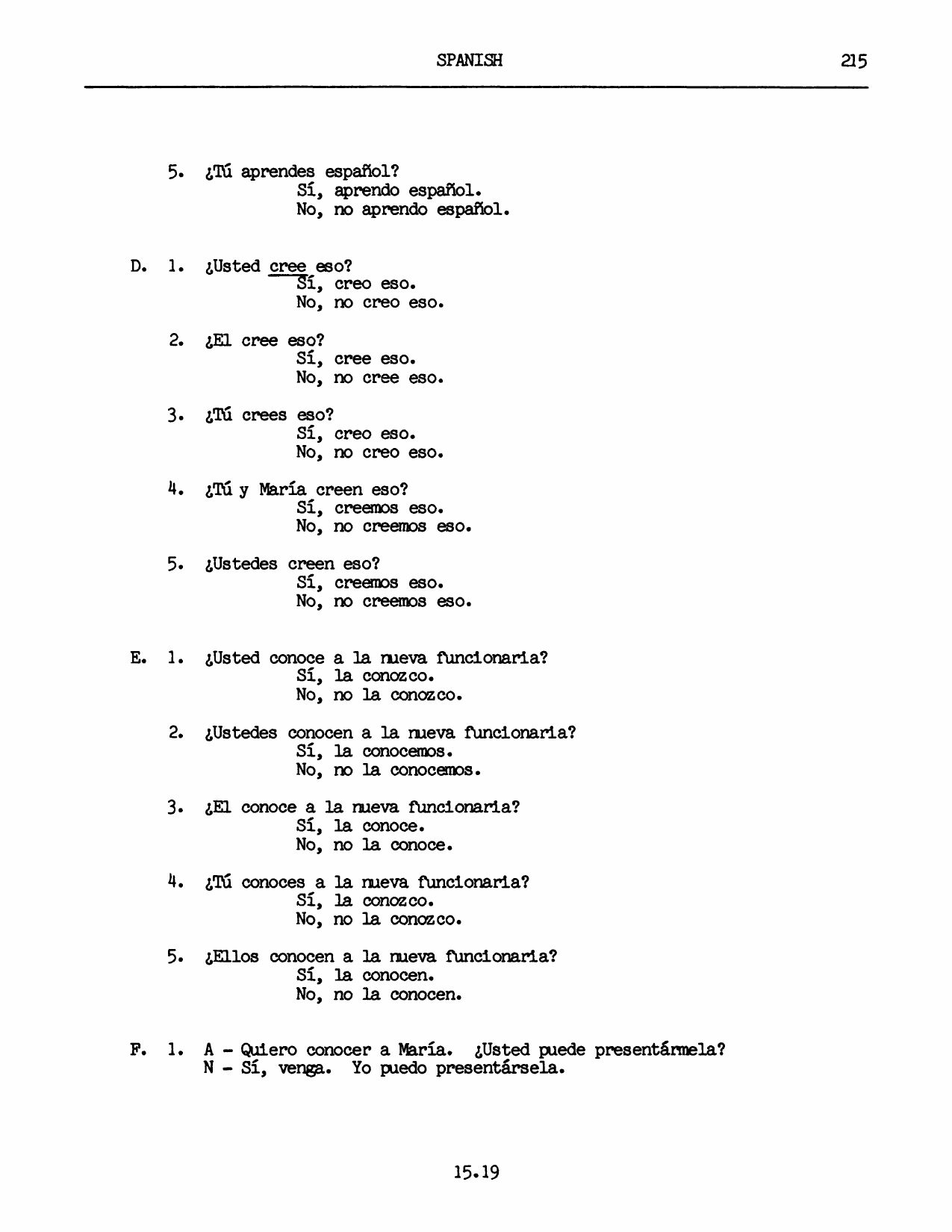
2. N — Quisiera conocer al muevo funcionario.
¿(Tú) puedes presentármelo?
A - Claro, ven, voy a presentártelo. (Ven, te lo presento. )
3. A - Con su permiso, permíta(n)me presentarme.
Soy Mary Jones, la rueva secretaría del Fmbajador.
4. N - ¿Puedes presentarme a la secretaria del Ministro Consejero?
A - Claro. ¿Quieres que te la presente ahora mismo?
N - Sí, preséntamela ahora mismo, si puedes.
5. N- Bill, quiero que me presentes al Embajador.
A - Claro. Ven, voy a presentártelo. (Ven, te lo presento. )
Questions and Answers: (continued)
A. 1. Do you eat a great deal?
Yes, I eat a great deal.
No, I don't eat very much.
2. Do you (pl.) eat a great deal?
Yes, we eat a great deal.
No, we don't eat very much.
3. Do you eat a great deal? (familiar)
Yes, I eat a great deal.
No, I don't eat very much.
4. Does Jose eat a great deal?
Yes, he eats a great deal.
No, he doesn't eat very much.
5. Do Jose and Anita eat a great deal?
Yes, they eat a great deal
No, they don't eat very much.
B. 1. Are you selling the car?
Yes, I am selling the car.
No, I am not selling the car.
2. Are you (pl.) selling the car?
Yes, we are selling the car.
No, we are not selling the car.
3. Are you selling the car? (familiar)
Yes, I am selling the car.
No, I am not selling the car.
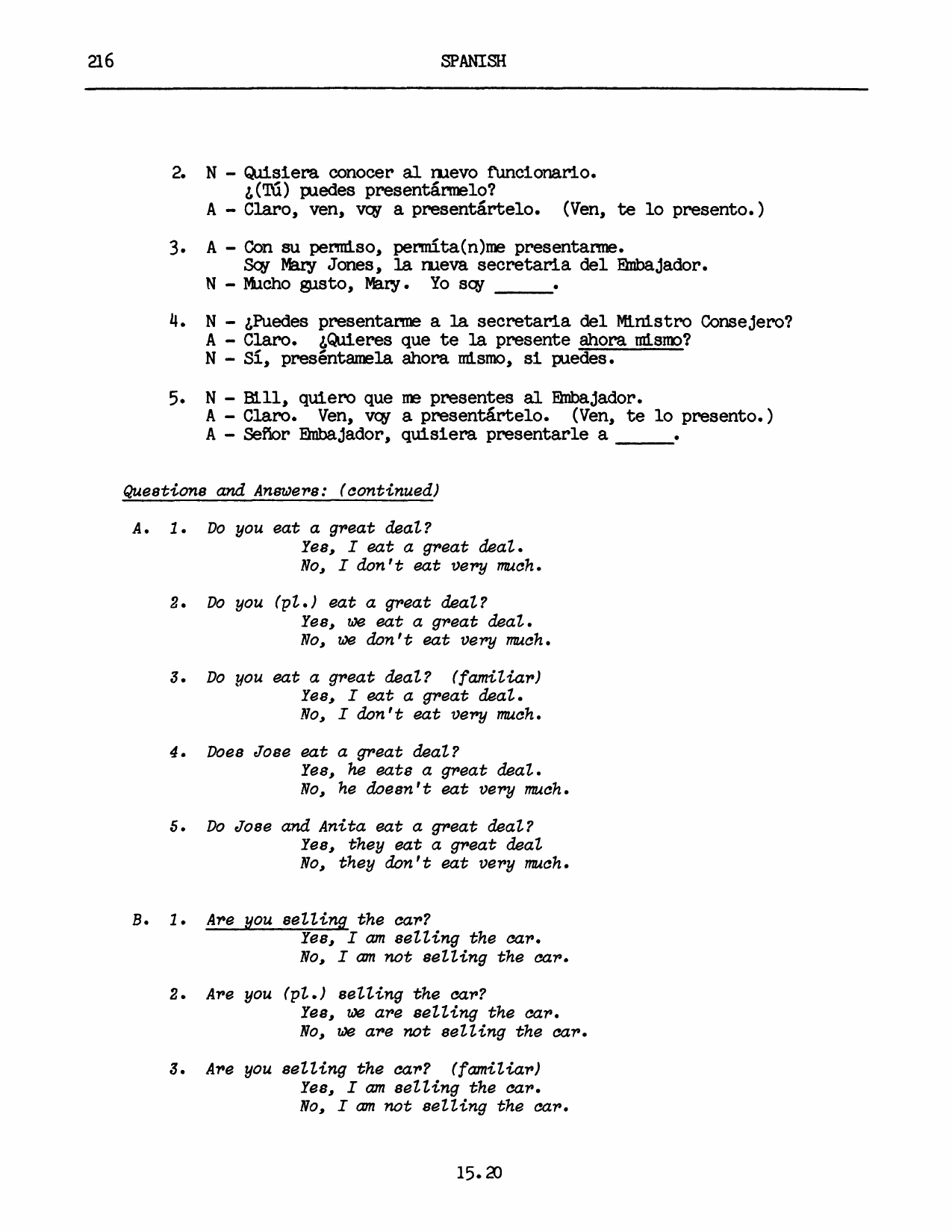
4. Is Jose selling the car?
Yes, he te selling the car.
No, he ts not selling the car.
de Are they selling the car?
Yes, they are selling the car.
No, they are not selling the car.
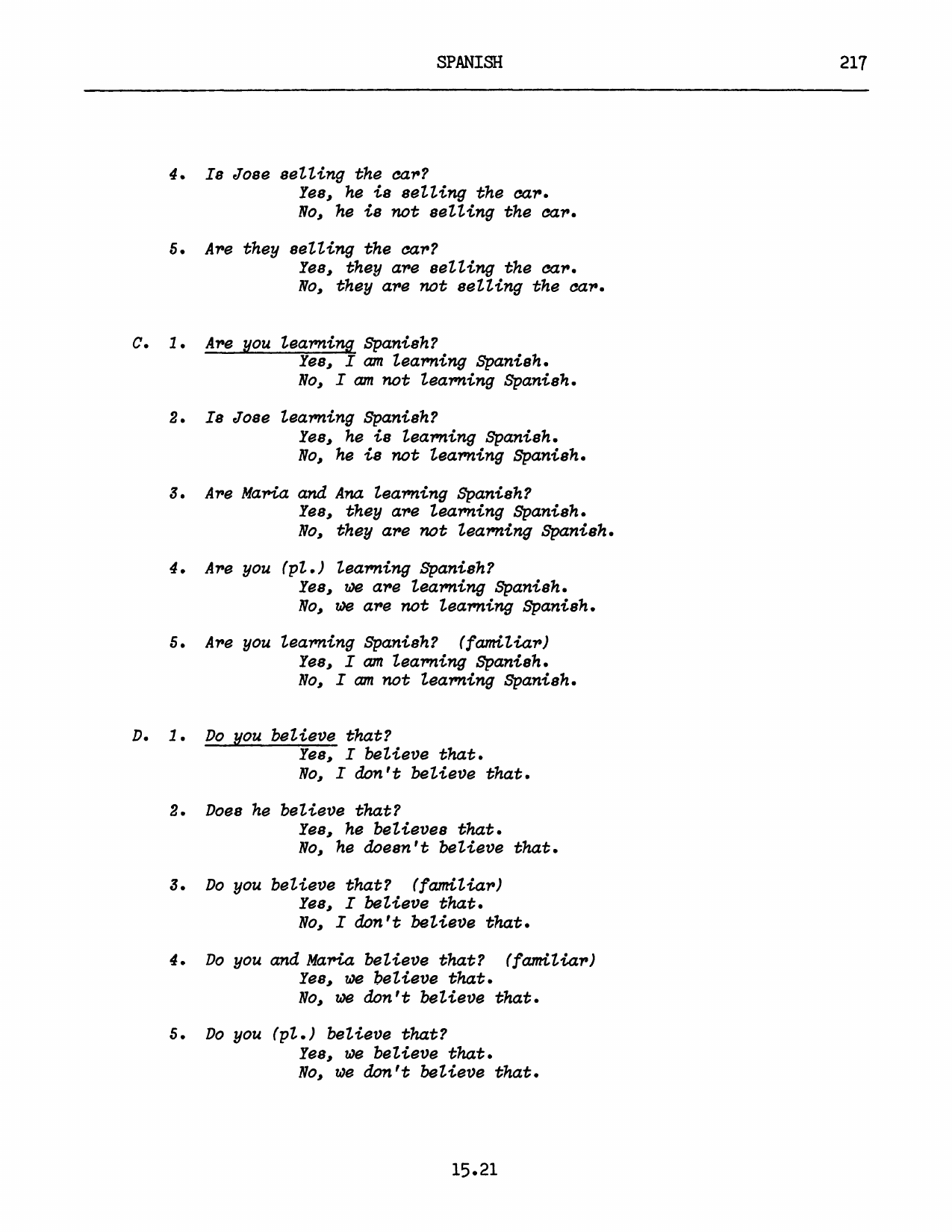
C. 1. Are you learning Spanish?
Yes, I am learning Spanish.
No, I am not learning Spanish.
2. Ie José learning Spanish?
Yes, he is learning Spanish.
No, he ts not learning Spanish.
3. Are Maria and Ana learning Spanish?
Yes, they are learning Spanish.
No, they are not learning Spanish.
Are you (pl.) learning Spanish?
Yes, we are learning Spanish.
No, we are not learning Spanish.
56 Are you learning Spanish? (familiar)
Yes, I am learning Spanish.
No, I am not learning Spanish.
dD. 1. Do you believe that?
Yes, I believe that.
No, I don't believe that.
2. Does he believe that?
Yes, he believes that.
No, he doeen't believe that.
3. Do you believe that? (familiar)
Yes, I believe that.
No, I don't believe that.
4. Do you and Maria believe that? (familiar)
Yes, we believe that.
No, we don't believe that.
5. Do you (pl.) believe that?
Yes, we believe that.
No, we don't believe that.
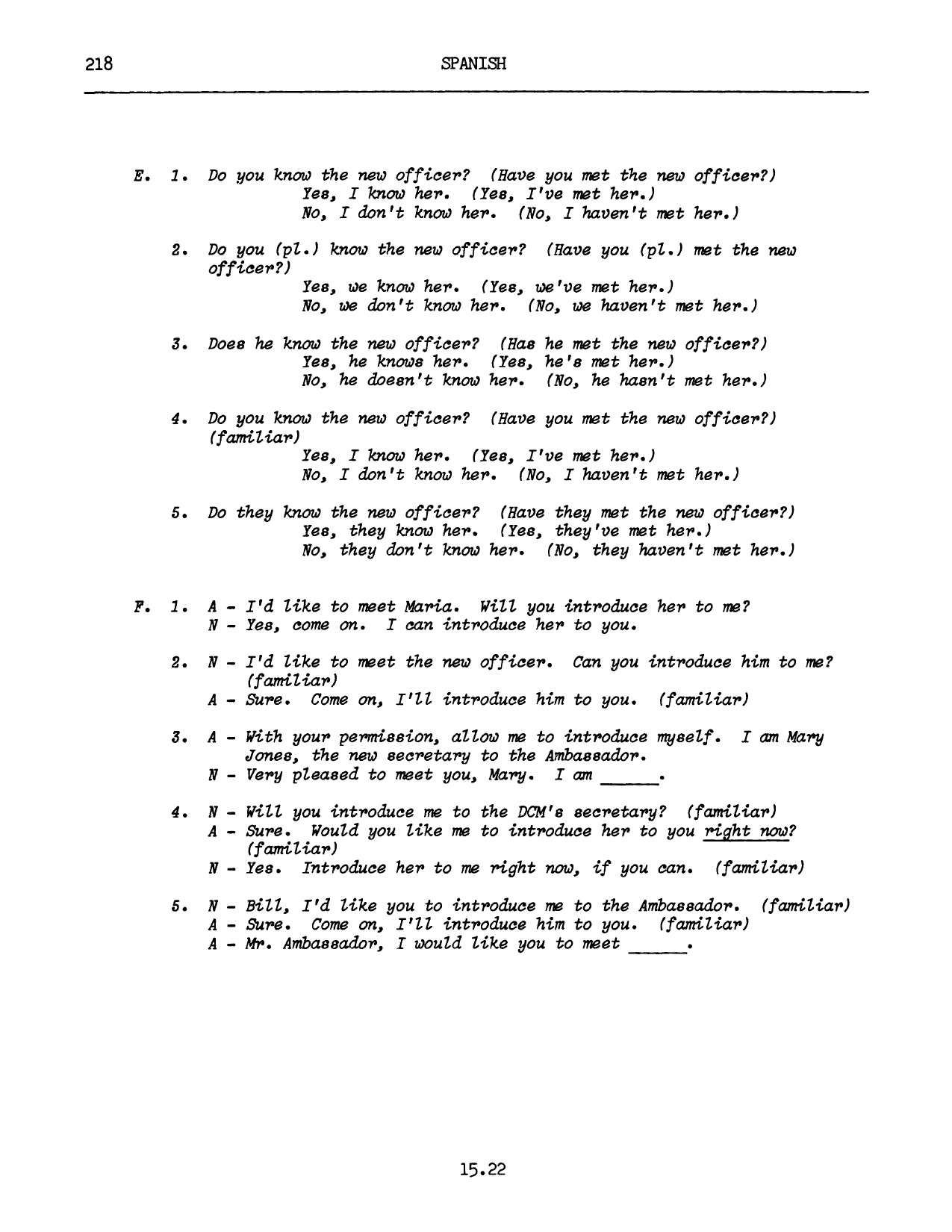
E. 1. Do you know the new officer? (Have you met the new officer?)
Yes, I know her. (Yes, I've met her.)
No, I don't know her. (No, I haven't met her.)
2. Do you (pl.) know the new officer? (Have you (pl.) met the new
officer?)
Yes, we know her. (Yee, we've met her.)
No, we don't know her. (No, we haven't met her.)
3. Does he know the new officer? (Hae he met the new officer?)
Yes, he knows her. (Yes, he's met her.)
No, he doesn't know her. (No, he hasn't met her.)
4. Do you know the new officer? (Have you met the new officer?)
(familiar)
Yes, I know her. (Yes, I've met her.)
No, I don't know her. (No, I haven't met her.)
5. Do they know the new officer? (Have they met the new officer?)
Yes, they know her. (Yes, they've met her.)
No, they don't know her. (No, they haven't met her.)
FP. 1. A- I'd like to meet Maria. Will you introduce her to me?
N - Yes, come on. I can introduce her to you.
2. N- I'd like to meet the new officer. Can you introduce him to me?
(familiar)
A - Sure. Come on, I'll introduce him to you. (familiar)
3. A - With your permission, allow me to introduce myself. I am Mary
Jones, the new secretary to the Ambassador.
4. WN - Will you introduce me to the DCM's secretary? (familiar)
A - Sure. Would you like me to introduce her to you right now?
(familiar)
W - Yes. Introduce her to me right now, if you can. (familiar)
5. N- Bill, I'd like you to introduce me to the Ambassador. (familiar)
A - Sure. Come on, I'll introduce him to you. (familiar)
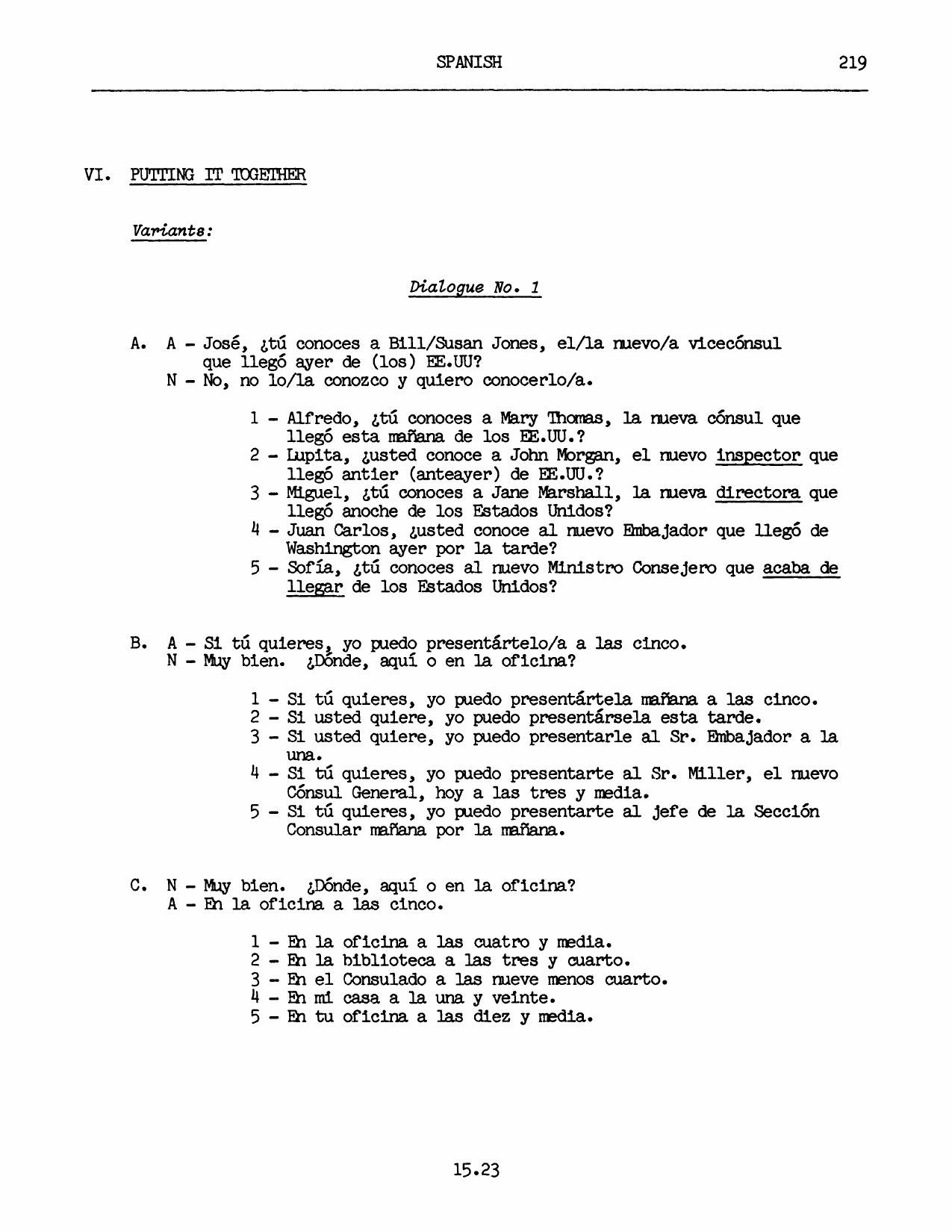
VI. PUTTING TT TOGETHER
Variants:
Dialogue No. 1
A. A — José, ¿tú conoces a Bill/Susan Jones, el/la mevo/a vicecónsul
que llegó ayer de (los) EE.UU?
N - No, no lo/la conozco y quiero conocerlo/a.
1 - Alfredo, ¿tú conoces a Mary Thomas, la rueva cónsul que
llegó esta mañana de los EE.UU. ?
2 - Lupita, ¿usted conoce a John Morgan, el muevo inspector que
llegó antier (anteayer) de EE.UU.?
3 - Miguel, ¿tú conoces a Jane Marshall, la meva directora que
llegó anoche de los Estados Unidos?
4 - Juan Carlos, ¿usted conoce al nuevo Embajador que llegó de
Washington ayer por la tarde?
5 - Sofía, ¿tú conoces al nuevo Ministro Consejero que acaba de
llegar de los Estados Unidos?
B. A - Si tú quieres, yo puedo presentártelo/a a las cinco.
N - Muy bien. ¿Dónde, aquí o en la oficina?
1 = Si tú quieres, yo puedo presentártela mafíiana a las cinco. 2 - Si usted quiere, yo puedo presentársela esta tarde. 3 - Si usted quiere, yo puedo presentarle al Sr. Embajador a la
una.
4 — Si tú quieres, yo puedo presentarte al Sr. Miller, el mevo
Cénsul General, hoy a las tres y media.
5 - Si tú quieres, yo puedo presentarte al jefe de la Sección
Consular mañana por la mañana.
C. N- Muy bien. ¿Dónde, aquí o en la oficina?
A - En la oficina a las cinco.
1 - En la oficina a las cuatro y media.
2 - En la biblioteca a las tres y cuarto.
3 = En el Consulado a las nueve menos cuarto.
4 - Eh mí casa a la una y veinte.
5 - En tu oficina a las diez y media.
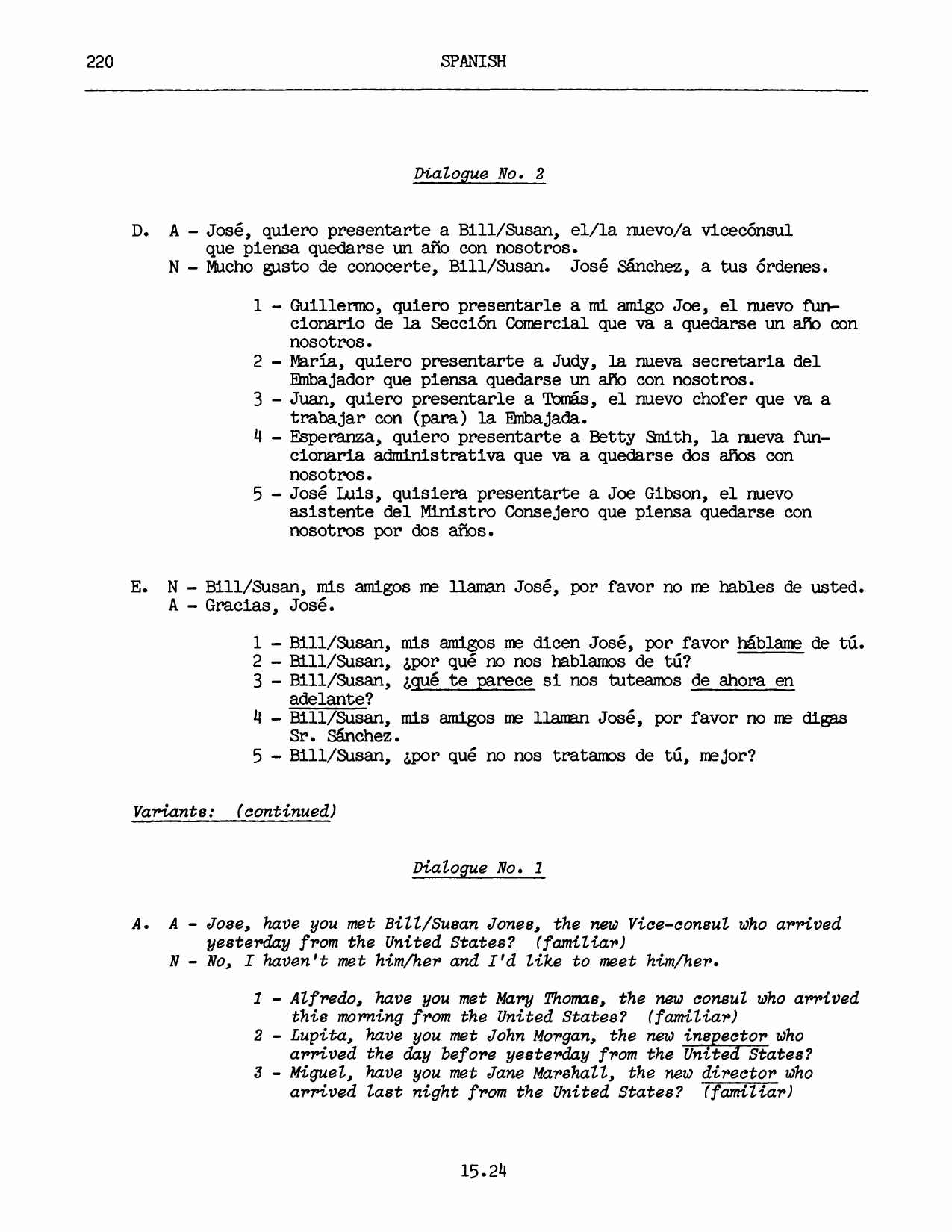
Dialogue No. 2
D. A — José, quiero presentarte a Bill/Susan, el/la mevo/a vicecónsul
que piensa quedarse un año con nosotros.
N - Mucho gusto de conocerte, Bill/Susan. José Sánchez, a tus órdenes.
1 - Guillermo, quiero presentarle a mi amigo Joe, el nuevo fun-
cionario de la Sección Comercial que va a quedarse un año con nosotros.
2 - María, quiero presentarte a Judy, la nueva secretaria del
Embajador que piensa quedarse un año con nosotros.
3 - Juan, quiero presentarle a Tomás, el nuevo chofer que va a
trabajar con (para) la Embajada.
4 - Esperanza, quiero presentarte a Betty Smith, la meva fun-
cionaria administrativa que va a quedarse dos años con nosotros.
5 - José Luis, quisiera presentarte a Joe Gibson, el nuevo
asistente del Ministro Consejero que piensa quedarse con nosotros por dos años.
E. N = Bill/Susan, mis amigos me llaman José, por favor no me hables de usted.
A - Gracias, José.
1 - Bill/Susan, mis amigos me dicen José, por favor háblame de tú. 2 - B111/Susan, ¿por qué no nos hablamos de tú?
3 - Bill/Susan, ¿qué te parece si nos tuteamos de ahora en
adelante?
4 — Bi11/Susan, mis amigos me llaman José, por favor no me digas
Sr. Sánchez.
5 - Bill/Susan, ¿por qué no nos tratamos de tú, mejor?
Variants: (continued)
Dialogue No. 1
A. A - José, have you met Bill/Susan Jones, the new Vice-consul who arrived
yesterday from the United States? (familiar)
N - No, I haven't met him/her and I'd like to meet him/her.
1 - Alfredo, have you met Mary Thomas, the new consul who arrived
this morning from the United States? (familiar)
2 - Lupita, have you met John Morgan, the new inspector who
arrived the day before yesterday from the United States?
3 - Miguel, have you met Jane Marshall, the new director who
arrived last night from the United States? (familiar)
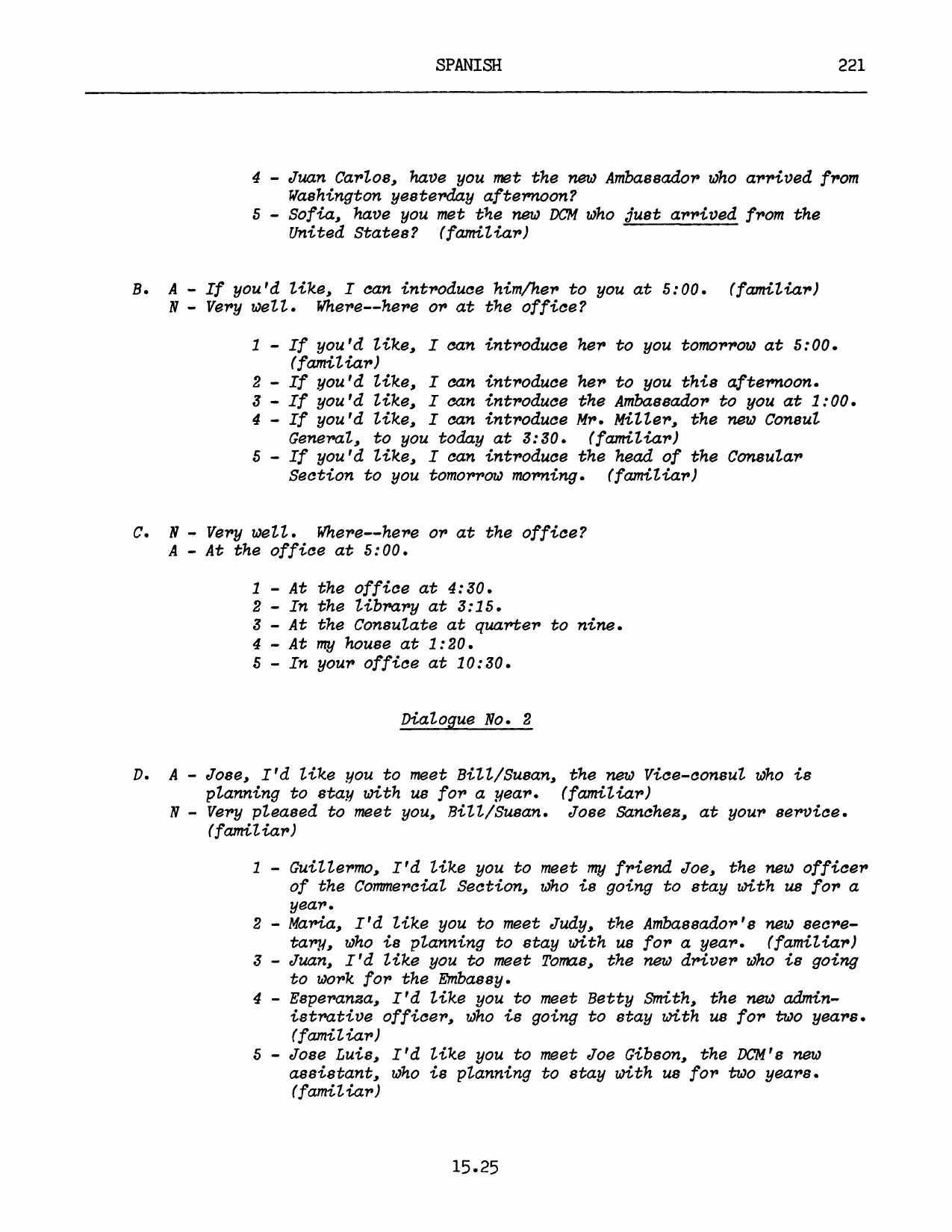
4 - Juan Carlos, have you met the new Ambassador who arrived from
Washington yesterday afternoon?
5 - Sofía, have you met the new DCM who just arrived from the
United States? (familiar)
B. A- If you'd like, I can introduce him/her to you at 5:00. (familiar)
N - Very well. Where--here or at the office?
1 - If you'd like, I can introduce her to you tomorrow at 5:00.
(familiar)
2 - If you'd like, I can introduce her to you this afternoon. 3 - If you'd like, I can introduce the Ambassador to you at 1:00. 4 - If you'd like, I can introduce Mr. Miller, the new Consul
General, to you today at 3:30. (familiar)
5 - If you'd like, I can introduce the head of the Consular
Section to you tomorrow morning. (familiar)
C. N- Very well. Where--here or at the office?
A - At the office at 5:00.
1 - At the office at 4:30.
2 - In the library at 3:15.
3 - At the Consulate at quarter to nine.
4 - At my house at 1:20.
5 - In your office at 10:30.
Dialogue No. 2
D. A - José, I'd like you to meet Bill/Susan, the new Vice-consul who te
planning to stay with us for a year. (familiar)
WN - Very pleased to meet you, Bill/Susan. Jose Sánchez, at your service.
(familiar)
1 - Guillermo, I'd like you to meet my friend Joe, the new officer
of the Commercial Section, who ts going to stay with us fora year.
2 - Maria, I'd like you to meet Judy, the Ambassador's new secre-
tary, who ts planning to stay with us for a year. (familiar)
3 - Juan, I'd like you to meet Tomas, the new driver who is going
to work for the Embassy.
4 - Esperanza, I'd like you to meet Betty Smith, the new admin-
tstrative officer, who te going to stay with us for two years. (familiar)
5 - José Luis, I'd like you to meet Joe Gibson, the DCM's new
assistant, who ts planning to stay with us for two years. (familiar)
E. N- Bill/Susan, my friends call me José; please don't address me with the
formal "usted" form. (familiar)
A - Thanks, Jose.
1 - Bill/Suean, my friends call me José; please address me with
the familiar "tú" form. (familiar)
2 - Bill/Susan, why don't we address one another with the familiar
"ti" form?
3 - Bill/Susan, how about addressing each other with the familiar
"tu" form from now on? (familiar)
Mr. Sanchez. (familiar)
5 - Bill/Susan, better yet, why don't we address one another with
the familiar "tú" form?
VII. MAKING IT WORK
VIII. USING IT