CYCLE 17
GETTING ACQUAINTED
Describing Yourself and Your Family
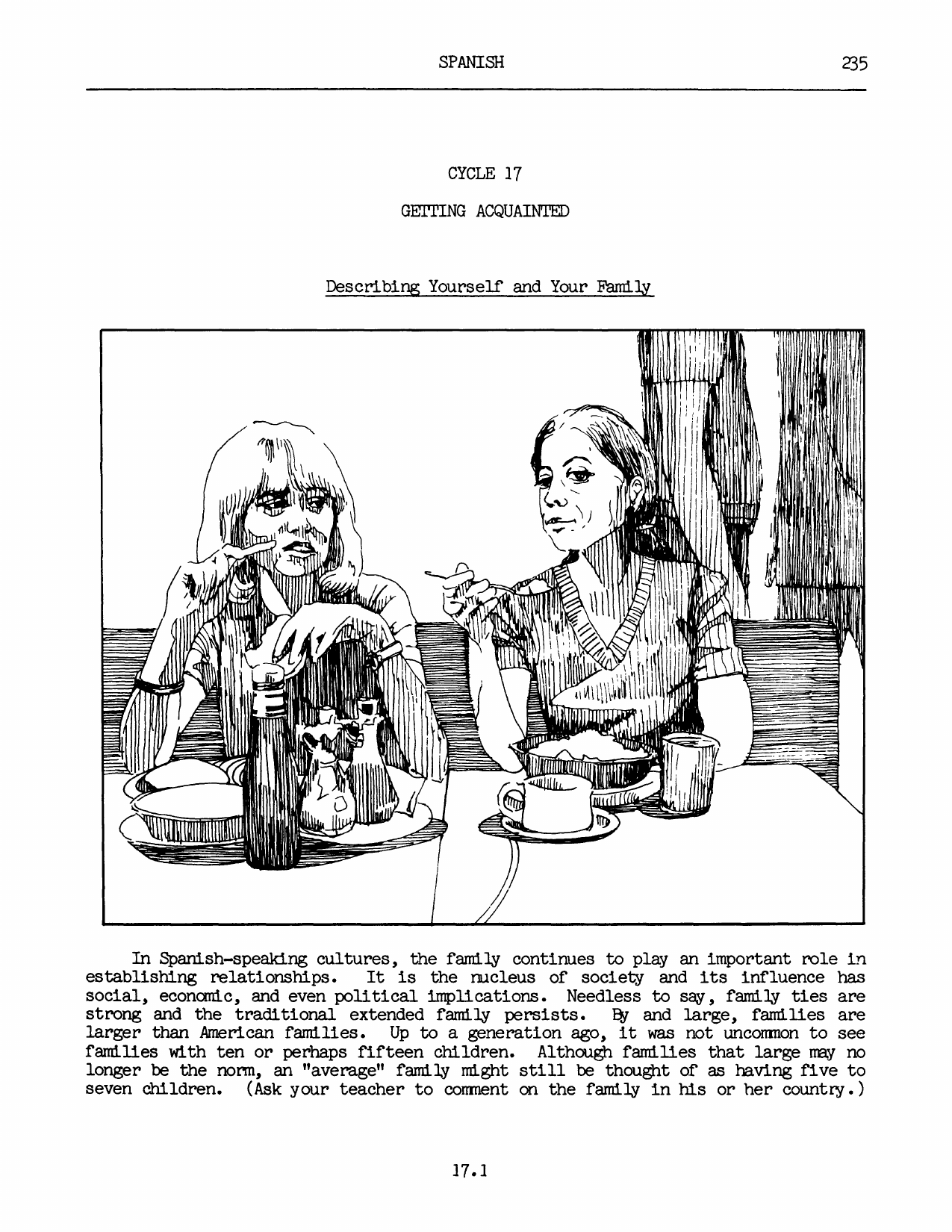
In Spanish-speaking cultures, the family continues to play an important role in
establishing relationships. It is the mcleus of society and its influence has social, economic, and even political implications. Needless to say, family ties are strong and the traditional extended family persists. By and large, families are larger than American families. Up to a generation ago, it was not uncommon to see families with ten or perhaps fifteen children. Although families that large may no longer be the norm, an "average" family might still be thought of as having five to seven children. (Ask your teacher to comment on the family in his or her country.)
This page has a drawing, chart, or fill-in layout — original page
I. SETTING THE SCENE
You have recently arrived at post and have become friends with a co-worker from the host country. One day, you decide to have lunch together in the Embassy cafeteria. After sitting down at one of the tables, you begin your conversation in Spanish.
II. HEARING IT
III. SEEING IT
Dialogue:
Conversación sobre la familia
N — ¿De qué parte de (los) Estados Unidos eres tú?
A - Soy de Kansas. ¿Eres tú (natural) de aquí? ¿Tú naciste aquí en
Bogotá?
N — Bueno, ahora vivo aquí, pero nací en Cali. Y tú, ¿dónde naciste? A = Nací en Kansas, en un pueblito (pueblecito) en el centro del estado.
Tú eres casada/o, ¿no?
N - Sí, soy casada/o. ¿Y tú?
A - No, no soy casada/o. ¿Ustedes tienen hijos?
N - Si, tenemos tres.
A —- ¡No me digas!
N — ¡Sí! Me casé muy joven.
A —- En tu familia, ¿cuántos son?
N - Somos siete. Mi papá (padre), mi mamá (madre), dos hermanos, dos hermanas,
Y yOu
A - ¿Tú eres la/el mayor?
N - ¿Yo? No, soy la/el menor. ¿Tú eres la/el mayor?
A - Si, soy la/el mayor de tres hermanos.
Dialogue: (continued)
Conversation about the family
N - What part of the United States are you from? (familiar)
(1) A - I'm from Kansas. Are you (originally) from here? Were you born here
in Bogota? (familiar)
N - Well, I live here now, but I was born in Cali. And you, where were
you born? (familiar)
A - I was born in Kansas, in a small town in the central part of the
state. You're married, aren't you? (familiar)
N - Yes, I'm married. And you? (familiar)
(2) A = No, I'm not married. Do you (pl.) have any children?
(3) N - Yes, we have three.
(4) A - You don't say! (familiar)
(5) N - Really! I married very young.
A - How many are there in your family? (familiar)
(6) N - There are seven of us: my dad, my mom, two brothers, two sisters,
and me.
A - Are you the eldest? (familiar)
(7) N - Me? No, I'm the youngest. Are you the eldest? (familiar)
A - Yes, I'm the eldest of three children.
Language Notes
l. The word nativo (meaning native) is not used in Spanish the same way that
it is used in English. Mary Spanish speakers use the word to refer to the indige-nous or "Indian" population. The Spanish phrase natural de has almost the same meaning as the English word "native" in a question such as "Are you a native of...?"
2 The fact that an =n appears at the end of this word means that it is
referring to two or more people (i.e., it is a plural form), which in Spanish is the normal way to ask this question. In other words, you are asking, "Do you and your husband/wife have any children?"
3. The ending mos conveys the meaning of "we" in Spanish. It is not neces-
sary to use the word nosotros/as, which is the dictionary word for "we."
(i.e., "Don't tell me"). However, when used with exclamation marks, as in this dialogue, it is more like the exclamation of surprise that is used in English when saying "You don't say!"
5. The dictionary translation of si is "yes." However, when said with empha-
tic enthusiasm, as in this dialogue, it is similar to the English expression "Really yn
6. The words mamá and papá are considered less formal than the words madre and
padre, so that is why they are translated here as "mom" and "dad." In Latin America, however, the words papá and mamá are often used to mean "father" and "mother"; thus, both sets of words can be used interchangeably.
T. The dictionary will probably translate yo as "I," and this is correct.
Notwithstanding, the Spanish language will often use yo in places where English uses "me." Nevertheless, the flavor of both the Spanish and the Fnglish sentences is the same.
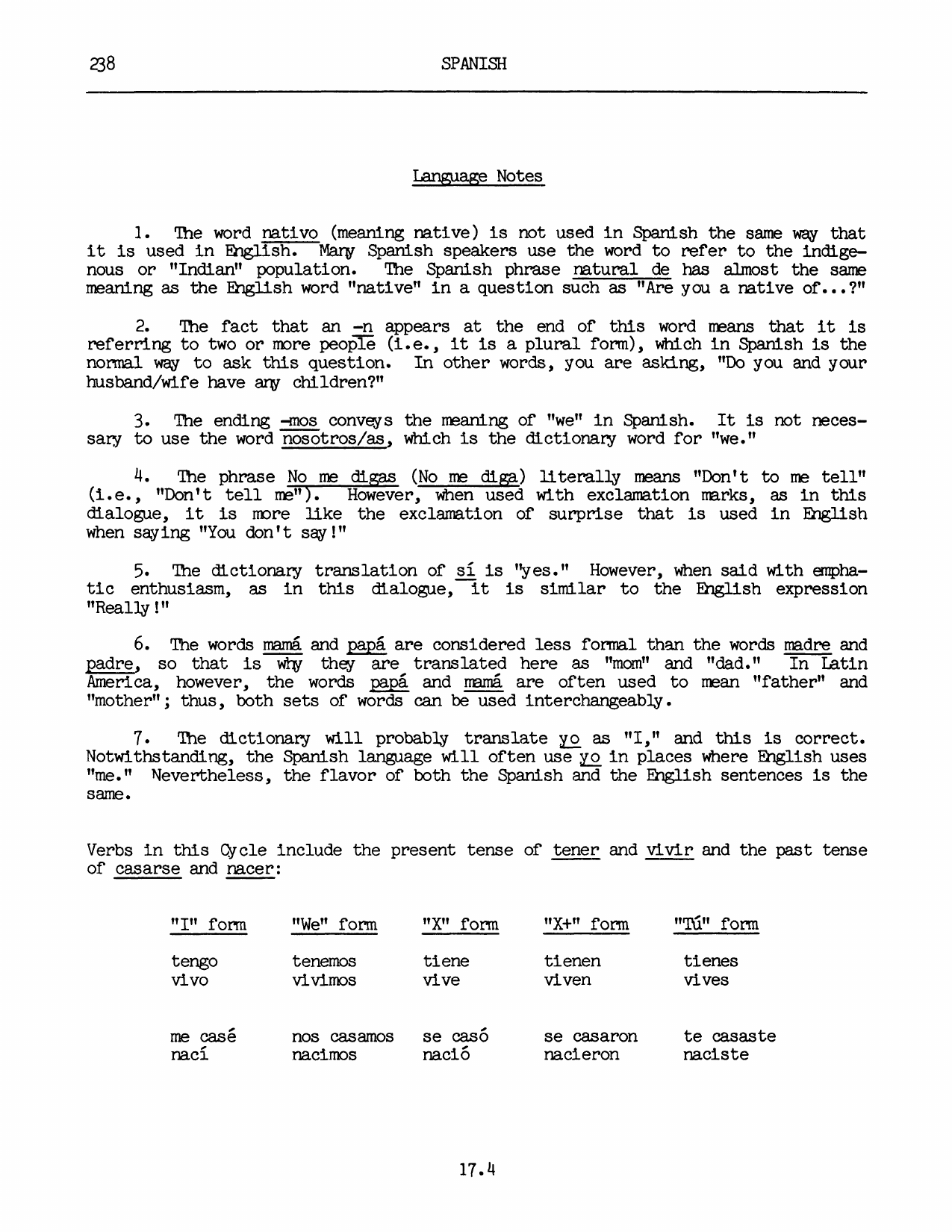
Verbs in this Cycle include the present tense of tener and vivir and the past tense of casarse and nacer:
Narrative:
Conversacién sobre la familia
Usted quiere conocer mejor a su compafiera/o de trabajo colombiana/o y tener la oportunidad de conversar con ella/él en español.
Un día, mientras almierzan juntas/os en la cafeteria de la Embajada, ella/él le cuenta que nació en Cali, que se casó muy joven, que tiene tres hi jos, que en su familia son siete y que ella/él es la/el menor de cinco hermanos. Usted le dice a su amiga/o que usted nació en un pueblito (pueblecito) en el centro del estado de Kansas, que es soltera/o y que usted es la/el mayor de tres her-manos.
Questions:
1 = ¿Qué quiere usted?
What do you want?
2 = ¿Dónde nació su amiga/o?
Where was your friend born?
3 = ¿Quién se casó my joven?
Who married very young?
4 — ¿Cuántas personas hay en la familia de su amiga/o?
How many persons are there in your friend's family?
5 - ¿Cuántos hijos tiene ella/él?
How many children does she/he have?
6 = ¿Ella/él es la/el mayor de su familia?
Ie she/he the eldest of her/his family?
7 - ¿Dónde nació usted?
Where were you born?
8 - ¿Es usted casada/o?
Are you married?
9 - Ustedes, ¿cuántos son de familia?
How many are there in your family?
10 - ¿Es usted la/el menor?
Are you the youngest?
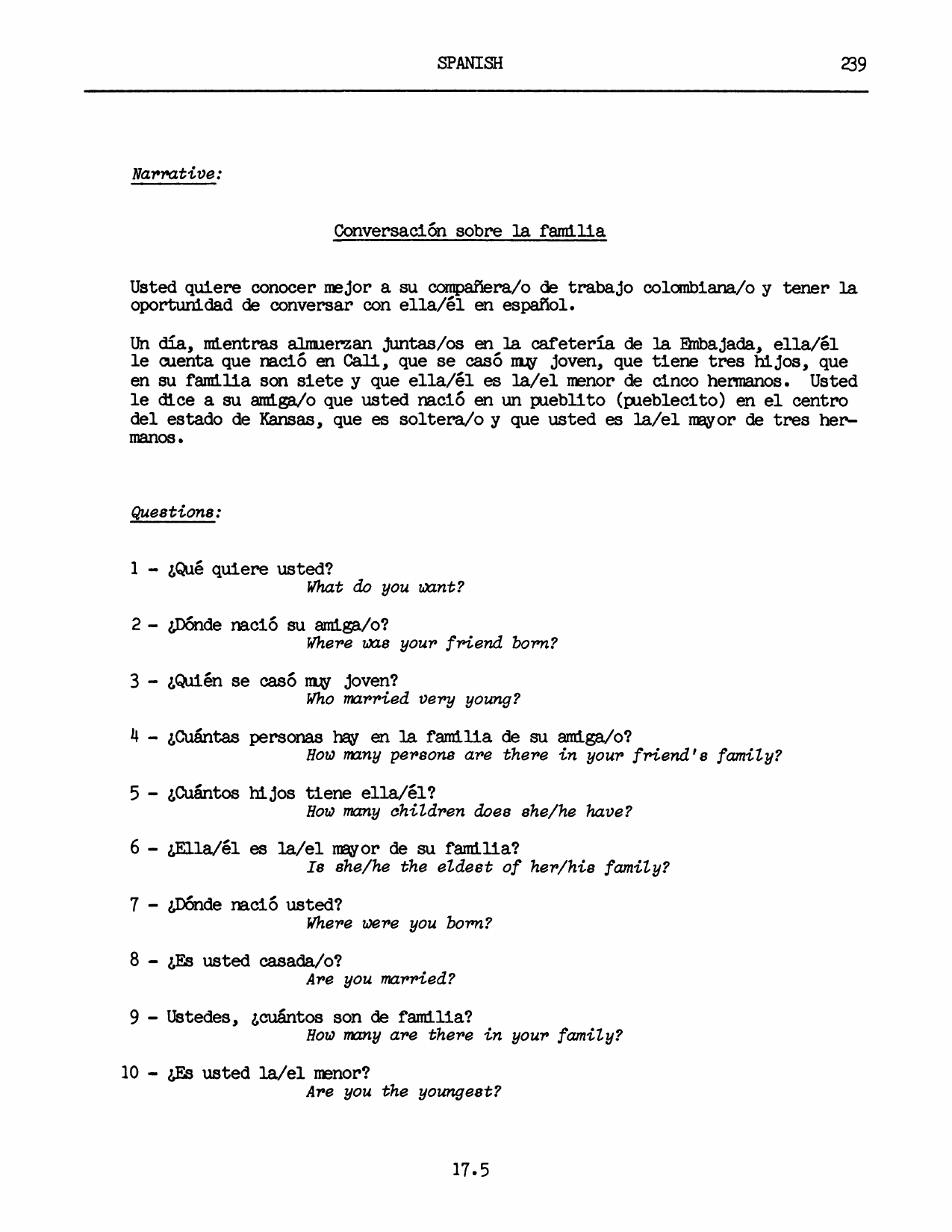
Fill in the Blanks - No. 1:
Conversación sobre la familia
?
la/el mayor?
This page has a drawing, chart, or fill-in layout — original page
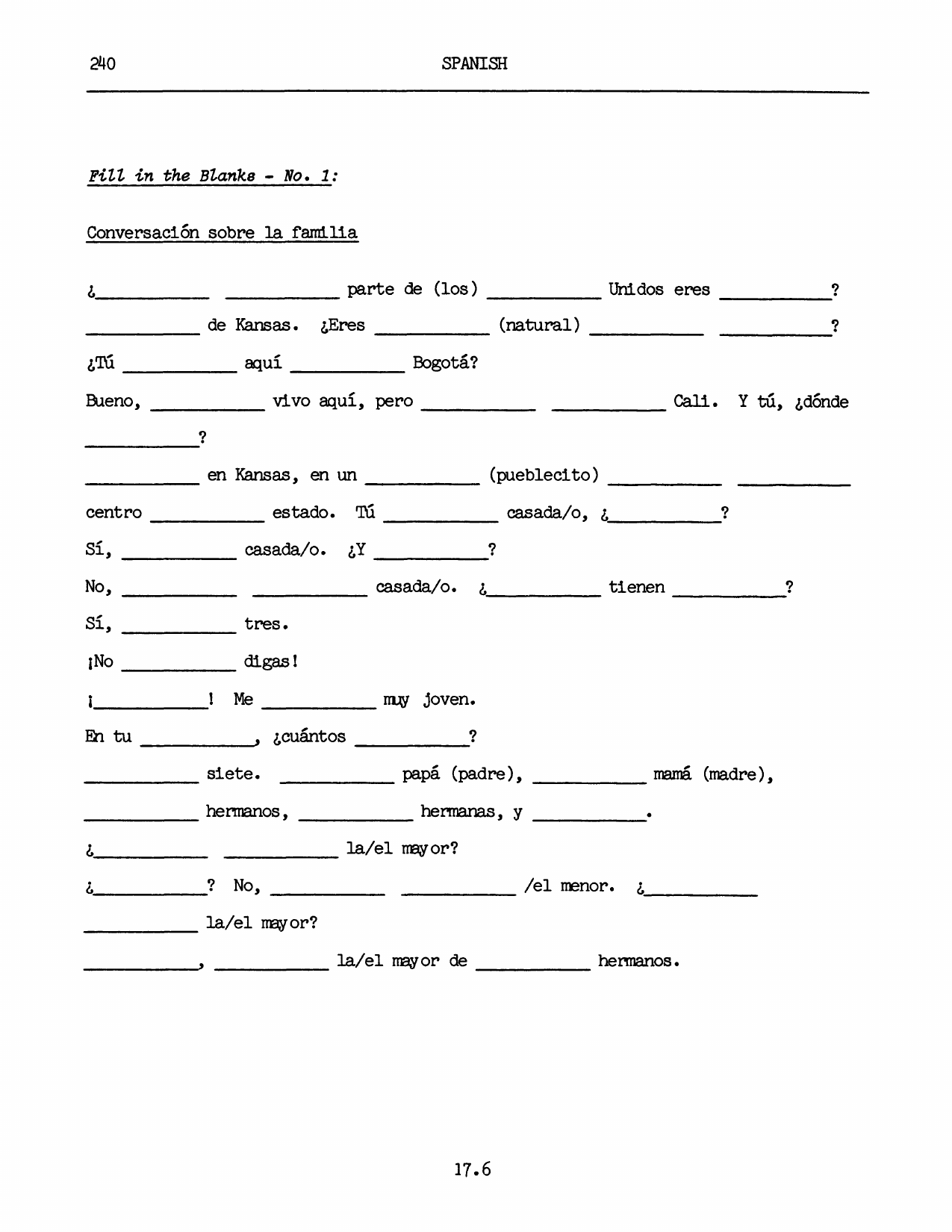
Fill in the Blanke - No. 2:
Conversación sobre la familia
?
This page has a drawing, chart, or fill-in layout — original page
IV. TAKING IT APART
Vocabulary:
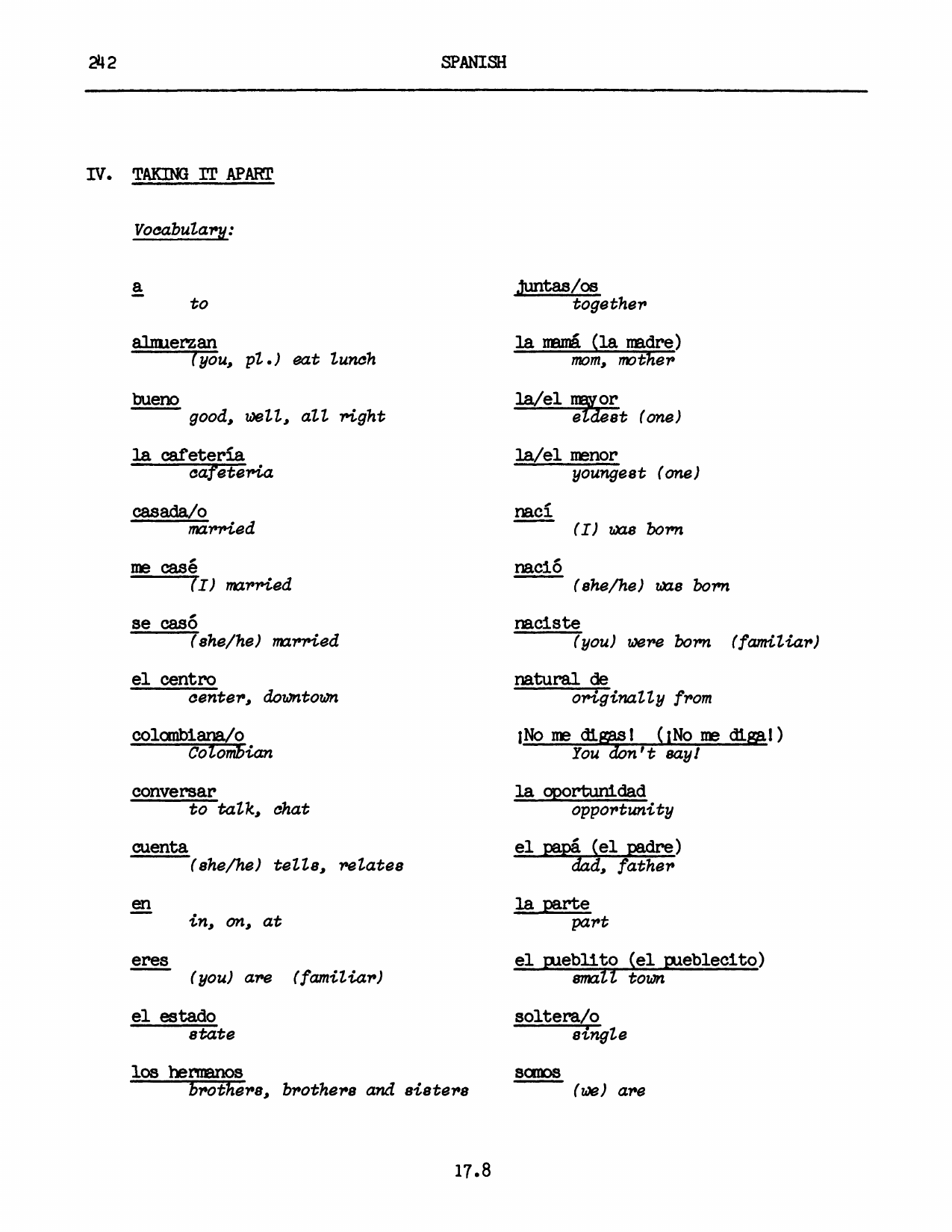
Ve. GETTING THE FEEL OF IT
Questions and Answers:
A. 1. ¿De dónde eres tú (es usted)?
a. Bueno, mi familia vive en Valparaíso, pero yo nací en
Santiago.
b. Bueno, vivo en Guayaquil, pero nací en Quito. C. Bueno, ahora vivo aquí en México, pero nací en
Guadalajara.
d. Nací en un pueblito (pueblecito) cerca de Buenos Aires. e. Bueno, ahora vivo en Lima, pero nací en Cuzco.
B. 1. ¿Ustedes tienen hi jos?
a. Si, tenemos dos, un niño (varón) y una niña. b. No, no tenemos ninguno.
C. Sí, tenemos dos hijas que viven en (los) Estados Unidos. d. Sí, tenemos tres varones. Dos trabajan en (los) EE.UU.
y uno estudia aquí.
e. Sí, tenemos dos, pero no viven con nosotros.
C. 1. ¿Qué clase de trabajo haces tú (hace usted)?
a. Bueno, ahora trabajo como profesora/profesor. b. Soy la/el asistente del Ministro Consejero. C. Soy vicecónsul.
d. Como soy economista, trabajo en la Sección Económica. e. Como soy abogada/o, trabajo como consejera/o legal.
D. 1. ¿Cuántas palabras escribe usted a máquina por minuto?
Escribo 60 palabras por minuto.
¿Cuántas palabras escriben ustedes a máquina por minuto?
Escribimos 50 palabras por minuto.
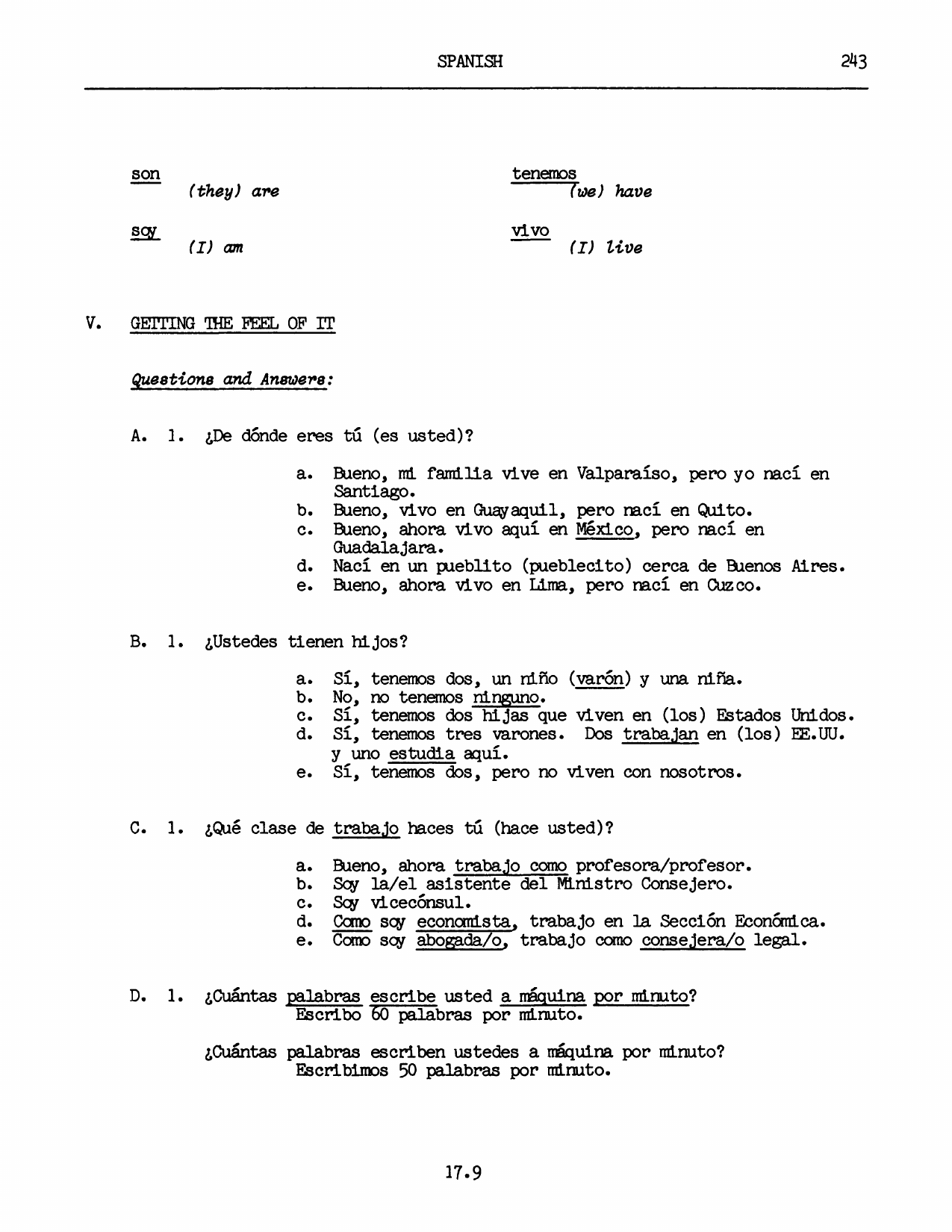
¿Cuántas palabras escribe la secretaria a máquina por minuto?
La secretaria escribe 70 palabras por minuto.
¿Cuántas palabras escriben ellas a máquina por minuto?
Ellas escriben 45 palabras por minuto.
¿Cuántas palabras escribes tú a máquina por minuto?
Escribo más o menos 30 palabras por minuto.
2. ¿Dónde vives tú?
Vivo en Arlington.
(Ustedes, ellos, Ana, el funcionario, la secretaria)
3. ¿Ud. recibe muchas cartas?
Sí, recibo muchas.
No, no recibo muchas.
(El Embajador, tú, ustedes, ellos, nosotros)
4, ¿El Embajador decide eso?
Si, el Embajador decide eso.
No, el Embajador no decide eso.
(Nosotros, el Ministro Consejero, ustedes, ella, tú)
5. ¿Usted permite eso?
S1, permito eso.
No, no permito eso.
(José, el jefe, ellos, tú, nosotros)
Questions and Answers: (continued)
A. 1. Where are you from?
a. Well, my family lives in Valparaiso, but I was born in
Santiago.
b. Well, I live in Guayaquil, but I was born in Quito. C. Well, I now live here in Mexico City, but I was born in
Guadalajara.
d. I was born in a small town near Buenos Aires. e. Well, I now live in Lima, but I was born in Cusco.
B. 1. Do you (pl.) have any children?
a. Yes, we have two, a boy and a girl.
Cc. Yes, we have two daughters who live in the United States. d. Yes, we have three song. Two work in the U.S. and one
studies here.
e. Yes, we have two, but they don't live with us.
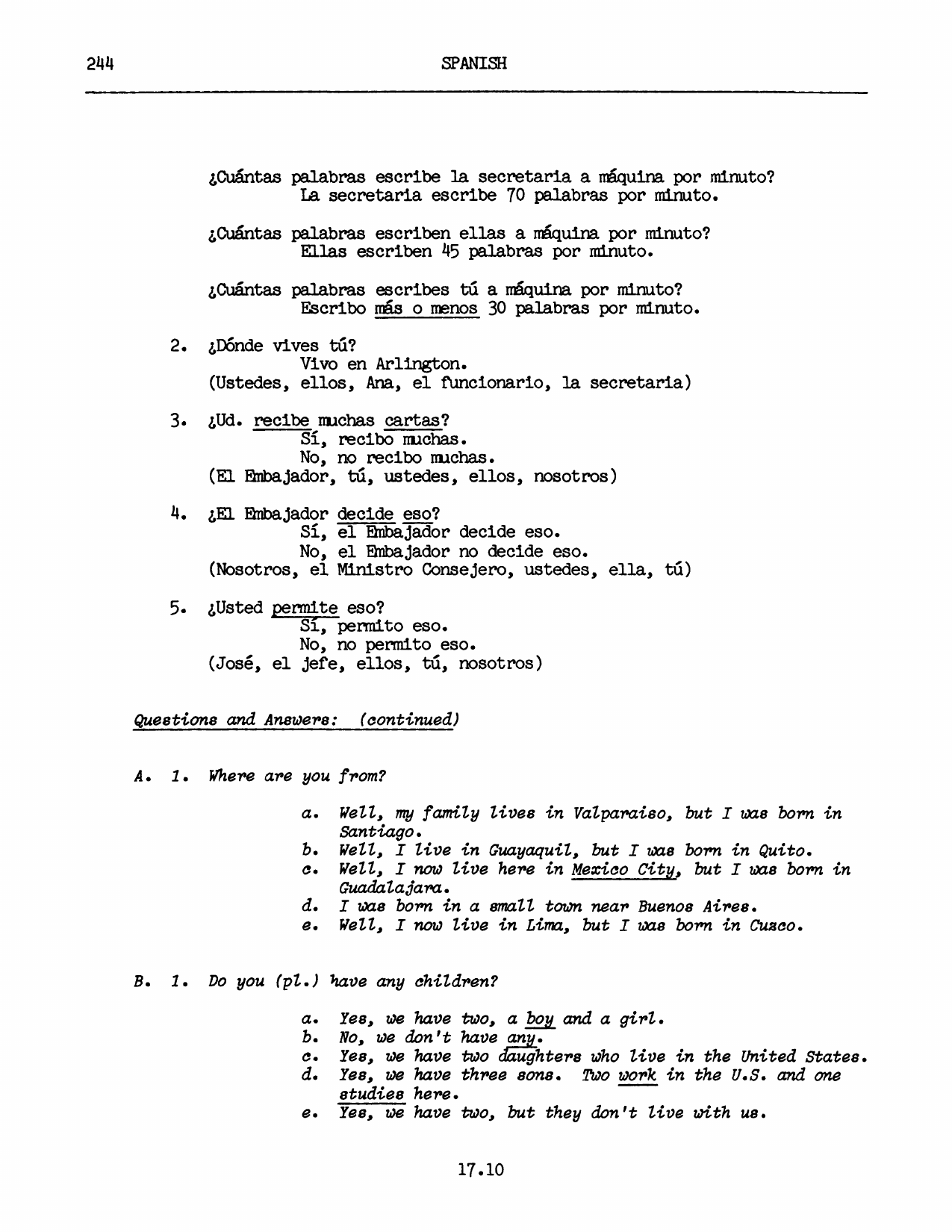
C. 1. What type of work do you do?
a. Well, I'm now working as a teacher.
b. I am the DCM's asstetant.
Ce I ama Vice-consul.
d. Since I am an economist, I work in the Economic Section. e. Since I am a lawyer, I work as a legal advisor.
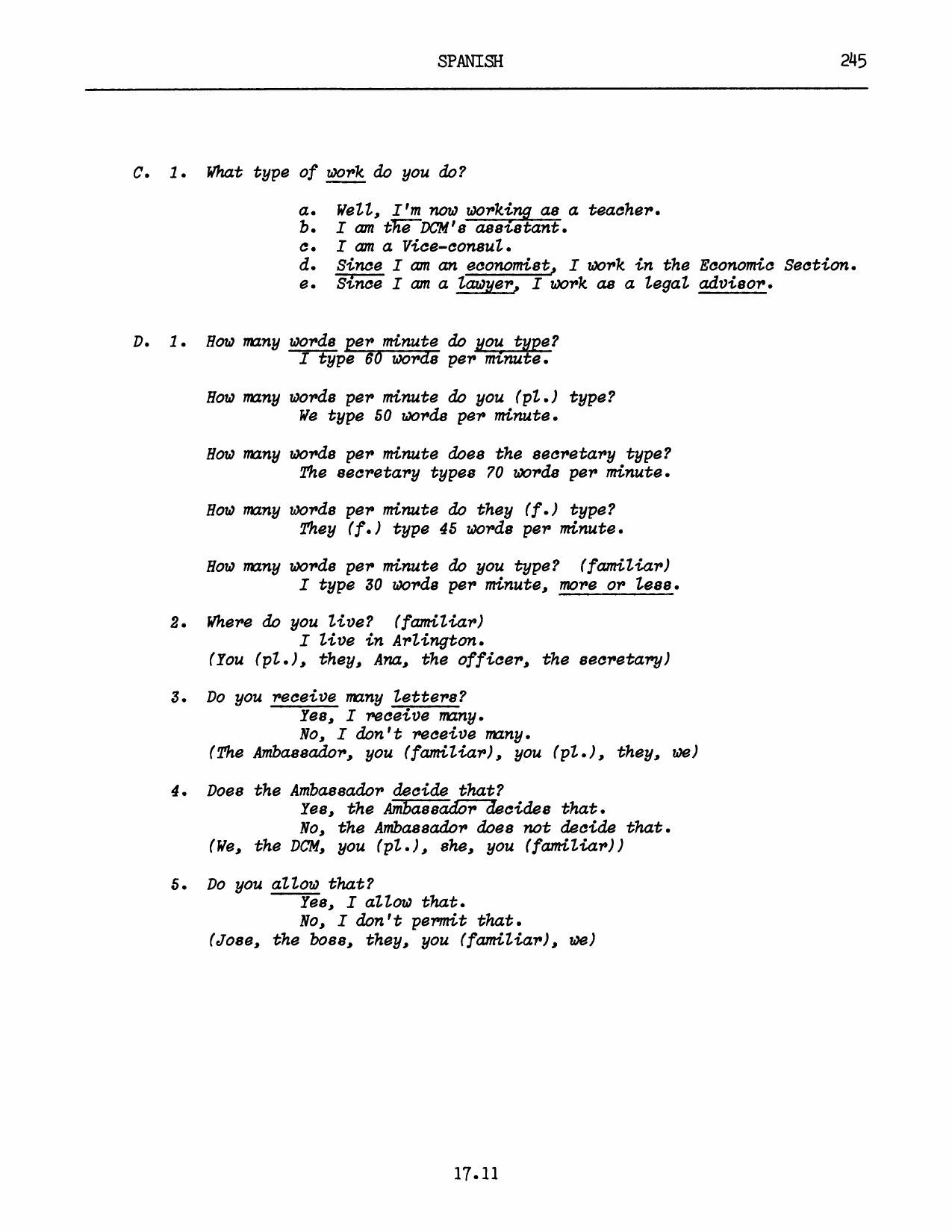
D. 1. How many words per minute do you type?
How many words per minute do you (pl.) type?
We type 50 words per minute.
How many words per minute does the secretary type?
The secretary types 70 words per minute.
How many words per minute do they (f.) type?
They (f.) type 45 words per minute.
How many words per minute do you type? (familiar)
I type 30 words per minute, more or lees.
2. Where do you live? (familiar)
I live in Arlington.
(You (pl.), they, Ana, the officer, the secretary)
3. Do you receive many letters?
Yes, I receive many.
No, I don't receive many.
(The Ambassador, you (familiar), you (pl.), they, we)
4. Does the Ambassador decide that?
Yes, the Ambassador decides that.
No, the Ambassador does not decide that.
(We, the DCM, you (pl.), she, you (familiar))
5. Do you allow that?
Yes, I allow that.
No, I don't permit that.
(José, the bose, they, you (familiar), we)
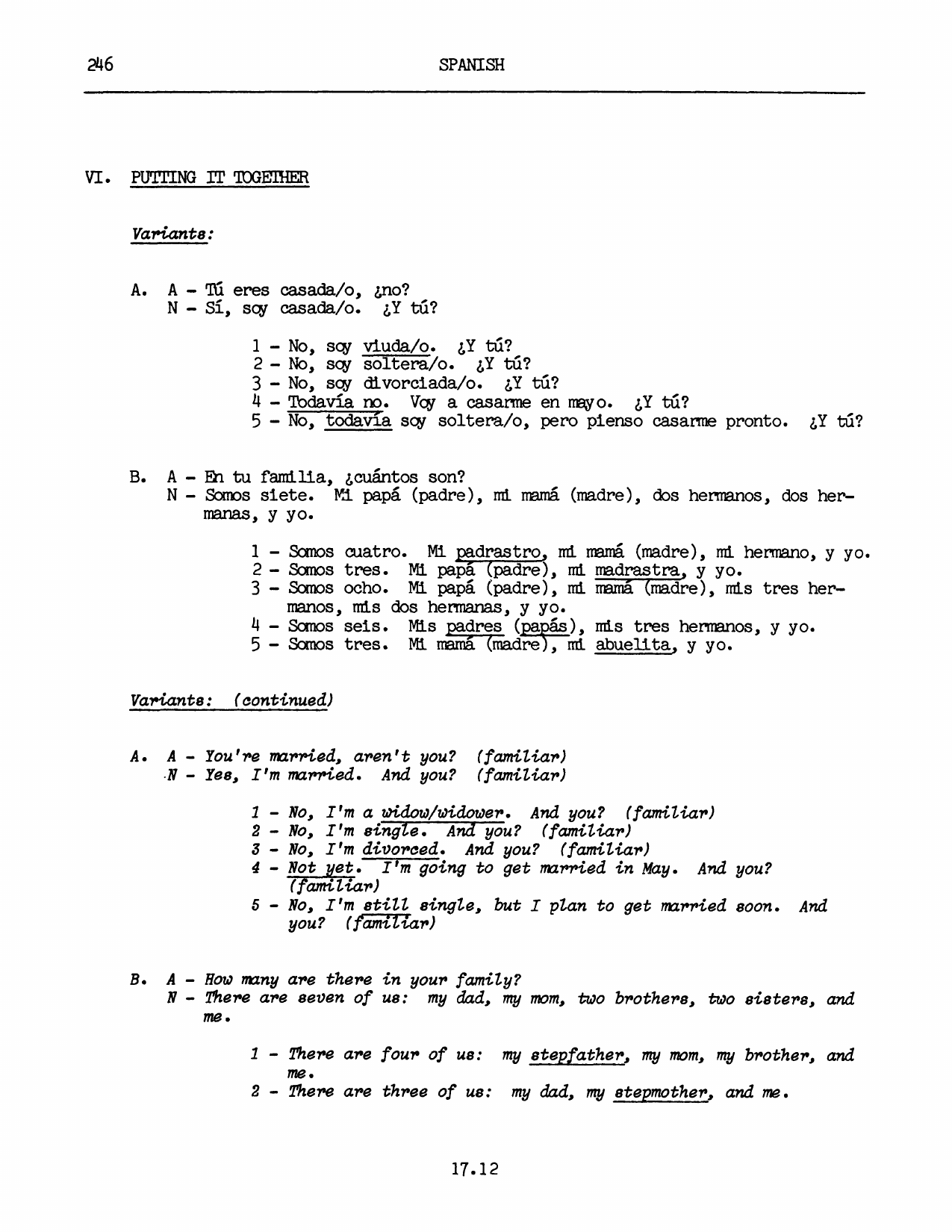
VI. PUTTING IT TOGETHER
Vartante:
A. A-— Tú eres casada/o, ¿no? —
N - Si, soy casada/o. ¿Y tú?
1 - No, soy viuda/o. ¿Y tú?
2 - No, soy soltera/o. ¿Y tú?
3 - No, soy divorciada/o. ¿Y tú?
4 - Todavía no. Voy a casarme en mayo. ¿Y tú?
5 - No, todavía soy soltera/o, pero pienso casarme pronto. ¿Y tú?
B. A — & tu familia, ¿cuántos son?
N - Somos siete. Mi papá (padre), mi mamá (madre), dos hermanos, dos her-
manas, y yo.
1 - Somos cuatro. Mi padrastro, mi mamá (madre), mi hermano, y yo. 2 - Somos tres. Mi papa (padre), mi madrastra, y yo. 3 - Somos ocho. Mi papá (padre), mi mamá (madre), mis tres her-
manos, mis dos hermanas, y yo.
4 — Somos seis. Mis padres (papás), mis tres hermanos, y yo. 5 - Somos tres. Mi mamá (madre) mi abuelita, y yo» °
Variants: (continued)
A. A - You're married, aren't you? (familiar)
-N - Yes, I'm married. And you? (familiar)
1 - No, I'm a widow/widower. And you? (familiar)
2 - No, I'm single. And you? (familiar)
3 - No, I'm divorced. And you? (familiar)
4 - Not yet. I'm going to get married in May. And you?
(familiar)
5 - No, I'm still single, but I plan to get married soon. And
you? (familiar)
B. A - How many are there in your family?
N - There are seven of us: my dad, my mom, two brothers, two sisters, and
me.
1 - There are four of us: my stepfather, my mom, my brother, and
me »
2 - There are three of us: my dad, my stepmother, and me.
3 - There are eight of us: my dad, my mom, my three brothers, my
two steters, and me.
4 - There are six of us: my parente, my three brothers (brothers
and sister or brother and sisters), and me.
5 - There are three of us: my mom, my grandmother, and me.
VIT. MAKING IT WORK
VIII. USING IT