CYCLE 19
GETTING ACQUAINTED
Social Courtesies
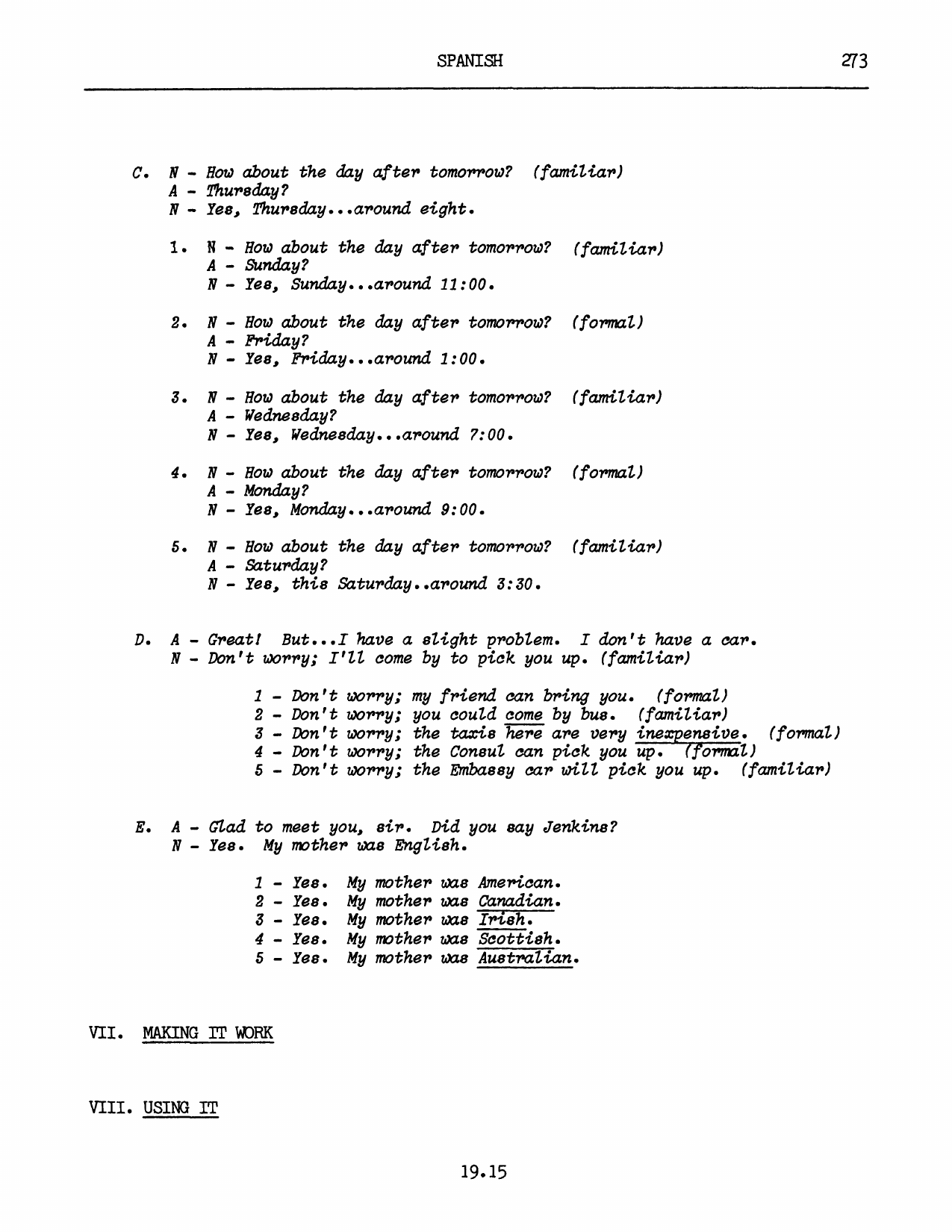
In the following situation, an American is invited to visit a friend's home.
Although the invitation is informal, it should be treated with due respect; enter-taining at home, even informally, is not as common as it is in the United States.
This page has a drawing, chart, or fill-in layout — original page
I. SETTING THE SCENE
Your friend from the Embassy, who ts a host country national, invitee you to her house to meet her family.
IT. HEARING TT
III. SEEING IT
Dialogue:
La invitación
N - Mira, quiero que tú vayas a mi casa un día de estos para conocer a la
familia...especialmente a mi marido y a los chicos.
A - Encantada/o. Me gustaría ir.
N - ¿Cuándo podrías ir?
A - Cuando tú quieras.
N - ¿Qué te parece pasado mañana?
A - ¿El jueves?
N - Sí, el jueves...como a las ocho.
A - ¡Magnífico! Pero...tengo un pequeño problema. No tengo carro (coche). N - No te preocupes. Yo paso por ti.
(El jueves por la noche)
N - Roberto, quiero presentarte a mi compañera/o de trabajo, Kimberly /Mike
Jones. Kim/Mike, mi esposo.
N = Mucho gusto de conocerla/o. Roberto Lépez Jenkins, para servirle. A - El gusto es mio, señor. ¿Dijo Jenkins?
N - Sí. Mi madre era inglesa.
Dialogue: (continued)
The invitation
(1) WN - Listen, I want you to come to my house one of these days to meet the
family...especially my husband and the kids. (familiar)
A - I'd be delighted. I'd love to.
WN - When could you come? (familiar)
A - Whenever you'd like. (familiar)
WN - How about the day after tomorrow? (familiar)
(2) A - Thursday?
N - Yes, Thursday... around eight.
(3) A- Great! But...I have a slight problem. I don't have a car.
WN - Don't worry; I'll come by to pick you up. (familiar)
(Thursday evening)
N - Roberto, I'd like you to meet my co-worker, Kimberly/Mike Jones.
Kim/Mike, my husband.
(4) WN - Glad to meet you. Roberto López Jenkins, at your service.
A - The pleasure te mine, sir. Did you say Jenkins?
(4,5) N - Yes. My mother was English.
Language Notes
la. The "command" form of the verb mirar ("to look") is the formal mire or
the familiar mira, which are often used in cases where in English you would say, "Listen."
lb. You express "want to do something" with guiero or one of its forms. Thus,
familiar "tú" form, Quiero que tú vayas. Vaya (vayas) is the "command" form of ir.
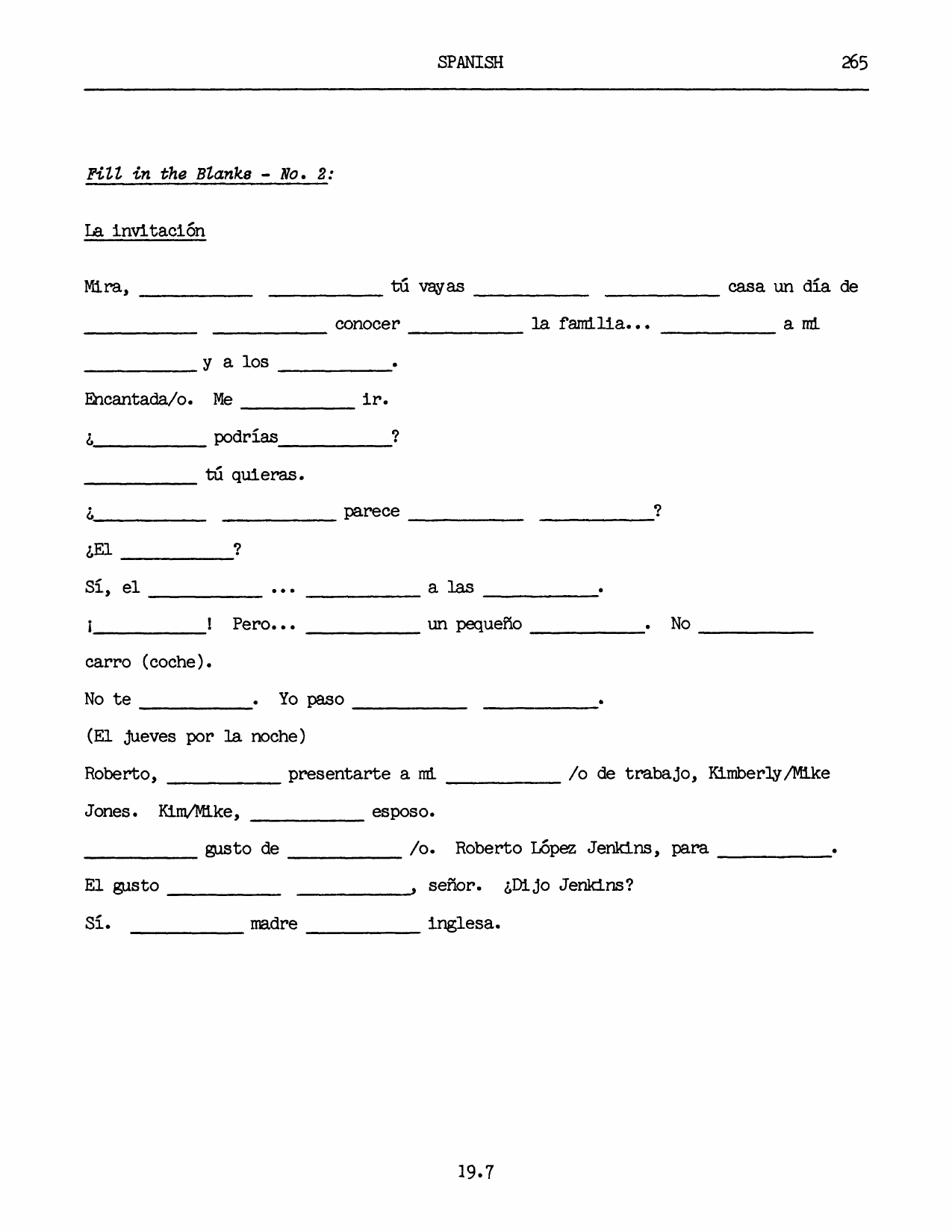
Other examples:
Quiero comer ("I want to eat") vs. Quiero que coma (comas) ("I want you to eat") Quiero hablar ("I want to talk") vs. Quiero que hable (hables) ("I want you to talk")
lc. In Spanish you often use the verb ir in places where in English you would
use the verb "come." (The same is also true for "take" and "bring.")
2 In contrast to English usage, the days of the week in Spanish are NOT
capitalized and are usually preceded by the article el ("the"). Where English speakers say "On Monday," for example, speakers of Spanish would say el lunes. About the only time when you don't use the article el in Spanish is to say some-thing like "Today is Monday," Hoy es lunes.
However, in many areas there may be a more popular, regional word for "car." For example, in Argentina, México, and Spain, the word coche is preferred; this word is also universally understood. Such vocabulary differences are not unusual; the Spanish-speaking world encompasses such a large area that differences exist. Nevertheless, these differences or preferences should not pose ary serious diffi-culties for you.
4, Men often use such courteous phrases as para servirle, su_servidor, etc.
However, it is more appropriate for a woman to welcome a person into her home by using a phrase such as Bienvenida/o a nuestra casa ("Welcome to our home"). Similarly, on being introduced, a woman would not generally give her full name as Roberto does in our dialogue.
5. The word inglesa is not capitalized because nationalities, like the days
of the week, months of the year, and names of languages, are not capitalized.
Narrative:
La invitación
Su amiga, la colombiana, quiere que usted vaya a su casa para conocer a su familia. A usted le gustaría mucho ir, y podría hacerlo cuando su amiga quisiera. A su amiga le parece bien el jueves a las ocho. A usted también le parece bien el jueves, pero tiene un problema, no tiene carro (coche). Su amiga le dice que no se preocupe, que ella pasa por usted.
El jueves por la noche cuando usted llega a casa de su amiga, usted conoce a su marido, Roberto. El le da su nombre completo y a usted le sorprende el apellido Jenkins, y Roberto le explica que su madre era inglesa.
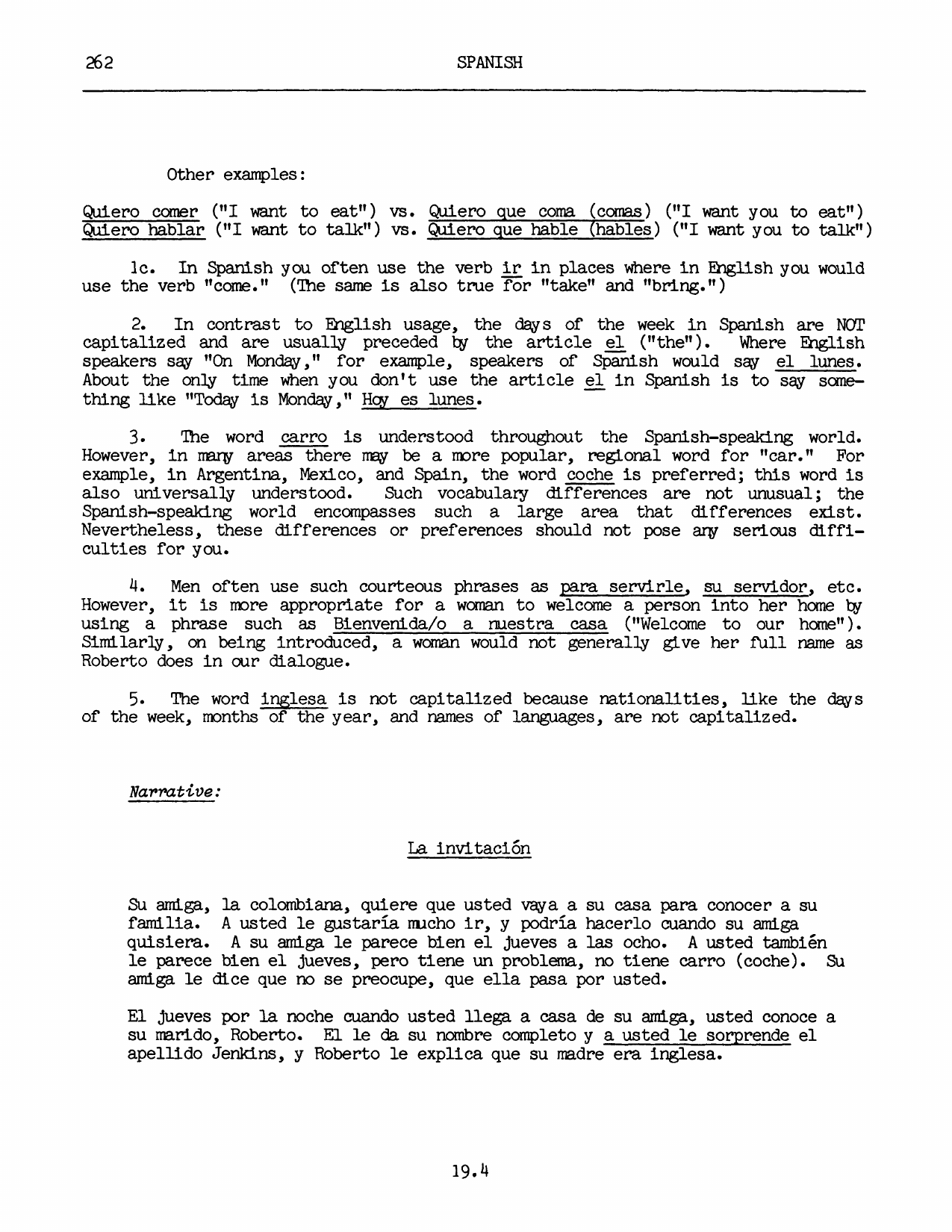
Questions:
1 = ¿Qué quiere su amiga?
What does your friend (f.) want?
2 - ¿Cuándo podría ir usted?
When could you come?
3 = ¿Qué día le parece bien a su amiga
What day does your rienda (f.) prefer?
4 — ¿Qué problema tiene usted?
What's your problem?
5 - ¿Qué le dice su amiga?
What does your friend (f.) say to you?
6 = ¿A quién conoce usted en casa de su amiga
Whom do you meet at your Friend's (f.) home?
7 = ¿Qué le sorprende a usted?
What surprises you?
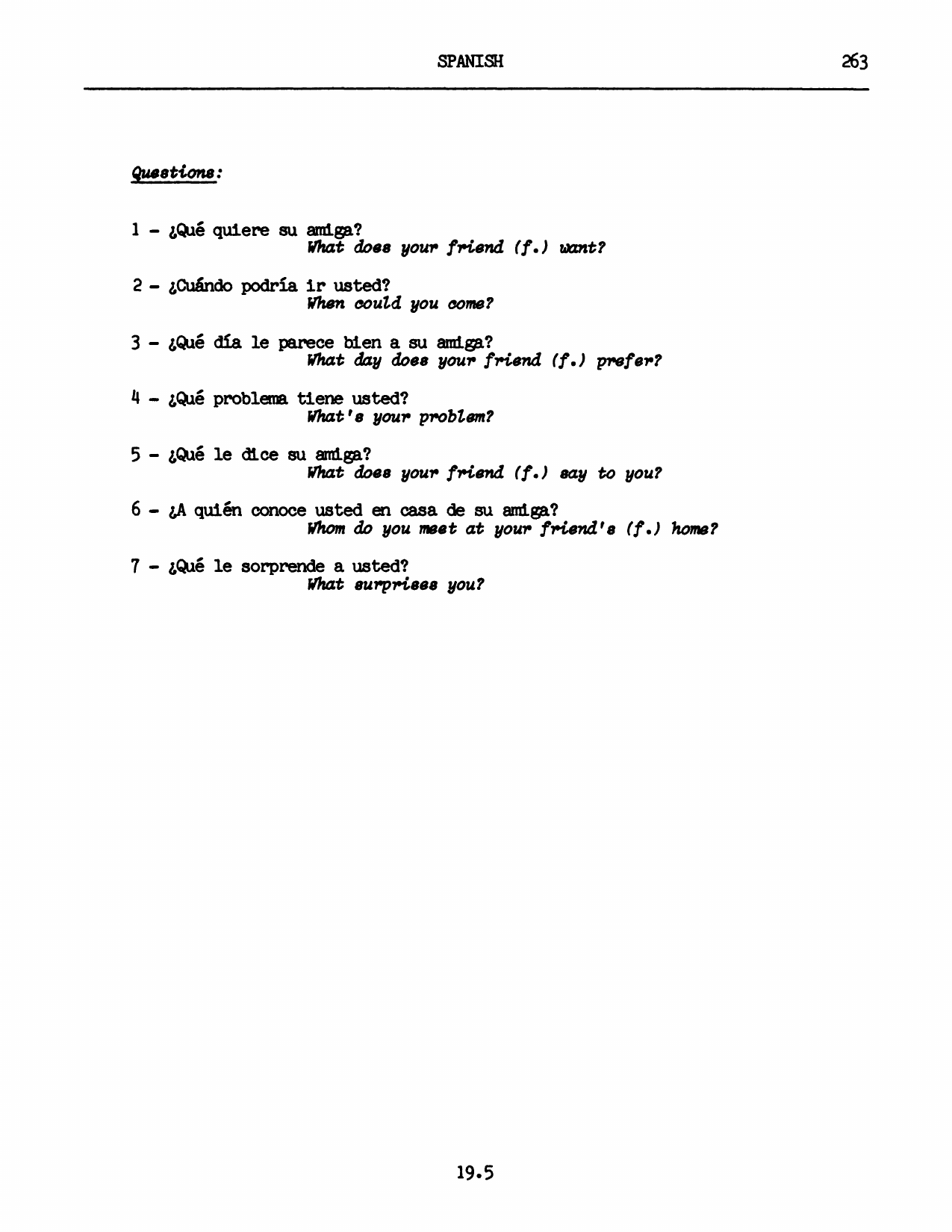
Fill in the Blanks - No. 1:
La invitación
(coche).
(El jueves por la noche)
servirle.
es mío, señor. ¿Dijo Jenkins?
This page has a drawing, chart, or fill-in layout — original page
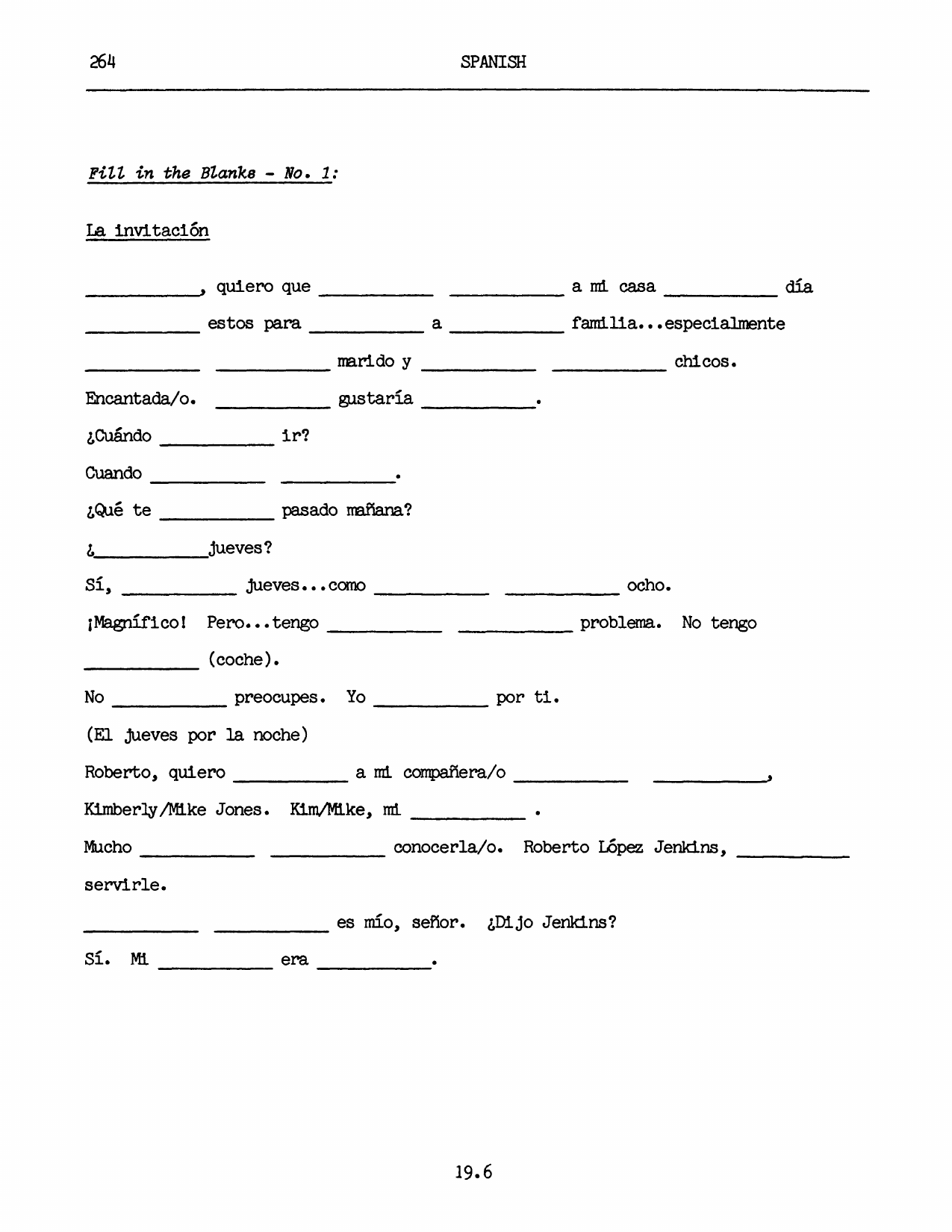
Fill in the Blanks - No. 2:
La invitación
ta quieras.
Sí, el
carro (coche).
No te
(El jueves por la noche)
This page has a drawing, chart, or fill-in layout — original page
IV. ‘TAKING IT APART
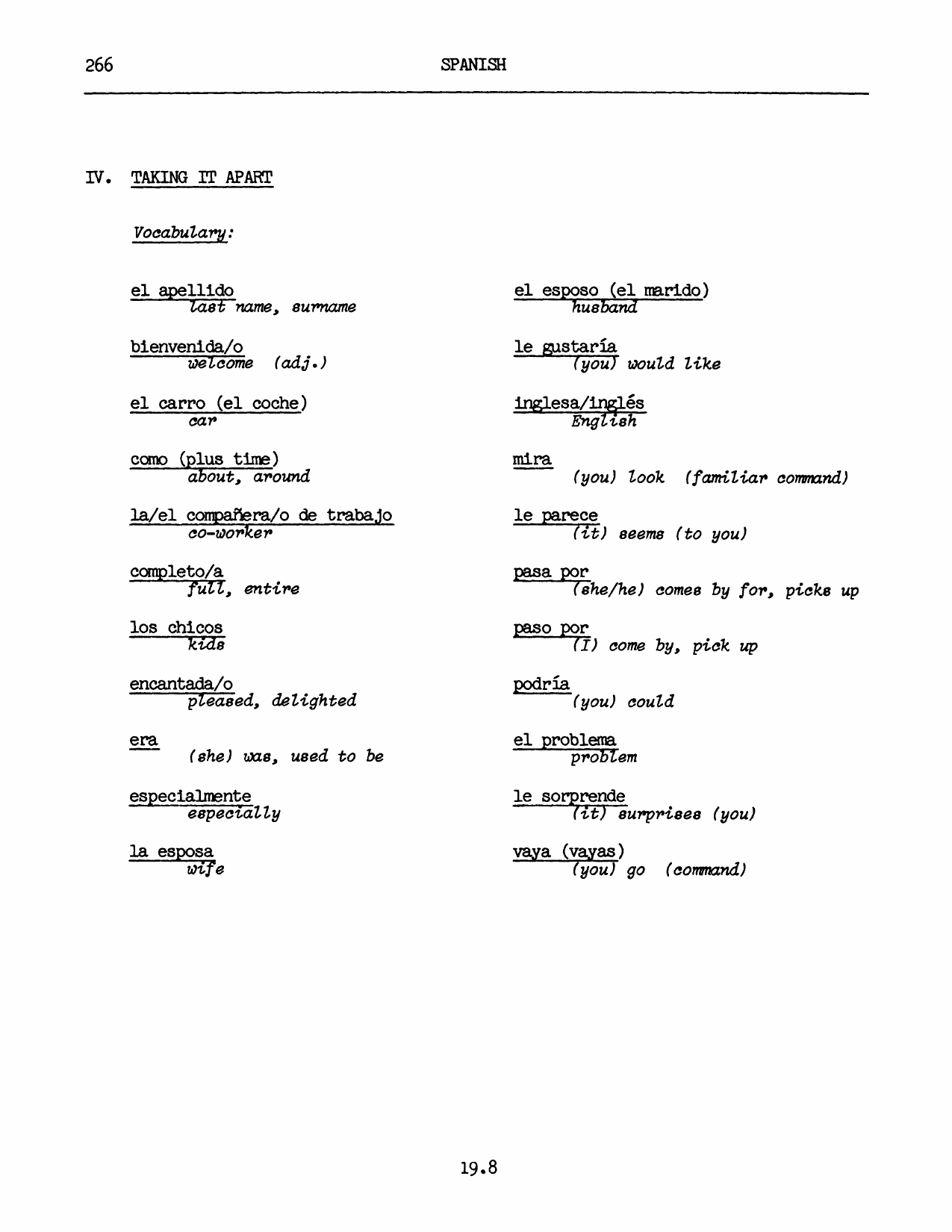
Vocabulary:
V. GETTING THE FEEL OF IT
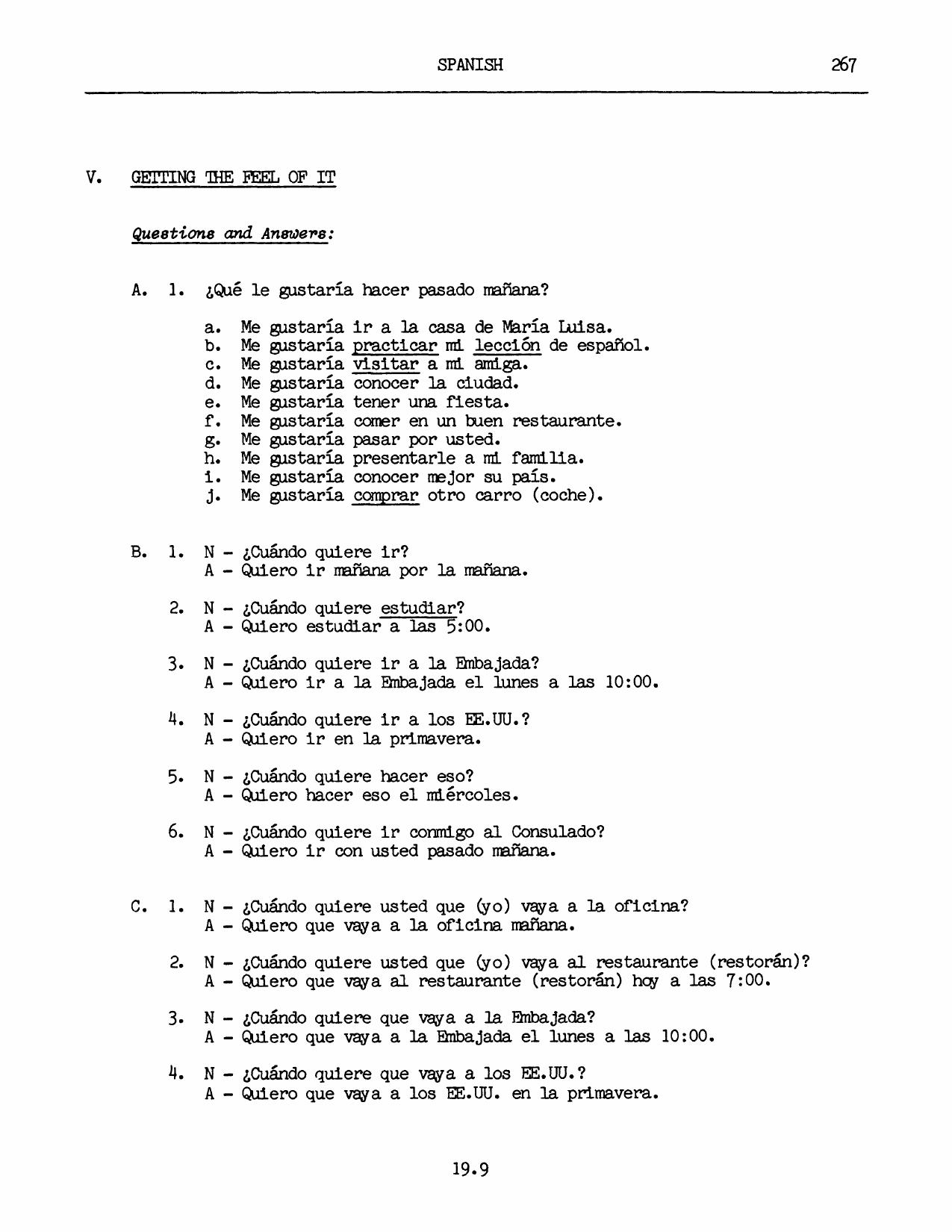
Questions and Answers:
A. 1. ¿Qué le gustaría hacer pasado mañana?
a. Me gustaría ir a la casa de María Luisa.
b. Me gustaría practicar mi lección de español.
C. Me gustaría visitar a mi amiga.
d. Me gustaría conocer la ciudad.
e. Me gustaría tener una fiesta.
f. Me gustaría comer en un buen restaurante.
g Me gustaría pasar por usted.
h. Me gustaría presentarle a mi familia.
i. Me gustaría conocer mejor su país.
j. Me gustaría comprar otro carro (coche).
B. 1. N- ¿Cuándo quiere ir?
A - Quiero ir mañana por la mañana.
2. N — ¿Cuándo quiere estudiar?
A - Quiero estudiar a las 5:00.
3. N- ¿Cuándo quiere ir a la Embajada?
A - Quiero ir a la Embajada el lunes a las 10:00.
4, N = ¿Cuándo quiere ir a los EE.UU.?
A - Quiero ir en la primavera.
5. N — ¿Cuándo quiere hacer eso?
A - Quiero hacer eso el miércoles.
6. N — ¿Cuándo quiere ir conmigo al Consulado?
A - Quiero ir con usted pasado mañana.
C. 1. N = ¿Cuándo quiere usted que (yo) vaya a la oficina?
A - Quiero que vaya a la oficina mañana.
2. N - ¿Cuándo quiere usted que (yo) vaya al restaurante (restorán)?
A - Quiero que vaya al restaurante (restorán) hoy a las 7:00.
3. N — ¿Cuándo quiere que vaya a la Embajada?
A - Quiero que vaya a la Embajada el lunes a las 10:00.
4, N = ¿Cuándo quiere que vaya a los EE.UU. ?
A - Quiero que vaya a los EE.UU. en la primavera.
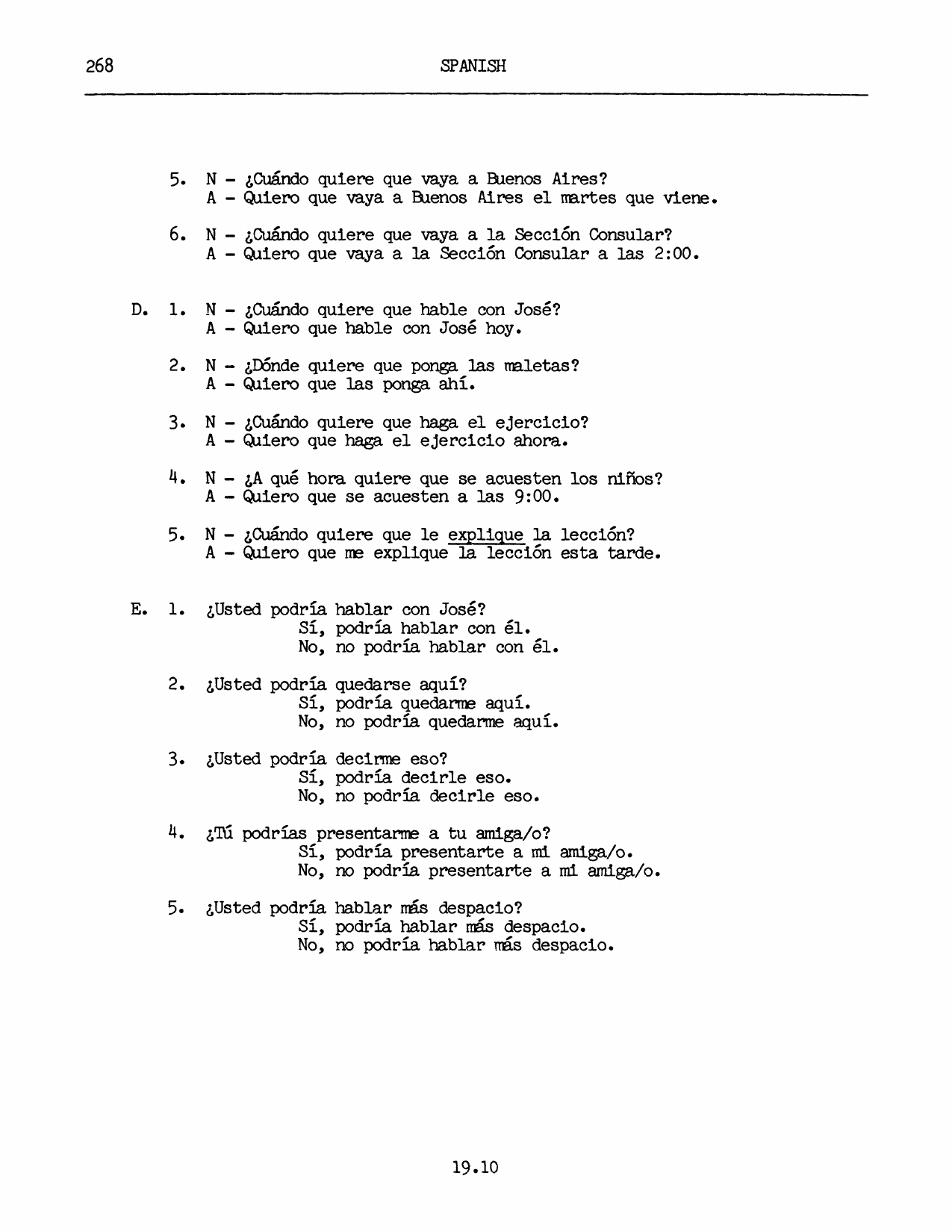
5. N = ¿Cuándo quiere que vaya a Buenos Aires?
A - Quiero que vaya a Buenos Aires el martes que viene.
6. N - ¿Cuándo quiere que vaya a la Sección Consular?
A - Quiero que vaya a la Sección Consular a las 2:00.
D. 1. N- ¿Cuándo quiere que hable con José?
A — Quiero que hable con José hoy.
2. N — ¿Dónde quiere que ponga las maletas?
A - Quiero que las ponga ahí.
3. N - ¿Cuándo quiere que haga el ejercicio?
A — Quiero que haga el ejercicio ahora.
4. N — ¿A qué hora quiere que se acuesten los niños?
A - Quiero que se acuesten a las 9:00.
5. N- ¿Cuándo quiere que le explique la lección?
A - Quiero que me explique la lección esta tarde.
E. 1. ¿Usted podría hablar con José?
Sí, podría hablar con él.
No, no podría hablar con él.
2. ¿Usted podría quedarse aquí?
Sí, podría quedarme aquí.
No, no podría quedarme aquí.
3. ¿Usted podría decirme eso?
Sí, podría decirle eso.
No, no podría decirle eso.
4. ¿Tú podrías presentarme a tu amiga/o?
Sí, podría presentarte a mi amiga/o.
No, no podría presentarte a mi amiga/o.
5. ¿Usted podría hablar más despacio?
Sí, podría hablar más despacio.
No, no podría hablar más despacio.
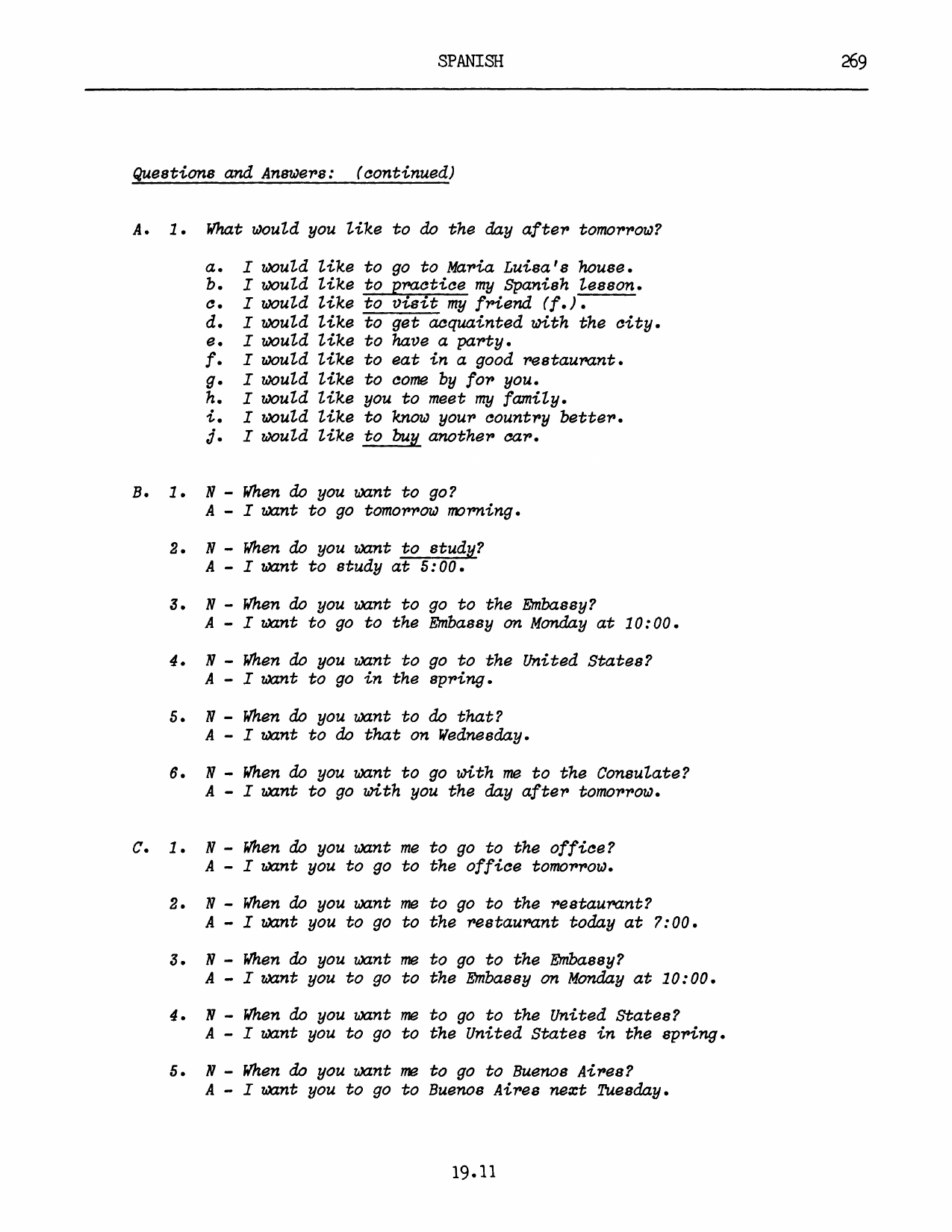
Questions and Answers: (continued)
A. 1. What would you like to do the day after tomorrow?
a. I would like to go to Maria Lutea's house.
b. I would like to practice my Spanish lesson.
c. I would like to visit my friend (f.).
d. I would like to get acquainted with the city.
e. I would like to have a party.
f. I would like to eat in a good restaurant.
g- I would like to come by for you.
h. I would like you to meet my family.
t. I would like to know your country better.
j- I would like to buy another car.
B. i. N - When do you want to go?
A - I want to go tomorrow morning.
2. N - When do you want to study?
A - I want to study at 5:00.
3. N - When do you want to go to the Embassy?
A ~ I want to go to the Embassy on Monday at 10:00.
4. N - When do you want to go to the United States?
A - I want to go in the spring.
de N - When do you want to do that?
A - I want to do that on Wednesday.
6. N - When do you want to go with me to the Consulate?
A - I want to go with you the day after tomorrow.
C. 1. N - When do you want me to go to the office?
A - I want you to go to the office tomorrow.
2. N - When do you want me to go to the restaurant?
A - I want you to go to the restaurant today at 7:00.
3 N - When do you want me to go to the Embassy?
A - I want you to go to the Embassy on Monday at 10:00.
4. N - When do you want me to go to the United States?
A - I want you to go to the United States in the spring.
be N - When do you want me to go to Buenos Aires?
A - I want you to go to Buenos Aires next Tuesday.
6. WN - When do you want me to go to the Consular Section?
A - I want you to go to the Consular Section at 2:00.
D. 1. N- When do you want me to speak with Jose?
A - I want you to speak with Jose today.
2. MN - Where do you want me to put the suitcases?
A - I want you to put them there.
3. WN - When do you want me to do the exercise?
A - I want you to do the exercise now.
4. WN - At what time do you want the children to go to bed?
A - I want them to go to bed at 9:00.
5. N - When do you want me to explain the lesson to you?
A - I want you to explain the lesson to me this afternoon.
E. 1. Could you speak with Jose?
Yes, I could speak with him.
No, I couldn't speak with him.
2. Could you stay here?
Yes, I could stay here.
No, I couldn't stay here.
3. Could you tell me that?
Yes, I could tell you that.
No, I couldn't tell you that.
4. Could you introduce your friend to me?
Yes, I could introduce my friend to you. (familiar) No, I couldn't introduce my friend to you. (familiar)
5. Could you speak more slowly?
Yes, I could speak more slowly.
No, I couldn't speak any more slowly.
VI. PUTTING IT TOGETHER
Variante:
A. N- Mira, quiero que tú vayas a mi casa un día de estos para conocer a la
familia.
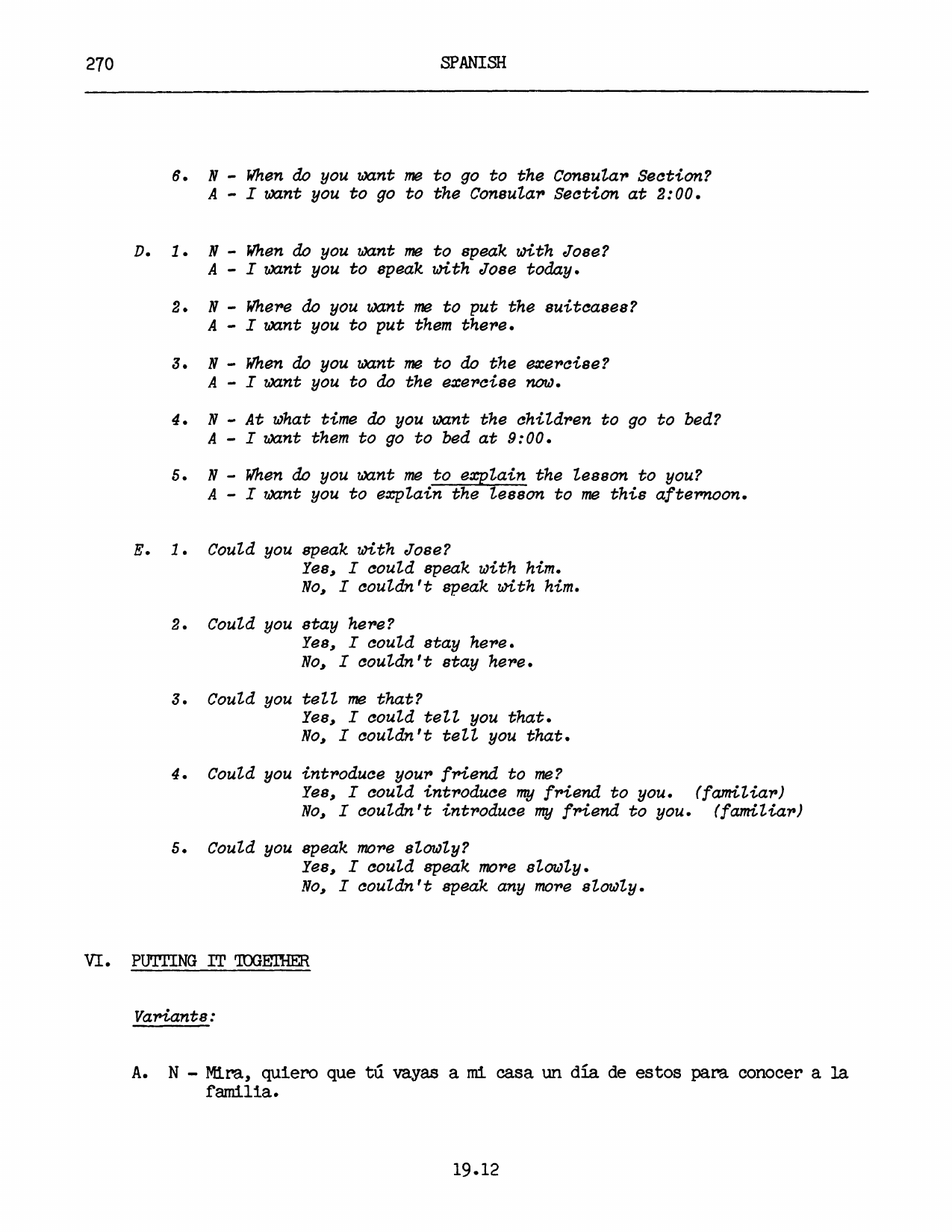
A - Encantada/o. Me gustaría ir.
1 - Mira, quiero que tú vayas a mi casa un día de estos para
conocer a mi marido.
2 - Mira, quiero que tú vayas a mi casa un día de estos para
conocer a mí hermano.
3 - Mire, quiero que usted vaya a mi casa un día de estos para
conocer a mi papá (padre).
4 — Mire, quiero que usted vaya a mi oficina un día de estos para
conocer a mis colegas.
5 - Mira, quiero que tú vayas a la Embajada un día de estos para
conocer al Embajador.
B. N = ¿Cuándo podrías ir?
A = Cuando tú quieras.
1 - Cuando tú digas.
2 - Cuando tú me invites.
3 - Cuando tú puedas.
4 — Cuando te sea conveniente.
5 - Cuando tú tengas tiempo.
Co N = ¿Qué te parece pasado mañana?
A - ¿El jueves?
N - Sí, el jueves...como a las ocho.
l. N- ¿Qué te parece pasado manaña?
A = ¿El domingo?
N - Sí, el domingo...como a las 11:00.
2. N- ¿Qué le parece pasado mañana?
A = ¿El viernes?
N - Sí, el viernes...como a la 1:00.
3. N- ¿Qué te parece pasado mañana?
A - ¿El miércoles?
N - Sí, el miércoles...como a la 7:00.
4, N- ¿Qué le parece pasado mañana?
A - ¿El lunes?
N - Sí, el lunes...como a las 9:00.
5. N- ¿Qué te parece pasado mañana?
A = ¿El sábado?
N - Si, este sábado que viene...como a las 3:30.
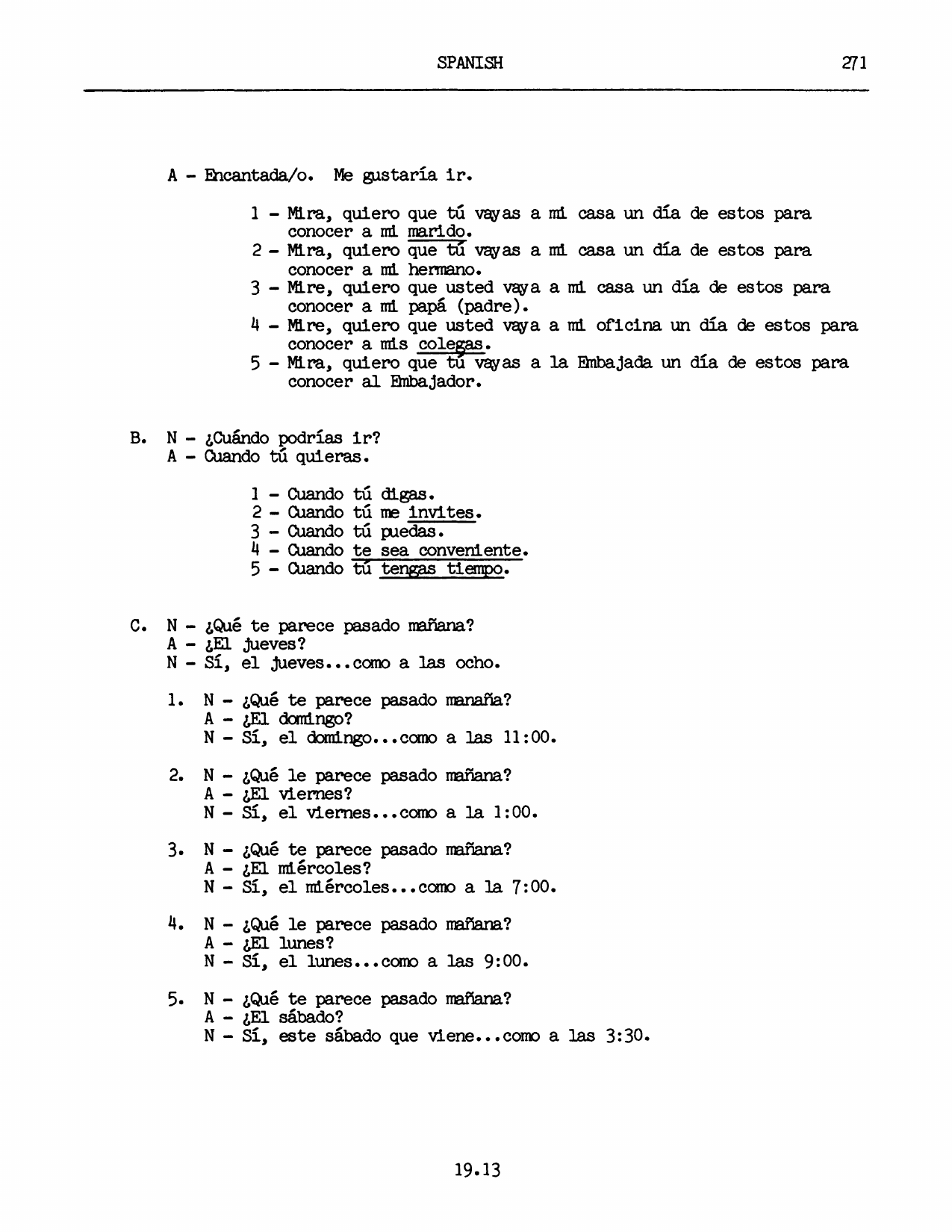
D. A = ¡Magnífico! Pero...tengo un pequeño problema. No tengo carro
(coche).
N — No te preocupes. Yo paso por ti.
1 = No se preocupe. Mi amigo puede traerla/o.
2 - No te preocupes. Puedes venir en autobús.
3 - No se preocupe. Los taxis aquí son my baratos. 4 — No se preocupe. El Cónsul puede pasar por usted. 5 - No te preocupes. El carro de la Embajada pasa por ti.
E. A - El gusto es mío, señor. ¿Dijo Jenkins?
N - Sí. Mi madre era inglesa.
1 - Sí. Mi madre era americana.
2 - Sí. Mi madre era canadiense.
3 - Si. Mi madre era irlandesa.
4} — Sí. Mi madre era escocesa.
5 - Sí. Mt madre era australiana.
Variants: (continued)
A. N - Listen, I want you to come to my house one of these days to meet the
family. (familiar)
A - I'd be delighted. I'd love to.
1 - Listen, I want you to come to my house one of these days to
meet my husband. (familiar)
2 - Listen, I want you to go come to my house one of these days to
meet my brother. (familiar)
3 - Listen, I want you come to my house one of these days to
meet my dad. (formal)
4 - Listen, I want you to come to my office one of these days to
meet my colleagues. (formal)
5 - Listen, I want you to come to the Embassy one of these days to
meet the Ambassador. (familiar)
B. N - When could you come? (familiar)
A - Whenever you'd like. (familiar)
1 - Whenever you say. (familiar)
2 - Whenever you invite me. (familiar)
3 - Whenever you can. (familiar)
4 - Whenever it's convenient for you. (familiar)
5 - Whenever you have time. (familiar)
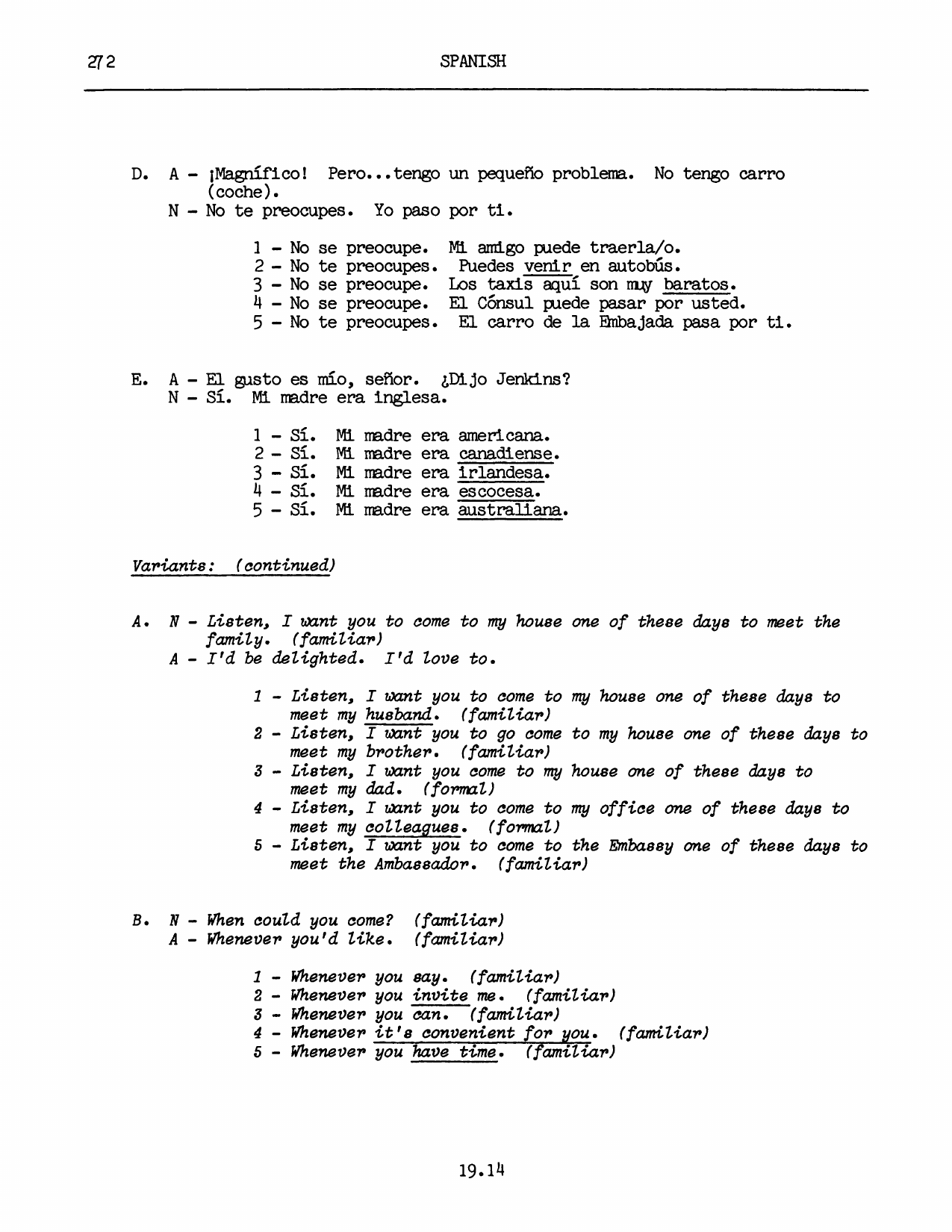
C. WN ~ How about the day after tomorrow? (familiar)
A - Thursday?
N - Yes, Thursday...around eight.
1. N - How about the day after tomorrow? (familiar)
A - Sunday?
WN - Yes, Sunday...around 11:00.
2. WN - How about the day after tomorrow? (format)
A - Frida y?
N ~ Yes, Friday. . around 1:00.
3. N - How about the day after tomorrow? (familiar)
A - Wednesday?
N - Yes, Wednesday...around 7:00.
4. N - How about the day after tomorrow? (format)
A - Monday?
N - Yes, Monday...around 9:00.
5. N - How about the day after tomorrow? (familiar)
A - Saturday?
WN - Yes, this Saturday..around 3:30.
D. A - Great! But...I have a slight problem. I don't have a car.
N - Don't worry; I'll come by to pick you up. (familiar)
Don't worry; my friend can bring you. (formal) Don't worry; you could come by bus. (familiar) Don't worry; the taxis here are very inexpensive. (formal) Don't worry; the Consul can pick you up. (formal) Don't worry; the Embassy car will pick you up. (familiar)
E. A = Glad to meet you, sir. Did you say Jenkins?
N - Yea. My mother was English.
- Yeg. My mother was American.
2 - Yee. My mother was Canadian.
3 - Yes. My mother was Irish.
- Yeg. My mother was Scottish.
- Yes. My mother was Australian.
VII. MAKING IT WORK
VIII. USING IT