CYCLE 20
GETTING ACQUAINTED
Social Courtesies - Small Talk, Expressing Appreciation, etc.
N i
SS SN |
Spanish and Latin American societies tend to be quite traditional; strict
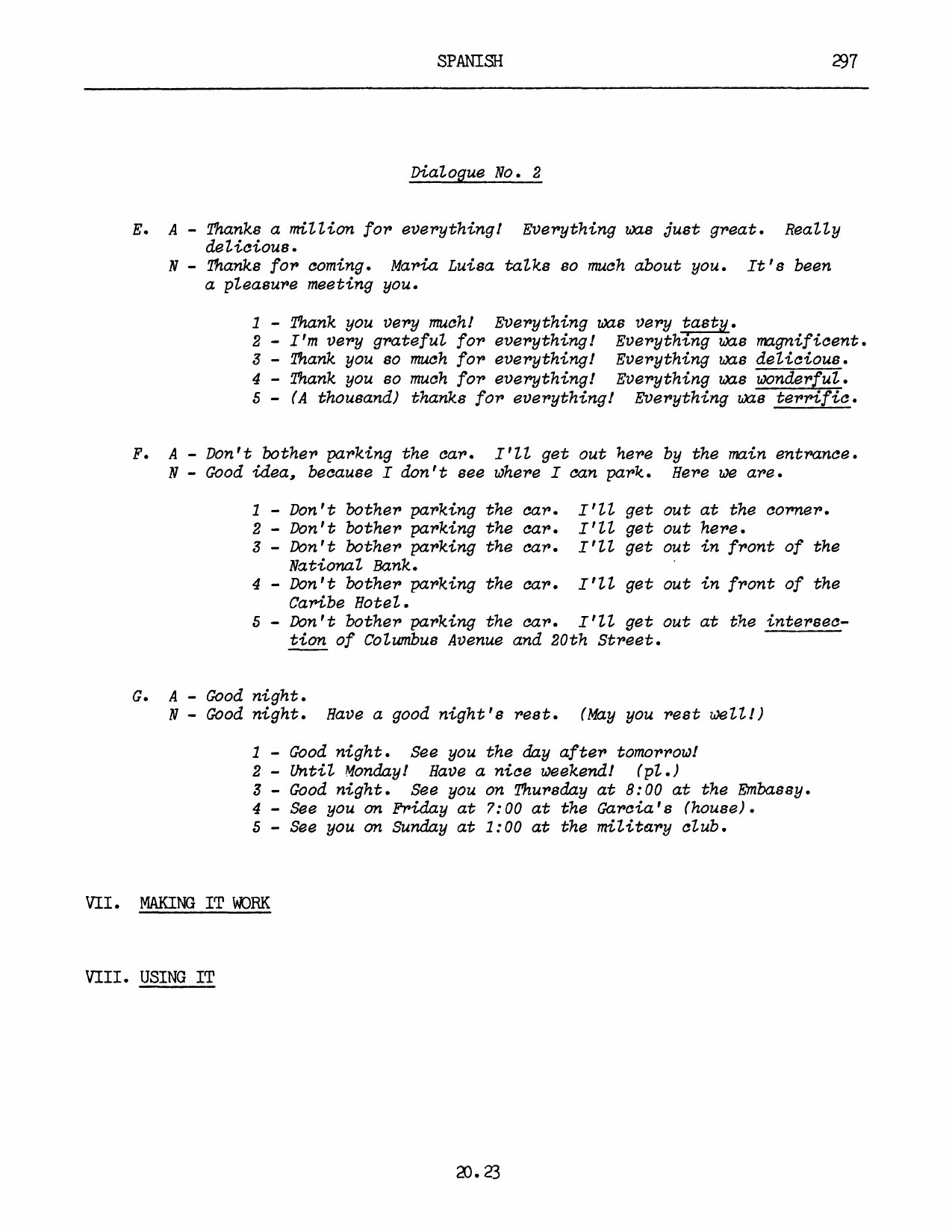
conventions govern social behavior. Although economic, social, and political events have brought about many changes in the makeup of society and in the roles of both men and women, a strong sense of family still prevails and people tend to follow traditional roles. Although the husband occupies a dominant position in most homes, he tends to do little to assist in its operation; the wife actually runs it. This tendency is reflected, or at least implied, in this Cycle's dialogue, when Roberto, instead of offering the guest más pollo, asks Maria Luisa to please jsirvele más pollo! (Ask your teacher to comment on the domestic roles of men and women in his/her country.)
This page has a drawing, chart, or fill-in layout — original page
I. SETTING THE SCENE (A)
You are at your friend's home. You have had a chance to meet the members of her family: her husband, their three children, and her elderly parents, who also live there. Around nine o'clock, after you have visited for about an hour, you all go to the dining room to eat dinner. Your conversation con-tinues during the meal.
II. HEARING IT (A)
III. SEEING IT (A)
In the following models both the American (Kimberly) and the friend (Maria Luisa) are women. Roberto is Maria Luisa's husband.
Dialogue No. 1:
La cena
Rob. - ¿Qué le parece mestra ciudad?
Ud. - Me gusta muchísimo. Estoy muy contenta de estar aquí.
Rob. — ¿Ha tenido la oportunidad de conocer nuestro balneario?
Ud. - No, todavía no. Pero me han dicho que la playa es preciosa. Unos
amigos me invitaron a ir este fin de semana.
Rob. - Tenga mucho cuidado con el sol. El sol es my fuerte aquí. Ud. - Gracias por su consejo, pero no se preocupe. Voy a protegerme del
sol.
Rob. - ¿Quiere más? María Luisa, por favor, jsirvele más pollo! Ud. - ¡Ay, no gracias! ¡No puedo! Ya no puedo comer ni un pedacito más. Rob. - Entonces, un poquito más de vino....
Ud. - Bueno...¡ya que usted insiste!
Dialogue No. 1: (continued)
The meal
Rob. - What do you think of our city?
You - I like it a great deal. I'm very happy to be here.
Rob. - Have you had a chance to visit our beach resort?
(1) You - No, not yet. But I've been told that the beach te lovely. Some
friends invited me to go this weekend.
Rob. - Watch out for the sun. The sun is very hot here.
You - Thanks for the advice, but don't worry. I'm going to take pre-
cautions against the sun.
Rob. - Would you like some more? Maria Luisa, please serve her some more
chicken!
(2) You - Oh, no thanks! I can't. Right now I couldn't eat any more, not
even a little bite more.
(3) Rob. - Then, a little more wine....
You - Well...since you insist!
I. SETTING THE SCENE (B)
It is now half past ten and the evening is coming to a close. The time has come for saying good night and expressing your appreciation for everything your hosts have done for you.
II. HEARING IT (B)
III. SEEING IT (B)
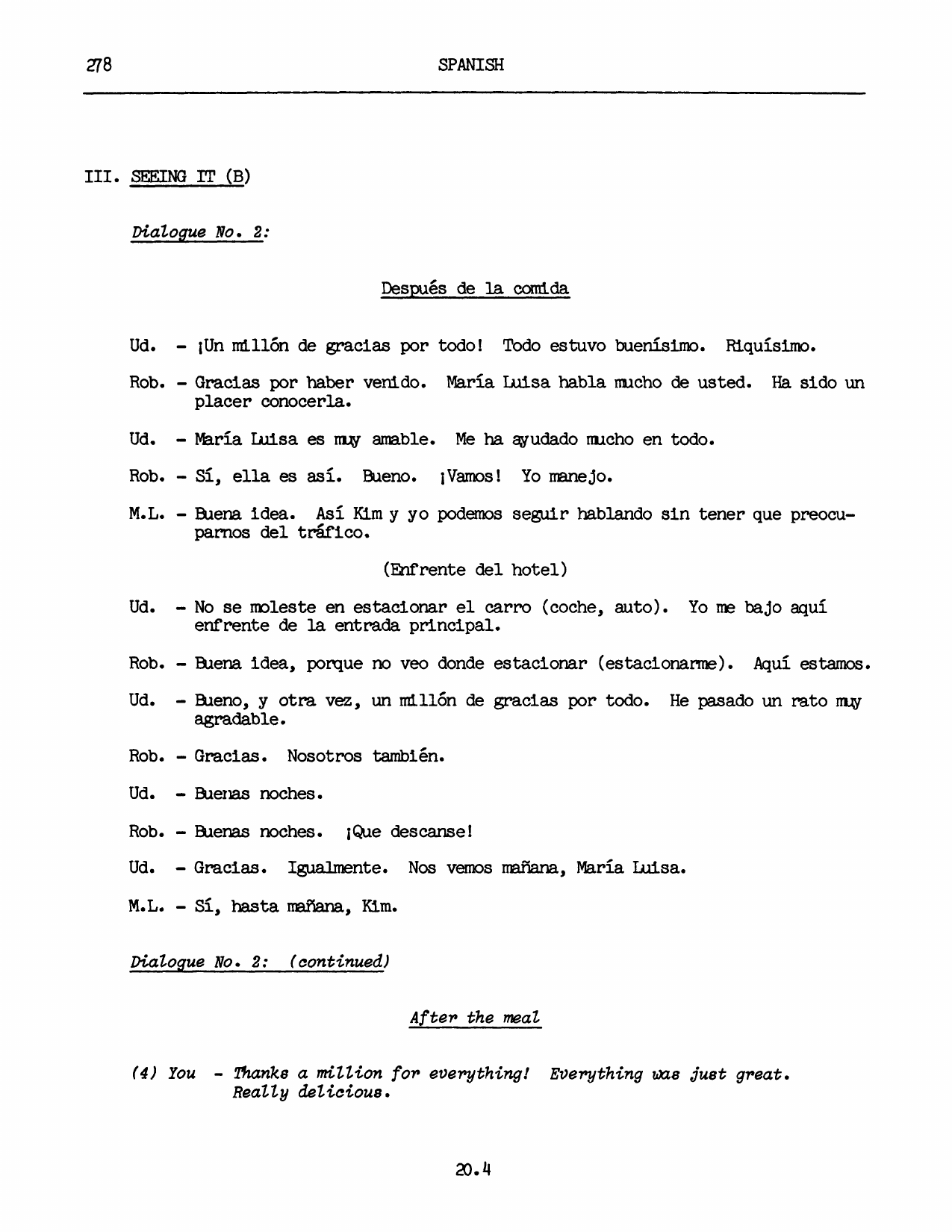
Dialogue No. 2:
Después de la comida
Ud. -— ¡Un millón de gracias por todo! Todo estuvo buenísimo. Riquisimo. Rob. - Gracias por haber venido. Maria Luisa habla mucho de usted. Ha sido un
placer conocerla.
Ud. - María Luisa es my amable. Me ha ayudado mucho en todo.
Rob. - Sí, ella es así. Bueno. ¡Vamos! Yo manejo.
M.L. — Buena idea. Así Kim y yo podemos seguir hablando sin tener que preocu-
parnos del tráfico.
(Enfrente del hotel)
Ud. - No se moleste en estacionar el carro (coche, auto). Yo me bajo aquí
enfrente de la entrada principal.
Rob. ~ Buena idea, porque no veo donde estacionar (estacionarme). Aquí estamos. Ud. - Bueno, y otra vez, un millón de gracias por todo. He pasado un rato my
agradable.
Rob. - Gracias. Nosotros también.
Ud. = Buenas noches.
Rob. — Buenas noches. ¡Que descanse!
Ud. - Gracias. Igualmente. Nos vemos mañana, María Luisa.
M.L. - Sí, hasta mañana, Kim.
Dialogue No. 2: (continued)
After the meal
(4) You - Thanks a million for everything! Everything was just great.
Really delicious.
(5) Rob. - Thanks for coming. Maria Lutsa talks so much about you. It's been
a pleasure meeting you.
You - Marta Luisa is very kind. She has helped me a great deal with
everything.
(6) Rob. - Yes, she's like that. Well, let's go! I'll drive.
M.L. - Good idea. That way, Kim and I can continue talking without
having to worry about the traffic.
(In front of the hotel)
You - Don't bother parking the car. I'll get out here by the main
entrance.
Rob. - Good idea, because I don't see where I can park. Here we are. You - Good, and again, thanks a million for everything. I've hada
most enjoyable time.
Rob. - Thanks. We have, too.
You - Good night.
Rob. - Good night. Have a good night's rest.
You - Thanks. You do the same. I'll see you tomorrow, Marta Luisa. M.L. - Yes; until tomorrow, Kim.
Language Notes
1. No, todavía no
Seldom will you hear a speaker of Spanish say no todavía, although
Americans often do so. Native speakers have a marked preference for saying Todavia no or No, todavía no.
2. pedacito
This word really means "small piece" or "bit," but it is used here more in
the sense of the English, "a little bite."
3. un poquito más de vino
Poquito is the dimimitive of poco, which means "few" or "little" (in
amount, not size). The noun that follows the expression un poco más...or un poquito
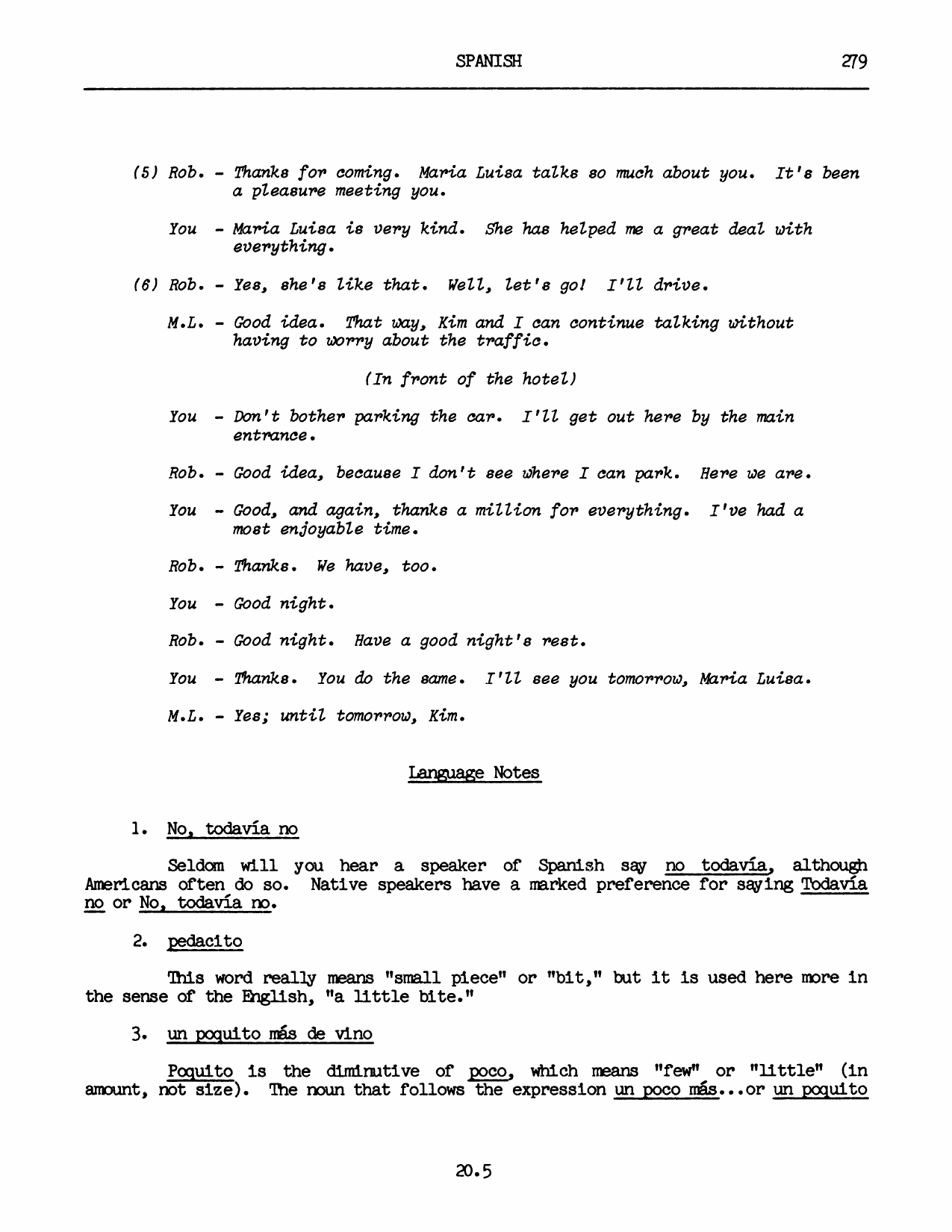
más +... 1s usually preceded by the preposition de: un poquito más de vino.
4. buenísimo
Just as mucho or mucha can be augmented by saying muchísimo or muchi-
sima, bueno or buena ("good") can become buenísimo or buenísima.
5. Gracias por haber venido (literally: "Thanks for having come")
It is useful to learn this phrase as soon as possible. The last word is
constructed from the infinitive:
-ar goes to -ado; -er and -ir go to -1do.
Examples:
esperar: esperado
comer: comido
pedir: pedido
6. There is no such word in Spanish as ¡Vamoos! Hollywood somehow developed
this word and disseminated it throughout the English-speaking world. The correct Spanish term is ¡Vamos! or ¡Vámonos!
Narrative No. 1:
La cena
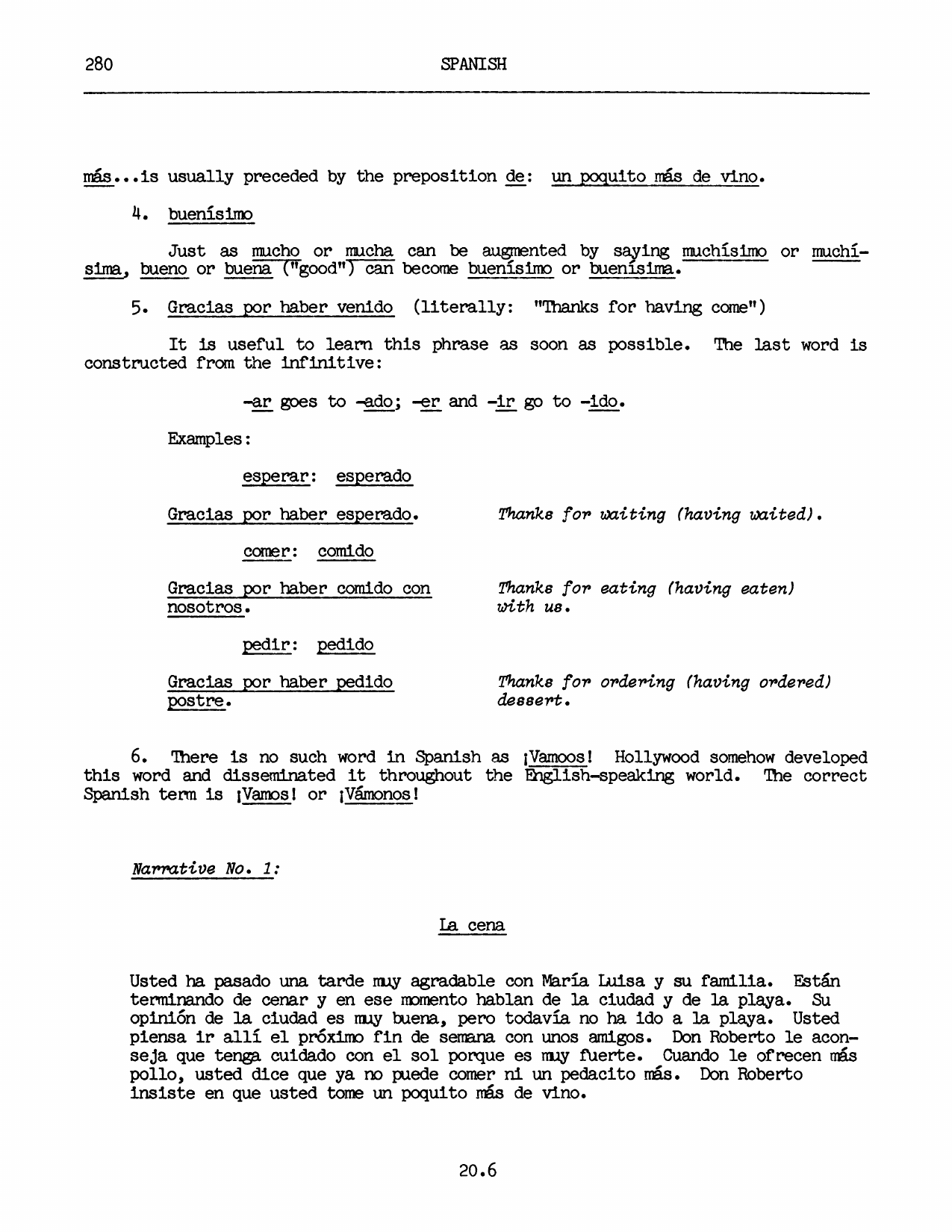
Usted ha pasado una tarde muy agradable con Maria Luisa y su familia. Están terminando de cenar y en ese momento hablan de la ciudad y de la playa. Su opinión de la ciudad es muy buena, pero todavía no ha ido a la playa. Usted piensa ir allí el próximo fin de semana con unos amigos. Don Roberto le acon-seja que tenga cuidado con el sol porque es muy fuerte. Cuando le ofrecen más pollo, usted dice que ya no puede comer ni un pedacito más. Don Roberto insiste en que usted tome un poquito más de vino.
Questions:
1 - ¿Usted lo ha pasado bien con sus nuevos amigos?
Have you had a good time with your new friends?
2 - ¿Han terminado de cenar?
Have you (pl.) finished eating dinner?
3 = ¿De qué hablan?
What are you talking about?
Y - ¿Cuál es su opinión de la ciudad?
What is your opinion of the city?
5 - ¿Ya ha ido a la playa?
Have you already gone to the beach?
6 - ¿Qué le aconseja Don Roberto?
What does Roberto advise?
7 - ¿Qué dice usted cuando le ofrecen más pollo?
What do you say when they offer you more chicken?
8 - ¿En qué insiste Don Roberto?
What does Roberto insist on?
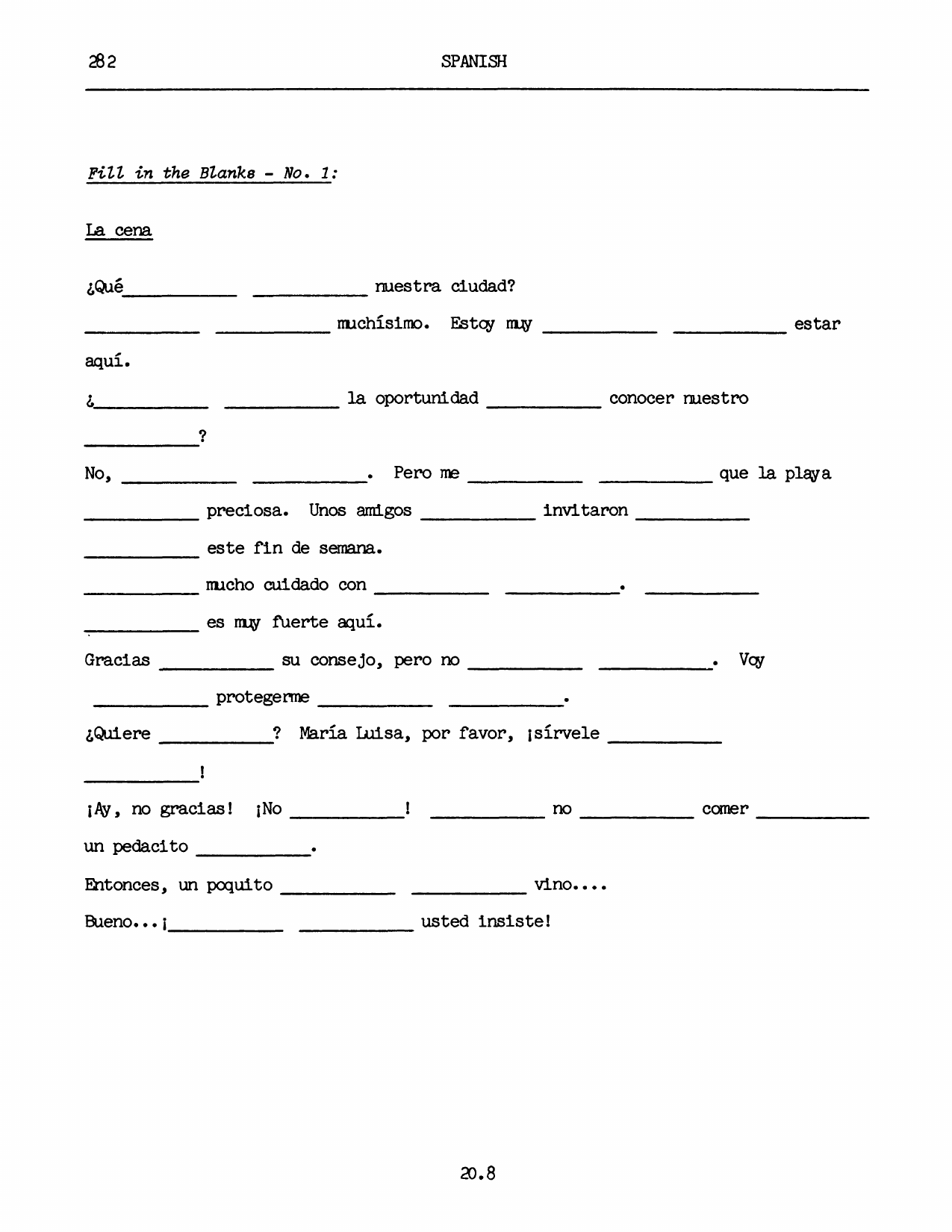
Fill in the Blanks - No. 1:
La cena
aquí.
?
este fin de semana.
es my fuerte aquí.
!
This page has a drawing, chart, or fill-in layout — original page
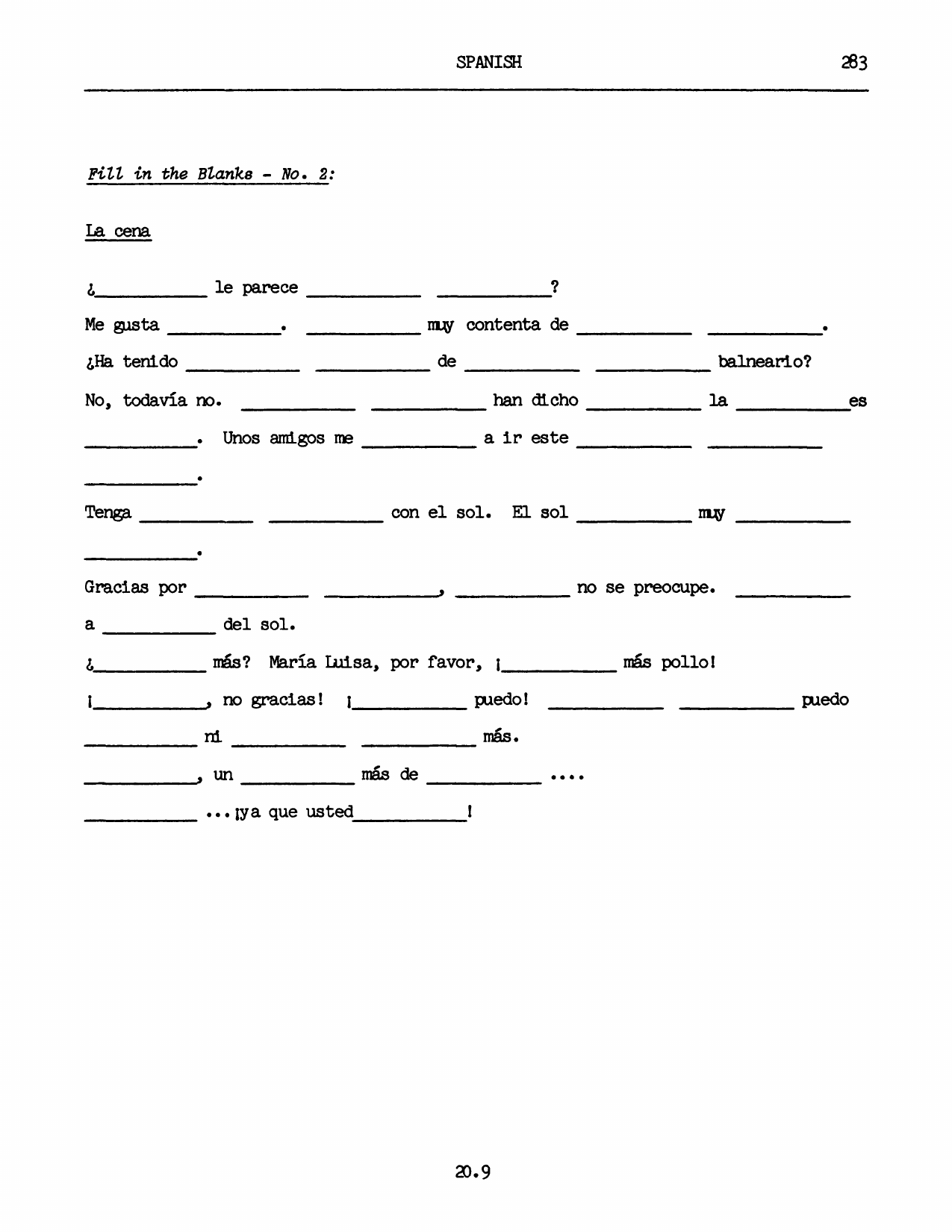
Fill in the Blanks - No. 2:
La cena
This page has a drawing, chart, or fill-in layout — original page
Narrative No. 2:
Después de la comida
En el momento de irse usted les agradece todas sus atenciones. Don Roberto le da las gracias a usted por haber venido y agrega que ha sido un placer cono-cerla. Usted le contesta que María Luisa es my amable y que le ha ayudado mucho. Finalmente, Don Roberto y María Luisa la llevan a su hotel en carro (coche). Como no hay donde estacionar el carro, usted decide bajarse frente a la entrada principal, lo que le parece a Don Roberto una buena idea. Se despi-den otra vez y se dan las buenas noches.
Questions:
1 - ¿Qué hace usted en el momento de irse?
What do you do when you are about to leave?
2 - ¿Por qué le da Don Roberto las gracias a usted?
Why does Roberto thank you?
3 - ¿Qué agrega Don Roberto?
What does Roberto add?
Y - ¿Qué hacen finalmente María Lusia y su marido?
What do Maria Luisa and her husband finally do?
5 = ¿Dónde decide bajarse usted del carro (coche, auto)?
Where do you decide to get out of the car?
6 = ¿Qué hacen ustedes otra vez?
What do you do again?
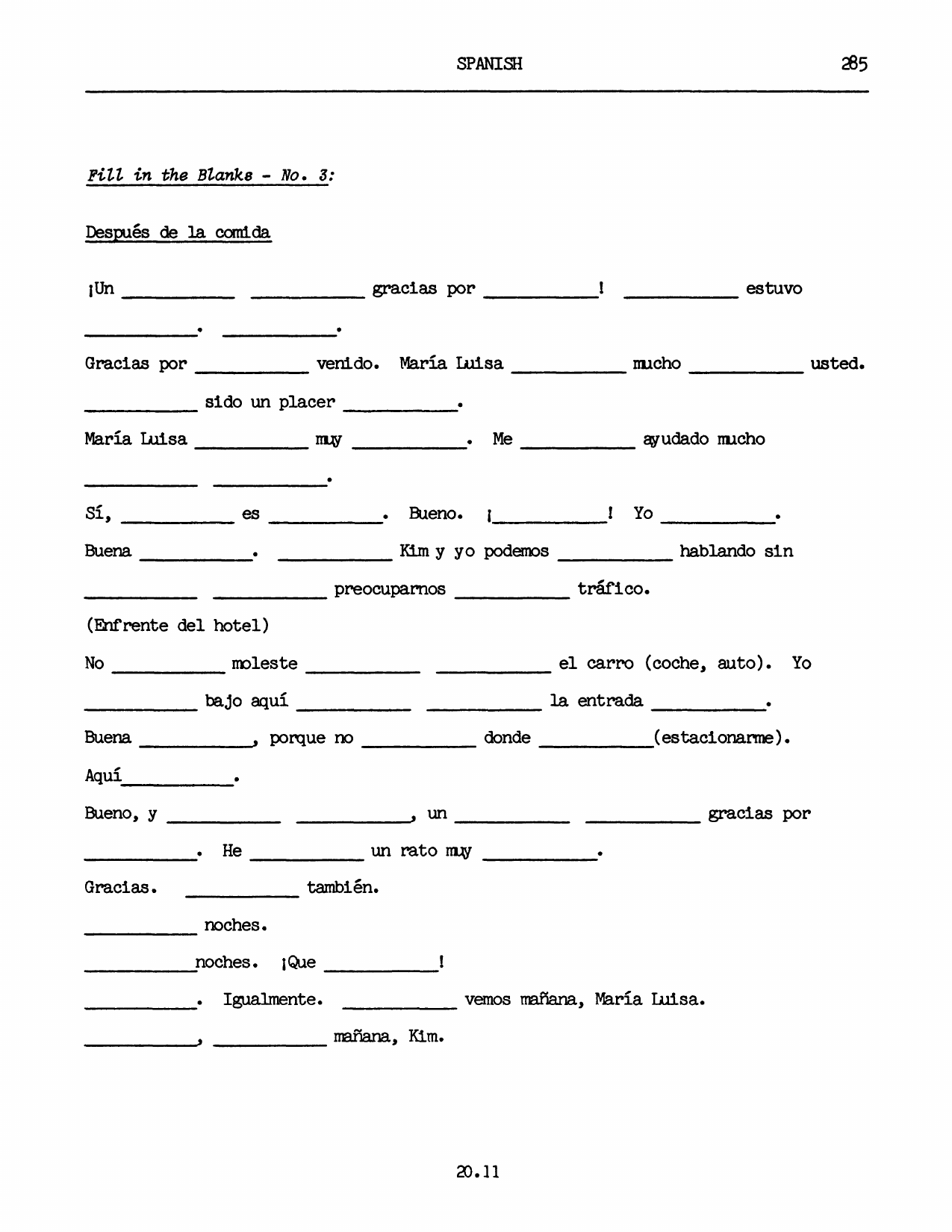
Fill in the Blanke - No. 3:
Después de la comida
(Enfrente del hotel)
noches.
noches. ¡Que
mañana, Kim.
This page has a drawing, chart, or fill-in layout — original page
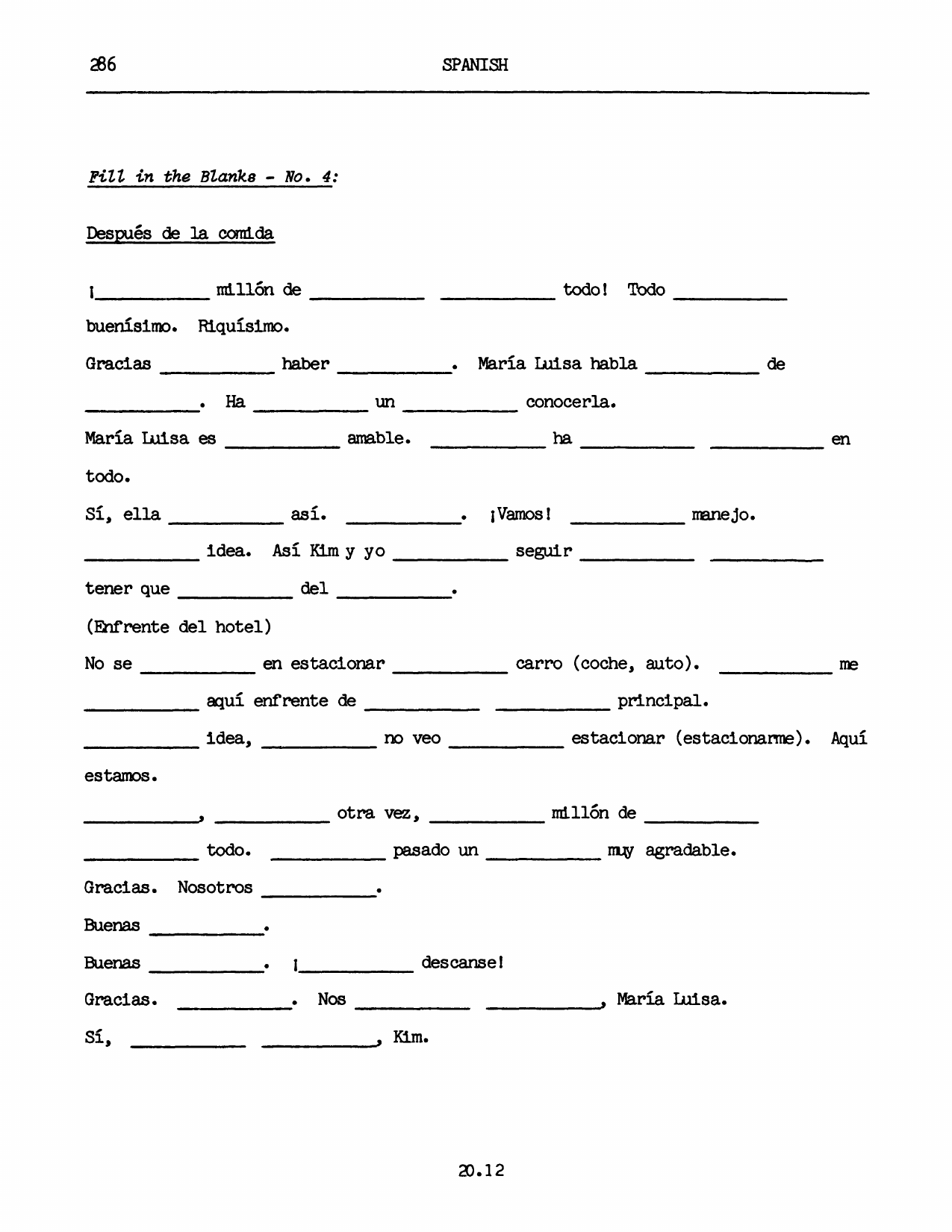
Fill in the Blanks - No. 4:
Después de la comida
buenisimo. Riquisimo.
todo.
(Enfrente del hotel)
estamos.
This page has a drawing, chart, or fill-in layout — original page
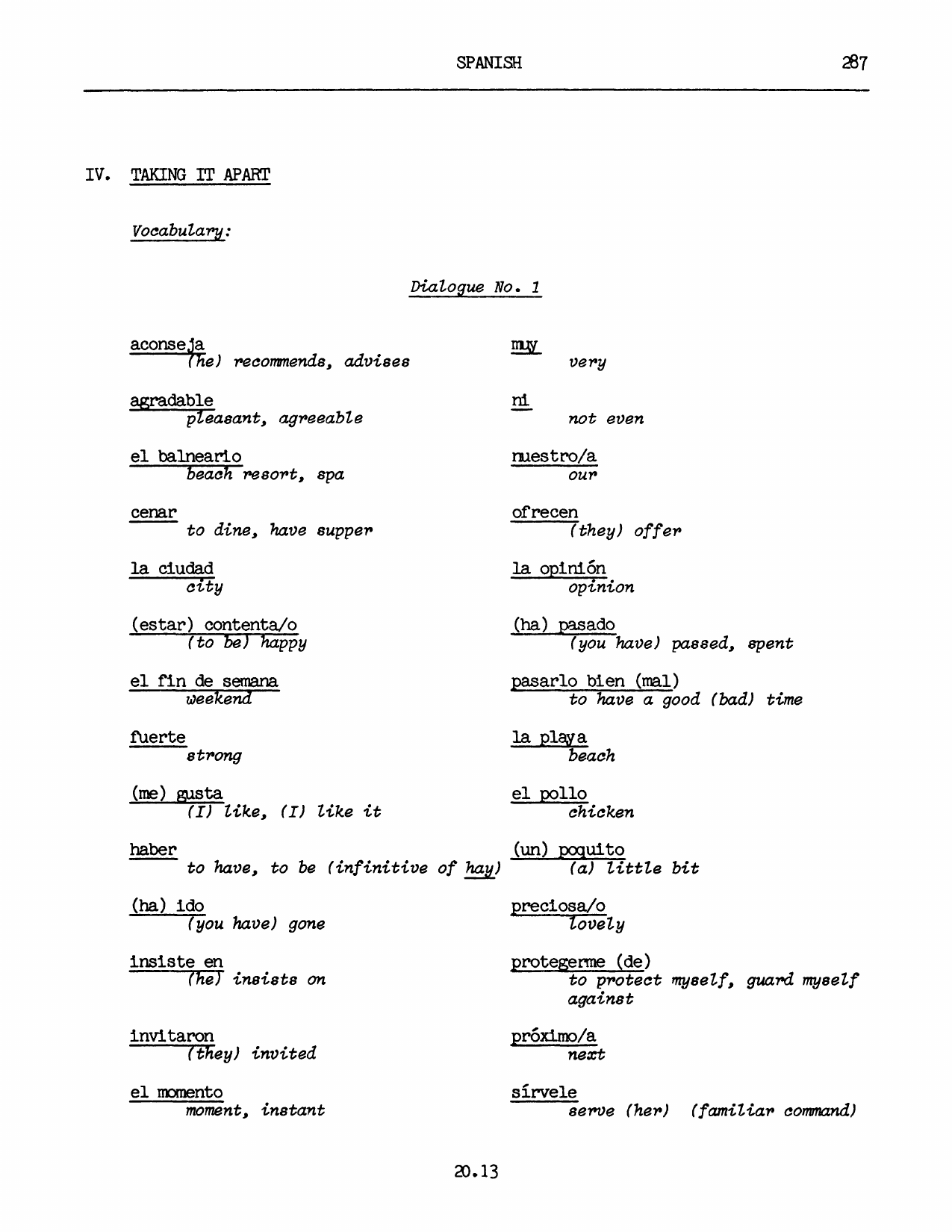
IV. TAKING IT APART
Vocabulary:
Dialogue No. 1
aconse ja
against
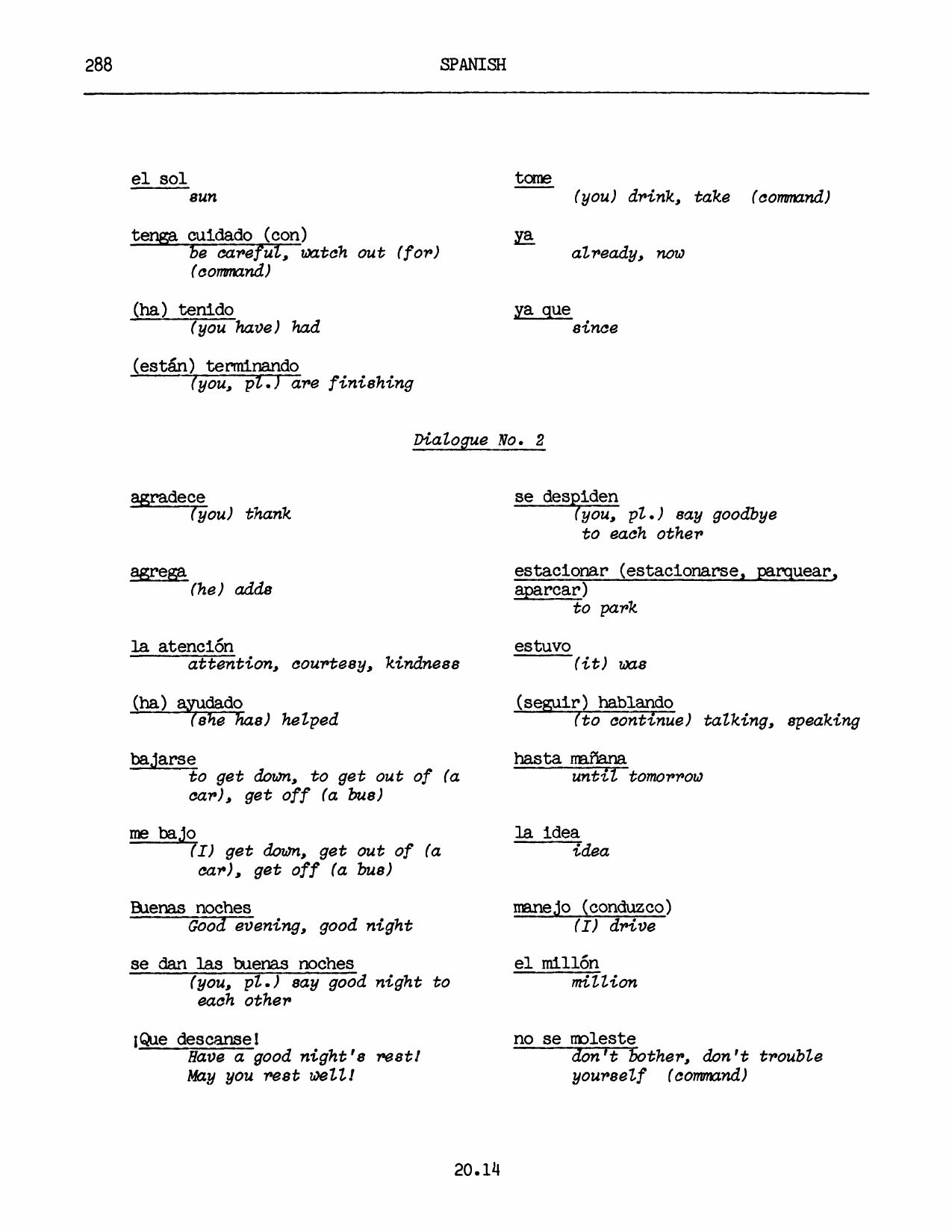
(command)
(estén) terminando
you, pl.) are finishing
Dialogue No. 2
to each ather
to park
car), get off (a bus)
car), get off (a bus)
each other
seguir (contimar)
to continue
V. GETTING THE FEEL OF IT
Questions and Answers:
A. 1. ¿Qué le parece la oficina?
Me parece muy grande.
2. ¿Qué le parece la playa?
Me parece my bonita.
3. ¿Qué le parece el hotel?
Me parece muy caro.
4, ¿Qué le parece su secretaria?
Me parece muy competente.
5. ¿Qué le parece la comida?
Me parece excelente.
B. 1. ¿Qué les parecen las oficinas?
Nos parecen my grandes.
2. ¿Qué les parecen las casas?
Nos parecen muy cómodas .
3. ¿Qué les parecen los libros?
Nos parecen muy interesantes.
4, ¿Qué les parecen los ejercicios?
Nos parecen my difíciles.
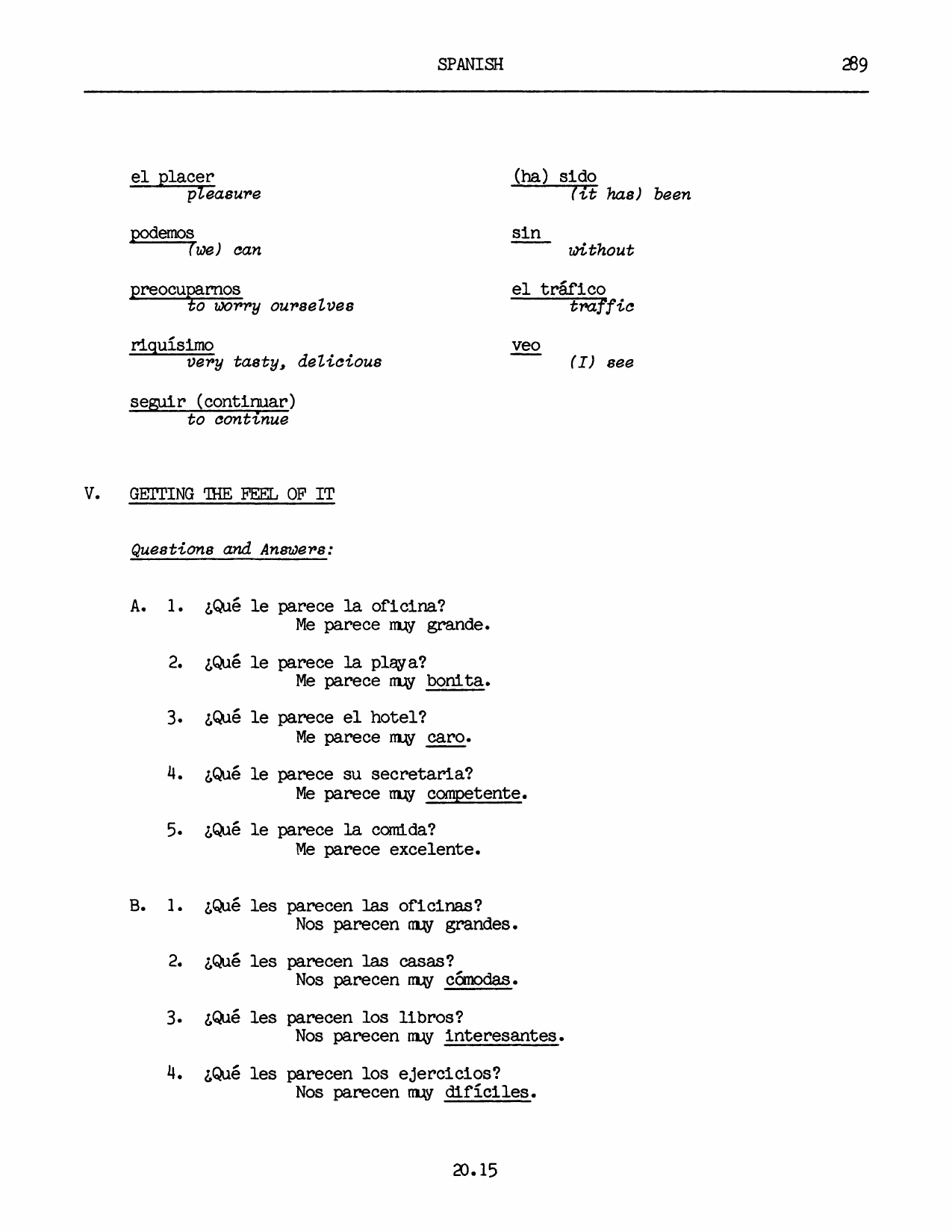
5. ¿Qué les parecen los cuartos?
Nos parecen muy pequeños.
C. 1. ¿Le gusta la oficina?
Si, me gusta.
No, no me gusta.
¿Le gustan las oficinas?
Si, me gustan.
No, no m gustan.
¿Les gustan las oficinas?
Sí, nos gustan.
No, no nos gustan.
2. ¿Le gusta el apartamento?
Sí, me gusta.
No, no me gusta.
¿Les gustan los apartamentos?
Si, nos gustan.
No, no nos gustan.
3. ¿Le gusta el carro (coche, auto)?
Sí, me gusta.
No, no me gusta.
¿Les gusta el carro (coche, auto)?
Sí, nos gusta.
No, no nos gusta.
4. ¿Le gusta la playa?
Sí, me gusta.
No, no me gusta.
¿Les gusta la playa?
Sí, nos gusta.
No, no nos gusta.
D. 1. ¿Usteá ha estudiado mucho?
Si, he estudiado mucho.
No, no he estudiado mucho.
¿Ustedes han estudiado mucho?
Si, hemos estudiado mucho.
No, no hemos estudiado mucho.
¿Tú has estudiado mucho?
S1, he estudiado mucho.
No, no he estudiado mucho.
¿José y María Luisa han estudiado mucho?
Si, han estudiado mucho.
No, no han estudiado mucho.
¿Ella ha estudiado mucho?
S1, ha estudiado mucho.
No, no ha estudiado mucho.
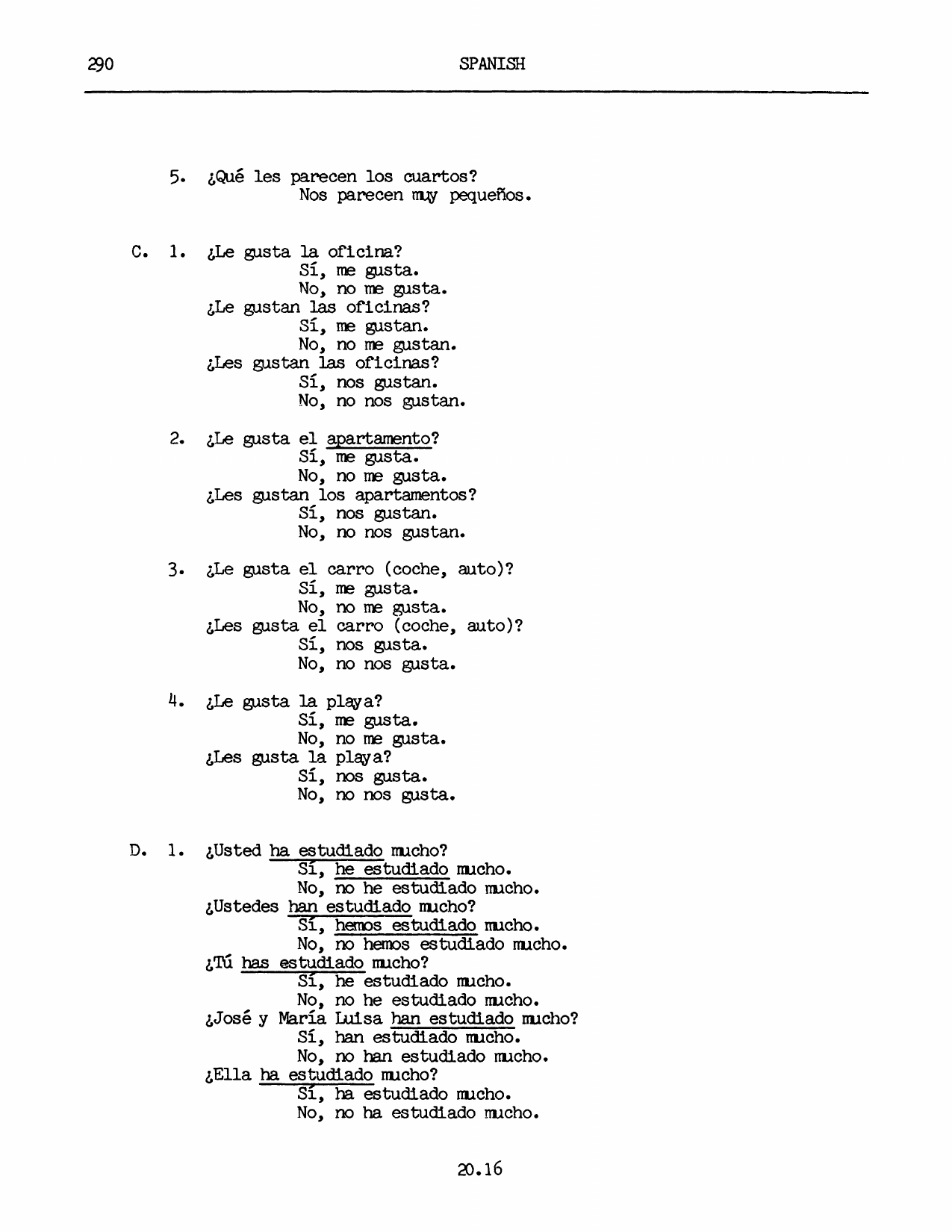
2. ¿Usted ha hablado con el/la Cónsul?
Sí, he hablado con él/ella.
No, no he hablado con él/ella.
(Tú, ustedes, ellos, Ud., ella)
3. ¿Usted ha comido en ese restaurante (restorán)?
Sí, he comido ahí.
No, no he comido ahí.
(El, ustedes, tú, Ud., ellos)
4. ¿Ellos han creído eso?
SI, han creído eso.
No, no han creído eso.
(Ud. , tú, ellos, José, ustedes)
5. ¿El Jefe ha recibido la carta?
Si, la ha recibido.
No, no la ha recibido.
(La secretaria, José, ustedes, tú, ellos)
6. ¿El Embajador ha permitido eso?
sí, el Embajador ha permitido eso.
No, el Embajador no ha permitido eso.
(Tú, el Cónsul, Uds., ellos, ella)
Questions and Answers: (continued)
A. 1. What do you think of the office?
I think it's very big.
2. What do you think of the beach?
I think it's very pretty.
3. What do you think of the hotel?
I think 1t's very expensive.
4. What do you think of your secretary?
I think she's very capable.
5. What do you think of the food?
I think it's excellent.
B. 1. What do you (pl.) think of the offices?
We think they are very big.
2. What do you (pl.) think of the houses?
We think they are very comfortable.
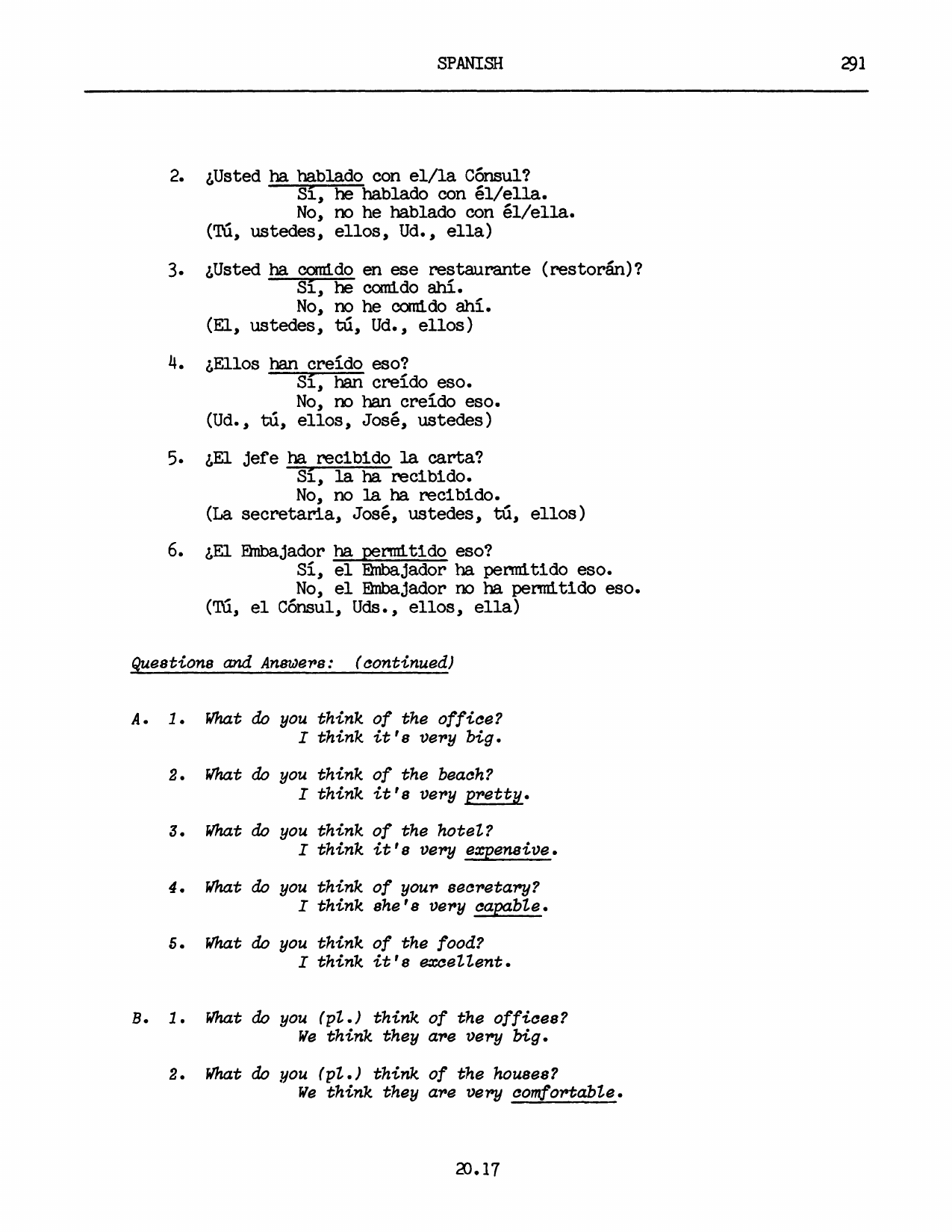
3. What do you (pl.) think of the booke?
We think they are very interesting.
4. What do you (pl.) think of the exercises?
We think they are very difficult.
5. What do you (pl.) think of the rooms?
We think they are very small.
Co 1. Do you like the office?
Yes, I like it.
No, I don't like it.
Do you like the offices?
Yes, I like them.
No, I don't like them.
Do you (pl.) like the offices?
Yes, we like them.
No, we don't like them.
2. Do you like the apartment?
Yes, I like it.
No, I don't like it.
Do you (pl.) like the apartments?
Yes, we like them.
No, we don't like them.
ER Do you like the car?
Yes, I like it.
No, I don't like it.
Do you (pl.) like the car?
Yes, we like it.
No, we don't like it.
4. Do you like the beach?
Yee, I like it.
No, I don't like it.
Do you (pl.) like the beach?
Yes, we like it.
No, we don't like it.
D. 1. Have you studied a lot?
Yes, I've studied a lot.
No, I haven't studied much.
Have you (pl.) studied a lot?
Yes, we've studied a lot.
No, we haven't studied much.
Have you studied a lot? (familiar)
Yes, I've studied a lot.
No, I haven't studied much.
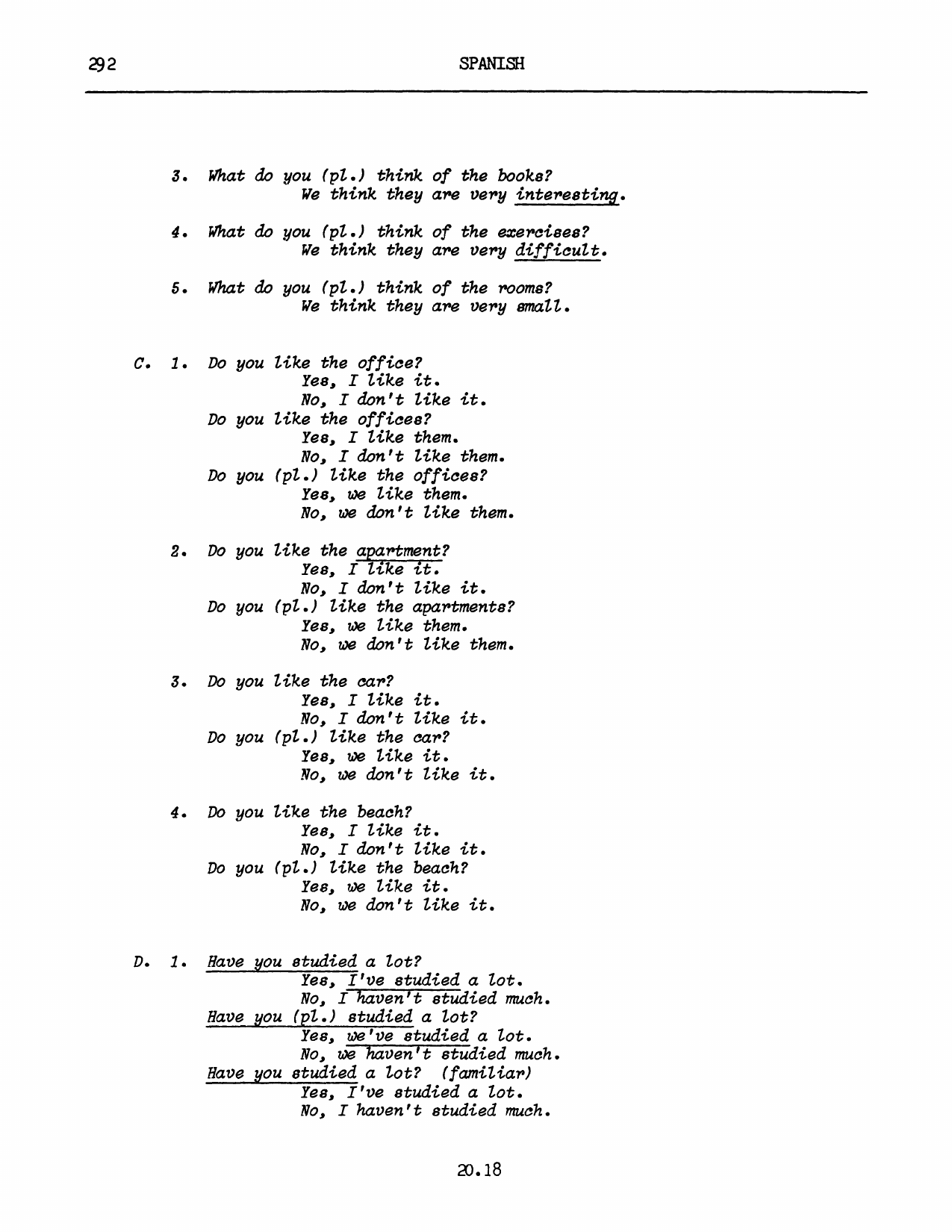
Have Jose and Maria Luisa studied a lot?
Yes, they've studied a lot.
No, they haven't studied much.
Has she studied a lot?
Yes, she's studied a great deal.
No, she hasn't studied much.
2. Have you spoken with the Consul?
Yes, I've spoken with him/her.
No, I haven't spoken with him/her.
(You (familiar), you (pl .), they, you, she)
3. Have you eaten in that restaurant?
Yes, I've eaten there.
No, I haven't eaten there.
(He, you (pl.), you (familiar), you, they)
4. Have they believed that?
Yes, they've 1 believed that.
No, they haven't believed that.
(You, you (familiar), they, Jose, you (pl.))
5. Has the boss received the letter?
Yes, he's received it.
No, he hasn't received it.
(The secretary, Jose, you (pl.), you (familiar), they)
6. Has the Ambassador allowed that?
Yes, the Ambassador has allowed that.
No, the Ambassador hasn't allowed that.
(You (familiar), the Consul, you (pl.) they, she)
VI. PUTTING_IT TOGETHER
Variante:
Dialogue No. 1
A. N- ¿Qué le parece nuestra ciudad?
A - Me gusta muchísimo. Estoy muy contenta/o de estar aquí.
1 - Me gusta muchísimo. Es una ciudad muy cosmopolita. 2 - Estoy muy contenta/o de estar aquí. Es una cludad sumamente
interesante.
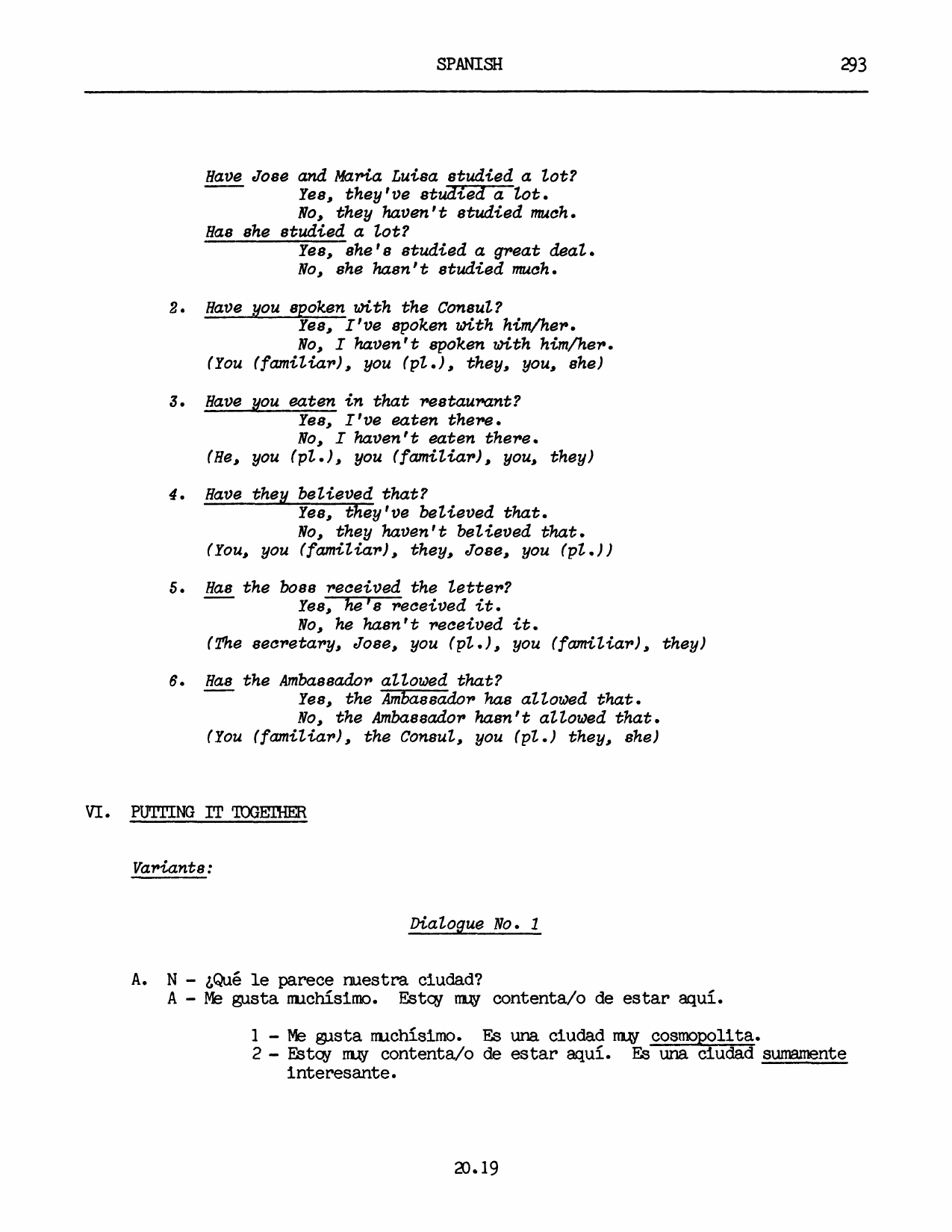
3 - Estoy encantada/o de estar aquí. Hay tanto que ver y tantos
lugares que conocer.
4 — Me gusta muchísimo. Hay tantas cosas que hacer. 5 - Estoy muy contenta/o de estar aquí. Hay tanto que ver y
tantas cosas que hacer.
B. N —- ¿Ha tenido la oportunidad de conocer nuestro balneario?
A - No, todavía no. Pero me han dicho que la playa es preciosa. Unos
amigos me invitaron a ir este fin de semana.
1 — No, todavía no. Pero me han dicho que la playa es my limpia.
Unos amigos me invitaron a ir este fin de semana.
2 - No, todavía no. Pero me han dicho que la carretera es exce-
lente. Unos amigos me invitaron a ir este fin de semana.
3 - No, todavía no. Pero me han dicho que está muy cerca. Unos
amigos me invitaron a ir el próximo fin de semana.
4 — No, todavía no. Pero me han dicho que hay muy buenos res-
taurantes ahí. Unos amigos me invitaron a ir el mes que viene.
5 - No, todavía no. Pero me han dicho que está muy bien cuidado.
Unos amigos me invitaron a ir el próximo fin de semana.
C. N - ¿Quiere más? María Luisa, por favor, ¡sírvele más pollo!
A —- ¡Ay, no gracias! ¡No puedo! Ya no puedo comer ni un pedacito más.
1 - ¿Quiere más? María Luisa, por favor, ¡sírvele más arroz! 2 - ¿Quiere más? María Luisa, por favor, jsirvele más pescado! 3 - ¿Quiere más? María Luisa, por favor, jsirvele más papas
(patatas)!
4 - ¿Quiere mis? Maria Luisa, por favor, jsirvele más carne! 5 - ¿Quiere más? Maria Luisa, por favor, jsirvele más ensalada!
D. N — Entonces, un poquito más de vino....
A —- Bueno... ¡ya que usted insiste!
1 - Entonces, un poquito más de café....
2 - Entonces, un poquito más de pastel....
3 - Entonces, un poquito más de helado....
4 — Entonces, un poquito más de limonada....
5 - Entonces, un poquito más de té»...
Dialogue No. 2
E. A —- ¡Un millón de gracias por todo! Todo estuvo buenísimo. Riquisim.
N - Gracias por haber venido. Maria Luisa habla mucho de usted. Ha sido
un placer conocerla/o.
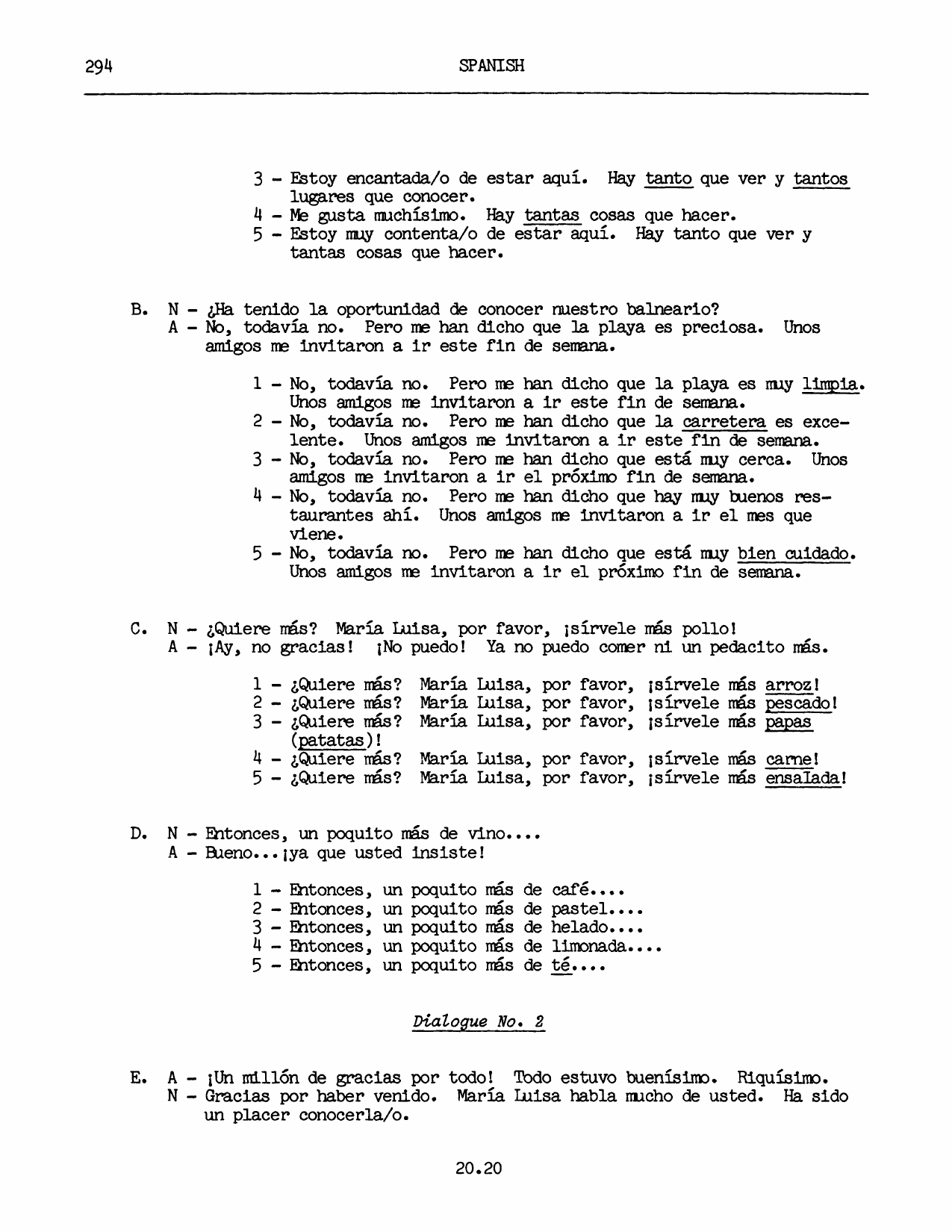
1 — ¡Muchas gracias por todo! Todo estuvo muy sabroso. 2 - ¡Muy agradecida/o por todo! Todo estuvo magnífico. 3 - ¡Muchísimas gracias por todo! ‘Todo estuvo delicioso. Y — ¡Muchísimas gracias por todo! Todo estuvo maravilloso. 5 - ¡Mil gracias por todo! Todo estuvo formidable.
F. A - No se moleste en estacionar el carro (coche, auto). Yo me bajo aquí
enfrente de la entrada principal.
N — Buena idea, porque no veo donde estacionar(me). Aquí estamos.
1 = No se moleste en estacionar el carro (coche, auto). Yo me
bajo en la esquina.
2 - No se moleste en estacionar el carro (coche, auto). Yo me
bajo aquí.
3 - No se moleste en estacionar el carro (coche, auto). Yo me
bajo enfrente del Panco Nacional.
4 — No se moleste en estacionar el carro (coche, auto). Yo me
bajo enfrente del Hotel Caribe.
5 - No se moleste en estacionar el carro (coche, auto). Yo me
bajo en la esquina (intersección) de la Avenida Colón y la calle 20.
G. A — Buenas noches.
N - Buenas noches. ¡Que descanse!
1 —- Buenas noches. ¡Hasta pasado mañana!
2 - ¡Hasta el lunes! ¡Que tengan un buen fin de semana! 3 - Buenas noches. Hasta el jueves a las 8:00 en la Embajada. 4 - Hasta el viernes a las 7:00 en casa de los García. 5 - Hasta el domingo a la 1:00 en el club militar.
Variants: (continued)
Dialogue No. 1
A. WN - What do you think of our city?
A - I like it a great deal. I'm very happy to be here.
1 - I like tt a great deal. It's a very cosmopolitan city. 2 - I'm very happy to be here. It's an extremely interesting
city.
3 - I'm delighted to be here. There's so much to see and so many
places to visit.
4 - I like it a great deal. There are so many things to do.
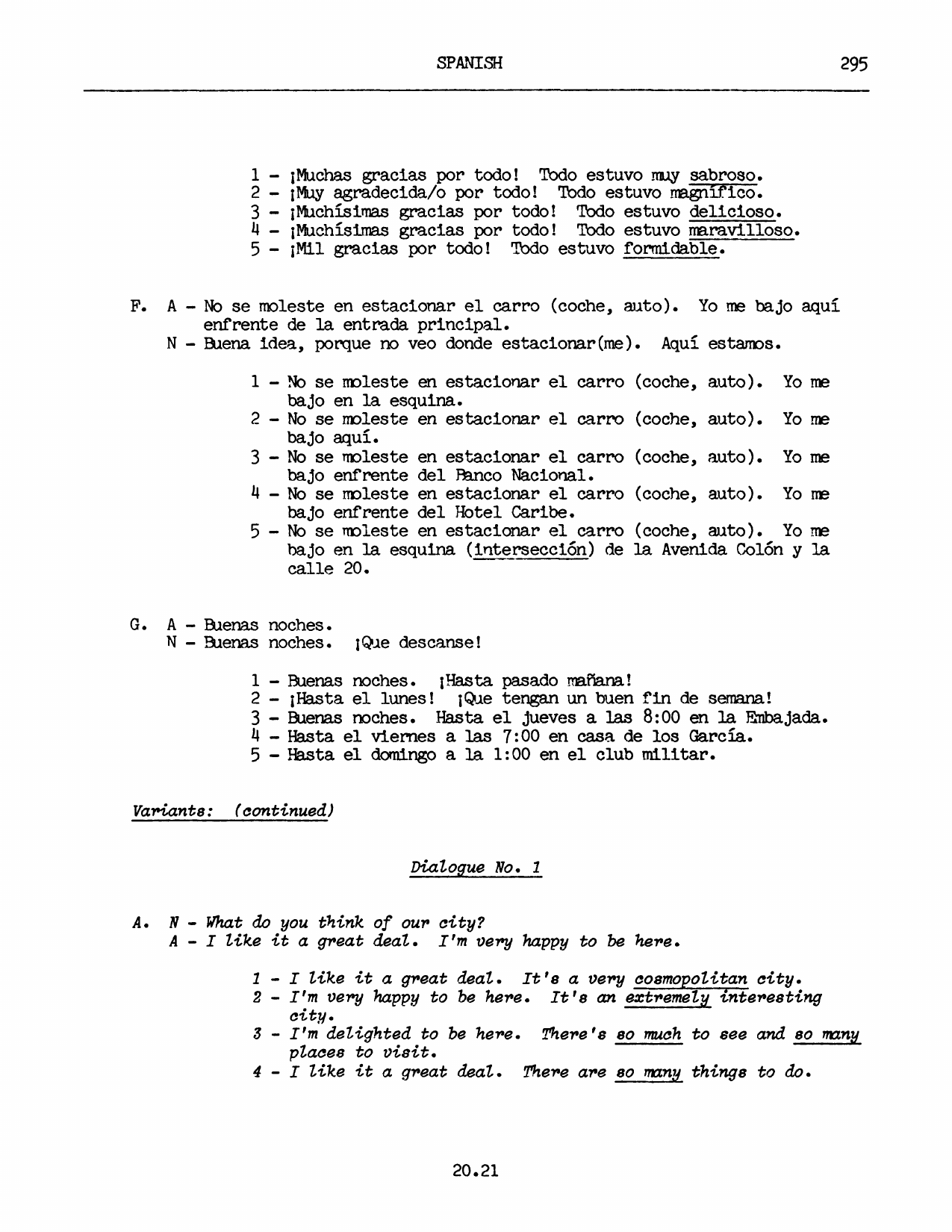
5 - I'm very happy to be here. There's so much to see and so many
things to do.
B. N - Have you had a chance to visit our beach resort?
A - No, not yet. But I've been told that the beach tis lovely. Some
friends invited me to go this weekend.
1 - No, not yet. But I've been told that the beach is very clean.
Some friends invited me to go this weekend.
2 - No, not yet. But I've been told that the highway is excellent.
Some friends invited me to go this weekend.
3 - No, not yet. But I've been told that it ts very near. Some
friends invited me to go next weekend.
4 - No, not yet. But I've been told that there are very good
restaurants there. Some friends invited me to go next month.
5 - No, not yet. But I've been told that it's very well kept.
Some friends invited me to go next weekend.
C. N - Would you like some more? Maria Luisa, please serve her some more
chicken!
A - Oh, no thanks! I can't. Right now I couldn't eat any more, not even
a little bite more.
1 - Would you like some more? María Luisa, please serve her some
more rice!
2 - Would you like some more? Maria Luisa, please serve her some
more fish!
3 - Would you like some more? María Luisa, please serve her some
more potatoes!
4 - Would you like some more? María Luisa, please serve her some
more meat!
5 - Would you like some more? Maria Luisa, please serve her some
more salad!
D. N - Then, a little more wine....
4 - Well...since you insist!
1 - Then, a little more coffee....
2 - Then, a little more pie (Mex. cake)....
3 - Then, a little more tce cream...
4 - Then, a little more lemonade....
5 - Then, a little more tea....
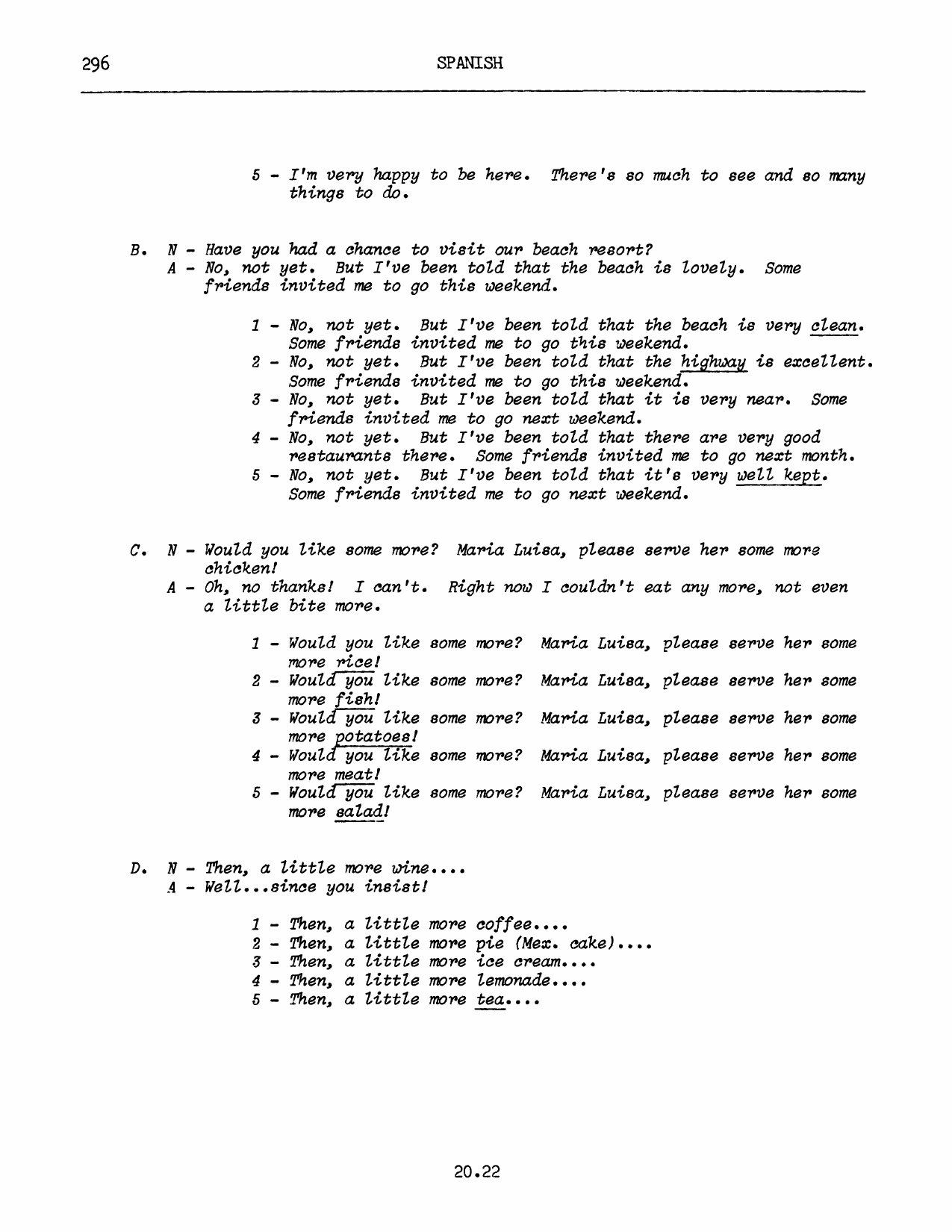
Dialogue No. 2
E. A - Thanks a million for everything! Everything was just great. Really
delicious.
N - Thanks for coming. Marta Luisa talks so much about you. It's been
a pleasure meeting you.
1 - Thank you very much! Everything was very tasty. 2 - I'm very grateful for everything! Everything was magnificent. 3 - Thank you so much for everything! Everything was delicious. 4 - Thank you so much for everything! Everything was wonderful. 5 - (A thousand) thanks for everything! Everything was terrific.
F. A = Don't bother parking the car. I'll get out here by the main entrance.
N - Good idea, because I don't see where I can park. Here we are.
1 - Don't bother parking the car. I'll get out at the corner. 2 - Don't bother parking the car. I'll get out here. 3 - Don't bother parking the car. I'll get out in front of the
National Bank.
4 - Don't bother parking the car. I'll get out in front of the
Caribe Hotel.
5 - Don't bother parking the car. I'll get out at the intersec-
tion of Columbus Avenue and 20th Street.
G. A = Good night.
N - Good night. Have a good night's rest. (May you rest well!)
1 - Good night. See you the day after tomorrow!
2 - Until Monday! Have a nice weekend! (pl.)
3 - Good night. See you on Thursday at 8:00 at the Embassy. 4 - See you on Friday at 7:00 at the Garcia's (house). 5 - See you on Sunday at 1:00 at the military club.
VII. MAKING IT WORK
VIII. USING IT