CYCLE 23
GETTING ACQUAINTED
¡Aaa Local Holidays
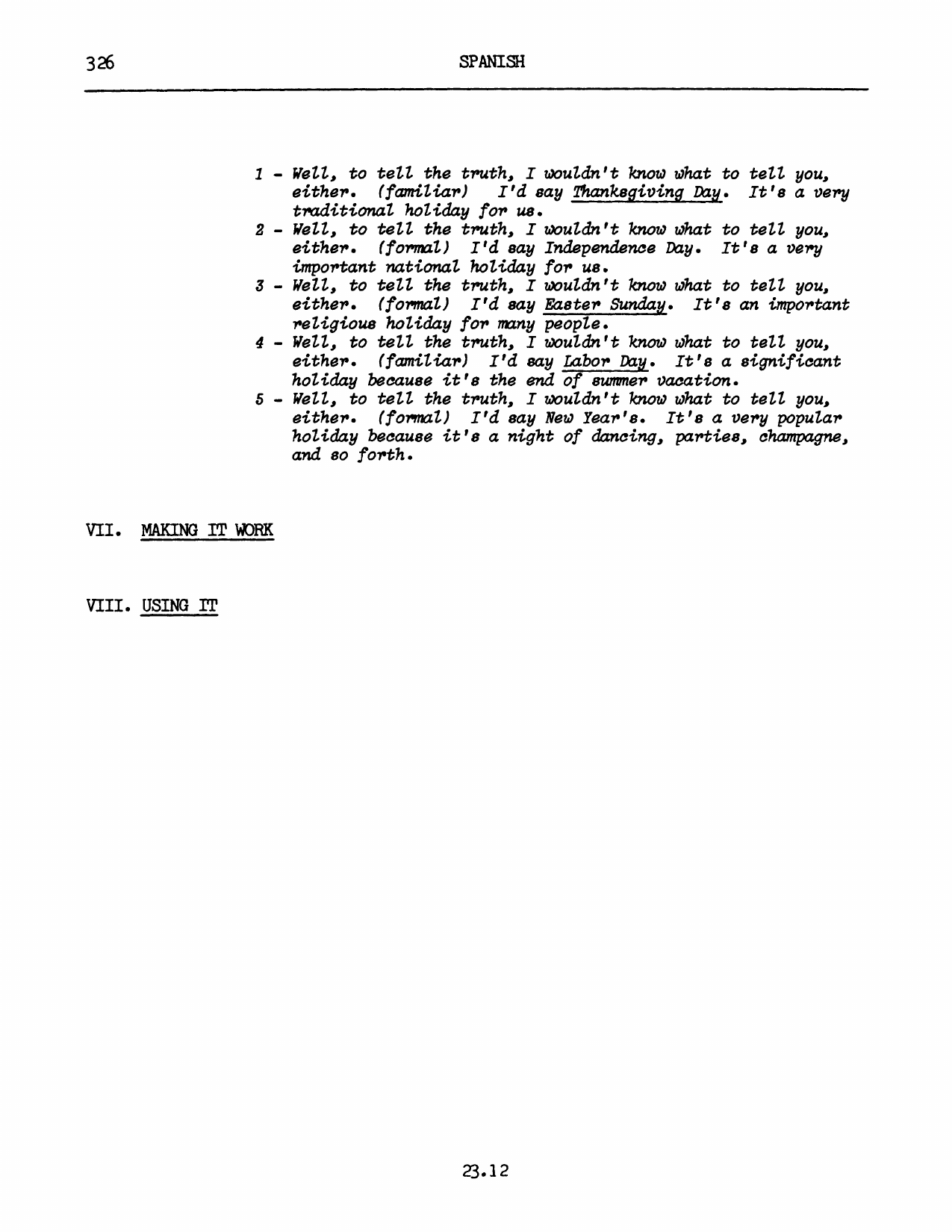
While you are at your post, it is important to know something about holidays
and how people are expected to behave on them so that you can avoid ainnavertently
on New Year's Eve if local custom dictates that it is a holtary for family gatherings; instead, you may decide to have an informal open hou
Being knowledgeable about holidays and the social behavior associated with them
has its practical aspects as well. For example, in Venezuela and many other areas, it is not a good idea to wear good clothing during the carnival season, since this is a time for playing tricks on people, whether they are friends or total strangers
This page has a drawing, chart, or fill-in layout — original page
A person's rank or social standing is of no consequence, and everyone is fair game. Pranks are usually limited to such things as squirting water with an atomizer sold precisely for this purpose, but they mey go as far as throwing buckets of water or spraying water with hoses. It is all done in fun, and everyone has a good time. Nevertheless, the practice may lend itself to extreme acts; in Guayaquil, Ecuador, for instance, teenagers have been known to throw balloons filled with smelly liquids, while in Barranquilla, Colombia, you may have cornstarch instead of water unexpectedly thrown in your face.
I. —SETTING THE SCENE
There's a holiday coming up next week and you would like to know more about local holidays and how they are celebrated. You ask a friend to tell you more about them as you chat at an outdoor café one afternoon.
II. HEARING IT
III. SEEING IT
Dialogue:
Días de fiesta (feriados)
A = ¿Cuál es el día de fiesta más importante de Colombia?
N - Pues, no sabría decirte. Hay varios...el Año Nuevo...el Día de la
Independencia... .el Carnaval....
A —- ¿Cuándo es el Día de la Independencia?
N - Es el 20 de julio.
A - Y, el Carnaval. ¿Cuándo es?
N - El Carnaval dura varios días. Se celebra antes de la cuaresma. A —- Nosotros no celebramos el Carnaval...excepto en Nueva Orleáns. Por eso no
sé mucho de eso. ¿Es una fiesta grande?
N - Sí, bastante grande. Pero nada como el de Río (de Janeiro). ¿Cuál es el
día de fiesta más importante para ustedes?
A - Pues, en realidad, yo tampoco sabría decirte. Yo diría el día de Navidad.
Es una época (temporada) muy sentimental para nosotros.
N - Para nosotros también. A medianoche, toda la familia se retine...y todos
vamos a (la) misa del (de) gallo juntos. ¿No celebran el Año Nuevo?
A - ¡SÍ! Es una noche de bailes, fiestas, champán (champaña), etcétera.
¡Mucha alegría!
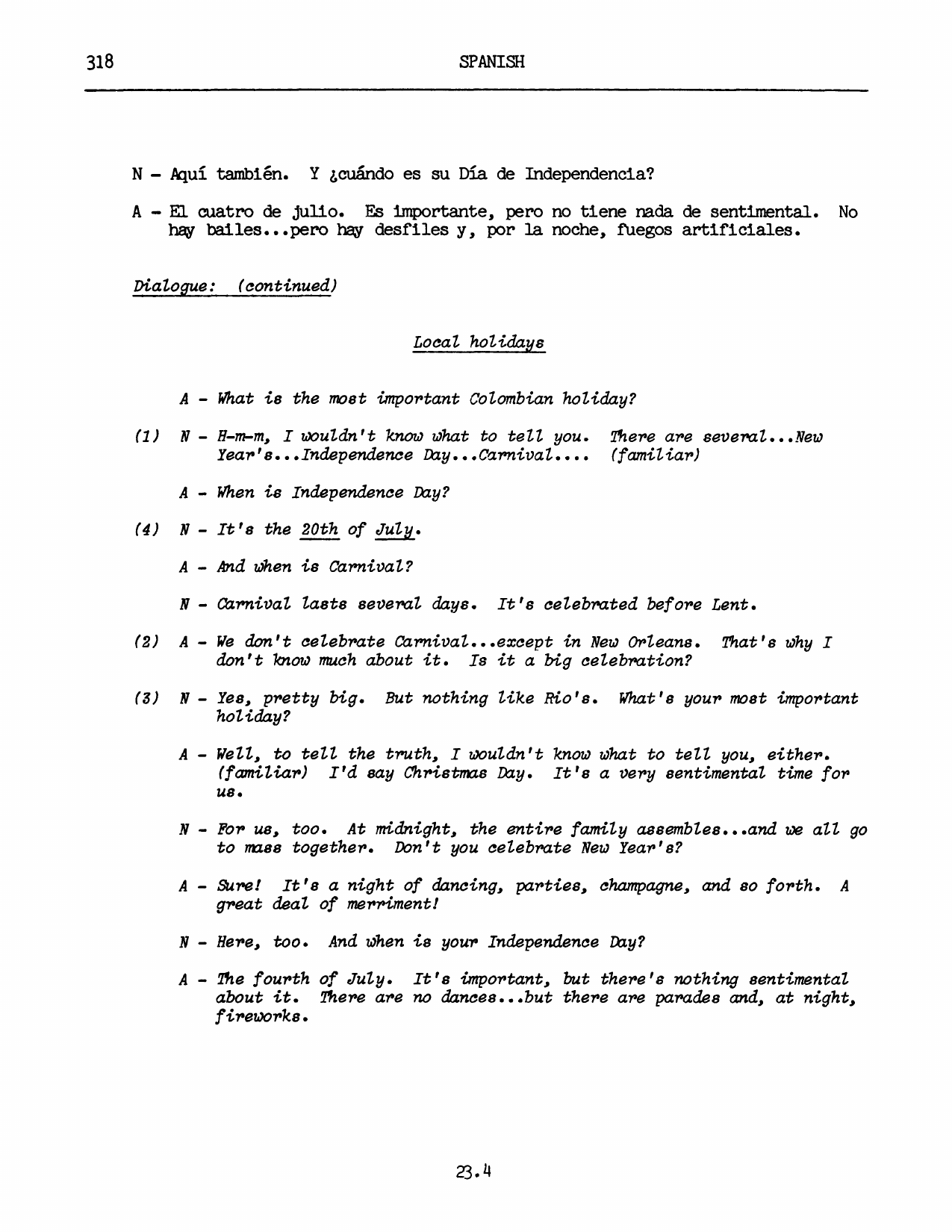
N — Aquí también. Y ¿cuándo es su Día de Independencia?
A - El cuatro de julio. Es importante, pero no tiene nada de sentimental. No
hay bailes...pero hay desfiles y, por la noche, fuegos artificiales.
Dialogue: ( continued)
Local holidays
A - What is the most important Colombian holiday?
(1) N- H-mm, I wouldn't know what to tell you. There are several...New
Year's... Independence Day...Carnival.... (familiar)
A - When te Independence Day?
(4) N- It's the 20th of July.
A - And when te Carnival?
N - Carnival lasts several days. It's celebrated before Lent.
(2) A - We don't celebrate Carnival...except in New Orleans. That's why I
don't know much about it. Is it a big celebration?
(3) N- Yes, pretty big. But nothing like Rio's. What's your most important
holiday?
A - Well, to tell the truth, I wouldn't know what to tell you, either.
(familiar) I'd say Christmas Day. It's a very sentimental time for us.
N - For us, too. At midnight, the entire family assembles...and we all go
to mass together. Don't you celebrate New Year's?
A - Sure! It's a night of dancing, parties, champagne, and so forth. A
great deal of merriment!
N - Here, too. And when is your Independence Day?
A - The fourth of July. It's important, but there's nothing sentimental
about it. There are no dances...but there are parades and, at night, fireworks.
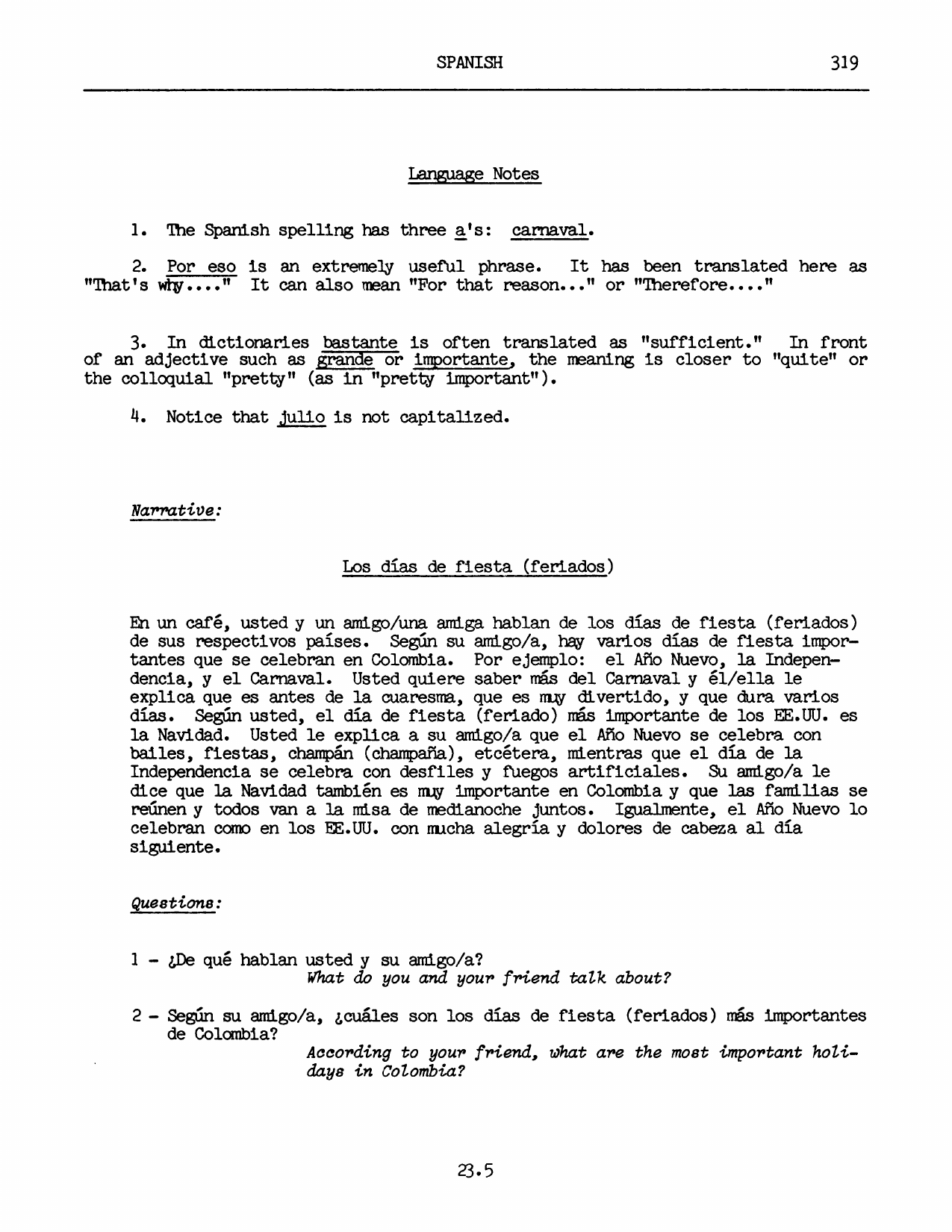
Language Notes
1. The Spanish spelling has three a's: carnaval.
2. Por eso is an extremely useful phrase. It has been translated here as
"That's why...." It can also mean "For that reason..." or "Therefore...."
3. In dictionaries bastante is often translated as "sufficient." In front
of an adjective such as grande or importante, the meaning is closer to "quite" or the colloquial "pretty" (as in "pretty important").
4, Notice that julio is not capitalized.
Narrative:
Los días de fiesta (feriados)
En un café, usted y un amigo/una amiga hablan de los días de fiesta (feriados) de sus respectivos países. Según su amigo/a, hay varios días de fiesta impor-tantes que se celebran en Colombia. Por ejemplo: el Año Nuevo, la Indepen-dencia, y el Carnaval. Usted quiere saber más del Carnaval y él/ella le explica que es antes de la cuaresma, que es my divertido, y que dura varios días. Según usted, el día de fiesta (feriado) más importante de los EE.UU. es la Navidad. Usted le explica a su amigo/a que el Afío Nuevo se celebra con bailes, fiestas, champán (champaña), etcétera, mientras que el día de la Independencia se celebra con desfiles y fuegos artificiales. Su amigo/a le dice que la Navidad también es muy importante en Colombia y que las familias se reúnen y todos van a la misa de medianoche juntos. Igualmente, el Año Nuevo lo celebran como en los EE.UU. con mucha alegría y dolores de cabeza al día siguiente.
Questions:
1 - ¿De qué hablan usted y su amigo/a?
What do you and your friend talk about?
2 = Según su amigo/a, ¿cuáles son los días de fiesta (feriados) más importantes
de Colombia?
According to your friend, what are the most important holi-days in Colombia?
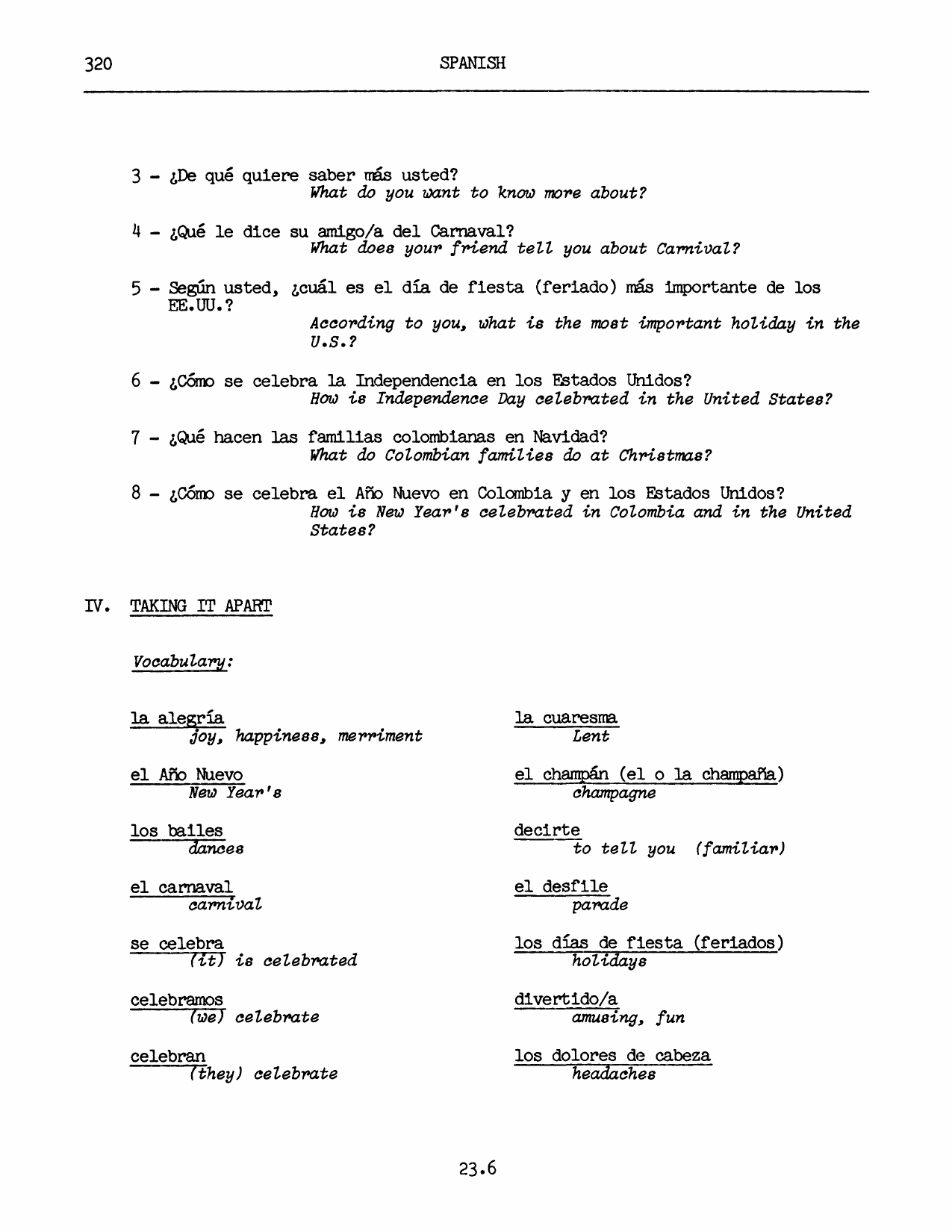
3 - ¿De qué quiere saber más usted?
What do you want to know more about?
4 — ¿Qué le dice su amigo/a del Carnaval?
What does your friend tell you about Carnival?
5 - Según usted, ¿cuál es el día de fiesta (feriado) más importante de los
EE.UU. ?
According to you, what is the most important holiday in the U.S?
6 - ¿Cómo se celebra la Independencia en los Estados Unidos?
How ts Independence Day celebrated in the United States?
7 - ¿Qué hacen las familias colombianas en Navidad?
What do Colombian families do at Christmas?
8 — ¿Cómo se celebra el Año Nuevo en Colombia y en los Estados Unidos?
How te New Year's celebrated in Colombia and in the United States?
IV. ‘TAKING IT APART
Vocabulary:
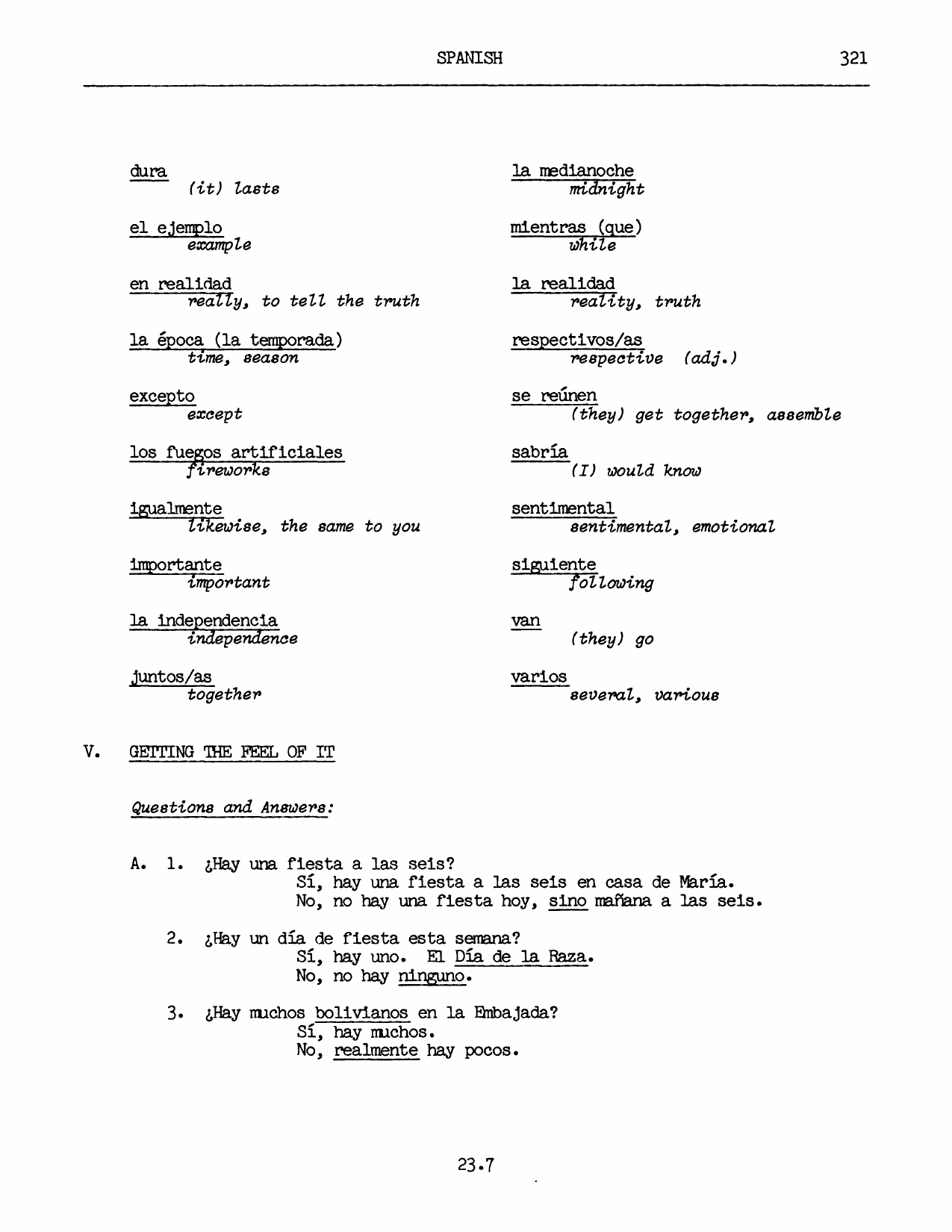
GETTING THE FEEL OF IT
Questions and Answers:
A. 1. ¿Hay una fiesta a las seis?
Sí, hay una fiesta a las seis en casa de María. No, no hay una fiesta hoy, sino mañana a las sels.
2. ¿Hay un día de fiesta esta semana?
Sí, hay uno. El Día de la Raza.
No, no hay ninguno.
3. ¿Hay muchos bolivianos en la Embajada?
Sí, hay muchos.
No, realmente hay pocos.
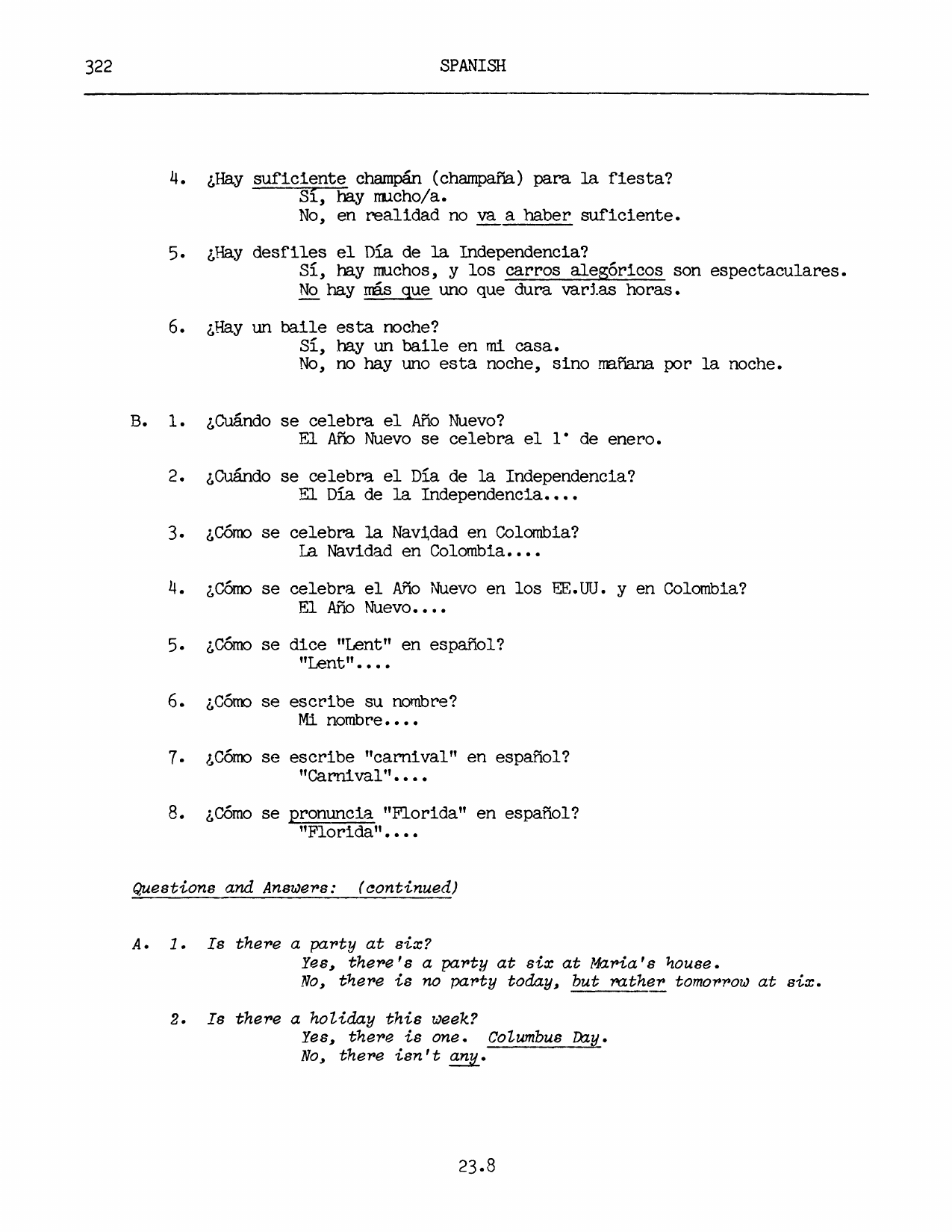
4. ¿Hay suficiente champán (champaña) para la fiesta?
Sí, hay mucho/a.
No, en realidad no va a haber suficiente.
5. ¿Hay desfiles el Día de la Independencia?
Sí, hay muchos, y los carros alegóricos son espectaculares. No hay más que uno que dura varias horas.
6. ¿Hay un baile esta noche?
Sí, hay un baile en mi casa.
No, no hay uno esta noche, sino mañana por la noche.
B. 1. ¿Cuándo se celebra el Año Nuevo?
El Año Nuevo se celebra el 1° de enero.
2. ¿Cuándo se celebra el Día de la Independencia?
El Día de la Independencia....
3. ¿Cómo se celebra la Navidad en Colombia?
La Navidad en Colombia....
Y. ¿Cómo se celebra el Año Nuevo en los EE.UU. y en Colombia?
El Año Nuevo...-.
5. ¿Cómo se dice "Lent" en español?
"Lent" ....
6. ¿Cómo se escribe su nombre?
Mi nombre....
7. ¿Cómo se escribe "carnival" en español?
"Carnival". eee
8. ¿Cómo se pronuncia "Florida" en español?
"Florida"....
Questions and Answers: (continued)
A. 1. Is there a party at six?
Yes, there's a party at síx at Maria's house.
No, there is no party today, but rather tomorrow at six.
2. Is there a holiday this week?
Yes, there is one. Columbus Day.
No, there ten't any.
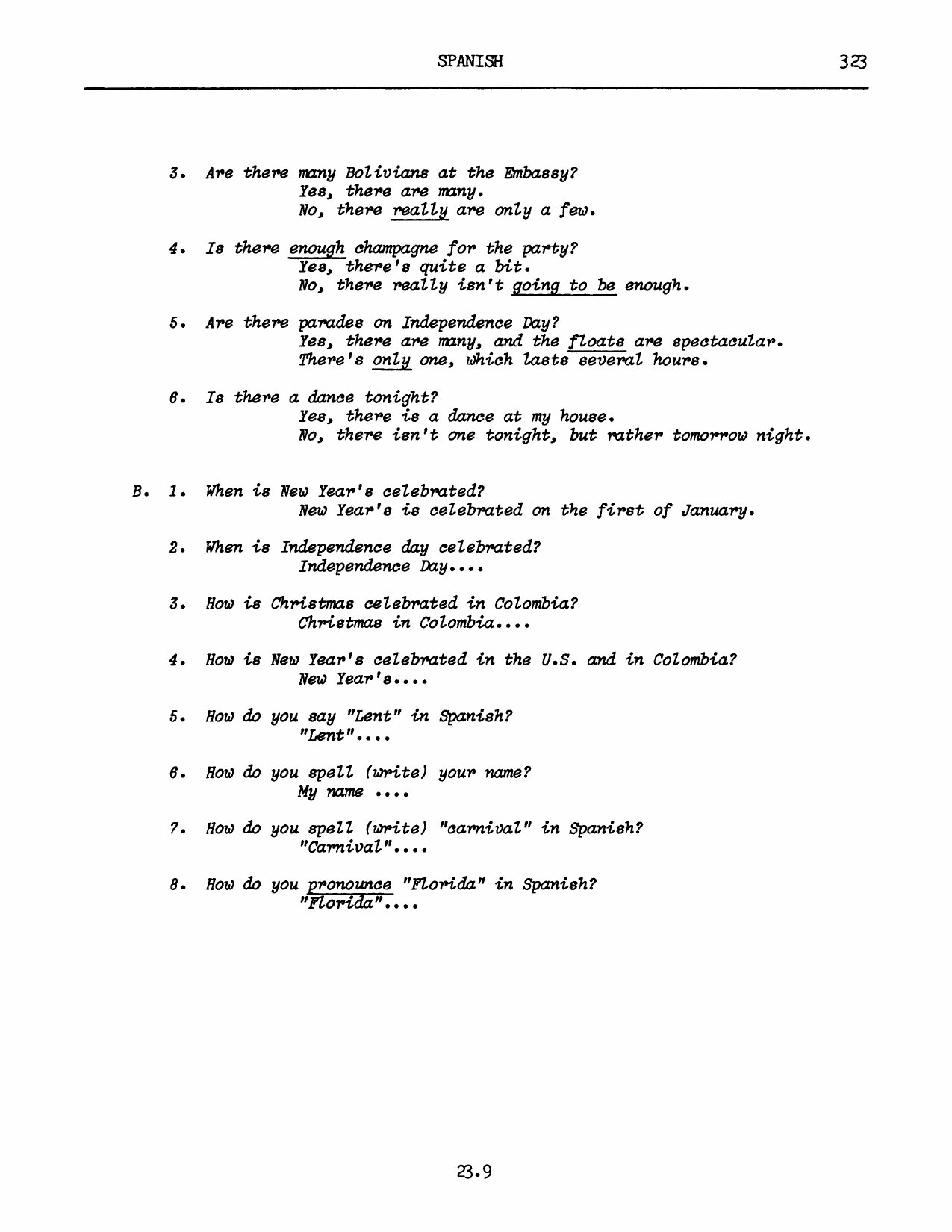
de. Are there many Bolivians at the Embassy?
Yes, there are many.
No, there really are only a few.
4. ls there enough champagne for the party?
Yes, there's quite a bit.
No, there really ten't going to be enough.
de. Are there parades on Independence Day?
Yes, there are many, and the floate are spectacular. There's only one, which lasts several hours.
6. Is there a dance tonight?
Yes, there is a dance at my house.
No, there tan't one tonight, but rather tomorrow night.
B. 1. When is New Year's celebrated?
New Year's is celebrated on the first of January.
2. When is Independence day celebrated?
Independence Day....
3. How te Christmas celebrated in Colombia?
Christmas in Colombia...»
4. How te New Year's celebrated in the U.S. and in Colombia?
New Year's....
5-6 How do you say "Lent" in Spanish?
"Lent ", ...
6. How do you spell (write) your name?
My name ose.
7. How do you spell (write) "carnival" in Spanish?
"Carnival"....
8. How do O you orida”. pronounce "Florida" in vps nish?
VI. PUTTING IT TOGETHER
Variants:
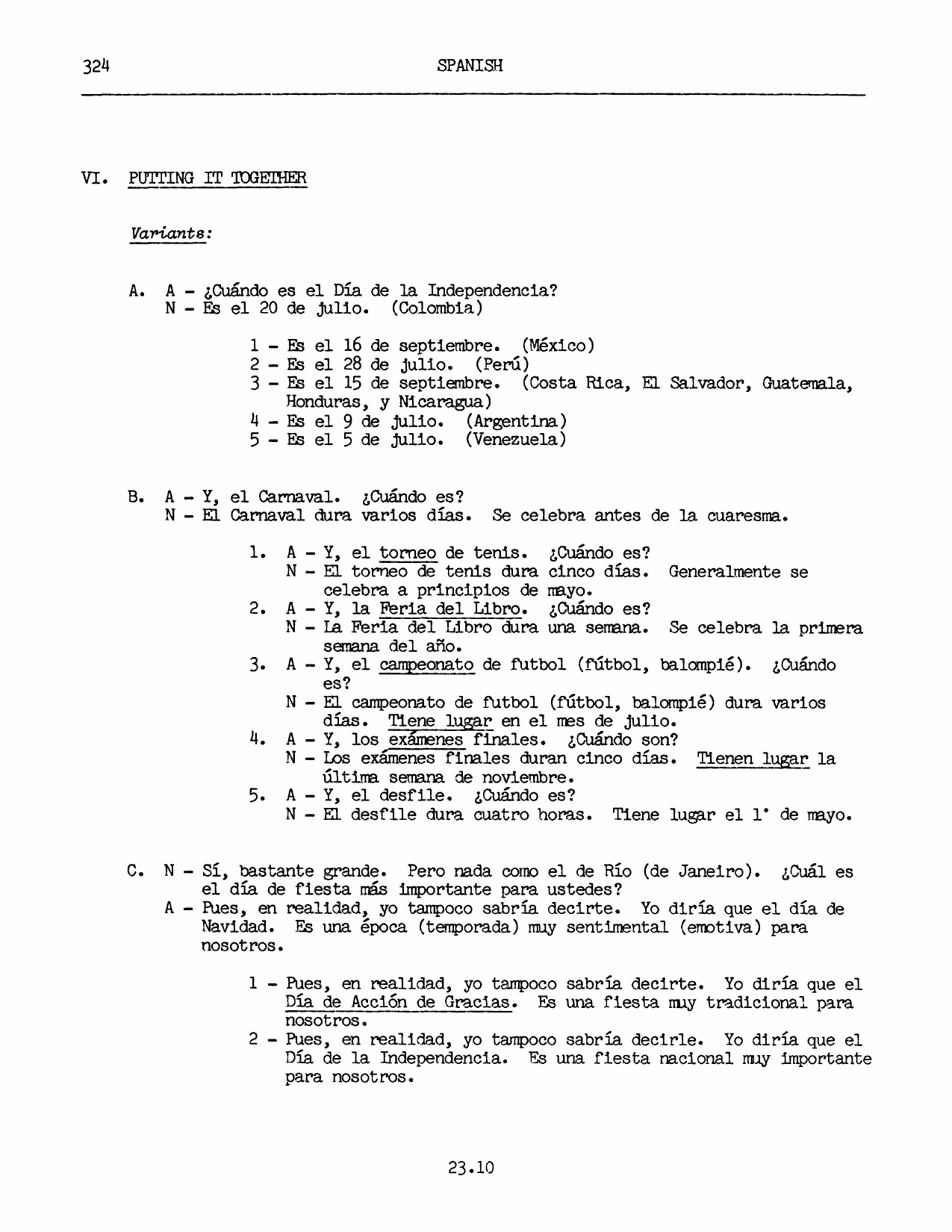
A. A = ¿Cuándo es el Día de la Independencia?
N - Es el 20 de julio. (Colombia)
1 - Es el 16 de septiembre. (México)
2 - Es el 28 de julio. (Perú)
3 - Es el 15 de septiembre. (Costa Rica, El Salvador, Guatemala,
Honduras, y Nicaragua)
4 —- Es el 9 de julio. (Argentina)
5 - Es el 5 de julio. (Venezuela)
B. A- Y, el Carnaval. ¿Cuándo es?
N - El Carnaval dura varios días. Se celebra antes de la cuaresma.
1. A - Y, el torneo de tenis. ¿Cuándo es?
N - El torneo de tenis dura cinco días. Generalmente se
celebra a principios de mayo.
2. A - Y, la Feria del Libro. ¿Cuándo es?
N — La Feria del Libro dura una semana. Se celebra la primera
semana del año.
3. A-— Y, el campeonato de fútbol (fútbol, balompié). ¿Cuándo
es?
N — El campeonato de fútbol (fútbol, balompié) dura varios
días. Tiene lugar en el mes de julio.
4, A -— Y, los exámenes finales. ¿Cuándo son?
N = Los exámenes finales duran cinco días. Tienen lugar la
última semana de noviembre.
5. A-Y, el desfile. ¿Cuándo es?
N — El desfile dura cuatro horas. Tiene lugar el 1° de mayo.
C. N- Si, bastante grande. Pero nada como el de Río (de Janeiro). ¿Cuál es
el día de fiesta más importante para ustedes?
A - Pues, en realidad, yo tampoco sabría decirte. Yo diría que el día de
Navidad. Es una época (temporada) muy sentimental (emotiva) para nosotros.
1 - Pues, en realidad, yo tampoco sabría decirte. Yo diría que el
Día de Acción de Gracias. Es una fiesta my tradicional para nosotros.
2 - Pues, en realidad, yo tampoco sabría decirle. Yo diría que el
Día de la Independencia. Es una fiesta nacional my importante para nosotros.
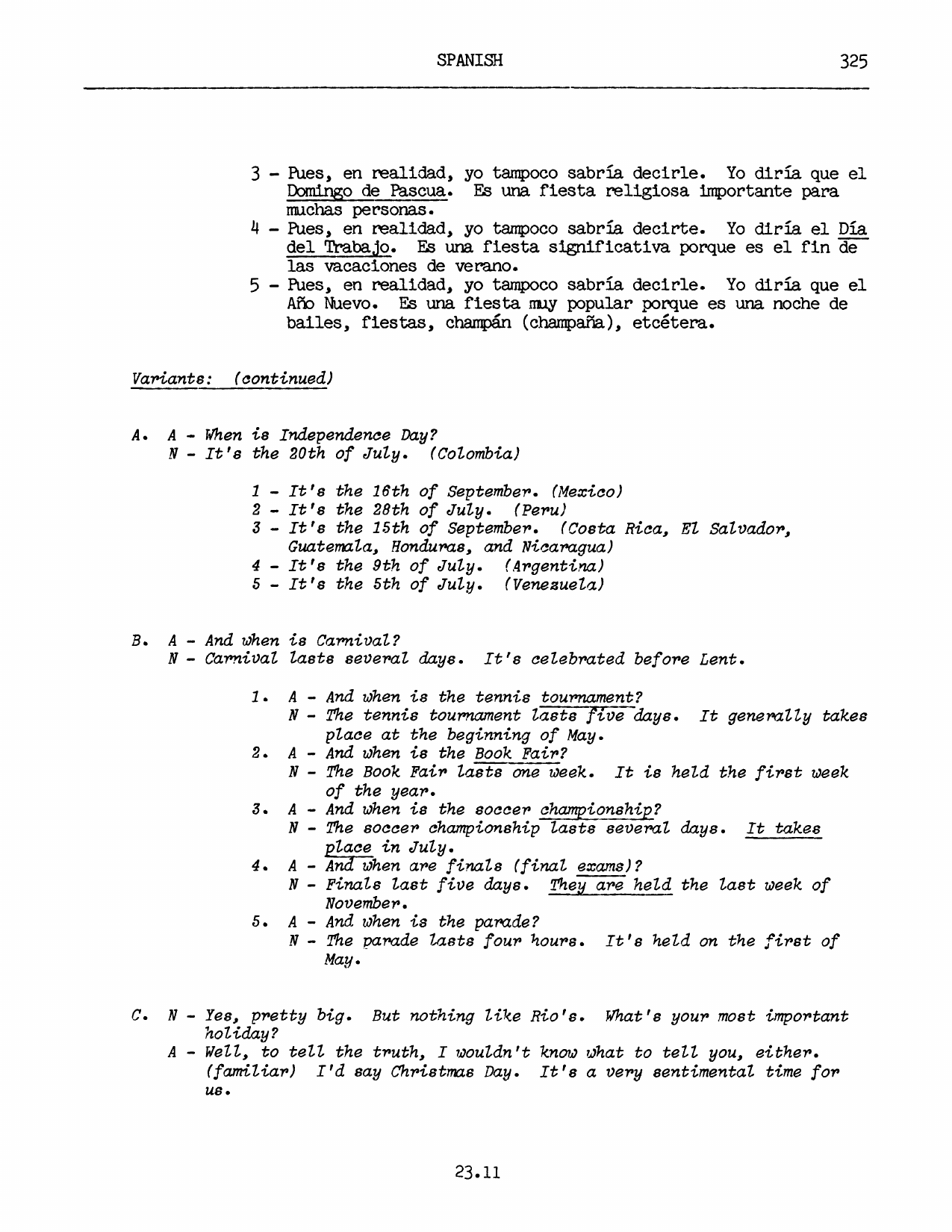
3 - Pues, en realidad, yo tampoco sabría decirle. Yo diría que el
Domingo de Pascua. Es una fiesta religiosa importante para muchas personas.
4 — Pues, en realidad, yo tampoco sabría decirte. Yo diría el Día
del Trabajo. Es una fiesta significativa porque es el fin de las vacaciones de verano.
5 - Pues, en realidad, yo tampoco sabría decirle. Yo diría que el
Año Nuevo. Es una fiesta my popular porque es una noche de bailes, fiestas, champán (champaña), etcétera.
Variants: (continued)
A. A - When ts Independence Day?
N - It's the 20th of July. (Colombia)
1 - It's the 16th of September. (México)
2 - It's the 28th of July. (Perú)
3 - It's the 15th of September. (Costa Rica, El Salvador,
Guatemala, Honduras, and Nicaragua)
4 - It's the 9th of July. (Argentina)
5 - It's the Sth of July. (Venezuela)
B. A - And when ls Carnival?
N - Carnival lasts several days. It's celebrated before Lent.
1. A - And when is the tennis tournament?
N - The tennis tournament lasts five days. It generally takes
place at the beginning of May.
2. A - And when te the Book Fair?
N - The Book Fair lasts one week. It is held the first week
of the year.
3. A - And when is the soccer championship?
N - The soccer championship lasts several days. It takes
lace in July.
4. A - And when are finals (final exams)?
N - Finale last five days. They are held the last week of
November.
5. A - And when ts the parade?
N - The parade lasts four hours. It's held on the first of
May.
C. N- Yes, pretty big. But nothing like Rio's. What's your most important
noliday?
A - Well, to tell the truth, I wouldn't know what to tell you, either.
(familiar) I'd say Christmas Day. It's a very sentimental time for use
1 - Well, to tell the truth, I wouldn't know what to tell you,
either. (familiar) I'd say Thankegiving Day. It's a very traditional holiday for us.
2 - Well, to tell the truth, I wouldn't know what to tell you,
either. (formal) I'd say Independence Day. It's a very important national holiday for us.
3 - Well, to tell the truth, I wouldn't know what to tell you,
either. (formal) I'd say Easter Sunday. It's an important religious holiday for many people.
4 - Well, to tell the truth, I wouldn't know what to tell you,
either. (familiar) I'd say Labor Day. It's a significant holiday because it's the end of summer vacation.
5 - Well, to tell the truth, I wouldn't know what to tell you,
either. (formal) I'd say New Year's. It's a very popular holiday because it's a night of dancing, parties, champagne, and so forth.
VII. MAKING IT WORK
VIII. USING IT