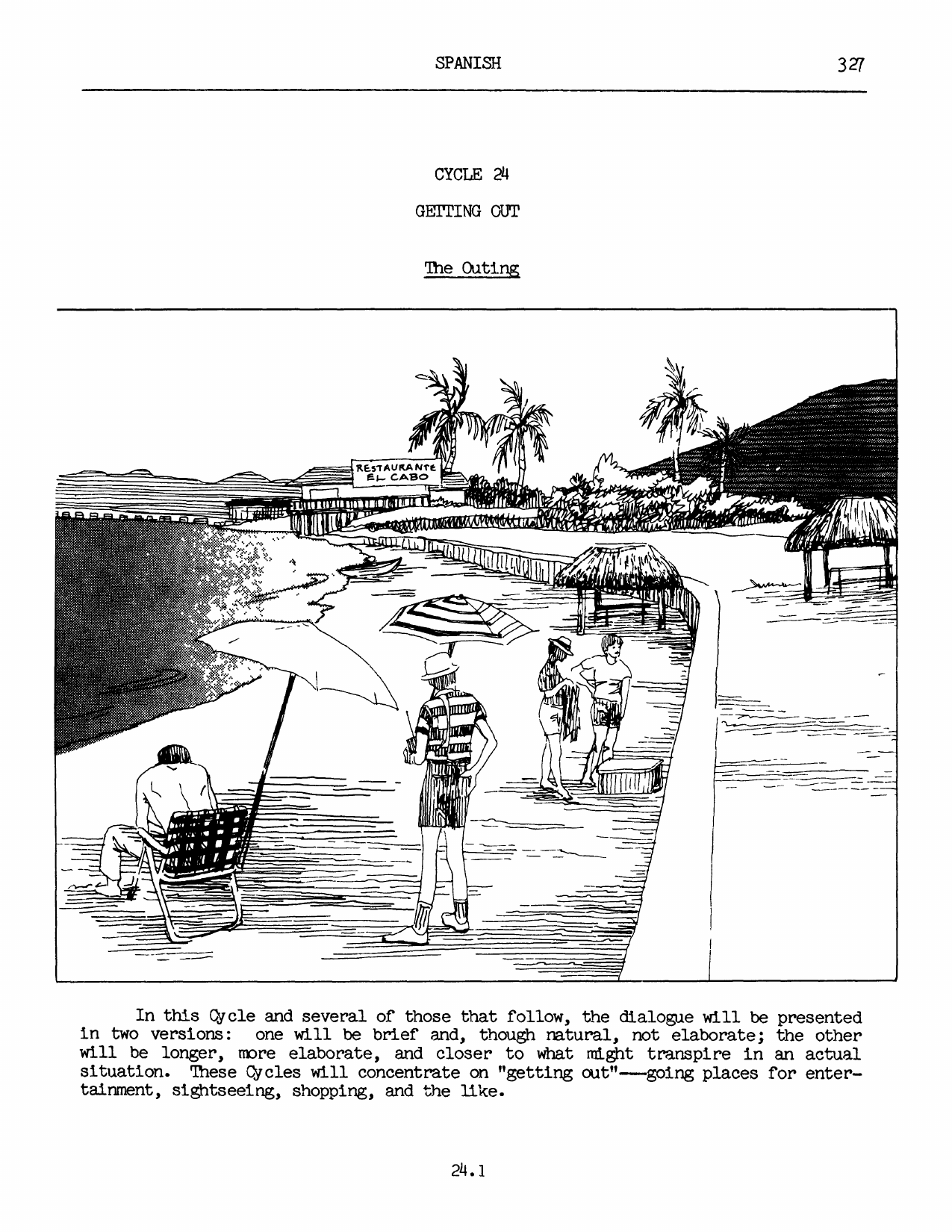
CYCLE 24
GETTING OUT
The Outing
In this Cycle and several of those that follow, the dialogue will be presented
in two versions: one will be brief and, though natural, not elaborate; the other will be longer, more elaborate, and closer to what might transpire in an actual situation. These Cycles will concentrate on "getting out"——going places for enter-tainment, sightseeing, shopping, and the like.
This page has a drawing, chart, or fill-in layout — original page
I. SETTING THE SCENE
You would like to go on an outing with your family, so you ask a friend to give you some suggestions.
II. HEARING IT
III. SEEING IT
Dialogue No. 1: (Short Version)
A dónde ir de paseo
A - Manuel, mi familia y yo queremos ir a la playa. ¿Cuál playa nos
recomiendas?
N - Bueno, las del norte son más bonitas y no se llenan de gente. A - ¿Cuál es la mejor playa? (¿Cuál playa es la mejor?)
N —- A nosotros nos gusta "El Cabo." Es grande, limpia, y hay un hotel que
tiene un restaurante (restorán) de primera.
A - ¿Cómo es la carretera hacia el norte?
N - Regular Tiene partes buenas (tramos buenos) y partes malas (tramos
malos).
A = ¿Cuánto tiempo toma para llegar a "El Cabo"?
N - Como dos horas y media.
A - Bien. Vamos a ir allí.
N = ¡Que lo pasen (my) bien!
24,2
Dialogue No. 1: (Short Version - continued)
Where to go on an outing
A - Manuel, my family and I would like to go to the beach. What beach do
you recommend? (familiar)
N - Well, those to the north are much nicer and not very crowded. A - Which ts the best beach?
(1) N - We like "El Cabo." It's big, clean, and there's a hotel that has a
first-class restaurant.
A - What's the condition of the road to the north?
N - So-so. It has good and bad stretches.
A - How long does it take to get to "El Cabo"?
N - About two and a half hours.
A - Good. We'll go there.
(2) N - Have a (very) good time! (pl.)
Dialogue No. 2: (Long Version)
A dónde ir de paseo
A —- Manuel, la (mi) familia y yo queremos salir a pasear este fin de semana.
¿Qué nos aconsejas?
N - Bueno, si les gustan las playas, podrían ir a las del norte. Son my
bonitas .
A — ¡Buena idea! ¿Cuál es la mejor playa? (¿Cuál playa es la mejor?) N - A nosotros nos gusta más "El Cabo," porque es muy limpia y no se llena de
gente.
A - ¿Hay un buen hotel cerca de la playa?
N - Sí, en la playa misma, y tiene un restaurante (restorán) de primera.
24,3
A - ¿Cómo es la carretera hacia el norte?
N = Regular, tiene partes buenas (tramos buenos) y partes malas (tramos
malos).
A = ¿Cuánto tiempo toma de aquí a "El Cabo"?
N - Sin parar, toma como dos horas y media. Es un poco lejos, pero vale la
pena.
A - Mi esposa/o y los chicos van a ponerse my contentos cuando sepan (se
enteren) que vamos a ir a la playa.
Dialogue No. 2: (Long Version - continued)
Where to go on an outing
A - Manuel, my family and I would like to go away for the weekend. What
do you recommend?
N - Well, tf you like beaches, you could go to the ones to the north. They
are very nice.
A - Good idea! Which is the best beach?
N - We like "El Cabo" best; it is clean and not very crowded. A - Is there a good hotel near the beach?
N - Yes, there's one right on the beach, and it has a firet-class
restaurant.
A - What's the condition of the road to the north?
N - So-so; it has good and bad stretches.
A - How long does it take to get from here to "El Cabo"?
N - Without stopping, it takes about two and a half hours. It's a bit far,
but 1t's worth it.
(3) A - My wife/husband and the kids are going to be very happy when they find
out that we're going to the beach.
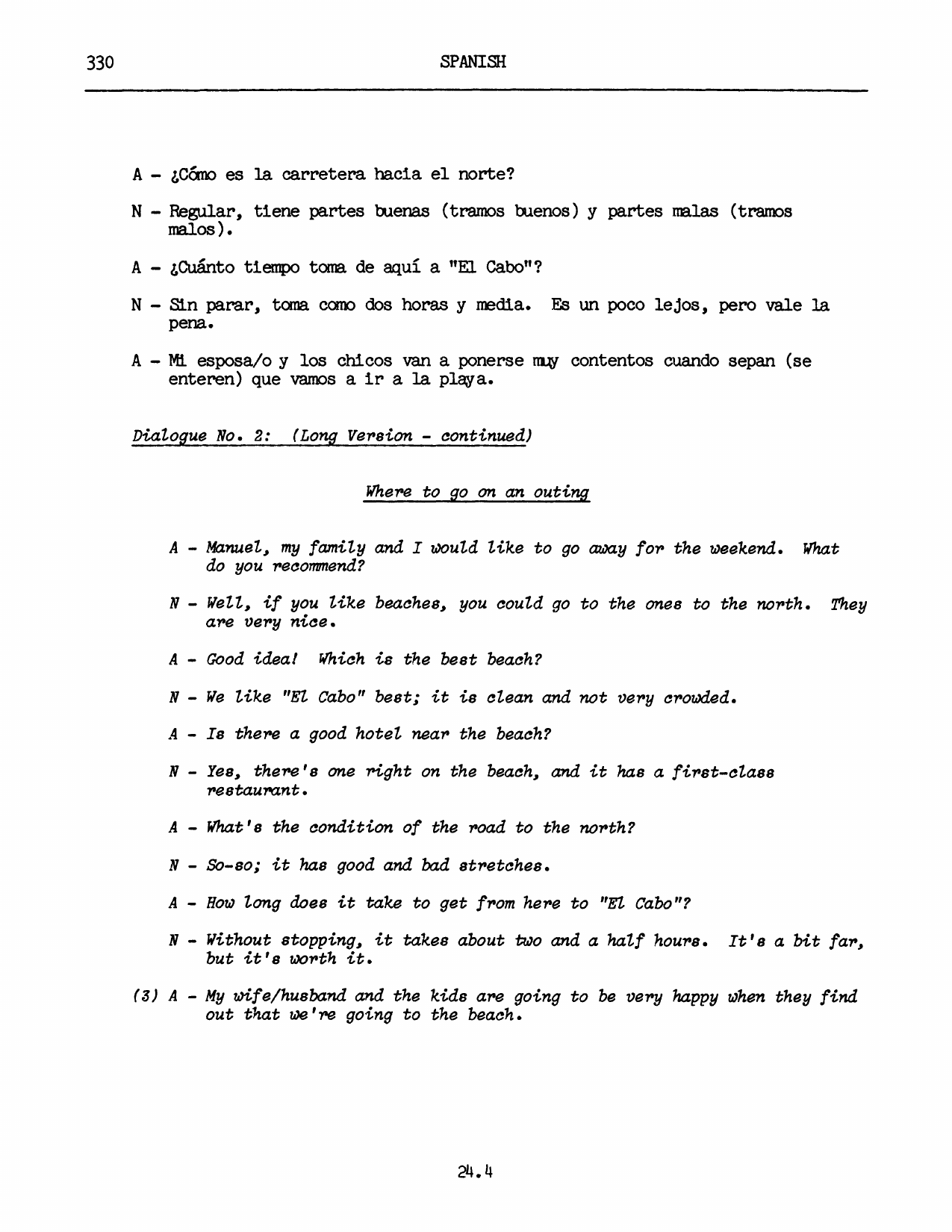
Language Notes
l. de primera
The complete phrase is de primera clase, but in casual, fast speech you
normally will hear the shortened version, de primera.
2. ¡Que (lo pasen my bien)!
Expressions beginning with que are often used to convey wishes of various
kinds. Verbs used in these expressions have the same form as those used after Quiero que.
Thus:
3. Cuando sepan
The word cuando takes the same form of the verb that you have used after
quiero que when we are talking about something that has not happened yet. Cuando sepan is translated as "when they find out," for they (the members of the family) still do not know that they are going to go to the beach. Sepan comes from the verb saber.
Examples:
well.
24,5
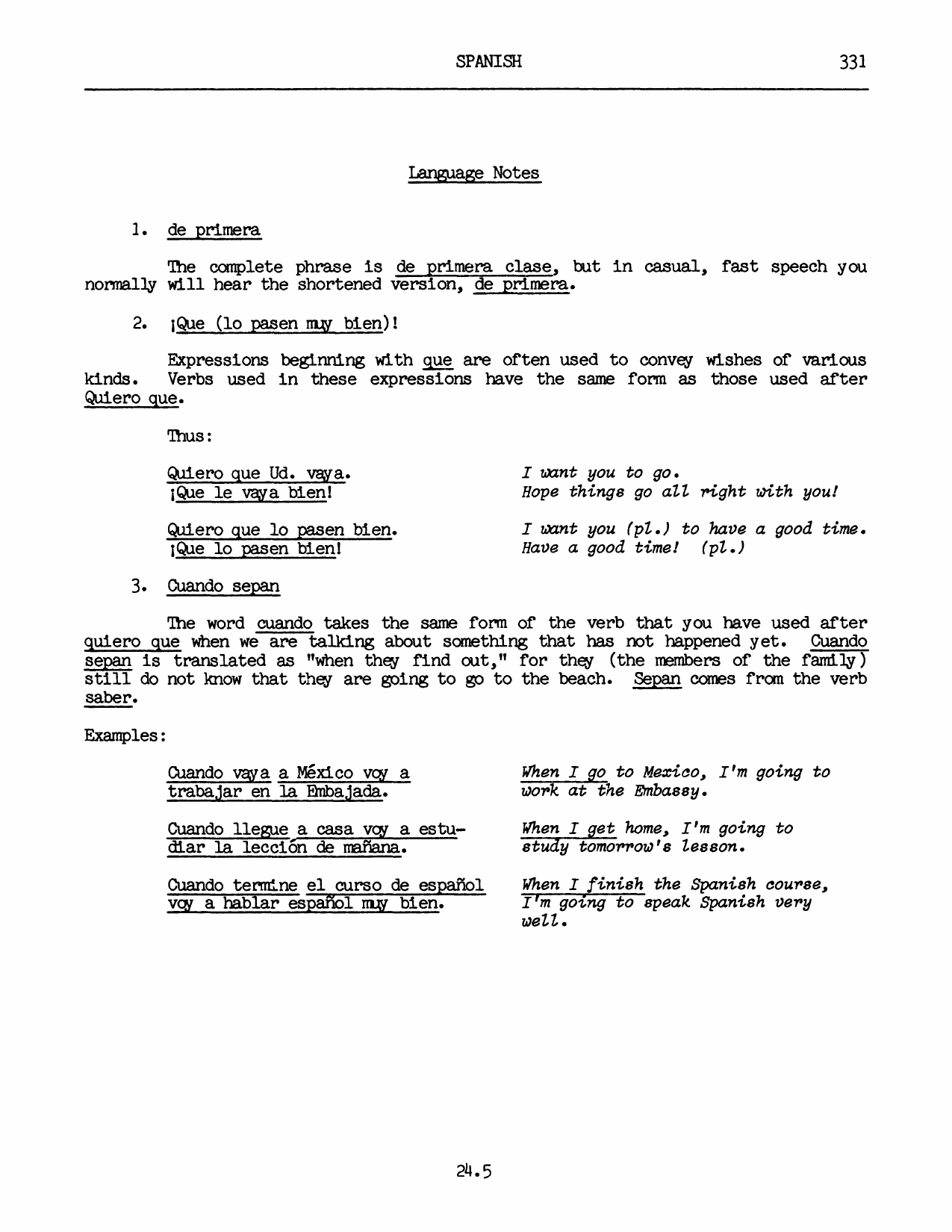
Narrative No. 1:
A dónde ir de paseo
Usted y su familia quieren salir de pases este fin de semana. Su amigo Manuel les aconseja que vayan a las playas del norte. El les recomienda, sobretodo, la playa "El Cabo" que según él es una playa grande, limpia, que no se llena de gente, y donde hay un buen hotel en la misma playa que tiene un restaurante (restorán) de primera. Maruel le dice (a usted) que la carretera es regular, con partes buenas (tramos buenos) y partes malas (tramos malos), y que toma dos horas y media para llegar allí. Usted decide aceptar la sugerencia de su aml go.
Questions:
1 = ¿A dónde quieren ir usted y su familia?
Where do you and your family want to go?
2 - ¿Qué les aconseja su amigo Manuel?
What does your friend Manuel recommend (for you, pl.)?
3 - ¿Por qué cree Manuel que la playa "El Cabo" es la mejor?
Why does Manuel think that "El Cabo" ie the best beach?
4 ~ ¿Qué clase de restaurante (restorán) hay ahí?
What kind of restaurant can one find there?
5 - ¿Cómo es la carretera hacia el norte?
What's the condition of the road to the north?
6 - ¿Cuánto tiempo toma para llegar hasta al14?
How long does it take to get there?
7 - ¿Qué decide hacer usted?
What do you decide to do?
Narrative No. 2:
A dónde ir de paseo
Usted quiere salir de paseo este fin de semana con su familia. Su amigo Manuel dice que si les gustan las playas les aconseja que vayan a las del norte ya que son muy bonitas. La playa que más le gusta a su amigo se llama "El Cabo" y le
24,6
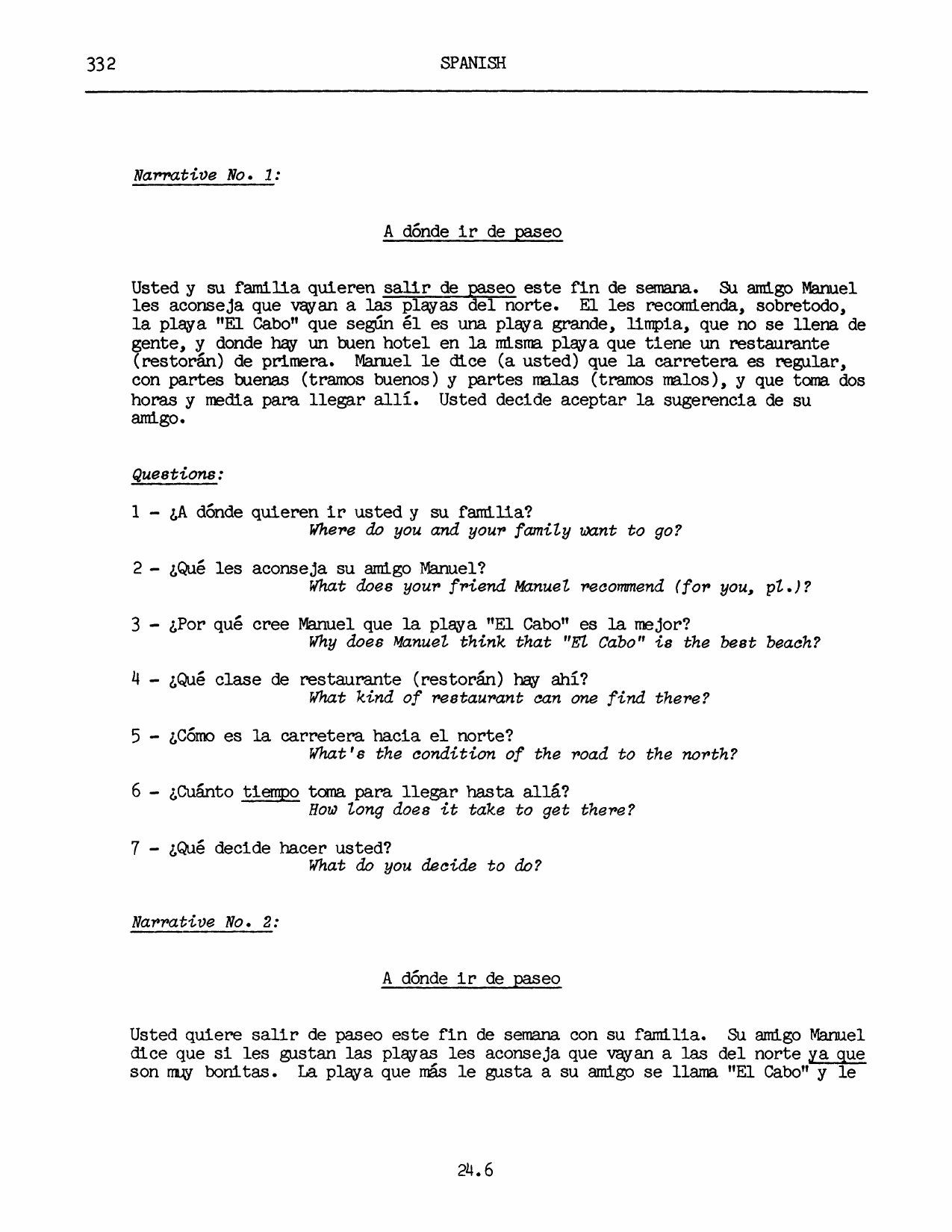
gusta porque es my limpia y porque no se llena de gente. Además, en la misma playa hay un hotel que tiene un restaurante (restorán) de primera. Manuel le dice que la carretera hacia el norte tiene partes buenas (tramos buenos) tanto como partes malas (tramos malos) y que toma como dos horas y media llegar hasta allí. A pesar de que es un poco lejos, su amigo le asegura que vale la pena. Usted dice que tanto su esposa/o como sus hijos se van a poner muy contentos cuando sepan (se enteren) que van a ir a la playa.
Questions:
1 - ¿Qué quiere hacer usted con su familia este fin de semana?
What do you want to do with your family this weekend?
2 - ¿A dónde les aconseja su amigo Manuel que vayan y por qué?
Where does your friend Manuel recommend that you go and why?
3 - ¿Cuál playa es la que más le gusta a su amigo y por qué?
Which beach does your friend like the best and why?
4 — ¿Cómo es la carretera hacia el norte?
What's the condition of the road to the north?
5 - Según su amigo, ¿vale la pena ir a "El Cabo"?
According to your friend, is it worth it to go to "El Cabo"?
6 - ¿Cree usted que a su esposa/o y a sus hijos les va a gustar la idea de ir
a la playa?
Do you think that your wife/husband and your children are going to like the idea of going to the beach?
IV. TAKING TT APART
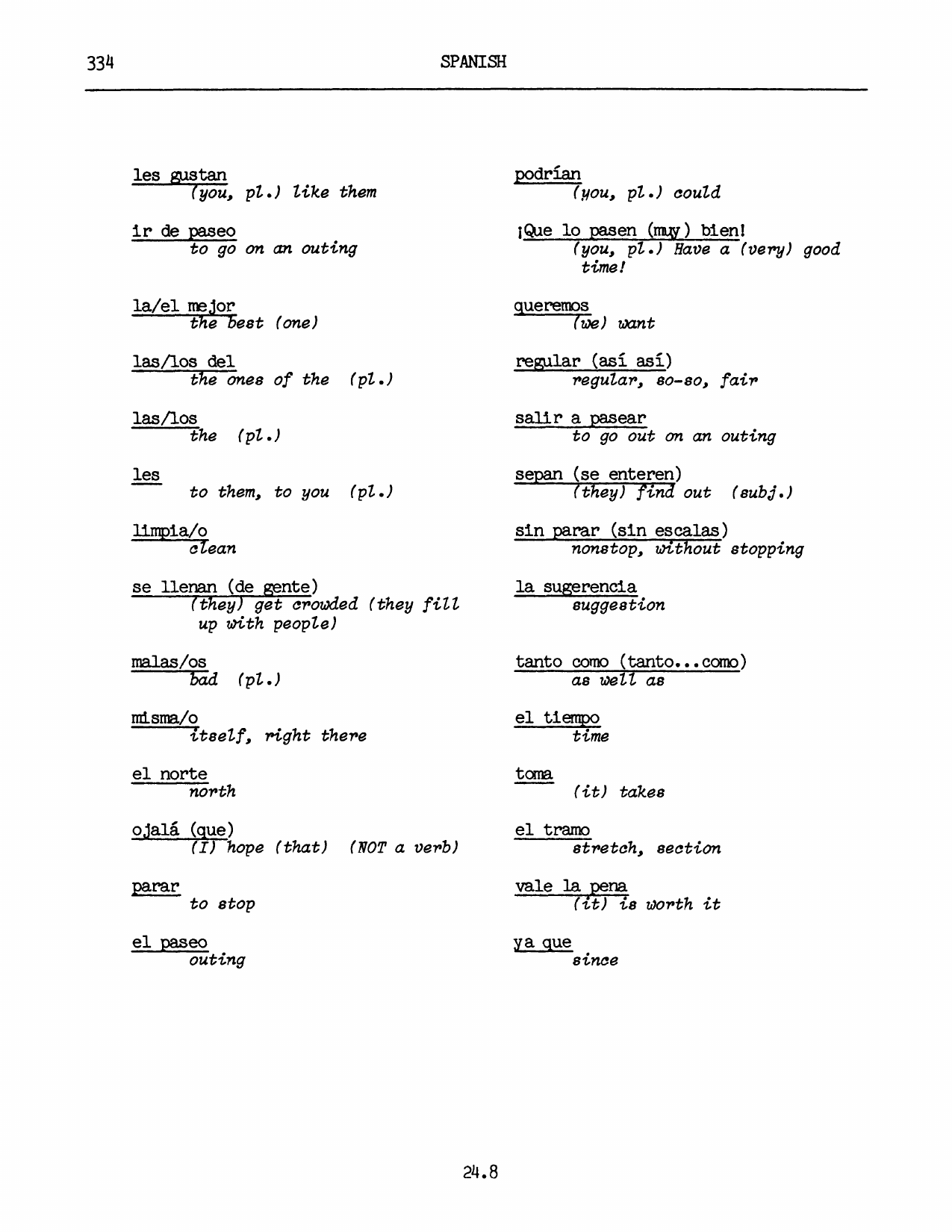
Vocabulary:
24,7
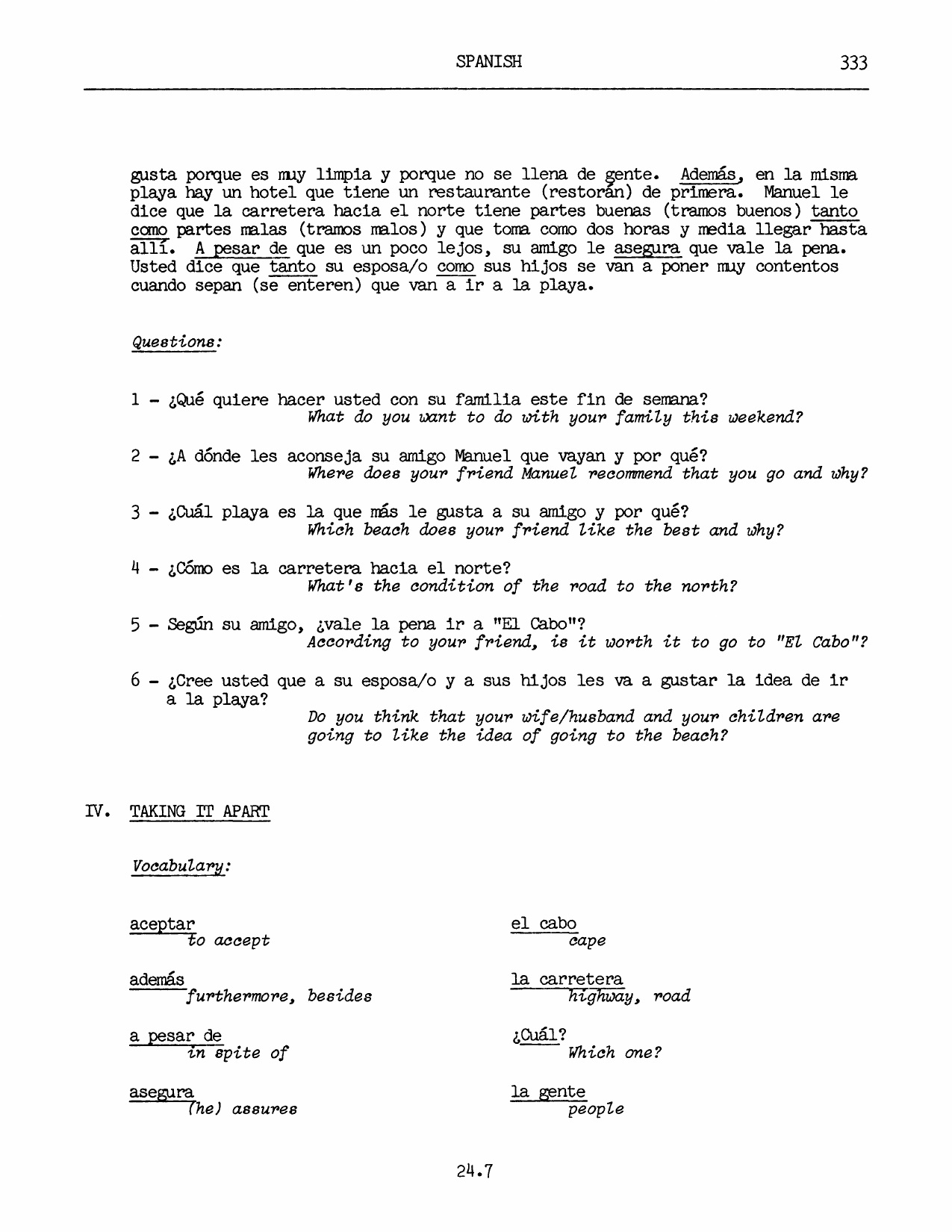
time!
up with people)
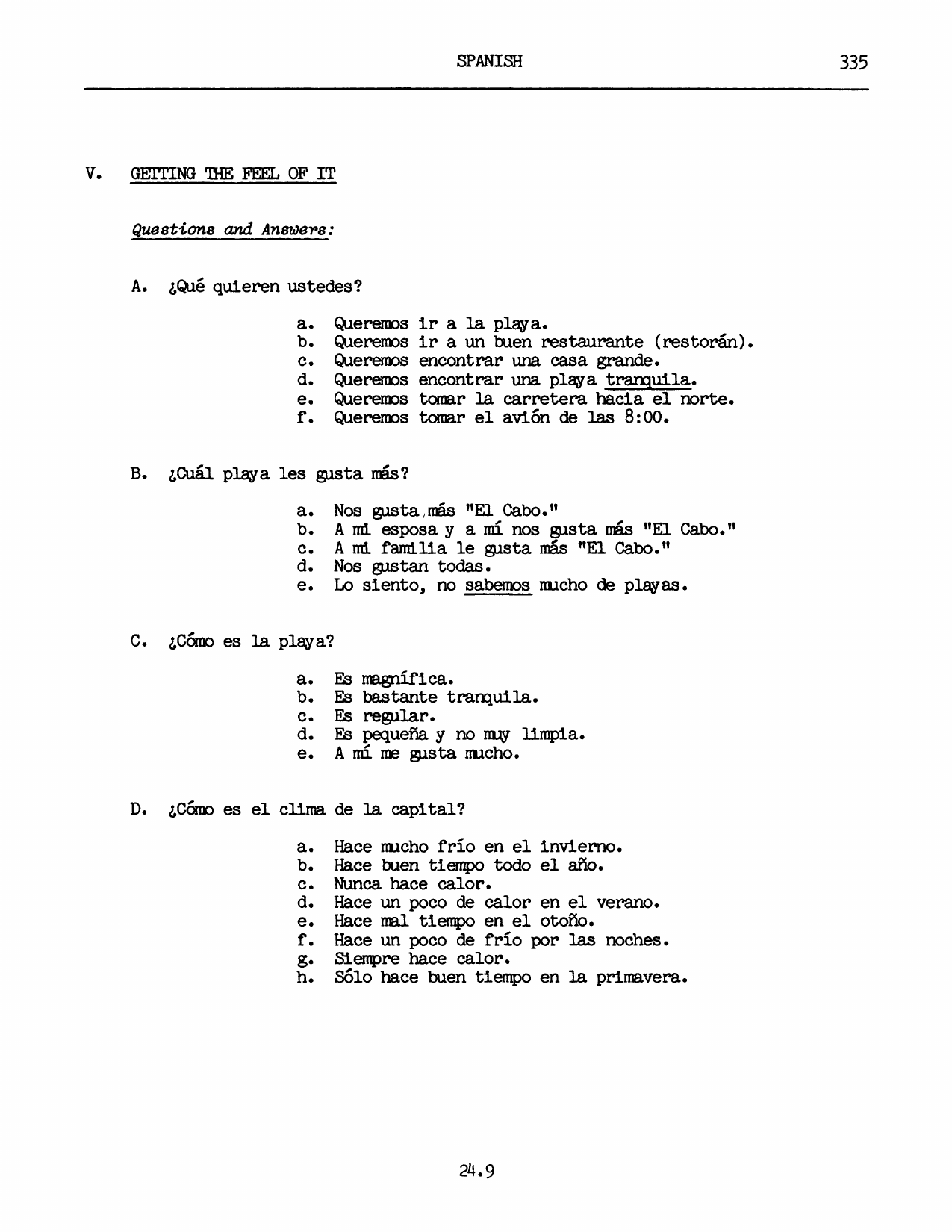
GETTING THE FEEL OF IT
Questions and Answers:
A. ¿Qué quieren ustedes?
a. Queremos ir a la playa.
b. Queremos ir a un buen restaurante (restorán). C. Queremos encontrar una casa grande.
d. Queremos encontrar una playa tranquila.
e. Queremos tomar la carretera hacia el norte. f. Queremos tomar el avión de las 8:00.
B. ¿Cuál playa les gusta más?
a. Nos gusta más "El Cabo."
b. Ami esposa y a mi nos gusta más "El Cabo." C. Ami familia le gusta más "El Cabo."
d. Nos gustan todas.
e. Lo siento, no sabemos mucho de playas.
C. ¿Cómo es la playa?
a. Es magnífica.
b. Es bastante tramuila.
C. Es regular.
d. Es pequeña y no my limpia.
e. A mi me gusta mucho.
D. ¿Cómo es el clima de la capital?
a. Hace mucho frío en el invierno.
b. Hace buen tiempo todo el año.
c. Nunca hace calor.
d. Hace un poco de calor en el verano.
e. Hace mal tiempo en el otoño.
f. Hace un poco de frío por las noches.
g Siempre hace calor.
h. Sólo hace buen tiempo en la primavera.
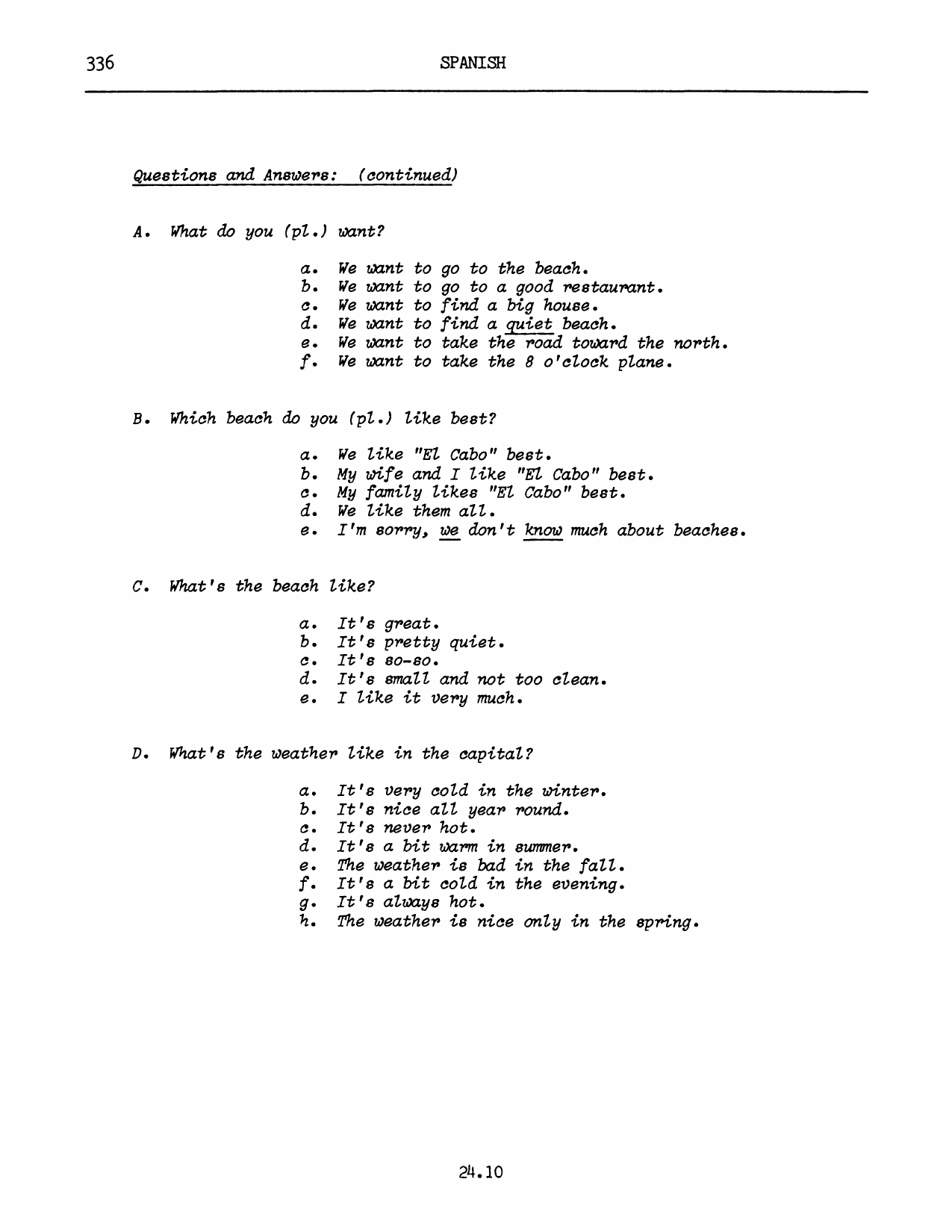
Questions and Answers: (continued)
A. What do you (pl.) want?
a. We want to go to the beach.
b. We want to go to a good restaurant.
C. We want to find a big house.
d. We want to find a quiet beach.
e. We want to take the road toward the north. f. We want to take the 8 o'clock plane.
B. Which beach do you (pl.) like best?
a. We like "El Cabo" best.
b. My wife and I like "El Cabo" best.
C. My family likes "El Cabo" best.
d. We like them all.
e. I'm sorry, we don't know much about beaches.
C. What's the beach like?
a. It's great.
b. It's pretty quiet.
C. It's 80-80.
d. It's small and not too clean.
e. I like tt very much.
D. What's the weather like in the capital?
a. It's very cold in the winter.
b. It's nice all year round.
C. It's never hot.
d. It's a bit warm in summer.
e. The weather ts bad in the fall.
f. It's a bit cold in the evening.
g. It's always hot.
h. The weather ie nice only in the spring.
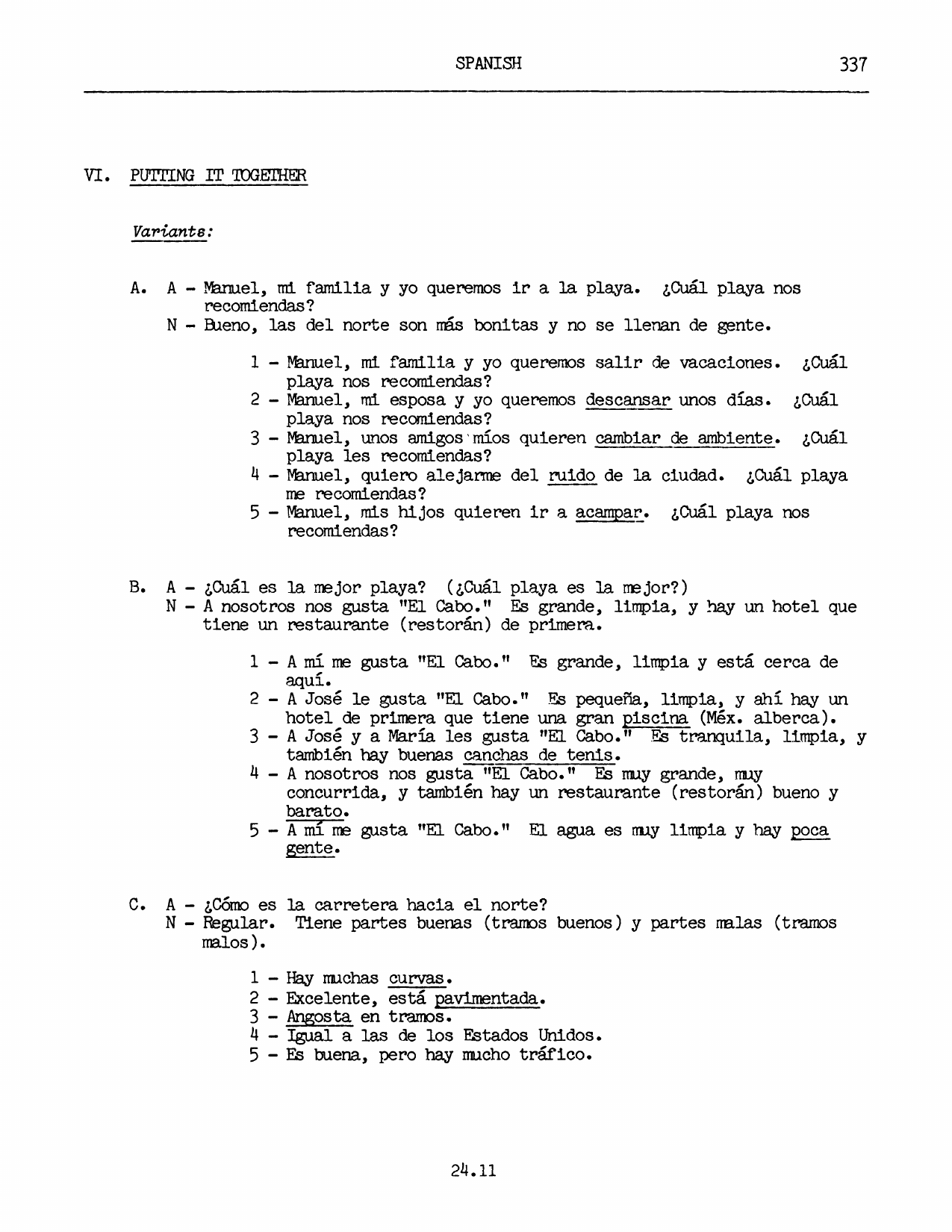
VI. PUTTING IT TOGETHER
Variants:
A. A - Mamel, mi familia y yo queremos ir a la playa. ¿Cuál playa nos
recomiendas?
N - Bueno, las del norte son más bonitas y no se llenan de gente.
1 = Manuel, mi familia y yo queremos salir de vacaciones. ¿Cuál
playa nos recomiendas?
2 —- Manuel, mí esposa y yo queremos descansar unos días. ¿Cuál
playa nos recomiendas?
3 - Maruel, unos amigos míos quieren cambiar de ambiente. ¿Cuál
playa les recomiendas?
4 — Maruel, quiero alejarme del ruido de la ciudad. ¿Cuál playa
me recomiendas?
5 - Manuel, mis hijos quieren ir a acampar. ¿Cuál playa nos
recomiendas?
B. A = ¿Cuál es la mejor playa? (¿Cuál playa es la mejor?)
N - A nosotros nos gusta "El Cabo." Es grande, limpia, y hay un hotel que
tiene un restaurante (restorán) de primera.
1-A má me gusta "El Cabo." Es grande, limpia y está cerca de
aquí.
2 - A José le gusta "El Cabo." Es pequeña, limpia, y ahí hay un
hotel de primera que tiene una gran piscina (Méx. alberca).
3 - A José y a María les gusta "El Cabo." Es tranquila, limpia, y
también hay buenas canchas de tenis.
4 —- A nosotros nos gusta "El Cabo." Es muy grande, muy
concurrida, y también hay un restaurante (restorán) bueno y barato.
5 - A mí me gusta "El Cabo." El agua es my limpia y hay poca
gente.
C. A — ¿Cómo es la carretera hacia el norte?
N - Regular. Tiene partes buenas (tramos buenos) y partes malas (tramos
malos).
1 - Hay muchas curvas.»
2 - Excelente, está pavimentada.
3 - Angosta en tramos.
4 — Igual a las de los Estados Unidos.
5 - Es buena, pero hay mucho tráfico.
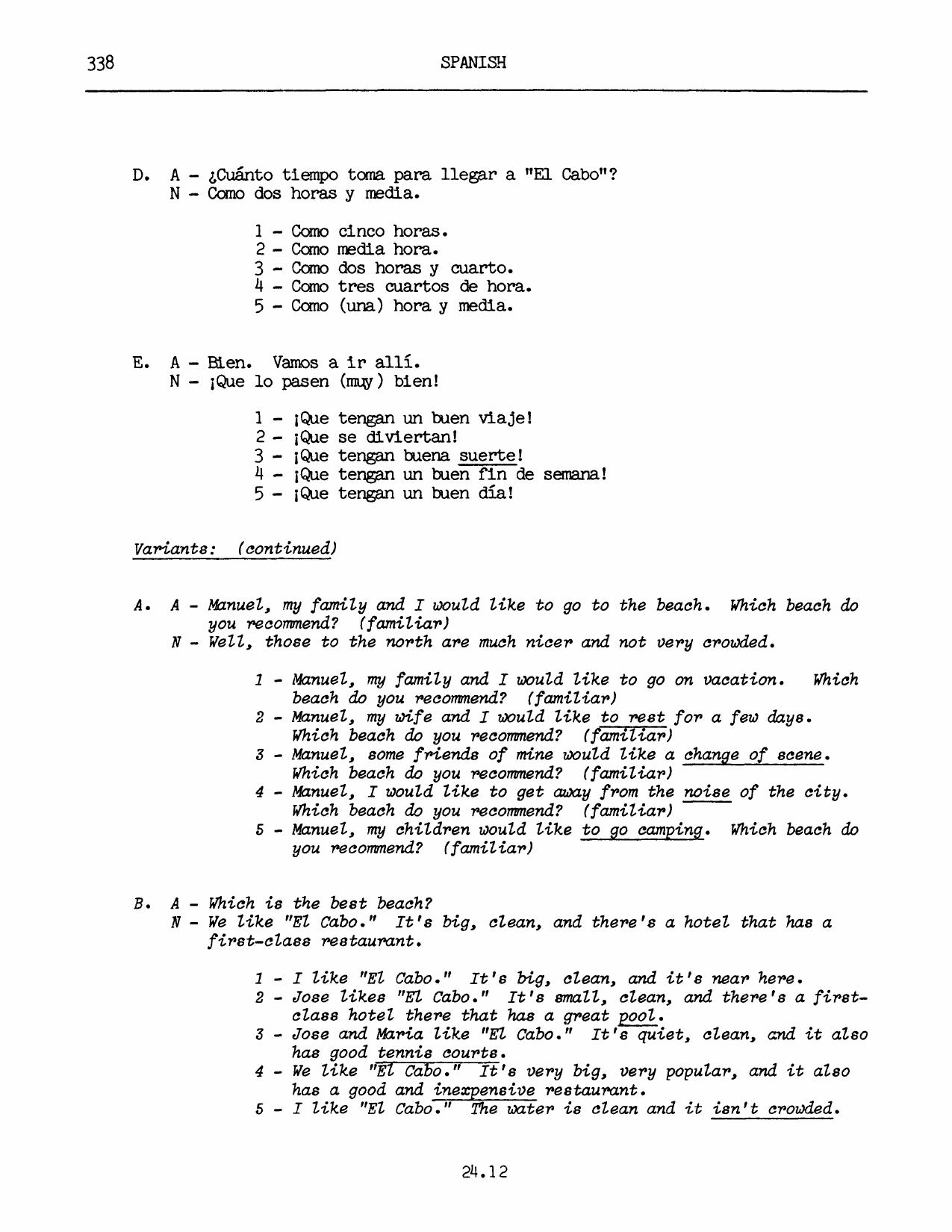
D. A — ¿Cuánto tiempo toma para llegar a "El Cabo"?
N — Como dos horas y media.
1 - Como cinco horas.
2 - Como media hora.
3 - Como dos horas y cuarto.
4 — Como tres cuartos de hora.
5 - Como (una) hora y media.
E. A- Bien. Vamos air allí.
N = ¡Que lo pasen (muy) bien!
1 - ¡Que tengan un buen viaje!
2 - ¡Que se diviertan!
3 - ¡Que tengan buena suerte!
4 - ¡Que tengan un buen fin de semana!
5 - ¡Que tengan un buen día!
Variants: (continued)
A. A - Manuel, my family and I would like to go to the beach. Which beach do
you recommend? (familiar)
N - Well, those to the north are much nicer and not very crowded.
1 - Manuel, my family and I would like to go on vacation. Which
beach do you recommend? (familiar)
2 - Manuel, my wife and I would like to rest for a few days.
Which beach do you recommend? (familiar)
3 - Manuel, some friends of mine would like a change of scene.
Which beach do you recommend? (familiar)
4 - Manuel, I would like to get away from the noise of the city.
Which beach do you recommend? (familiar)
5 - Manuel, my children would like to go camping. Which beach do
you recommend? (familiar)
B. A - Which ts the best beach?
N - We like "El Cabo." It's big, clean, and there's a hotel that has a
first-class restaurant.
1 - I like "El Cabo." It's big, clean, and it's near here. 2 - José likes "El Cabo." It's small, clean, and there's a first-
class hotel there that has a great pool.
3 - José and Marta like "El Cabo." It's quiet, clean, and it also
has good tennis courts.
4 - We like "ET Cabo." It's very big, very popular, and it also
has a good and inexpensive restaurant.
5 - I like "El Cabo." The water is clean and it isn't crowded.
24,12
C. A - What's the condition of the road to the north?
N - So-so. It has good and bad stretches.
1 - It has many curves.
2 - Excellent; it’s paved.
3 - Narrow in parte.
4 - Tt's like those in the United States.
5 - It's good, but there's a lot of traffic.
D. A - How long does it take to get to "El Cabo"?
N - About two and a half hours.
1 - About five hours.
2 - About half an hour.
3 - About two and a quarter hours.
4 - About three quarters of an hour.
5 - About an hour and a half.
E. A - Good. We'll go there.
N - Have a (very) good time! (pl.)
1 - Have a good trip! (pl.)
2 - Have a good time! (pl.)
3 - Good tuck! (pl.)
4 - Have a good weekend! (pl.)
5 - Have a good day! (pl.)
VII. MAKING IT WORK
VIII. USING IT