CYCLE 2
GETTING OUT
Shopping at a Local Market
| IN ¿Era
All
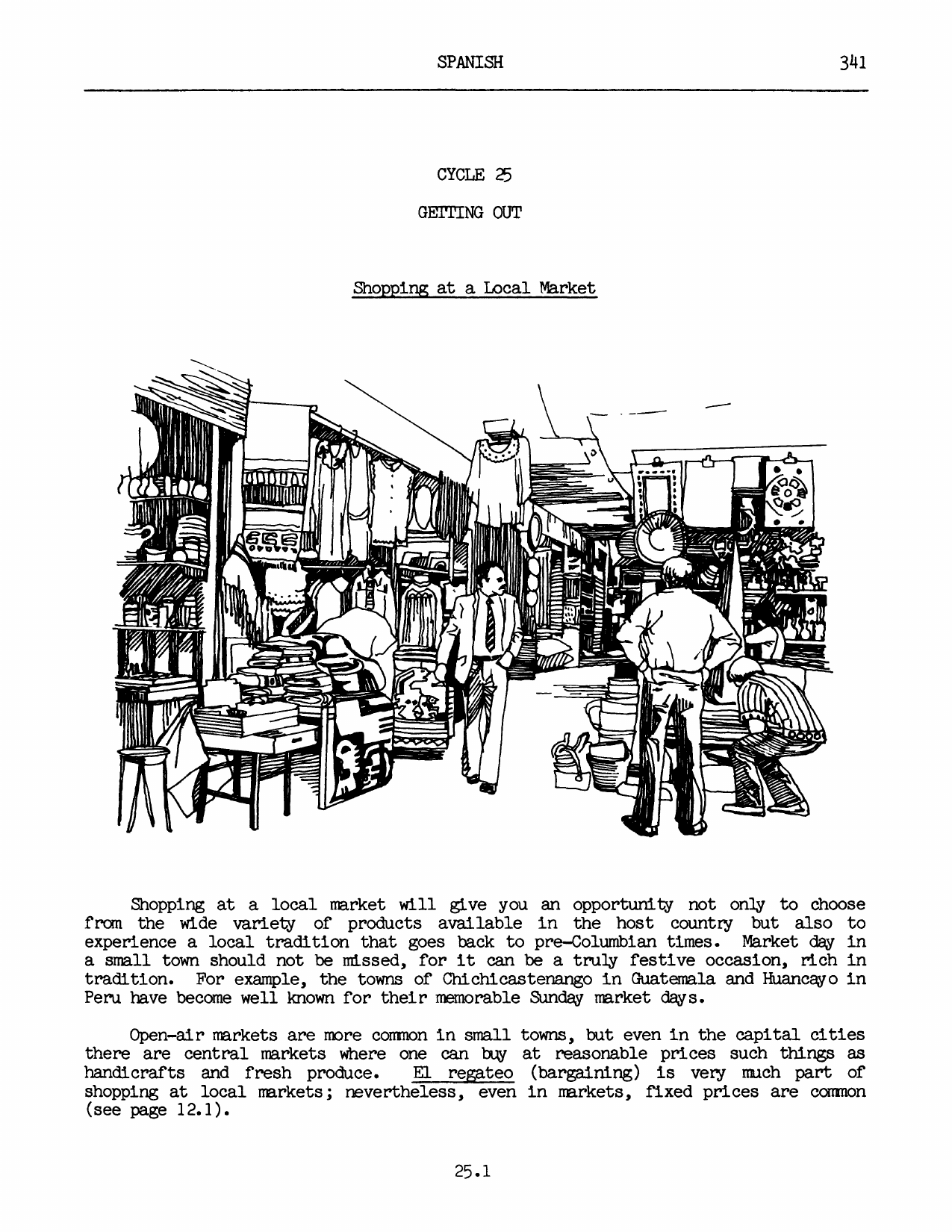
Shopping at a local market will give you an opportunity not only to choose
from the wide variety of products available in the host country but also to experience a local tradition that goes back to pre-Columbian times. Market day in a small town should not be missed, for it can be a truly festive occasion, rich in tradition. For example, the towns of Chichicastenango in Guatemala and Huancayo in Perú have become well known for their memorable Sunday market days.
Open-air markets are more common in small towns, but even in the capital cities
there are central markets where one can buy at reasonable prices such things as handicrafts and fresh produce. El regateo (bargaining) is very much part of shopping at local markets; nevertheless, even in markets, fixed prices are common (see page 12.1).
This page has a drawing, chart, or fill-in layout — original page
I. SETTING THE SCENE (A)
You would like to buy some local handmade articles, so your neighbor suggests that you go to the central market, where a wide variety of handmade articles is offered at prices lower than those in the stores downtown.
II. HEARING IT (A)
III. SEEING IT (A)
Dialogue No. 1: (Short Version)
A dónde ir de compras
A = ¿Qué tal, María?
N - My bien, Jean. ¿Vas de compras?
A - Sí, quiero comprar algunas artesanías. ¿Adónde me aconsejas que vaya? N — Bueno, en el mercado central hay una gran variedad de artesanías. A = ¿Son más baratas en el mercado que en el centro?
N- Sí. Y también se puede regatear. *
A — Pero yo no sé regatear. ¿Quieres ir conmigo?
N - Sí, claro. ¡Vamos!
*Explicar lo del regateo - ver la página 12.1.
Dialogue No. 1: (Short Version - continued)
Where to go shopping
A - How are you doing, Maria?
(1) N - Very well, Jean. Are you going shopping? (familiar)
(2) A - Yes, I want to buy some local handmade articles. Where do you recom-
mend that I go? (familiar)
N - Well, at the central market they have a wide variety of handmade
articles.
(3) A - Are they cheaper at the market than downtown?
N - Yes. And you can also bargain.
A - But I don't know how to bargain. Do you want to go with me? N - Yes, of course. Let's go!
I. SETTING THE SCENE (B)
Some friends of yours from the States are here on a visit and they are interested in buying some local handmade articles. Your neighbor suggests that you take them to the central market, where your friends can bargain and choose from a wide variety of handmade articles. You ask your neighbor to go with you so that she/he can show you how to bargain.
II. HEARING IT (B)
III. SEEING IT (B)
Dialogue No. 2: (Long Version)
A dónde ir de compras
A —- ¿Qué tal, Maria?
N - Hola, Jean. ¿Cómo están tus amigos?
A - Están my contentos de estar aquí. Hoy quieren salir de compras. ¿Adónde
me aconsejas que los lleve?
N - Podrías llevarlos al mercado central para que vean toda clase de arte-
sanilas.
A - ¿Las artesanías son más baratas en el mercado que en el centro?
N - Sí, mucho más. También ahí se puede regatear y tus amigos se van a diver-
tir muchísimo con eso.
A = ¿Quieres ir con nosotros para que nos des una demostración?
N - ¡Por qué no! ¿A qué hora quieren salir?
A - ¿Qué te parece después de la comida, como a las tres y media? N - ¡Fantástico! Pasen a buscarme cuando estén listos.
Dialogue No. 2: (Long Version - continued)
Where to go shopping
A - How are you doing, Maria?
N - Hello, Jean. How are your friends? (familiar)
(1) A - They are very happy to be here. They want to go shopping today. Where
do you recommend that I take them? (familiar)
N - You could take them to the central market so they can see all kinds of
local handmade articles.
A - Are handmade articles cheaper at the market than downtown? N - Yes, much. Also, you can bargain there and your friends will enjoy
that very much.
A - Do you want to go with us so that you can give us a demonstration? N - Why not? At what time would you (pl.) like to leave?
(5) A - How about after dinner--like around 3:30?
(4) N - Great! Come to get me whenever you (pl.) are ready.
Language Notes
l. Ir de compras vs. salir de compras
The idea of "shopping" is expressed with de compras, usually with ir and
sometimes with salir in front.
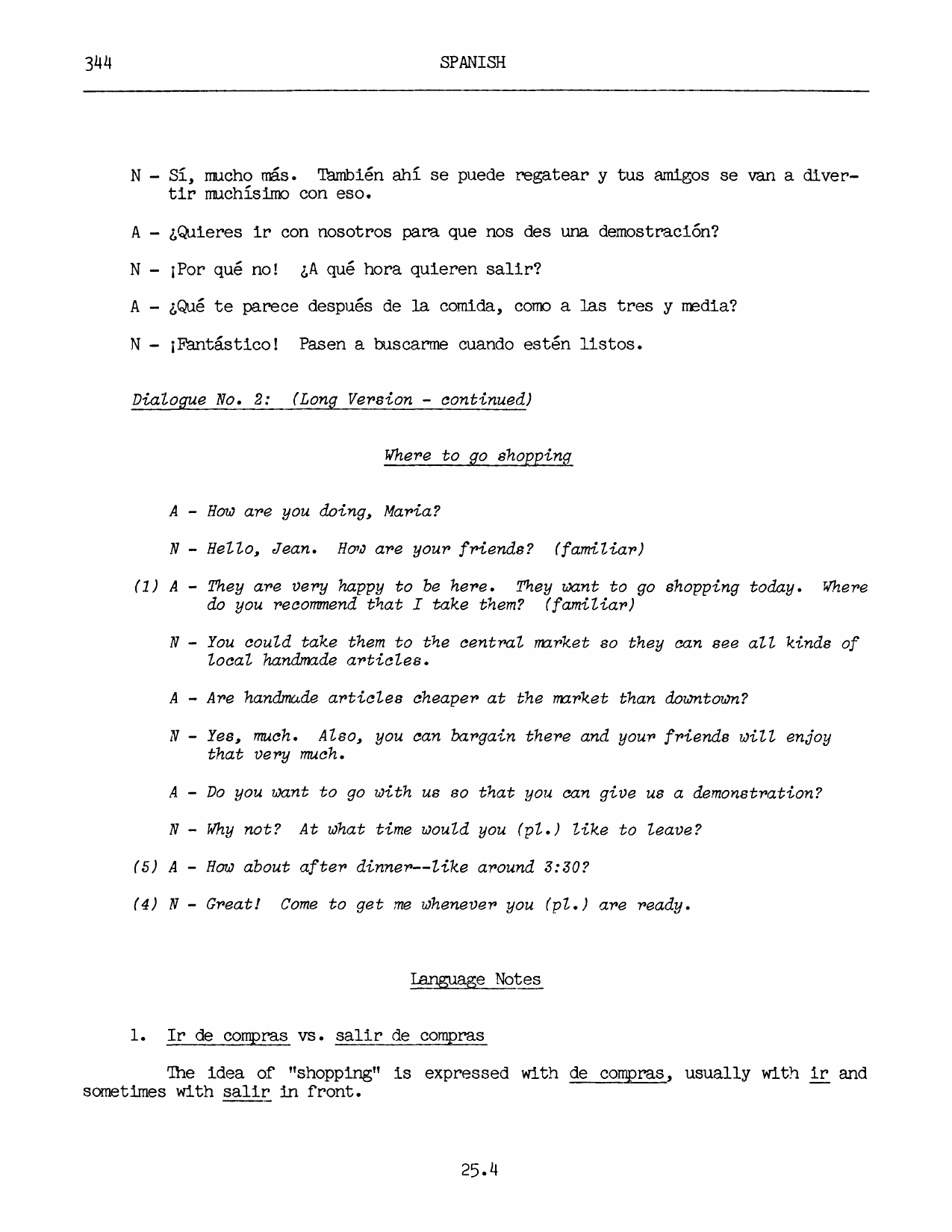
The difference between ir de compras and salir de compras is minimal. The
former can be equated with "going shopping" and the latter with "going out shopping." Ir is the idea of "going," whereas salir is the idea of "going out."
2. Me aconsejas que vaya
Me aconseja(s) que. «ts followed by the same verb form as Quiero que (see
that I go.
3. Más baratas...que
In this phrase, speakers of English use "than," while Spanish speakers use
que:
el centro.
Before a numeral (or any idea of quantity), speakers of Spanish use de:
4. Cuando estén listos/as
ready.
(familiar)
ready.
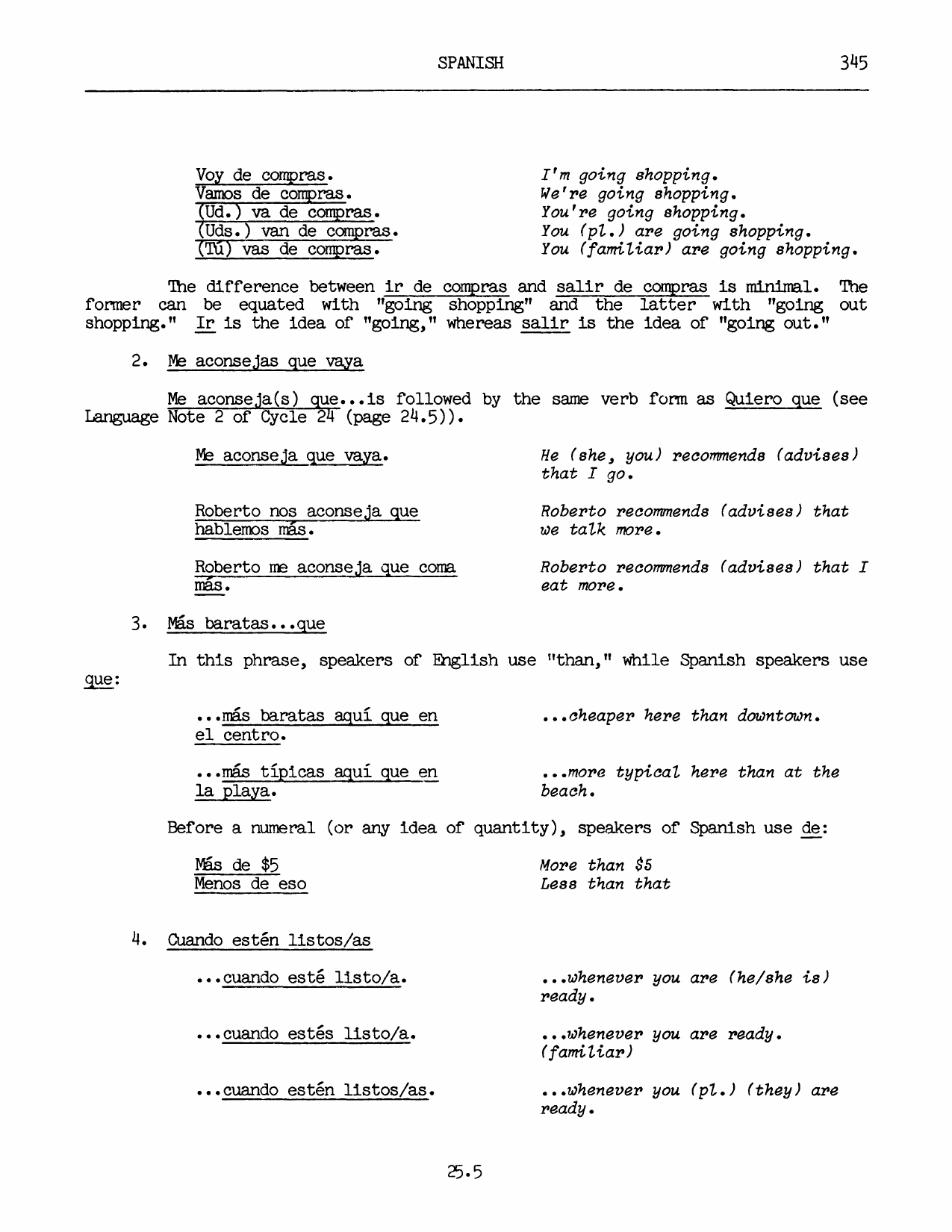
(See Language Note 3 of Cycle 24 (page 24.5) for the use of the word cuando
with the subjunctive. )
Estar listo/a is an idiomatic expression similar to the English "to be ready,"
while ser listo/a is equivalent to the English "to be smart."
5. La comida is the Spanish word for "dinner" or "meal." In Latin American
countries as well as in Spain, the main meal of the day is normally around 2:00 or 3:00 in the afternoon rather than in the evening, as 1t is in the U.S. (Ask your teacher to comment on this custom.)
Narrative No. 1:
A dónde ir de compras
Usted piensa ir a comprar unos regalos típicos. Al salir ve a María y le cuenta sus planes. María le aconseja que vaya al mercado central porque ahí hay una gran variedad de cosas típicas. También todo es más barato y se puede regatear. Usted quiere que María vaya con usted para que le dé una demostra-ción del "regateo." A María le parece una buena idea y decide acompañarla/o.
Questions:
1 - ¿Qué piensa hacer usted?
What do you plan to do?
2 - ¿A quién ve usted al salir?
Whom do you see on your way out?
3 - ¿Qué le aconseja María (que haga)?
What does Maria recommend that you do?
4 — ¿Por qué es mejor el mercado central que otras tiendas (almacenes)?
Why ts the central market better than other stores?
5 - ¿Por qué quiere ir usted con Maria?
Why do you want to go with Maria?
6 - ¿Qué le parece a Maria la idea de ir con usted?
What does Maria think of the idea of going with you?
Narrative No. 2
A dónde ir de compras
Usted se encuentra con (a) su vecina María y ella le pregunta por sus amigos de EE.UU. que están aquí de visita. Usted le dice que ellos están my contentos de estar aquí y que hoy quieren salir de compras. María le aconseja que los lleve al mercado central ya que ahí hay toda clase de artesanías que son más baratas que en el centro. Además, se puede regatear y María cree que sus amigos se van a divertir muchísimo con eso. Usted quiere que María los
después de la comida, como a las tres y media.
Questions:
1 - ¿Con (A) quién se encuentra usted?
Whom do you meet?
2 - ¿Qué le pregunta su vecina?
What does your neighbor ask you?
3 - ¿Qué le dice usted a María?
What do you tell Maria?
4 - ¿Qué le aconseja María y por qué?
What does María recommend and why?
5 - ¿Qué se puede hacer en el mercado central?
What can you do at the central market?
6 - ¿Qué cree María que va a pasar?
What does Maria think ts going to happen?
7 - ¿Qué quiere usted que María haga?
What do you want Maria do to?
8 = ¿En qué quedan usted y María?
What do you and María agree on?
IV. TAKING IT APART
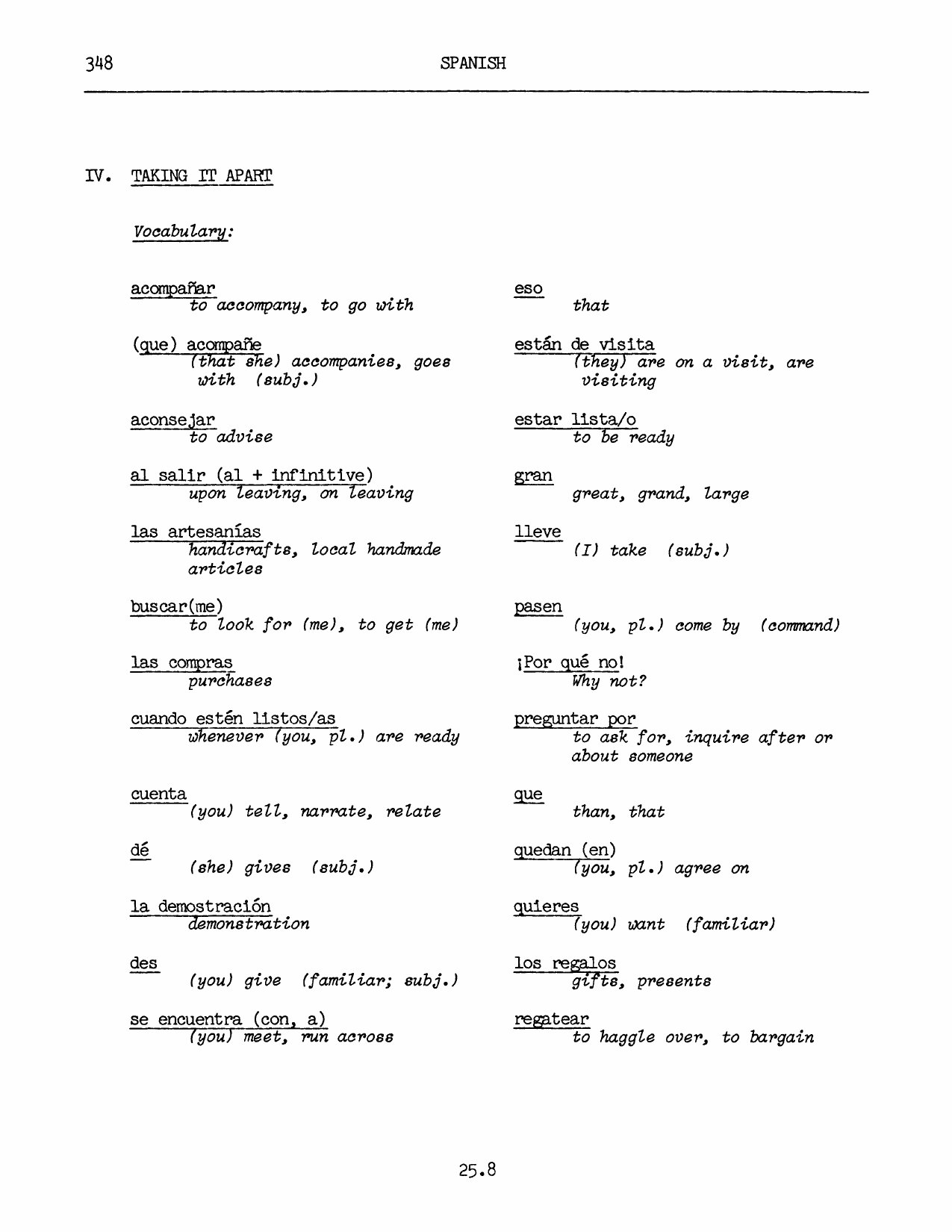
Vocabulary:
articles
about someone
V. GETTING THE FEEL OF IT
Questions and Answers:
A. 1. ¿Usted va de compras ahora?
sí eeee
(Tú, ustedes, usted y María, ellos, ella)
B. 1. ¿Dónde va a trabajar?
Voy Geese
(Ustedes, ti, 61, ellos, nosotros)
C. 1. ¿Cuántos años van a vivir en...?
Vamos A....
(Tú, él, ellos, ustedes, usted)
D. 1. ¿Van a comer ahora?
Si,....
(El, tú, tú y tu esposa/o, ellos, José)
E. 1. ¿Qué le aconseja usted a su amigo/a (que haga)?
a. Le aconsejo que vaya a las playas del norte. b. Le aconsejo que hable con el Cónsul.
C. Le aconsejo que tome el autobús (Méx. camión) en la
siguiente esquina.
d. Le aconsejo que siga (continúe) practicando el español. e. Le aconsejo que estacione su carro (coche) en el esta-
cionamiento de la esquina.
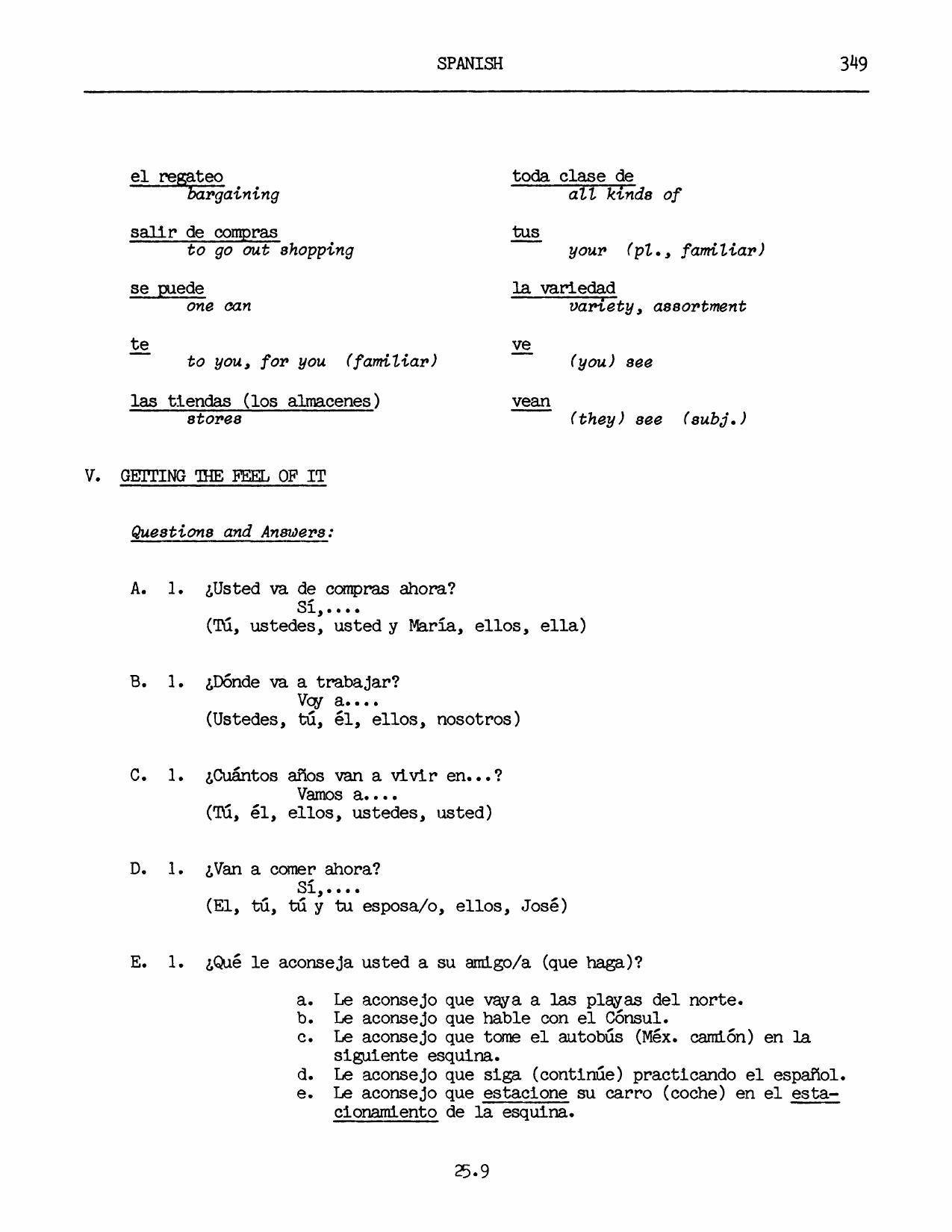
f. Le aconsejo que se baje enfrente del Hotel Internacional. g Le aconsejo que maneje (conduzca) con cuidado. h. Le aconsejo que tenga cuidado de no beber agu: agua de la
llave (del grifo, de la canilla).
F. 1. ¿Qué crée usted (crees tú) que sea mejor? ¿Que...O que...?
a. Es mejor que usted vaya (tú vayas) a las playas del
norte.
b. Es mejor que hable (hables) con el Cónsul. C. Es mejor que tome (tomes) el autobús (Méx. camión) en la
siguiente esquina.
d. Es mejor que siga (sigas) practicando el español. e. Es mejor que estacione (estaciones) su (tu) carro (coche)
en el estacionamiento de la esquina.
f. Es mejor que se baje (te bajes) enfrente del Hotel
Internacional.
g. Es mejor que maneje (manejes) con cuidado. h. Es mejor que tenga (tengas) cuidado de no beber agua de
la llave (del grifo, de la canilla).
G. 1. ¿Qué quiere usted (quieres tú) que yo haga?
a. Quiero que vaya (vayas) a las playas del norte. b. Quiero que hable (hables) con el Cónsul.
C. Quiero que tome (tomes) el autobús (Méx. camión) en la
siguiente esquina.
d. Quiero que siga (sigas) practicando el español. e. Quiero que estacione (estaciones) su (tu) carro (coche)
en el estacionamiento de la esquina.
f. Quiero que se baje (te bajes) enfrente del Hotel
Internacional.
£+ Quiero que maneje (manejes) con cuidado.
h. Quiero que tenga (tengas) cuidado de no beber agua de la
llave (del grifo, de la canilla).
H. 1. ¿Quiere (quieres) venir conmigo?
Sí, quiero ir con usted (contigo).
(Ustedes, ellos, ella, José y tú, tú)
Questions and Answers: (continued)
A. 1. Are you going shopping now? (formal)
Ye8j+....
(You (familiar), you (pl.), you and Maria, they, she)
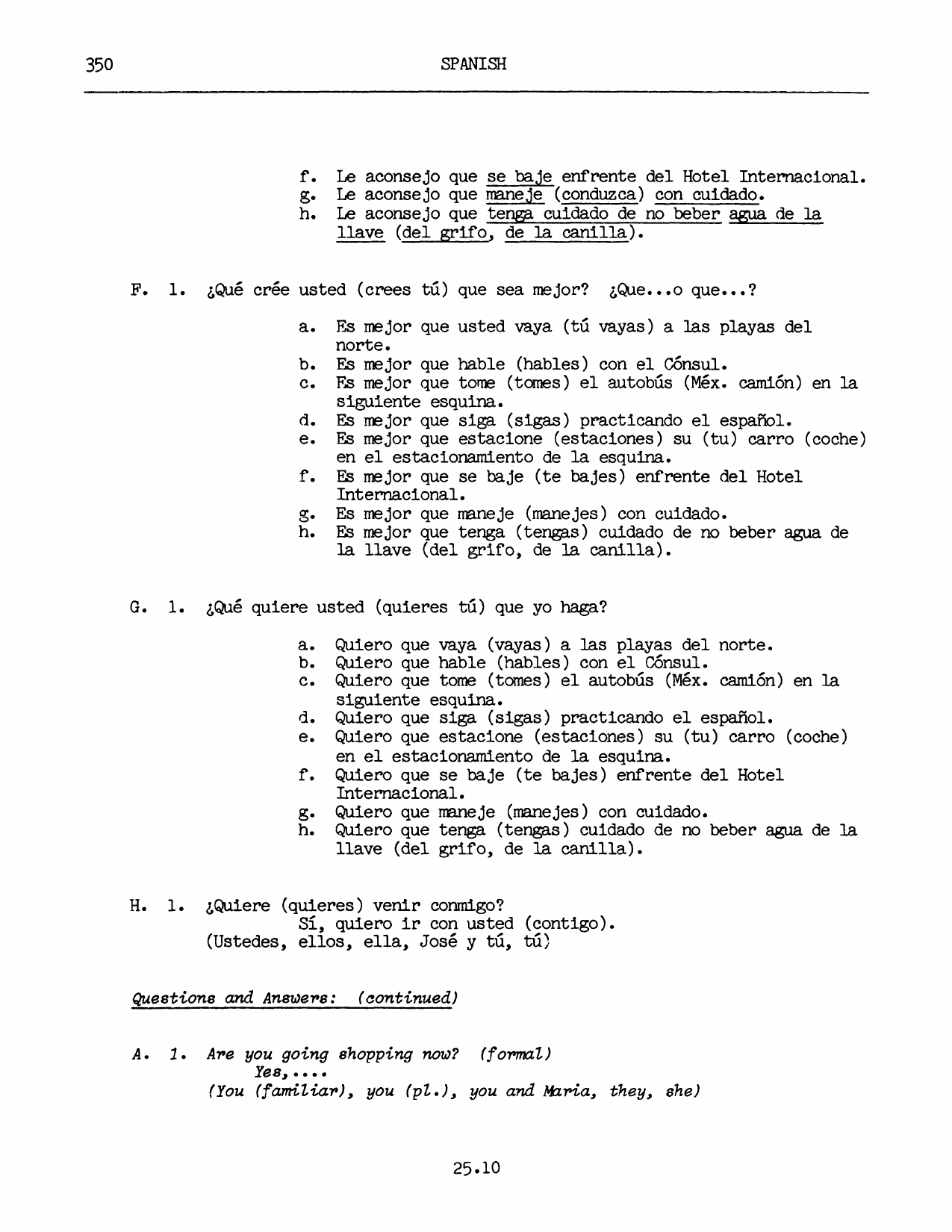
B. 1. Where are you going to work? (formal)
I'm going t0....
(You (pl.), you (familiar), he, they, we)
C. 1. How many years are you (pl.) going to live in...?
We are going td...
(You (familiar), he, they, you (pl.), you (formal))
D. 1. Are you (pl.) going to eat now?
YO8,....
(He, you (familiar), you and your wife/husband (familiar), they, Jose)
E. 1. What do you advise your friend (to do)?
a. I recommend (advise) that he/she go to the beaches to the
north .
b. I recommend (advise) that he/she talk to the Consul. ce. I recommend (advise) that he/she take the bus at the next
corner.
d. I recommend (advise) that he/she continue practicing Spanish. e. I recommend (advise) that he/she park his/her car in the
rking garage (lot) on the corner.
f. I recommend (advise) that he/she get off in front of the
International Hotel.
g» I recommend (advise) that he/she drive carefully. h. I recommend (advise) that he/she be careful not to drink tap
F. 1. What do you think would be better? That I...or that I...?
a. It would be better for you to go to the beaches to the north. b. It would be better for you to talk to the Consul. ec. It would be better for you to take the bus at the next corner. d. It would be better for you to continue practicing Spanish. e. It would be better for you to park your car in the parking
garage (lot) on the corner.
f. It would be better for you to get off in front of the
International Hotel.
g- It would be better for you to drive carefully.
h. It would be better for you to be careful not to drink tap
water.
G. 1. What do you want me to do?
a. I want you to go to the beaches to the north.
b. I want you to speak with the Consul.
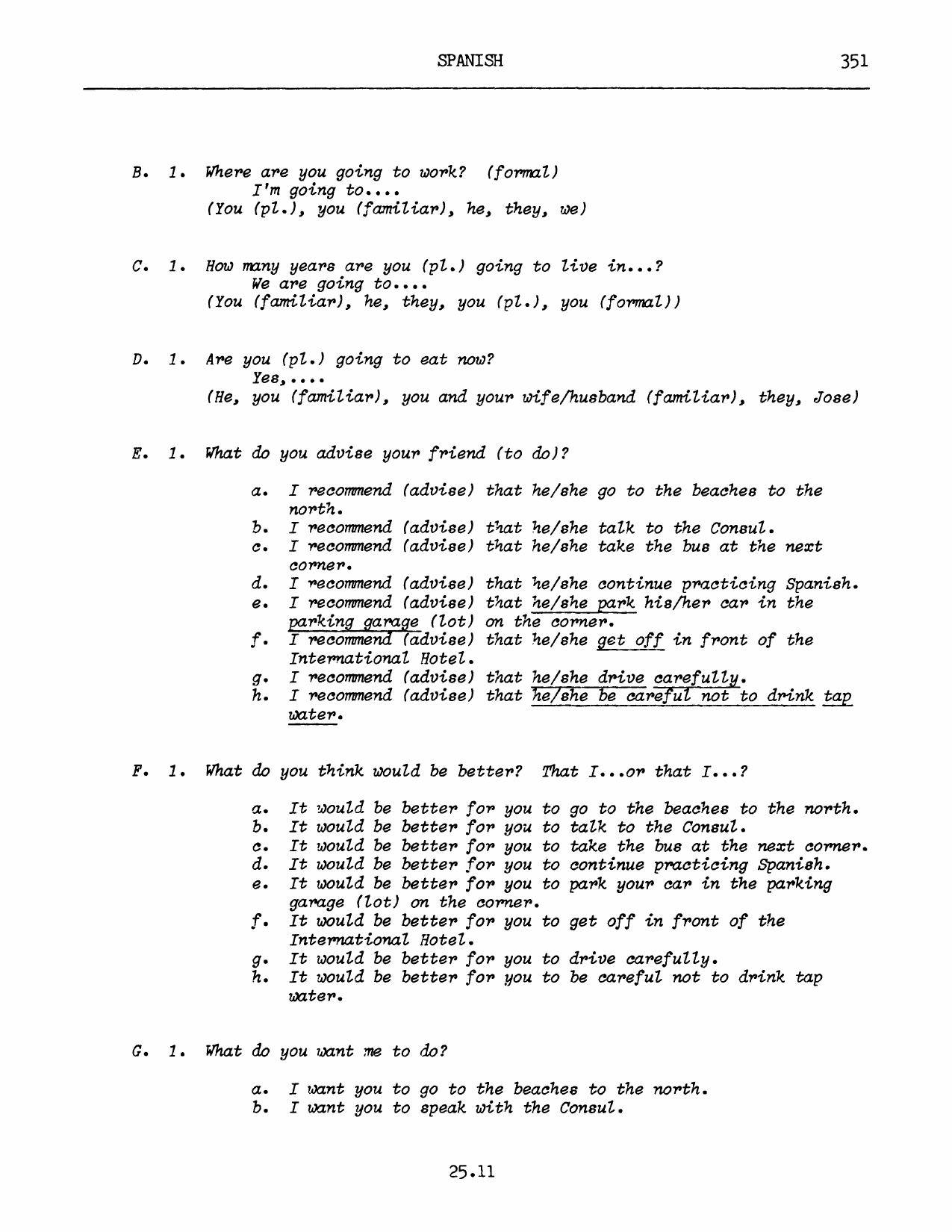
ce. I want you to take the bus at the next corner.
d. I want you to continue practicing Spanish.
e. I want you to park your car in the parking garage (lot) on the
corner.
f. I want you to get off in front of the International Hotel. g» I want you to drive carefully.
h. I want you to be careful not to drink tap water.
H. 1. Do you want to come with me?
Yes, I want to go with you.
(You (pl.), they, she, Jose and you (familiar), you (famitiar))
VI. PUTTING IT TOGETHER
Variants:
A. A = ¿Qué tal, María?
N - Muy bien, Jean, ¿Vas de compras?
A - Sí, quiero comprar algunas artesanías. ¿Adónde me aconsejas que vaya?
1 - Sí, quiero comprar algo de fruta. ¿Adónde me aconsejas que
vaya?
2 - Sí, quiero llevar a mis amigos a comprar artesanías. ¿Adónde
me aconsejas que los lleve?
3 - Si, quisiera comprar algo típico de aquí para regalarle a ml
madre (mamá). ¿Qué me aconsejas que le compre?
4 — Sí, quiero preparar una comida típica de aquí y necesito
comprar verduras frescas. ¿Adónde me aconsejas que vaya?
5 - Si, me interesa ver artículos de piel (cuero). ¿Adónde me
aconsejas que vaya?
B. N —- Bueno, en el mercado central hay una gran variedad de artesanías.
A - ¿Son más baratas en el mercado que en el centro?
1 - ¿Son más caras en el centro que en el mercado?
2 - ¿Son más baratas aquí que en los EE.UU?
3 - ¿Son más baratas allí que allá en el centro?
4 - ¿Son de mejor calidad las del mercado que las del centro? 5 - ¿Son más típicas las del mercado que las del centro?
Co A - Pero yo no sé regatear. ¿Quieres ir conmigo?
N - Sí, claro. ¡Vamos!
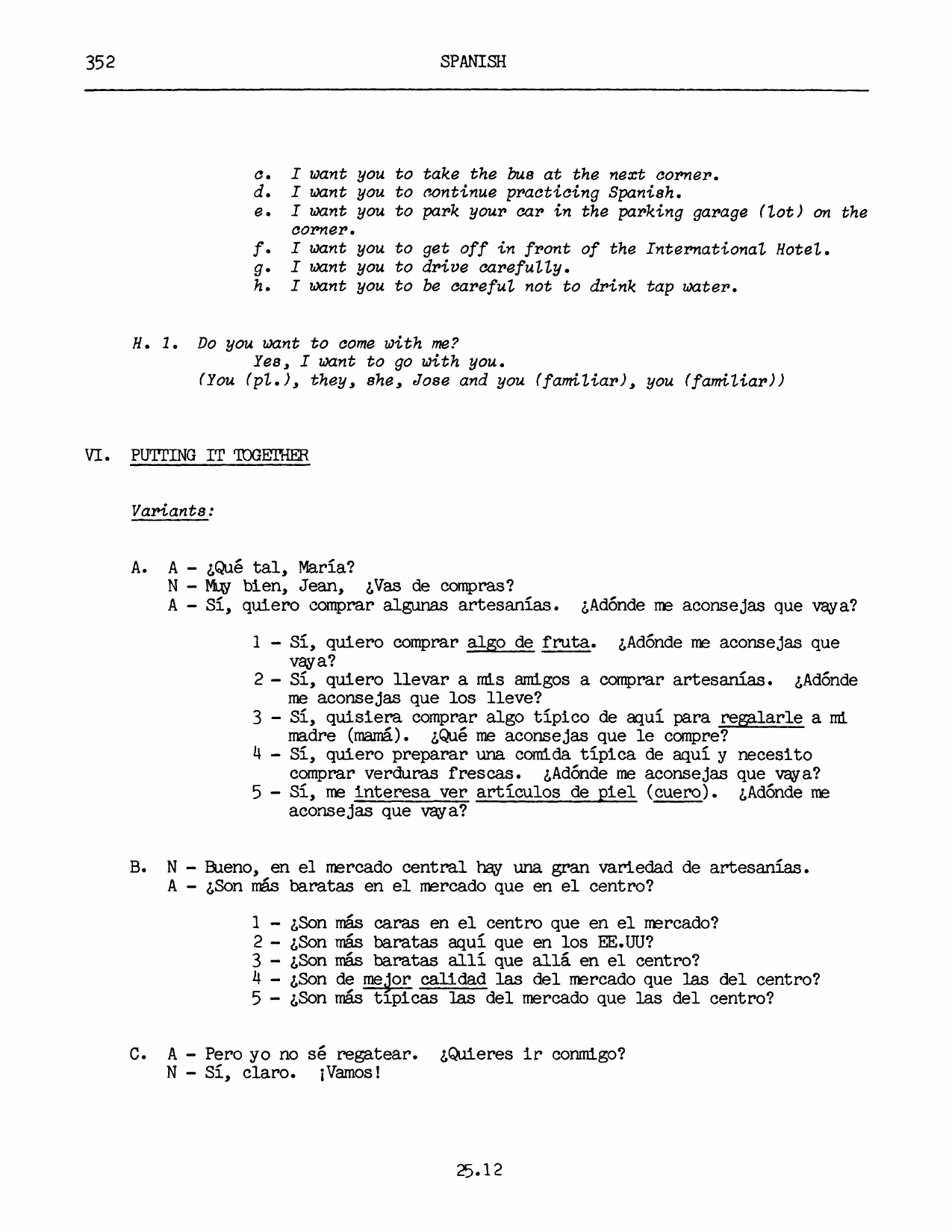
1 - No creo saber suficiente español como para regatear.
¿Quieres ir conmigo?
2 - Yo munca he regateado. ¿Quieres ir conmigo para que me
enseñes cómo (5) hacerlo?
3 - No creo poder regatear sola/o. ¿Por qué no me acompañas? 4 — No estoy acostumbrada/o a regatear. ¿Por qué no me acompañas ? 5 - Me da un poco de miedo regatear. ¿Puedes acompañarme?
Variants: (continued)
A. A ~ How are you doing, Maria?
N - Very well, Jean. Are you going shopping? (familiar)
A ~ Yes, I want to buy some local handmade articles. Where do you recom-
mend (advise) that I go? (familiar)
1 - Yes, I want to buy some fruit. Where do you recommend
(advise) that I go?
2 - Yes, I want to take my friends to buy local handmade articles.
Where do you recommend (advise) that I take them?
3 - Yes, I'd like to buy something characteristic of this country
(from here) in order to give it to my mother. What do you recommend (advise) that I buy her?
4 - Yes, I want to prepare a typical meal (from here) and I need
to buy fresh vegetables. Where do you recommend (advise) that I go?
5 - Yes, I'm interested in seeing leather goods. Where do you
recommend (advise) that I go?
B. WN - Well, at the central market they have (there ts) a wide (great) variety
of handicrafts.
A - Are they cheaper at the market than downtown?
1 - Are they more expensive downtown than at the market? 2 - Are they cheaper here than in the U.S.?
3 - Are they cheaper there than downtown?
4 - Are the ones at the market of better quality than the ones
5 - Are the ones at the market more characteristic than the ones
downtown?
C. A = But I don't know how to bargain. Do you want to go with me?
(familiar)
N - Yes, of course. Let's go!
1 - I don't think I know enough Spanish to bargain. Do you want
to go with me? (familiar)
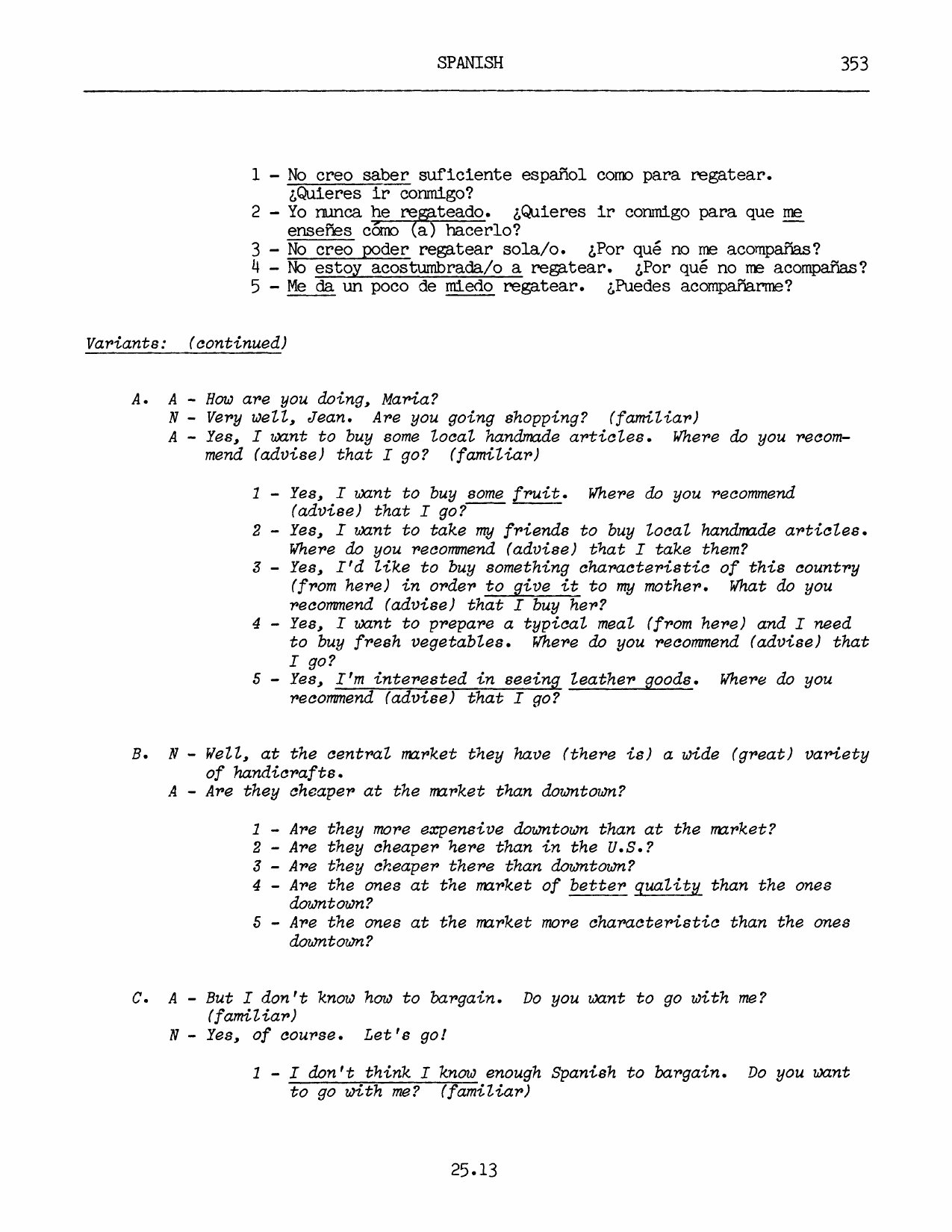
2 - I have never bargained. Do you want to come with me in order
to show me how to do it?
3 - I don't think I can bargain alone. Why don't you come with
me?
4 - I am not accustomed to bargaining. Why don't you come with
me?
5 - I ama little afraid of bargaining. Can you come with me?
VII. MAKING IT WORK
VIII. USING IT