CYCLE 26
GETTING OUT
Dining Out
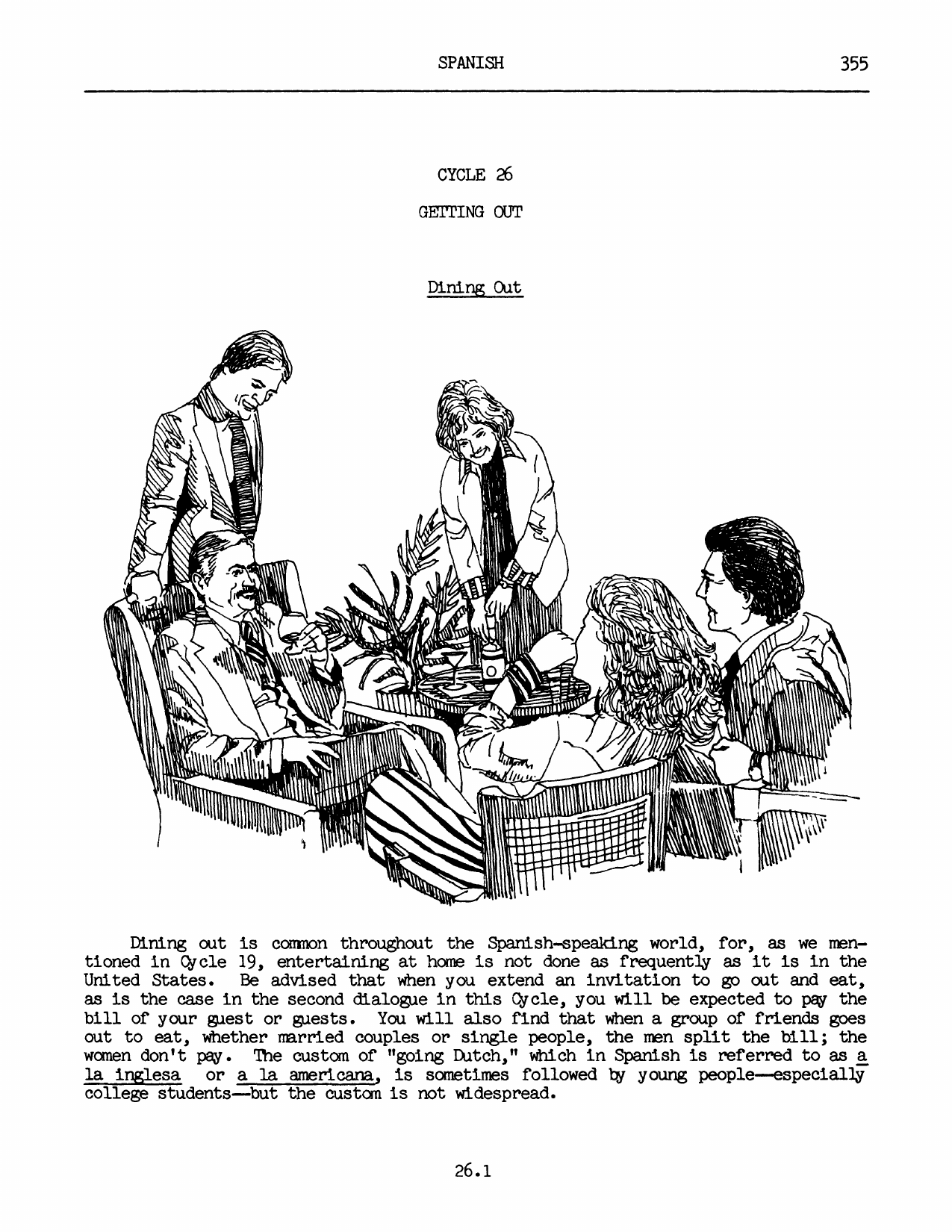
Dining out is common throughout the Spanish-speaking world, for, as we men-
tioned in Cycle 19, entertaining at home is not done as frequently as it is in the United States. Be advised that when you extend an invitation to go out and eat, as is the case in the second dialogue in this OQycle, you will be expected to pay the bill of your guest or guests. You will also find that when a group of friends goes out to eat, whether married couples or single people, the men split the bill; the women don! t pay. The custom of "going Dutch," which in Spanish is referred to as a la inglesa or a la americana, is sometimes followed by young people—especially college students—but the custom is not widespread.
This page has a drawing, chart, or fill-in layout — original page
I. SETTING THE SCENE (A)
You would like to go to a restaurant that serves a variety of native dishes. You ask a friend to recommend a good restaurant.
II. HEARING IT (A)
III. SEEING IT (A)
Dialogue No. 1: (Short Verston)
A dónde ir a comer
A - Manuel, ¿puedes recomendarme un buen restaurante (restorán)? N - ¿Qué clase de comida quieres?
A —- Quiero probar la comida típica (criolla).
N - Bueno, en "El Rancho" hay una gran variedad de platos (platillos) del país. A —- ¿Cuál es la especialidad de la casa?
N - Los mariscos y el puerco (la carne de cerdo) son su especialidad. A = ¿Sirven postres típicos?
N - Sí, muchos. Hay una lista completa en el menú.
A - Gracias, Manuel.
Dialogue No. 1: (Short Version - continued)
Where to go out to eat
A - Manuel, can you recommend a good restaurant? (familiar) WN - What xind of food would you like? (familiar)
A - I would like to try typical (native) food.
(1) N - Well, "El Rancho" has a wide variety of native dishes.
(1) A - What ts the specialty of the house?
(4) N - Their specialties are seafood and pork.
A - Do they serve typical desserts?
N - Yes, many. There's a complete list on the menu.
A - Thank you, Manuel.
I. SETTING THE SCENE (B)
You would like to go out to eat this evening with a group of friends from the States, and you invite your friend Manuel and his wife Maria to join you. You ask Manuel to recommend a good restaurant that serves a wide variety of regional dishes, and Manuel knows just the place where you can all go to have a great time.
II. HEARING IT (B)
III. SEEING IT (B)
Dialogue No. 2: (Long Version)
A dónde ir a comer
A —- Manuel, queremos que tú y Maria nos acompañen a un restaurante (restorán)
esta noche para que conozcan a rmiestros amigos norteamericanos.»
N - Con mucho gusto. ¿Adónde piensan ir?
A - No sabemos. Quiero que nos recomiendes un lugar donde sirvan buenos pla-
tos (platillos) típicos.
N - Bueno, en "El Rancho" hay una gran variedad de platos (platillos) regiona-
les. También hay un show (espectáculo) folklórico y pista de baile.
A - ¡Debe ser muy elegante!
N - No demasiado elegante, pero el servicio es de primera y los precios son
bastante razonables (módicos).
A - Entonces, (ustedes) quedan invitados.
N - Gracias, Mike. María va a ponerse muy contenta. ¿A qué hora nos reunimos
(nos juntamos )?
A - Pasaremos a recogerlos a las seis y media.
N - ¡Magnífico (fantástico, regio)! Estaremos listos.
A — ¡Chao!
Dialogue No. 2: (Long Version - continued)
Where to go out to eat
A - Manuel, we would like for you and Maria to go to a restaurant with us
tonight so that you can meet some of our American friends.
N - With pleasure. Where do you plan to go?
A - We don't know. I would like you to recommend a place where they
serve good native dishes.
N - Well, "El Rancho" has a wide variety of regional dishes. They also
have a folklorie show and a dance floor.
A - It must be very elegant!
(2) WN - Not terribly elegant, but the service is first class and the prices
are quite reasonable.
(3) A - Then consider yourselves invited.
N - Thanks, Mike. Maria ts going to be very happy. At what time shall we
meet?
A - We'll pick you up at 6:30.
N - Great! We'll be ready.
(5) 4 - Bye!
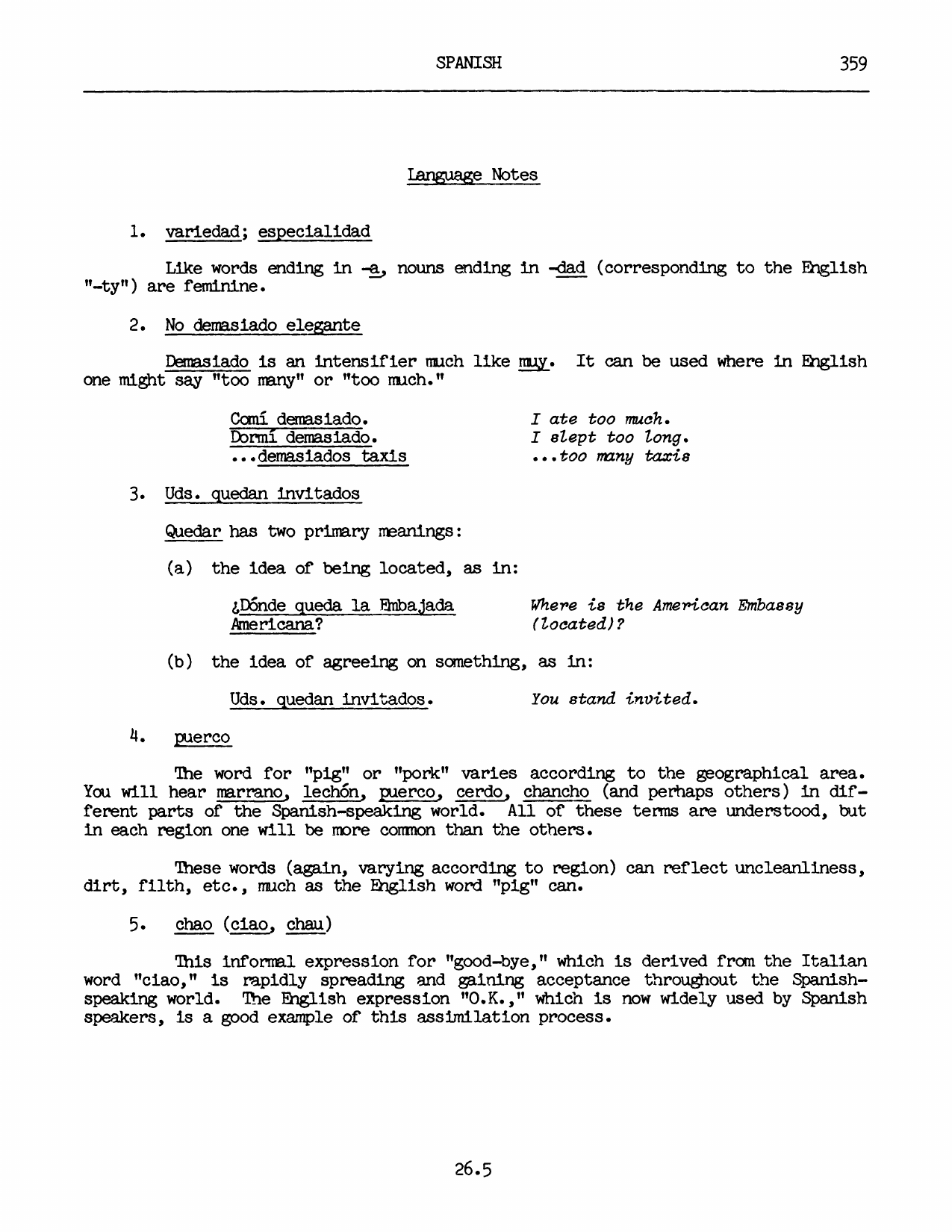
Language Notes
l. variedad; especialidad
Like words ending in -a, nouns ending in -dad (corresponding to the English
"-ty") are feminine.
2. No demasiado elegante
Demasiado is an intensifier much like muy. It can be used where in English
one might say "too many" or "too much."
3. Uds. quedan invitados
Quedar has two primary meanings:
(a) the idea of being located, as in:
(b) the idea of agreeing on something, as in:
4. puerco
The word for "pig" or "pork" varies according to the geographical area.
You will hear marrano, lechón, puerco, cerdo, chancho (and perhaps others) in dif-ferent parts of the Spanish-speaking world. All of these terms are understood, but in each region one will be more common than the others.
These words (again, varying according to region) can reflect uncleanliness,
dirt, filth, etc., mich as the English word "pig" can.
5. chao (ciao, chau)
This informal expression for "good-bye," which is derived from the Italian
word "ciao," is rapidly spreading and gaining acceptance throughout the Spanish-speaking world. The English expression "O.K.," which is now widely used by Spanish speakers, is a good example of this assimilation process.
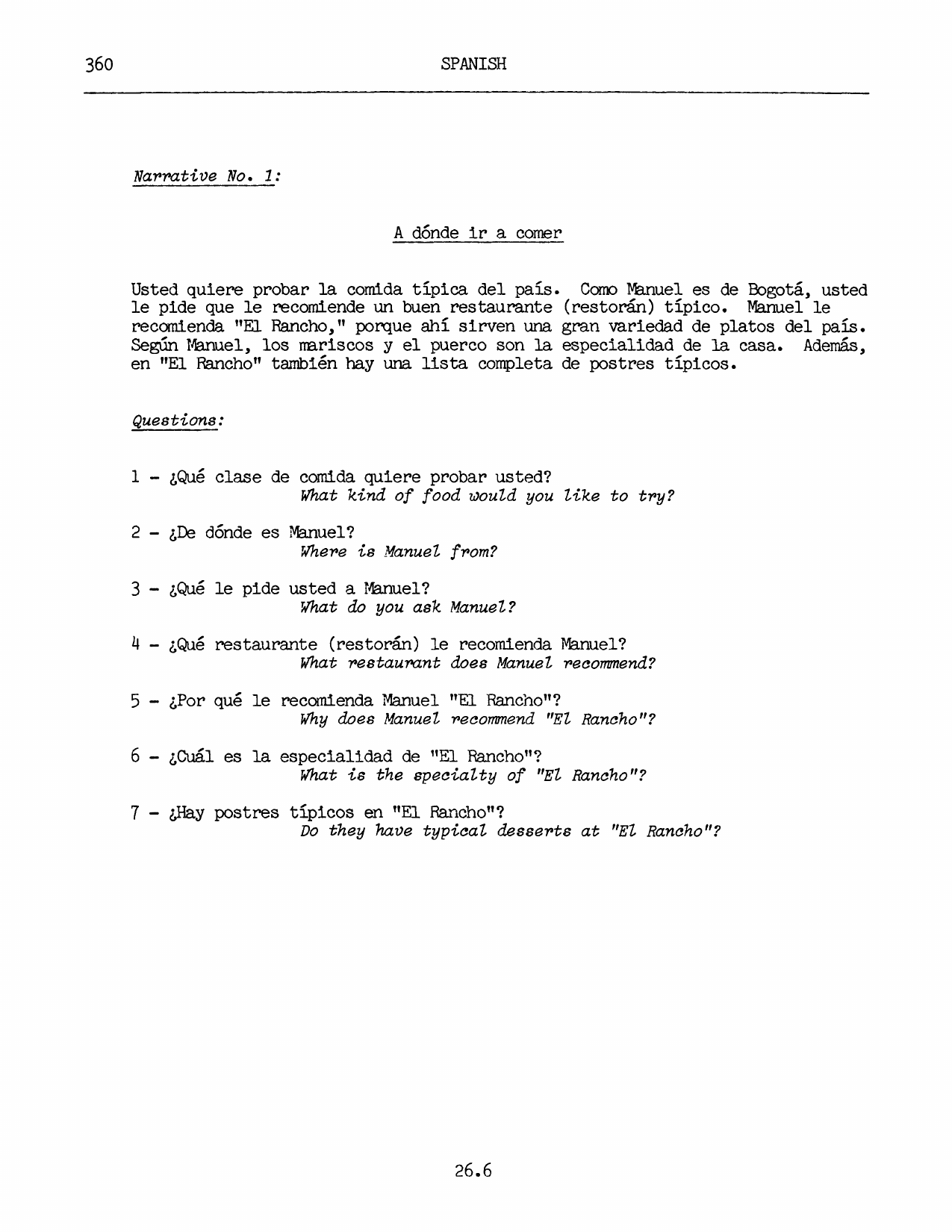
Narrative No. 1:
A dónde ir a comer
Usted quiere probar la comida típica del país. Como Manuel es de Bogotá, usted le pide que le recomiende un buen restaurante (restorán) típico. Manuel le recomienda "El Rancho," porque ahí sirven una gran variedad de platos del país. Según Manuel, los mariscos y el puerco son la especialidad de la casa. Además, en "El Rancho" también hay una lista completa de postres típicos.
Questions:
1 - ¿Qué clase de comida quiere probar usted?
What kind of food would you like to try?
2 — ¿De dónde es Manuel?
Where ts Manuel from?
3 = ¿Qué le pide usted a Manuel?
What do you ask Manuel?
4 - ¿Qué restaurante (restorán) le recomienda Manuel?
What restaurant does Manuel recommend?
5 = ¿Por qué le recomienda Manuel "El Rancho"?
Why does Manuel recommend "El Rancho"?
6 - ¿Cuál es la especialidad de "El Rancho"?
What te the specialty of "El Rancho"?
7 - ¿Hay postres típicos en "El Rancho"?
Do they have typical desserts at "El Rancho"?
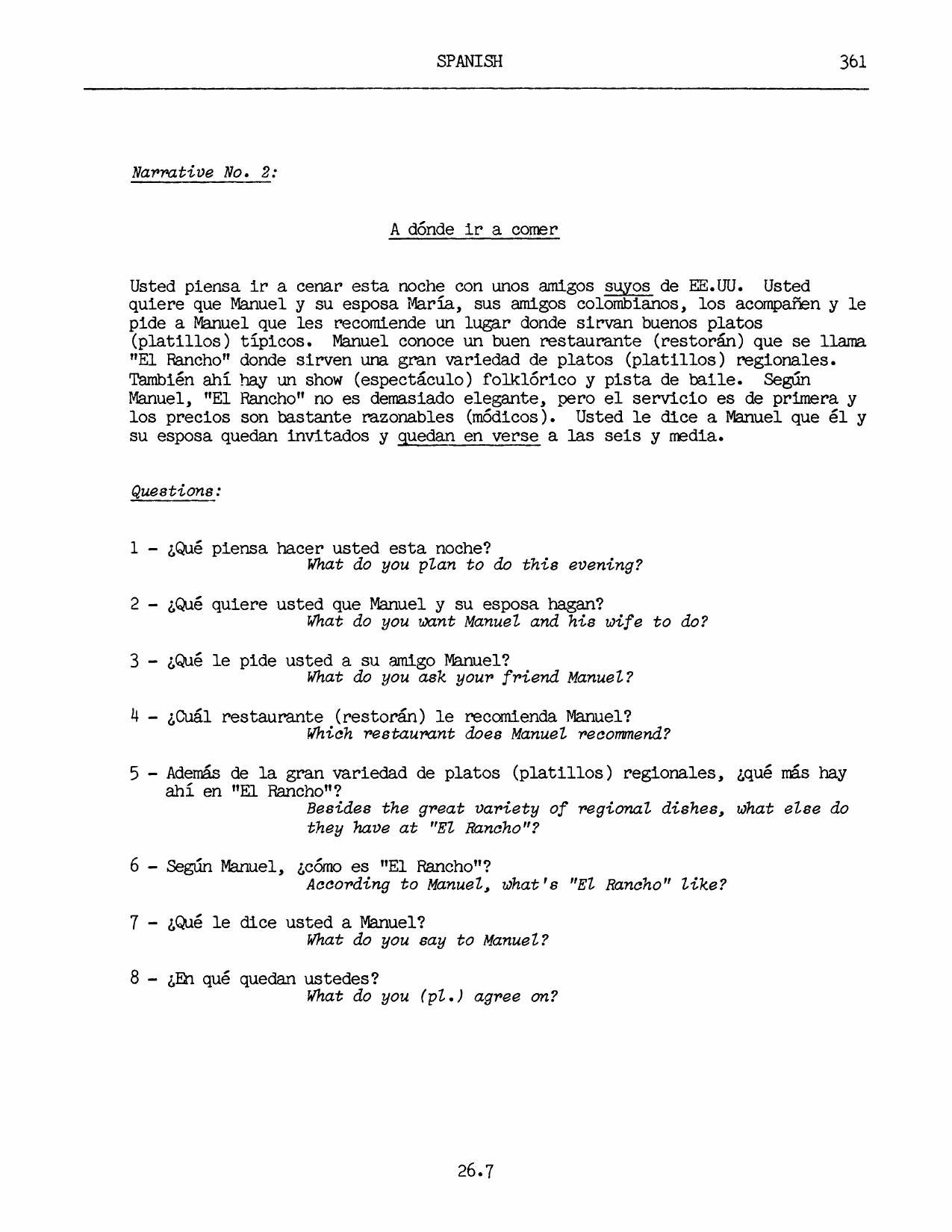
Narrative No. 2:
A dónde ir a comer
Usted piensa ir a cenar esta noche con unos amigos suyos de EE.UU. Usted quiere que Manuel y su esposa María, sus amigos colombianos, los acompañen y le pide a Manuel que les recomiende un lugar donde sirvan buenos platos (platillos) típicos. Manuel conoce un buen restaurante (restorán) que se llama "El Rancho" donde sirven una gran variedad de platos (platillos) regionales. También ahí hay un show (espectáculo) folklórico y pista de baile. Según Manuel, "El Rancho" no es demasiado elegante, pero el servicio es de primera y los precios son bastante razonables (módicos). Usted le dice a Manuel que él y su esposa quedan invitados y quedan en verse a las seis y media.
Questions:
1 - ¿Qué piensa hacer usted esta noche?
What do you plan to do this evening?
2 = ¿Qué quiere usted que Manuel y su esposa hagan?
What do you want Manuel and his wife to do?
3 - ¿Qué le pide usted a su amigo Manuel?
What do you ask your friend Manuel?
4 — ¿Cuál restaurante (restorán) le recomienda Manuel?
Which restaurant does Manuel recommend?
5 - Además de la gran variedad de platos (platillos) regionales, ¿qué más hay
ahí en "El Rancho"?
Besides the great variety of regional dishes, what else do they have at "El Rancho"?
6 - Según Manuel, ¿cómo es "El Rancho"?
According to Manuel, what's "El Rancho" like?
7 - ¿Qué le dice usted a Manuel?
What do you say to Manuel?
8 — ¿En qué quedan ustedes?
What do you (pl.) agree on?
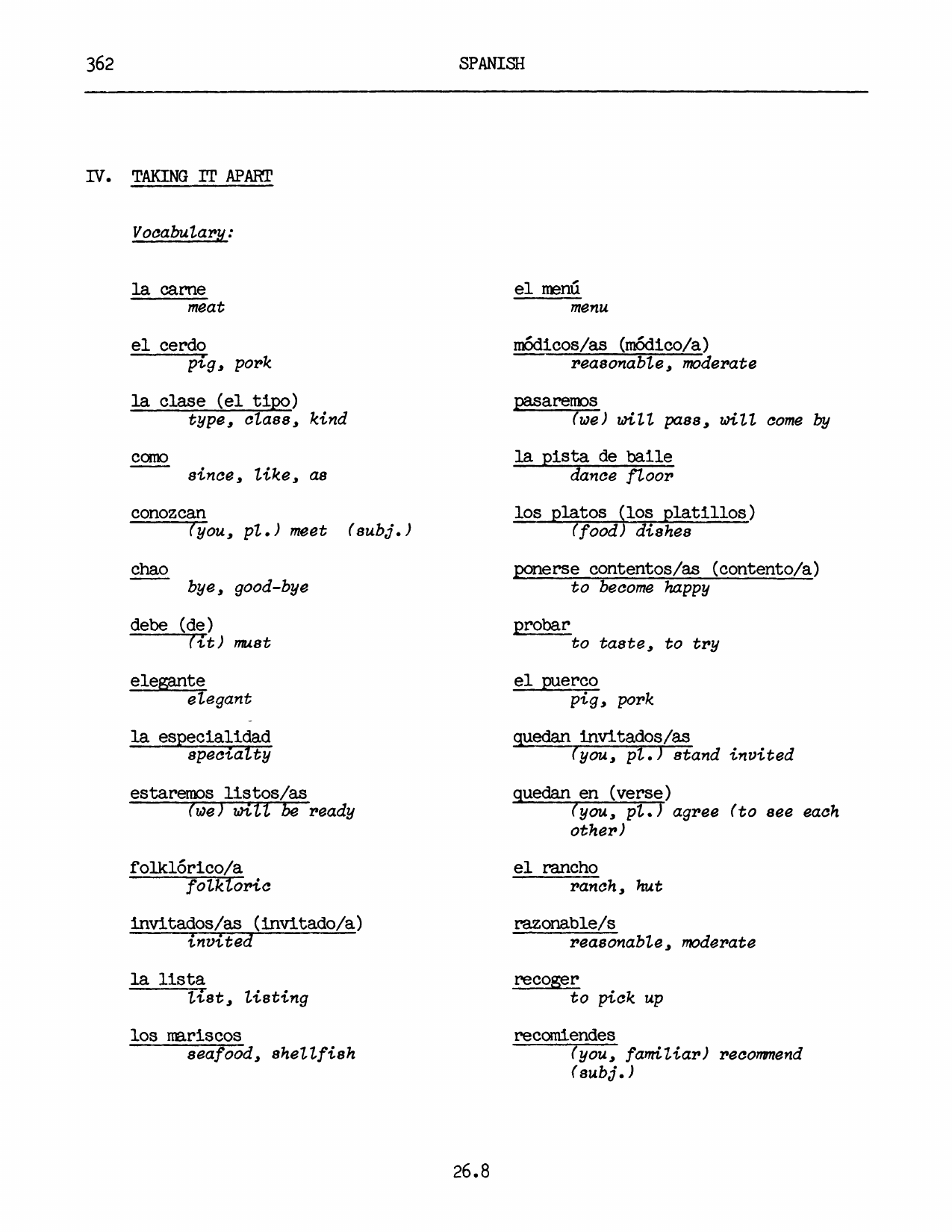
IV. TAKING IT APART
Vocabulary:
other)
(subj.)
V. GETTING THE FEEL OF IT
Questions and Answers:
A. 1. ¿Por qué quiere ir conmigo?
a. Quiero ir con usted porque quiero comprar algo típico. b. Quiero ir con usted porque quiero que usted compre algo
típico.
2. ¿Por qué quieres 1r conmigo?
a. Quiero ir contigo porque quiero hablar con María Elena. b. Quiero ir contigo porque quiero que tú hables con María
Elena.
3. ¿Por qué quiere ir con él?
a. Quiero ir con él porque quiero visitar a José. b. Quiero ir con él porque quiero que él visite a José.
4, ¿Por qué quieres ir con nosotros?
a. Quiero ir con ustedes porque quiero parar en la Embajada. b. Quiero ir con ustedes porque quiero que ustedes paren en la
Embajada.
5. ¿Por qué quiere ir con nosotros?
a. Quiero ir con ustedes porque quiero comer en el centro. b. Quiero ir con ustedes porque quiero que comamos en el
centro.
B. 1. ¿Usted habló con Manuel?
Sí, hablé con él.
No, no hablé con él.
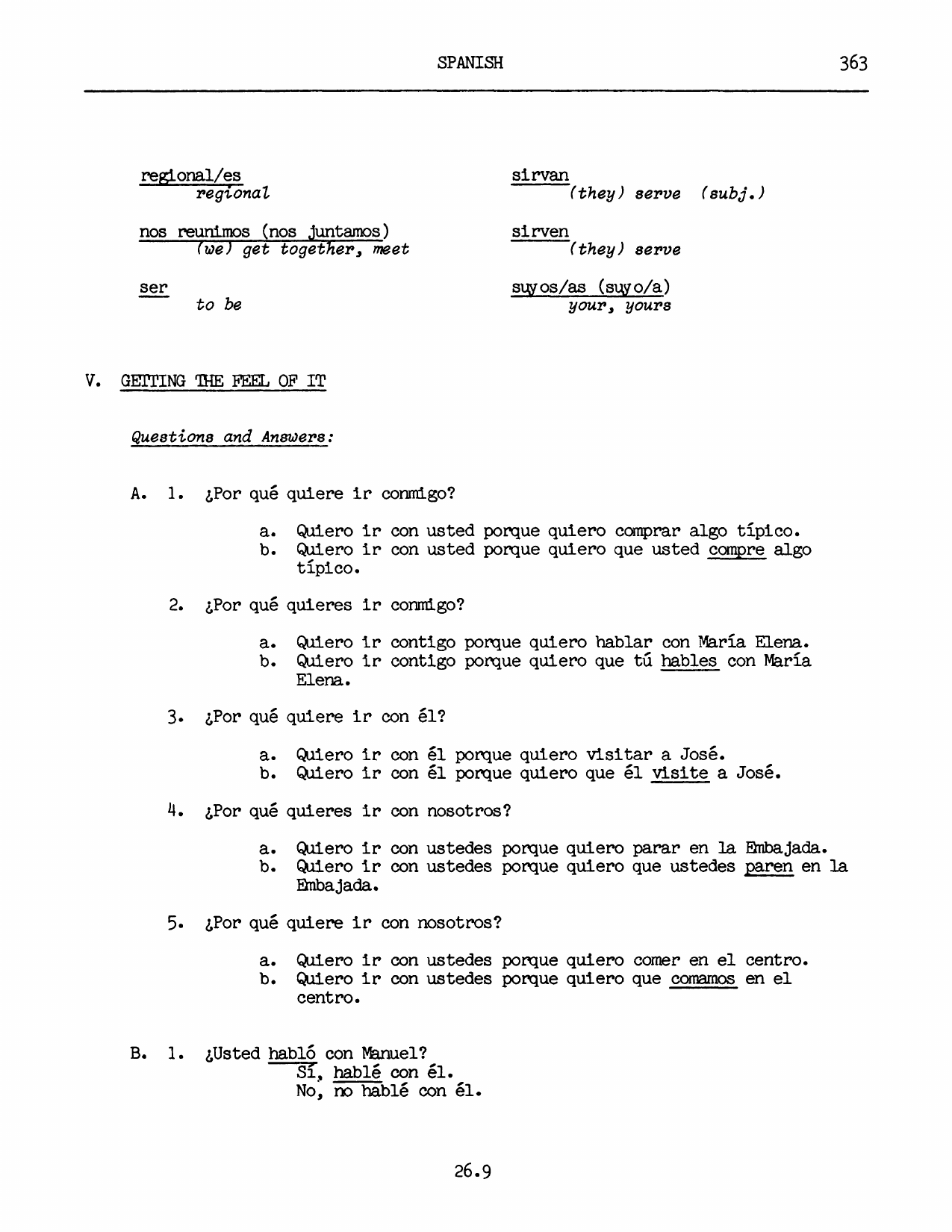
2. ¿Ustedes hablaron con Maria?
Sí, hablamos con ella.
No, no hablamos con ella.
3. ¿Tú hablaste con Manuel y Maria?
1, hablé con ellos.
No, no hablé con ellos.
4, ¿La secretaria habló contigo?
Si, habló conmigo.
No, no habló conmigo.
5. ¿Ellas hablaron con usted?
Sí, hablaron conmigo.
No, no hablaron conmigo.
C. 1. ¿Usted esperó mucho tiempo?
Si, esperé mucho tiempo.
No, no esperé mucho tiempo.
(Ustedes, ellos, tú, María luisa, él)
D. 1. ¿Terminaron la tarea de ayer?
Sí, la terminamos.
No, no la terminamos.
(Tú, ellas, “Manuel y usted, él, usted)
Questions and Answers: (continued)
A. 1. Why do you want to go with me? (formal)
a. I want to go with you because I want to buy something
typical.
b. I want to go with you because I want you to buy something
typical.
2. Why do you want to go with me? (familiar)
a. I want to go with you because I want to talk to Maria Elena.
(familiar)
b. I want to go with you because I want you to talk to Maria
Elena. (familiar)
3. Why do you want to go with him? (formal)
a. I want to go with him because I want to visit Jose. b. I want to go with him because I want him to visit Jose.
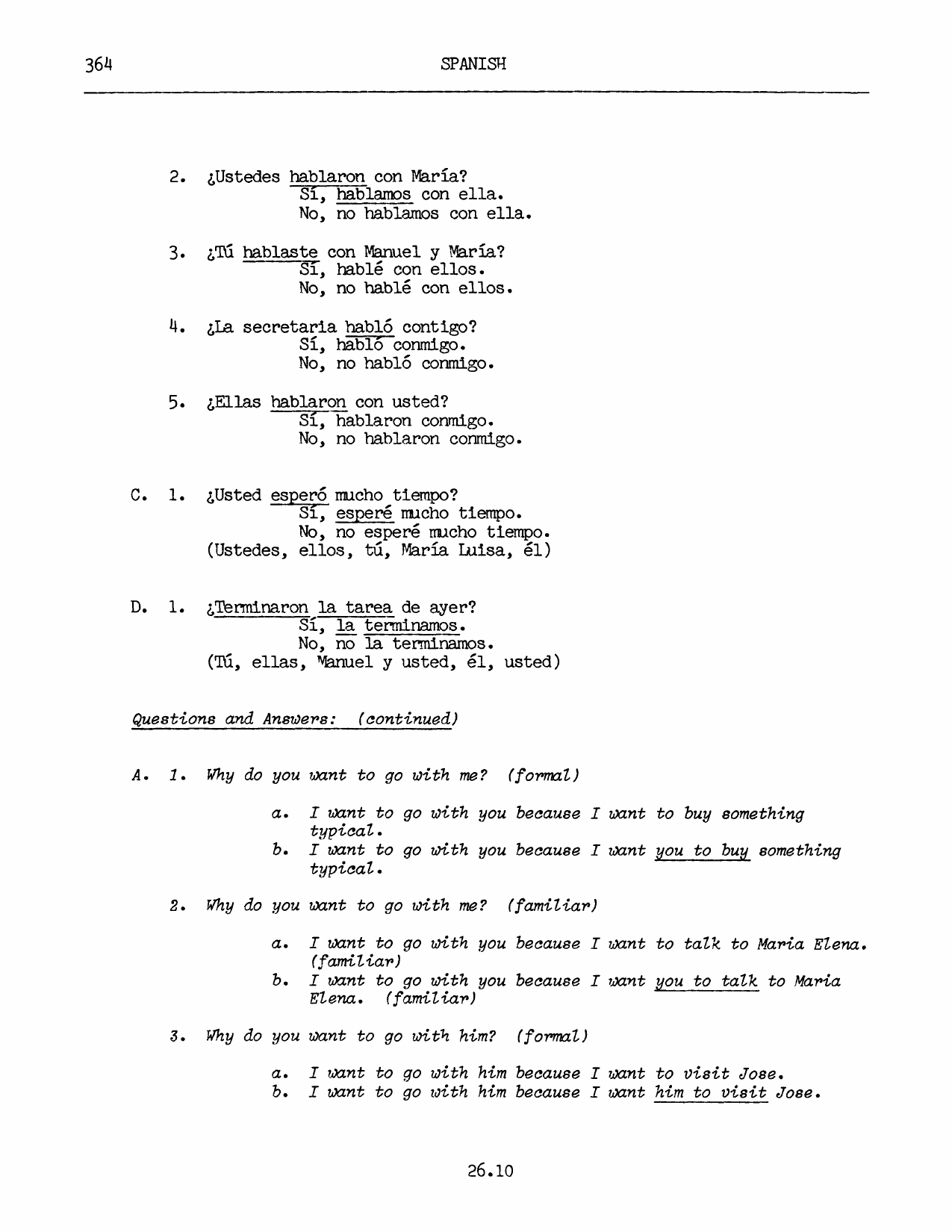
4. Why do you want to go with us? (familiar)
a. I want to go with you (pl.) because I want to stop at the
Embassy.
b. I want to go with you (pl.) because I want you (pl.) to stop
at the Embassy.
Se Why do you want to go with us? (formal)
a. I want to go with you (pl.) because I want to eat downtown. b. I want to go with you (pl.) because I would like for us to
eat downtown.
Ton Paes oo orth him.
Did you (pl.) speak with Maria?
To. ES PGA hen.
3. Did you speak with Manuel and Maria? (familiar)
Yes, I spoke with them.
No, I didn't speak with them.
4, Did the secretary speak with you? (familiar)
Yes, she spoke with me.
No, she didn't speak with me.
Did they (f.) speak with you? (formal)
Yes, they spoke with me.
No, they didn't speak with me.
Co l. Did you wait a long time?
Yes, I waited a long time.
No, I didn't wait a tong time.
(You (pl.), they, you (familiar), Maria Luisa, he)
D. 1. Did you (pl.) finish yesterday's homework?
Yes, we finished it.
No, we didn't finish it.
(You (familiar), they (f.), Manuel and you, he, you)
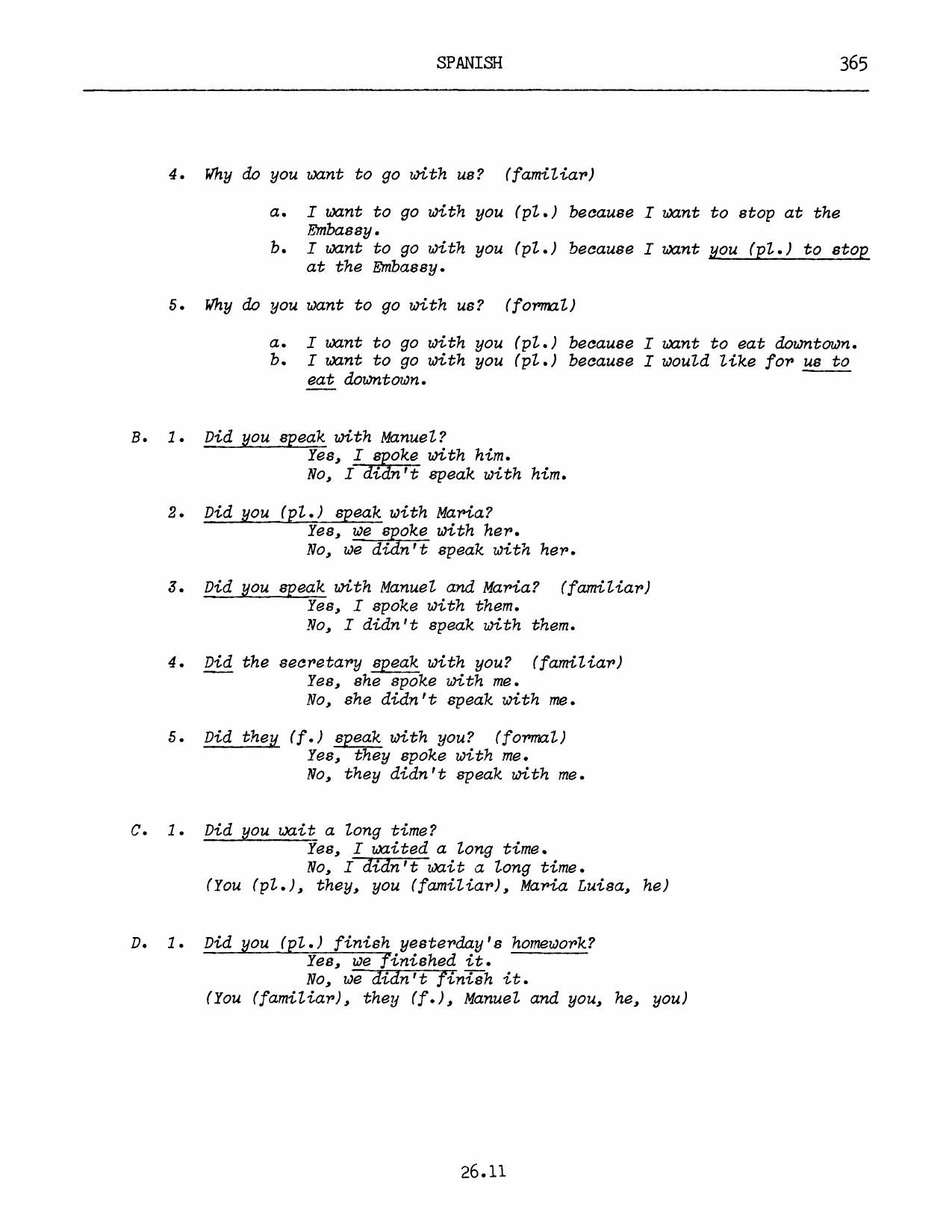
VI. PUTTING IT TOGETHER
Variants:
A. A — Mamel, ¿puedes recomendarme un buen restaurante (restorán)?
N - ¿Qué clase de comida quieres?
l. A — Manuel, ¿puedes recomendarme un buen hotel?
N = ¿Qué clase de servicio quieres?
2. A - Mamel, ¿puedes recomendarme un buen mecánico?
N - ¿Qué clase de carro (coche) tienes?
3. A -— Manuel, ¿puedes recomendarme un buen libro?
N - ¿Qué clase de libros te gusta leer?
4. A - Maruel, ¿puedes recomendarme una buena universidad?
N = ¿Qué quieres estudiar?
5. A - Maruel, ¿puedes recomendarme un buen abogado?
N - ¿Para qué clase de caso?
B. N- ¿Qué clase de comida quieres?
A - Quiero probar la comida típica.
1 - Quíero probar la comida italiana.
2 - Quiero probar la comida española.
3 = Quiero probar la comida mexicana picante.
4 — Quiero probar la comida china.
5 - Quiero probar los mariscos.
C. A = ¿Cuál es la especialidad de la casa?
N - Los mariscos y el puerco (la carne de cerdo) son su especialidad.
1 - El arroz con pollo es su especialidad.
2 - La carne asada es su especialidad.
3 - Los vinos chilenos son su especialidad.
4 — El pescado es su especialidad.
5 - Los platos (platillos) típicos son su especialidad.
D. A = ¿Sirven postres típicos?
N - Sí, muchos. Hay una lista completa en el menú.
1 - ¿Sirven carnes asadas?
2 - ¿Sirven vinos del país?
3 - ¿Sirven quesos frescos?
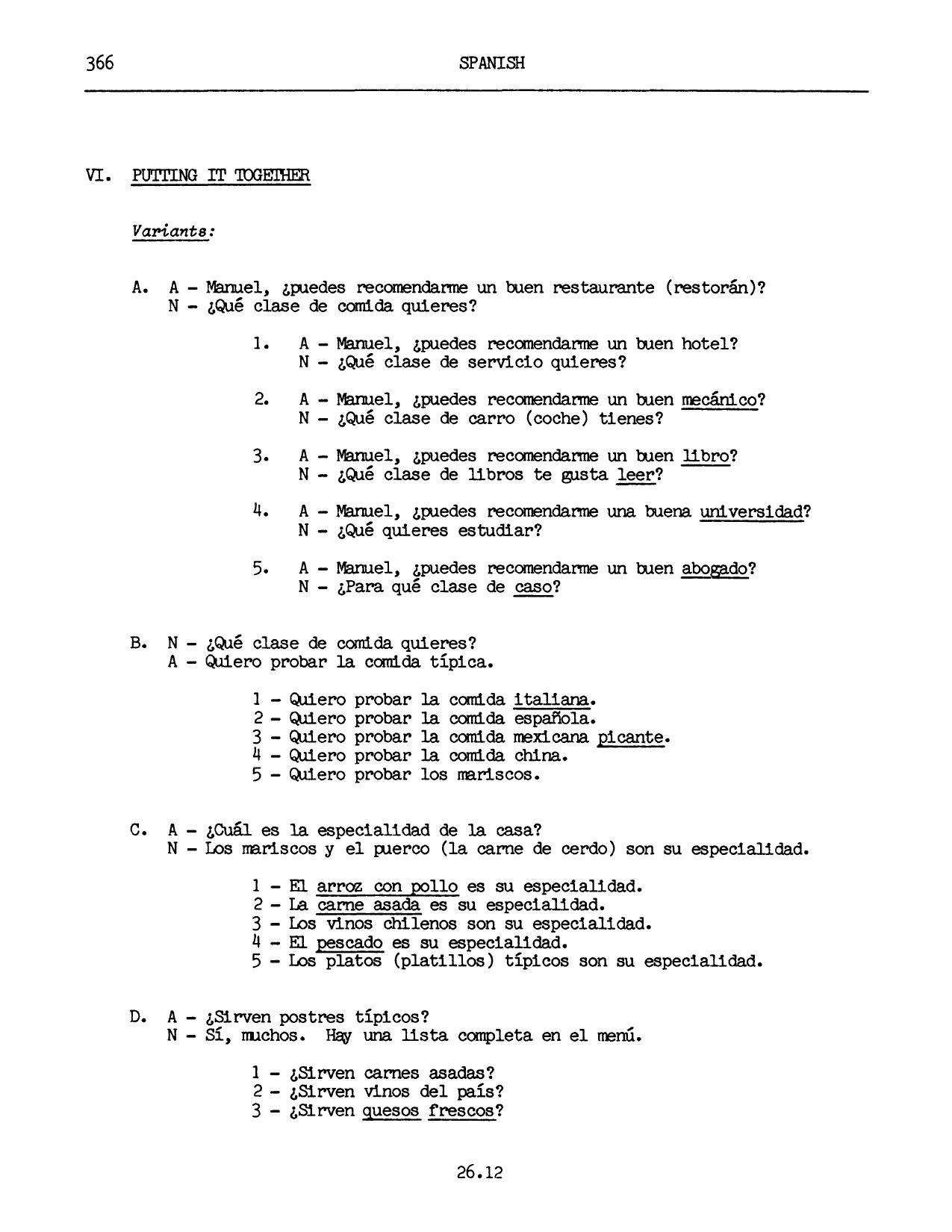
4 — ¿Sirven vinos importados?
5 - ¿Sirven cerveza del país?
Variants: (continued)
A. A - Manuel, can you recommend a good restaurant? (familiar)
WN - What kind of food would you like? (familiar)
1. A - Manuel, can you recommend a good hotel? (familiar)
N - What kind of service do you want? (familiar)
2. A - Manuel, can you recommend a good mechanic? (familiar)
N - What kind of car do you have? (familiar)
3. A - Manuel, can you recommend a good book? (familiar)
WN - What kind of books do you like to read? (familiar)
4. A - Manuel, can you recommend a good university? (familiar)
N - What do you want to study? (familiar)
5. A - Manuel, can you recommend a good lawyer? (familiar)
N - For what kind of case?
B. W - What kind of food would you like? (familiar)
A - I would like to try typical (native) food.
1 - I'd like to try Italtan food.
2 - I'd like to try Spanteh food.
3 - I'd like to try spicy Mexican food.
4 - I'd like to try Chinese food.
5 - I'd like to try seafood.
C. A - What te the specialty of the house?
N - Their specialties are seafood and pork.
1 - Chicken and rice is their specialty.
2 - Brotled meat te their specialty.
3 - Chilean wines are their specialty.
4 - Fish is their specialty.
5 - Native dishes are their specialty.
D. A - Do they serve typical desserts?
N - Yes, many. There's a complete list on the menu.
1 - Do they serve broiled meats?
2 - Do they serve domestic wines?
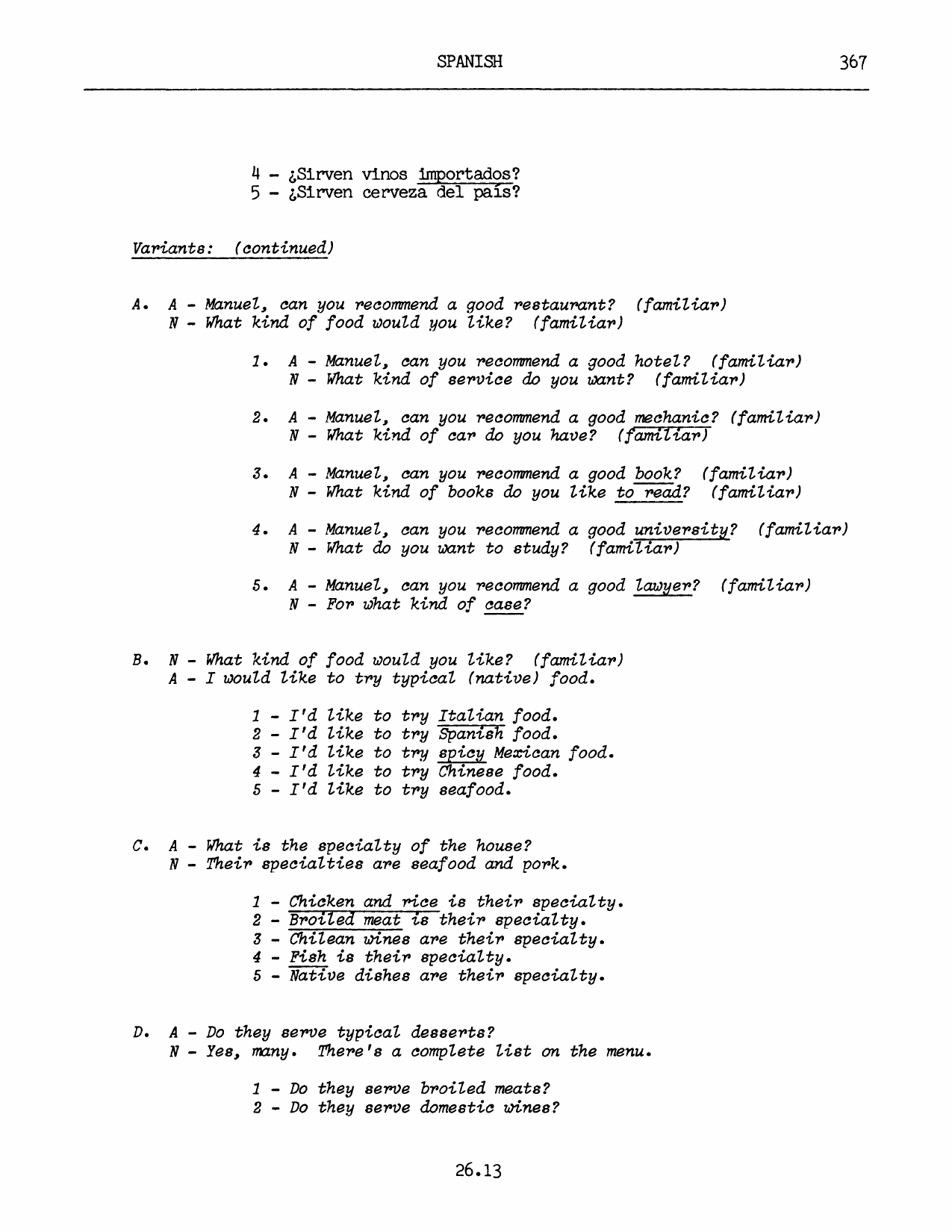
3 - Do they serve fresh cheeses?
4 - Do they serve imported wines?
5 - Do they serve domestic beer?
VIT. MAKING IT WORK
VIII. USING IT