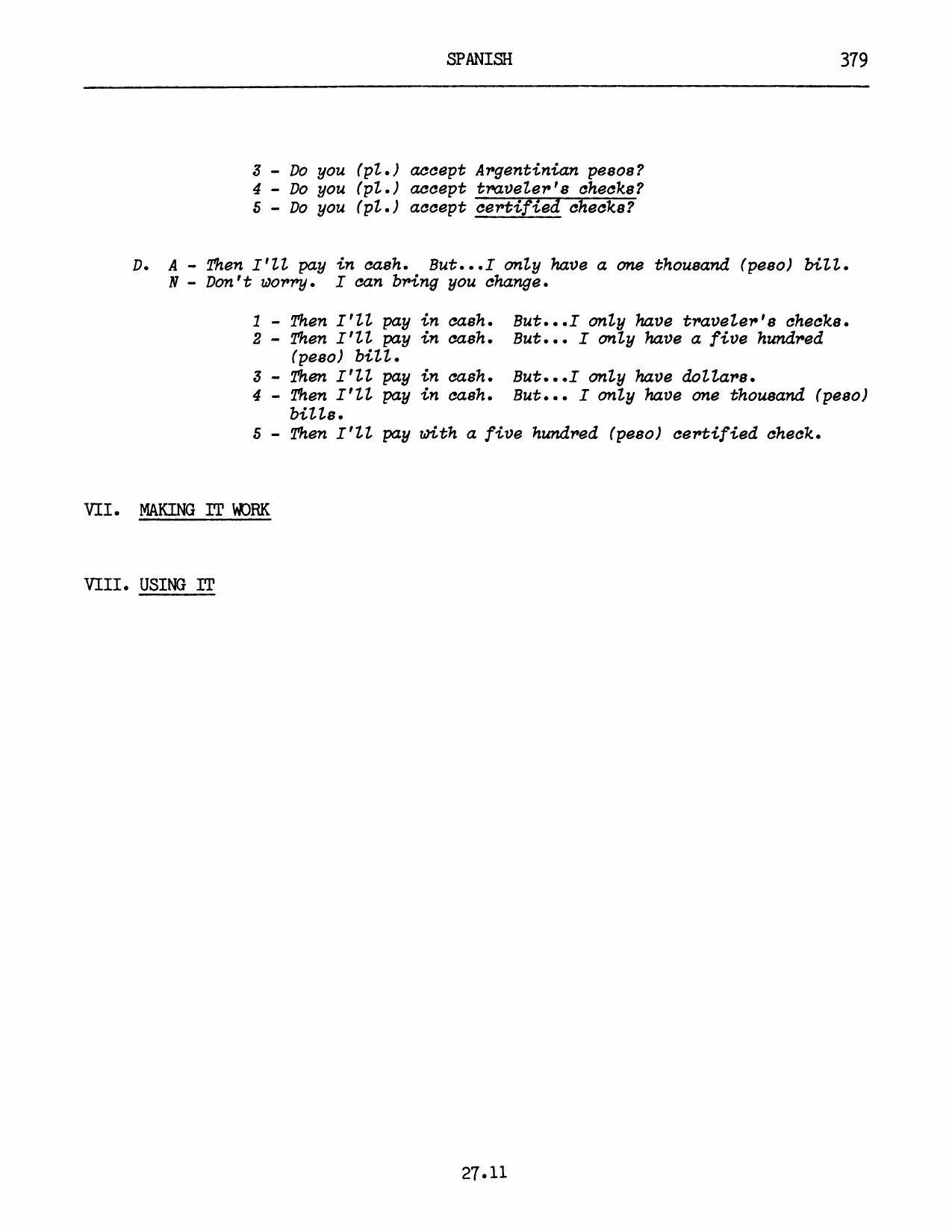
CYCLE 27
GETTING OUT
Paying at a Restaurant
This Cycle explains how to pay at a restaurant. (Refer to page 5.2 if you have
questions on tipping or on how to attract a waiter's or waitress's attention. )
This page has a drawing, chart, or fill-in layout — original page
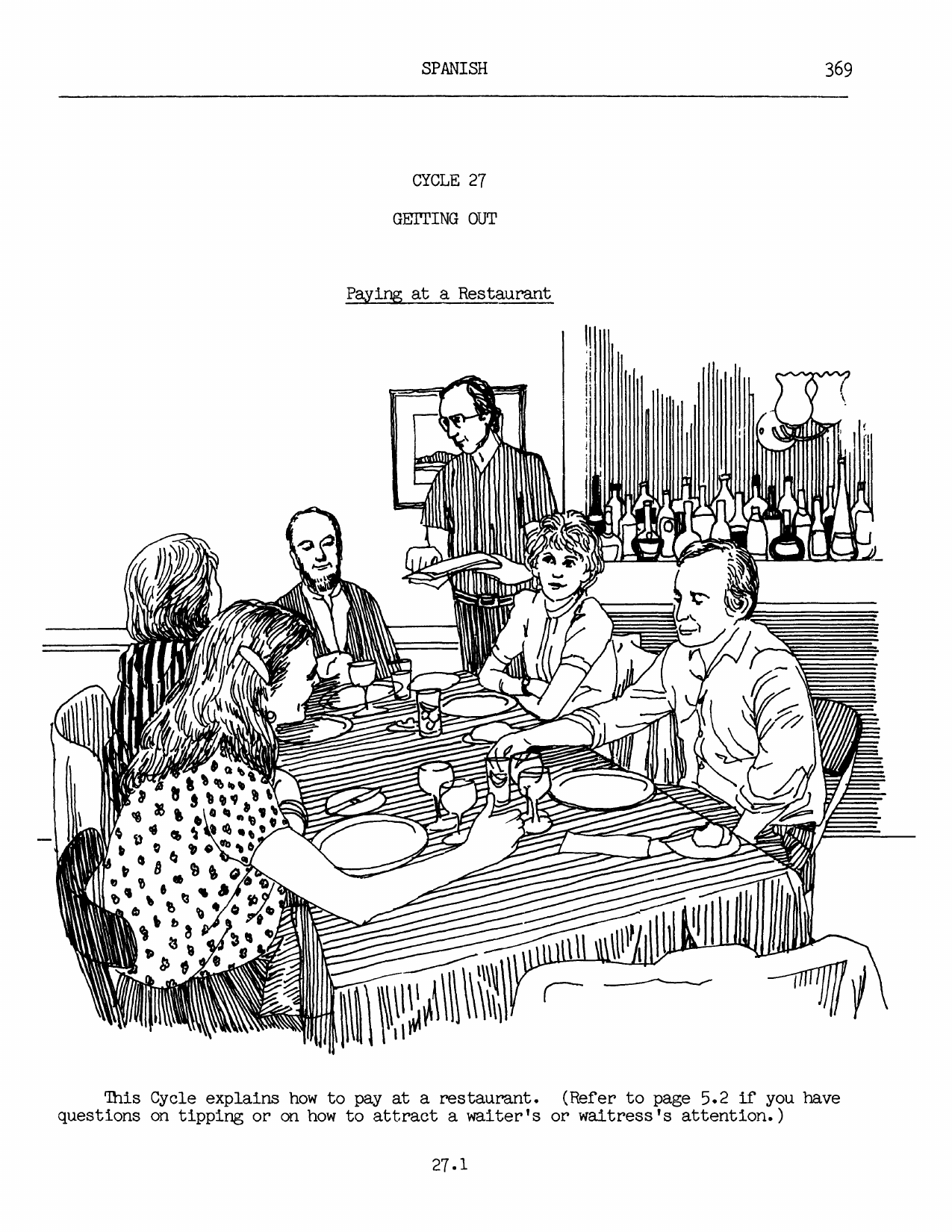
I. SETTING THE SCENE
You have finished your meal and are ready to leave, so you ask the waiter/ waitress to bring you the check.
II. HEARING IT
III. SEEING IT
Dialtoque No. 1: (Short Version)
Pagando, en el restaurante (restorán)
A - Señor/señorita, tráigame la cuenta, por favor.
N - Aquí la tiene, sefior/sefiorita/sefiora.
A - ¿Pago aquí o en la caja?
N - Como usted quiera. Da lo mismo.
A = ¿Aceptan tarjetas de crédito?
N - Sólo aceptamos Visa y American Express.
A - Entonces, voy a pagar en efectivo (al contado). Pero...sdlo tengo un
billete de mil (pesos).
N - No se preocupe. Yo puedo traerle el cambio....
(Después de un rato)
N - Aquí tiene, señor/señorita/señora.
A — Muchas gracias. Quédese con el cambio.
N — Muchas gracias. ¡Hasta pronto!
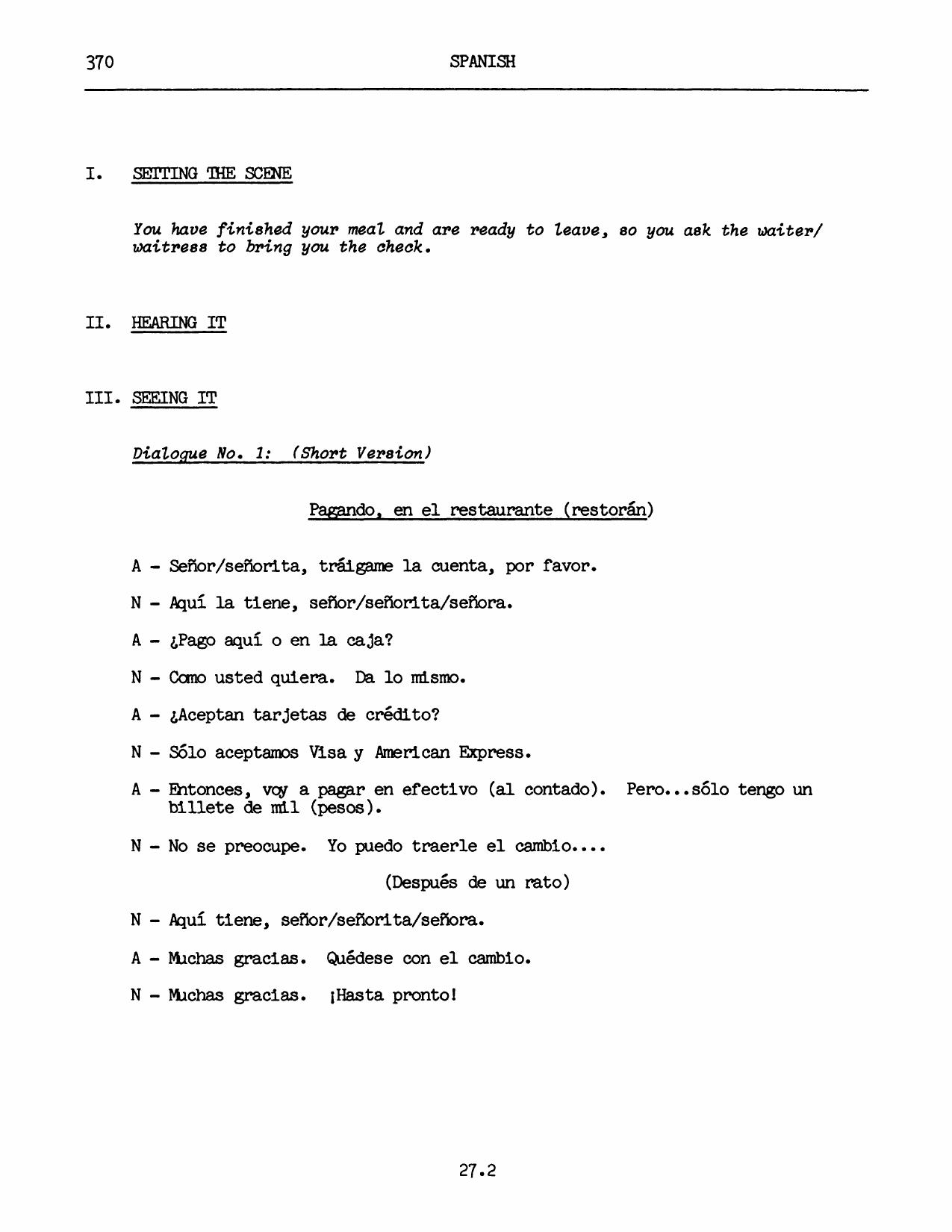
Dialoque No. 1: (Short Version - continued)
Paying at a restaurant
(1) A - Waiter/miss, bring me the check, please.
N - Here it is, sir/miss/ma'am.
(2) A - Shall I pay here or at the cashier?
(3) WN - As you wish. It doesn't matter.
A - Do you (pl.) accept credit cards?
N - We accept only Visa and American Express.
A - Then I'll pay in cash. But...I only have a one thousand (peso) bill. N - Don't worry. I can bring you the change....
(After a while)
N - Here you are, sir/miss/ma'am.
A - Thank you very much. Keep the change.
N - Thank you very much. See you soon!
Dialogue No. 2: (Long Version)
Pagando, en el restaurante (restorán)
A - Señor/señorita, trálgame la cuenta, por favor.
N - Aquí la tiene, sefior/sefiorita/sefiora.
A — ¿Se puede pagar con tarjeta de crédito?
N - Sólo aceptamos Visa y American Express.
A — En ese caso, voy a pagar en efectivo (al contado).
¿Le pago a usted o en la caja?
N - Como usted quiera. Da lo mismo.
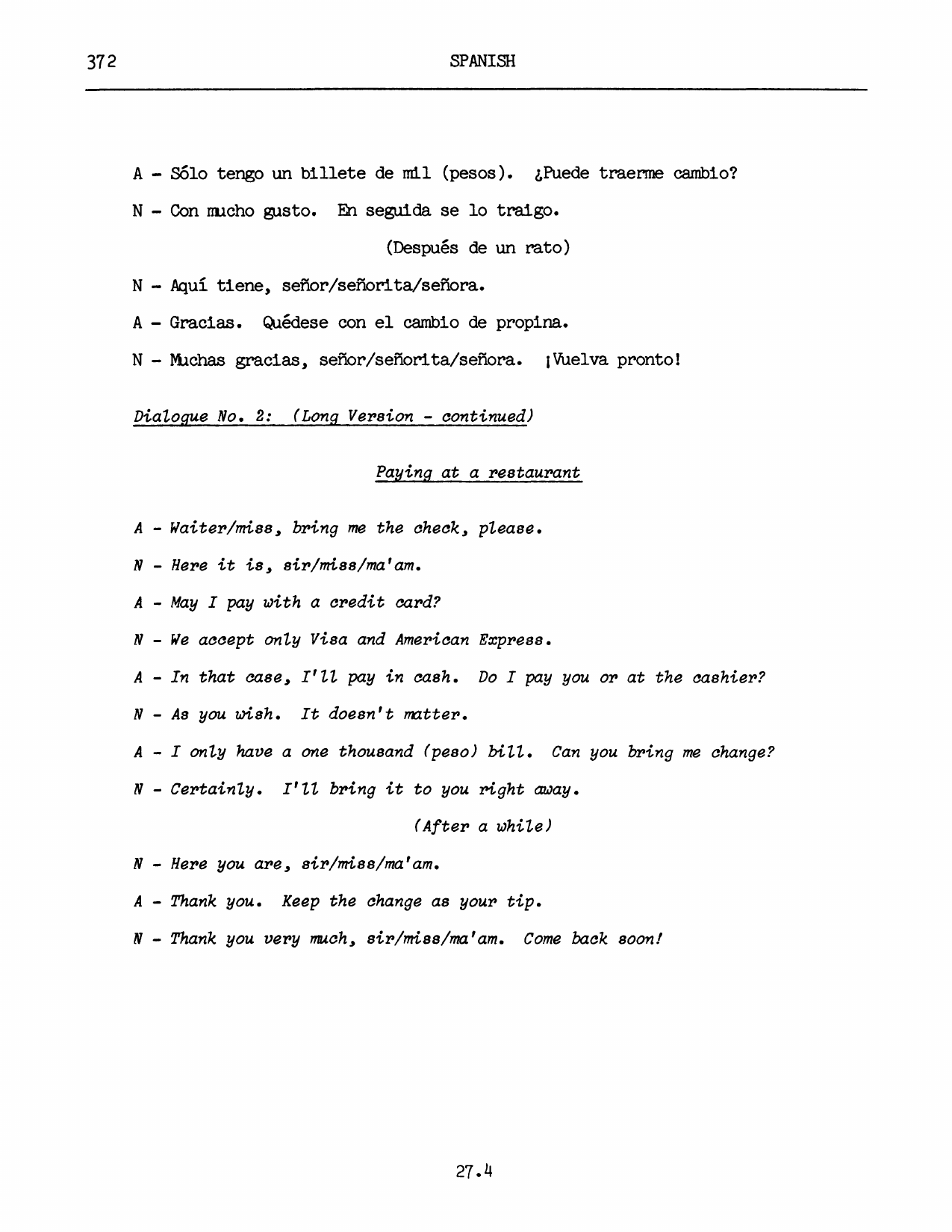
A - Sólo tengo un billete de mil (pesos). ¿Puede traerme cambio? N - Con mucho gusto. En seguida se lo traigo.
(Después de un rato)
N = Aquí tiene, señor/señorita/señora.
A - Gracias. Quédese con el cambio de propina.
N - Muchas gracias, señor/señorita/señora. ¡Vuelva pronto!
Dialogue No. 2: (Long Version - continued)
Paying at a restaurant
A - Waiter/miss, bring me the check, please.
N - Here it is, sir/meas/ma'am.
A - May I pay with a credit card?
N - We accept only Visa and American Express.
A - In that case, I'll pay in cash. Do I pay you or at the cashier? N - As you wish. It doesn't matter.
A - I only have a one thousand (peso) bill. Can you bring me change? N - Certainly. I'll bring it to you right away.
(After a white)
N - Here you are, sir/miss/ma'am.
A - Thank you. Keep the change as your tip.
N - Thank you very much, sir/miss/ma'am. Come back soon!
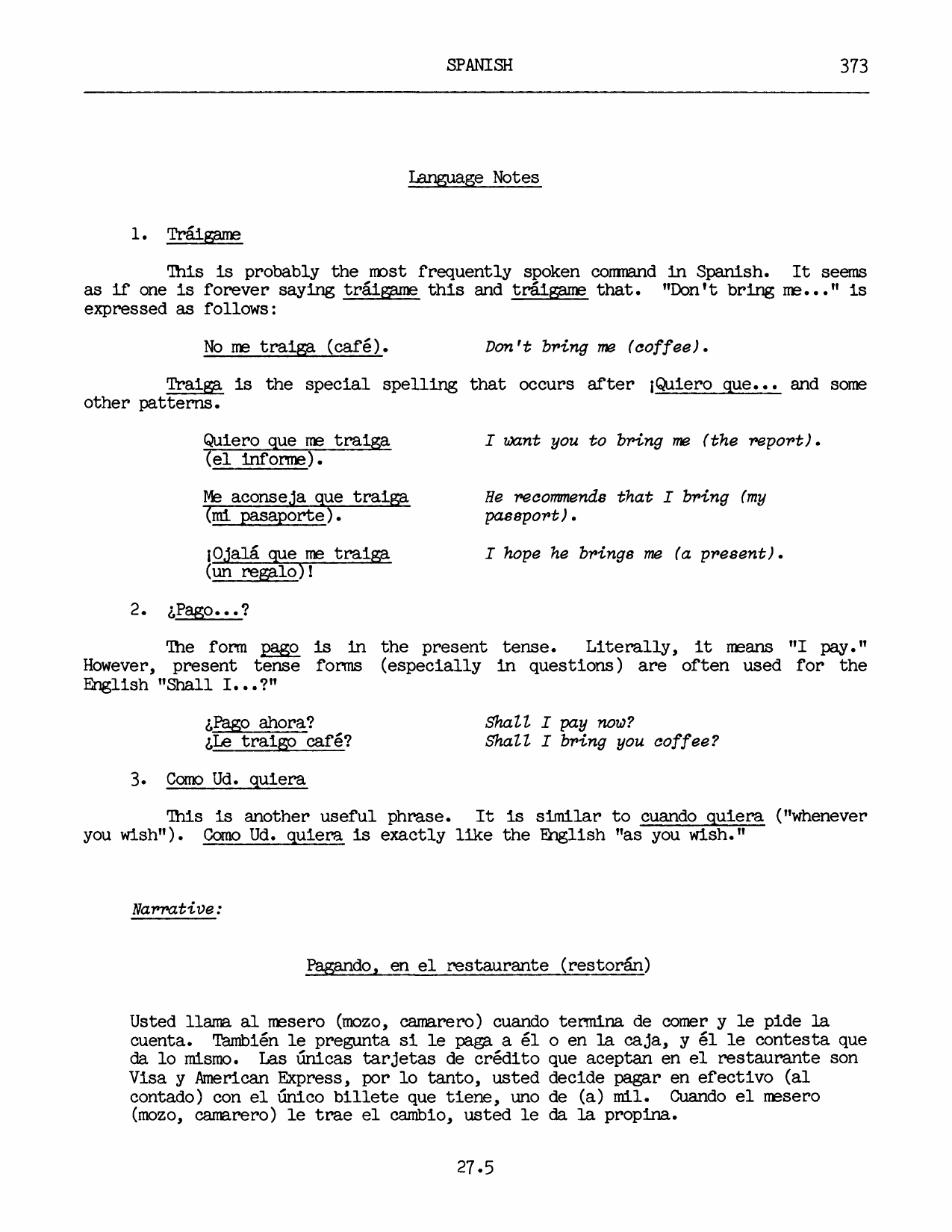
Language Notes
1. Tráigame
This is probably the most frequently spoken command in Spanish. It seems
as if one is forever saying tráigame this and tráigame that. "Don't bring me..." is expressed as follows:
Traiga is the special spelling that occurs after ¡Quiero que... and some
other patterns.
(el informe).
(un regalo)!
Co ¿PagOo..?
The form pago is in the present tense. Literally, it means "I pay."
However, present tense forms (especially in questions) are often used for the English "Shall T...?"
3. Como Ud. quiera
This is another useful phrase. It is similar to cuando quiera ("whenever
you wish"). Como Ud. quiera is exactly like the English "as you wish."
Narrative:
Pagando, en el restaurante (restorán)
Usted llama al mesero (mozo, camarero) cuando termina de comer y le pide la cuenta. También le pregunta si le paga a él o en la caja, y él le contesta que da lo mismo. Las únicas tarjetas de crédito que aceptan en el restaurante son Visa y American Express, por lo tanto, usted decide pagar en efectivo (al contado) con el único billete que tiene, uno de (a) mil. Cuando el mesero (mozo, camarero) le trae el cambio, usted le da la propina.
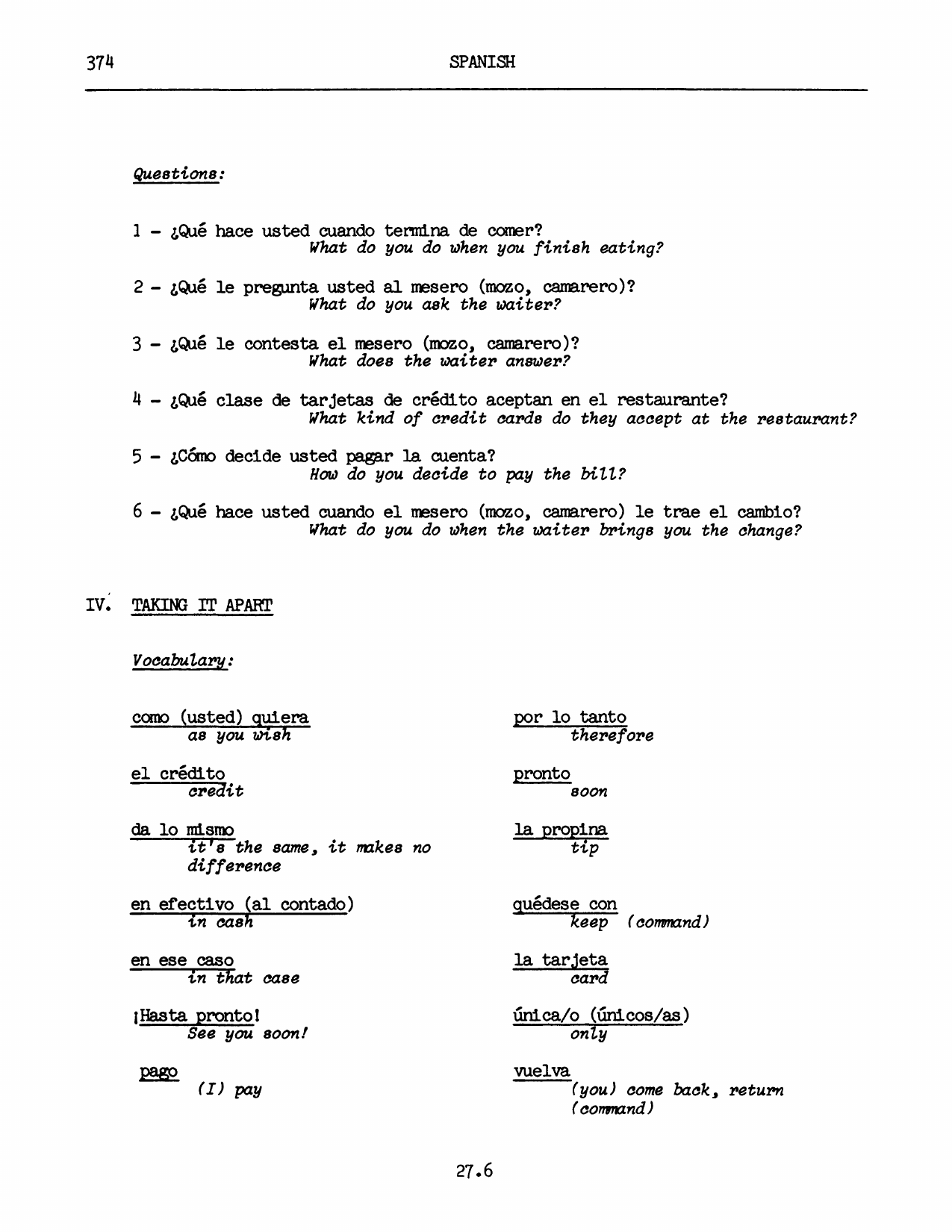
Questions:
1 - ¿Qué hace usted cuando termina de comer?
What do you do when you finish eating?
2 - ¿Qué le pregunta usted al mesero (mozo, camarero)?
What do you ask the waiter?
3 = ¿Qué le contesta el mesero (mozo, camarero)?
What does the waiter answer?
4 — ¿Qué clase de tarjetas de crédito aceptan en el restaurante?
What kind of credit cards do they accept at the restaurant?
5 = ¿Cómo decide usted pagar la cuenta?
How do you decide to pay the bill?
6 = ¿Qué hace usted cuando el mesero (mozo, camarero) le trae el cambio?
What do you do when the waiter brings you the change?
IV. TAKING IT APART
Vocabulary:
difference
vuelva
(command )
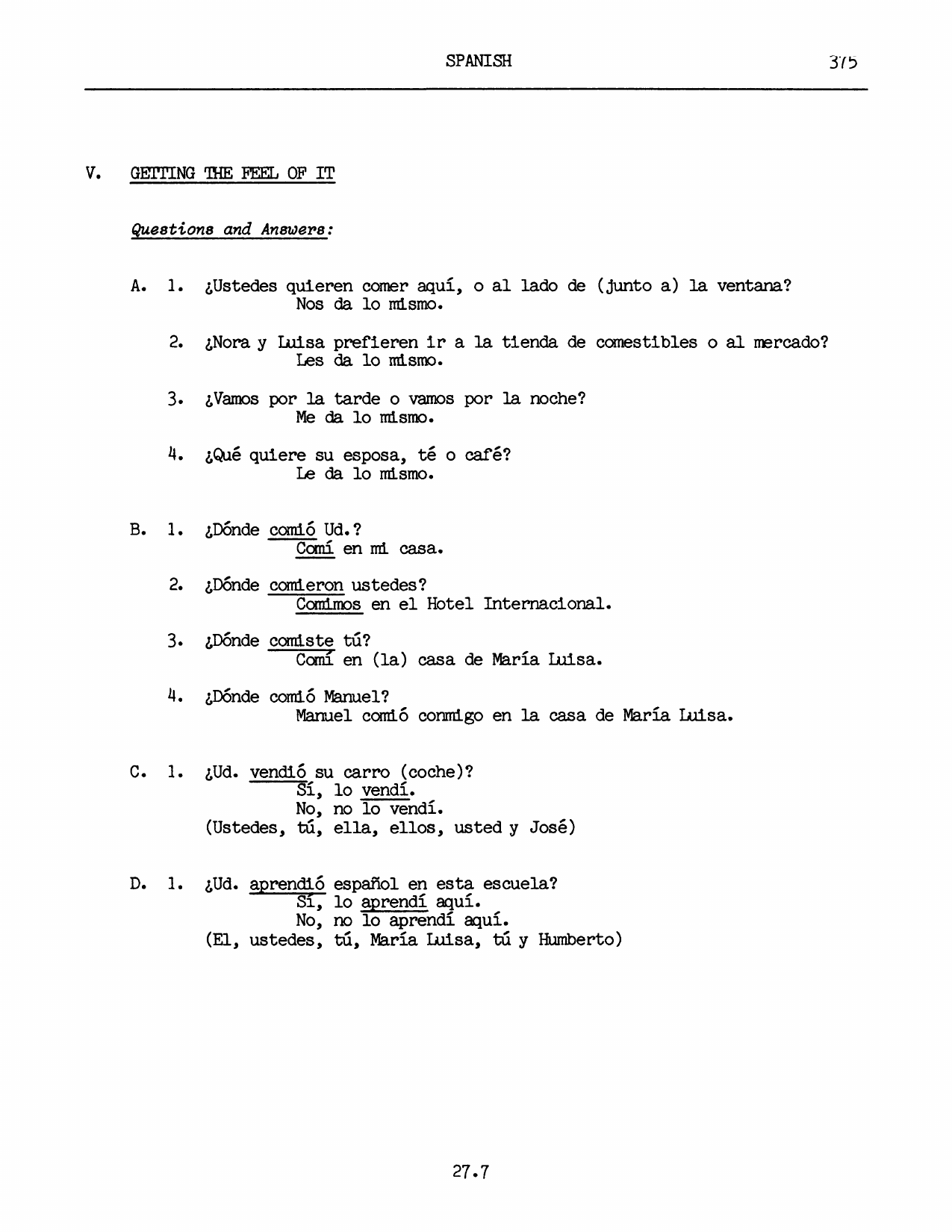
V. GETTING THE FEEL OF IT
Questions and Answers:
A. 1. ¿Ustedes quieren comer aquí, o al lado de (junto a) la ventana?
Nos da lo mismo.
2. ¿Nora y Luisa prefieren ir a la tienda de comestibles o al mercado?
Les da lo mismo.
3. ¿Vamos por la tarde o vamos por la noche?
Me da lo mismo.
4. ¿Qué quiere su esposa, té o café?
Le da lo mismo.
B. 1. ¿Dónde comió Ud. ?
Comí en mi casa.
2. ¿Dónde comieron ustedes?
Comimos en el Hotel Internacional.
3. ¿Dónde comiste tú?
Comí en (la) casa de María Luisa.
4, ¿Dónde comió Manuel?
Maruel comió conmigo en la casa de María Luisa.
C. 1. ¿Ud. vendió su carro (coche)?
i, lo vendí.
No, no lo vendí.
(Ustedes, tú, ella, ellos, usted y José)
D. 1. ¿Ud. aprendió español en esta escuela?
Sí, lo aprendí aquí.
No, no lo aprendí aquí.
(El, ustedes, tú, María Luisa, tú y Humberto)
E. Fill in the blanks with the appropriate word: pregunta ("asks") or pide
("asks for," "requests"). Model:
típicos. Manuel le pregunta....
Manuel le pide....
una bebida.
(platillo) típico.
Questions and Answers: (continued)
A. 1. Do you (pl.) want to eat here or near the window?
It makes no difference to us.
2. Do Nora and Luisa prefer to go to the store or to the market?
It makes no difference to them.
3. Shall we go in the afternoon or at night?
It makes no difference to me.
4. What would your wife like, tea or coffee?
It makes no difference to her.
B. 1. Where did you eat?
I ate at my house.
2. Where did you (pl.) eat?
We ate at the Internattonal Hotel.
This page has a drawing, chart, or fill-in layout — original page
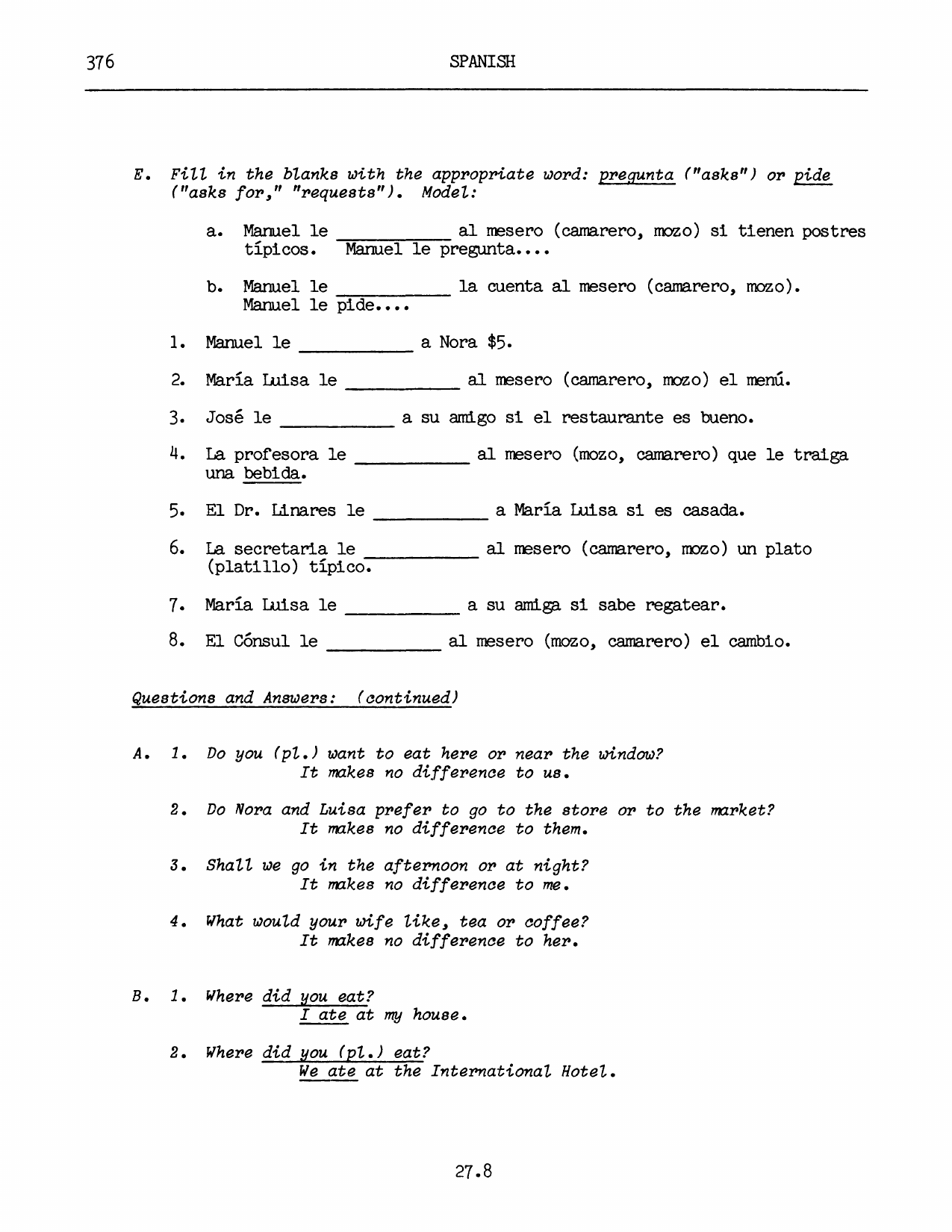
3. Where did you eat? (familiar)
I ate at Maria Luisa's house.
4. Where did Manuel eat?
Manuel ate with me at Maria Luisa's house.
C. 1. Did you sell your car?
Yes, I sold it.
No, I didn't sell it.
(You (pl.), you (familiar), she, they, you and Jose)
D. 1. Did you learn Spanish at this school?
Yes, I learned it here.
No, I didn't learn it here.
(He, you (pl.), you (familiar), Maria Luisa, you and Humberto (familiar))
VI. PUTTING IT TOGETHER
Variants:
A. A - Sefior/sefiorita, traéigame la cuenta, por favor.
N - Aquí la tiene, señor/señorita/señora.
1 - Señor, traigame una botella de vino, por favor. 2 - Señor, tráigame agua mineral, por favor.
3 - Señor, tráigale una taza de café con leche a la señorita, por
favor.
4 - Señor, tráigame una cerveza, por favor.
5 - Señor, tráiganos una botella de vino tinto, por favor.
B. A — ¿Pago aquí o en la caja?
N - Como usted quiera. Da lo mismo.
1 - ¿Pago en efectivo (al contado) o con cheque?
2 - ¿Pago ahora o por correo?
3 - ¿Pago en dólares o en pesos?
4 - ¿Le pago a Ud. o a la cajera?
5 - ¿Pago al contado (en efectivo) o a crédito?
C. A - ¿Aceptan tarjetas de crédito?
N - Sólo aceptamos Visa y American Express.
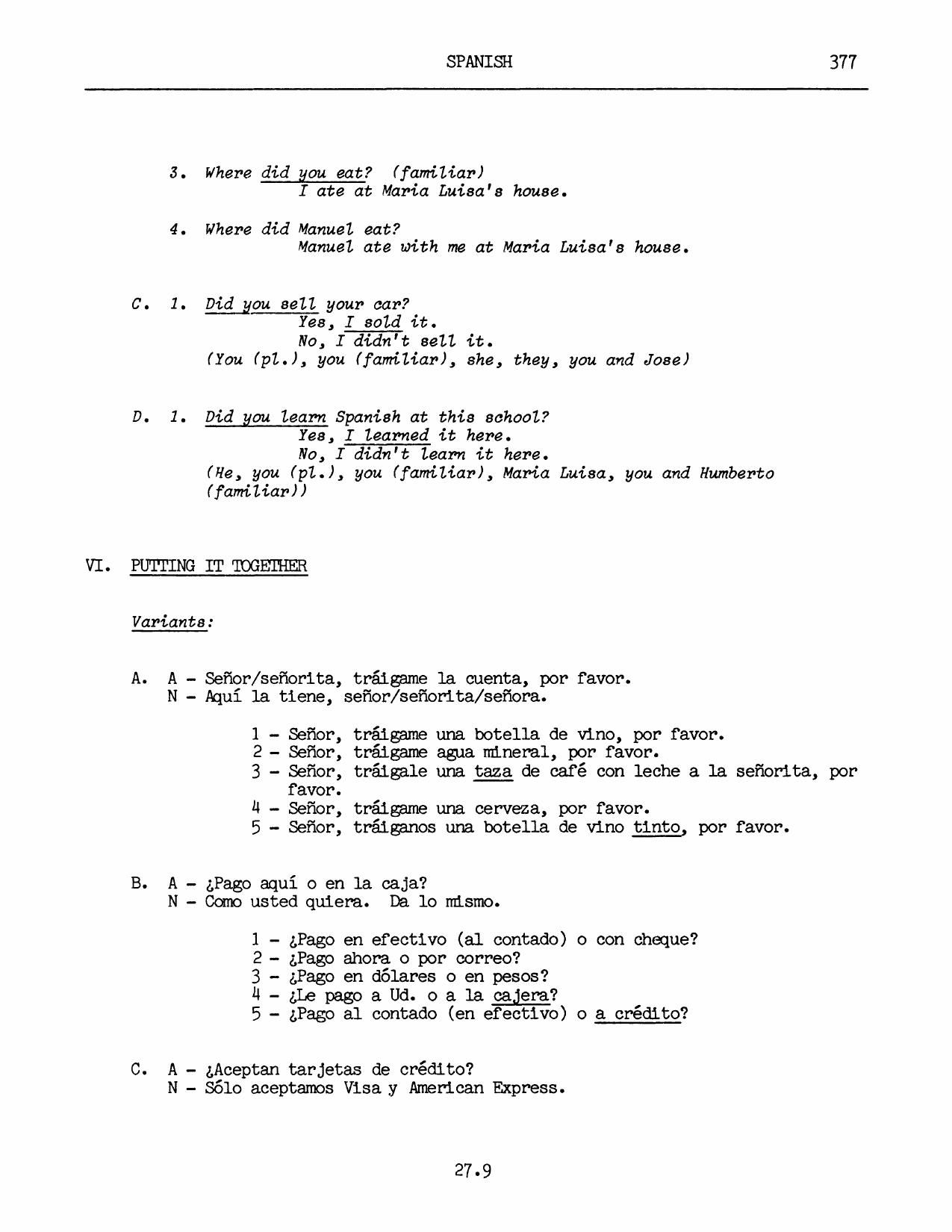
1 - ¿Aceptan dólares?
2 - ¿Aceptan cheques personales?
3 = ¿Aceptan pesos argentinos?
4 — ¿Aceptan cheques viajeros (de viaje)?
5 - ¿Aceptan cheques certificados?
D. A - Entonces, voy a pagar en efectivo (al contado). Pero...sdlo tengo un
billete de (a) mil (pesos).
N = No se preocupe. Yo puedo traerle el camblo....
1 - Entonces, voy a pagar al contado. Pero...sólo tengo cheques
viajeros (de viaje).
2 - Entonces voy a pagar al contado. Pero...sdlo tengo un
billete de quinientos (pesos).
3 - Entonces, voy a pagar en efectivo. Pero... sólo tengo
dólares.
4 — Entonces, voy a pagar al contado. Pero...sdlo tengo billetes
de (a) m1 (pesos).
5- proa voy a pagar con un cheque certificado de quinientos
pesos).
Variantes: (continued)
A. A - Waiter/miss, bring me the check, please.
N - Here it is, sir/mias/ma'am.
1 - Waiter, bring me a bottle of wine, please.
2 - Waiter, bring me some mineral water, please.
3 - Waiter, bring the young lady a cup of coffee with milk, please. 4 - Waiter, bring me a beer, please.
5 - Waiter, bring us a bottle of red wine, please.
B. A - Shall I pay here or at the cashier?
N - As you wish. It doesn't matter.
1 - Shall I pay in cash or with a check?
2 - Shall I pay now or by mil?
3 - Shall I pay in dollars or in pesos?
4 - Shall I pay you or the cashier?
5 - Shall I pay in cash or charge it?
C. A- Do you (pl.) accept credit cards?
N - We accept only Visa and American Express.
1 - Do you (pl.) accept dollars?
2 - Do you (pl.) accept personal checks?
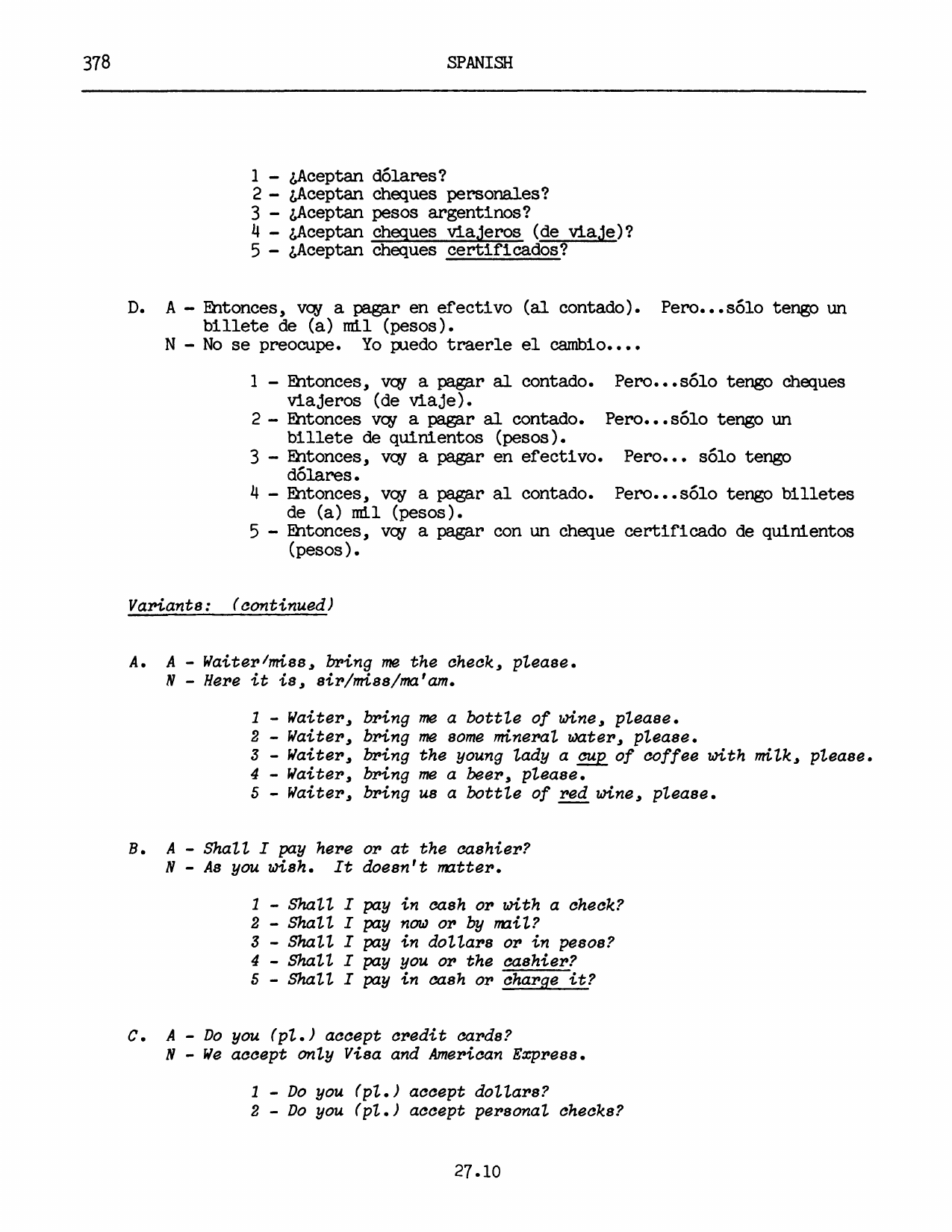
3 - Do you (pl.) accept Argentinian pesos?
4 - Do you (pl.) accept traveler's checks?
5 - Do you (pl.) accept certified checks?
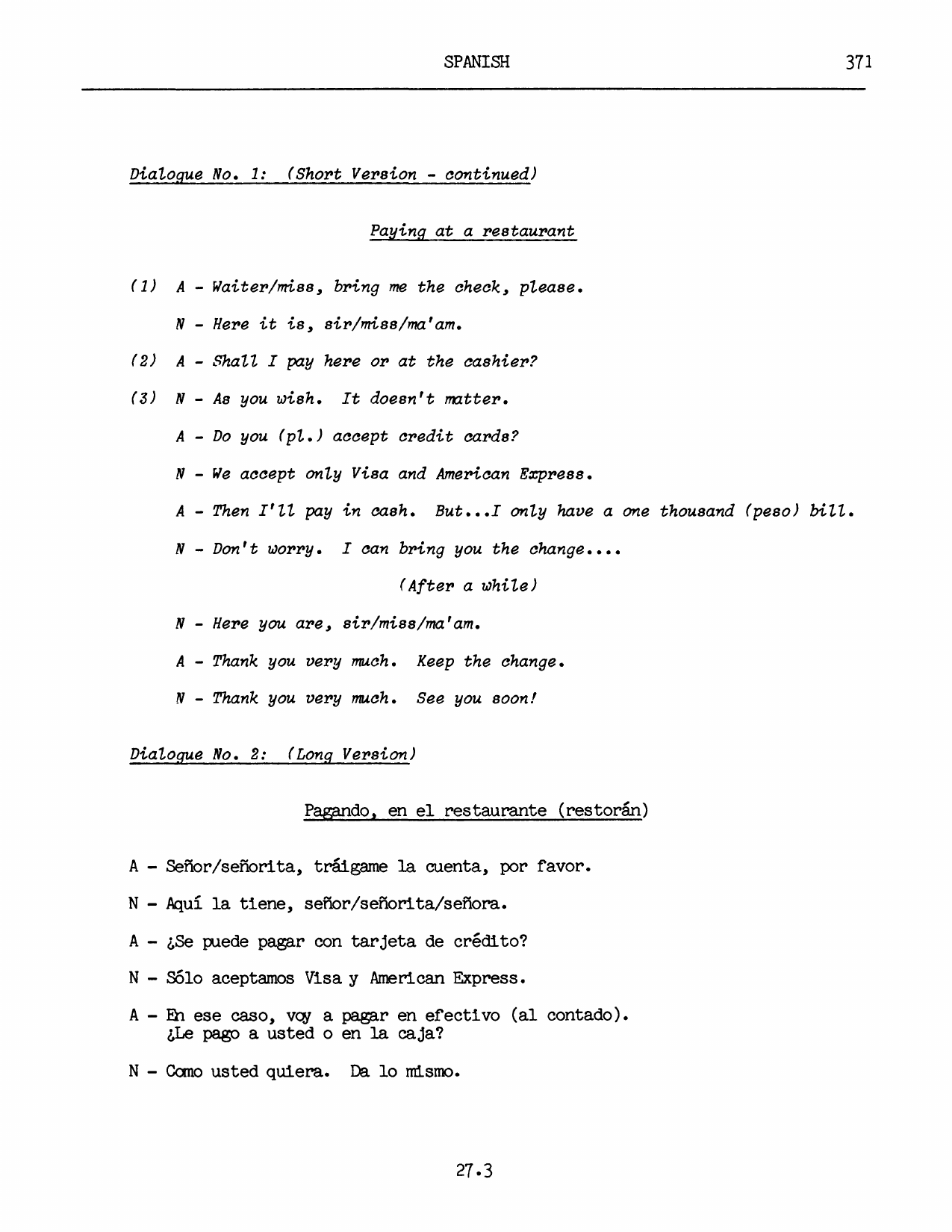
D. A - Then I'll pay in cash. But...I only have a one thousand (peso) bill.
N - Don't worry. I can bring you change.
1 - Then I'll pay in cash. But...I only have traveler's checks. 2 - Then I'll pay in cash. But... I only have a five hundred
(peso) bill.
3 - Then I'll pay in cash. But...I only have dollars. 4 - Then I'll pay in cash. But... I only have one thousand (peso)
bills.
5 - Then I'll pay with a five hundred (peso) certified check.
VII. MAKING IT WORK
VIII. USING IT