CYCLE 28
GETTING OUT
Sight-Seeing
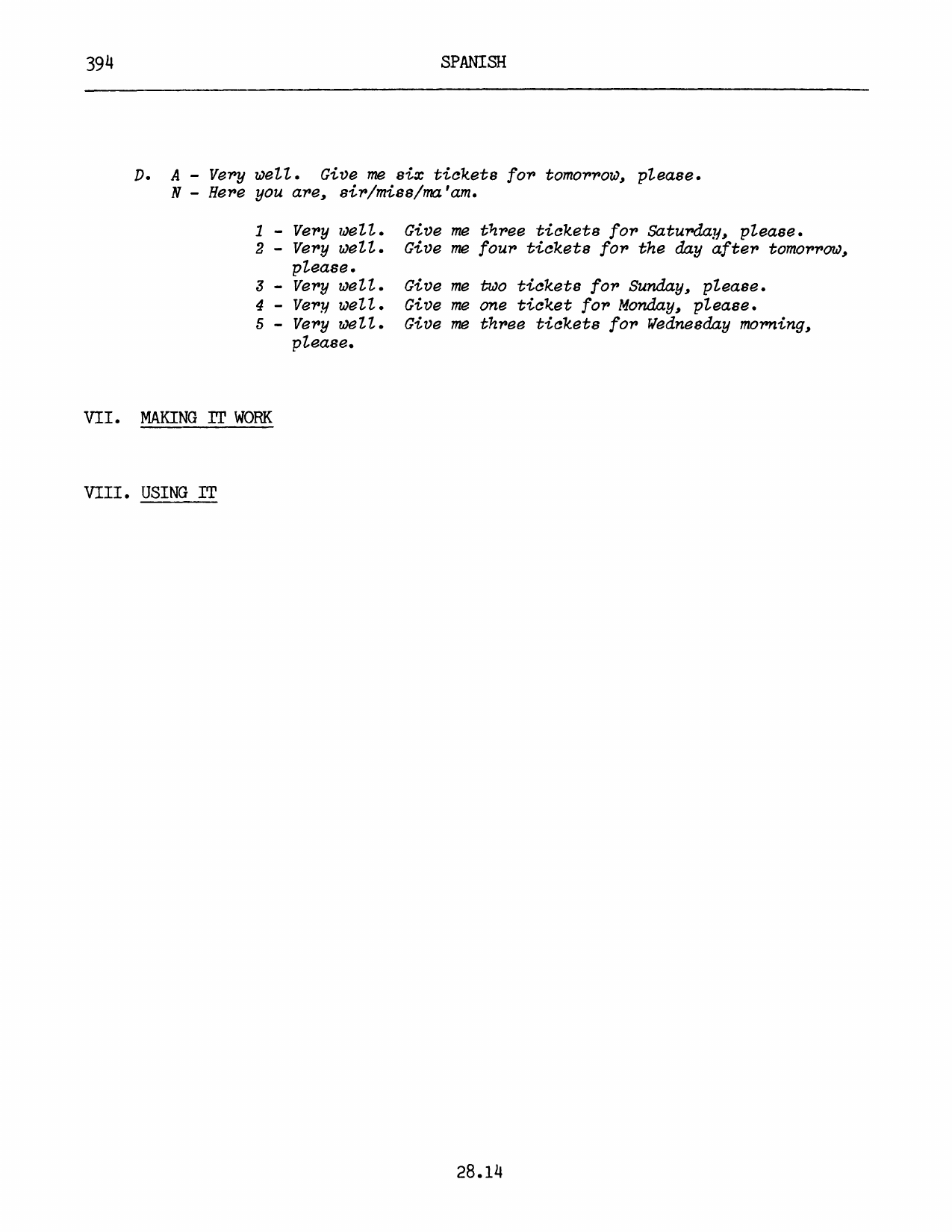
In every Spanish-speaking country, tour packages are available through local
travel agencies. Domestic air carriers connect major cities within each country and English-speaking tour guides are often available. You will also find that major credit cards are widely accepted; nevertheless, you may be surprised to find that in some countries, such as Colombia, it is cheaper to buy an airplane ticket in local currency than to charge your ticket on a credit card. It's a good idea to look into price differences before purchasing an airplane ticket or a tour package.
This page has a drawing, chart, or fill-in layout — original page
I. SETTING THE SCENE
You and a group of friends would like to see some of the sights in and around México City. You go to a travel agency to make the arrangementa for a day trip to the Toltec ruinas, which are just a few hours away.
II. HEARING IT
111. SEEING IT
Dialogue No. 1: (Short Version)
Haciendo los arreglos (preparativos) para una excursión
A - Buenos días, seforita. Necesito información sobre las excursiones a las
ruinas.
N - Si, sefior/sefiorita/sefiora. Tenemos una que sale todos los días a las ocho
de la mañana para Teotihuacán (Teotihuacan) y Tula y está de regreso (vuelta) como a las ocho de la noche.
A = ¿El almierzo está incluido?
N - No, señor/señorita/señora. Almorzamos en un restaurante (restorán) cerca
de Teotihuacán (Teotihuacan), pero eso se paga aparte.
A — ¿Hay un guía que hable inglés?
N - El guía no habla mucho inglés, pero tenemos folletos en inglés. A - My bien. Déme seis boletos (billetes) para mañana, por favor. N = Aquí tiene, sefior/sefiorita/sefiora.
Dialogue No. 1: (Short Version - continued)
Making arrangements for a tour
A - Good morning, miss. I need some information about tours to the ruina.
(5) N - Yes, sir/miss/ma'am. We have one that leaves every day at eight
o'clock in the morning for Teotihuacan and Tula and gets back at about eight o'clock in the evening.
A - Is lunch included?
(1) N - No, sir/miss/ma'am. We shall have lunch at a restaurant near
Teotihuacan, but you pay for that separately.
(3) A - Is there a guide who speaks English?
N - The guide doesn't speak much English, but we have brochures in
English.
A - Very well. Give me six tickets for tomorrow, please.
N - Here you are, sir/miss/ma'am.
Dialogue No. 2: (Long Verston)
Haciendo los arreglos (preparativos) para una excursión
A ~ Buenos días, señorita. ¿Ustedes hacen excursiones a las ruinas de Tula? N - Si, señor/señorita/señora. Tenemos excursiones de un día, y otras de dos
o tres días.
A ~ Me interesan las excursiones que van por el día. ¿Qué paradas hacen? N - Bueno, salimos de aquí a las ocho de la mañana y visitamos las ruinas de
Teotihuacán (Teotihuacan) en las afueras de la ciudad. Después almorzamos en un restaurante (restorán) cerca de ahí y por la tarde seguimos hasta las ruinas de Tula. De ahí volvemos (regresamos) y estamos de regreso (vuelta) como a eso de las ocho de la noche.
A —- ¿En cuánto sale (cuánto cuesta, cuánto vale) esa excursión?
N ~ Sale en (cuesta, vale) $950 (pesos) por persona.
A - ¿Eso incluye el almuerzo?
N - No, señor/señorita/señora. El almerzo lo paga cada uno aparte. A — ¿Hay un guía que explique todo durante el viaje?
N - Si, sefior/sefiorita/sefiora, pero el guía habla solamente español. Tenemos
estos folletos en inglés.
A —- Está bien. Déme seis boletos (billetes) para mañana, por favor. N - Aquí tiene. Entonces, los esperamos mañana a las ocho menos cuarto. A —- Muchas gracias, señorita/señor/señora.
N - Gracias a usted, señor/señorita/señora.
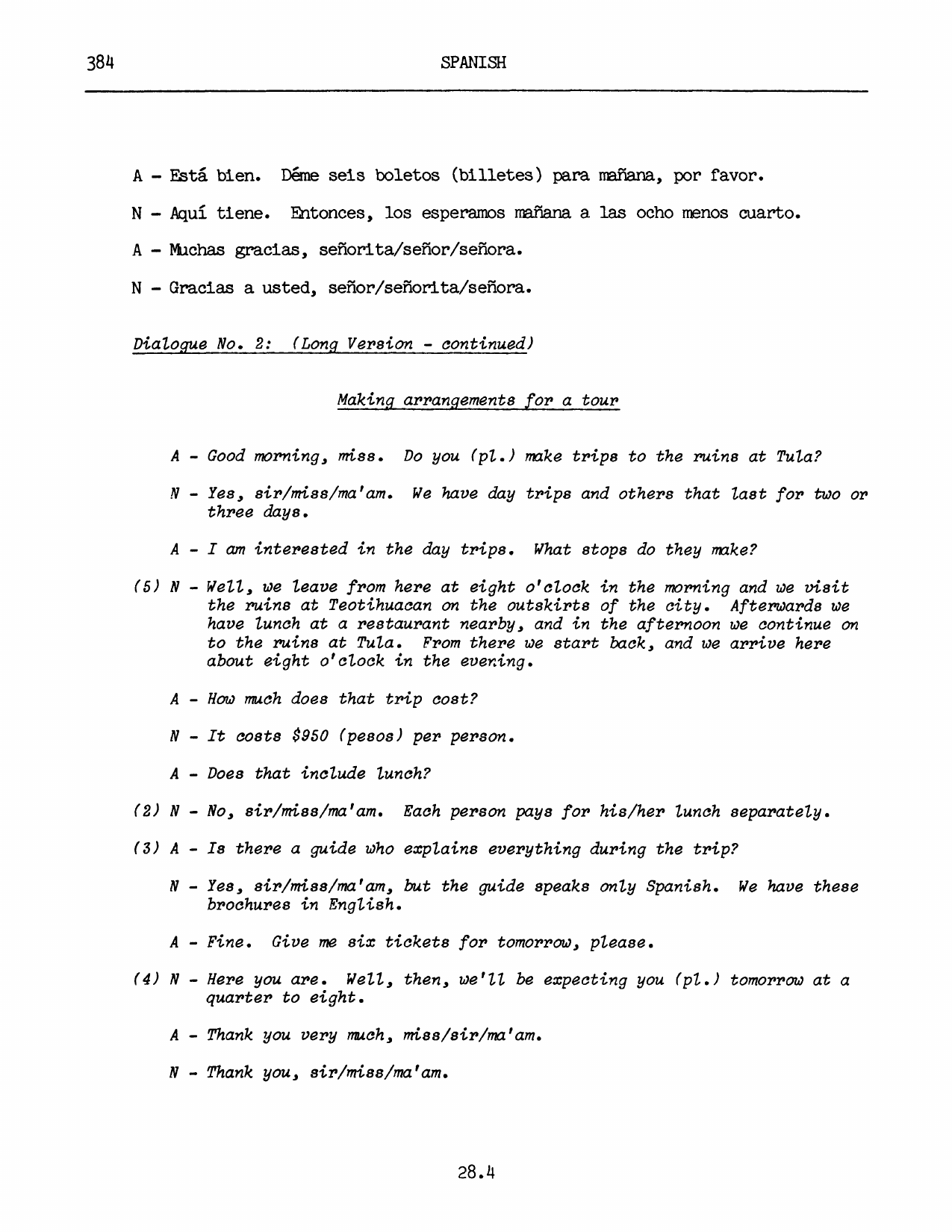
Dialogue No. 2: (Long Version - continued)
Making arrangements for a tour
A - Good morning, miss. Do you (pl.) make trips to the ruins at Tula? N - Yes, sir/miss/ma'am. We have day trips and others that last for two or
three days.
A - I am interested in the day trips. What stops do they make?
(5) N - Well, we leave from here at eight o'clock in the morning and we visit
the ruins at Teotihuacan on the outskirts of the city. Afterwards we have lunch at a restaurant nearby, and in the afternoon we continue on to the ruins at Tula. From there we start back, and we arrive here about eight o'clock in the evening.
A - How much does that trip cost?
N - It costs $950 (pesos) per person.
A - Does that include lunch?
(2) N - No, str/miss/ma'am. Each person pays for his/her lunch separately. (3) A - Is there a guide who explains everything during the trip?
N - Yes, sir/miss/ma'am, but the guide speaks only Spanish. We have these
brochures in English.
A - Fine. Give me six tickets for tomorrow, please.
(4) N - Here you are. Well, then, we'll be expecting you (pl.) tomorrow at a
quarter to eight.
A - Thank you very much, miss/sir/ma'am.
N - Thank you, sir/miss/ma'am.
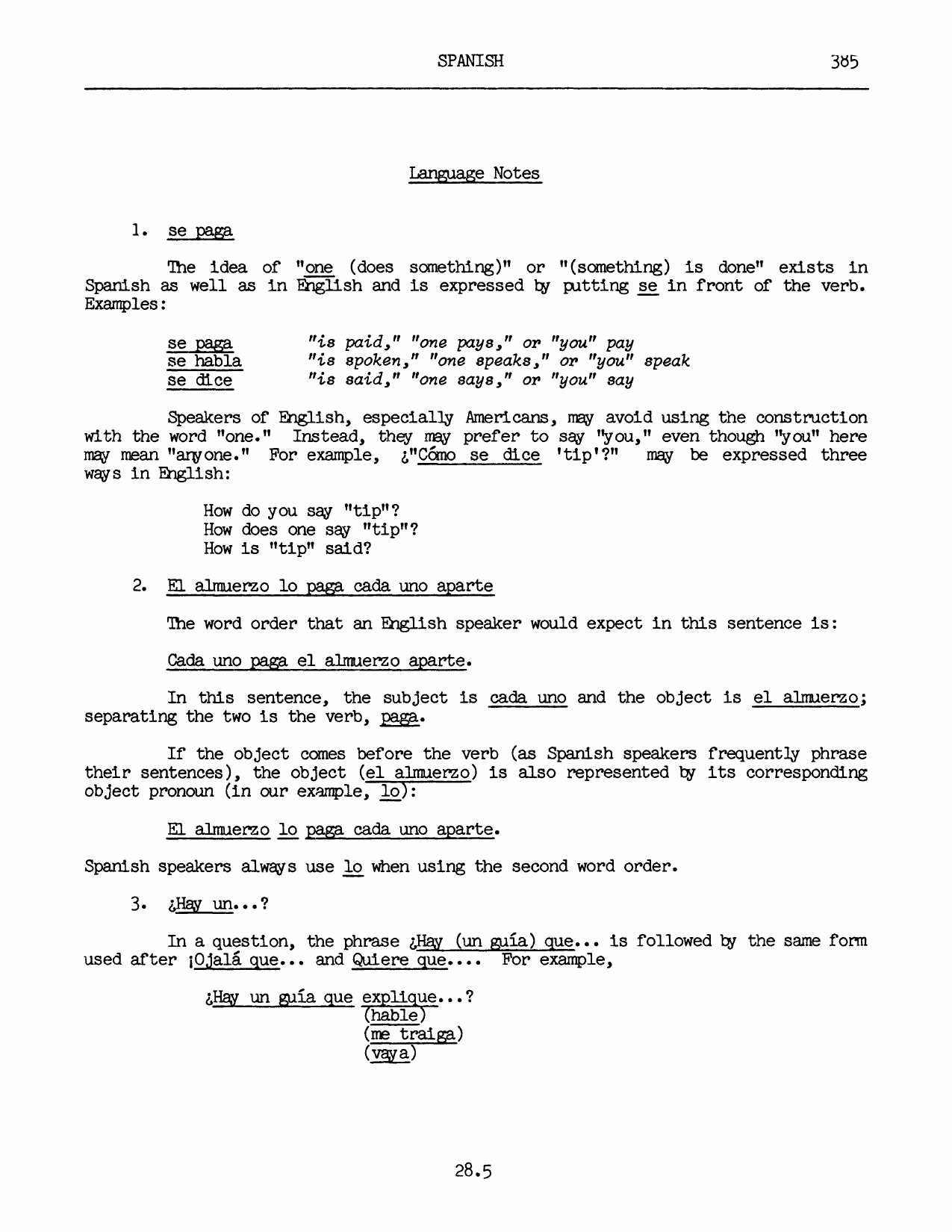
Language Notes
1. se paga
The idea of "one (does something)" or "(something) is done" exists in
Spanish as well as in English and is expressed by putting se in front of the verb. Examples:
Speakers of English, especially Americans, may avoid using the construction
with the word "one." Instead, they may prefer to say "you," even though "you" here may mean "anyone." For example, ¿"Cómo se dice 'tip'?" may be expressed three ways in English:
How do you say "tip"?
How does one say "tip"?
How is "tip" said?
2. El almerzo lo paga cada uno aparte
The word order that an English speaker would expect in this sentence is:
Cada uno paga el almuerzo aparte.
In this sentence, the subject is cada uno and the object is el almuerzo;
separating the two is the verb, paga.
If the object comes before the verb (as Spanish speakers frequently phrase
their sentences), the object (el almuerzo) is also represented by its corresponding object pronoun (in our example, lo):
El almuerzo lo paga cada uno aparte.
Spanish speakers always use lo when using the second word order.
3. ¿Hay Un...?
In a question, the phrase ¿Hay (un guía) que... is followed by the same form
used after ¡Ojalá que... and Quiere que.... For example,
¿Hay un guía que explique. ..?
(hable)
(me traiga)
(vaya
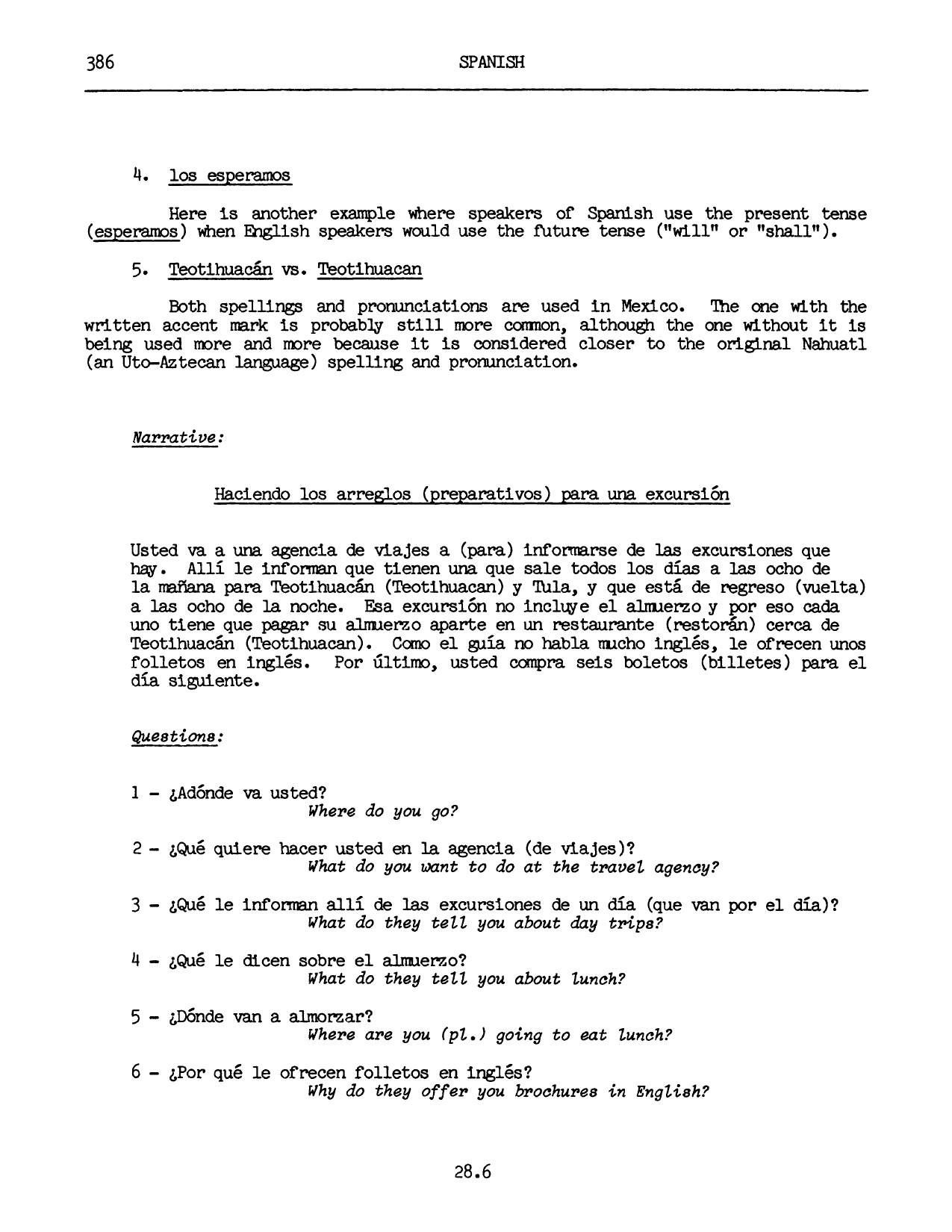
4, los esperamos
Here is another example where speakers of Spanish use the present tense
(esperamos) when English speakers would use the future tense ("will" or "shall").
5. Teotihuacán vs. Teotihuacan
Both spellings and pronunciations are used in Mexico. The one with the
written accent mark is probably still more conmon, although the one without it is being used more and more because it is considered closer to the original Nahuatl (an Uto-Aztecan language) spelling and prormnciation.
Narrative:
Haciendo los arreglos (preparativos) para una excursión
Usted va a una agencia de viajes a (para) informarse de las excursiones que hay. Allí le informan que tienen una que sale todos los días a las ocho de la mañana para Teotihuacán (Teotihuacan) y Tula, y que está de regreso (vuelta) a las ocho de la noche. Esa excursión no incluye el almuerzo y por eso cada uno tiene que pagar su almuerzo aparte en un restaurante (restorán) cerca de Teotihuacán (Teotihuacan). Como el guía no habla mucho inglés, le ofrecen unos folletos en inglés. Por último, usted compra seis boletos (billetes) para el día siguiente.
Questions:
1 - ¿Adónde va usted?
Where do you go?
2 - ¿Qué quiere hacer usted en la agencia (de viajes)?
What do you want to do at the travel agency?
3 = ¿Qué le informan allí de las excursiones de un día (que van por el día)?
What do they tell you about day trips?
y — ¿Qué le dicen sobre el almuerzo?
What do they tell you about lunch?
5 - ¿Dónde van a almorzar?
Where are you (pl.) going to eat lunch?
6 - ¿Por qué le ofrecen folletos en inglés?
Why do they offer you brochures in English?
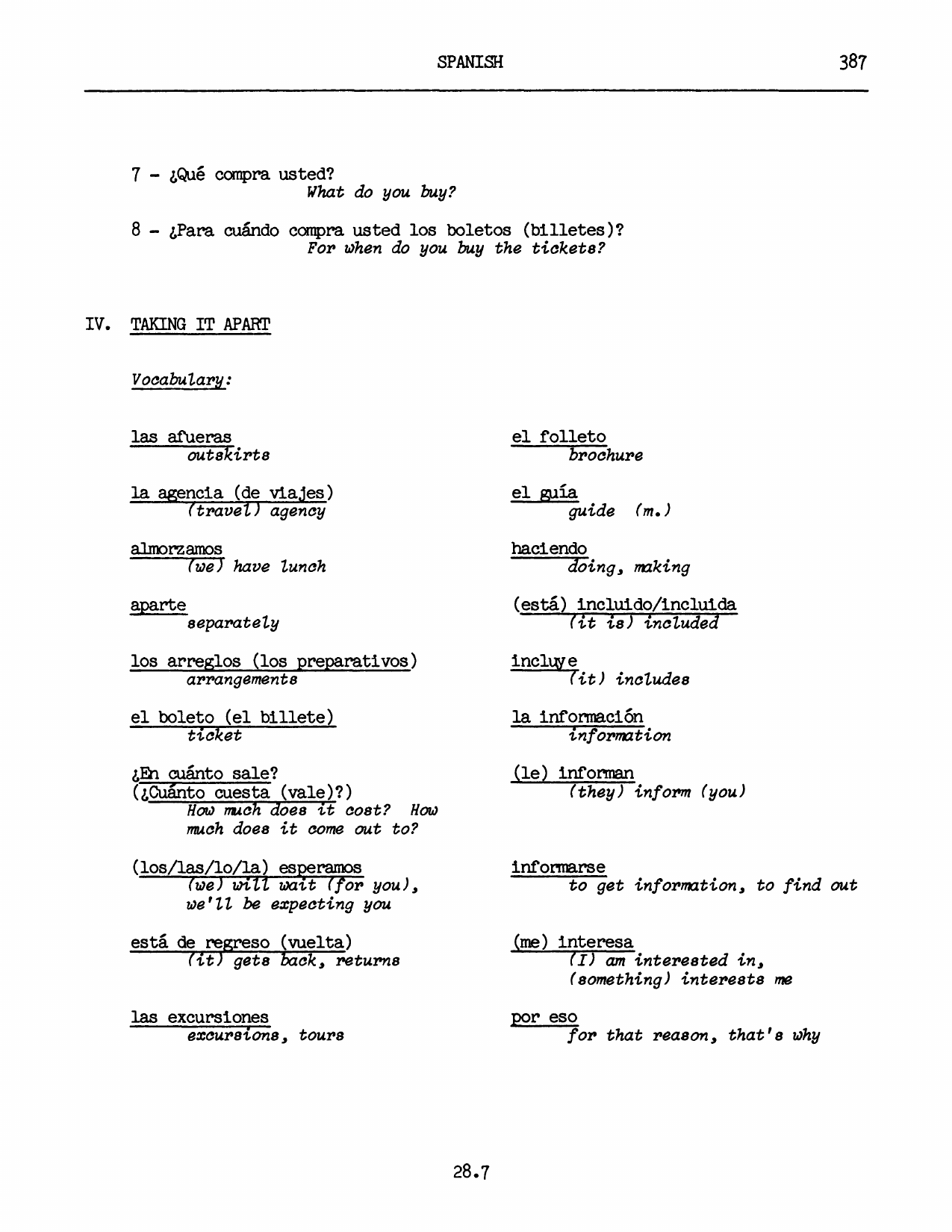
7 = ¿Qué compra usted?
What do you buy?
8 - ¿Para cuándo compra usted los boletos (billetes)?
For when do you buy the tickets?
IV. TAKING_IT APART
Vocabulary:
How mue oes tt cost? How
much does it come out to?
we'll be expecting you
(something) interests me
V. GETTING THE FEEL OF IT
Questions and Answers:
A. 1. ¿Qué quiere conseguir Ud.?
a. Quiero conseguir información sobre las excursiones. b. Quiero conseguir un apartamento (departamento, piso)
bueno y barato.
C. Quiero conseguir una buena empleada (sirvienta). d. Quiero conseguir una niñera para esta noche. €» Quiero conseguir un taxi para ir al aeropuerto. f. Quiero conseguir una profesora de español. g Quiero conseguir una casa cerca de la Embajada. h. Quiero conseguir un guía que hable inglés.
B. 1. ¿Cómo se paga?
a. Se paga aparte.
b. Se paga como usted quiera.
C. Se paga con cheque.
d. Se paga por correo.
e. Se paga en dólares.
f. Se paga en efectivo (al contado).
g Se paga ahora mismo.
h. Se paga por adelantado (anticipado).
C. 1. ¿Cuántos boletos (billetes) quiere?
a. Déme 5 boletos (billetes) para mañana.
b. Déme 2 boletos (billetes) para esta tarde. c. Déme 3 boletos (billetes) para las ruinas de Tula. d. Déme 6 boletos (billetes) para esa excursion. e. Déme un boleto (billete) para el jueves.
f. Déme 3 boletos (billetes) para hay.
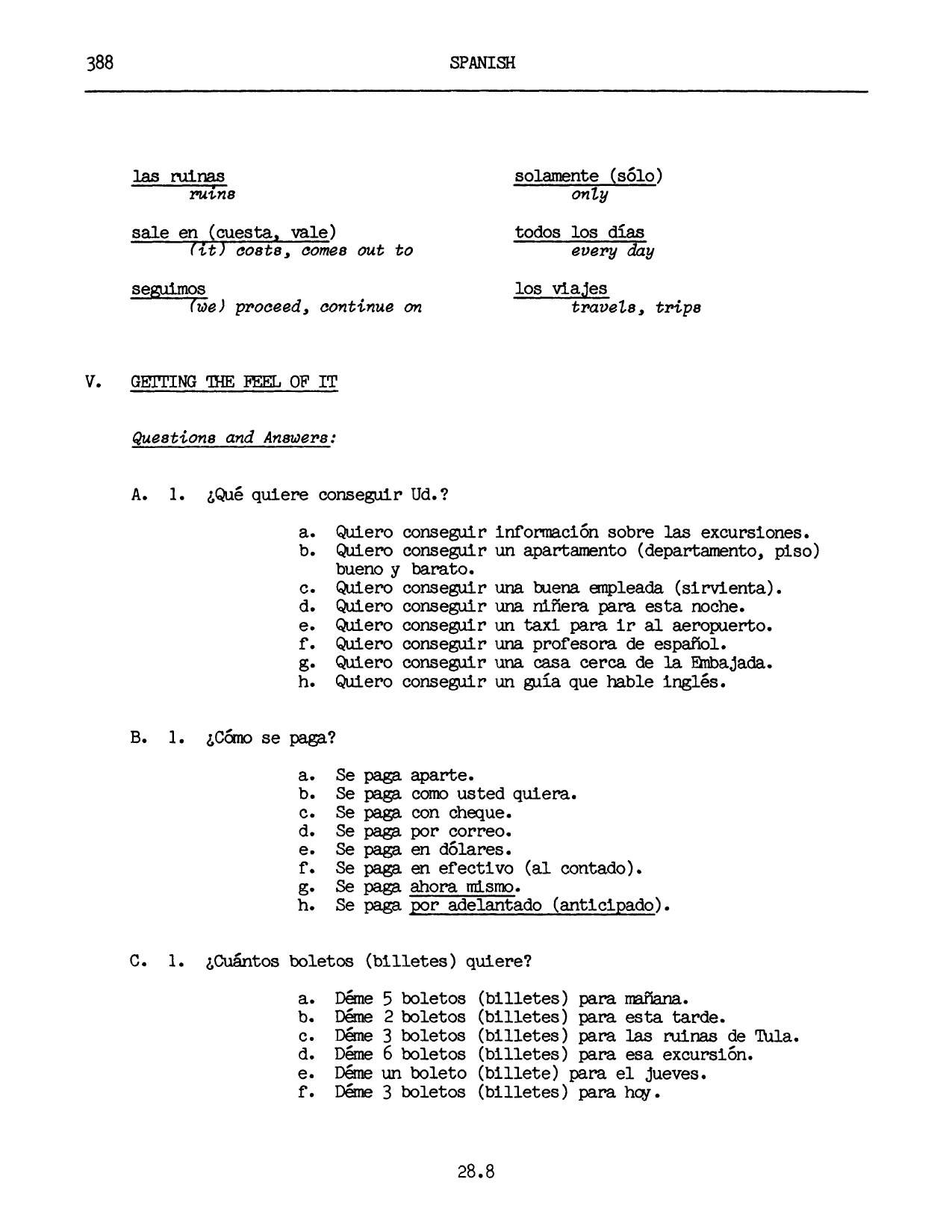
£. Déme 4 boletos (billetes) para el sábado.
h. Déme 2 boletos (billetes) para el viernes por la noche.
Si, viví ahí hace muchos años.
¿María Luisa vivió en Nueva York alguna vez?
Sí, vivió ahí hace mucho tiempo.
¿Ustedes vivieron en Nueva York alguna vez?
Sí, vivimos ahí por cinco años hasta 1975.
4. ¿Ellos vivieron en Nueva York alguna vez?
Sí, vivieron ahí hace diez años.
5. ¿Tú viviste en Nueva York alguna vez?
Sí, viví ahí cuando era niño/a.
E. 1. ¿El jefe decidió eso?
Si, el jefe lo decidió.
No, el jefe no lo decidió.
(El Embajador, María, ustedes, tú, él, ellos)
F, 1. ¿Usted recibió el cheque?
Sí, lo recibí.
No, no lo recibí.
(Maruel, tú, ustedes, ella, ellos)
Escribí cuatro.
No escribí ninguna.
(Ustedes, tú, ella, ellos, Luis)
H. l. ¿Usted permitió eso?
Sí, lo permití.
No, no lo permití.
(El jefe, tú, ellos, ustedes, ella)
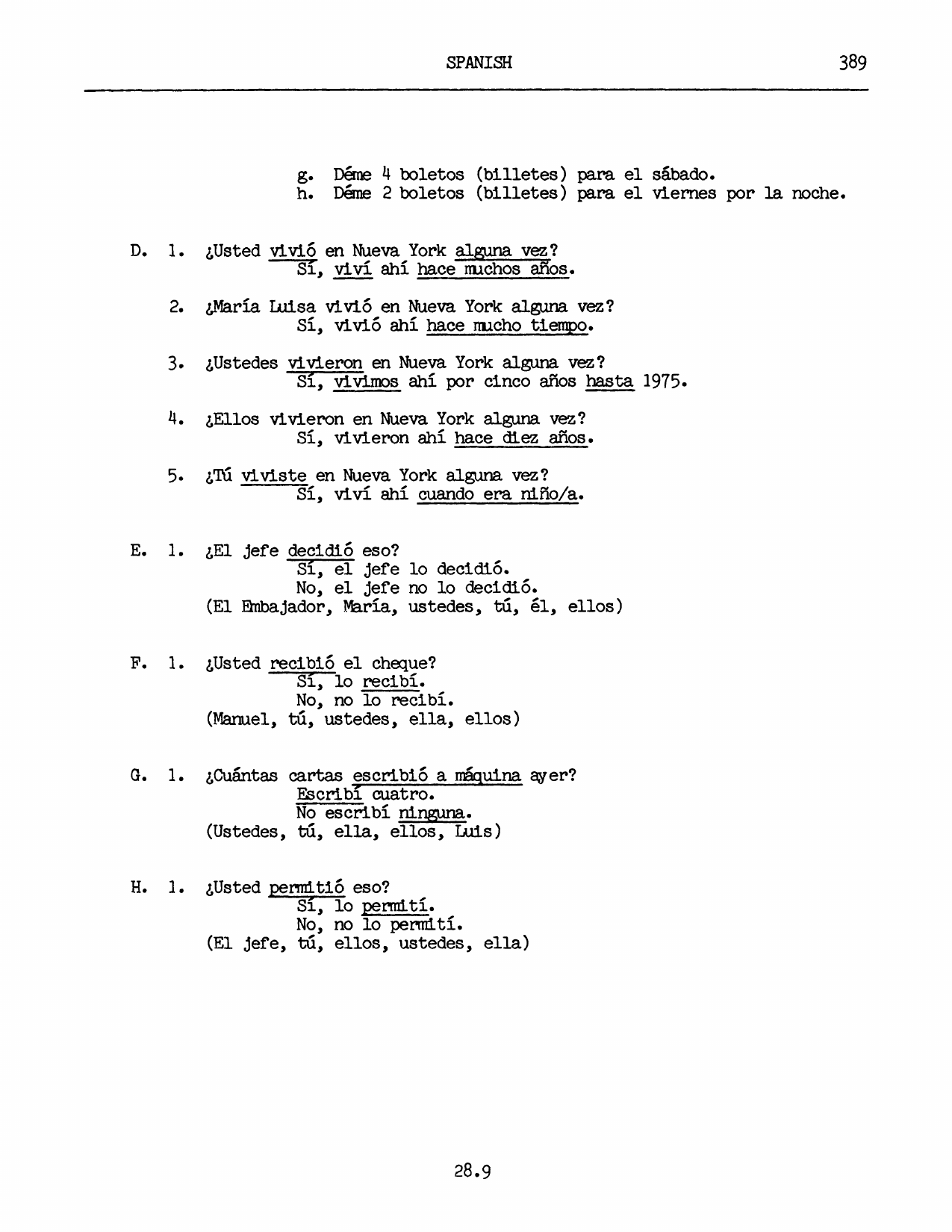
Questions and Answers: (continued)
A. 1. What would you like to get?
a. I would like to get some information about tours. b. I would like to get a good and inexpensive apartment. C. I would like to get a good mid.
d. I would like to get a baby-sitter for tonight. e. I would like to get a taxi to go to the airport. f. I would like to get a Spanish teacher.
ge I would like to get a house near the Embassy. h. I would like to get a guide who speaks English.
B. 1. How do you pay?
a. You pay separately.
b. You pay as you wish.
ce. You pay by check.
d. You pay by mil.
e. You pay in dollars.
f. You pay in cash.
g» You pay right now.
h. You pay in advance.
C. 1. How many tickets do you want?
a. Give me five tickets for tomorrow.
b. Give me two tickets for this afternoon.
Cc. Give me three tickets for the ruins at Tula. d. Give me six tickets for that tour.
e. Give me one ticket for Thursday.
f. Give me three tickets for today.
ge Give me four tickets for Saturday.
h. Give me two tickets for Friday night.
D. 1. Did you live in New York at one time?
Yes, I lived there many years ago.
2. Did María Luisa live in New York at one time?
Yes, she lived there a long time ago.
3. Did you (pl.) live in New York at one time?
Yes, we lived there for five years, up to 1975.
4. Did they live in New York at one time?
Yes, they lived there ten years ago.
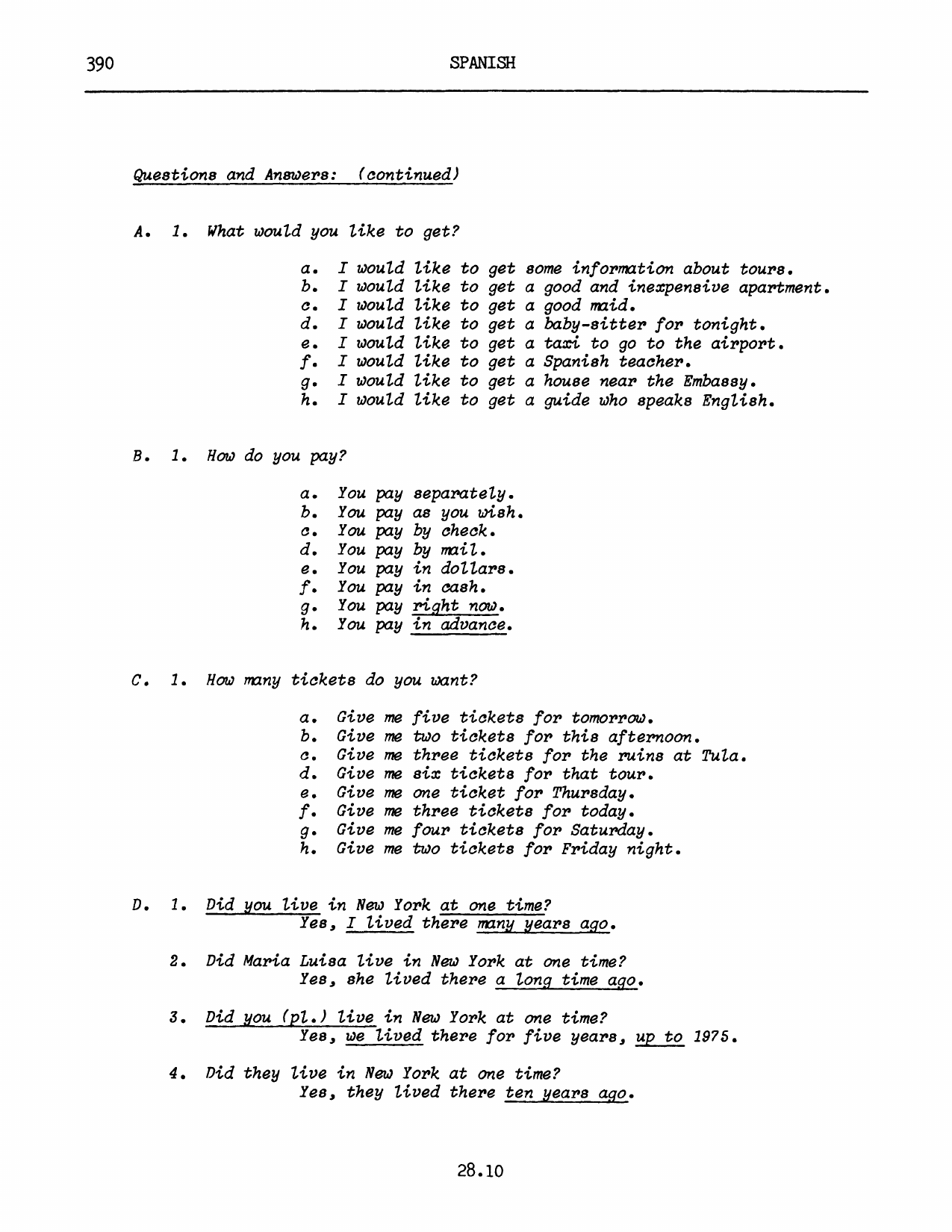
5. Did you live in New York at one time? (familiar)
Yes, I lived there when I was a child.
E. 1. Did the boss decide that?
Yes, the boss decided it.
No, the boss didn't decide it.
(The Ambassador, Maria, you (pl.), you (familiar), he, they)
F. 1. Did you receive the check?
Yes, I received it.
No, I didn't receive it.
(Manuel, you (familiar), you (pl.), she, they)
G. 1. How many letters did you type yesterday?
I wrote four.
I didn't write any.
(You (pl.), you (familiar), she, they, Luis)
H, 1. Did you allow that?
Yes, I allowed it.
No, I didn't allow it.
(The boss, you (familiar), they, you (pl.), she)
VI. PUTTING IT TOGETHER
Variants:
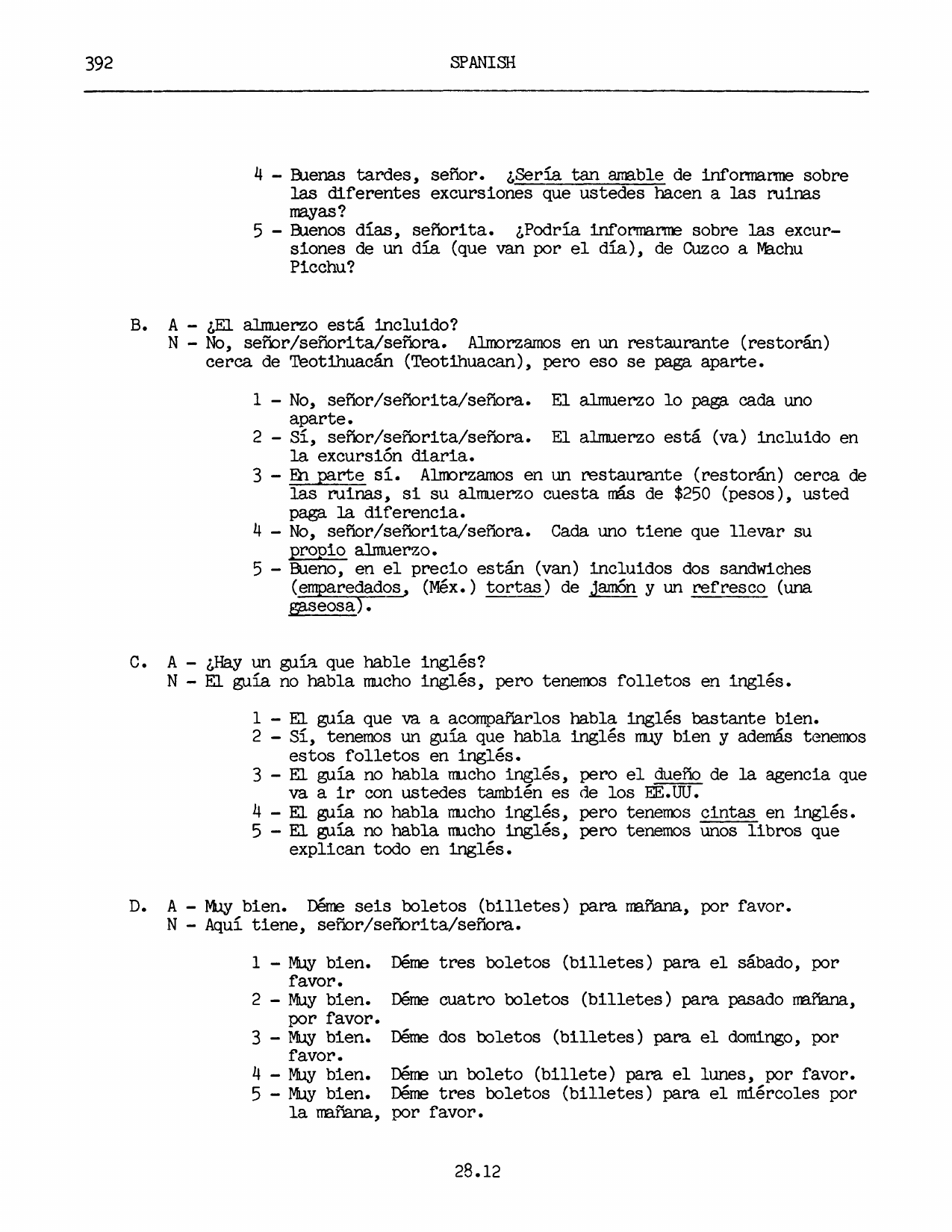
A. A - Buenos días, señorita. Necesito información sobre las excursiones a
las ruinas.
N - Si, señor/señorita/señora. Tenemos una que sale todos los días a las
ocho de la mañana para Teotihuacán (Teotihuacan) y Tula y está de regreso (vuelta) como a las ocho de la noche.
1 - Buenos días, señorita. ¿Ustedes hacen excursiones a las
ruinas de Tula?
2 — Buenas tardes, señorita. Necesito información sobre sus
viajes a la costa del Pacífico.
3 - Buenos días, señor. ¿Ustedes hacen excursiones a diferentes
lugares de interés en las afueras de la ciudad?
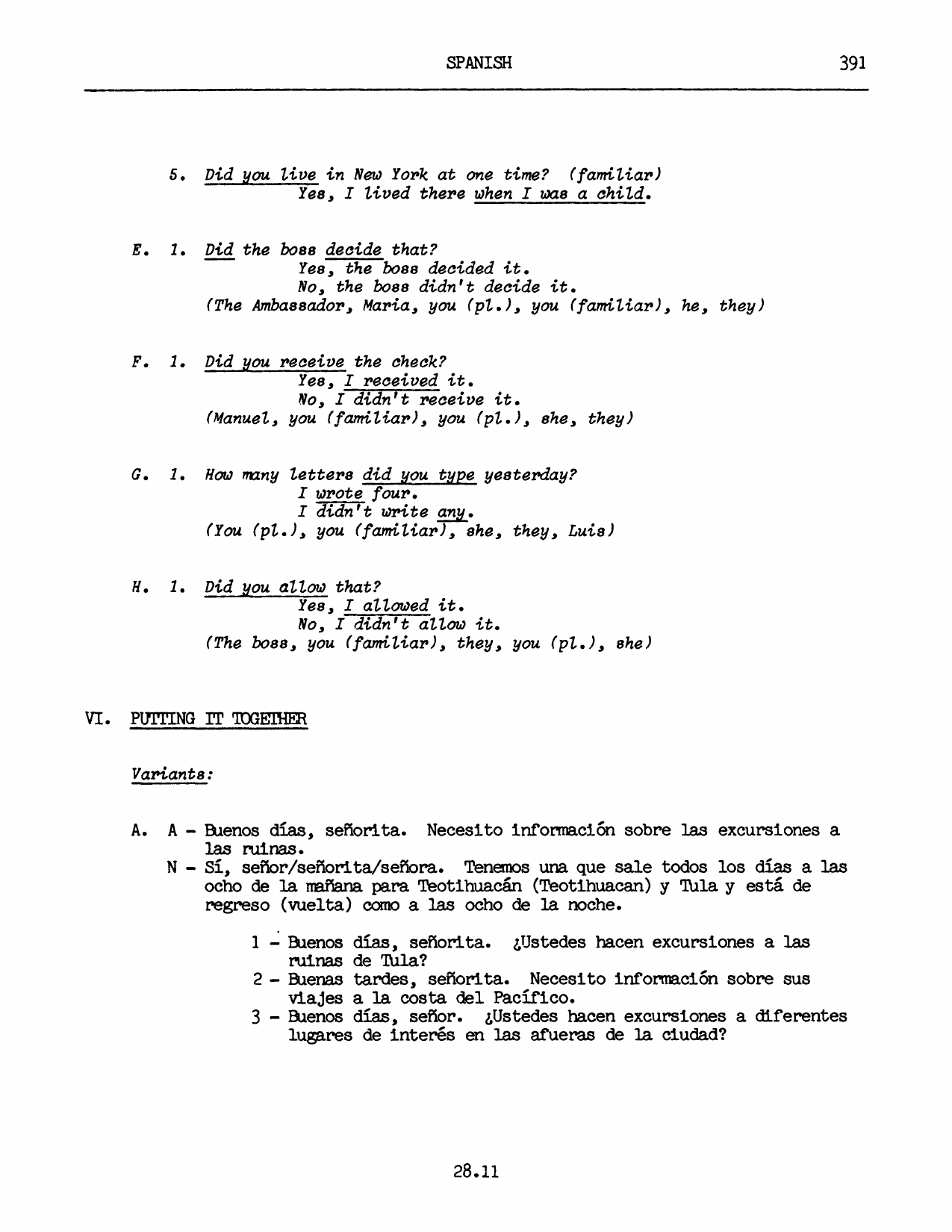
4 — Buenas tardes, señor. ¿Sería tan amable de informarme sobre
las diferentes excursiones que ustedes hacen a las ruinas mayas?
5 - Buenos días, señorita. ¿Podría informarme sobre las excur-
siones de un día (que van por el día), de Cuzco a Machu Picchu?
B. A = ¿El almerzo está incluido?
N - No, señor/señorita/señora. Almorzamos en un restaurante (restorán)
cerca de Teotihuacán (Teotihuacan), pero eso se paga aparte.
1 - No, señor/señorita/señora. El almuerzo lo paga cada uno
aparte.
2 - Sí, señor/señorita/señora. El almuerzo está (va) incluido en
la excursión diaria.
3 - En parte sí. Almorzamos en un restaurante (restorán) cerca de
las ruinas, si su almuerzo cuesta más de $250 (pesos), usted paga la diferencia.
4 — No, señor/señorita/señora. Cada uno tiene que llevar su
propio almuerzo.
5 — Bueno, en el precio están (van) incluidos dos sandwiches
(emparedados, (Méx.) tortas) de jamón y un refresco (una gaseosa).
C. A — ¿Hay un guía que hable inglés?
N - El guía no habla mucho inglés, pero tenemos folletos en inglés.
1 - El guía que va a acompañarlos habla inglés bastante bien. 2 - Si, tenemos un guía que habla inglés my bien y además tenemos
estos folletos en inglés.
3 - El guía no habla mucho inglés, pero el dueño de la agencia que
va a ir con ustedes también es de los EE.UU.
4 — El guía no habla mucho inglés, pero tenemos cintas en inglés. 5 - El guía no habla mucho inglés, pero tenemos unos libros que
explican todo en inglés.
D. A — Muy bien. Déme seis boletos (billetes) para mañana, por favor.
N = Aquí tiene, señor/señorita/señora .
1 - May bien. Déme tres boletos (billetes) para el sábado, por
favor.
2 —- Muy bien. Déme cuatro boletos (billetes) para pasado mañana,
por favor.
3 - Muy bien. Déme dos boletos (billetes) para el domingo, por
favor.
4 — Muy bien. Déme un boleto (billete) para el lunes, por favor. 5 - Muy bien. Déme tres boletos (billetes) para el miércoles por
la mañana, por favor.
Variants: (continued)
A. A - Good morning, miss. I need some information about tours to the rutne.
N - Yes, str/miss/ma'am. We have one that leaves every day at eight
o'clock in the morning for Teotihuacan and Tula and gets back at about eight o'clock in the evening.
1 - Good morning, miss. Do you (pl.) make tripe to the ruins at
Tula?
2 - Good afternoon, miss. I need information on your trips to
the Pacific coast.
3 - Good morning, sir. Do you (pl.) make trips to different
points of interest on the outekirte of the city?
4 - Good afternoon, sir. Would you be so kind ae to inform me
about the various tours that you (pl.) have to the Mayan ruins?
5 - Good morning, miss. Could you tell me about your day trips
from Cuzco to Machu Piechu?
B. A- Is lunch included?
N - No, sir/miss/ma'am. We shall have lunch at a restaurant near
Teotihuacan, but you pay for that separately.
1 - No, sir/miss/ma'am. Each person pays for his/her lunch
separately.
2 - Yes, str/miss/ma'am. Lunch ts included in the daily trip. 3 - Part of it ts. We shall have lunch at a restaurant near the
ruins; tf your lunch ts more than $250 (pesos), you pay the difference.
4 - No, sir/miss/ma'am. Everyone has to take his/her own lunch. 5 - Well, two ham sandwiches and a soft drink are included in the
price.
C. A - Is there a guide who speaks English?
N - The guide doesn't speak much English, but we have brochures in English.
1 - The guide who will accompany you (pl.) speaks English fairly
well.
2 - Yes, we have a guide who speaks English very well; further
more, we have these brochures in English.
3 - The guide doesn't speak much English, but the owner of the
agency, who is also going to go with you (pl.), ts from the United States.
4 - The guide doesn't speak much English, but we have tapes in
English.
5 - The guide doesn't speak much English, but we have some books
that explain everything in English.
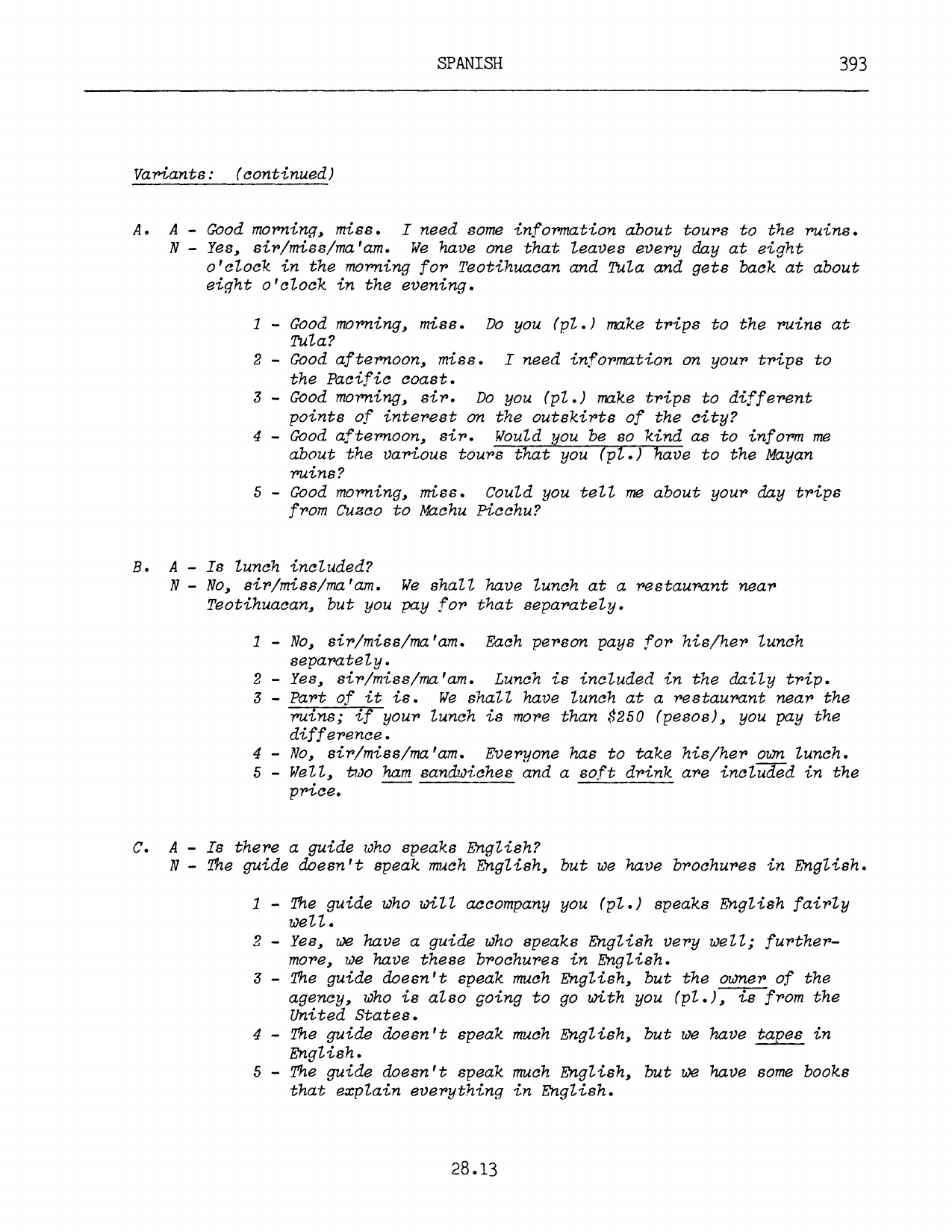
D. A - Very well. Give me six tickets for tomorrow, please.
N - Here you are, sir/miss/ma'am.
1 - Very well. Give me three tickets for Saturday, please. 2- Very well. Give me four tickets for the day after tomorrow,
please.
3 - Very well. Give me two tickets for Sunday, please. 4 - Very well. Give me one ticket for Monday, please. 5 - Very well. Give me three tickets for Wednesday morning,
please.
VII. MAKING IT WORK
VIII. USING IT