CYCLE 29
GETTING OUT
Sports
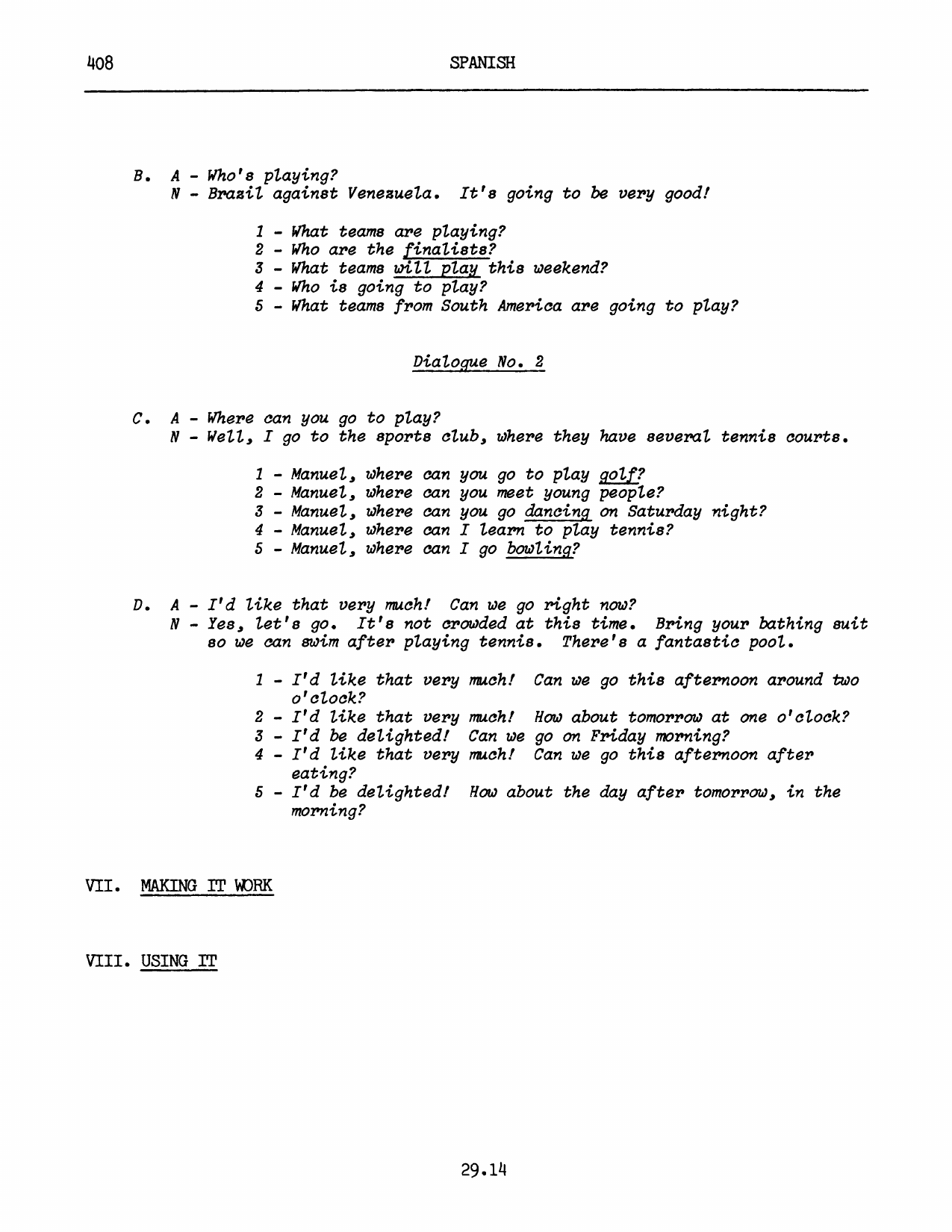
Sports play an important part in everyday life in Spain and Latin America.
Soccer is played in all Spanish-speaking countries and can definitely be considered the national sport of these countries. Baseball and tennis are also quite popular, but they can't rival the popularity of soccer.
While Americans often think of bullfighting as a sport, Spaniards and Latin
Americans think of it as an art form where man and beast are pitted one against the other in a life and death ritual. The bullfighter risks his/her life while the bull either wins out or dies defending himself. Bullfighting is not practiced in every Spanish-speaking country and, even in those countries where it is found (i.e., Spain, Mexico, Venezuela, Colombia, Ecuador, and Peru), it is not as popular as it once was.
This page has a drawing, chart, or fill-in layout — original page
I. SETTING THE SCENE (A)
You are interested in going to a soccer match and ask a friend to give you some information on an upcoming game.
II. HEARING IT (A)
III. SEEING IT (A)
Dialogue No. 1:
Los deportes - el fútbol (fútbol, balompié)
A — Maruel, ¿hay un partido de fútbol (fútbol, balompié) este fin de semana? N - Sí, en el Estadio Nacional, el sábado.
A —- ¿Quiénes juegan?
N - Brasil contra Venezuela. ¡Va a ser my bueno!
A - ¿SÍ? ¿Cómo puedo conseguir entradas?
N - Ve a la taquilla (boletería) dos horas antes del partido porque tienes que
hacer cola.
A — ¿Cuál equipo es el mejor?
N - Los dos son buenos, pero yo prefiero al de Brasil.
A - Si te interesa, te invito.
N - ¡Ah! Muchas gracias. ¡Qué amable!
Dialogue No. 1: (continued)
Sports - soccer
A - Manuel, is there going to be a soccer game this weekend?
N - Yes, at the National Stadium, on Saturday.
A - Who's playing?
N - Brazil against Venezuela. It's going to be very good!
A - Really? How can I get tickets?
N - Go to the box office two hours before the game because you have to
stand in line. (familiar)
A - Which team is better?
(2)(3) N - Both are good, but I prefer Brazil's.
A - If you're interested, you're invited!
N - Oh! Thank you very much. How kind!
I. SETTING THE SCENE (B)
You would like to find out where you can go to play tennis and swim, so you ask a friend to give you some suggestions.
II. HEARING IT (B)
III. SEEING IT (B)
Dialogue No. 2:
Los deportes - el tenis y la natación
A —- Manuel, ¿tú prácticas algún deporte?
N - Sí. Me gusta nadar y jugar tenis. ¿Y tú?
A - A mí también me gusta nadar, pero en tenis no soy my bueno. ¿Adónde se
puede ir a jugar?
N - Bueno, yo voy al club deportivo, donde hay varias canchas de tenis.
A — ¿Hay que ser socio?
N - Bueno, la primera vez puedes ir como invitado mío, y después decides si
quieres hacerte socio.
A — ¡Me gustaría mucho! ¿Vamos ahora mismo?
N - Sí, vamos. A esta hora no hay mucha gente. Lleva tu traje de baño (Perú-
ropa de baño) para que nademos después de jugar tenis. Hay una piscina (pileta, Méx. alberca) fantástica.
A —- Espérame un minuto. Voy a buscarlo.
Dialoque No. 2: (continued)
Sports - tennis and swimming
(7) A - Manuel, do you participate in any sports?
(5) N - Yes. I like to swim and play tennis. And you?
A - I like to swim, too, but I'm not very good at tennis. Where can you go
to play?
N - Well, I go to the sports club, where they have several tennis courts. A - Do you have to be a member?
(4) N - Well, the first time you can go as my guest, and later you can decide
whether you would like to become a member.
A - I'd like that very mich! Can we go right now?
N - Yes, let's go. It's not crowded at this time. Bring your bathing suit
so we can swim after playing tennis. There's a fantastic pool.
(6) A - Wait for me just a minute. I'll go get it.
Language Notes
1. fútbol o balompié
Soccer is called fútbol or (less commonly) balompié in Spanish. With re-
gard to the word fútbol, some people stress the first syllable (like the English
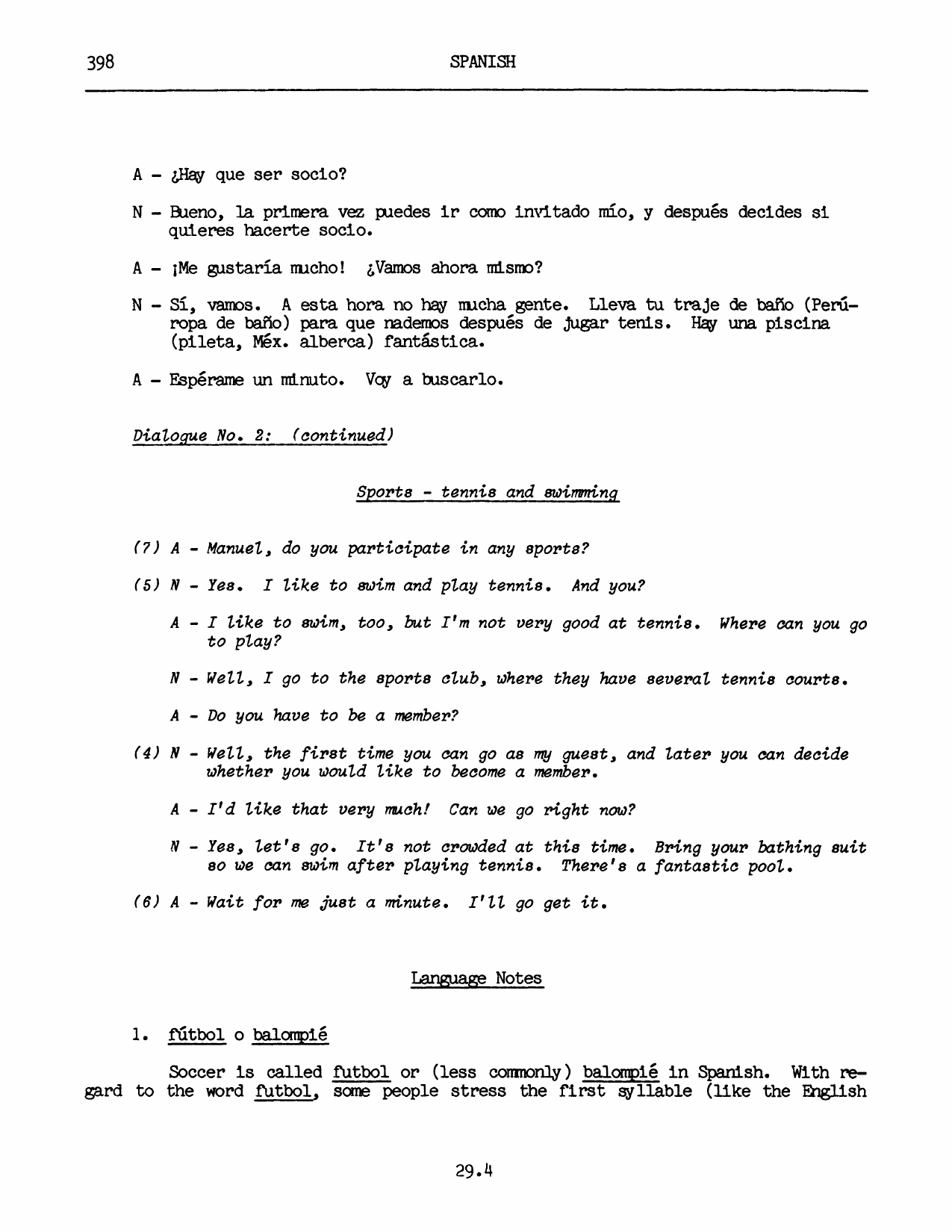
word), and they then write the word with an accent mark: fútbol. Other people stress the second syllable ('fut-BOL'); in this case, the accent is not used: fut-bol. "Football" as played in the States is referred to as fútbol americano.
2. los dos
This is the short version of the full phrase los dos equipos. We have
translated los dos as "both." There is a word for "both": ambos (or ambas), but los dos is common. In fact, you can say los tres, los cuatro, etc. For example,
3. In Spanish there are several ways of expressing the equivalent of the
idiomatic English term "to root" (e.g., for a team), and these vary from country to country. Some common examples are: (yo) voy por, (yo) estoy con, (yo) le voy a, and (yo) estoy a favor de. (Ask your teacher which expression is used in his/her country.
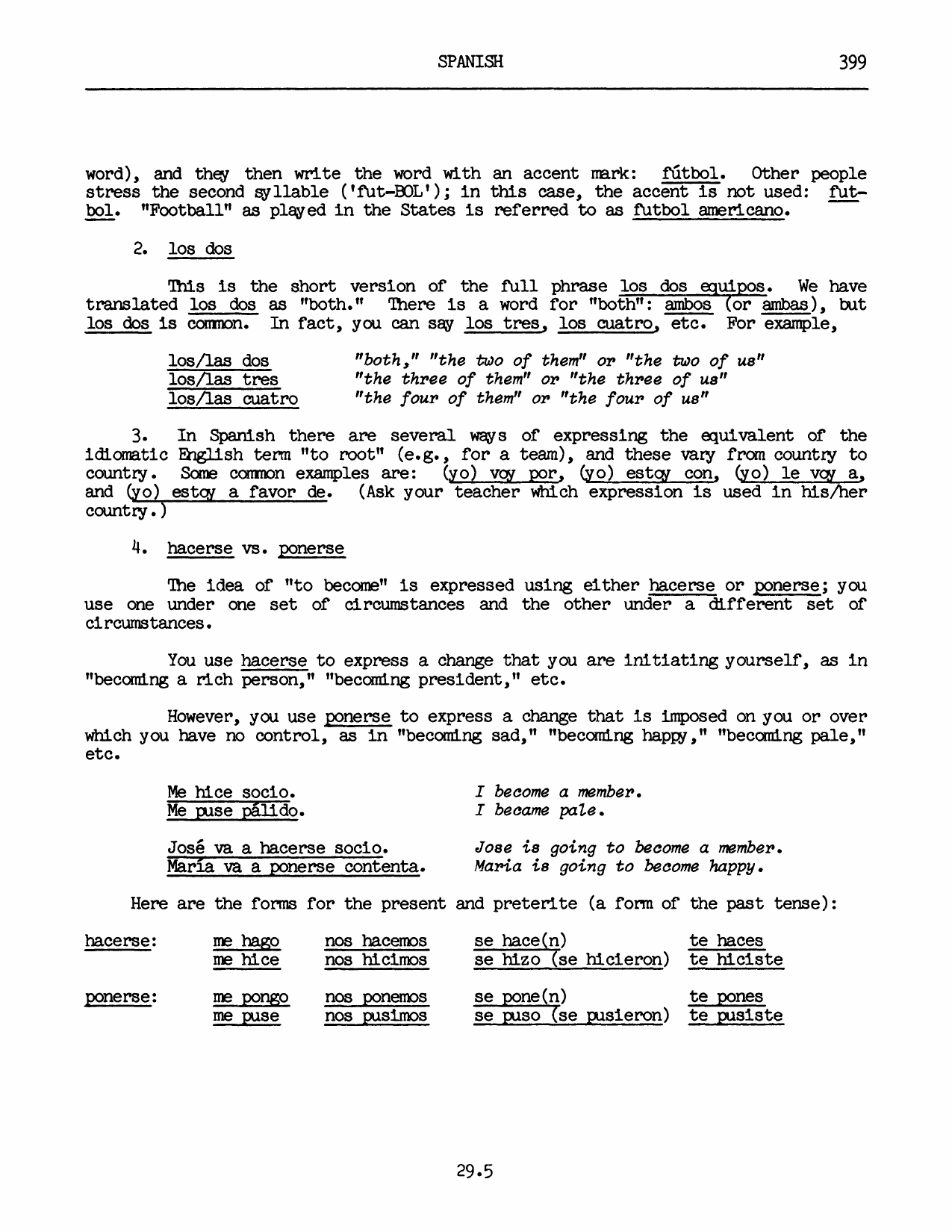
4, hacerse vs. ponerse
The idea of "to become" is expressed using either hacerse or ponerse; you
use one under one set of circumstances and the other under a different set of circumstances.
You use hacerse to express a change that you are initiating yourself, as in
"becoming a rich person," "becoming president," etc.
However, you use ponerse to express a change that is imposed on you or over
which you have no control, as in "becoming sad," "becoming happy," "becoming pale," etc.
Here are the forms for the present and preterite (a form of the past tense):
5. le gusta
In Spanish the idea of "liking" is expressed by using gustar; the structure
used is the reverse of that used in English, but the meaning is the same.
The structure of me gusta eso, for example, is "that is pleasing to me"
(or, literally, "to me is pleasing that"), but the translation is simply, "I líke that." Until you get used to it, you will have to remember the grammatical struc-ture. For example, you should not say me gusta las comidas típicas, but you should instead say me gustan las comidas típicas, since the structure is "typical foods are pleasing to m."
It is not difficult to get used to this. If you want to say "I like,"
remember that you will say me gusta or me gustan, depending on whether you like one thing or more than one thing. For example,
Me gustan (las oficinas)
Nos gustan (las oficinas)
Le gustan (las oficinas)
Les gustan (las oficinas)
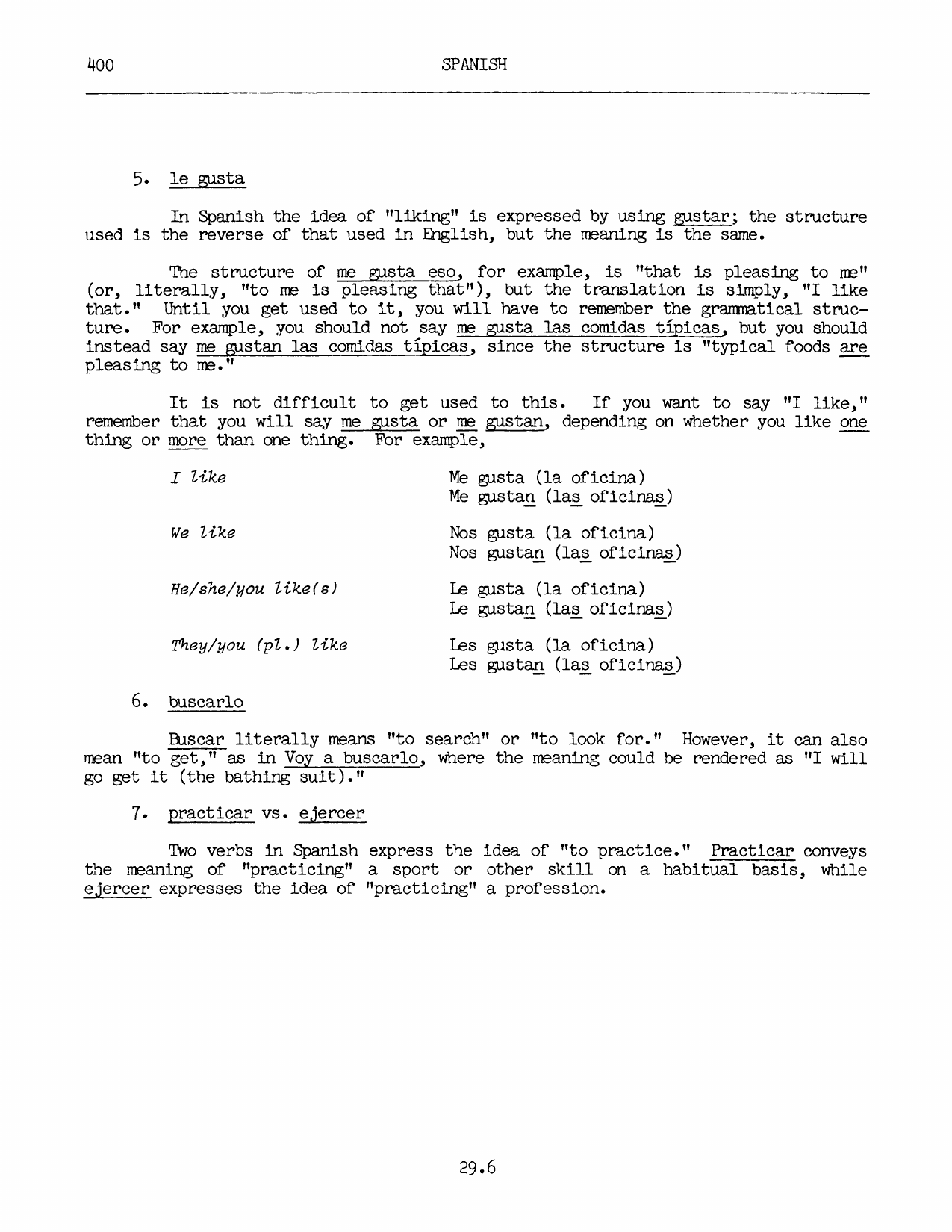
6. buscarlo
Buscar literally means "to search" or "to look for." However, it can also
mean "to get," as in Voy a buscarlo, where the meaning could be rendered as "I will go get it (the bathing suit)."
7. practicar vs. ejercer
Two verbs in Spanish express the idea of "to practice." Practicar conveys
the meaning of "practicing" a sport or other skill on a habitual basis, while ejercer expresses the idea of "practicing" a profession.
Narrative No. 1:
Los deportes - el fútbol (fútbol, balompié)
A usted le interesa ver un partido (juego) de fútbol (fútbol, balompié) latino-americano. Su amigo Manuel le dice que hay uno de Brasil contra Venezuela este fin de semana, y que va a ser muy bueno. Para conseguir entradas (los boletos) hay que hacer cola dos horas antes del partido. Según Maruel, los dos equipos son buenos, pero él prefiere al de Brasil. Usted invita a Mamel al partido y él acepta su invitación.
Questions:
1 = ¿Qué le interesa a usted?
What are you interested in?
2 - ¿Hay un partido de fútbol (fútbol, balompié) este fin de semana?
Is there a soccer game this weekend?
3 - ¿Qué hay que hacer para conseguir (las) entradas (los boletos)?
What do you have to do to get tickets?
4 - ¿Cuánto tiempo tiene que hacer cola?
How long do you have to wait in line?
5 - ¿Qué equipos juegan?
What teams are playing?
6 — ¿Cómo son los dos equipos?
What are the two teams like?
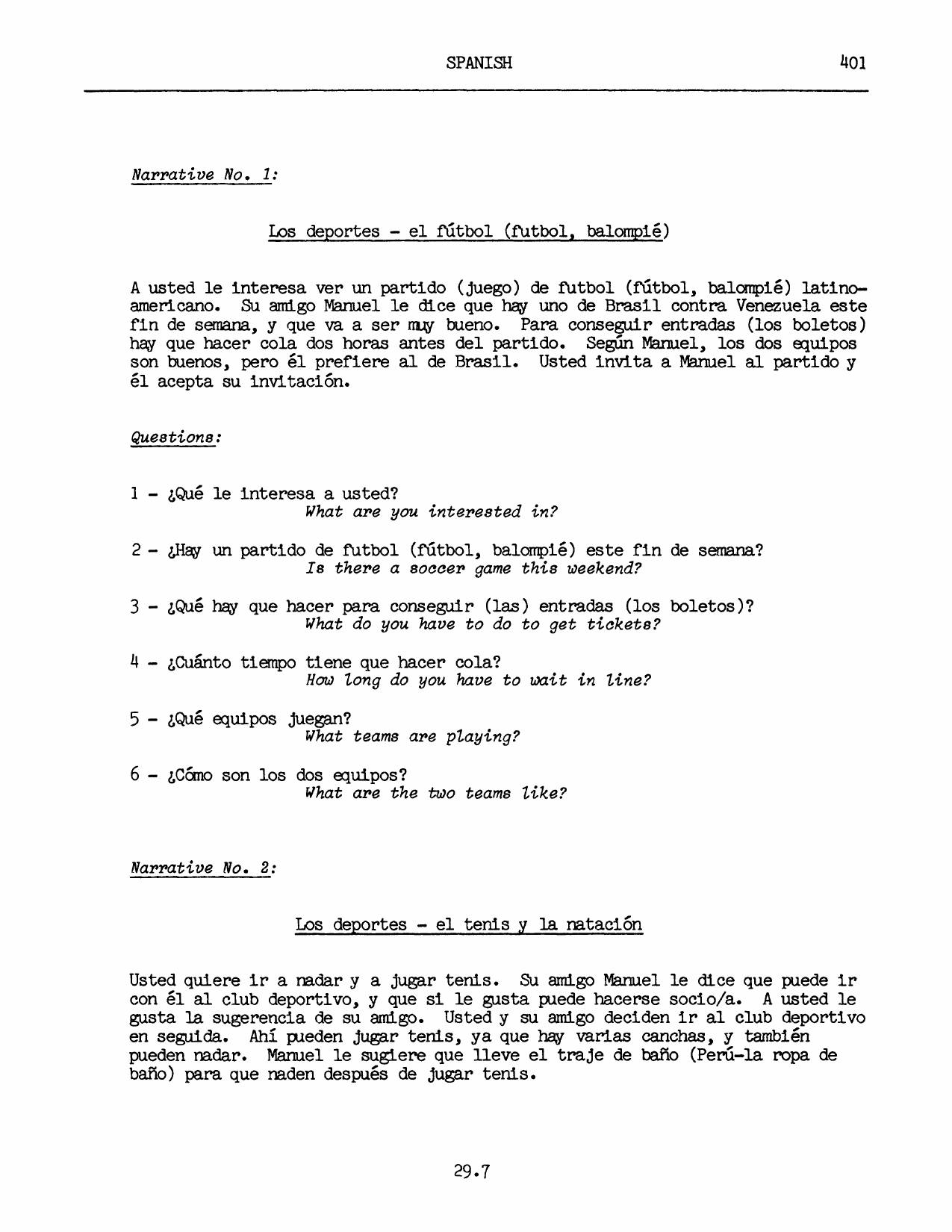
Narrative No. 2:
Los deportes - el tenis y la natación
Usted quiere ir a nadar y a jugar tenis. Su amigo Manuel le dice que puede ir con él al club deportivo, y que si le gusta puede hacerse socio/a. A usted le gusta la sugerencia de su amigo. Usted y su amigo deciden ir al club deportivo en seguida. Ahí pueden jugar tenis, ya que hay varias canchas, y también pueden nadar. Maruel le suglere que lleve el traje de baño (Perú-la ropa de baño) para que naden después de jugar tenis.
Questions:
1 = ¿Qué quiere hacer usted?
What do you want to do?
2 - ¿Qué le dice su amigo Mamel?
What does your friend Manuel tell you?
3 = ¿Qué tiene que hacer usted para hacerse socio/a?
What do you have to do to become a member?
4 — ¿Qué le gusta a usted?
What do you like?
5 - ¿Qué deciden hacer usted y su amigo?
What do you and your friend decide to do?
6 - ¿Qué le sugiere Manuel?
What does Manuel suggest?
IV. TAKING IT APART
Vocabulary:
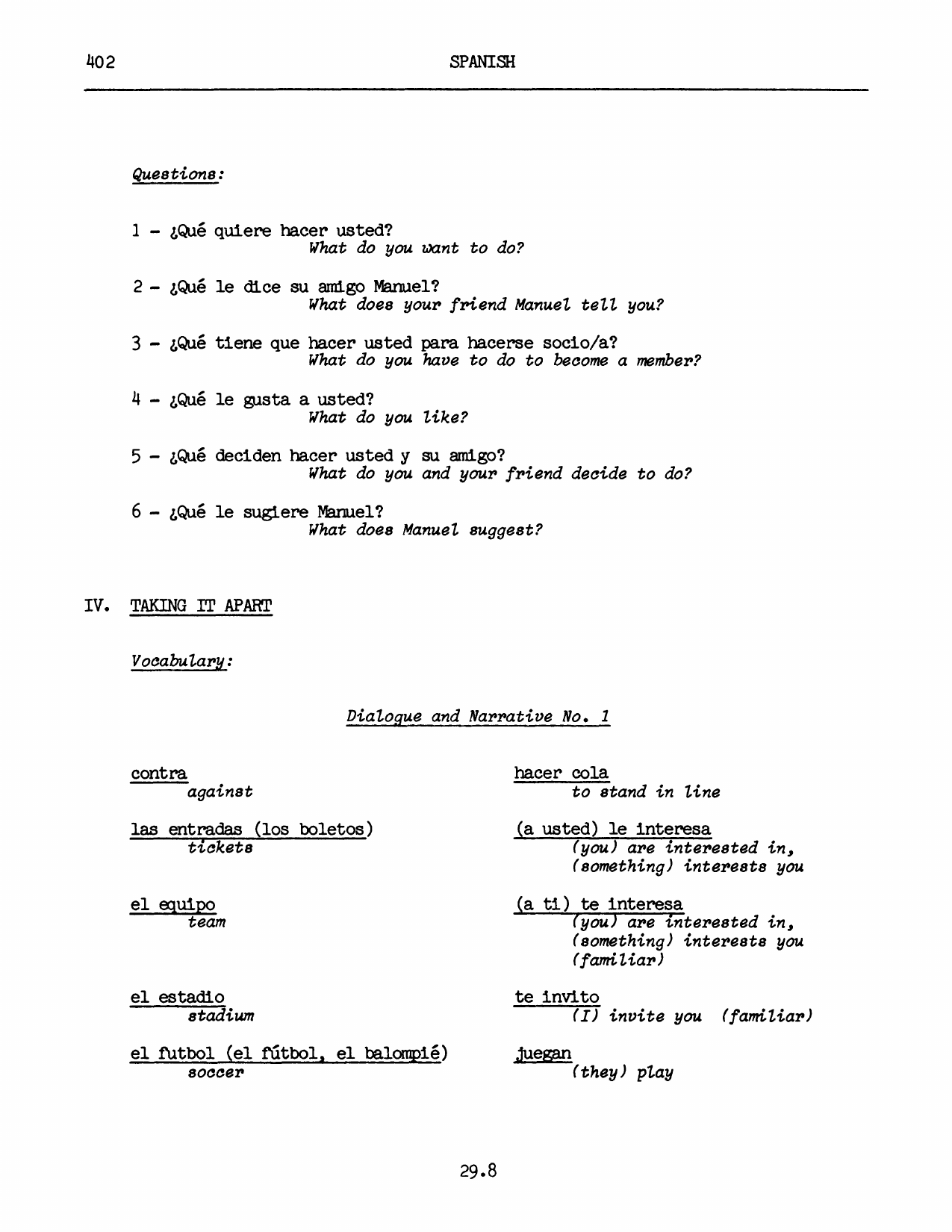
Dialogue and Narrative No. 1
(something) interests you
(something) interests you (familiar)
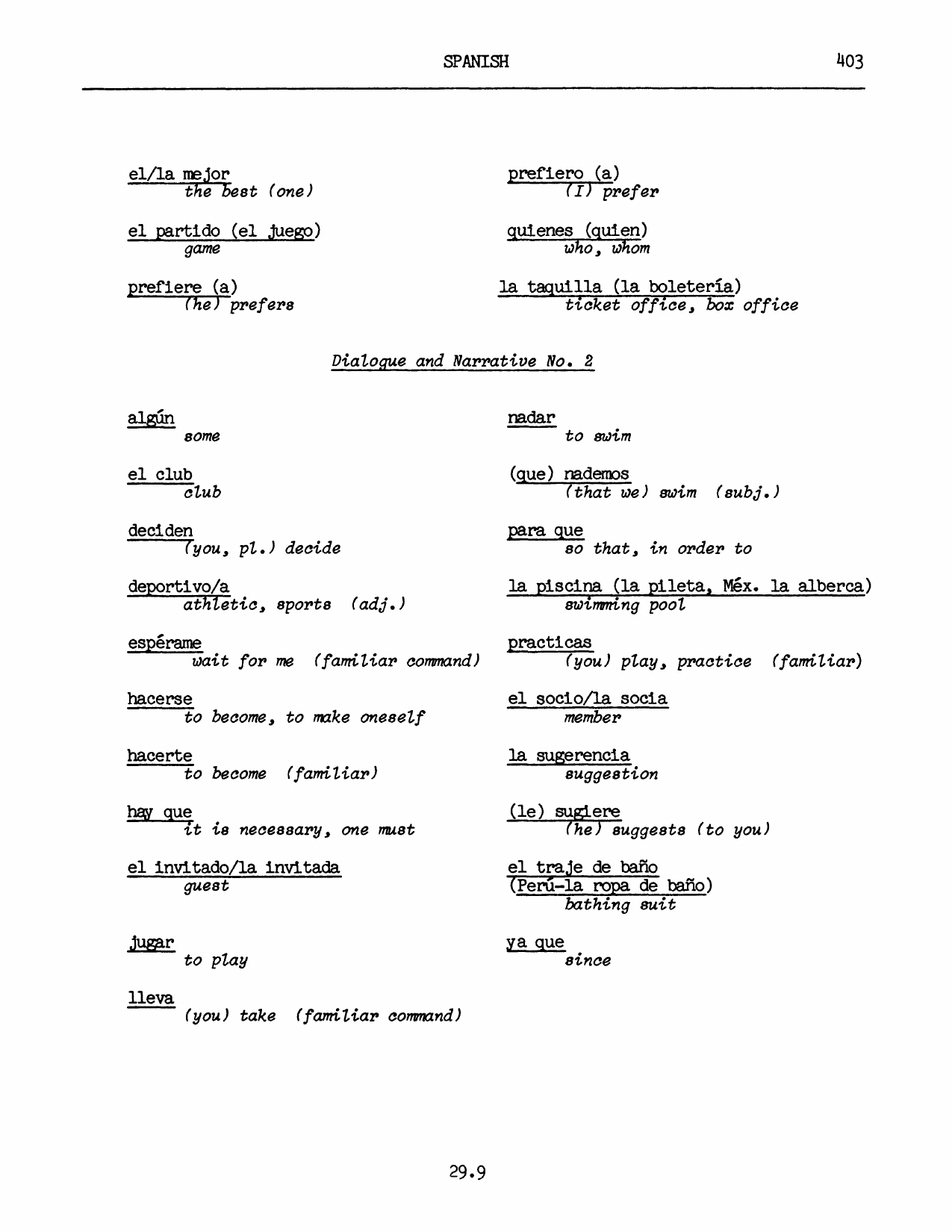
Dialogue and Narrative No. 2
bathing suit
lleva
(you) take (familiar command)
V. GETTING THE FEEL OF IT
Questions and Answers:
A. 1. ¿Qué le interesa a Ud.?
a. (A mí) me interesa ver un partido (juego) de fútbol. b. (A mí) me interesa ir a las playas del norte. C. (A mí) me interesa comprar unos regalos típicos. d. (A mí) me interesa encontrar un apartamento
(departamento, piso).
e. (A mí) me interesa probar la comida chilena. f. (A mí) me interesa saber cómo se celebra la Navidad. g. (A mí) me interesa conocer a los padres de María Luisa. h. (A mí) me interesa vender mi carro (coche, auto).
B. 1. ¿Qué hay este fin de semana?
a. Hay un partido de fútbol (fútbol, balompié). b. Hay una fiesta.
C. Hay una excursión a las ruinas.
d. Hay un baile.
e. Hay un desfile.
f. Hay una corrida de toros.
g- Hay un concierto.
h. Hay un campeonato de tenis.
C. 1. ¿Qué quiere hacer Ud. ?
a. Quiero ir a nadar.
b. Quiero ir a jugar tenis.
C. Quiero hacerme socio del club.
d. Quiero llenar la solicitud para el club.
e. Quiero hablar español bien.
f. Quiero ir a la playa con Maria Luisa.
g Quiero tomar cerveza.
h. Quiero ir a la fiesta de Manuel.
D. 1. ¿Qué (le) sugiere su amigo?
a. Mi amigo (me) sugiere que vaya con él al club. b. Mi amigo (me) sugiere que me haga socio del club. c. Mi amigo (me) sugiere que presente el pasaporte. d. Mi amigo (me) suglere que consiga dos cartas de
recomendación.
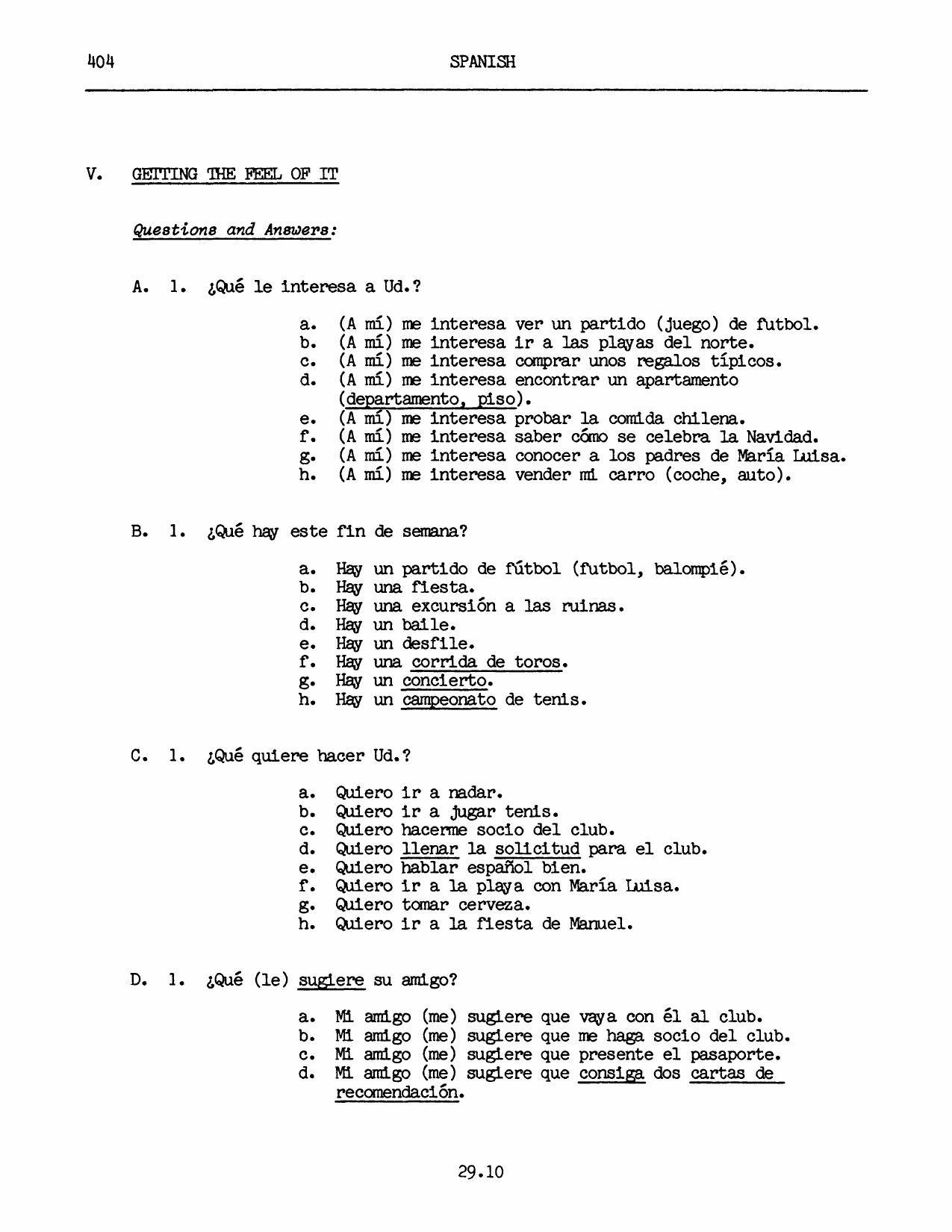
e. Mi amigo (me) sugiere que vaya a jugar tenis con él. f. Mi amigo (me) sugiere que estudie más.
g£. Mi amigo (me) sugiere que visite el museo. h. Mi amigo (me) sugiere que vaya a nadar al club.
E. 1. ¿Qué van a hacer ustedes?
a. Mi amigo y yo vamos a ir al club.
b. Mi amigo y yo vamos a ir a un partido (juego) de fútbol. C. Mi amigo y yo vamos a preparar una comida peruana. d. Mi amigo y yo vamos a ir a una excursión.
e. Mi amigo y yo vamos a hablar con el Cónsul. f. Mi amigo y yo vamos a llenar una solicitud. g Mi amigo y yo vamos a tener una entrevista. h. Mi amigo y yo vamos a estudiar español.
Questions and Answers: (continued)
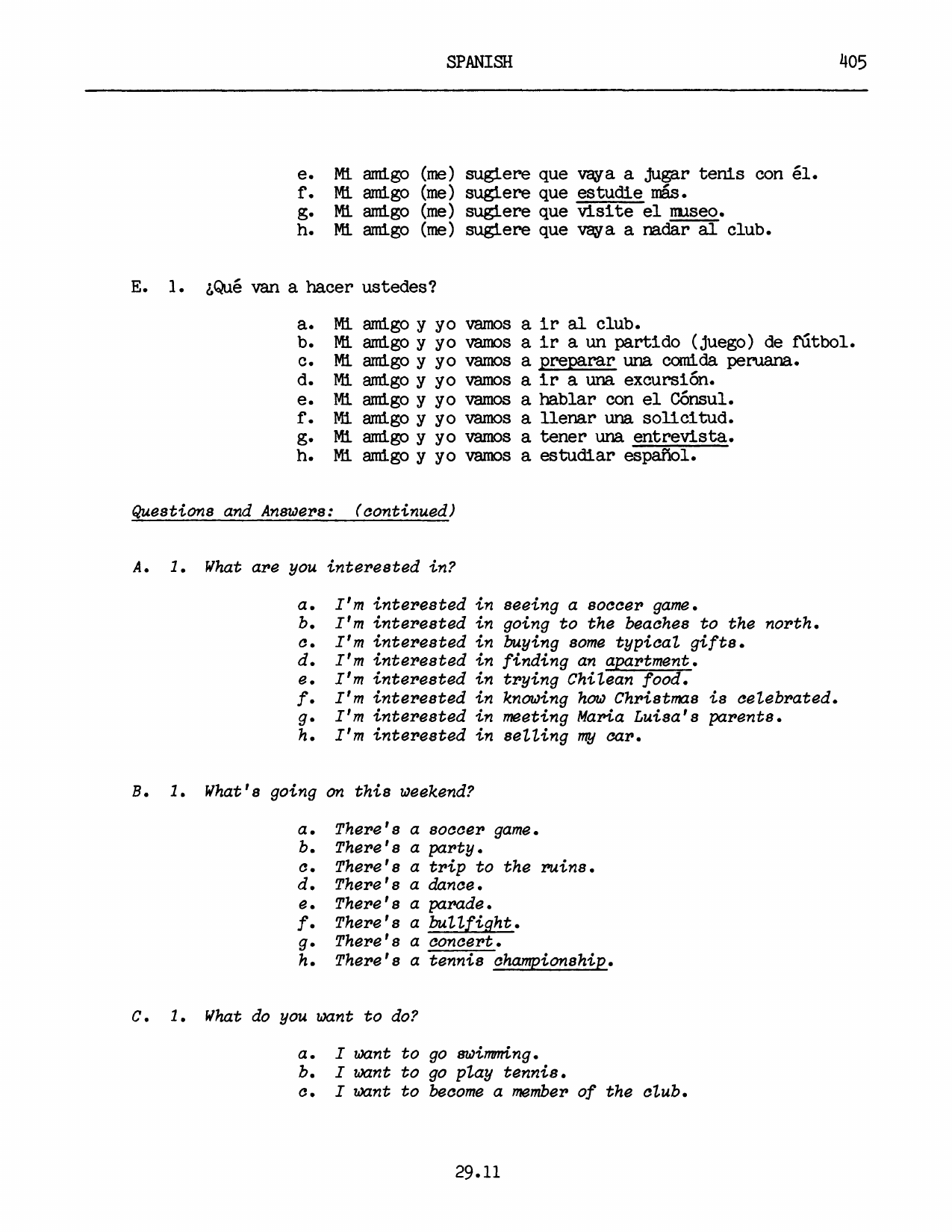
A. 1. What are you interested in?
a. I'm interested in seeing a soccer game.
b. I'm interested in going to the beaches to the north. C. I'm interested in buying some typical gifts. d. I'm interested in finding an apartment.
e. I'm interested in trying Chilean food.
f. I'm interested in knowing how Christmas is celebrated. ge I'm interested in meeting Maria Luisa's parents. h. I'm interested in selling my car.
B. 1. What's going on this weekend?
a. There's a soccer game.
b. There's a party.
C. There's a trip to the ruins.
d. There's a dance.
e. There's a parade.
f. There's a bullfight.
ge There's a concert.
h. There's a tennis championship.
C. 1. What do you want to do?
a. I want to go swimming.
b. I want to go play tennis.
C. I want to become a member of the club.
d. I want to fill out the application for the club. e. I want to speak Spanish well.
f. I want to go to the beach with Maria Luisa. ge I want to drink beer.
h. I want to go to Manuel's party.
D. 1. What does your friend suggest (to you)?
a. My friend suggests that I go with him to the club. b. My friend suggests that I become a member of the club. C. My friend suggests that I show my passport. d. My friend suggests that I get two letters of
recommendation.
e. My friend suggests that I go play tennis with him. f. My friend suggests that I study more.
g. My friend suggests that I visit the museum. h. My friend suggests that I go swimming at the club.
E. 1. What are you (pl.) going to do?
a. My friend and I are going to go to the club. b. My friend and I are going to go to a soccer game. C. My friend and I are going to prepare a Peruvian dinner. d. My friend and I are going to go on a trip. e. My friend and I are going to speak with the Consul. f. My friend and I are going to fill out an application. g» My friend and I are going to have an interview. h. My friend and I are going to study Spanish.
VI. PUTTING IT TOGETHER
Variante:
Dialogue No. 1
A. A — Manuel, ¿hay un partido de fútbol (fútbol, balompié) este fin de
semana?
N - Sí, en el Estadio Nacional, el sábado.
1 —- ¿Hay un desfile este fin de semana?
2 - ¿Hay un concierto este fin de semana?
3 — ¿Hay un campeonato de tenis este fin de semana? 4 — ¿Hay una corrida de toros este fin de semana?
5 - ¿Hay fuegos artificiales este fin de semana?
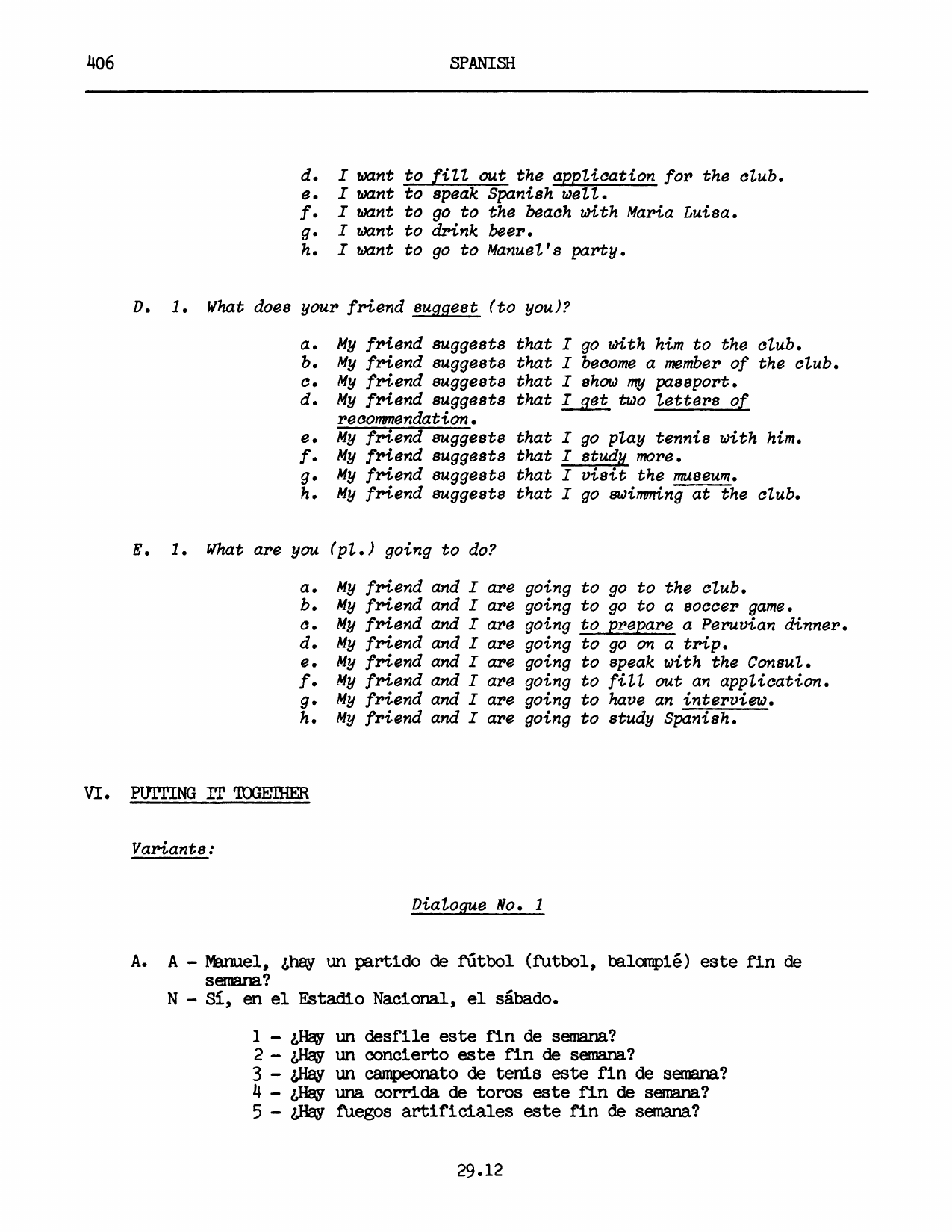
B. A= ¿Quiénes juegan?
N - Brasil contra Venezuela. ¡Va a ser my bueno!
1 = ¿Qué equipos juegan?
2 - ¿Quiénes son los finalistas?
3 — ¿Qué equipos jugarán este fin de semana?
y — ¿Quién va a jugar?
5 - ¿Qué equipos de Sudamérica (Suramérica) van a jugar?
Dialogue No. 2
C. A — ¿Adónde se puede ir a jugar?
N - Bueno, yo voy al club deportivo, donde hay varias canchas de tenis.
] - Manuel, ¿adónde se puede ir a jugar (al) golf?
2 - Manuel, ¿dónde se puede conocer gente joven?
3 - Maruel, ¿adónde se puede ir a bailar los sábados por la noche? 4 — Maruel, ¿dónde puedo aprender a jugar tenis?
5 ~ Maruel, ¿adónde puedo ir a jugar a los bolos (a jugar
boli che)?
D. A — ¡Me gustaría mcho! ¿Vamos ahora mismo?
N - Si, vamos. A esta hora no hay mucha gente. Lleva tu traje de baño
(Perú-la ropa de baño) para que nademos después de jugar tenis. Hay una piscina (pileta, Méx. alberca) fantástica.
1 — ¡Me gustaría mucho! ¿Podemos ir esta tarde como a las dos? 2 - ¡Me gustaría mucho! ¿Qué tal mañana a la una?
3 - ¡Me encantaría! ¿Podemos ir el viernes por la mañana? 4 — ¡Me gustaría mucho! ¿Vamos esta tarde después de comer? 5 —- ¡Me encantaría! ¿Qué tal pasado mañana por la mañana?
Variants: (continued)
Dialogue No. 1
A. A - Manuel, ts there going to be a soccer game this weekend?
N - Yes, at the Nattonal Stadium, on Saturday.
1 - Is there going to be a parade this weekend?
2 - Is there going to be a concert this weekend?
3 - Is there going to be a tennis championship this weekend? 4 - Is there going to be a bullfight this weekend?
5 - Are there any fireworks this weekend?
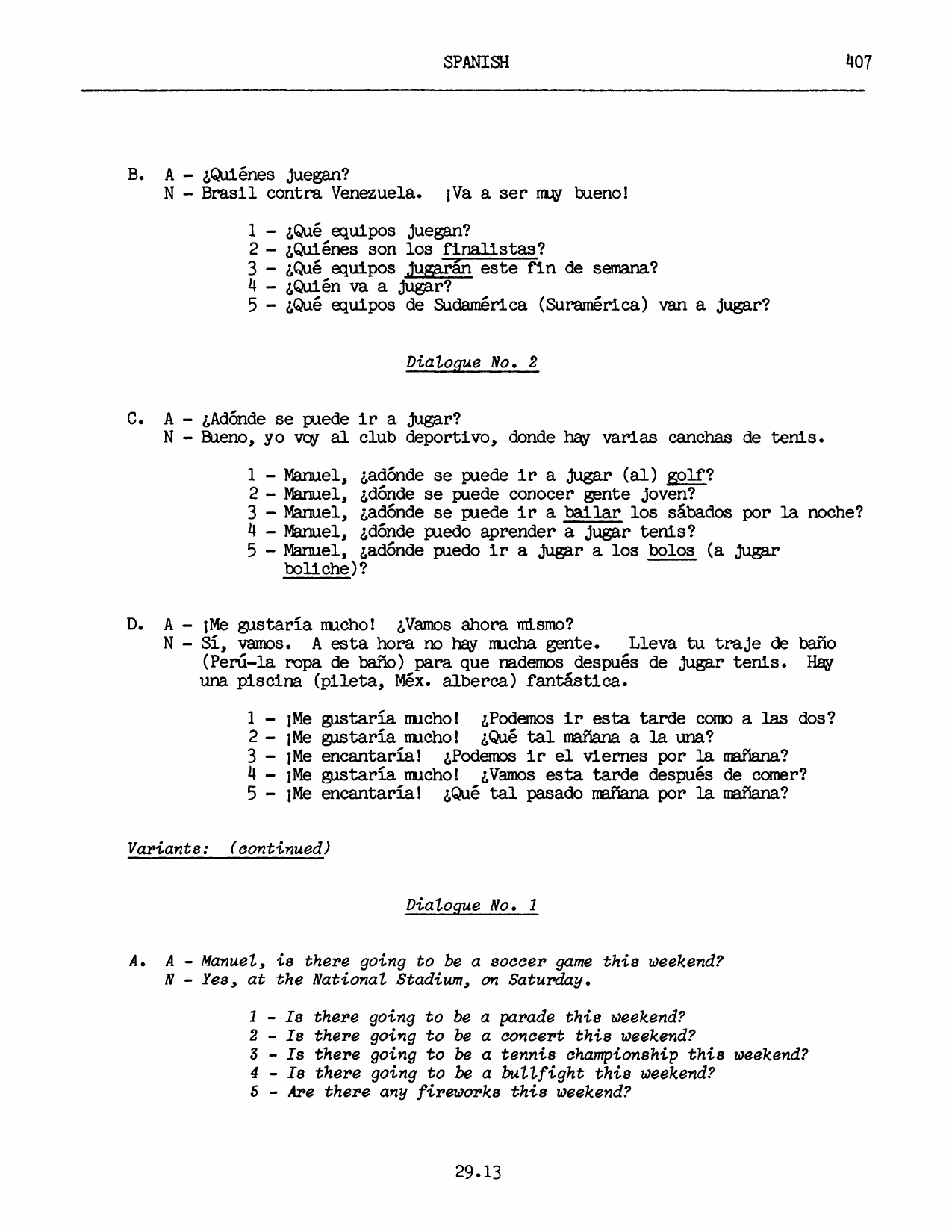
B. A - Who's playing?
N - Brazil against Venezuela. It's going to be very good!
1 - What teams are playing?
2 - Who are the finalists?
3 - What teams will play this weekend?
4 - Who is going to play?
5 - What teams from South America are going to play?
Dialogue No. 2
C. A - Where can you go to play?
N - Well, I go to the sports club, where they have several tennis courts.
1 - Manuel, where can you go to play golf?
2 - Manuel, where can you meet young people?
3 - Manuel, where can you go dancing on Saturday night? 4 - Manuel, where can I learn to play tennis?
5 - Manuel, where can I go bowling?
D. A- I'd like that very much! Can we go right now?
N - Yes, let's go. It's not crowded at this time. Bring your bathing suit
so we can swim after playing tennis. There's a fantastic pool.
1 - I'd like that very mich! Can we go this afternoon around two
o'clock?
2 - I'd like that very mich! How about tomorrow at one o'clock? 3 - I'd be delighted! Can we go on Friday morning? 4 - I'd like that very mich! Can we go this afternoon after
eating?
5 - I'd be delighted! How about the day after tomorrow, in the
morning?
VII. MAKING IT WORK
VIII. USING IT