CYCLE 30
GETTING THINGS
Housing
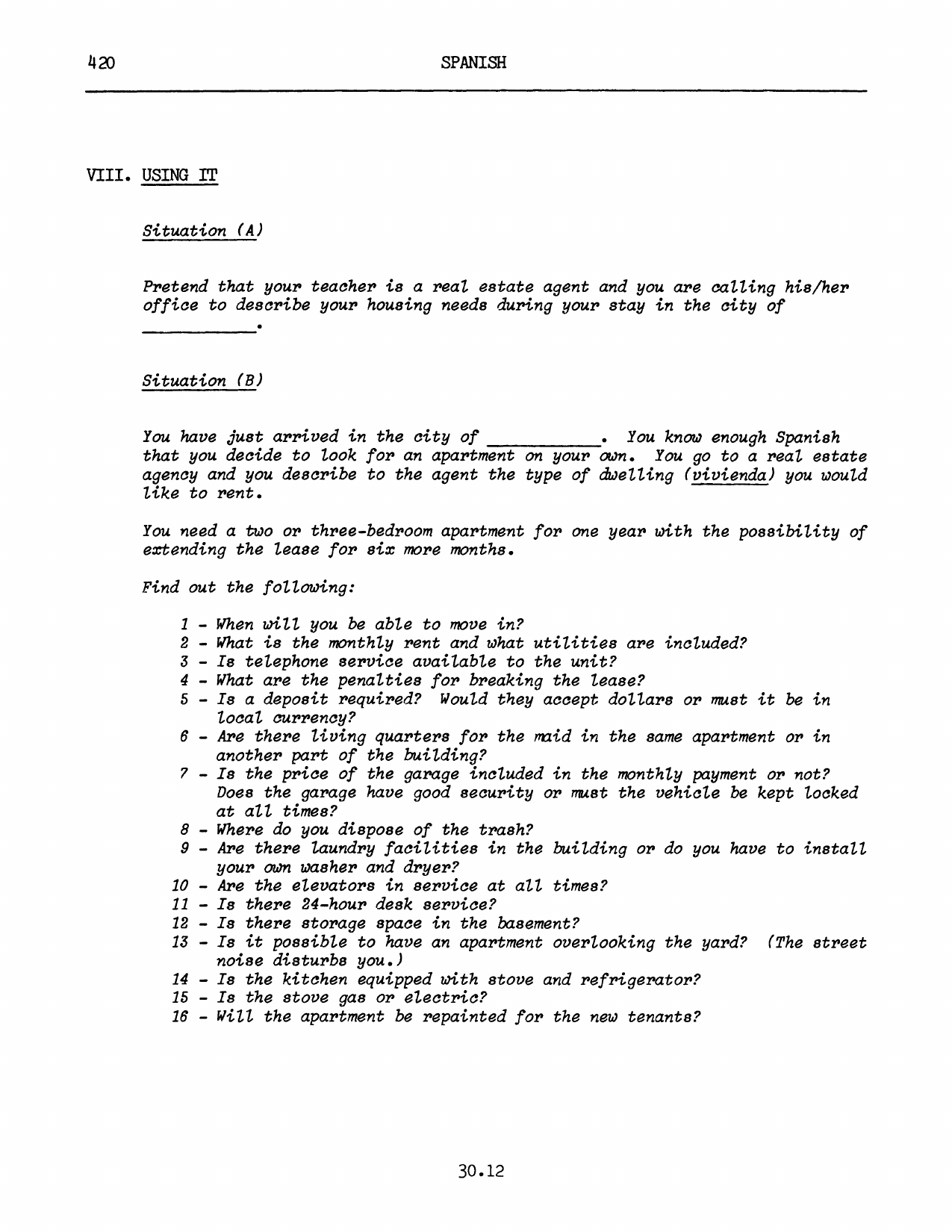
Housing in the Spanish-speaking world is somewhat different from that
in the United States. For example, rooms are generally bigger and ceilings higher; window sizes vary; and ceiling light fixtures are not always available. Most homes have enclosed yards, which often cannot be seen from the street. Servants' quar-ters are quite common throughout Latin America, though less so in Spain. In older apartment buildings, the servants' quarters for each apartment are often on the roof, while in more modern buildings the servants' quarters might be part of the apartment itself. Private homes usually have servants' quarters in the rear of the house or on the roof.
This page has a drawing, chart, or fill-in layout — original page
In many places throughout Latin America, having a phone installed is still a
long, drawn-out process. Sometimes even the mediation of the Embassy or Consulate will not help to speed things up. For example, in Mexico a person wishing to have home telephone service not only has to pay installation and service fees, but also may be required to buy stock in the Mexican telephone compary, "Teléfonos de México."
Utility billing errors, and sometimes payments, may have to be taken care of in
person; this is usually done at the main downtown office of the utility company in question.
I. SETTING THE SCENE
You are looking for a house or an apartment to rent for the duration of your tour. You begin your search by looking at what's available near the Embassy.
II. HEARING IT
ITI. SEEING IT
Dialoque:
Buscando casa_o apartamento (departamento, piso)
A - Señora, quisiera saber si hay algún apartamento (departamento, piso)
(alguna casa) desocupado/a (vacante, disponible).
N - Sí, señorita/señor/señora. Hay uno/a vacante y otro/a que va a
desocuparse a fin de mes.
A - ¿Qué tan grandes son?
N - El/la que está desocupado/a es de tres dormitorios (alcobas, Méx.
recámaras) con sala, comedor, cocina y baño. El/la otro/a es de dos dormitorios con sala-comedor, cocina y un baño.
A - ¿Podría mostrarme (mostrarnos) el/la que está desocupado/a?
N - Sí, por aquí, por favor. Es éste/a, pase(n) (adelante). Como ve(n), las
piezas tienen closets (armarios) grandes y las ventanas dan al patio.
A —- Es demasiado grande para mí, y quisiera una cocina más moderna que ésta, si
es posible (de ser posible).
N - En ese caso, el/la otro/a sería mejor para usted. La inquilina trabaja
en la Embajada Americana y ella podría mostrárselo/la.
A - ¿Cuánto es el alquiler (la renta, el arriendo) de ése/a?
N - Son $10.000 (pesos) al mes y hay que dar un depósito de un mes al firmar el
contrato.
A = ¿Tiene teléfono?
N - Sí, pero usted tiene que hablar con la inquilina y con la compañía telefó-
nica para que no lo desconecten y lo pongan a su nombre.
A - ¿Cuánto se paga por la electricidad y otros servicios?
N - Eso depende, pero la electricidad sale más o menos (en) $1.500 (pesos), el
gas (en) $1.000 y el agua (en) $500.
A —- Muchas gracias. Voy a tratar de verlo/a y si decido tomarlo/a, vuelvo a
firmar el contrato.
N - Señorita/señor/señora, es importante que se decida lo más pronto posible
porque hay dos personas más que están interesadas.
A = Muy bien, señora. Hasta luego.
Looking for a house or an apartment
(1) A - Ma'am, I would like to know if you have any vacancies.
N - Yes, mse/sir/ma'am. There ts one that ls vacant and another that will
be available at the end of the month.
A - How big are they?
(2) N - The one that ts vacant is a three-bedroom apartment with living room,
dining room, kitchen, and bath. The other one ls a two-bedroom with a combination living room-dining room, kitchen, and one bathroom.
A - Could you show me (us) the one that te vacant?
N - Yes, this way, please. It's this one; go right in. As you can see,
the bedrooms have large closets and the windows overlook the yard.
A - It's too big for me, and I would like a more modern kitchen than this,
if at all possible.
N - In that case, the other one would be better for you. The tenant works
at the American Embassy and she could show it to you.
A - How much ts the rent for that one?
N - It's $10,000 (pesos) a month, and you have to put down a month's
deposit on signing the contract.
(3) A - Does tt have a phone?
N - Yes, but you have to speak with the tenant and the telephone company so
that they won't disconnect it and in order to have them put it in your name.
(4) A - How much do you pay for electricity and other utilities?
N - That depends, but the electricity comes out to more or less $1,500
(pesos), the gas $1,000, and the water $500.
A - Thank you very mich. I'm going to try to see it; tf I decide to take
it, I'll be back to sign the contract.
N - Miss/sir/ma'am, it's important that you make up your mind as soon as
possible because there are two more people who are interested.
A - All right, ma'am. Bye, now.
Language Notes
1. Spanish equivalents for the word "apartment" vary, depending on the area.
In Latin America the words apartamento and departamento are commonly used, while in Spain the word piso is preferred.
2. The word "room" can be translated into Spanish using the following words:
habitación, cuarto, pieza, y sala. (The word sala, in the context of the home, means living room.) On the other hand, the word "bedroom" can be translated by using the words dormitorio, alcoba, (Mex. recámara) and, depending on the context, by the words cuarto, pieza, and habitación.
Narrative:
Buscando casa _o apartamento (departamento, piso)
Los apartamentos que la Embajada le recomendaba eran demasiado caros, por lo tanto, usted decidió buscar uno por su cuenta. Primero, usted fue a hablar con la administradora (gerente) de un edificio de apartamentos que estaba rela-tivamente cerca de la Embajada Americana. Cuando usted le preguntó si había algún apartamento vacante, ella le contestó que en ese momento había uno, pero que había otro que iba a estar disponible a fin de mes. Usted le dijo que quería ver el que estaba vacante, y ella se lo mostró muy amablemente. El apartamento era demasiado grande para usted y la cocina no era my moderna. La dueña le dijo que el que iba a desocuparse era más pequeño, y que usted podía hablar con la inquilina y preguntarle si podía verlo. También le informó que
ese apartamento costaba $10.000 (pesos) mensuales y que había que dar un depósito de un mes al firmar el contrato de alquiler. La señora le dijo que si quería conservar el teléfono, tenía que hablar con la imuilina y con la com pañía de teléfonos. Ella creía que la electricidad le saldría por más o menos $1.500 (pesos), el gas (en) $1.000, y el agua (en) $500. Usted decidió ver el apartamento que iba a desocuparse y volver a hablar con la dueña. Al despe-dirse, ella le aconsejó decidirse rápidamente porque había otras personas interesadas en ese apartamento.
Questions:
1 - Describa los apartamentos que la Embajada le recomendaba.
Describe the apartments that the Embassy recommended to you.
2 - ¿Qué decidió usted hacer?
What did you decide to do?
3 - ¿Qué hizo usted primero?
What did you do first?
4 — ¿Cuál fue la contestación de la administradora (gerente)?
What was the manager's answer?
5 - Describa el apartamento que usted vio.
Describe the apartment that you saw.
6 - Describa el apartamento que iba a desocuparse.
Describe the apartment that was going to be vacated.
7 — Para ver este apartamento, ¿qué tendría que hacer usted?
In order to see this apartment, what would you have to do?
8 - ¿Qué más le informó la administradora?
What else did the manager tell you?
9 = ¿Qué decidió (hacer) usted con respecto al segundo apartamento?
What did you decide En do) with respect to the second apartment?
10 - ¿Qué le aconsejó la administradora (gerente)?
What did the manager advise you to do?
IV. TAKING IT APART
Vocabulary:
GETTING THE FEEL OF IT
Questions and Answers:
A. 1. ¿Qué clase de apartamento (departamento, piso) busca?
a. Uno de tres dormitorios (recámaras, alcobas) con sala y
comedor separados, y una cocina moderna.
b. Me gustaría uno con vista a la piscina (la pileta, la
alberca) o al patio interior.
c. Uno no my grande que tenga una cocina moderna. d. Quiero alquilar (rentar, arrendar) uno en el primer piso
(la planta baja) porque no puedo subir escaleras.
€. El más grande que tenga porque en mi familia somos cinco.
B. 1. ¿Es necesario que la casa tenga patio?
a. SÍ, queremos que tenga patio, aunque sea pequeño. b. Si está cerca de un parque, no es necesario que tenga
patio.
C. Si, porque queremos que los niños jueguen al aire libre. d. No. Lo único que importa es que esté cerca de la
Embajada Americana.
e. Sí, siempre que (siempre y cuando) el alquiler (la renta,
el arriendo) no sea demasiado caro/a.
C. 1. ¿Ya encontró apartamento (casa)?
a. No, todavía no y hace un mes que ando buscando. b. Pues, encontré varios apartamentos buenos (varias casas
buenas) » pero costaban más de lo que yo podía pagar.
C. Sólo encontré uno/a que me gustó, y estaba demasiado
lejos de la Embajada Americana.
d. Creo que sí, pero todavía no he firmado el contrato de
e. No. ¿Usted sabe de alguno/a que no sea my caro/a y que
esté cerca de la Embajada?
Questions and Answers: (continued)
A. 1. What kind of apartment are you looking for?
a. One with three bedrooms, a separate living room and
dining room, and a modern kitchen.
b. I would like one overlooking the pool or the courtyard.
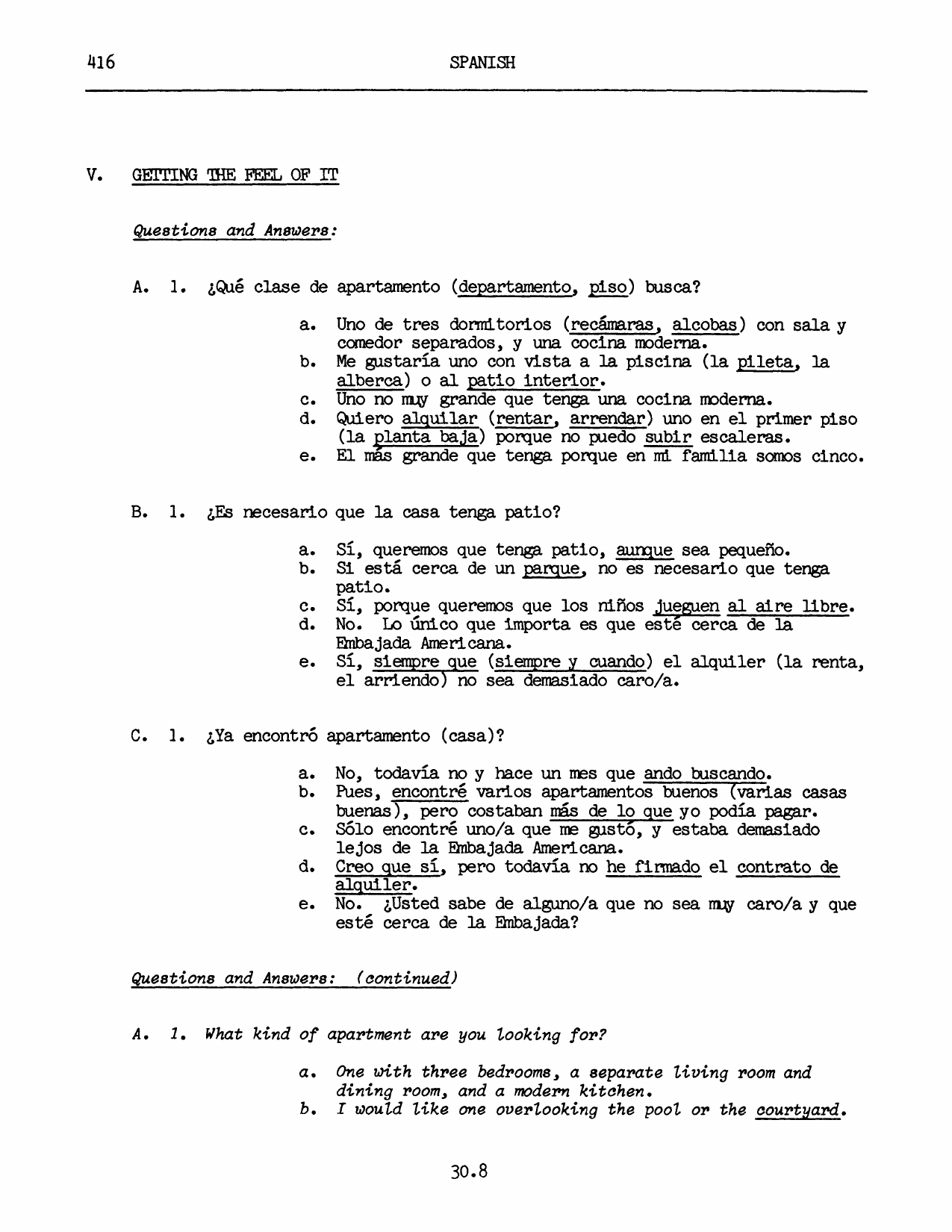
C. One that isn't very big that has a modern kitchen. d. I would like to rent one on the first floor, because I
can't climb stairs.
e. The largest one that you have, because we are a family of
five.
B. 1. Is it necessary that the house have a yard?
a. Yes, we want it to have a yard, even if it is a small
one.
b. If it is near a park, it ta not necessary that it have a
yard.
C. Yes, because we would like the children to play outdoors. d. No. The only thing that mtters ts that it be near the
American Embassy.
e. Yes, as long as the rent ts not too high.
C. 1. Have you found an apartment (a house) yet?
a. No, not yet, and I have been looking for a month. b. Well, I found several nice apartments (houses), but they
were more than I could pay.
ec. I found only one that I liked, and it was too far away
from the American Embassy.
d. I think so, but I haven't signed the lease yet. e. No. Do you know of one that is not too expensive and
that ts close to the Embassy?
VI. PUTTING IT TOGETHER
Variants:
A. A = Señora, quisiera saber si hay algún apartamento (departamento, piso)
(alguna casa) desocupado/a (vacante, disponible).
N - Si, sefiorita/sefior/sefiora. Hay uno/a vacante y otro/a que va a desocu-
parse a fin de mes.
1 - Señora, ¿hay algún apartamento disponible?
2 - Señora, ¿tiene algún apartamento desocupado?
3 - Señora, necesito un apartamento amueblado, ¿tiene alguno para
alquilar?
4 - Señora, quisiera alquilar un apartamento por un año, ¿hay
alguno desocupado?
5 - Señora, en la Embajada Americana me dijeron que usted tenía un
apartamento desocupado, ¿es verdad?
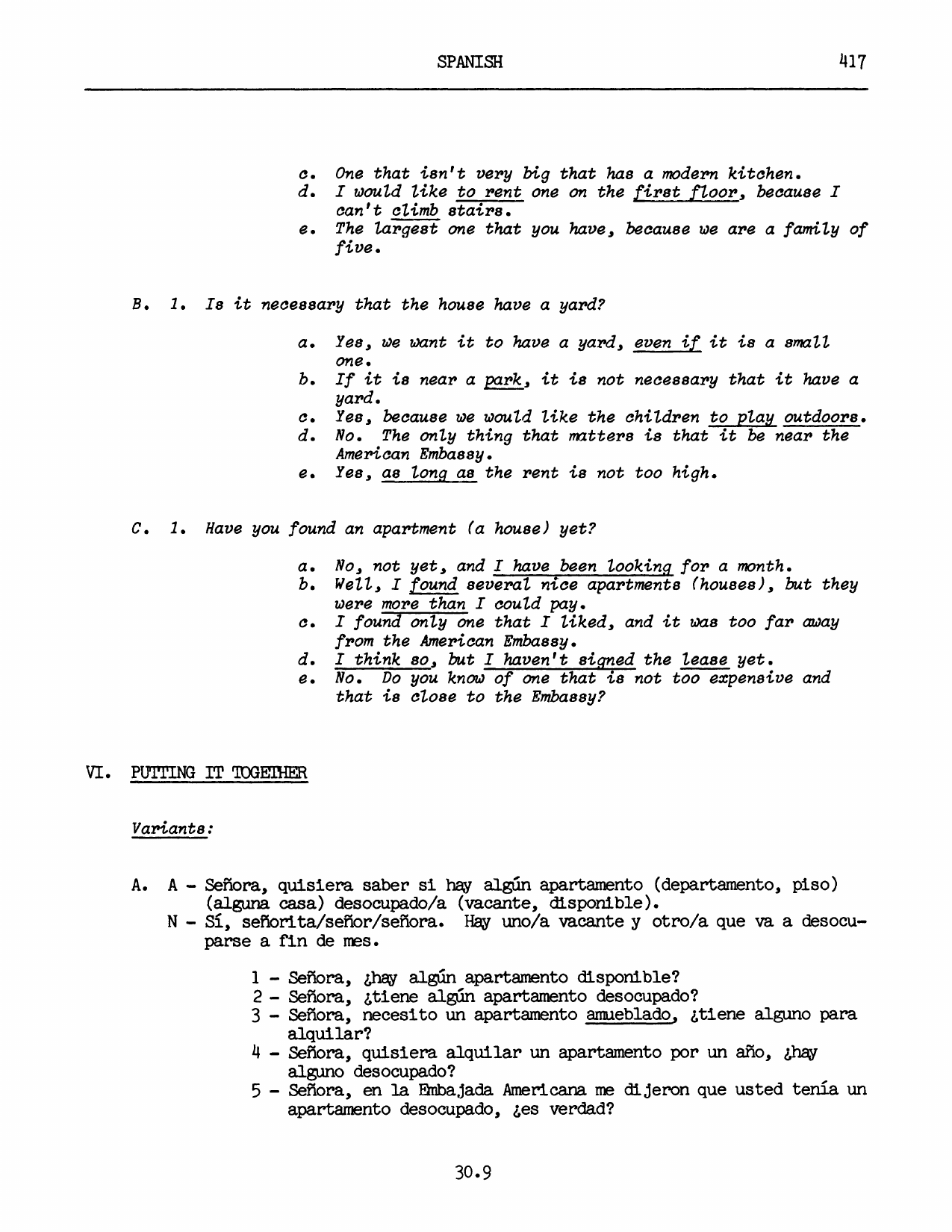
B. A — ¿Qué tan grandes son?
N - El/la que está desocupado/a es de tres dormitorios (alcobas, Méx.
recámaras) con sala, comedor, cocina y baño. El/la otro/a es de dos dormitorios con sala-comedor, cocina y un baño.
1 - ¿Son del mismo tamaño?
2 — ¿De qué tamaño son?
3 - ¿Puede describirmelos?
4 — ¿De cuántos dormitorios (cuántas recámaras) son? 5 - ¿Cómo son?
C. A — ¿Podría mostrarme (mostrarnos) el/la que está desocupado/a?
N - Sí, por aquí, por favor. Es éste/a, pase(n) (adelante). Como ve(n),
las piezas tienen closets (armarios) grandes y las ventanas dan al patio.
1 = ¿Puedo (podemos) ver el/la que está desocupado/a? 2 — ¿Puede mostrarme (mostrarnos) el/la que está desocupado/a? 3 - ¿Es posible ver el/la que está desocupado/a?
4 — ¿Puedo (podemos) ver el/la que está disponible? 5 - ¿Sería posible ver el/la que está desocupado/a?
D. A — ¿Cuánto es el alquiler (la renta, el arriendo) de ése/a?
N - Son $10.000 (pesos) al mes y hay que dar un depósito de un mes al
firmar el contrato.
1 - El alquiler (el arriendo, la renta) es (de) $5.505 (pesos) al
mes, pero hay que dar un depósito que se le va a devolver (a usted) cuando se vaya.
2 - Incluyendo la electricidad (luz) y el agua, sale (en) $6.515
(pesos) al mes, pero el teléfono se paga aparte.
3 - Cuesta $8.650 (pesos) al mes, pero eso incluye el derecho a
usar la piscina (Méx. alberca, pileta) y las canchas de tenis.
4 — Los apartamentos con vista al mar cuestan $6.000 (pesos) men-
suales, sin incluir el agua ni la electricidad (luz).
5 - Son $1.050 (pesos) mensuales por un apartamento (departamento,
piso) de dos dormitorios (alcobas, Méx. recámaras), pero el alquiler (arriendo, la renta) va a subir el mes próximo (que viene, que entra).
Variants: (continued)
A. A - Ma'am, I would like to know tf you have any vacanctes.
N - Yes, miss/sir/ma'am. There te one that ts vacant and another that will
be available at the end of the month.
1 - Ma'am, are there any apartments available?
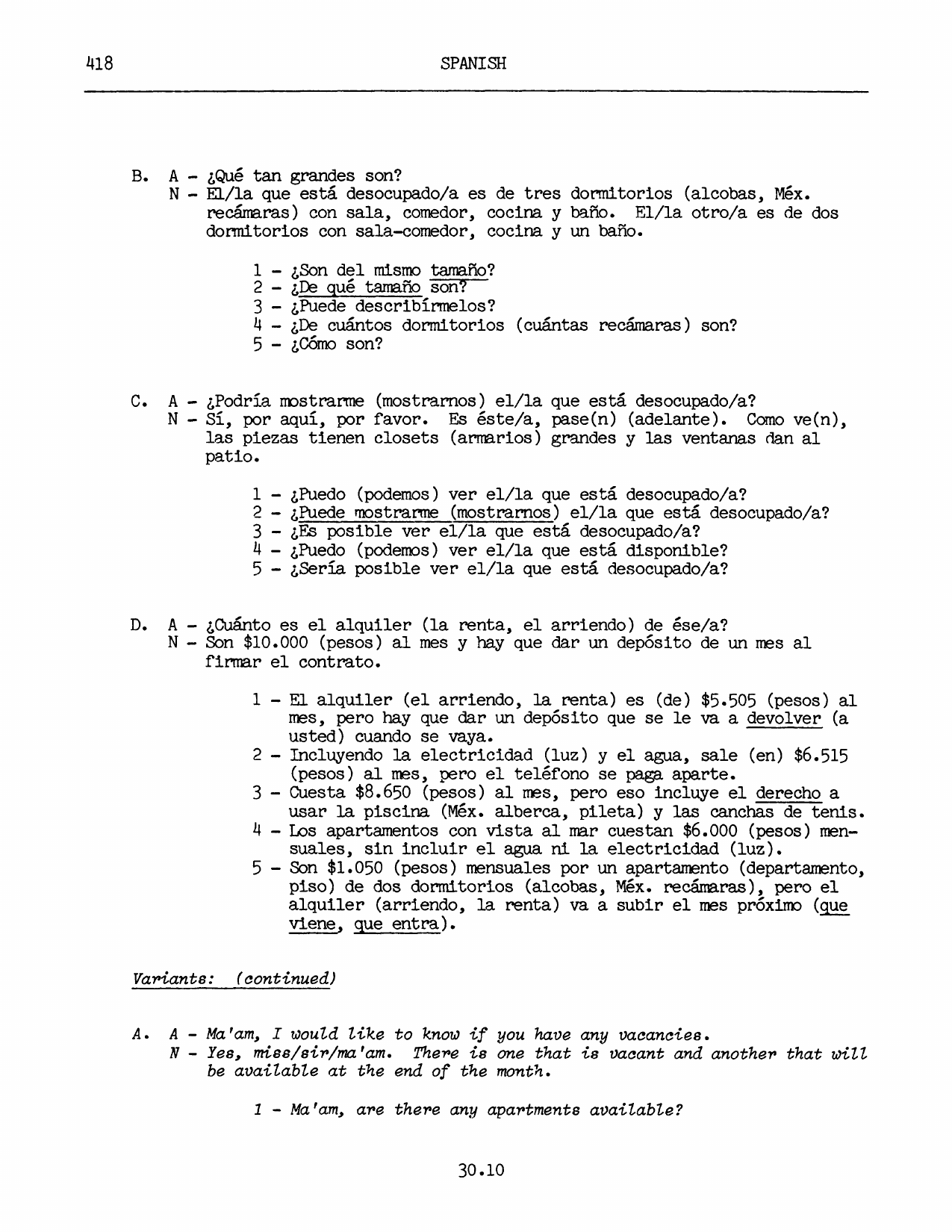
2 - Ma'am, do you have any vacancies?
3 - Ma'am, I need a furnished apartment; do you have any for rent? 4 - Ma'am, I would like to rent an apartment for a year; is there
one available?
5 - Ma'am, they told me at the American Embassy that you have a
vacancy; ts that correct?
B. A ~ How big are they?
N - The one that is vacant is a three-bedroom apartment with living room,
dining room, kitchen, and bath. The other one is a two-bedroom with a combination living room-dining room, kitchen, and one bathroom.
1 - Are they the same size?
2 - How big are they?
3 - Would you describe them for me?
4 - How many bedrooms do they have?
5 - What are they like?
C. A - Could you show me (us) the one that is vacant?
N - Yes, this way, please. It's this one; go right in. As you can see,
the bedrooms have large closets and the windows overlook the yard.
1 - May I (we) see the one that is vacant?
2 - Can you show me (us) the one that is vacant?
3 - Is it possible to see the one that is vacant?
4 - May I (we) see the one that is available?
5 - Would it be possible to see the one that te vacant?
D. A - How much is the rent for that one?
N - It's $10,000 (pesos) a month and you have to put down a month's deposit
on signing the contract.
1 - The rent is $5,505 (pesos) a month, but you have to put down
(give) a deposit that will be returned to you when you leave.
2 - Including utilities (electricity and water), it comes out to
$6,515 (pesos) a month, but the telephone is paid separately.
3 - It's (it costs) $8,650 (pesos) per month, but that includes
the right to use the swimming pool and the tennis courts.
4 - The apartments with an ocean view cost $6,000 (pesos) per
month not including utilities (water and electricity).
5 - It's $1,050 (pesos) per month for a two-bedroom apartment, but
the rent will be going up next month.
VII. MAKING IT WORK
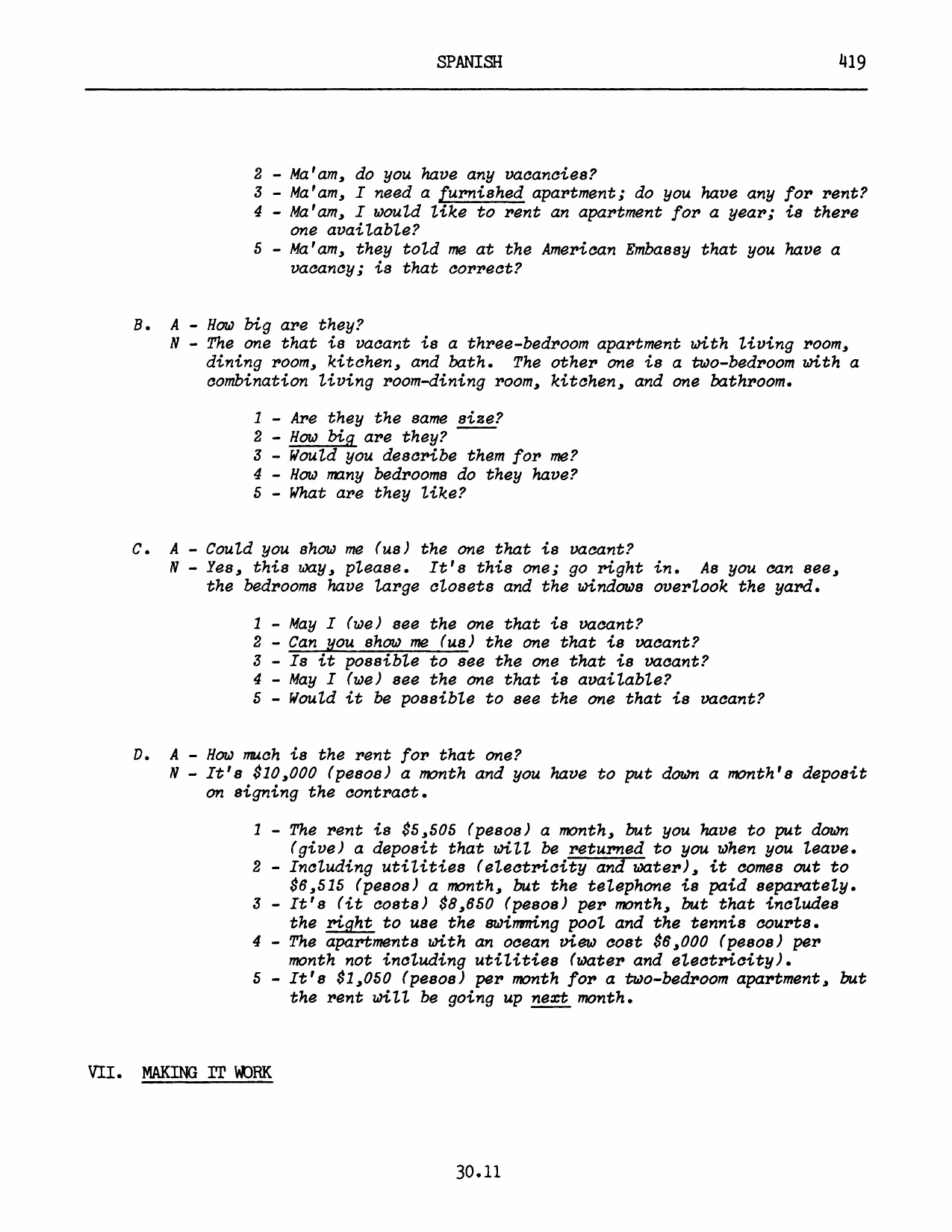
VIII. USING IT
Situation (A)
Pretend that your teacher is a real estate agent and you are calling his/her office to describe your housing needs during your stay in the city of
Situation (B)
that you decide to look for an apartment on your own. You go to a real estate agency and you describe to the agent the type of dwelling (vivienda) you would
You need a two or three-bedroom apartment for one year with the possibility of extending the lease for six more months.
Find out the following:
1 - When will you be able to move in?
2 - What ts the monthly rent and what utilities are included? 3 - Is telephone service available to the unit?
4 - What are the penalties for breaking the lease?
5 - Is a deposit required? Would they accept dollars or must it be in
local currency?
6 - Are there living quarters for the mid in the same apartment or in
another part of the building?
? - Is the price of the garage included in the monthly payment or not?
Does the garage have good security or mst the vehicle be kept locked at all times?
8 - Where do you dispose of the trash?
9 - Are there laundry facilities in the building or do you have to install
your own washer and dryer?
10 - Are the elevators in service at all times?
11 - Is there 24-hour desk service?
12 - Is there storage space in the basement?
13 - Is it possible to have an apartment overlooking the yard? (The street
noise disturbs you.)
14 - Is the kitchen equipped with stove and refrigerator?
15 - Is the stove gas or electric?
16 - Will the apartment be repainted for the new tenants?