CYCLE 31
GETTING THINGS
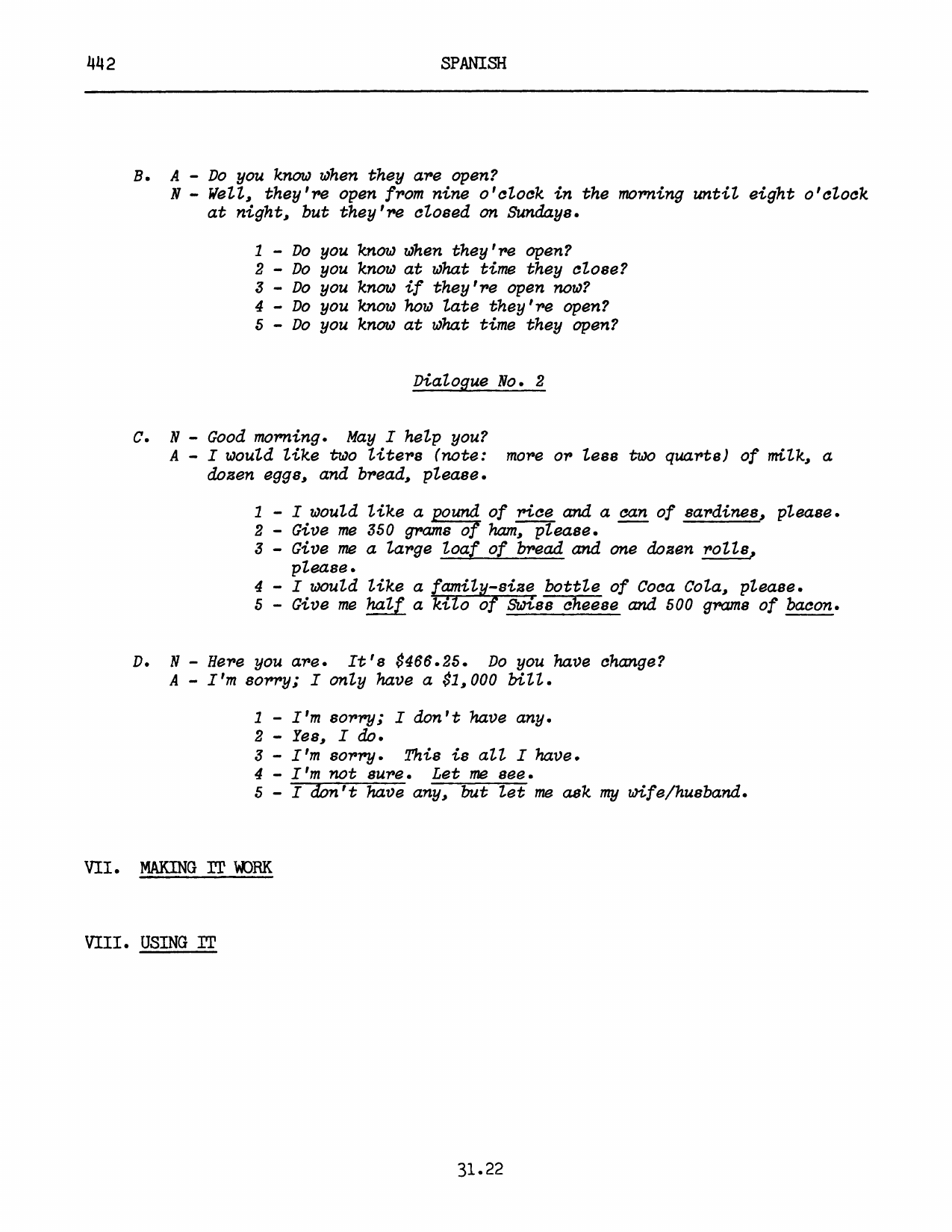
Where to Go Grocery Shoppi:
Ma |
en
Y 3
=m oma csi Ml ASS (a)
The use of the metric system of weights and measures is prevalent throughout
the Spanish-speaking world, but the English (U.S.) system of units of measure is used in some areas for certain things. For example, gasoline in Guatemala is sold by the galón ("gallon"), while in most other places it is sold by the litro ("liter"). In Honduras you can buy butter by the libra ("pound"), but in other countries you buy it by the kilo or gramos ("grams"). Depending on the kind of sales outlet from which you buy, you will often find the same product sold by weight in one place and by quantity in another. While a supermarket may allow you to buy eggs by the docena ("dozen"), at a local open air market they may be sold by the kilo, as in many places throughout Mexico. If you are not sure what unit of measure is used
This page has a drawing, chart, or fill-in layout — original page
at a local store or market, you can ask the clerk "How much are (oranges, eggs, etc.)?" by saying ¿A cómo está (la naranja, el huevo, etc.)?, and the salesperson will answer using the appropriate unit of weight or measure.
Old-fashioned butcher shops, bakeries, and neighborhood stores are still very
much a part of everyday life in Latin America and Spain. For example, the most com-mon place to buy bread is at a panadería ("bakery"). They have a large selection of pan de dulce and pan de sal there, and the customer can choose either by telling the clerk behind the counter what he or she wants, or by picking up a tray and tongs at the entrance, selecting the bread, and then taking it to the counter, where the clerk will bag it and charge him or her for it.
Be advised that such things as fresh bread, milk, and eggs are available early
in the day, and many stores may not have any of these products left if you do your shopping after work. This is particularly true in large metropolitan areas like México City, where the demand is often mich greater than the supply. It may be a good idea to have your maid buy these items during the day if you are unable to do it yourself, and it wouldn't be a bad idea to arrange to have milk delivered to your home.
I. SETTING THE SCENE (A)
You have recently moved into an apartment and as of yet you have not had a chance to familiarize yourself with the neighborhood. You need to buy a few things, such as bread, milk, and eggs. On the way out, you see one of your neighbors and decide to ask her where you should go to buy your groceries.
II. HEARING IT (A)
III. SHEING IT (A)
Dialogue No. 1:
Con una vecina
A - Perdone, señora. Acabo de midarme (cambiarme) a este edificio y todavía
no conozco muy bien el vecindario (barrio). ¿Podría decirme dónde puedo comprar pan, leche y huevos?
N - Pues, mire. Aquí en la esquina hay una tienda pequeña pero no tienen
muchas cosas.
A - ¿Y dónde puedo comprar carne, verduras, y otras cosas?
N - En el supermercado que queda (está) a cuatro cuadras (calles) de aquí, por
esta misma calle.
A — ¿Sabe de qué hora a qué hora está abierto?
N - Bueno, está abierto de (las) mueve de la mañana a (las) ocho de la noche
durante la semana (entre semana), pero los domingos está cerrado (no abren los domingos).
A —- Muchísimas gracias. ¡Muy amable, señora! Permítame presentarme. Me llamo
Michael/Mary Smith y vivo en el apartamento (departamento, piso) veintidós.
N - Mucho gusto, señor/señorita/señora (de) Smith. (Yo) soy la señora María
(de) Sánchez del apartamento (departamento, piso) veintiocho. Mi familia y yo estamos a sus Órdenes.
A - Muchas gracias, señora (de) Sánchez. Ha sido un verdadero placer cono-
ceria. Hasta la vista.
Dialogue No. 1: (continued)
With a neighbor
(1) A - Pardon me, mi'am. I've just moved in and I'm still not very familiar
with the neighborhood. Could you tell me where I can buy bread, milk, and egga?
N - Well, let's see. Right here on the corner there's a small store, but
they don't have many things.
A - And where can I buy meat, vegetables, and other things?
(2) N - At the supermarket that's four blocks from here, on this same street.
A - Do you know when they are open?
N - Well, they're open from nine o'clock in the morning until eight o'clock
at night, but they're closed on Sundays.
A - Thank you very mich, You're very kind, m'am! Allow me to introduce
myself. My name is Michael/Mary Smith and I live in apartment 22.
(3) N - Nice to meet you, Mr./Miss/Mrs. Smith. I am Mrs. Maria Sánchez of
apartment 28. My family and I will be happy to help you in any way we can.
A - Thank you very much, Mrs. Sanchez. It's been a pleasure meeting you.
So tong.
I. SETTING THE SCENE (B)
Since the corner store is closer, you decide to go there to get the few things you need. It is a small neighborhood store attended by a clerk behind a counter.
II. HEARING IT (B)
III. SEEING IT (B)
Dialogue No. 2:
En la tienda de la esquina
A - Buenos días, señor/señorita/señora.
N - Buenos días. ¿En qué puedo servirle (servirlo/a)?
A - Quiero dos litros de leche, una docena de huevos y pan, por favor. N - Aquí tiene. Son $466,25. ¿Tiene cambio (sencillo, menudo)? A = Lo siento, sólo tengo un billete de (a) $1.000 (mil).
N - Está bien. No se preocupe. Aquí tiene el vuelto (cambio).
A - ¿Puede darme una bolsa de papel?
N - Lo siento, no tengo ninguna. ¿Quiere que se lo envuelva, o quiere una
ca ja?
A = Envuélvamelo, por favor. Gracias. Hasta luego.
N - Hasta luego, señor/señorita/señora.
Dialogue No. 2: (continued)
At the corner store
A - Good morning, sir/mise/ma'am.
(4) N - Good morning. May I help you?
A - I would like two litere (note: more or less two quarts) of milk, a
dozen eggs, and bread, please.
N - Here you are. It's $466.25. Do you have change?
A - I'm sorry; I only have a $1,000 bill.
N - That's all right. Don't worry about it. Here's the change. A - Can you give me a paper bag?
(5) N - I'm sorry; I don't have any. Would you like me to wrap it for you, or
would you like a box?
(5) A - Wrap it for me, please. Thank you. So tong.
WN - So long, sir/miss/ma'am.
Language Notes
1. Acabo de mdarme (acabar de + infinitive)
The idea of "having Just done something" is expressed in Spanish by the
verb acabar followed by the preposition de and the infinitive form of the verb that indicates what you have just done.
Examples :
2. Queda (está) a cuatro cuadras (calles) de aquí (quedar a or estar a +
distance
In Spanish, there are two verbs that express the idea of being located:
estar and quedar. To say "New York is 300 miles away," speakers of Spanish say Nueva York esta _a trescientas millas de aquí or Nueva York queda a trescientas millas de aquí. Notice that the preposition a in the Spanish sentence has no coun-terpart in the English translation; nevertheless, this word is mandatory in the Spanish construction when expressing the idea of how far something is from something else. (See Language Note 4 of Cycle 8.)
Examples:
La playa queda (está) a tres horas The beach is three hours from
Mi casa queda (est4) a media cuadra My house is half a block from the
3. Estamos a sus órdenes is a very friendly phrase reflecting the host's
desire to be of service and of help to you. It is a common and often-used expression denoting a high degree of hospitality. A similar expression with which you are probably familiar is Mi casa es su casa ("My house is your house"). This is obviously an exaggeration, but it does reflect this hospitality.
4, ¿En qué puedo servirle (servirlo/a)?
It is not umisual to find differences in how certain words or expressions
are used from country to country and even within the same country. The expression ¿En qué puedo servirle (servirlo/a)? is a case in point. In most Spanish-speaking areas, the expression is said using the word servirle for both men and women; how-ever, in a few other places, notably Chile, the expression is used with servirlo for a man and servirla for a woman.
5. ¿Quiere que lo envuelva? vs. ¿Quiere que se lo envuelva?
You are familiar with phrases such as póngalo/la ahí ("put it there") and
tráigame una cerveza ("bring me a beer"); however, in this dialogue the construction that is being used in these two sentences, ¿Quiere que se lo envuelva? and Envuélva-melo, por favor, combines the direct and the indirect objects in the same sentence. In Spanish, whenever both objects appear in the same sentence, the indirect object is placed before the direct object. Thus, "Do you want me to wrap it for you?" becomes "¿Quiere que se lo/la envuelva?", while "Wrap it for me, please" is "Envuélvamelo/la, por favor. 7
Other examples are as follows:
I want to sell the car for Manuel.
or
I want to sell it for Manuel.
por favor.
mañana.
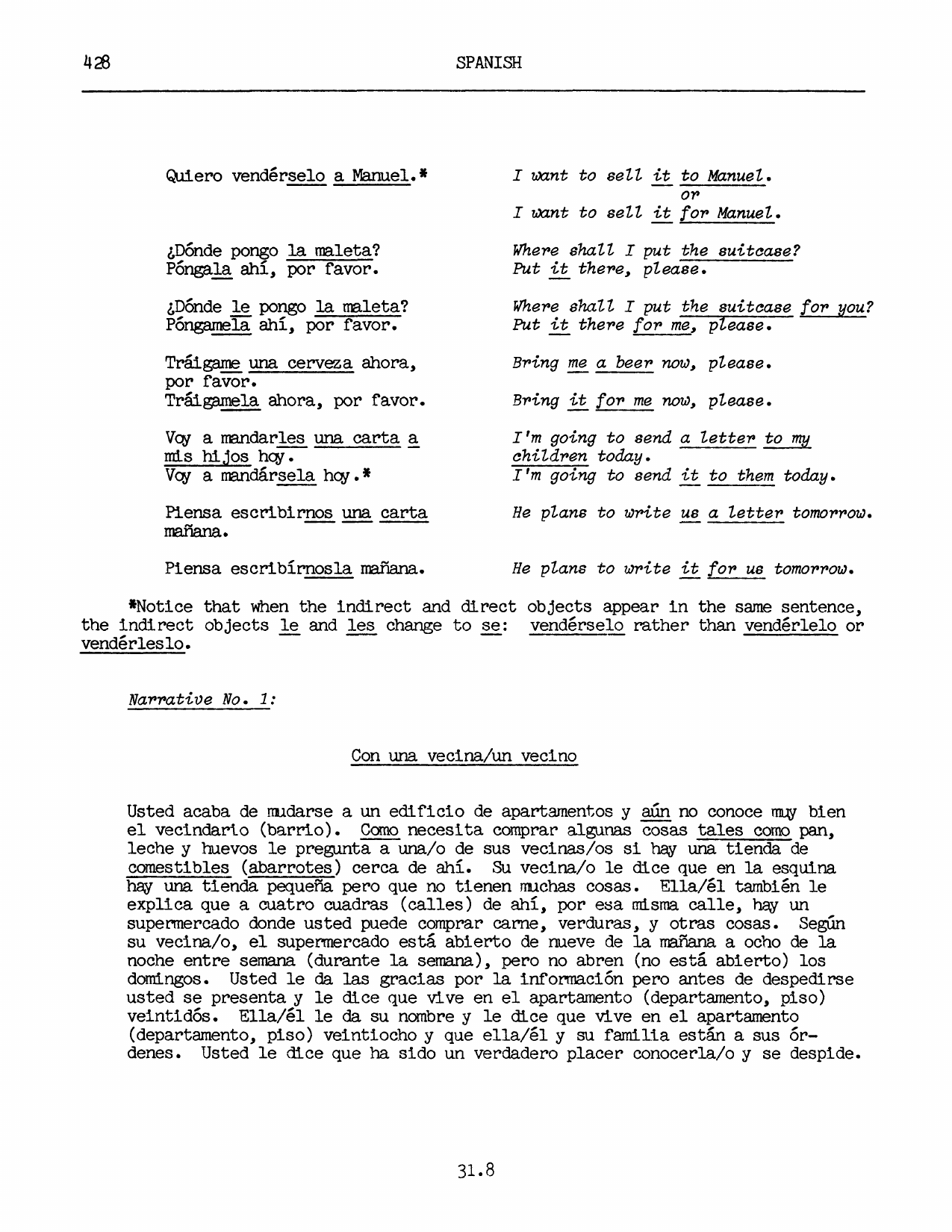
*Notice that when the indirect and direct objects appear in the same sentence,
the indirect objects le and les change to se: vendérselo rather than vendérlelo or vendérleslo.
Narrative No. 1:
Con una vecina/un vecino
Usted acaba de mudarse a un edificio de apartamentos y aún no conoce my bien el vecindario (barrio). Como necesita comprar algunas cosas tales como pan, leche y huevos le pregunta a una/o de sus vecinas/os si hay una tienda de comestibles (abarrotes) cerca de ahí. Su vecina/o le dice que en la esquina hay una tienda pequeña pero que no tienen muchas cosas. FElla/él también le explica que a cuatro cuadras (calles) de ahí, por esa misma calle, hay un supermercado donde usted puede comprar carne, verduras, y otras cosas. Según su vecina/o, el supermercado está abierto de mueve de la mañana a ocho de la noche entre semana (durante la semana), pero no abren (no está abierto) los domingos. Usted le da las gracias por la información pero antes de despedirse usted se presenta y le dice que vive en el apartamento (departamento, piso) veintidós. Ella/él le da su nombre y le dice que vive en el apartamento (departamento, piso) veintiocho y que ella/él y su familia están a sus Ór-denes. Usted le dice que ha sido un verdadero placer conocerla/o y se despide.
Questions:
1 = ¿Qué acaba de hacer usted?
What have you just done?
2 - ¿Usted ya conoce my bien el vecindario (barrio)?
Have you become very familiar with the neighborhood yet?
3 - ¿Qué necesita comprar usted?
What do you need to buy?
4 - ¿Qué le dice su vecina/o de la tienda de la esquina?
What does your neighbor tell you about the corner store?
5 - ¿Qué le explica ella/él con respecto al supermercado?
What does she/he explain to you with regard to the supermarket?
6 — ¿De qué hora a qué hora está abierto el supermercado?
When ts the supermarket open?
7 - ¿Qué hace usted antes de despedirse?
What do you do before saying good-bye?
8 - ¿Qué le dice su vecina/o?
What does your neighbor say to you?
9 - Por último, ¿qué hace usted?
Finally, what do you do?
Narrative No. 2:
En la tienda de la esquina
Como la tienda de la esquina queda (está) más cerca, usted decide ir ahí para comprar lo que necesita. Al entrar a la tienda de comestibles (abarrotes) usted saluda al/a la dependiente que lo/la atiende y le dice que quiere dos litros de leche, una docena de huevos, y pan. Su compra sale en $466,25 (pesos) y el/la dependiente le pregunta si tiene cambio (sencillo, menudo). Usted le dice que lo siente pero que sólo tiene un billete de (a) mil. El/ella le dice que está bien, que no importa y le da el vuelto (cambio). Usted le pide una bolsa de papel y el/la dependiente le dice que lo siente pero que no tiene ninguna. El/ella entonces le pregunta si se lo envuelve y usted le dice que sí, que por favor se lo envuelva. El/ella así lo hace y usted se lo agra-dece. Finalmente, ustedes se despiden.
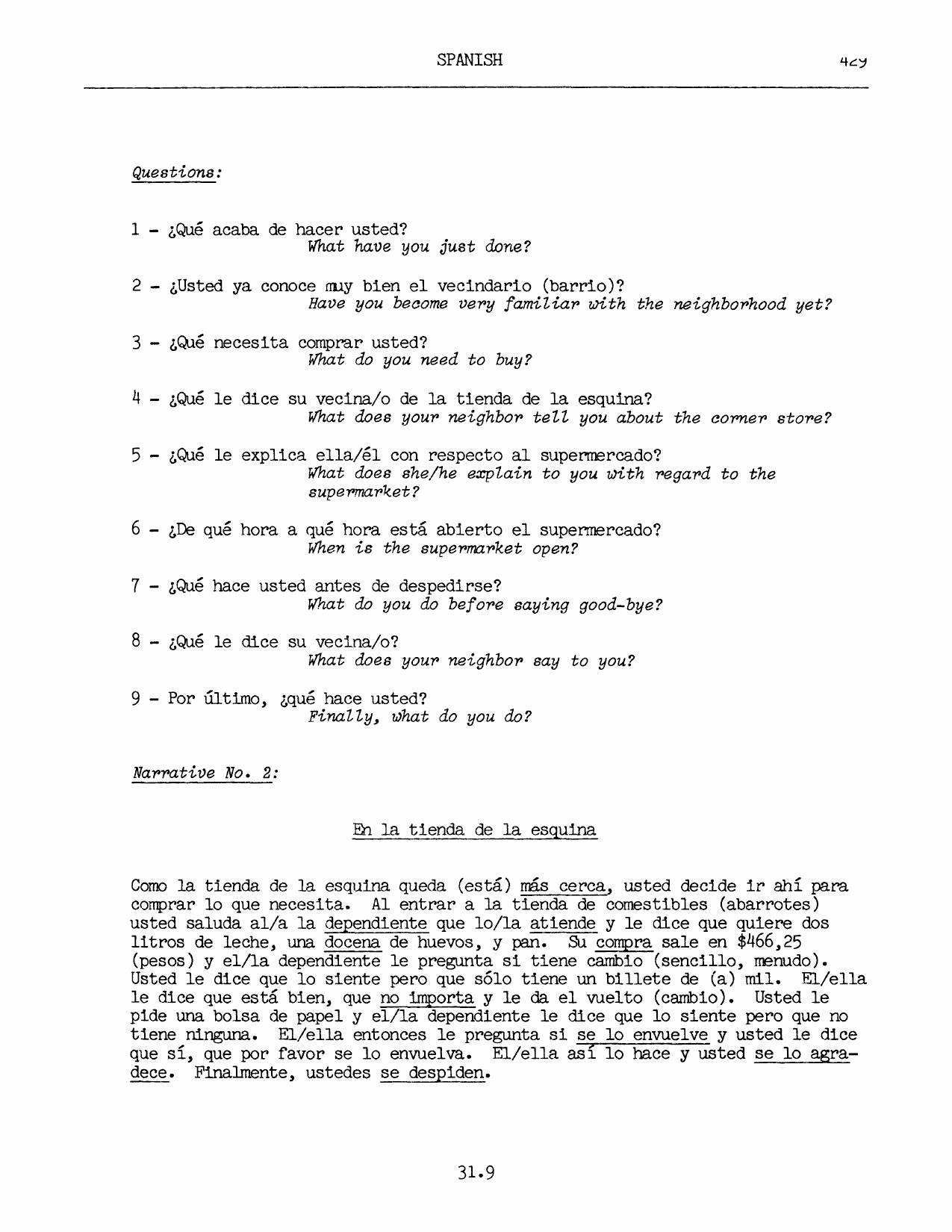
Questions:
1 - ¿Por qué decide usted ir a la tienda de la esquina?
Why do you decide to go to the corner store?
2 - ¿Qué hace usted al entrar a la tienda de comestibles (abarrotes)?
What do you do upon entering the grocery store?
3 = ¿Qué le dice usted al/a la dependiente?
What do you say to the clerk?
4 — ¿En cuánto sale la compra?
How much does the purchase come to?
5 - ¿Usted tiene cambio (sencillo, menudo)?
Do you have any change?
6 = ¿Qué le dice el/la dependiente y qué hace él/ella?
What does the clerk say to you and what does he/she do?
7 — ¿Qué le pide usted al/a la dependiente?
What do you request from the clerk?
8 — ¿Qué le responde (contesta)?
What does he/she answer you?
9 = ¿Qué quiere usted que él/ella haga con lo que usted compró?
What do you want him/her to do with your purchase?
10 - ¿Qué hace usted cuando él/ella se lo envuelve?
What do you do when he/she wraps tt for you?
11 - Finalmente, ¿qué hacen ustedes?
Finally, what do you (pl.) do?
IV. ‘TAKING IT APART
Vocabulary:
Dialogue No. 1
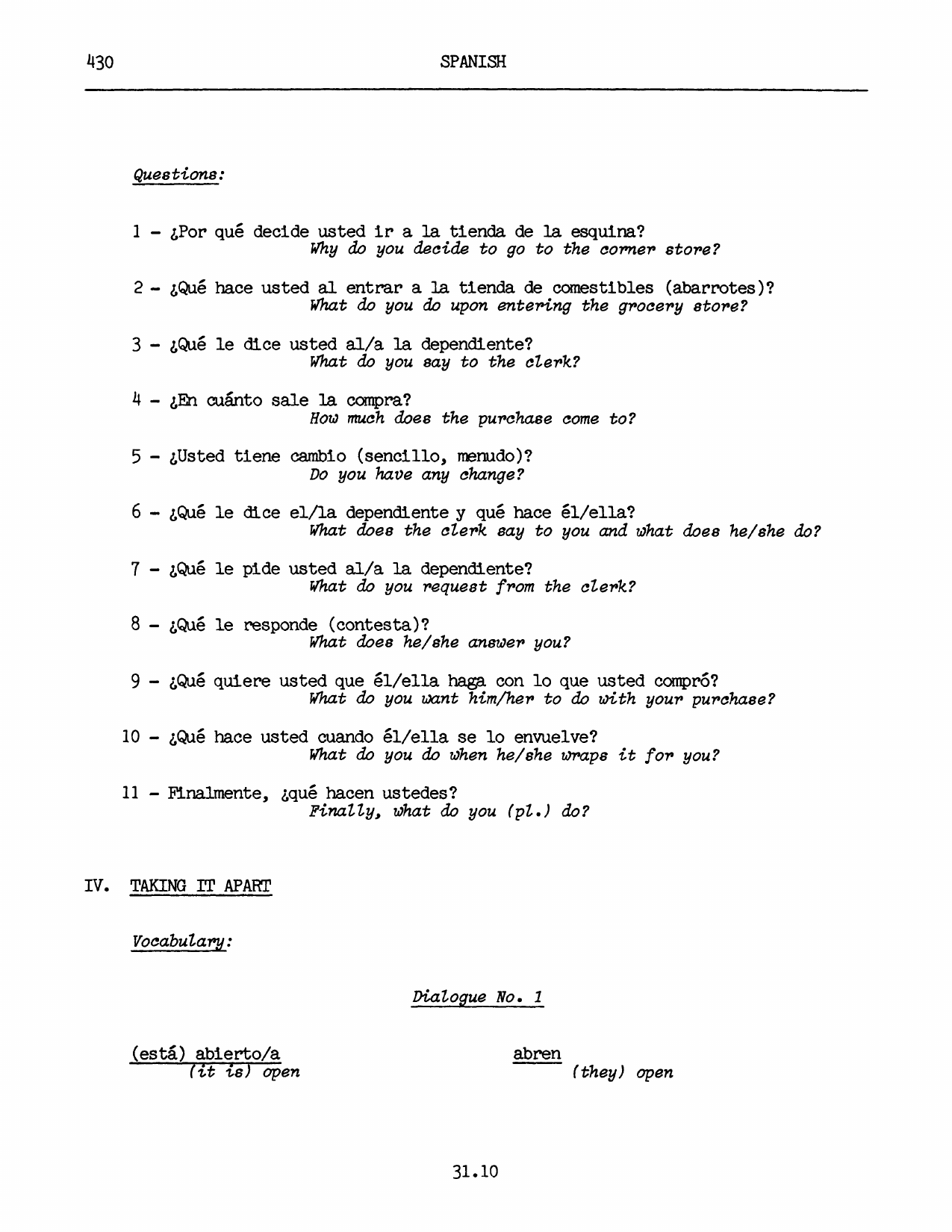
another)
myself (command)
you tn any way we can, (we)
are at your service
Narrative No. 1
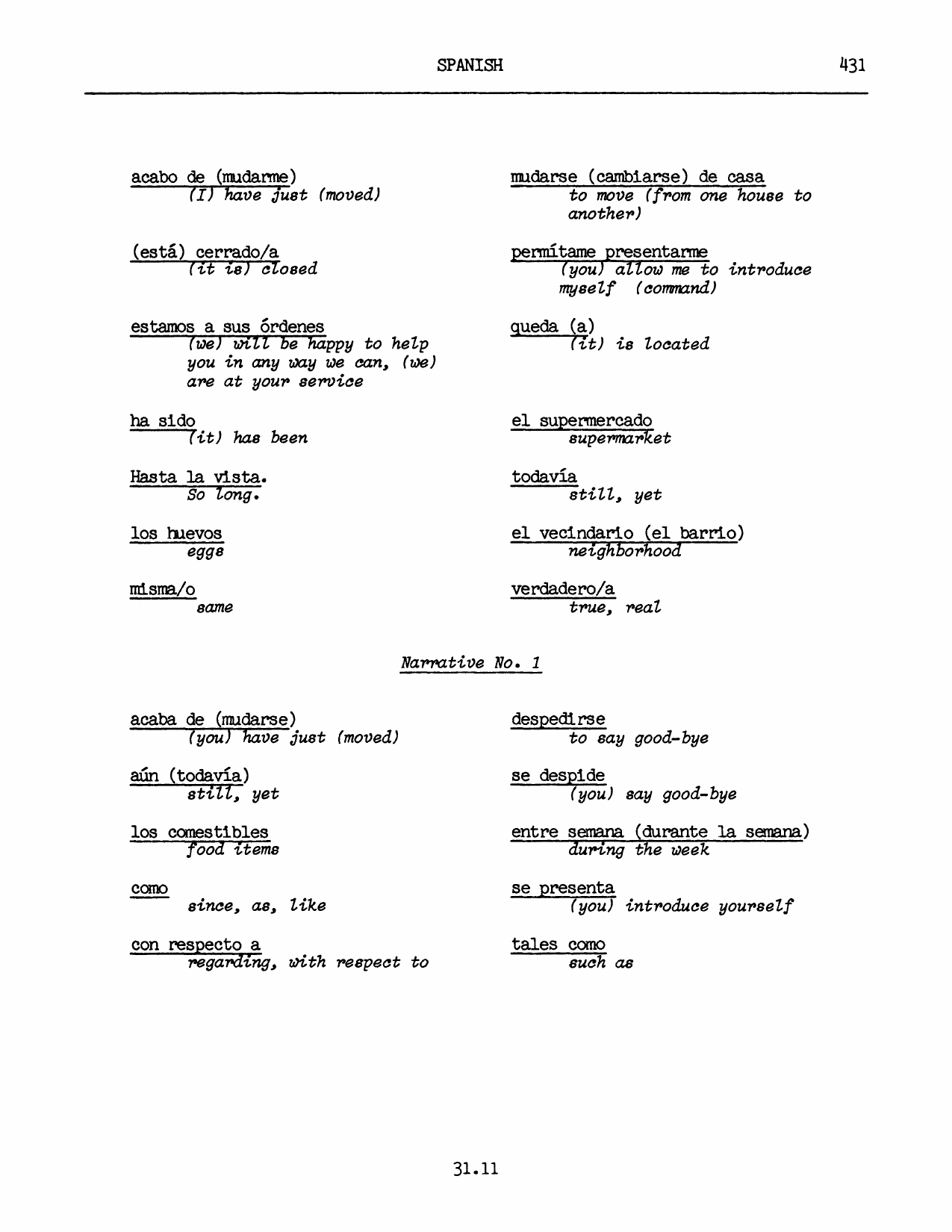
Dialogue No. 2
tt for you (command)
(command)
Narrative No. 2
each other
waite on
el/la dependiente
clerk
V. GETTING THE FEEL OF IT
Questions and Answers:
A. 1. ¿Dónde puedo comprar cigarrillos (cigarros) y puros?
Puede comprarlos en la tabaquería (cigarrería).
2. ¿Dónde puedo comprar tortillas?
Puede comprarlas en la tortillería.
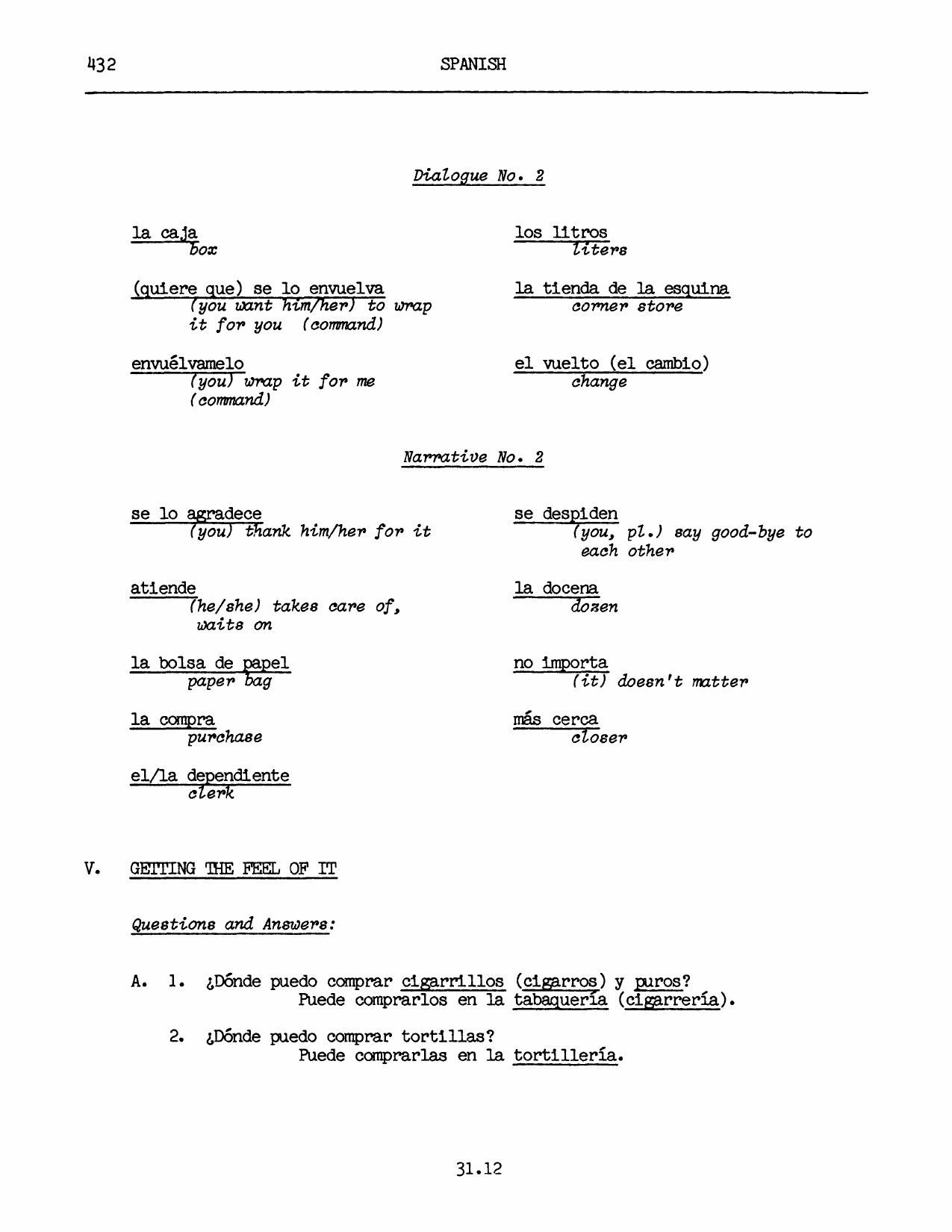
3. ¿Dónde puedo comprar pasteles?
Puede comprarlos en la pastelería.
4, ¿Dónde puedo comprar dulces?
Puede comprarlos en la dulcería.
5. ¿Dónde puedo comprar leche?
Puede comprarla en la lechería.
6. ¿Dónde puedo comprar pan?
Puede comprarlo en la panadería.
¿Dónde se puede comprar gasolina (nafta, bencina)?
Se puede comprar en la gasolinera (estación de servicio).
26 ¿Dónde se puede comprar un par de zapatos?
Se pueden comprar en la zapatería.
3. ¿Dónde se puede comprar un reloj?
Se puede comprar en la relojería o en la joyería.
4 ¿Dónde se puede comprar libros?
Se pueden comprar en la librería.
5. ¿Dónde se puede comprar flores?
Se pueden comprar en la florería (floristería).
6. ¿Dónde se puede comprar carne?
Se puede comprar en la carnicería.
C. 1. ¿Dónde se puede conseguir una piñata?
Se puede conseguir en el mercado.
¿Cuándo se puede hablar con el jefe?
Se puede hablar con él a las dos.
¿Dónde se puede tomar el autobús (ómibus, colectivo, microbús, bus, Méx. camión)?
Se puede tomar en la esquina.
¿Cuánto se deja de propina?
Se deja el quince por ciento.
5. ¿Cómo se va de aquí a la Embajada?
Se puede ir a pie.
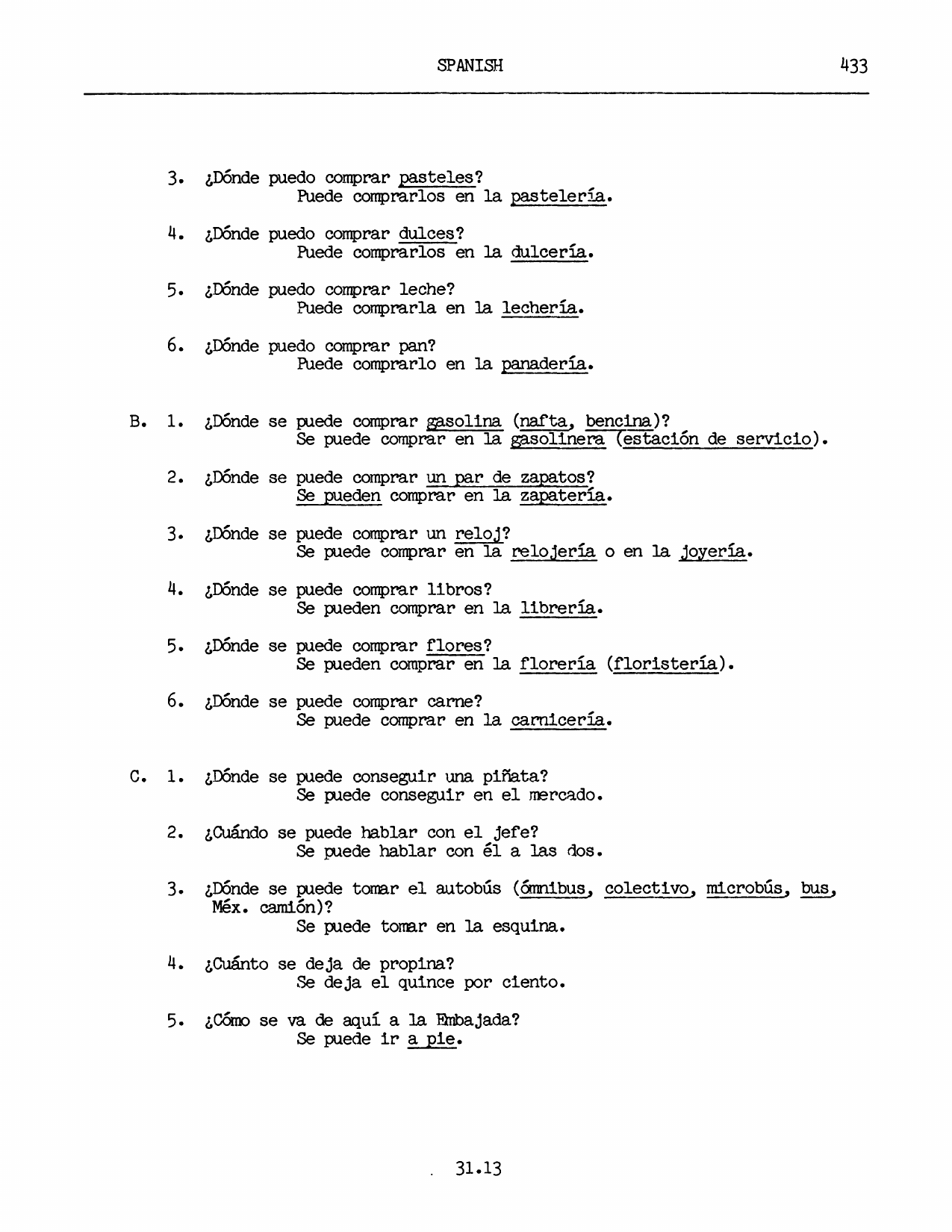
D. 1. ¿Es ésa la única tienda de comestibles (abarrotes) del vecindario
(barrio)?
Sí, ésa es la única.
2. ¿Es ése el único supermercado cerca de aquí?
Sí, ése es el único.
3. ¿Esa es la única carne que le queda?
Sí, ésa es la única.
4. ¿Son ésos los únicos periódicos que tiene?
sí, son los únicos.
5. ¿Esas son las únicas revistas en inglés que vende?
Sí, son las únicas.
E. N- ¿Para qué necesita el español?
A - Para poder desempeñar mi trabajo mejor.
a. Para hablar con los bolivianos.
b. Para viajar por España.
C. Para conversar con los argentinos.
d. Para darme a entender.
e. Para poder llevar una vida normal en Venezuela.
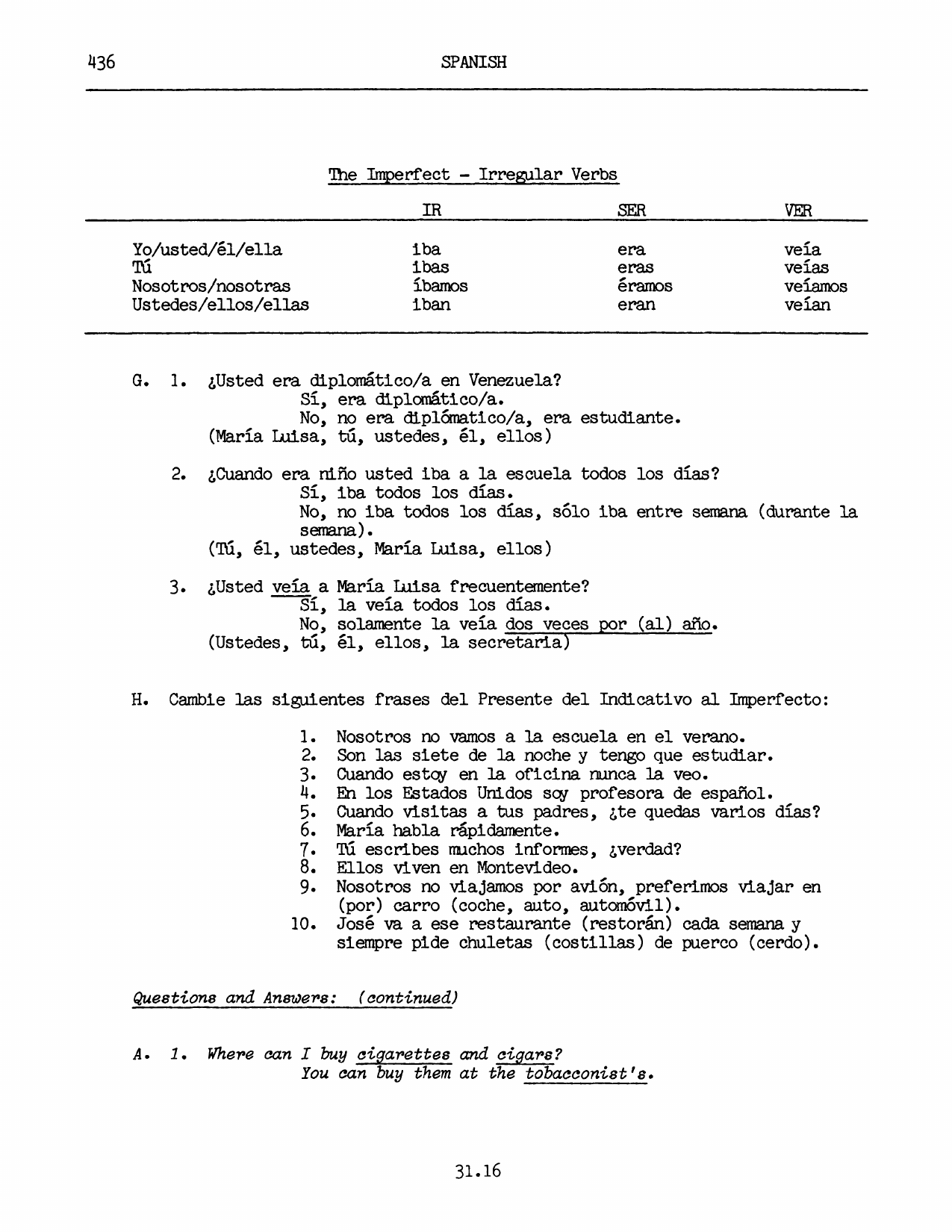
The Imperfect
Note: The meaning conveyed by the Imperfect tense in Spanish can be translated into English in several different ways. For example, Yo estudiaba can mean "I used to study," "I was studying," "I would study," or "I studied" in the sense of a repeated or routine action or a description of what used to happen or was happening at a cer-tain point in time.
F. 1. En la universidad, ¿usted estudiaba todo el día?
Sí, estudiaba todo el día.
No, no estudiaba todo el día.
(El, ustedes, tú, José y María luisa, ella)
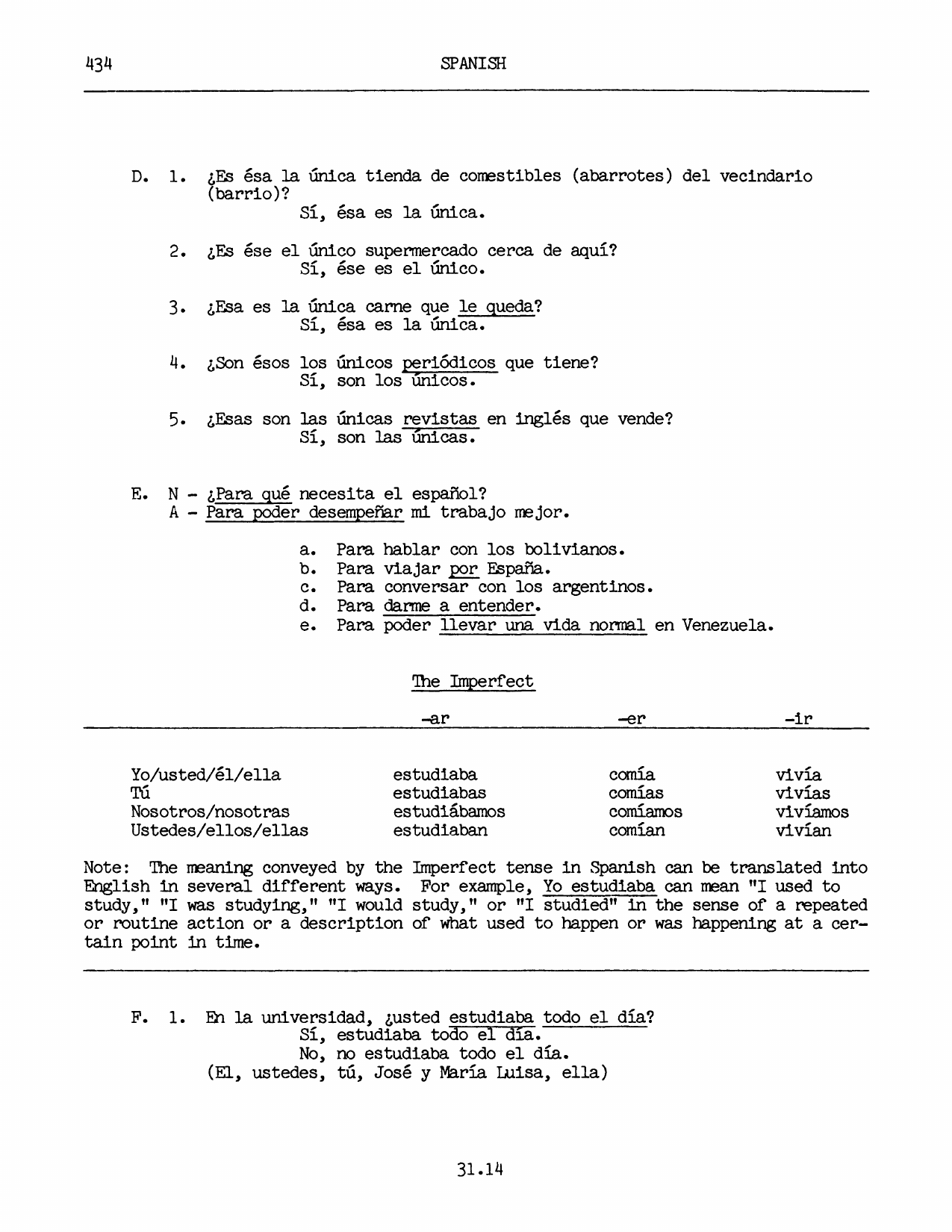
2. ¿El Embajador viajaba mucho?
sí, viajaba mucho.
No, no viajaba mucho.
(Ustedes, ellos, usted, tú, él)
3. ¿El profesor hablaba lentamente (despacio)?
Si, hablaba lentamente (despacio).
No, hablaba rápidamente.
(Tú, ellos, usted, ustedes, ella)
4, ¿Usted tenía casa en Quito?
Si, tenía casa ahí.
No, no tenía casa ahí.
(Tú, María y Alfonso, ellos, ustedes, él)
5. En Chile, ¿usted leía el periódico?
Sí, lo leía.
No, no lo leía.
(Ustedes, ellos, tú, usted y Juan, él)
6. ¿Tú podías ir los fines de semana a la playa?
Sí, podía ir cada fin de semana.
No, no podía ir más que una vez por (al) mes.
(Usted, ellos, ustedes, tú e Isabel, ella)
7. En Honduras, ¿ustedes vivian cerca de la Embajada?
Si, vivíamos my cerca.
No, vivíamos bastante lejos de la Embajada.
(Tú, usted, ellos, él, Margarita y Juan José)
8. ¿La secretaria escribía muchas cartas?
Sí, escribía muchas.
No, en realidad escribía pocas.
(Los funcionarios, ella, tú, ustedes, él)
9. ¿Tú recibías el correo?
Sí, lo recibía todos los días.
No, yo no lo recibía.
(Ellos, ustedes, él, usted, el funcionario)
10. ¿Usted salía a comer frecuentemente?
Sí, salía a comer todos los días.
No, solamente salía a comer de vez en cuando.
(Ustedes, tú, él, ellos, la secretaria
The Imperfect - Irregular Verbs
G. 1. ¿Usted era diplomático/a en Venezuela?
Si, era diplomático/a.
No, no era diplómatico/a, era estudiante.
(María Luisa, tú, ustedes, él, ellos)
2. ¿Cuando era niño usted iba a la escuela todos los días?
Sí, iba todos los días.
No, no iba todos los días, sólo iba entre semana (durante la semana).
(Tú, él, ustedes, María Luisa, ellos)
3. ¿Usted veía a María luisa frecuentemente?
Sí, la veía todos los días.
No, solamente la veía dos veces por (al) año.
(Ustedes, tú, 61, ellos, la secretaria)
H. Cambie las siguientes frases del Presente del Indicativo al Imperfecto:
1. Nosotros no vamos a la escuela en el verano. 2. Son las siete de la noche y tengo que estudiar. 3. Cuando estoy en la oficina munca la veo.
4, En los Estados Unidos soy profesora de español. 5. Cuando visitas a tus padres, ¿te quedas varios días? 6. María habla rápidamente.
7. Tú escribes muchos informes, ¿verdad?
8. Ellos viven en Montevideo.
9. Nosotros no viajamos por avión, preferimos viajar en
(por) carro (coche, auto, automóvil).
10. José va a ese restaurante (restorán) cada semana y
siempre pide chuletas (costillas) de puerco (cerdo).
Questions and Answers: (continued)
A. 1. Where can I buy cigarettes and cigars?
You can buy them at the tobacconist's.
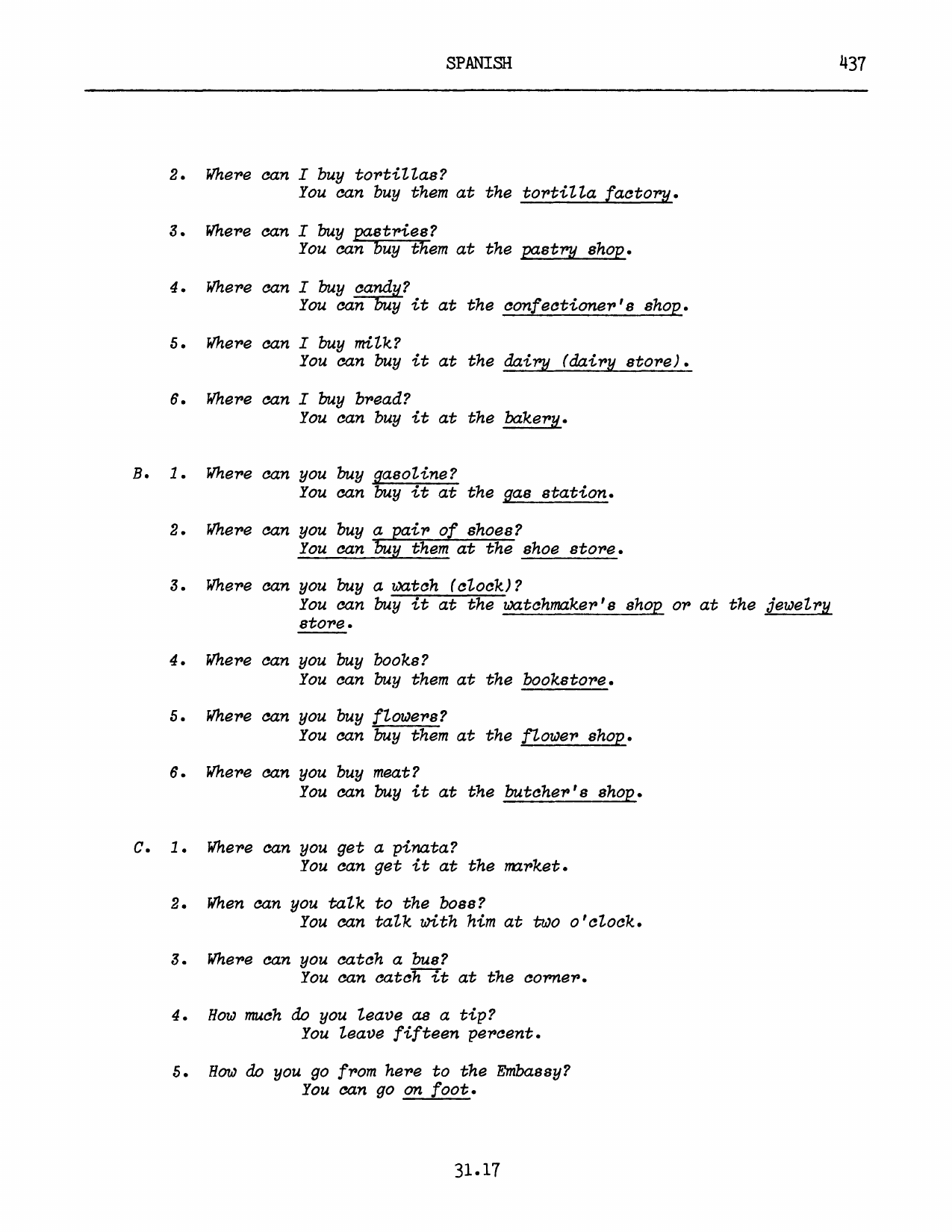
ae Where can I buy tortillas?
You can buy them at the tortilla factory.
3» Where can I buy pastries?
You can buy them at the pastry shop.
4. Where can I buy candy?
You can buy it at the confectioner's shop.
5. Where can I buy milk?
You can buy it at the dairy (dairy store).
6. Where can I buy bread?
You can buy it at the bakery.
Bo 1, Where can you buy gasoline?
You can buy it at the gas station.
2. Where can you buy a pair of shoes?
You can buy them at the shoe store.
3. Where can you buy a watch (clock)?
You can buy it at the watchmaker's shop or at the jewelry store.
4. Where can you buy books?
You can buy them at the bookstore.
Where can you buy flowers?
You can buy them at the flower shop.
6. Where can you buy meat?
You can buy it at the butcher's shop.
C. 1. Where can you get a pinata?
You can get tt at the market.
2. When can you talk to the boss?
You can talk with him at two o'clock.
3. Where can you catch a bus?
You can catch it at the corner.
4. How much do you leave as a tip?
You leave fifteen percent.
De How do you go from here to the Embassy?
You can go on foot.
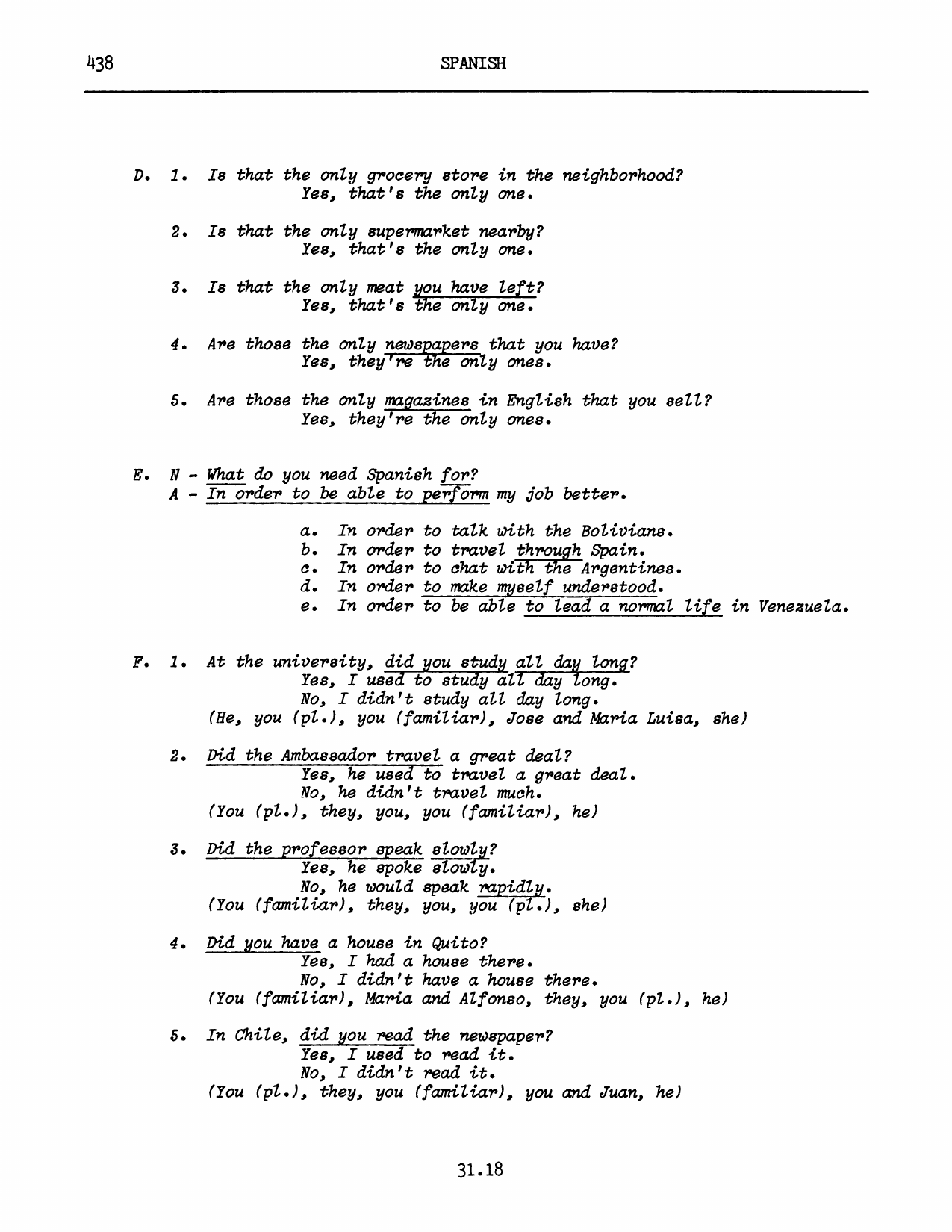
D. 1. Ie that the only grocery store in the neighborhood?
Yes, that's the only one.
2. Ie that the only supermarket nearby?
Yes, that's the only one.
3. Ie that the only meat you have left?
Yes, that's the only one.
4. Are those the only newspapers that you have?
Yes, they're the only ones.
5. Are those the only magazines in English that you sell?
Yes, they're the only ones.
E. W - What do you need Spanish for?
A - In order to be able to perform my job better.
a. In order to talk with the Boliviane.
b. In order to travel through Spain.
c. In order to chat with the Argentines.
d. In order to make myself understood.
e. In order to be able to lead a normal life in Venezuela.
F. 1. At the university, did you study all day long?
No, I didn't study all day long.
(He, you (pl.), you (familiar), José and Maria Luisa, she)
2. Did the Ambassador travel a great deal?
Yes, he used to travel a great deal.
No, he didn't travel much.
(You (pl.), they, you, you (familiar), he)
3. Did the professor speak slowly?
Yes, he spoke slowly.
No, he would speak rapidly.
(You (familiar), they, you, you (pl.), she)
4. Did you have a house in Quito?
Yes, I had a house there.
No, I didn't have a house there.
(You (familiar), Maria and Alfonso, they, you (pl.), he)
5. In Chile, did you read the newspaper?
Yes, I used to read it.
No, I didn't read it.
(You (pl.), they, you (familiar), you and Juan, he)
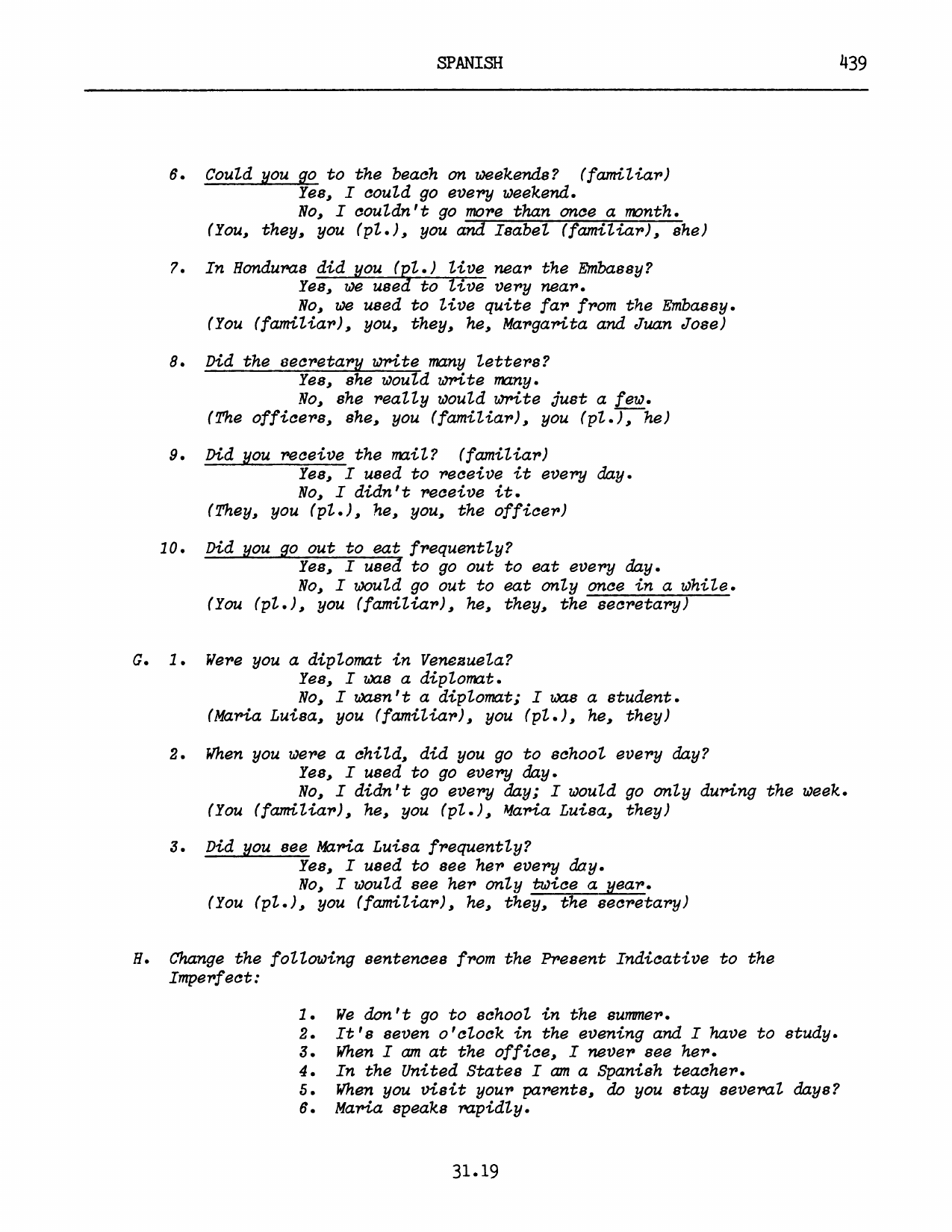
6. Could you go to the beach on weekends? (familiar)
Yes, I could go every weekend.
No, I couldn't go more than once a month.
(You, they, you (pl.), you and Isabel (familiar), she)
7. In Honduras did you (pt) live near the Embassy?
Yes, we used to live very near.
No, we used to live quite far from the Embassy.
(You (familiar), you, they, he, Margarita and Juan José)
8. Did the secretary write many letters?
Yes, she would write many.
No, she really would write just a few.
(The officers, she, you (familiar), you (pl.), he)
9. Did you receive the mail? (familiar)
Yes, I used to receive it every day.
No, I didn't receive it.
(They, you (pl.), he, you, the officer)
10. Did you go out to eat frequently?
Yes, I used to go out to eat every day.
No, I would go out to eat only once in a while.
(You (pl.), you (familiar), he, they, the secretary)
G. 1. Were you a diplomat in Venezuela?
Yes, I was a diplomat.
No, I wasn't a diplomat; I was a student.
(Maria Luisa, you (familiar), you (pl.), he, they)
2. When you were a child, did you go to school every day?
Yes, I used to go every day.
No, I didn't go every day; I would go only during the week.
(You (familiar), he, you (pl.), María Luisa, they)
3. Did you see María Luisa frequently?
Yes, I used to see her every day.
No, I would see her only twice a year.
(You (pl.), you (familiar), he, they, the secretary)
H. Change the following sentences from the Present Indicative to the
Imperfect:
1. We don't go to school in the summer.
2. It's seven o'clock in the evening and I have to study. 3. When I am at the office, I never see her.
4. In the United States I am a Spanish teacher. 5. When you visit your parents, do you stay several days? 6. Maria speaks rapidly.
7. You write many reporte, don't you?
8. They live in Montevideo.
9. We don't travel by plane; we prefer to travel by car. 10. José goes to that restaurant every week and always orders
pork chops.
VI. PUTTING IT TOGETHER
Variants:
Dialogue No. 1
A. A - Perdone, señora. Acabo de mudarme (cambiarme) a este edificio y
todavía no conozco my bien el vecindario (barrio). ¿Podría decirme dónde puedo comprar pan, leche y huevos?
N - Pues, mire. Aquí en la esquina hay una tienda pequeña pero no tienen
muchas cosas.
1 - Perdone, sefiora/sefiorita/sefior. Todavía no conozco my bien
el vecindario (barrio) y no sé dónde puedo comprar verduras y carne.
2 - Perdone. ¿Sería tan amable de decirme dónde puedo comprar
fruta?
3 - Perdón, señora/señorita/señor. ¿Puede decirme si hay un
supermercado aquí cerca (cerca de aquí)?
4 — Sefior/sefiorita/sefiora, ¿usted sabe si venden vino en
esa tienda de abarrotes (comestibles)?
5 - Perdone. ¿Hay una panadería aquí cerca (cerca de aquí)?
B. A — ¿Sabe de qué hora a qué hora está abierto?
N -— Bueno, está abierto de (las) nueve de la mañana a (las) ocho de la noche
durante la semana (entre semana), pero los domingos está cerrado (no abren los domingos).
1 = ¿Usted sabe cuándo está abierto?
2 - ¿Usted sabe a qué hora cierran?
3 - ¿Sabe si está abierto ahora?
4 — ¿Usted sabe hasta qué hora está abierto?
5 - ¿Sabe a qué hora abren?
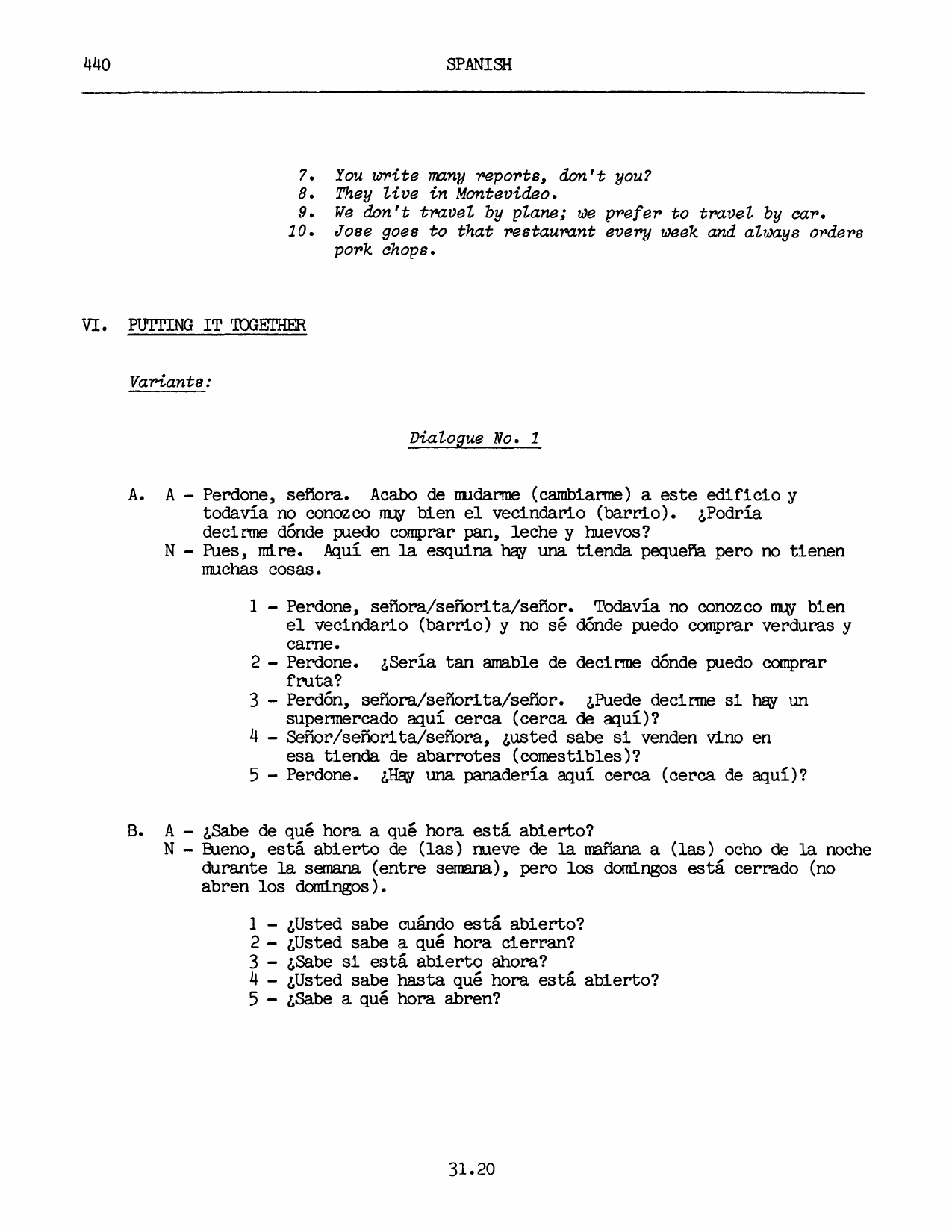
Dialogue No. 2
C. N= Buenos días. ¿En qué puedo servirle (servirlo/a)?
A - Quiero dos litros de leche, una docena de huevos y pan, por favor.
1 - Quiero una libra de arroz y una lata de sardinas, por favor. 2 — Déme trescientos cincuenta gramos de jamón, por favor.
pancitos (Méx. bolillos o teleras).
4 — Quiero una botella de Coca Cola tamaño familiar, por favor. 5 - Déme medio kilo de queso suizo y quinientos gramos de tocino.
D. N- Aquí tiene. Son $166,25. ¿Tiene cambio (sencillo, menudo)?
A - Lo siento, sólo tengo un billete de (a) $1.000 (mil).
1 - Lo siento, no tengo.
2 - Sí, si tengo.
3 - lo siento. Esto es todo lo que tengo.
4 — No estoy seguro/a. Dé jeme ver (A ver).
5 - Yo no tengo, pero permitame (déjeme) preguntarle a mi
esposa/o.
Variants: (continued)
Dialogue No. 1
A. A - Pardon me, ma'am. I've just moved in and I'm still not very
familiar with the neighborhood. Could you tell me where I can buy bread, milk, and eggs?
N - Well, let's see. Right here on the corner there's a small store, but
they don't have many things.
1 - Pardon me, ma'am/miss/sir. I'm still not very familiar with
the neighborhood and I don't know where I can buy vegetables and meat.
2 - Pardon me. Would you be so kind as to tell me where I can buy
some fruit?
3 - Pardon me, ma'am/miss/sir. Can you tell me if there's a
supermarket nearby?
4 - Sir/miss/ma'am, do you know tf they sell wine at
that grocery store?
5 - Excuse me. Is there a bakery nearby?
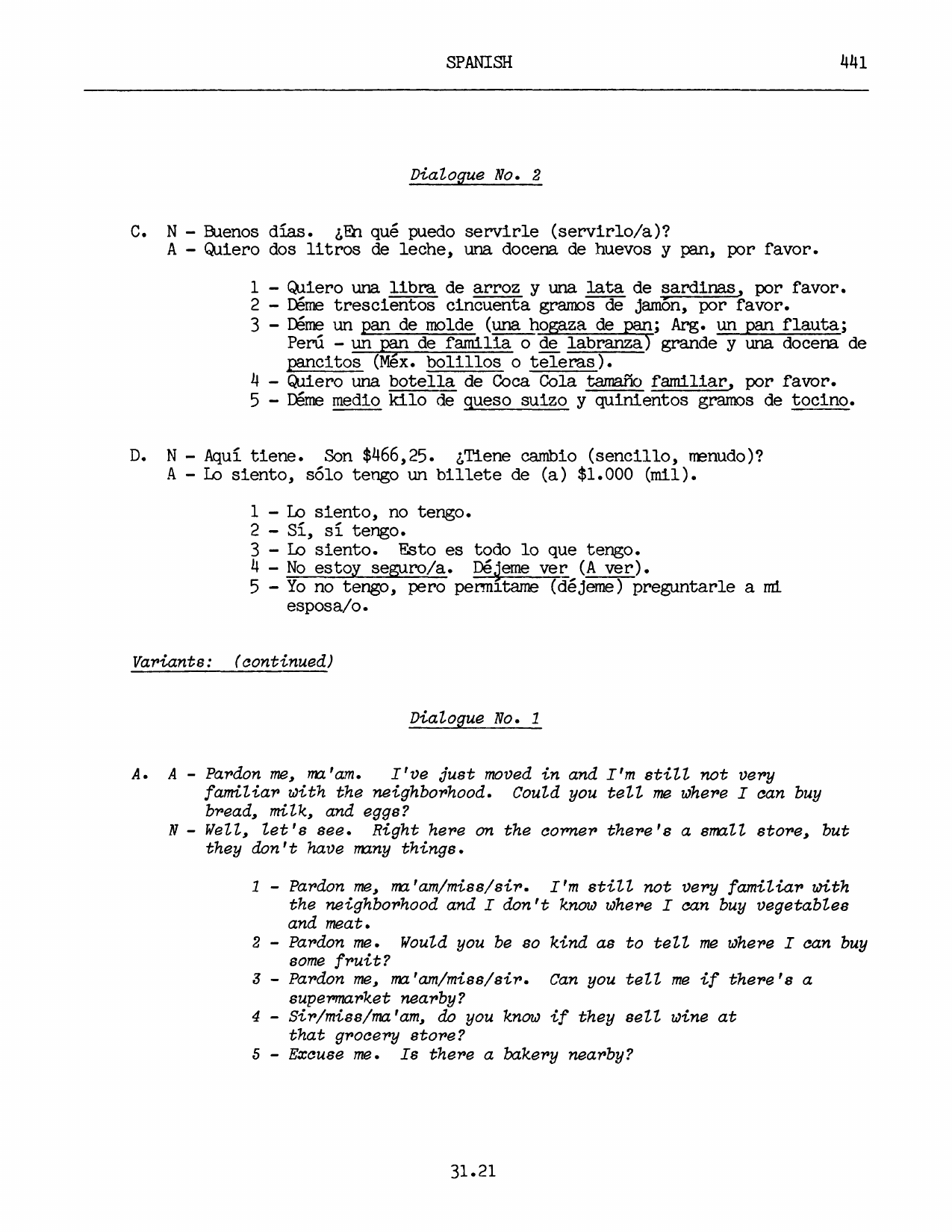
B. A - Do you know when they are open?
N - Well, they're open from nine o'clock in the morning until eight o'clock
at night, but they're closed on Sundays.
1 - Do you know when they're open?
2 - Do you know at what time they close?
3 - Do you know if they're open now?
4 - Do you know how late they're open?
5 - Do you know at what time they open?
Dialogue No. 2
C. N- Good morning. May I help you?
A - I would like two liters (note: more or less two quarte) of milk, a
dozen eggs, and bread, please.
1 - I would like a pound of rice and a can of sardines, please. 2 - Give me 350 grams of ham, please.
3 - Give me a large Loaf of bread and one dozen rolls,
please.
4 - I would like a family-size bottle of Coca Cola, please. 5 - Give me half a kilo of Swiss cheese and 500 grams of bacon.
D. WN - Here you are. It's $466.25. Do you have change?
A - I'm sorry; I only have a $1,000 bill.
1 - I'm sorry; I don't have any.
2 - Yes, I do.
3 - I'm sorry. This ls all I have.
4 - I'm not sure. Let me see.
5 - I don't have any, but let me ask my wife/hueband.
VII. MAKING IT WORK
VIII. USING IT