CYCLE 32
GETTING THINGS
How to Pay a Maid or Deliveryman
“La
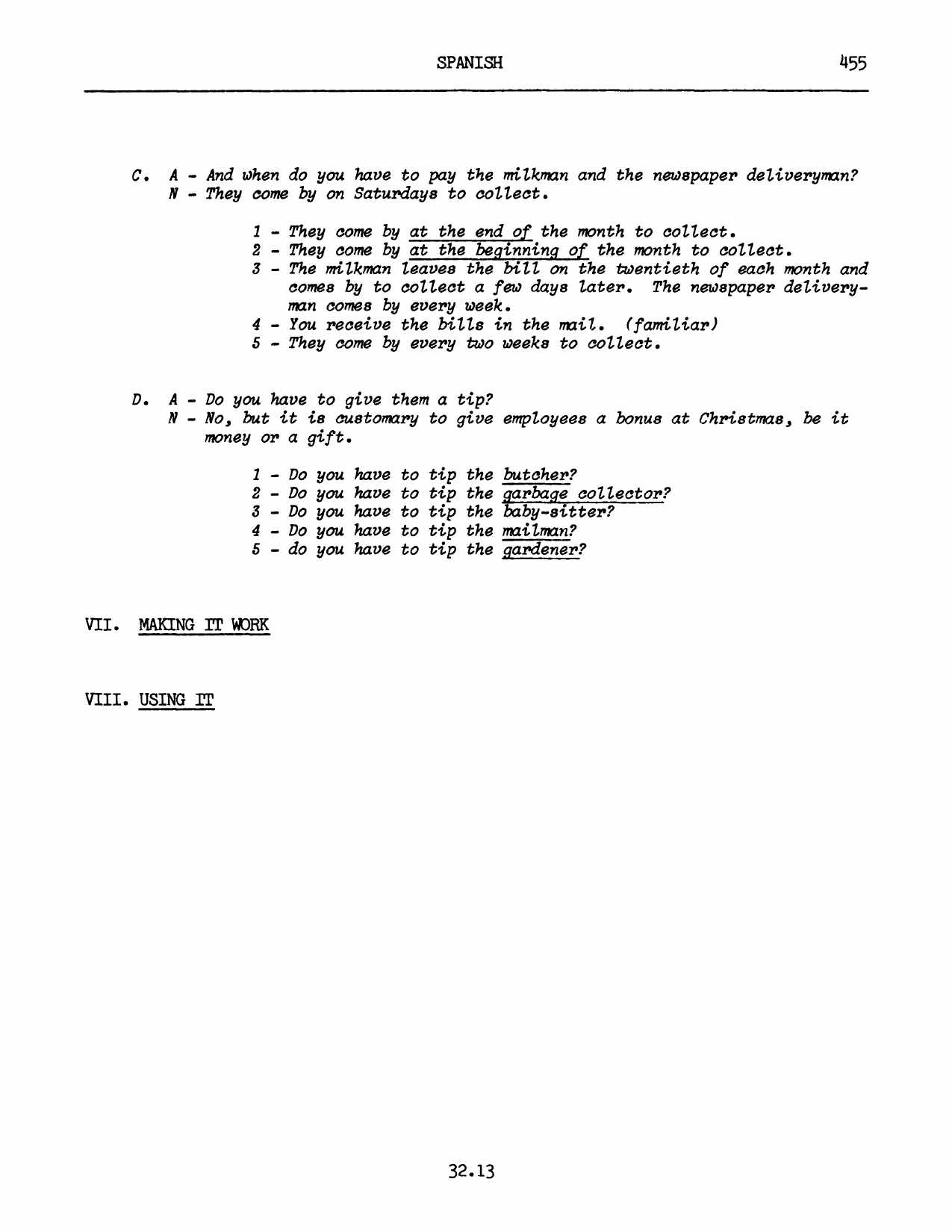
This Cycle will give you an idea of how to pay employees in the event you
decide to hire a maid or arrange for home delivery of such things as milk or a newspaper.
This page has a drawing, chart, or fill-in layout — original page
I. SETTING THE SCENE
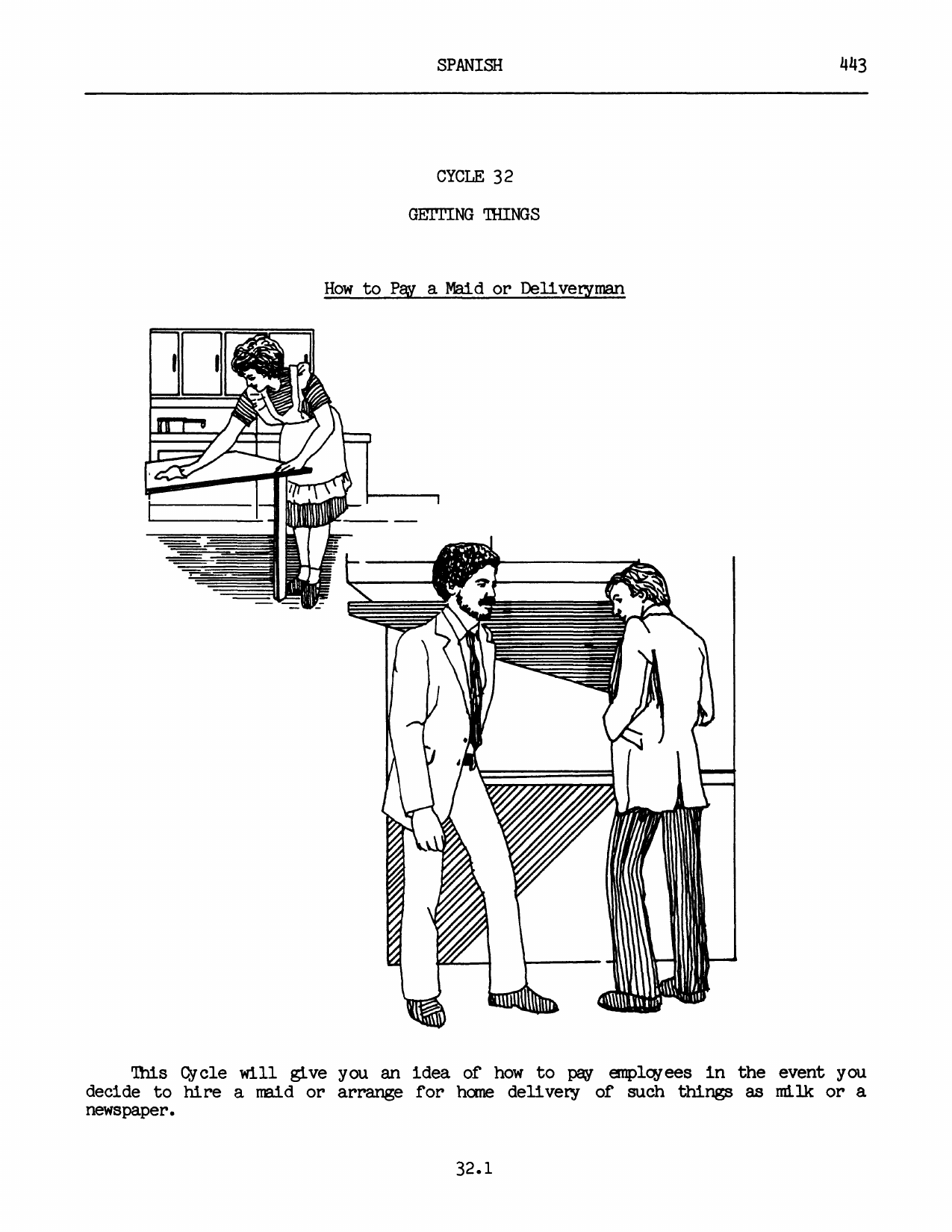
You would like to hire a maid and to have the newspaper and milk delivered to your home. You ask a friend about the local custom for paying for these services.
II. HEARING IT
III. SEEING IT
Dialoque No. 1: (Short Version)
Cómo pagarles a la empleada doméstica,
al lechero, al repartidor de diarios, etcétera
A - Manuel, ¿cómo hay que pagarle a la muchacha, por mes o por semana? N - Nosotros le pagamos cada quince días y le damos para el autobús cuando
sale en su día libre.
A - Y si damos una fiesta, ¿hay que darle propina?
N - Eso depende de ustedes. Pueden darle algo, si quieren.
A - Y, ¿cuándo hay que pagarles al lechero y al repartidor de diarios? N - Ellos pasan a cobrar los sábados.
A - ¿Hay que darles propina?
N - No, pero es costumbre darles a los empleados el aguinaldo en Navidad, ya
sea dinero o un regalo.
A - Gracias por la información, Maruel. Hasta luego.
N - Hasta luego, Mike/Mary.
Dialogue No. 1: (Short Version - continued)
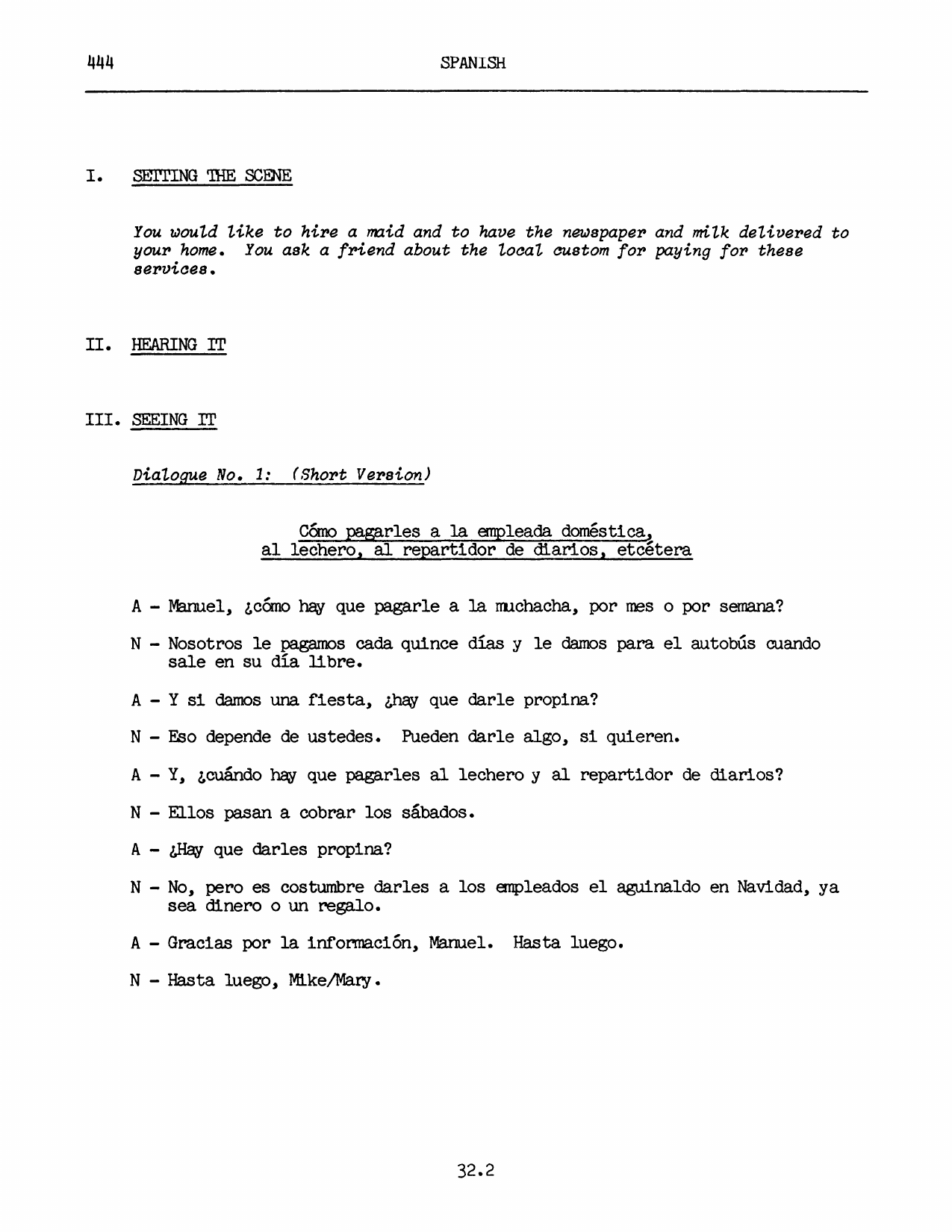
How to pay the maid, the milkman, the newspaper deliveryman, etc.
(1)(2) A - Manuel, how do you pay the maid, by the month or by the week?
(3) N - We pay her every two weeks and give her bus fare when she goes out on
her day off.
(1)(4) A - And tf we give a party, do we have to give her a tip?
N - That depends on you (pl.). You can give her something if you like. A - And when do you have to pay the milkman and the newspaper deliveryman? N - They come by on Saturdays to collect.
A - Do you have to give them a tip?
(4) N - No, but it ts customary to give employees a bonus at Christmas, be it
money or a gift.
A - Thanks for the information, Manuel. See you later.
N - So long, Mike/Mary.
Dialogue No 2: (Long Version)
Cómo pagarles a la empleada doméstica,
al lechero, al repartidor de diarios, etcétera
A —- Maruel, dime. ¿Cómo se le paga a la muchacha, por mes o por semana? N - Bueno, a mi muchacha le gusta que le pague cada quince días y que le dé
para el transporte en su día libre.
A - Y si damos una fiesta, ¿hay que darle propina?
N ~ Eso depende de ustedes. Yo creo que es una buena idea darle algo después
de la fiesta, pero no es necesario.
A - Y, ¿cuándo se les paga al lechero y al repartidor de diarios? N - Ellos pasan a cobrar cada semana (ocho días), generalmente los sábados.
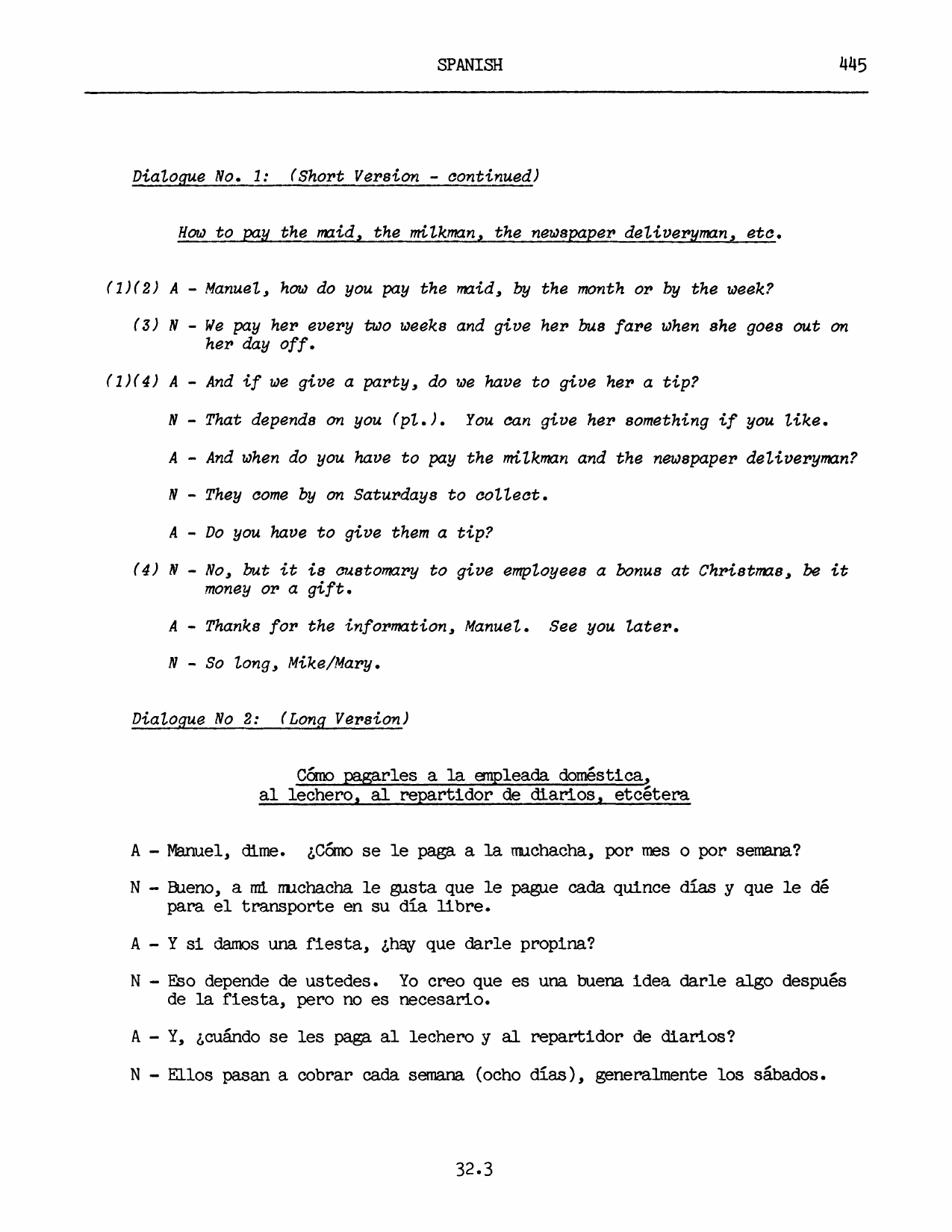
A - ¿Se les da propina?
N - No es necesario, pero a todos se les da el aguinaldo en Navidad. Puede ser
dinero o un regalo. Pero te diré un secreto, les gustan mucho los cigarrillos (cigarros) americanos.
A - Gracias por la información, Manuel. Nos vemos más tarde.
N - Hasta luego, Mike/Mary.
Dialogue No. 2: (Long Version - continued)
How to pay the maid, the milkman, the newspaper deliveryman, etc.
(2) A - Manuel, tell me. How do you pay the mid, by the month or by the week?
(3)(5) N - Well, my maid likes to be paid every two weeks and to be given bus fare
on her day off.
(1)(4) A - If we give a party, do we have to give her a tip?
N - That depends on you (pl.). I think it's a good idea to give her
something after the party, but it's not necessary.
A - And when do you pay the milkman and the newspaper deliveryman?
(3) N - They come by every week to collect, usually on Saturday.
A - Do you give them a tip?
(4) N - It's not necessary, but we do give them a bonus at Christmas. It can
be either money or a gift. But I'll tell you a secret: they like American cigarettes a great deal.
A - Thanks for the information, Manuel. See you later.
N - So long, Mike/Mary.
Language Notes
1. The impersonal expression, hay que
One way of expressing an obligation in Spanish is by using the construction
tener que + infinitive, as in Tengo que ir hay ("I have to go today"). However,
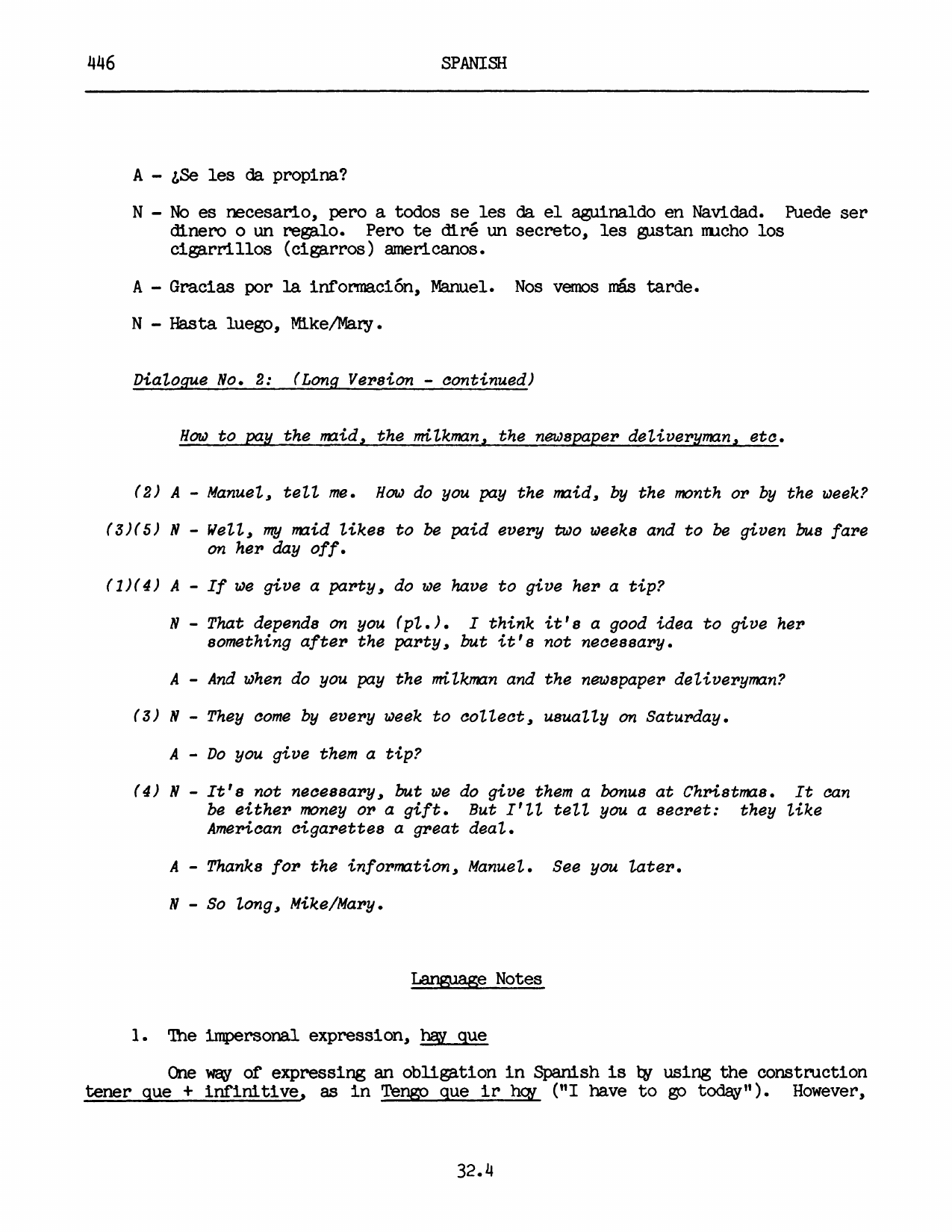
nitive. (Hay que = "one has to" vs. tiene que = "you (specifically) have to.") Note the following examples from this Cycle:
a la muchacha”?
2. La empleada doméstica
There are several words in Spanish for "maid": la muchacha, la sirvienta,
la empleada (doméstica), la criada, el servicio, la asistenta, and, in the river Plata region, la mucama. Words like sirvienta and criada tend to project a status of servitude; for this reason, the other terms have become more widely used in recent years.
3. Cada ocho días vs. cada quince días
Spanish speakers use the word semana in much the same way that English
speakers use the word "week." However, Spanish speakers often refer to a two-week period as quince días and to a one-week period as ocho días. For example, you could say “one week from today" or "two weeks from today" in either of two ways:
4. El aguinaldo
The word for "tip" is propina and the usual word for "gift" is regalo. The
word aguinaldo refers to a gift or bonus given to an employee at Christmas time.
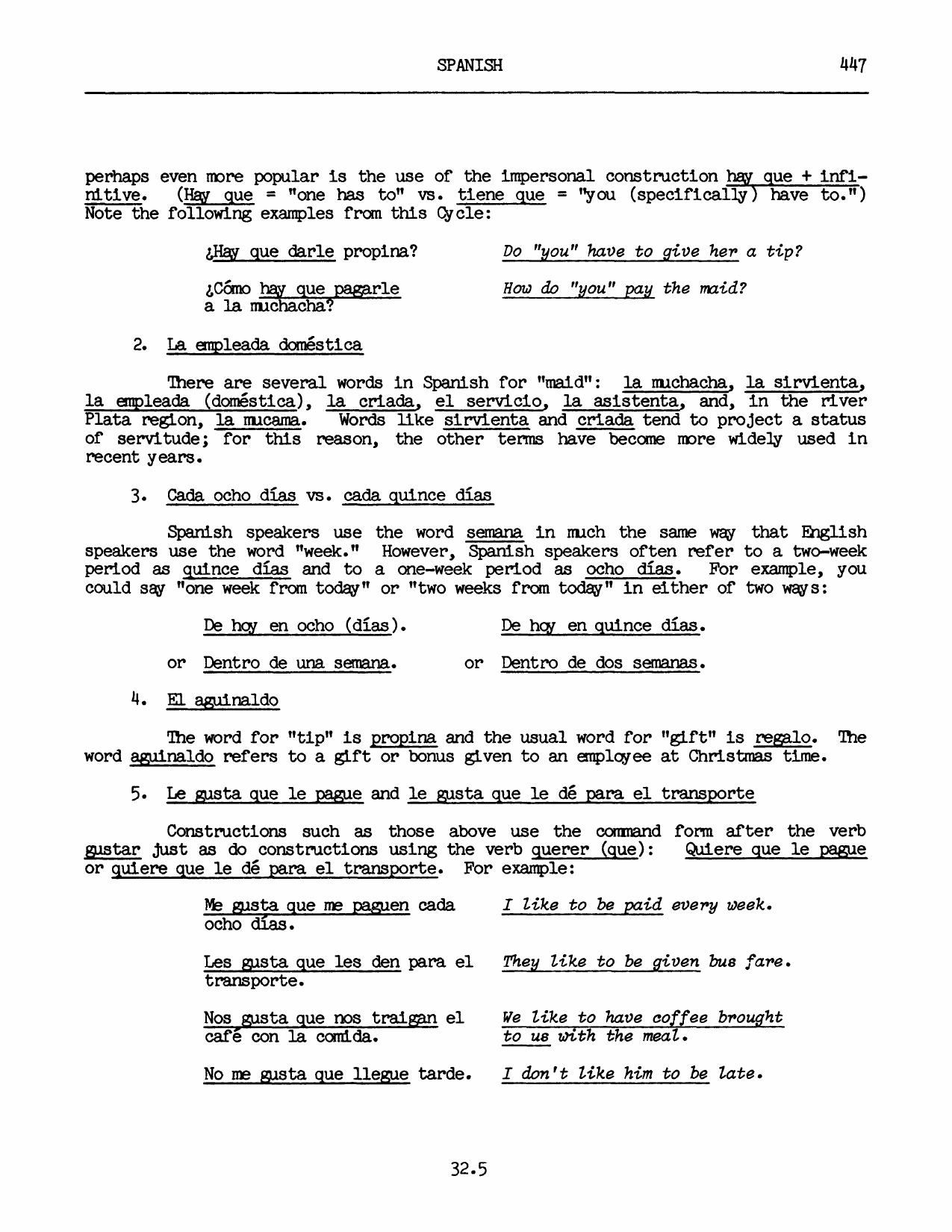
5. Le gusta que le pague and le gusta que le dé para el transporte
Constructions such as those above use the command form after the verb
gustar just as do constructions using the verb querer (que): Quiere que le pague or quiere que le dé para el transporte. For example:
ocho días.
Les gusta que les den para el They like to be given bus fare. transporte.
No me gusta que llegue tarde. JI don't like him to be late.
Narrative:
Cómo pagarles a la empleada doméstica,
al lechero, al repartidor de diarios, etcétera
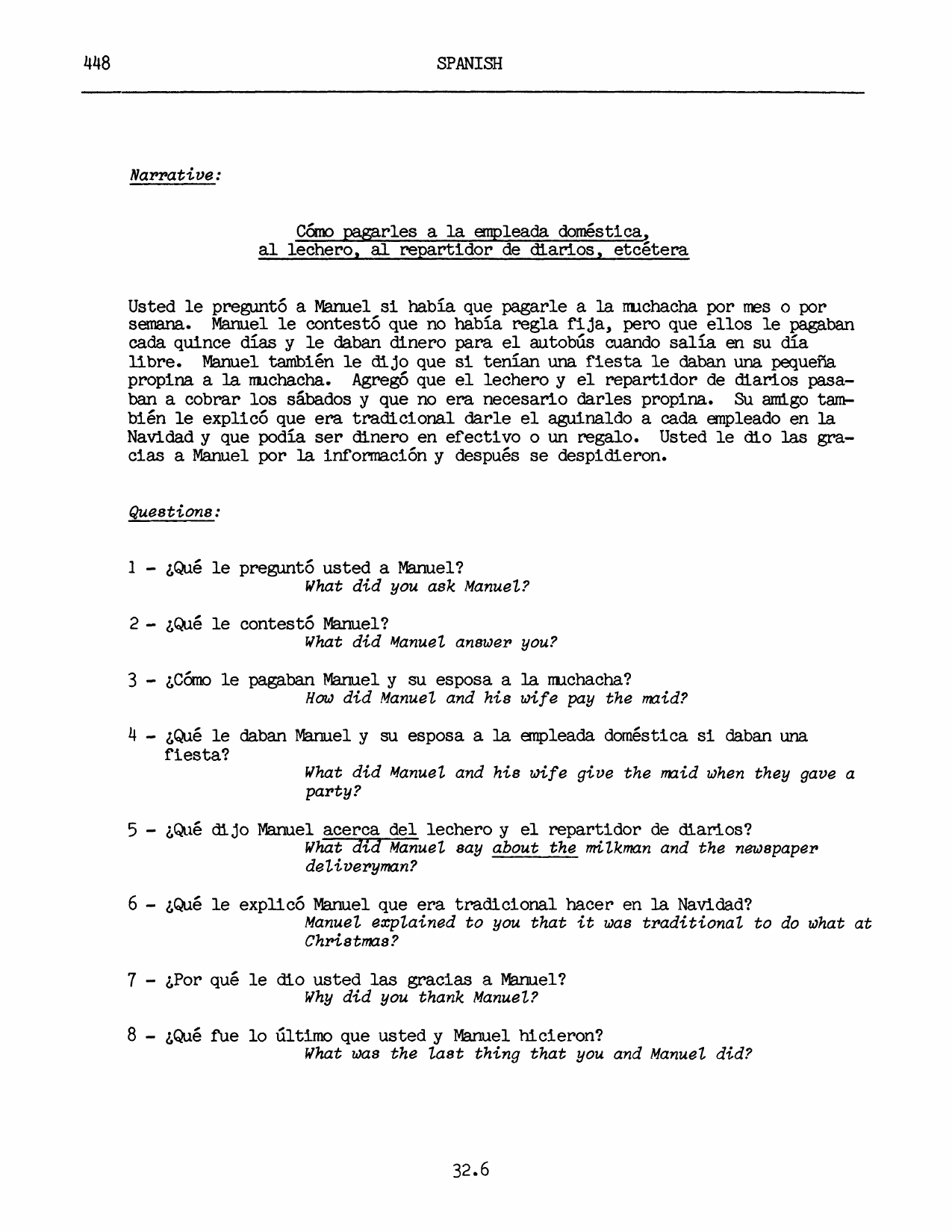
Usted le preguntó a Manuel si había que pagarle a la muchacha por mes o por semana. Manuel le contestó que no había regla fija, pero que ellos le pagaban cada quince días y le daban dinero para el autobús cuando salía en su día libre. Manuel también le dijo que si tenían una fiesta le daban una pequeña propina a la muchacha. Agregó que el lechero y el repartidor de diarios pasa-ban a cobrar los sábados y que no era necesario darles propina. Su amigo tam-bién le explicó que era tradicional darle el aguinaldo a cada empleado en la Navidad y que podía ser dinero en efectivo o un regalo. Usted le dio las gra-clas a Manuel por la información y después se despidieron.
Questions:
1 - ¿Qué le preguntó usted a Manuel?
What did you ask Manuel?
2 - ¿Qué le contestó Manuel?
What did Manuel answer you?
3 - ¿Cómo le pagaban Manuel y su esposa a la muchacha?
How did Manuel and his wife pay the maid?
4 — ¿Qué le daban Manuel y su esposa a la empleada doméstica si daban una
fiesta?
What did Manuel and his wife give the maid when they gave a party?
5 - ¿Qué dijo Manuel acerca del lechero y el repartidor de diarios?
What did Manuel say about the milkman and the newspaper deliveryman?
6 = ¿Qué le explicó Manuel que era tradicional hacer en la Navidad?
Manuel explained to you that it was traditional to do what at Christmas?
7 - ¿Por qué le dio usted las gracias a Manuel?
Why did you thank Manuel?
8 - ¿Qué fue lo último que usted y Manuel hicieron?
What was the last thing that you and Manuel did?
IV. TAKING IT APART
Vocabulary:
would give
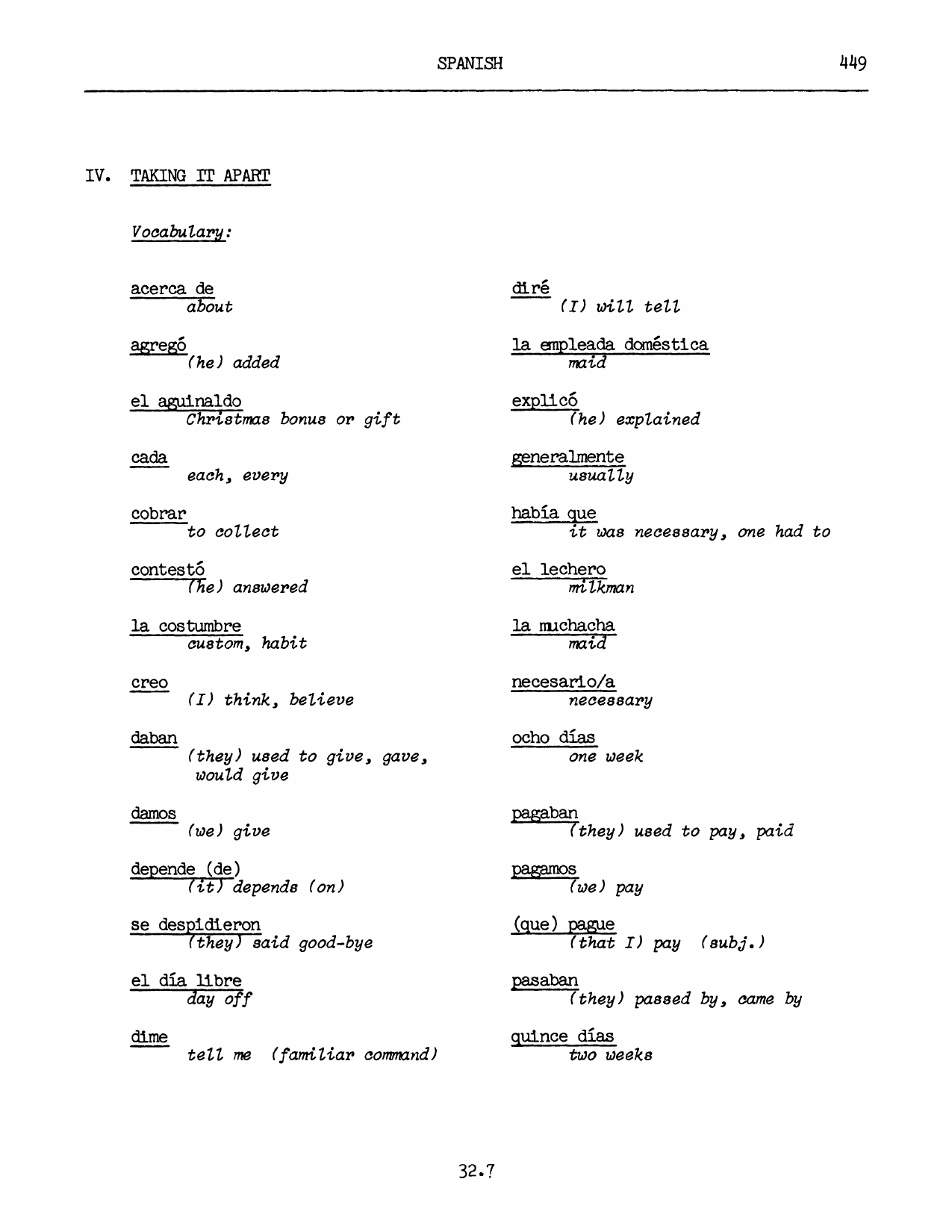
el secreto
secret
V. GETTING THE FEEL OF IT
Questions and Answers:
A. 1. ¿Cómo hay que pagarle a la muchacha?
2. ¿Hay que pagarle cada semana (ocho días)?
3. ¿Cuánto dinero hay que darle para el autobús?
4. ¿Hay que darle propina al lechero cuando pasa a cobrar?
5. ¿Qué hay que hacer para conseguir una empleada doméstica?
B. 1. ¿De quién depende?
Depende de nosotros.
2. ¿De quién depende eso?
Eso depende del Departamento de Estado.
3. La fecha de su salida (partida), ¿depende de usted?
No, depende de mi jefe.
4, ¿Esa decisión depende de usted?
No, esa decisión depende de mi esposa.
5. ¿De qué depende la excursión?
Depende del tiempo.
C. 1. ¿A quién le preguntó eso?
Le pregunté eso a mi amigo.
Se lo pregunté a mi amigo.
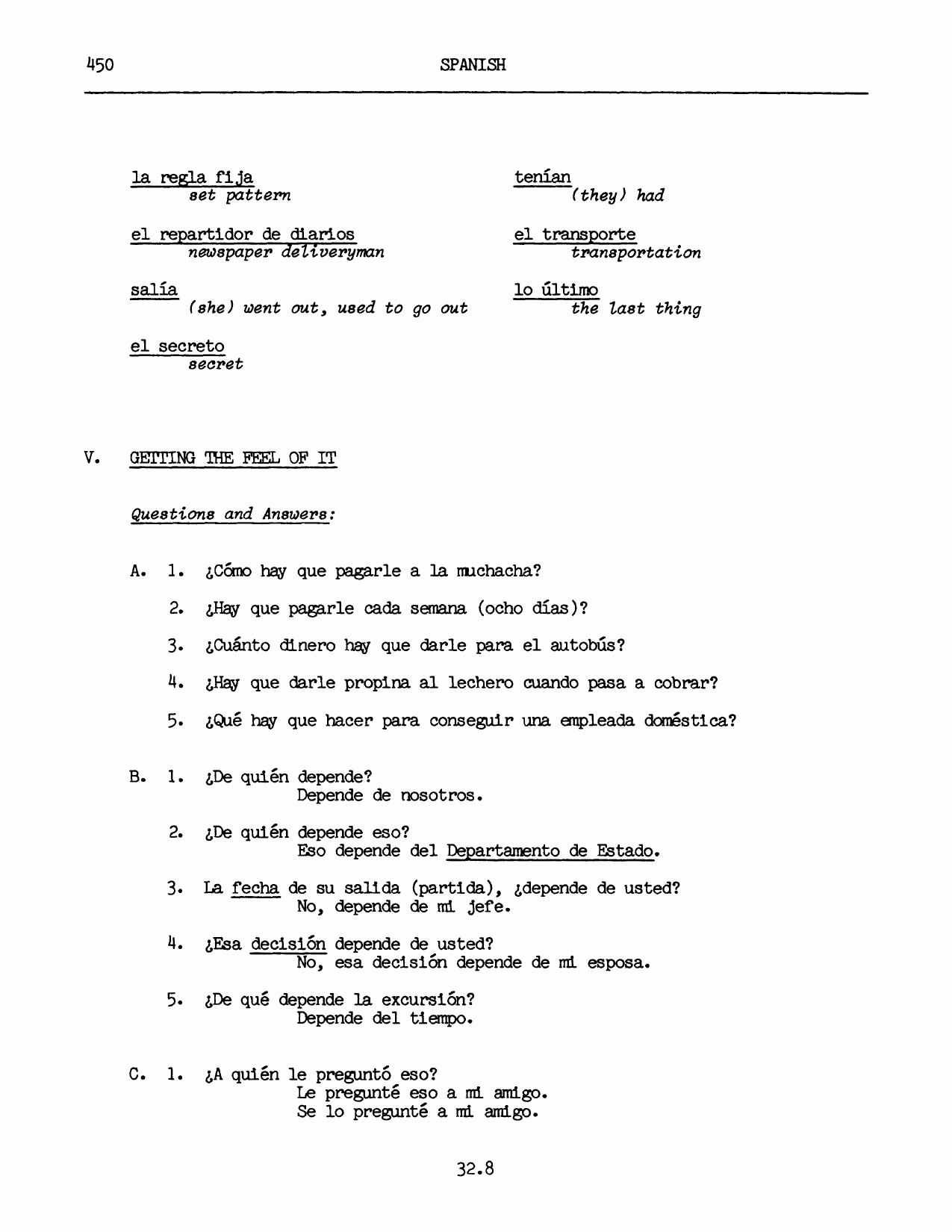
2. ¿A quién le pidió la información?
Le pedí la información a mi amigo.
Se la pedí a mi amigo.
3. ¿A quién le dio la propina?
Le di la propina al mesero (mozo, camarero).
Se la di al mesero (mozo, camarero).
4, ¿A quién le pagó el salario (sueldo)?
Le pagué el salario a la muchacha.
Se lo pagué a la muchacha.
5. ¿A quién le mandó la carta?
Le mandé la carta al Dr. Gómez.
Se la mandé al Dr. Gómez.
6. ¿A quién le presentó el documento?
Le presenté el documento al Cónsul.
Se lo presenté al Cónsul.
D. (Cambien los verbos del presente al pasado seleccionando las formas del
pretérito y del imperfecto que convengan. )
1. Usted le pregunta a Maruel si hay que pagarle a la muchacha por mes o
por semana. Manuel le contesta que no hay regla fija, pero que ellos le pagan cada quince días y le dan dinero para el autobús cuando sale en su día libre. Manuel también le dice que si tienen una fiesta le dan una pequeña propina a la muchacha. Agrega que el lechero y el repartidor de diarios pasan a cobrar los sábados y que no es necesario darles propina. Su amigo le explica que es tradicional darle el aguinaldo a cada empleado en Navidad y que puede ser dinero en efectivo o un regalo. Usted le da las gracias a Maruel por la información y después se despiden.
2. Usted llama al mesero (camarero, mozo) cuando termina de comer y le
pide la cuenta. También le pregunta si debe pagarle a él o en la caja y él le contesta que da lo mismo. Las únicas tarjetas de crédito que aceptan en ese restaurante son Visa y American Express, por lo tanto, usted decide pagar en efectivo con el único billete que tiene, uno de (a) mil. Cuando el mesero (camarero, mozo) le trae el cambio, usted le da la propina.
3. Usted visita una agencia de viajes para conseguir información sobre las
excursiones. A11í le informan que tienen una que sale todos los días a las ocho de la mañana para Teotihuacán (Teotihuacan) y Tula y está de vuelta a las ocho de la noche. Esa excursión no incluye el almuerzo. Por eso ustedes almerzan en un restaurante (restorán) cerca de las ruinas de Teotihuacán (Teotihuacan) y pagan el almierzo aparte. Como el guía no habla mucho inglés, le ofrecen unos folletos en inglés. Usted reserva seis boletos para el día siguiente.
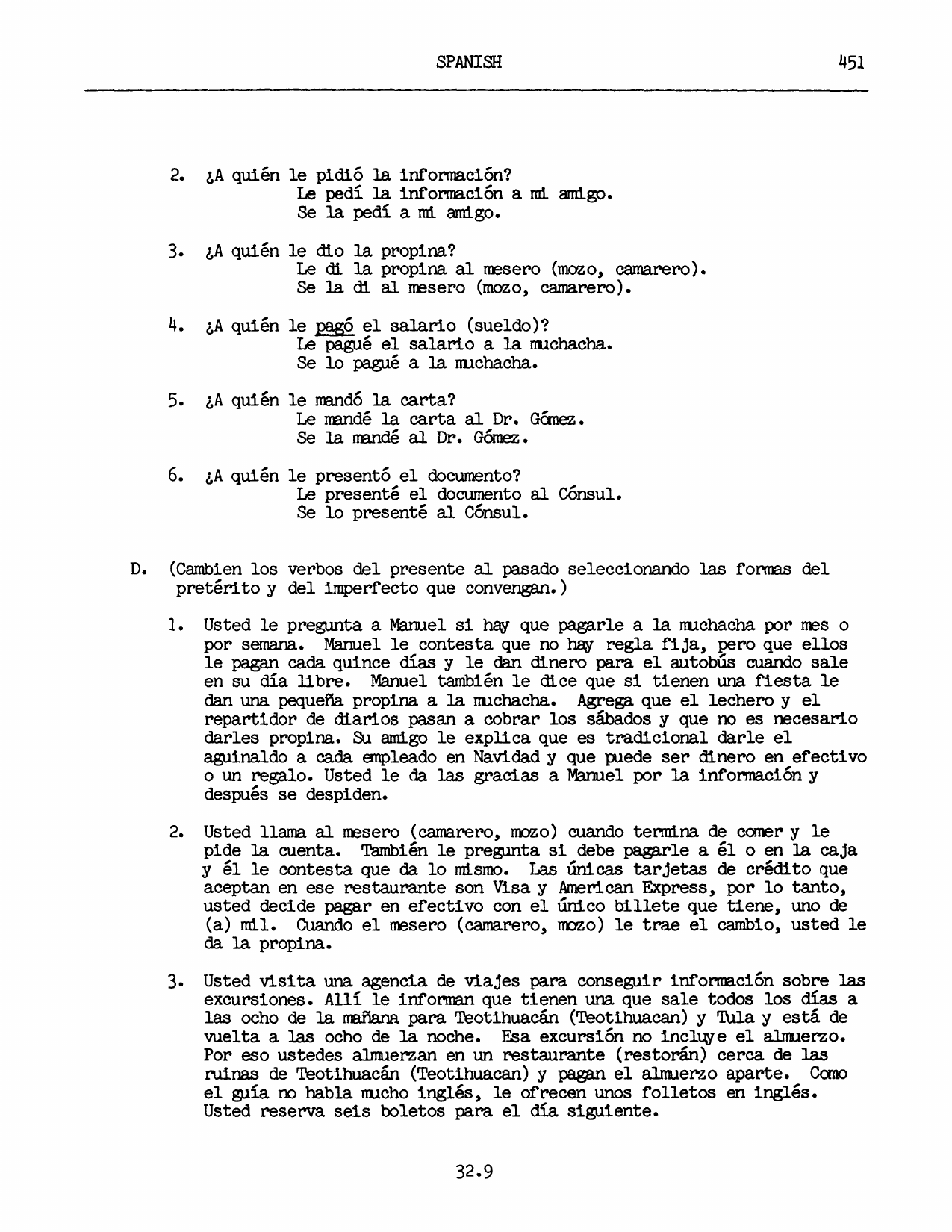
4. A usted le interesa ver un partido de fútbol sudamericano. Su amigo
Manuel le dice que hay uno de Brasil contra Venezuela este fin de semana y que va a ser muyy bueno. Para conseguir entradas hay que hacer cola dos horas antes del partido. Según Manuel, los dos equipos son buenos pero él prefiere al de Brasil. Usted invita a Manuel al partido y él acepta su invitación.
5. Usted quiere ir a nadar y a jugar tenis. Su amigo Manuel le dice que
puede ir con él al club deportivo, y que si le gusta el club puede hacerse socio. Mamuel le dice que en el club hay varias canchas de tenis y una piscina (pileta, Méx. alberca) fantástica y que si van en ese mismo momento no hay mucha gente. A usted le gusta macho la sugerencia de su amigo y deciden ir inmediatamente.
Questions and Answers: (continued)
A. 1. How do you pay the maid?
2. Do you have to pay her every week?
3. How much money do you have to give her for the bus?
4. Do you have to give the milkman a tip when he comes by to collect?
5. What do you have to do to get a maid?
B. 1. On whom does it depend?
It depends on us.
2. On whom does that depend?
That depends on the State Department.
3. Does the date of your departure depend on you?
No, tt depends on my boss.
4. Does that decision depend on you?
No, that decision depends on my wife.
5. On what does the trip depend?
It depends on the weather.
C. 1. Of whom did you ask that?
I asked that of my friend.
I asked it of my friend.
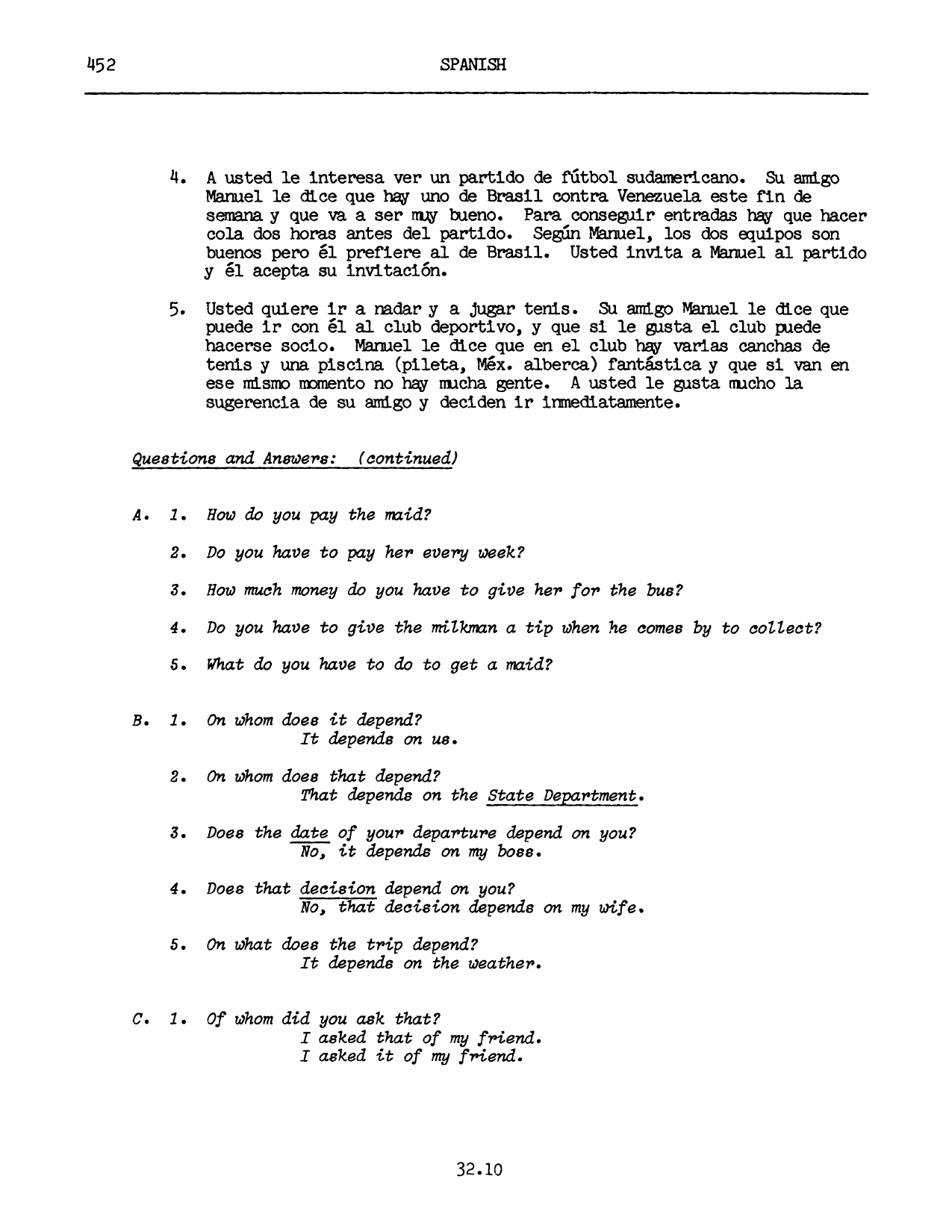
2. From whom did you request the information?
I requested the information from my friend.
I requested it from my friend.
3. To whom did you give the tip?
I gave the tip to the waiter.
I gave tt to the waiter.
I paid the salary to the maid.
I paid it to the maid.
5. To whom did you send the letter?
I sent the letter to Dr. Gómez.
I sent it to Dr. Gómez.
6. To whom did you give the document?
I gave the document to the Consul.
I gave it to the Consul.
VI. PUTTING IT TOGETHER
Variante:
A. A — Mamel, ¿cómo hay que pagarle a la muchacha, por mes o por semana?
N - Nosotros le pagamos cada quince días y le damos para el autobús cuando
sale en su día libre.
1 - Maruel, ¿cómo se le paga a la muchacha, por hora o por semana? 2 - Maruel, ¿cómo hay que pagarle a la muchacha, por día o por
hora?
3 - Manuel, ¿hay que pagarle a la muchacha semanalmente? 4 — Maruel, ¿hay que pagarle a la muchacha mensualmente? 5 - Manuel, ¿cómo hay que pagarle a la muchacha, quincenalmente o
mensualmente?
B. A- Y si damos una fiesta, ¿hay que darle propina?
N - Eso depende de ustedes. Pueden darle algo si quieren.
1 - Y si tenemos invitados, ¿hay que darle propina? 2 - Y si tenemos que salir de la ciudad, ¿hay que pagarle por
adelantado?
3 - Y si tiene que comprar comestibles (provisiones, víveres),
¿hay que darle propina?
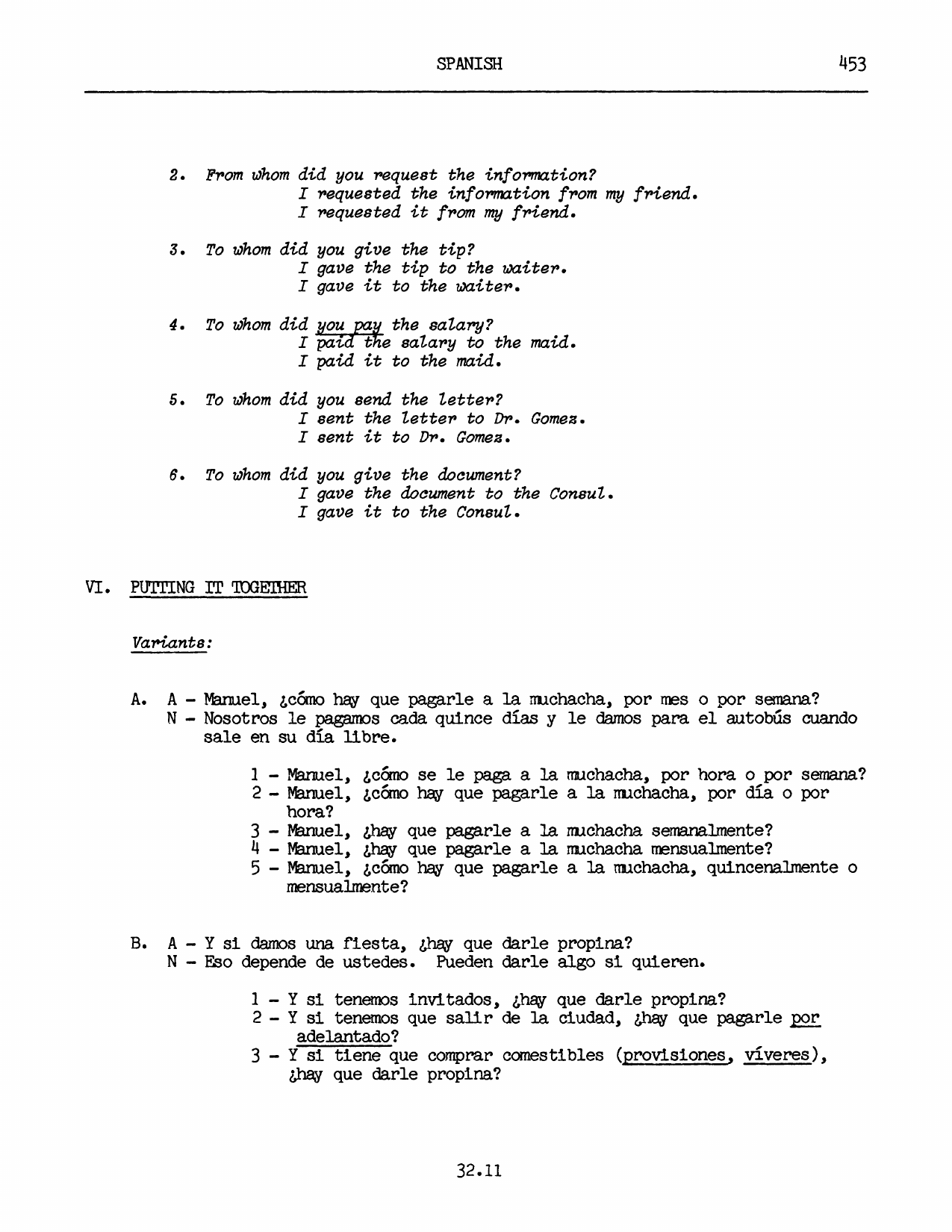
4 - Y si tiene que lavar la ropa, ¿hay que darle propina? 5 - Y si tiene que planchar la ropa, ¿hay que darle propina?
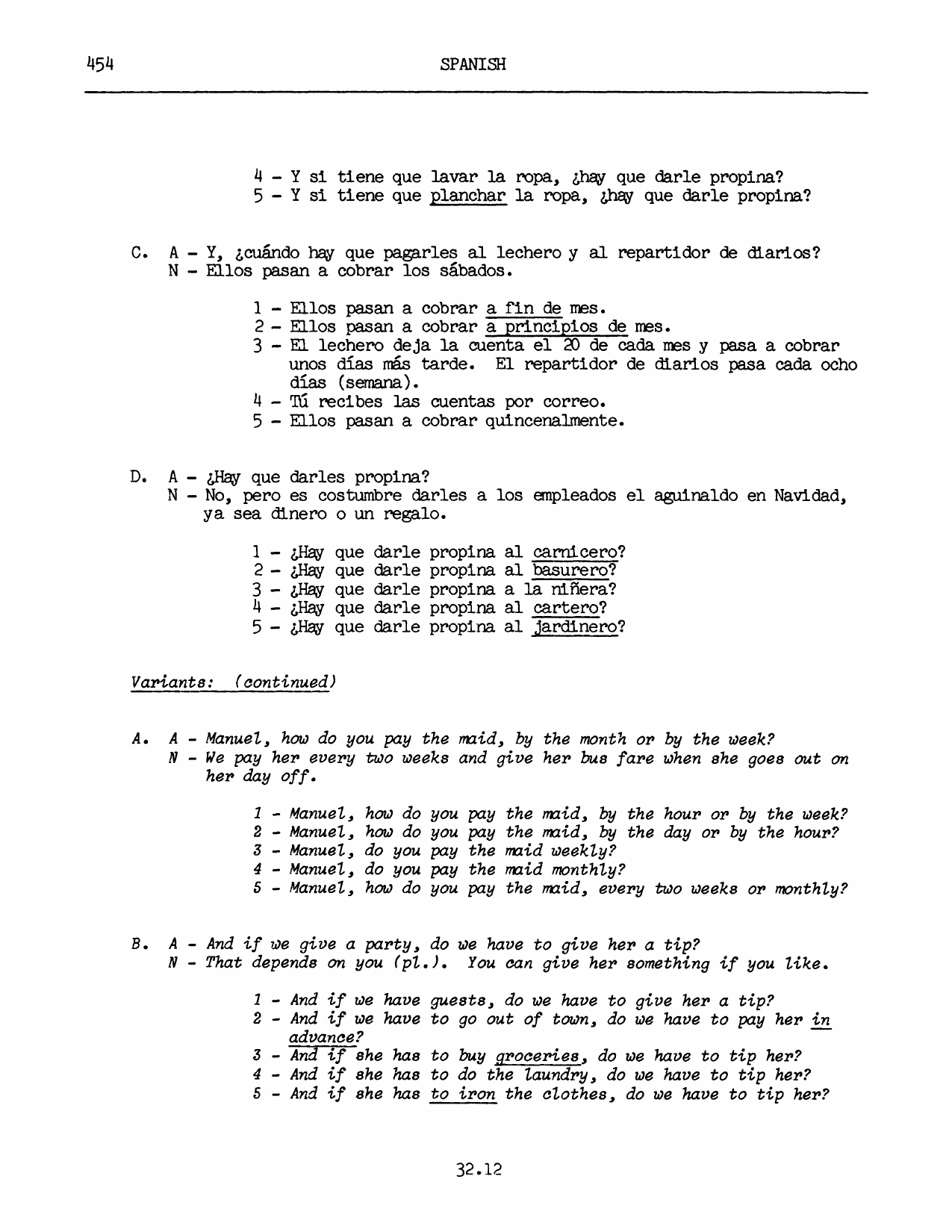
C. A -Y, ¿cuándo hay que pagarles al lechero y al repartidor de diarios?
N - Ellos pasan a cobrar los sábados.
1 - Ellos pasan a cobrar a fin de mes.
2 - Ellos pasan a cobrar a principios de mes.
3 - El lechero deja la cuenta el 20 de cada mes y pasa a cobrar
unos días más tarde. El repartidor de diarios pasa cada ocho días (semana).
4 — Tú recibes las cuentas por correo.
5 - Ellos pasan a cobrar quincenalmente.
D. A — ¿Hay que darles propina?
N - No, pero es costumbre darles a los empleados el aguinaldo en Navidad,
ya sea dinero o un regalo.
1 - ¿Hay que darle propina al carnicero?
2 - ¿Hay que darle propina al basurero?
3 - ¿Hay que darle propina a la niñera?
4 — ¿Hay que darle propina al cartero?
5 — ¿Hay que darle propina al jardinero?
Variants: (continued)
A. A = Manuel, how do you pay the maid, by the month or by the week?
N - We pay her every two weeks and give her bus fare when she goes out on
her day off.
1 - Manuel, how do you pay the maid, by the hour or by the week? 2 - Manuel, how do you pay the maid, by the day or by the hour? 3 - Manuel, do you pay the maid weekly?
4 - Manuel, do you pay the maid monthly?
5 - Manuel, how do you pay the maid, every two weeks or monthly?
B. A - And if we give a party, do we have to give her a tip?
N - That depends on you (pl.). You can give her something if you like.
1 - And if we have guests, do we have to give her a tip? 2 - And if we have to go out of town, do we have to pay her in
advance?
3 - And if she has to buy groceries, do we have to tip her? 4 - And if she has to do the laundry, do we have to tip her? 5 - And if she has to iron the clothes, do we have to tip her?
Co. A - And when do you have to pay the milkman and the newspaper deliveryman?
N - They come by on Saturdays to collect.
1 - They come by at the end of the month to collect. 2 - They come by at the beginning of the month to collect. 3 - The milkman leaves the bill on the twentieth of each month and
comes by to collect a few days later. The newspaper delivery-man comes by every week.
4 - You receive the bills in the mil. (familiar)
5 - They come by every two weeks to collect.
D. A= Do you have to give them a tip?
N - No, but it ts customary to give employees a bonus at Christmas, be it
money or a gift.
1 - Do you have to tip the butcher?
2 - Do you have to tip the garbage collector?
3 - Do you have to tip the Faby otbter?
4 - Do you have to tip the mailman?
5 - do you have to tip the gardener?
VII. MAKING IT WORK
VIII. USING IT