CYCLE 33
GETTING THINGS
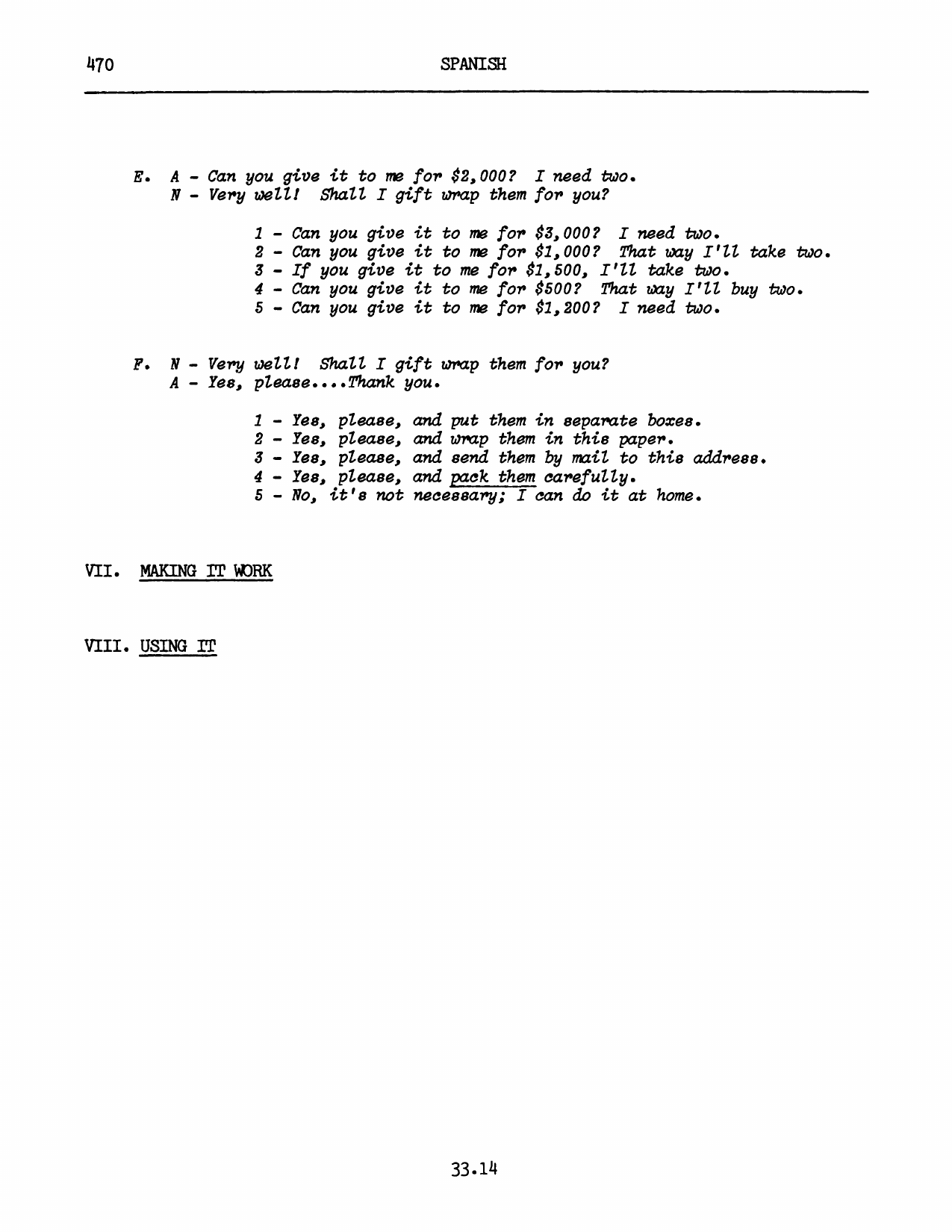
At the Gift Shop
This Cycle will help you manage the times when you decide to go shopping on
your own. It will help you feel more confident when telling a salesclerk exactly what you want, as well as enable you to understand what is being said to you.
You will find that there are few self-service stores or shops, so you will
usually require a salesclerk's help in finding what you need.
This page has a drawing, chart, or fill-in layout — original page
I. SETTING THE SCENE
You go to a local gift shop in search of a gift for a friend or relative in the States. You would like to find a gift that you can send by mail and that is characteristic of the crafts produced in the host country.
II. HEARING IT
III. SGEING IT
Dialogue No. 1: (Short Verston)
En la tienda de regalos
N = Buenos días. ¿En qué puedo sevirle (servirlo/a)?
A — Buenos días. Quisiera (quiero) comprar un regalo típico de aquí. N - Pues, mire. Tenemos telas, cerámica y Joyas.
A — Busco algo que pueda mandar por correo.
N - ¿Prefiere ver las telas o las Joyas?
A —- Muéstreme las joyas, por favor.
N - ¿Qué le parecen estos collares?
A - Son bonitos, pero demasiado caros. ¿Cuánto cuesta esa pulsera? N - ¿Esta? $2.500 (pesos), pero puedo rebajársela a $2. 200.
A — ¿No puede dármela en $2.000? Necesito dos.
N - ¡Está bien! ¿Se las envuelvo para regalo?
A — Si, por favor....Gracias.
N - Para servirle.
Dialoque No. 1: (Short Version - continued)
At the gift shop
N - Good morning. May I help you?
A - Good morning. I would like to buy a gift characteristic of this
area.
N - Well, let's see. We have fabrics, ceramics, and jewelry.
(1) A - I am looking for something that I can send by mail.
N - Would you rather see the fabrics or the jewelry?
A - Show me the jewelry, please.
N - What do you think of these necklaces?
(2) A - They're pretty but rather expensive. How much is that bracelet?
N - This one? $2,500 (pesos), but I can give it to you for $2,200.
(3) A - Can you give it to me for $2,000? I need two.
N - Very well! Shall I gift wrap them for you?
A - Yes, please....Thank you.
N - At your service.
Dialogue No. 2: (Long Version)
En la tienda de regalos
N - Buenos días. ¿En qué puedo sevirle (servirlo/a)?
A - Buenos días. Quiero (quisiera) comprar algo que sea típico de aquí. N - Cómo no, señorita/señora/señor. Tenemos telas, tallados en madera,
cerámica y Joyería fina.
A - Busco algo que pueda mandar por correo.
N = Bueno, los tallados son demasiado pesados y la cerámica es frágil. ¿Quiere
que le muestre las telas?
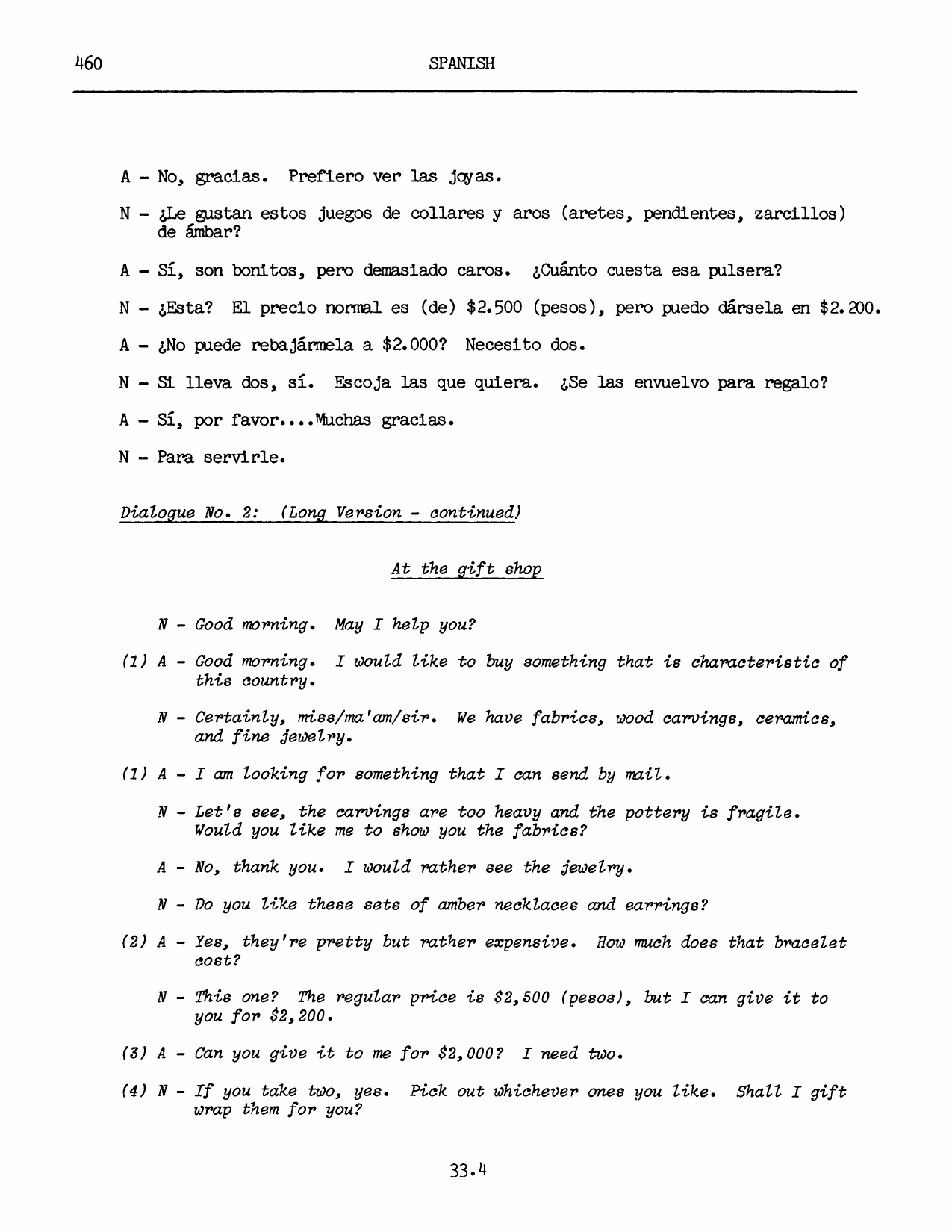
A - No, gracias. Prefiero ver las joyas.
N - ¿Le gustan estos juegos de collares y aros (aretes, pendientes, zarcillos)
de ámbar?
A - Si, son bonitos, pero demasiado caros. ¿Cuánto cuesta esa pulsera? N - ¿Esta? El precio normal es (de) $2.500 (pesos), pero puedo dársela en $2. 200. A - ¿No puede rebajármela a $2.000? Necesito dos.
N - Si lleva dos, sí. Escoja las que quiera. ¿Se las envuelvo para regalo? A - Si, por favor....Muchas gracias.
N - Para servirle.
Dialogue No. 2: (Long Version - continued)
At the gift shop
N - Good morning. May I help you?
(1) A - Good morning. I would like to buy something that is characteristic of
this country.
N - Certainly, miss/ma'am/sir. We have fabrics, wood carvings, ceramics,
and fine jewelry.
(1) A - I am looking for something that I can send by mail.
N - Let's see, the carvings are too heavy and the pottery is fragile.
Would you like me to show you the fabrice?
A - No, thank you. I would rather see the jewelry.
N - Do you like these sets of amber necklaces and earrings?
(2) A - Yes, they're pretty but rather expensive. How much does that bracelet
cost?
N - This one? The regular price ts $2,500 (pesos), but I can give it to
you for $2,200.
(3) A - Can you give it to me for $2,000? I need two.
(4) N - If you take two, yes. Pick out whichever ones you like. Shall I gift
wrap them for you?
A - Yes, please....Thank you very much.
N - At your service.
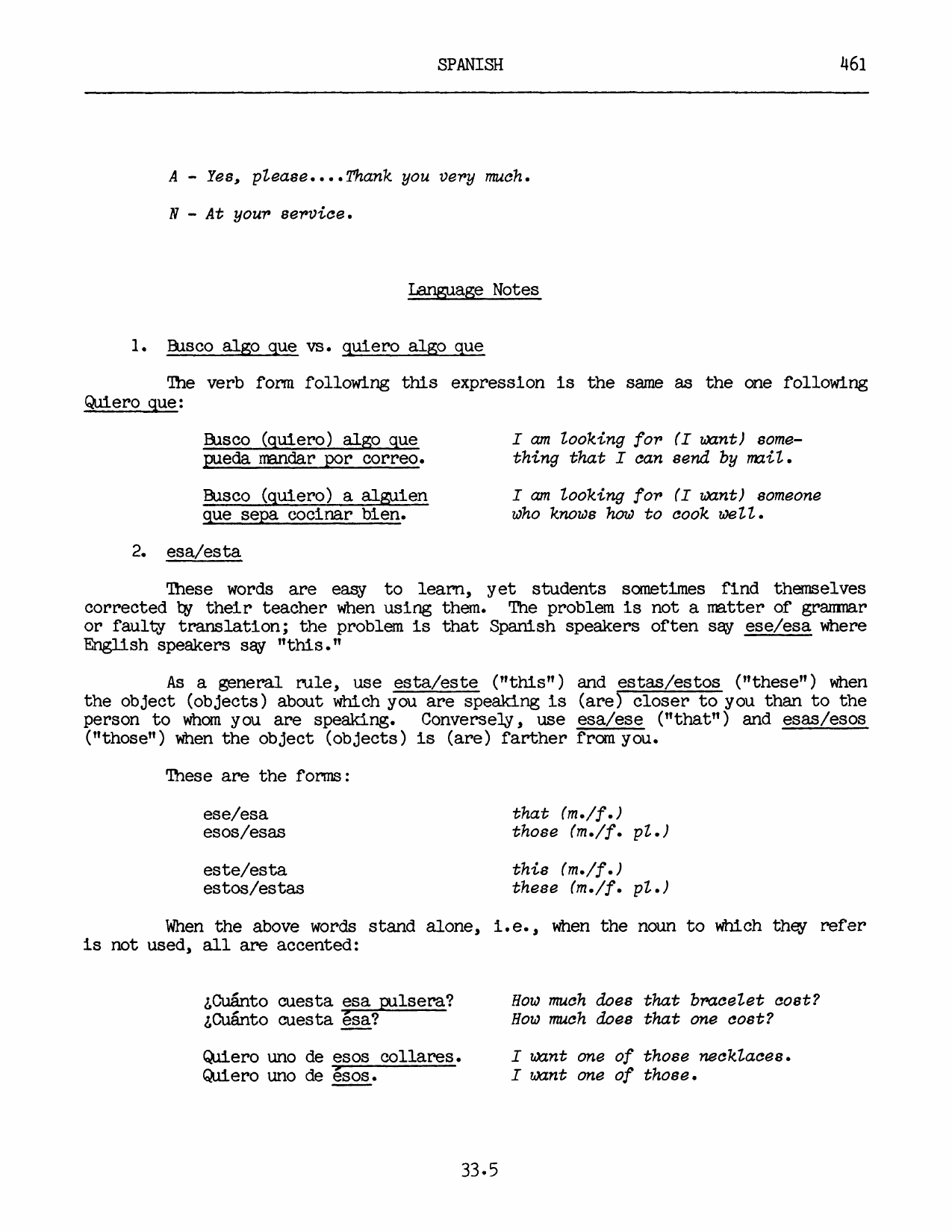
Language Notes
l. Busco algo que vs. quiero algo que
The verb form following this expression is the same as the one following
Quiero que:
2. esa/esta
These words are easy to learn, yet students sometimes find themselves
corrected by their teacher when using them. The problem is not a matter of granmar or faulty translation; the problem is that Spanish speakers often say ese/esa where English speakers say "this."
As a general rule, use esta/este ("this") and estas/estos ("these") when
the object (objects) about which you are speaking is (are) closer to you than to the person to whom you are speaking. Conversely, use esa/ese ("that") and esas/esos ("those") when the object (objects) is (are) farther from you.
These are the forms:
When the above words stand alone, i.e., when the noun to which they refer
is not used, all are accented:
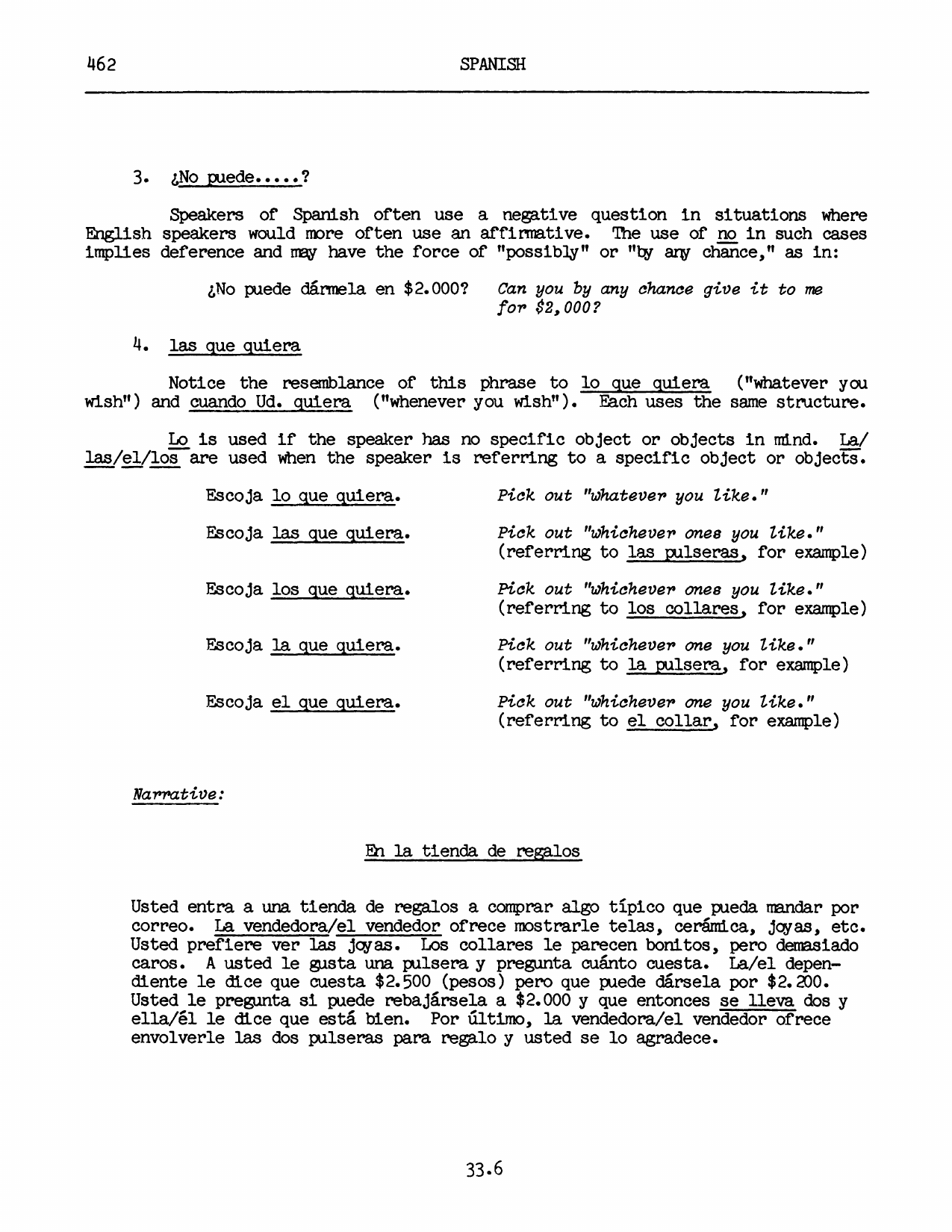
3. ¿No puede.....?
Speakers of Spanish often use a negative question in situations where
English speakers would more often use an affirmative. The use of no in such cases implies deference and may have the force of "possibly" or "by any chance," as in:
¿No puede dármela en $2.000? Can you by any chance give it to me
for $2,000?
4, las que quiera
Notice the resemblance of this phrase to lo que quiera ("whatever you
wish") and cuando Ud. quiera ("whenever you wish"). Each uses the same structure.
Lo is used if the speaker has no specific object or objects in mind. La/
las/el/los are used when the speaker is referring to a specific object or objects.
(referring to las pulseras, for example)
(referring to los collares, for example)
(referring to la pulsera, for example)
(referring to el collar, for example)
Narrative:
En la tienda de regalos
Usted entra a una tienda de regalos a comprar algo típico que pueda mandar por correo. La vendedora/el vendedor ofrece mostrarle telas, cerámica, joyas, etc. Usted prefiere ver las joyas. Los collares le parecen bonitos, pero demasiado caros. A usted le gusta una pulsera y pregunta cuánto cuesta. La/el depen-diente le dice que cuesta $2.500 (pesos) pero que puede dársela por $2. 200. Usted le pregunta si puede rebajársela a $2.000 y que entonces se lleva dos y ella/él le dice que está bien. Por último, la vendedora/el vendedor ofrece envolverle las dos pulseras para regalo y usted se lo agradece.
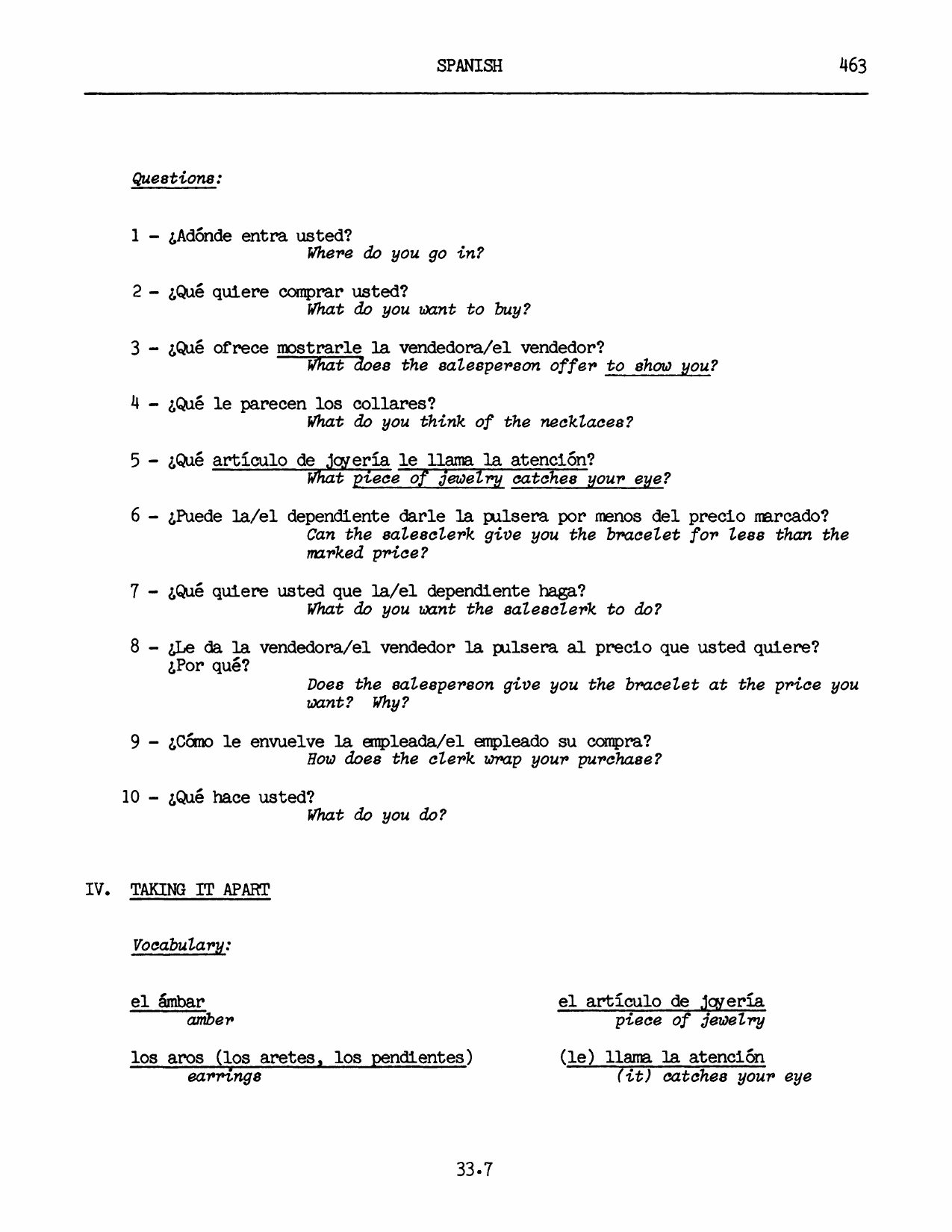
Questions:
1 — ¿Adónde entra usted?
Where do you go in?
2 - ¿Qué quiere comprar usted?
What do you want to buy?
3 - ¿Qué ofrece mostrarle la vendedora/el vendedor?
t does the salesperson offer to show you?
4 — ¿Qué le parecen los collares?
What do you think of the necklaces?
5 = ¿Qué artículo de iqveria le llama la atención?
6 = ¿Puede la/el dependiente darle la pulsera por menos del precio marcado?
Can the salesclerk give you the bracelet for less than the marked price?
7 - ¿Qué quiere usted que la/el dependiente haga?
What do you want the salesclerk to do?
8 - ¿Le da la vendedora/el vendedor la pulsera al precio que usted quiere?
¿Por qué?
Does the salesperson give you the bracelet at the price you want? Why?
9 - ¿Cómo le envuelve la empleada/el empleado su compra?
How does the clerk wrap your purchase?
10 = ¿Qué hace usted?
What do you do?
IV. TAKING IT APART
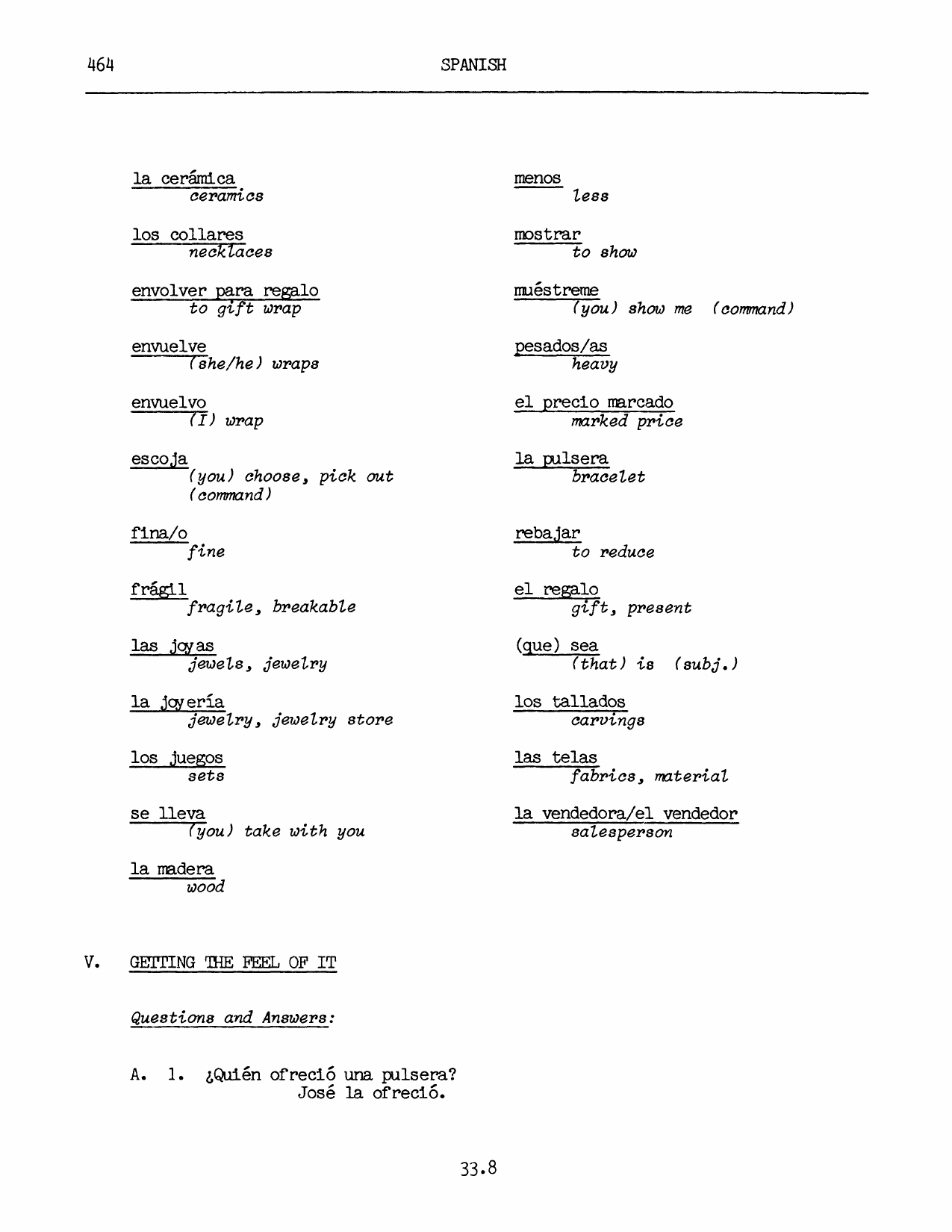
Vocabulary:
(command)
la madera
wood
GETTING THE FEEL OF IT
Questions and Answers:
A. 1. ¿Quién ofreció una pulsera?
José la ofreció.
2. ¿José le ofreció una pulsera?
Sí, José me ofreció una pulsera.
Sí, José me la ofreció.
Sí, él lo vendió.
2. ¿José le vendió un collar?
Sí, él me vendió un collar.
Si, él me lo vendió.
1. ¿María Luisa mandó unas cartas?
Sí, ella las mandó.
2. ¿María Luisa le mandó unas cartas?
Sí, María Luisa me mandó unas cartas.
Sí, ella me las mandó.
D. 1. ¿María Luisa preparó la comida?
Sí, ella la preparó.
¿María Luisa le preparó la comida?
Sí, María Luisa me preparó la comida.
Sí, ella me la preparó.
El vendedor lo mostró.
26 ¿El vendedor te mostró un anillo?
Sí, el vendedor me mostró un anillo.
Sí, él me lo mostró.
F, 1. ¿Quién dio la cena?
El Embajador la dio.
26 ¿El Embajador les dio una cena a ellos?
Sí, el Embajador les dio una cena.
Sí, el Embajador se la dio.
G. 1, ¿El mesero (mozo,camarero) ya trajo la cuenta?
Sí, ya la trajo.
2. ¿El mesero (camarero, mozo) ya nos trajo la cuenta?
Sí, el mesero ya nos trajo la cuenta.
Sí, el mesero ya nos la trajo.
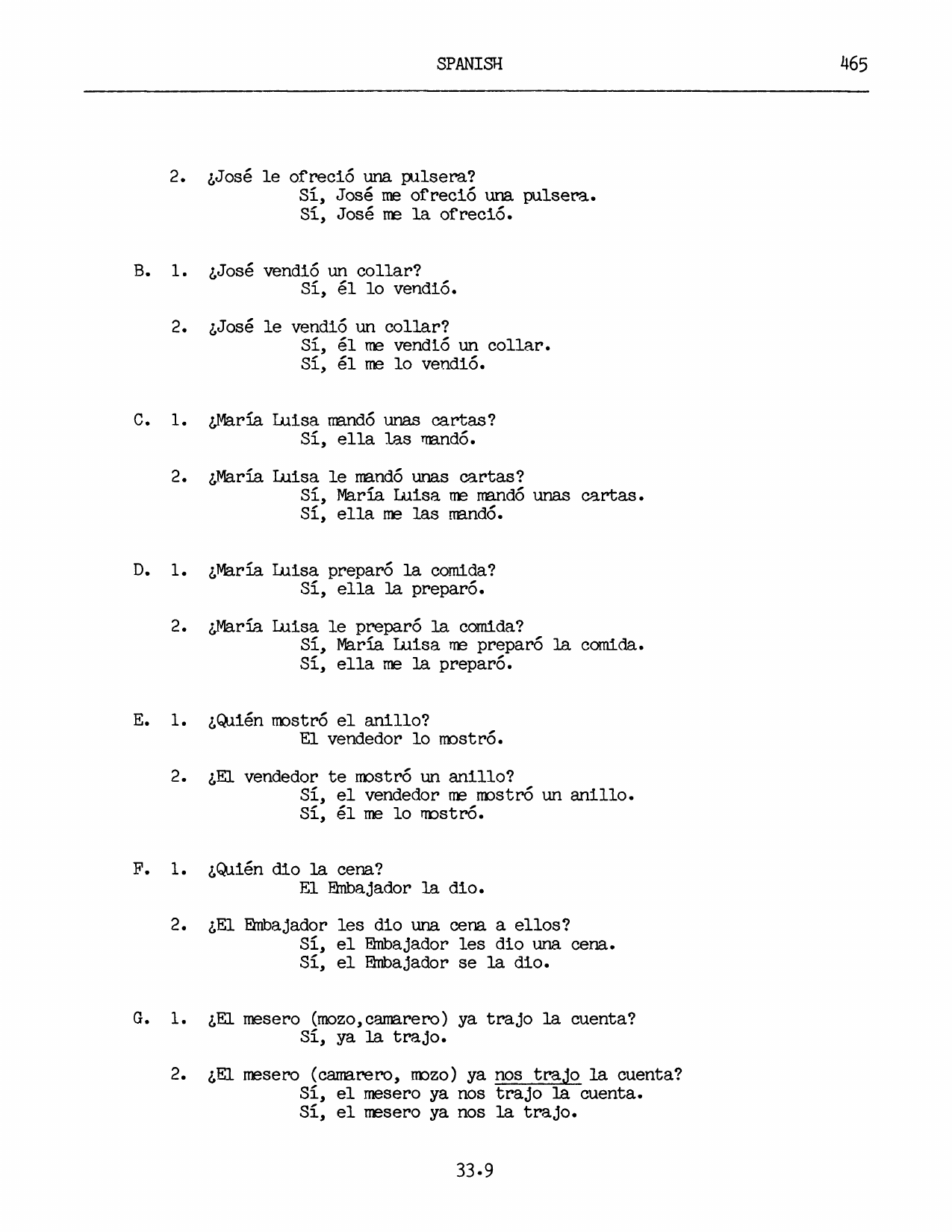
H. 1. ¿Quién escribió el informe?
Maria Luisa lo escribió.
2. ¿María Luisa te escribió el informe?
Sí, María Luisa me escribió el informe.
Sí, ella me lo escribió.
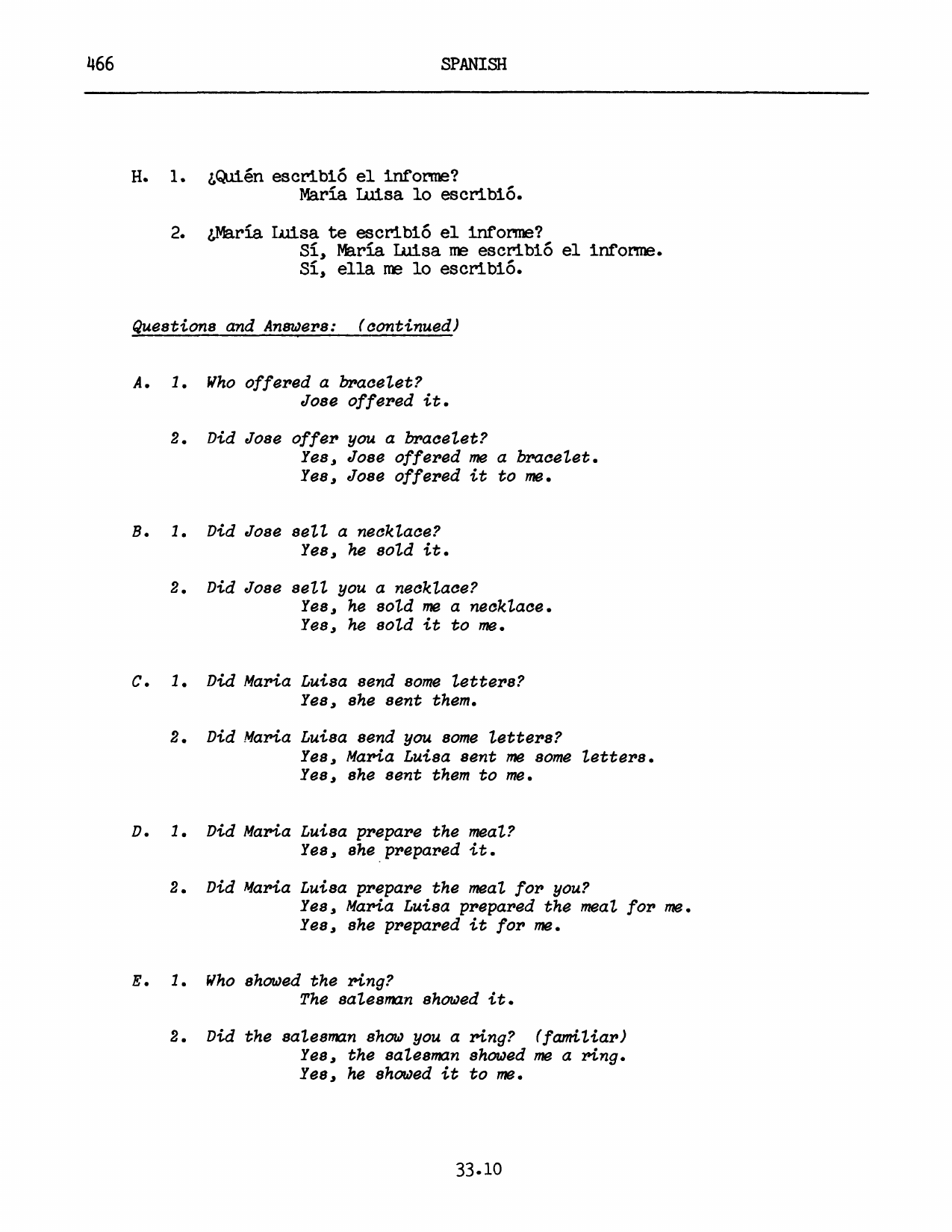
Questions and Answers: (continued)
A. 1. Who offered a bracelet?
José offered it.
2. Did Jose offer you a bracelet?
Yes, Jose offered me a bracelet.
Yes, Jose offered it to me.
B. 1. Did Jose sell a necklace?
Yes, he sold it.
2. Did Jose sell you a necklace?
Yes, he sold me a necklace.
Yes, he sold it to me.
C. 1. Did Maria Luisa send some letters?
Yes, she sent them.
2. Did Maria Luisa send you some letters?
Yes, Maria Luisa sent me some letters.
Yes, she sent them to me.
D. 1. Did Maria Luisa prepare the meal?
Yes, she prepared it.
2. Did Maria Luisa prepare the meal for you?
Yes, Maria Luisa prepared the meal for me.
Yes, she prepared it for me.
E. 1. Who showed the ring?
The salesman showed it.
2. Did the salesman show you a ring? (familiar)
Yes, the salesman showed me a ring.
Yes, he showed it to me.
F. 1. Who gave the dinner?
The Ambassador gave it.
2. Did the Ambassador give a dinner for them?
Yes, the Ambassador gave a dinner for them.
Yes, the Ambassador gave it for them.
G. 1. Did the waiter bring the check yet?
Yes, he already brought it.
2. Did the waiter bring us the check yet?
Yes, the waiter already brought us the check.
Yes, the waiter already brought it to us.
H. 1. Who wrote the report?
Maria Luisa wrote it.
2. Did Maria Luisa write the report for you? (familiar)
Yes, Maria Luisa wrote the report for me.
Yes, she wrote it for me.
VI. PUTTING ITT TOGETHER
Variante:
A. N — Buenos días. ¿En qué puedo sevirle (servirlo/a)?
A - Buenos días. Quisiera (quiero) comprar un regalo típico de aquí.
1 - Buenos días. Quisiera (quiero) comprar una alfombra de lana. 2 — Buenos días. Quisiera (quiero) comprar un tallado (una talla)
en madera hecho/hecha a mano.
3 - Buenas tardes. Quiero (quisiera) ver sus bandejas (Méx.
charolas), platos, jarras, y demás artículos de plata.
4 - Buenas tardes. Quiero (quisiera) ver artículos de cuero
(piel) como bolsas (bolsos), billeteras (carteras), y cin-turones.
5 - Buenos días. Quisiera (quiero) comprar una vajilla de porce-
lana para doce personas.
B. N — Pues, mire. Tenemos telas, cerámica, y joyas.
A — Busco algo que pueda mandar por correo.
1 - Busco algo que pueda mandar por correo aéreo.
2 - Busco algo que no sea demasiado caro.
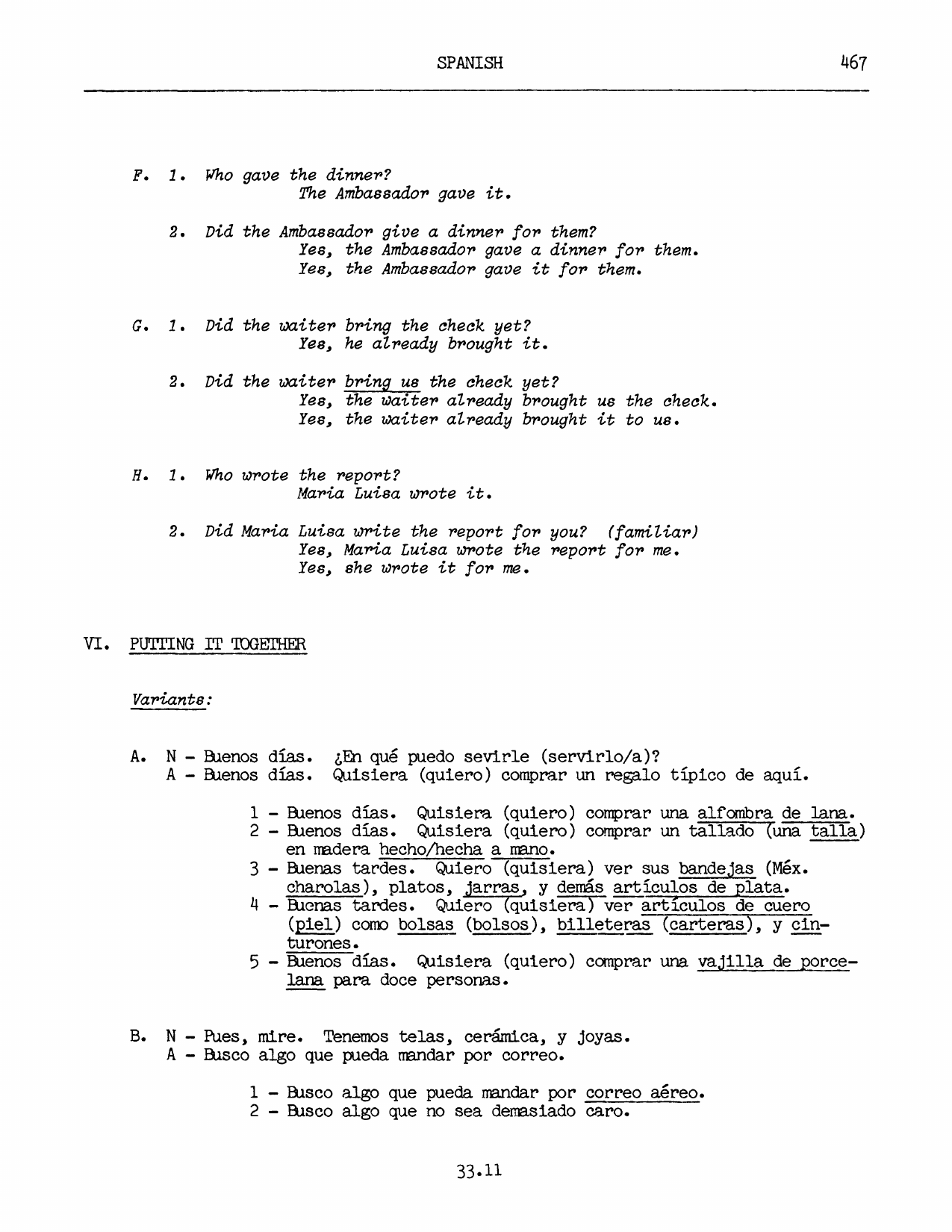
3 - Busco algo que no sea frágil.
4 — Quiero algo que no cueste demasiado.
5 - Quiero algo que no sea my pesado.
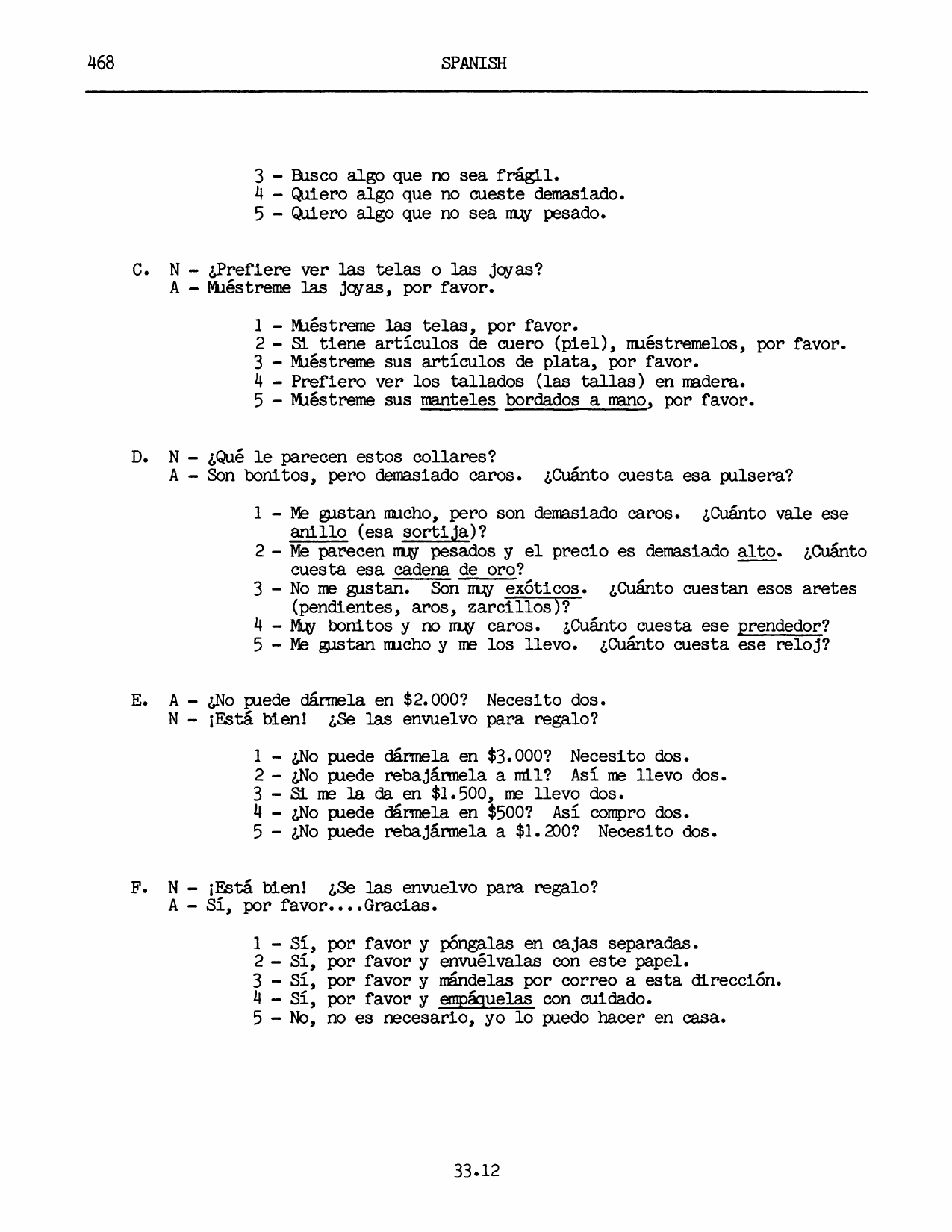
C. N- ¿Prefiere ver las telas o las joyas?
A = Muéstreme las joyas, por favor.
] - Muéstreme las telas, por favor.
2 - Si tiene artículos de cuero (piel), méstremelos, por favor. 3 - Muéstreme sus artículos de plata, por favor.
4 — Prefiero ver los tallados (las tallas) en madera. 5 - Miéstreme sus manteles bordados a mano, por favor.
D. N- ¿Qué le parecen estos collares?
A - Son bonitos, pero demasiado caros. ¿Cuánto cuesta esa pulsera?
1 — Me gustan mucho, pero son demasiado caros. ¿Cuánto vale ese
anillo (esa sorti ja)?
2 — Me parecen muy pesados y el precio es demasiado alto. ¿Cuánto
cuesta esa cadena de oro?
3 - No me gustan. Son my exóticos. ¿Cuánto cuestan esos aretes
(pendientes, aros, zarcillos)?
Y — Muy bonitos y no muy caros. ¿Cuánto cuesta ese prendedor? 5 — Me gustan macho y me los llevo. ¿Cuánto cuesta ese reloj?
E. A — ¿No puede dármela en $2.000? Necesito dos.
N - ¡Está bien! ¿Se las envuelvo para regalo?
1 — ¿No puede dármela en $3.000? Necesito dos.
2 — ¿No puede rebajármela a mil? Así me llevo dos. 3 - Si me la da en $1.500, me llevo dos.
4 — ¿No puede dármela en $500? Así compro dos.
5 — ¿No puede rebajármela a $1.200? Necesito dos.
F. N- ¡Está bien! ¿Se las envuelvo para regalo?
A - Si, por favor....Gracias.
1 - Sí, por favor y póngalas en cajas separadas.
2 - Sí, por favor y envuélvalas con este papel.
3 - Si, por favor y mándelas por correo a esta dirección. 4 — Si, por favor y empáquelas con cuidado.
5 — No, no es necesario, yo lo puedo hacer en casa.
Variante: (continued)
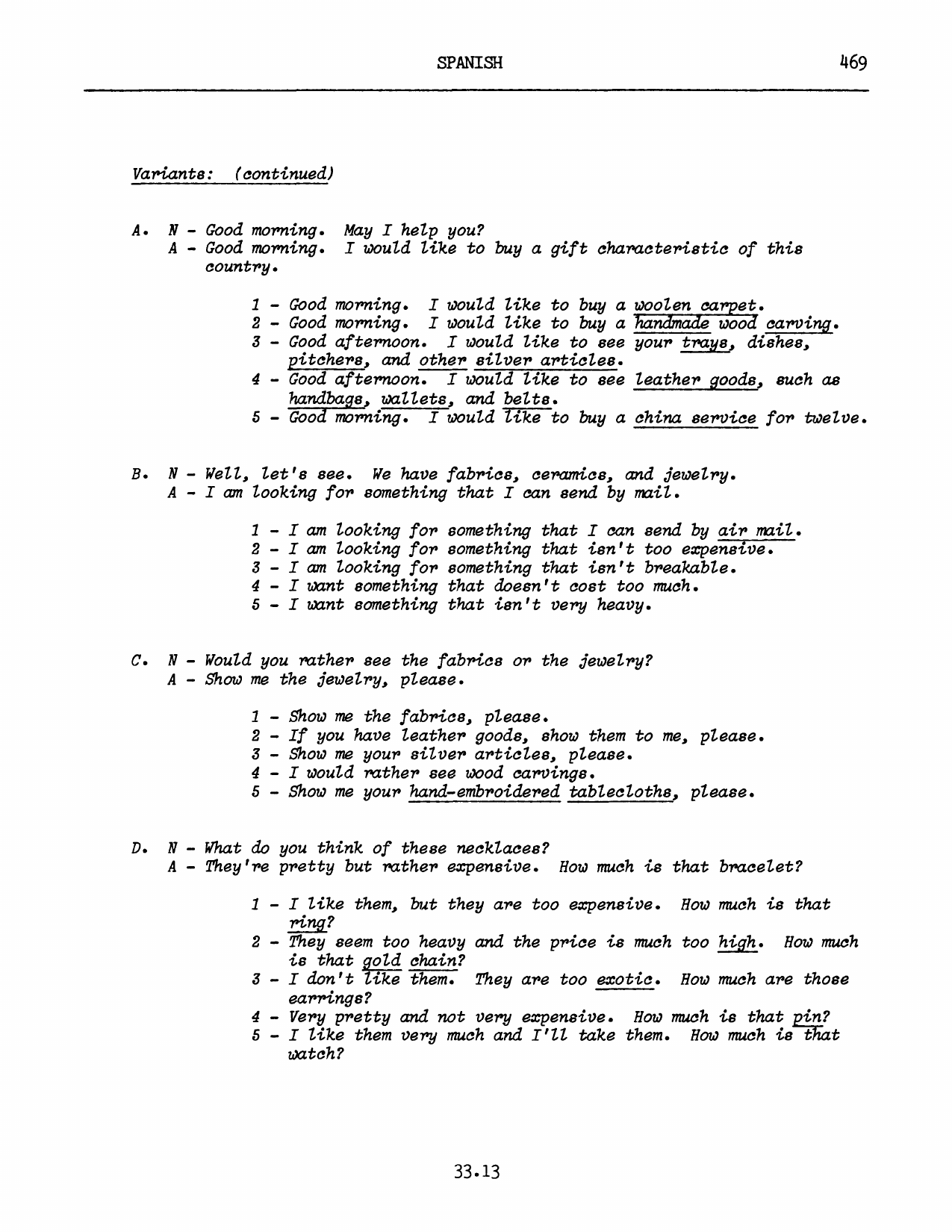
A. WN - Good morning. May I help you?
A - Good morning. I would like to buy a gift characteristic of this
country.
1 - Good morning. I would like to buy a woolen carpet.
3 - Good afternoon. I would like to see your trays, dishes,
pitchers, and other silver articles.
4 - Good afternoon. I would like to see leather goods, such as
handbags, wallets, and belts.
5 - Good morning. TI would Tike to buy a china service for twelve.
B. W- Well, let's see. We have fabrics, ceramics, and jewelry.
A - I am looking for something that I can send by mail.
1 - I am looking for something that I can send by atr mail. 2 - I am looking for something that isn't too expensive. 3 - I am looking for something that isn't breakable. 4 - I want something that doesn't cost too much.
5 - I want something that isn't very heavy.
C. N - Would you rather see the fabrics or the jewelry?
A - Show me the jewelry, please.
1 - Show me the fabrics, please.
2 - If you have leather goods, show them to me, please. 3 - Show me your silver articles, please.
4 - I would rather see wood carvings.
5 - Show me your hand-embroidered tableclothe, please.
D. WN - What do you think of these necklaces?
A - They're pretty but rather expensive. How much te that bracelet?
1 - I like them, but they are too expensive. How much ts that
ring?
2 - They seem too heavy and the price is much too high. How much
te that gold chain?
3 - I don't e them. They are too exotic. How much are those
earrings?
4 - Very pretty and not very expensive. How much is that pin? 5 - I like them very much and I'll take them. How much ts that
watch?
E. A ~ Can you give it to me for $2,000? I need two.
N - Very well! Shall I gift wrap them for you?
1 - Can you give tt to me for $3,000? I need two.
2 - Can you give it to me for $1,000? That way I'll take two. 3 - If you give it to me for $1,500, I'll take two. 4 - Can you give it to me for $500? That way I'll buy two. 5 - Can you give it to me for $1,200? I need two.
F. WN =- Very well! Shall I gift wrap them for you?
A - Yes, please....Thank you.
1 - Yes, please, and put them in separate boxes.
2 - Yes, please, and wrap them in this paper.
3 - Yes, please, and send them by mail to this address. 4 - Yes, please, and pack them carefully.
5 - No, it's not necessary; I can do it at home.
VIT. MAKING IT WORK
VIII. USING IT