CYCLE 34
GETTING THINGS
Entertainment
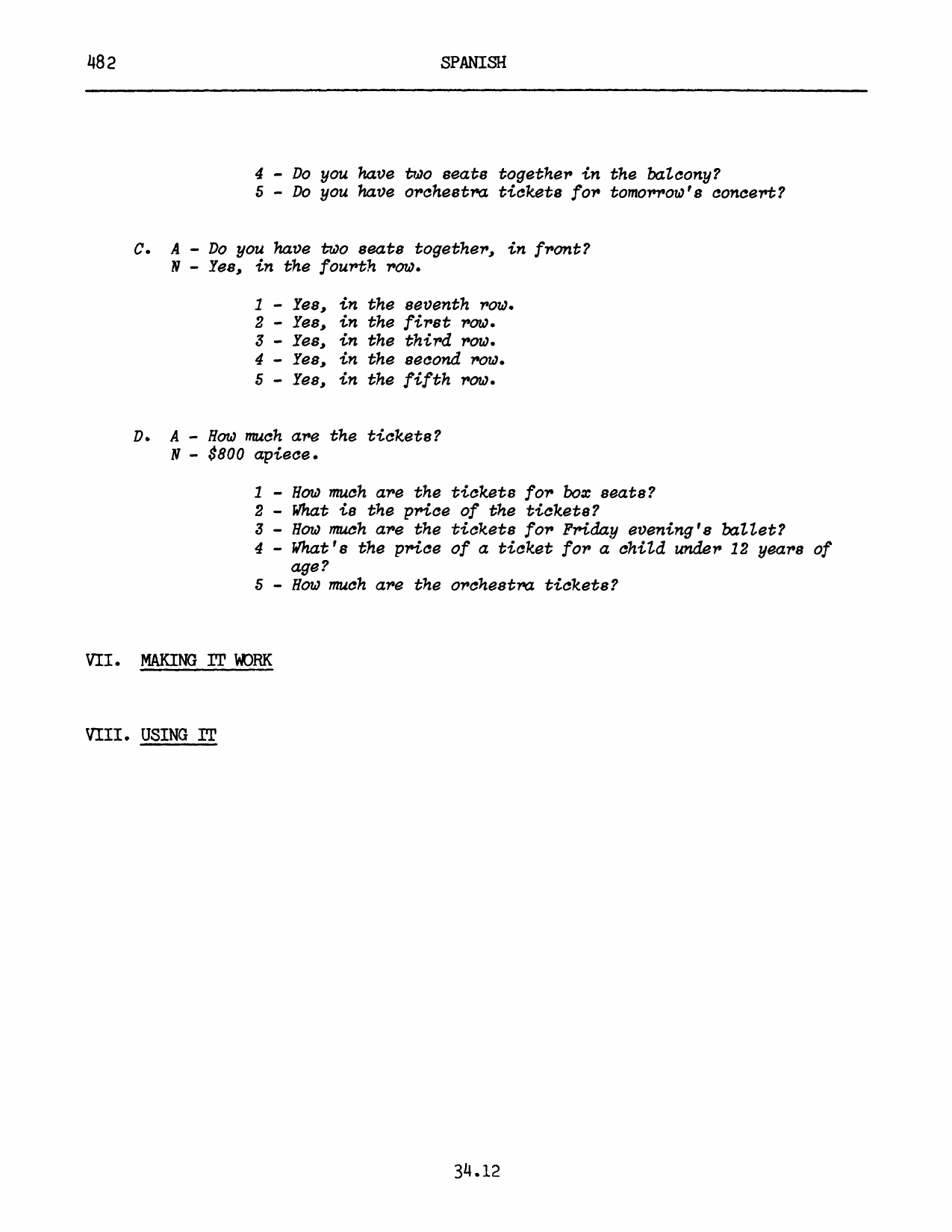
Naturally, there will be a wide variety of things to do for entertainment, such
as concerts, plays, and movies, while you are living in a Spanish-speaking country. Nevertheless, obtaining tickets will not always be easy; more often than not, you will have to buy tickets in person at the box office and to pay for them in cash.
This Cycle will help you to feel more at ease when purchasing tickets for a
performance.
This page has a drawing, chart, or fill-in layout — original page
I. SETTING THE SCENE
There's a concert this evening that you would like to attend because it has been highly recommended. You have been told that in order to get tickets you have to go in person to the theater box office several hours before the performance.
II. HEARING IT
III. SEEING IT
Dialogue No. 1: (Short Version)
Comprando entradas en la taquilla (boletería)
A = ¿Tiene entradas para el concierto (la función, la comedia, el drama, la
Ópera, la presentación, la obra) de esta noche?
N — Me quedan algunas de balcón (galería, gallinero), pero no hay más ni de
platea (luneta) ni de palco.
A — ¿Tiene dos asientos juntos, adelante?
N - Sí, en la cuarta fila.
A = ¿Se ve bien desde ahí?
N - Si, son buenos asientos.
A — ¿Cuánto cuestan las entradas?
N — $800 cada una.
A - Bien. Démelas.
N - Aquí están.
A - Gracias.
Dialogue No. 1: (Short Version - continued)
Buying tickets at the box office
A - Do you have tickets for this evening's concert (performance, comedy,
drama, opera, presentation, play)?
N - I have some left in the balcony, but there aren't any more in the
orchestra, and there aren't any box seats left.
A - Do you have two seats together, in front?
N - Yes, in the fourth row.
(1) A - Can you see well from there?
N - Yes, they are good seats.
A - How much are the tickets?
N - $800 apiece.
(2) A - Good, I'll take them.
N - Here they are.
A - Thank you.
Dialogue No. 2: (Long Version)
Comprando entradas en la taquilla (boletería)
A - ¿Tiene entradas para el concierto (la función, la comedia, el drama, la
ópera, la presentación, la obra) de esta noche?
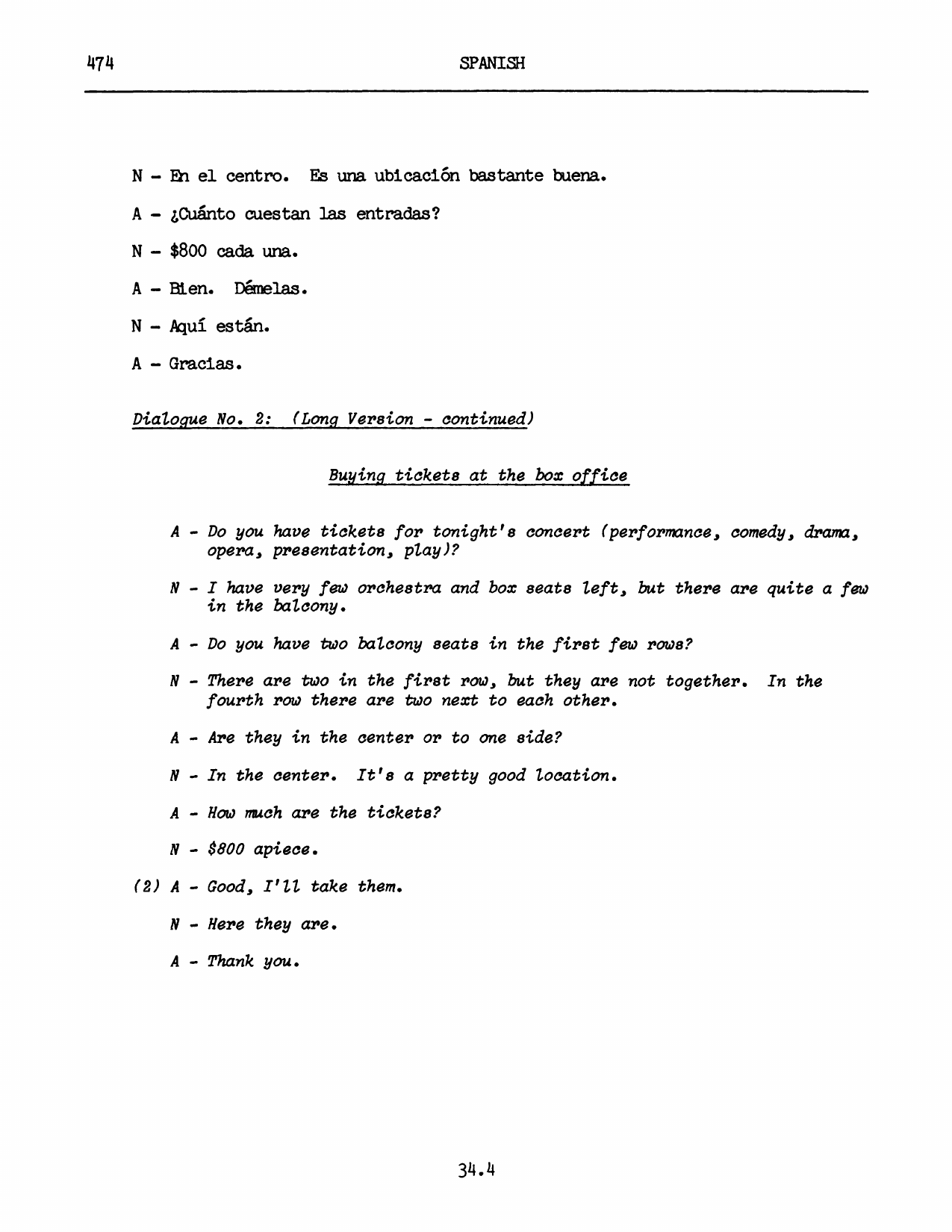
N - Me quedan my pocas de platea (luneta) y de palco pero hay bastantes de
balcón (galería, gallinero).
A - ¿Tiene dos asientos de balcón en las primeras filas?
N - Hay dos en la primera fila, pero están separados. En la cuarta fila hay
dos juntos.
A = ¿Están en el centro (medio) o a un lado?
N - En el centro. Es una ubicación bastante buena.
A = ¿Cuánto cuestan las entradas?
N — $800 cada una.
A - Bien. Démelas.
N = Aquí están.
A - Gracias.
Dialogue No. 2: (Long Version - continued)
Buying tickets at the box office
A - Do you have tickets for tonight's concert (performance, comedy, drama,
opera, presentation, play)?
N - I have very few orchestra and box seats left, but there are quite a few
in the balcony.
A - Do you have two balcony seats in the first few rows?
N - There are two in the first row, but they are not together. In the
fourth row there are two next to each other.
A - Are they in the center or to one side?
N - In the center. It's a pretty good location.
A - How much are the tickets?
N - $800 aptece.
(2) A - Good, I'll take them.
N - Here they are.
A - Thank you.
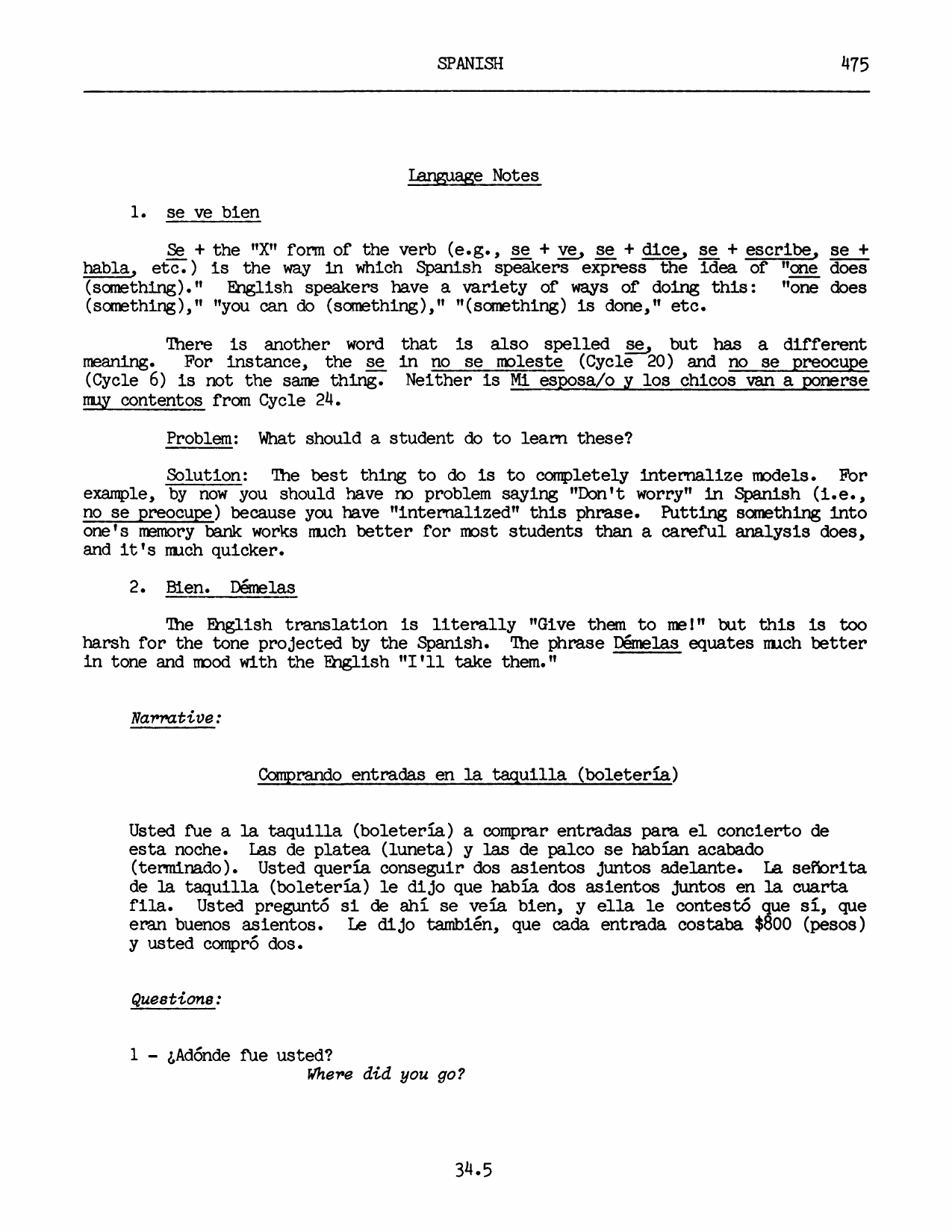
Language Notes
1. se ve bien
Se + the "X" form of the verb (e.g., se + ve, se + dice, se + escribe, se +
habla, etc.) is the way in which Spanish speakers express the idea of "one does
(something)," "you can do (something)," "(something) is done," etc.
There is another word that is also spelled se, but has a different
meaning. For instance, the se in no se moleste (Cycle ~ 20) and no se preocupe (Cycle 6) is not the same thing. Neither is Mi esposa/o y los chicos van a ponerse muy contentos from Cycle 24.
Problem: What should a student do to learn these?
Solution: The best thing to do is to completely internalize models. For
example, by now you should have no problem saying "Don't worry" in Spanish (i.e., no se preocupe) because you have "internalized" this phrase. Putting something into one's memory bank works much better for most students than a careful analysis does, and it's much quicker.
2. Bien. Démelas
The English translation is literally "Give them to me!" but this is too
harsh for the tone projected by the Spanish. The phrase Démelas equates much better in tone and mood with the English "I'll take them."
Narrative:
Comprando entradas en la taquilla (boletería)
Usted fue a la taquilla (boletería) a comprar entradas para el concierto de esta noche. Las de platea (luneta) y las de palco se habían acabado (terminado). Usted quería conseguir dos asientos juntos adelante. La señorita de la taquilla (boletería) le dijo que había dos asientos juntos en la cuarta fila. Usted preguntó si de ahí se veía bien, y ella le contestó que sí, que eran buenos asientos. Le dijo también, que cada entrada costaba $800 (pesos) y usted compró dos.
Questions:
1 = ¿Adónde fue usted?
Where did you go?
2 - ¿Qué quería comprar usted?
What did you want to buy?
3 - ¿Qué entradas se habían acabado (terminado)?
What tickets were sold out?
Y —- ¿Qué asientos quería conseguir usted?
What seats did you want to get?
5 - ¿Qué le dijo la señorita de la taquilla (boletería)?
What did the young woman from the box office tell you?
6 = ¿Qué preguntó usted?
What did you ask?
7 - ¿Qué le contestó ella?
What did she answer you?
8 - ¿Cuánto costaba cada entrada?
How much did each ticket cost?
9 - ¿Cuántas entradas compró usted?
How many tickets did you buy?
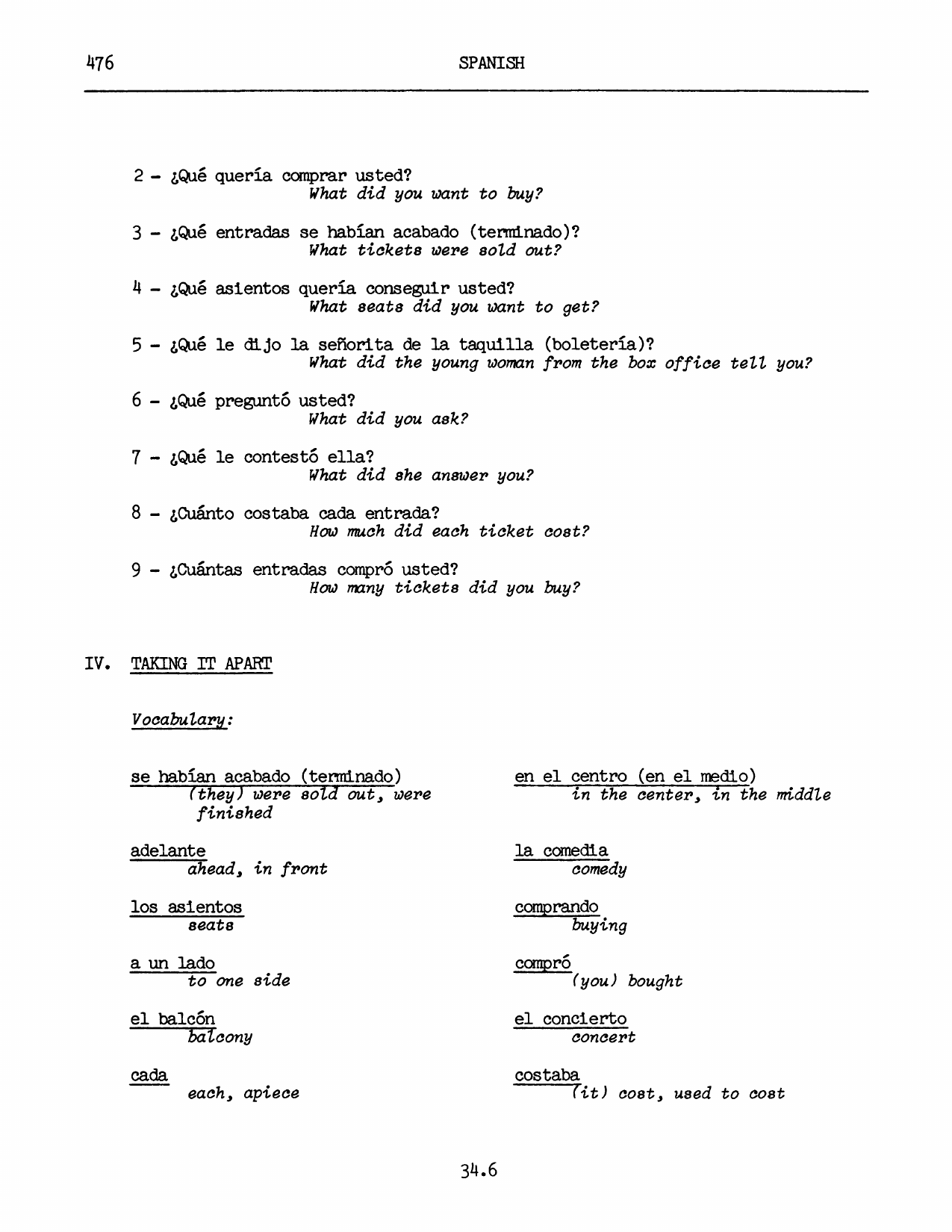
IV. ‘TAKING IT APART
Vocabulary:
finished
V. GETTING THE FEEL OF IT
Questions and Answers:
A. 1. ¿Qué quería comprar?
Yo quería comprar unas entradas.
2. ¿Qué quería conseguir?
Yo quería conseguir dos asientos juntos.
3. ¿Su familia quería ir a Panamá?
Si, mi familia quería ir a Panamá.
Y. ¿Su amigo quería estudiar después de la clase?
No, 61 no quería estudiar después de la clase.
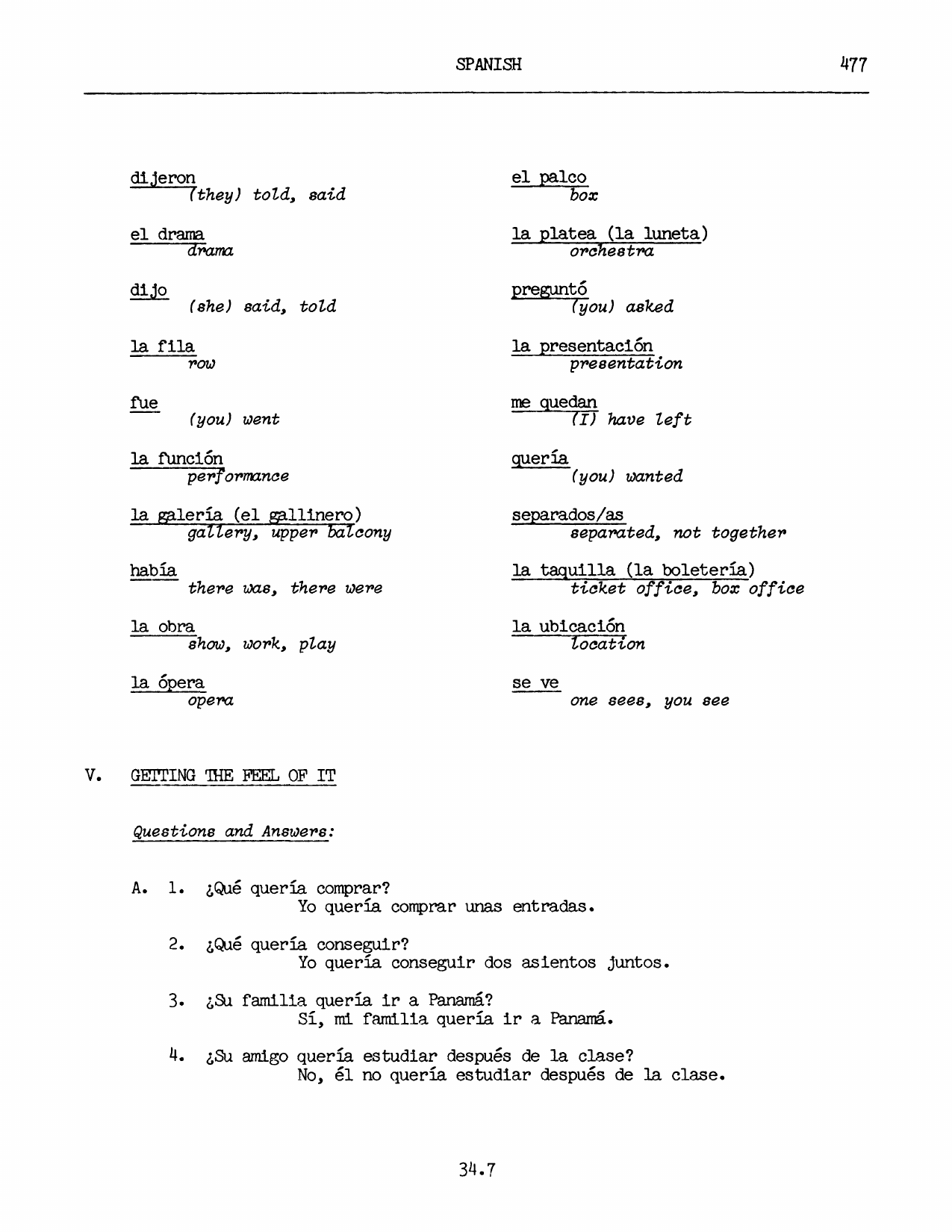
5. ¿Ustedes querían salir temprano?
Sí, nosotros queríamos salir temprano.
6. ¿José y María Luisa querían ir a la fiesta?
Sí, ellos querían ir a la fiesta.
B. 1. ¿Qué le dijeron?
a. Me dijeron que no había entradas.
b. Me dijeron que iban a Venezuela.
C. Me dijeron que tenían que hablar español todo el día. d. Me dijeron que eran guatemaltecos.
e. Me dijeron que estaban en el Hotel Internacional. f. Me dijeron que vivían en un apartamento.
g. Me dijeron que podía ir en su carro (coche, auto). h. Me dijeron que veían a María Luisa todos los días.
C. 1. ¿Qué les preguntó?
a. Les pregunté si tenían cheques viajeros (de viaje). b. Les pregunté si eran estudiantes.
c. Les pregunté si sabían la respuesta (contestación). d. Les pregunté si viajaban mucho.
e. Les pregunté si trabajaban para (con) el gobierno. f. Les pregunté si podían ayudarme.
g. Les pregunté si iban a la fiesta de la Embajada. h. Les pregunté si querían practicar inglés conmigo.
D. 1. ¿Qué les dijo?
a». Les dije que quería estudiar.
b. Les dije que tenía visa diplomática (visado diplomático). C. Les dije que estaba enfermo/a.
d. Les dije que no hablaba mucho español.
€. Les dije que era la secretaría del Embajador. f. Les dije que trabajaba en la Sección Consular. g Les dije que no iba a la fiesta.
h. Les dije que eran las 8:10 y que era hora de ir (irse) a
casa.
E. 1. ¿Qué le preguntaron?
a. Me preguntaron que por qué no quería ir al restaurante. b. Me preguntaron que cuándo podía traducir el documento. C. Me preguntaron que dónde estaba mi familia. d. Me preguntaron que cómo se veía desde la quinta fila.
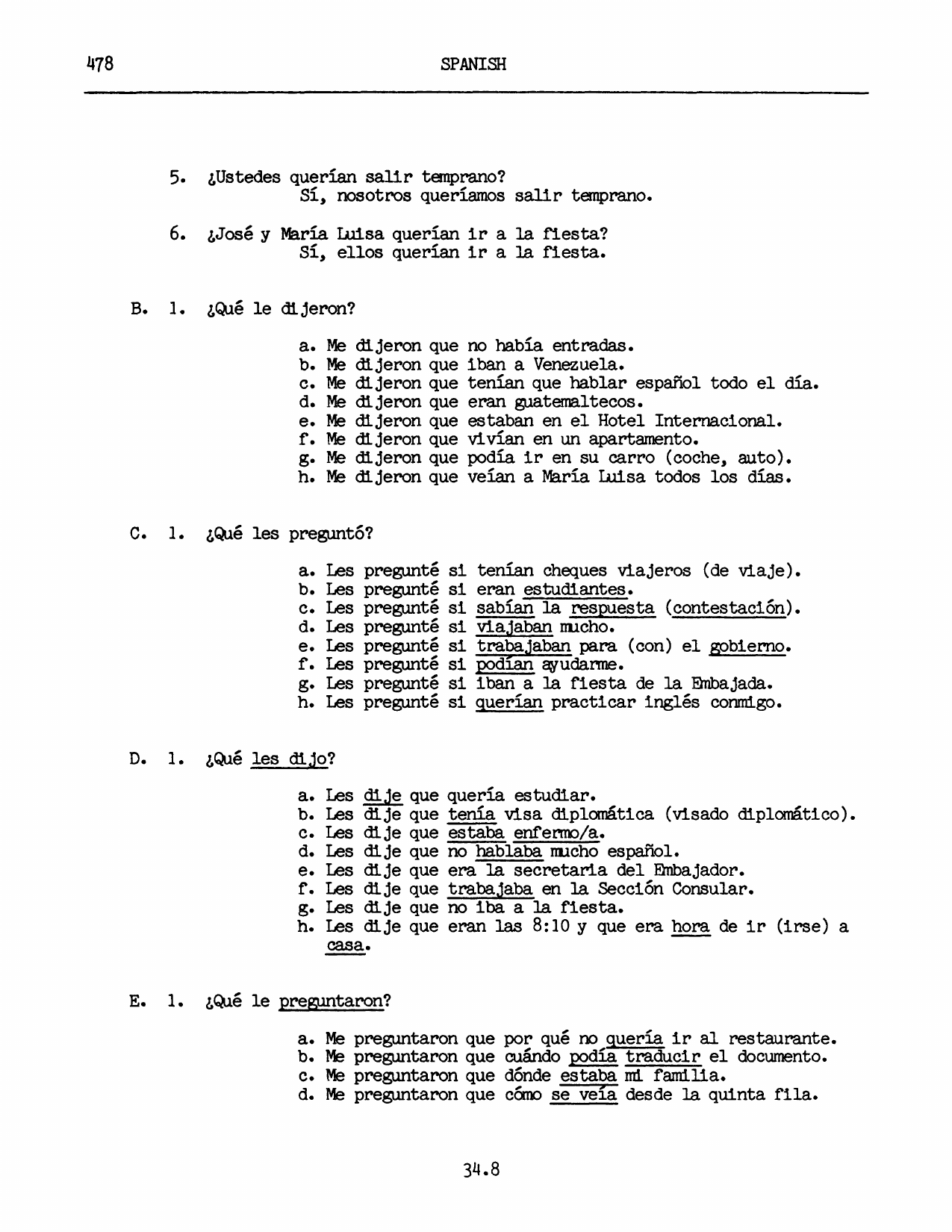
€. Me preguntaron si el Embajador estaba en los Estados
Unidos.
f. Me preguntaron si el Ministro Consejero era de California. g. Me preguntaron que dónde había estudiado español. h. Me preguntaron si era casado/a.
Questions and Answers: (continued)
A. 1. What did you want to buy?
I wanted to buy some tickets.
2. What did you want to get?
I wanted to get two seats together.
3. Did your family want to go to Panama?
Yes, my family wanted to go to Panama.
4. Did your friend want to study after class?
No, he did not want to study after class.
5. Did you (pl.) want to leave early?
Yes, we wanted to leave early.
6. Did Jose and Maria Luisa want to go to the party?
Yes, they wanted to go to the party.
B. 1. What did they tell you?
a. They told me there were no tickets.
b. They told me they were going to Venezuela.
c. They told me they had to speak Spanish all day long. d. They told me they were Guatemalans.
e. They told me they were staying at the International Hotel. f. They told me they lived in an apartment.
g» They told me I could go in their car.
h. They told me that they saw (used to see) María Luisa every
day.
C. 1. What did you ask them?
a. I asked them if they had traveler's checks. b. I asked them if they were students.
c. I asked them if they knew the answer.
d. I asked them if they traveled a great deal. e. I asked them if they worked for the government. f. I asked them if they could help me.
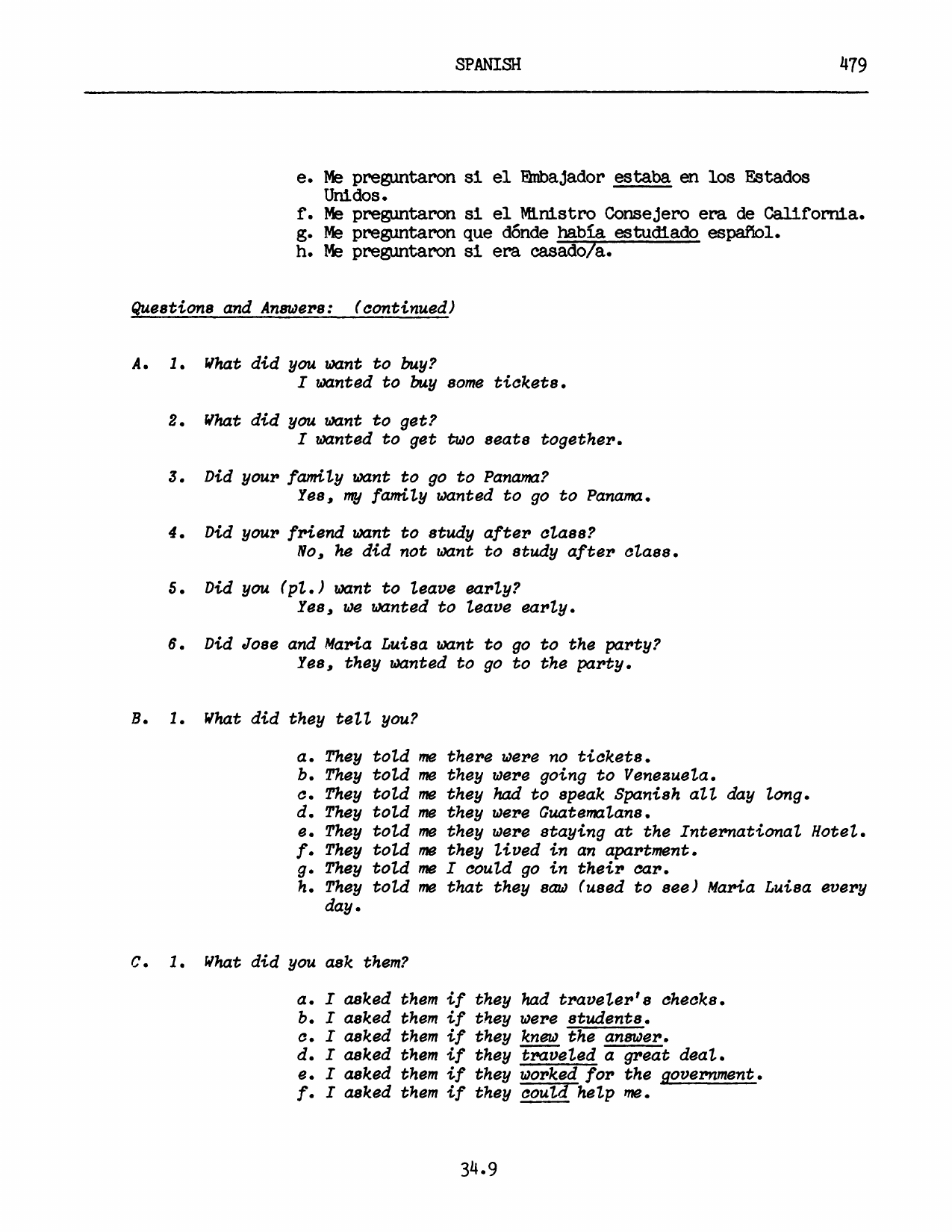
g- I asked them if they were going to the Embassy party. h. I asked them if they wanted to practice English with me.
D. 1. What did you tell them?
a». I told them that I wanted to study.
b. T told them that I had a diplomatic visa.
ec. I told them that I was sick.
d. I told them that T did not speak much Spanish. e. I told them that T was the Ambassador's secretary. f. I told them that I worked in the Consular Section. g- I told them that I was not going to the party. h. I told them it was 8:10 and that it wae time to go home.
E. 1. What did they ask you?
a. They asked me why I did not want to go to the restaurant. b. They asked me when I could translate the document. C. They asked me where my family was.
d. They asked me how well one could see from the fifth row. e. They asked me whether the Ambassador was in the United
States.
f. They asked me tf the DCM was from California. ge They asked me where I had studied Spanish.
h. They asked me if I was married.
VI. PUTTING IT TOGETHER
Variants:
A. A — ¿Tiene entradas para el concierto de esta noche?
N - Me quedan algunas de balcón (galería, gallinero), pero no hay más ni de
platea (luneta) ni de palco.
1 - ¿Tiene entradas para la comedia de esta noche?
2 - ¿Tiene entradas para el drama de esta noche?
3 - ¿Tiene entradas para la función de esta noche?
4 — ¿Tiene entradas para la conferencia de esta tarde? 5 - ¿Tiene entradas para el baile de esta noche?
B. A = ¿Tiene dos asientos juntos, adelante?
N - Sí, en la cuarta fila.
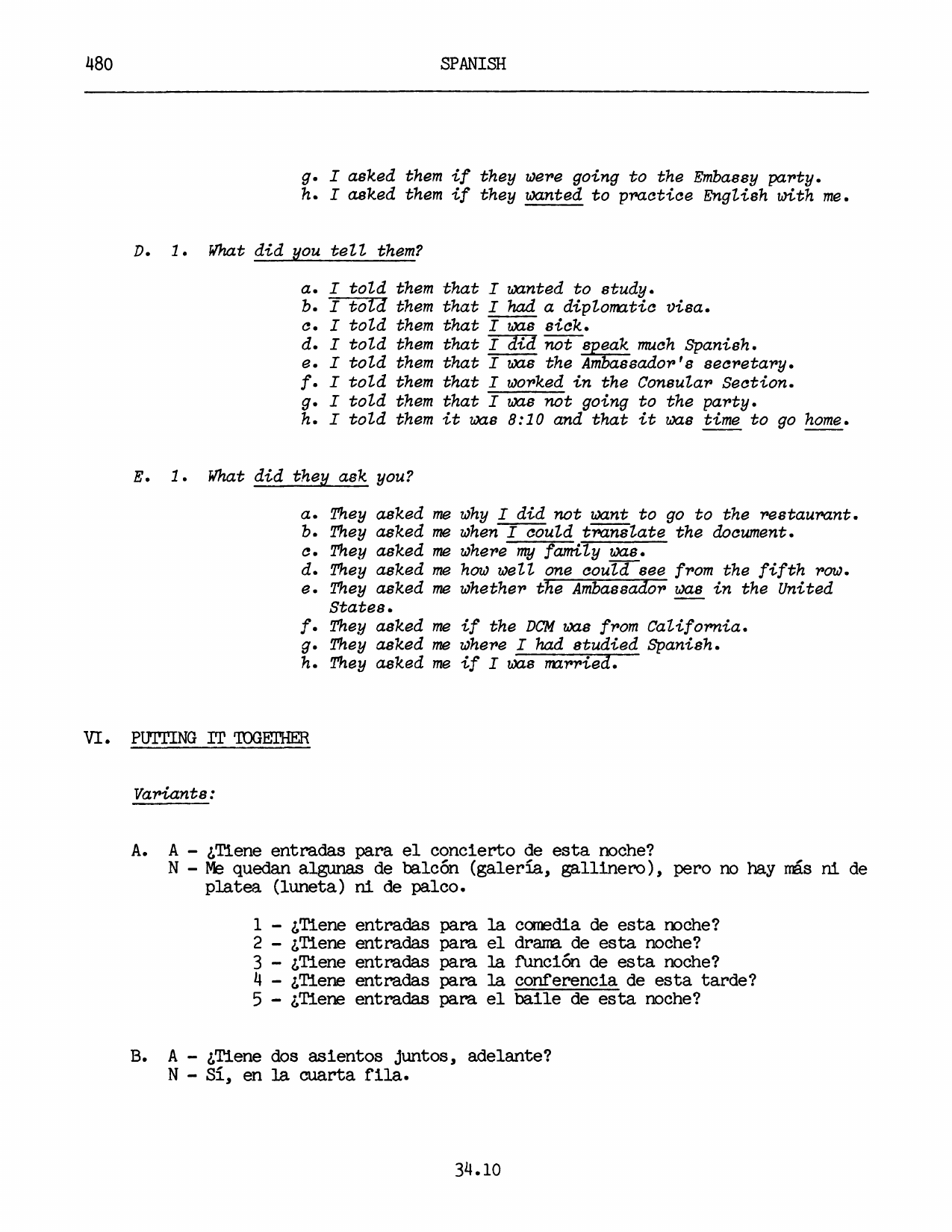
1 - ¿Tiene cuatro asientos juntos, adelante?
2 - ¿Tiene asientos juntos de galería?
3 - ¿Tiene seis asientos juntos de platea (luneta)? 4 — ¿Tiene dos asientos juntos de balcón?
5 - ¿Tiene entradas de platea (luneta) para el concierto de
mañana?
C. A - ¿Tiene dos asientos juntos, adelante?
N - Si, en la cuarta fila.
1 - Sí, en la séptima fila.
2 - Sí, en la primera fila.
3 - Sí, en la tercera fila.
4 - Sí, en la segunda fila.
5 - Sí, en la quinta fila.
D. A — ¿Cuánto cuestan las entradas?
N —- $800 cada una.
1 - ¿Cuánto cuestan las entradas de palco?
2 - ¿Cuál es el precio de las entradas?
3 - ¿Cuánto valen las entradas para el ballet del viernes por la
noche?
Y — ¿Cuál es el precio de una entrada para un niño menor de 12
años?
5 - ¿En cuánto salen las entradas de platea (luneta)?
Variante: (continued)
A. A - Do you have tickets for this evening's concert?
N - I have some left in the balcony, but there aren't any more in the
orchestra, and there aren't any box seats left.
1 - Do you have tickets for this evening's comedy?
2 - Do you have tickets for this evening's drama?
3 - Do you have tickets for this evening's performance? 4 - Do you have tickets for this afternoon's lecture? 5 - Do you have tickets for this evening's dance?
B. A - Do you have two seats together, in front?
N - Yes, in the fourth row.
1 - Do you have four seats together, in front?
2 - Do you have seats together in the gallery?
3 - Do you have six seats together in the orchestra?
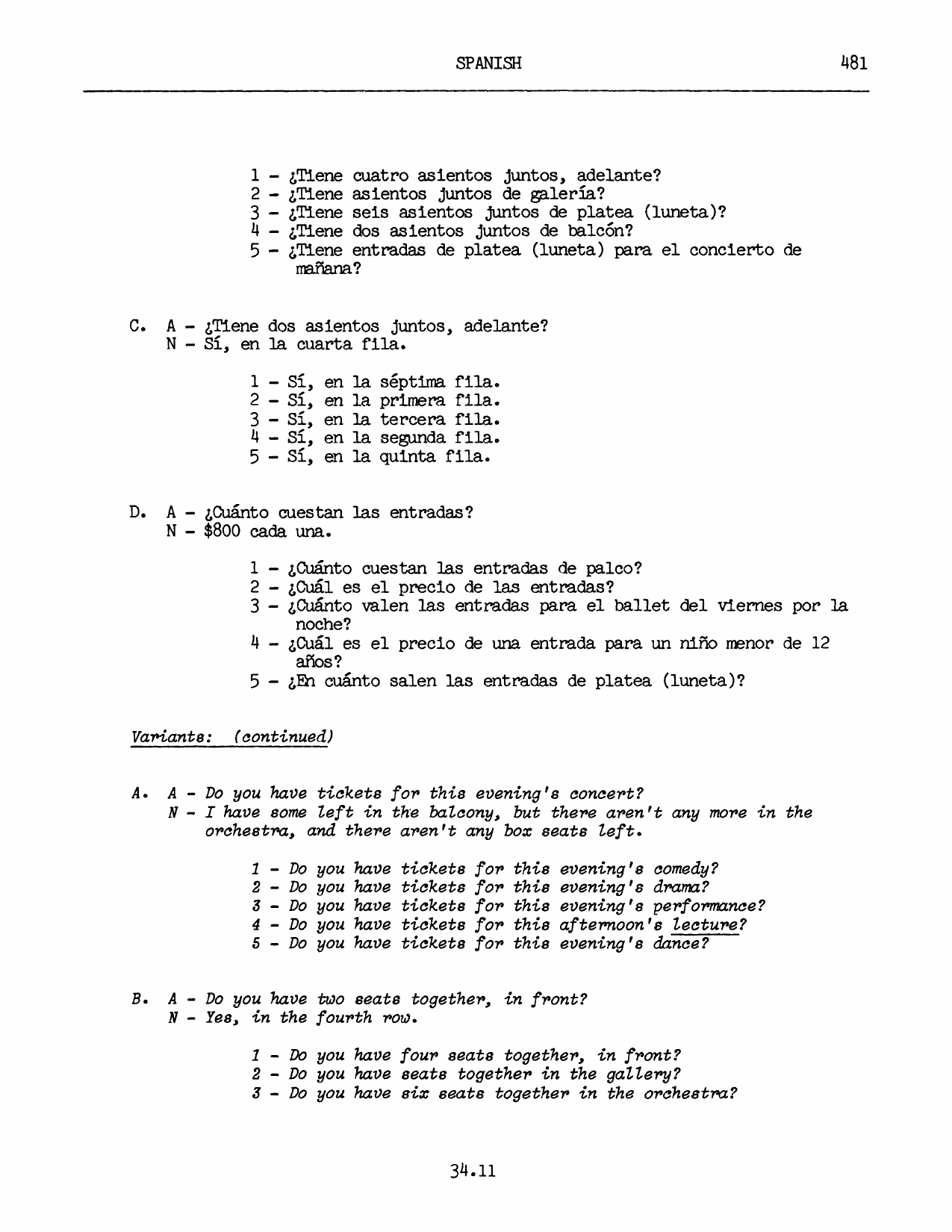
4 - Do you have two seats together in the balcony? 5 - Do you have orchestra tickets for tomorrow's concert?
C. A - Do you have two seats together, in front?
N - Yes, in the fourth row.
1 - Yes, in the seventh row.
2 - Yes, in the first row.
3 - Yes, in the third row.
4 - Yes, in the second row.
5 - Yes, in the fifth row.
D. A - How much are the tickets?
N - $800 apiece.
1 - How much are the tickets for box seats?
2 - What te the price of the tickets?
3 - How much are the tickets for Friday evening's ballet? 4 - What's the price of a ticket for a child under 12 years of
age?
5 - How much are the orchestra tickets?
VII. MAKING IT WORK
VITI. USING IT