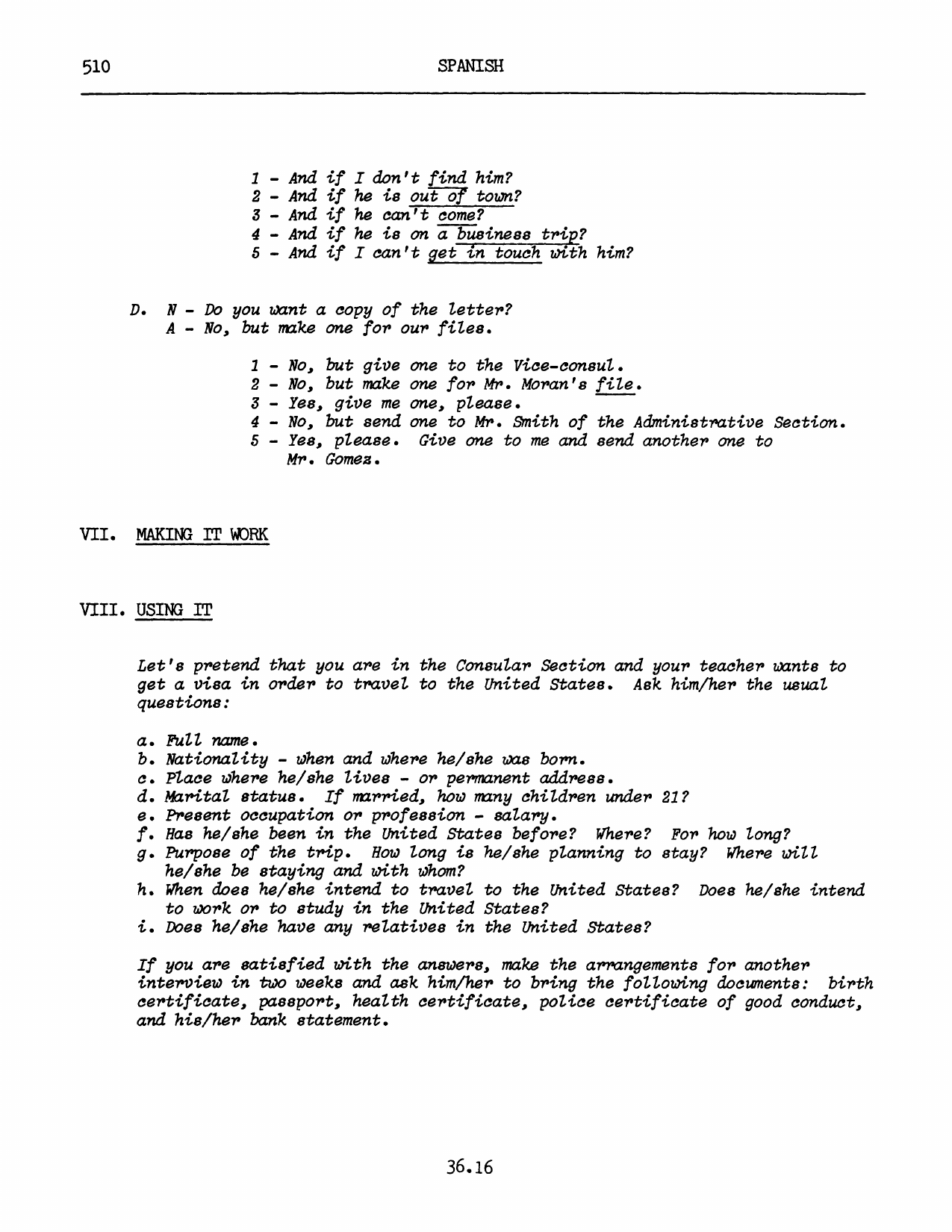
that most, if not all, natio nal emp y ess speak pnglish Nev. ertheless, you will
situation
This page has a drawing, chart, or fill-in layout — original page
I. SETTING THE SCENE
You are at the office and you ask your secretary to do several things for you. As the secretary doesn't speak English well, you have to explain what you want tn Spanish.
Ii. HEARING IT
III. SEEING IT
Dialogue No. 1: (Short Version)
Dándole instrucciones a la secretaria
A - Patricia, por favor llame por teléfono al Sr. Morán y dígale que quiero
verlo.
N - ¿Cuándo quiere que venga?
A - La semana que viene (que entra). Dígale que traiga los documentos de su
familia.
N - ¿Cuáles documentos?
A = Los certificados (las partidas, las actas) de nacimiento y los pasaportes. N - ¿Y si no consigo hablar con él?
A - En ese caso, mándele una carta hoy mismo.
N - ¿Usted quiere una copia de la carta?
A — No, pero haga una para nuestro archivo.
N - Si, señor/señorita/señora. Voy a tratar de llamarlo enseguida.
Dialogue No. 1: (Short Version - continued)
Directing the secretary
A - Patricia, please call Mr. Moran and tell him that I would like to see
him.
N - When would you like him to come?
A - Next week. Tell him to bring his family's documents.
N - Which documents?
A - Birth certificates and passports.
N - And if I am not able to reach him?
(1) A - In that case, send him a letter today.
WN - Do you want a copy of the letter?
A - No, but make one for our files.
N - Yes, str/miss/ma'am. I'll try to call him right away.
Dialogue No. 2: (Long Version)
Dándole instrucciones a la secretaria
A - Patricia, quiero que llame por teléfono al Sr. Morán y que le diga que
venga a verme.
N - ¿Cuándo quiere que venga?
A - Dígale que venga la semana que viene (que entra) y que me traiga los
documentos de su familia.
N = ¿Qué documentos tiene que traer?
A - Que traiga los certificados (las partidas, las actas) de nacimiento y los
pasaportes de todos ellos.
N - ¿Y si no consigo hablar con él?
A - Entonces escríbale una carta y mándesela hoy mismo.
N - ¿Usted quiere una copia de la carta?
A - No, pero haga una para mestro archivo.
N - Sí, señor. Voy a tratar de llamarlo ahora mismo.
Dialogue No. 2: (Long Version - continued)
A - Patricia, I would like you to call Mr. Moran and tell him to come to
see me.
N - When would you like him to come?
A - Tell him to come next week and to bring me his family's documente. N - What documents does he have to bring?
A - Have him bring birth certificates and passports for the whole family
(all of them).
N - And if I am not able to reach him?
(1) A - Then write him a letter and send it to him today.
N - Do you want a copy of the letter?
A - No, but make one for our files.
N - Yes, sir. I'll try to call him right nov.
Language Notes
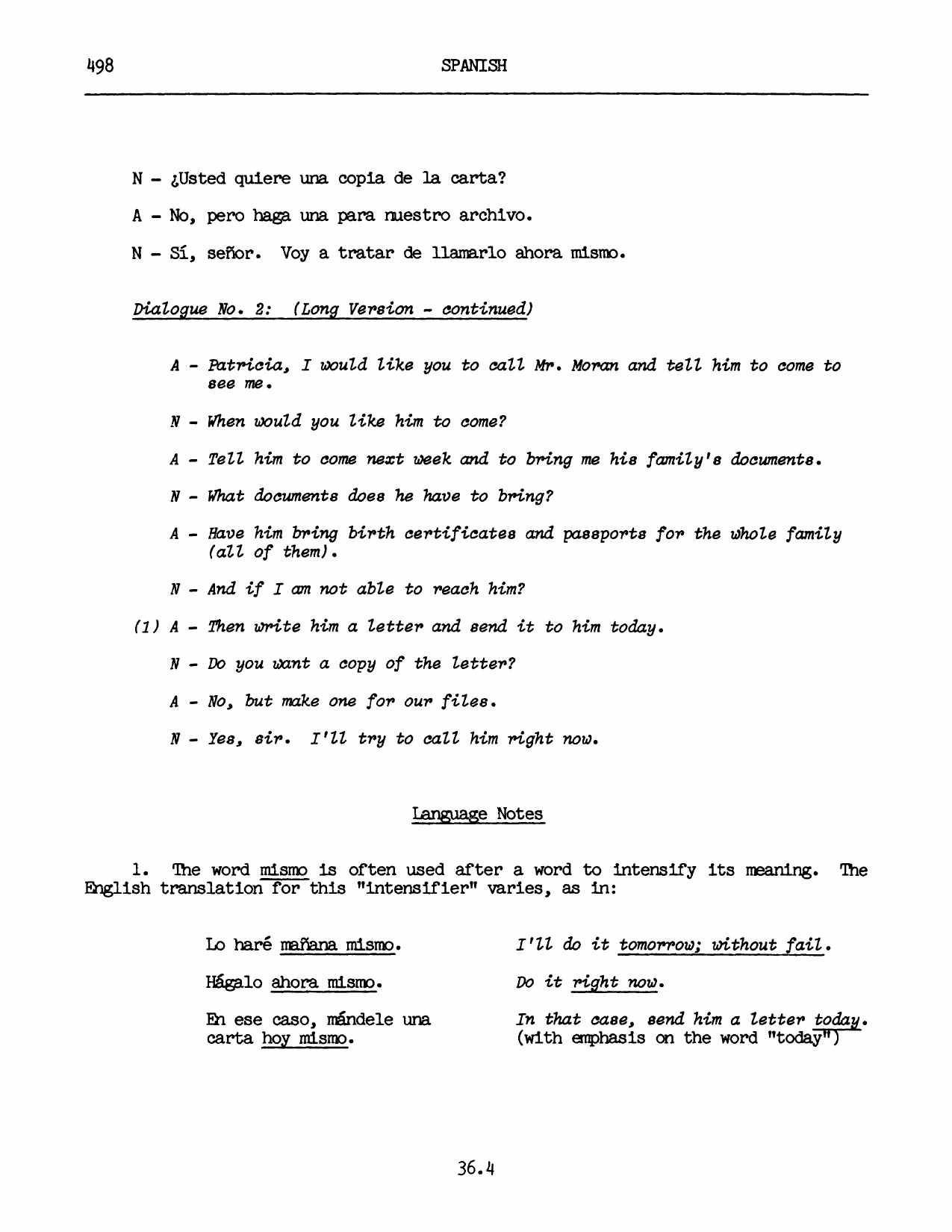
l. The word mismo is often used after a word to intensify its meaning. The
English translation for this "intensifier" varies, as in:
Narrative:
Dándole instrucciones a la secretaria
Es necesario que el Sr. Morán venga a verlo/a y que le traiga varios documen tos. Usted le pide a su secretaria que lo llame por teléfono y que haga los arreglos (preparativos) para una entrevista la próxima semana. La secretaria debe recordarle al Sr. Morán que traiga para la entrevista los certificados (las partidas, las actas) de nacimiento y los pasaportes de su familia.
Su secretaria quiere saber qué debe hacer si no consigue ponerse en contacto con el Sr. Morán y usted le dice que en ese caso le escriba una carta inmedia-tamente y que haga una copia para el archivo de la Sección Consular.
Questions:
1 - ¿Qué tiene que hacer el Sr. Morán?
What does Mr. Moran have to do?
2 - ¿Qué quiere usted que el Sr. Morán le traiga?
What do you want Mr. Moran to bring you?
3 = ¿Qué le pide usted a su secretaria que haga?
What do you ask your secretary to do?
4 — ¿Qué documentos debe traer el Sr. Morán a la entrevista?
What documents must Mr. Moran bring to the interview?
5 - ¿Qué más quiere saber la secretaria?
What else does the secretary want to know?
6 - ce quiere usted que ella haga si no puede ponerse en contacto con el Sr.
Morán?
What do you want her to do if she is unable to get in touch with Mr. Moran?
7 - ¿Cuántas copias de la carta quiere usted que ella haga para el archivo?
How many copies of the letter do you want her to make for the files?
IV. TAKING IT APART
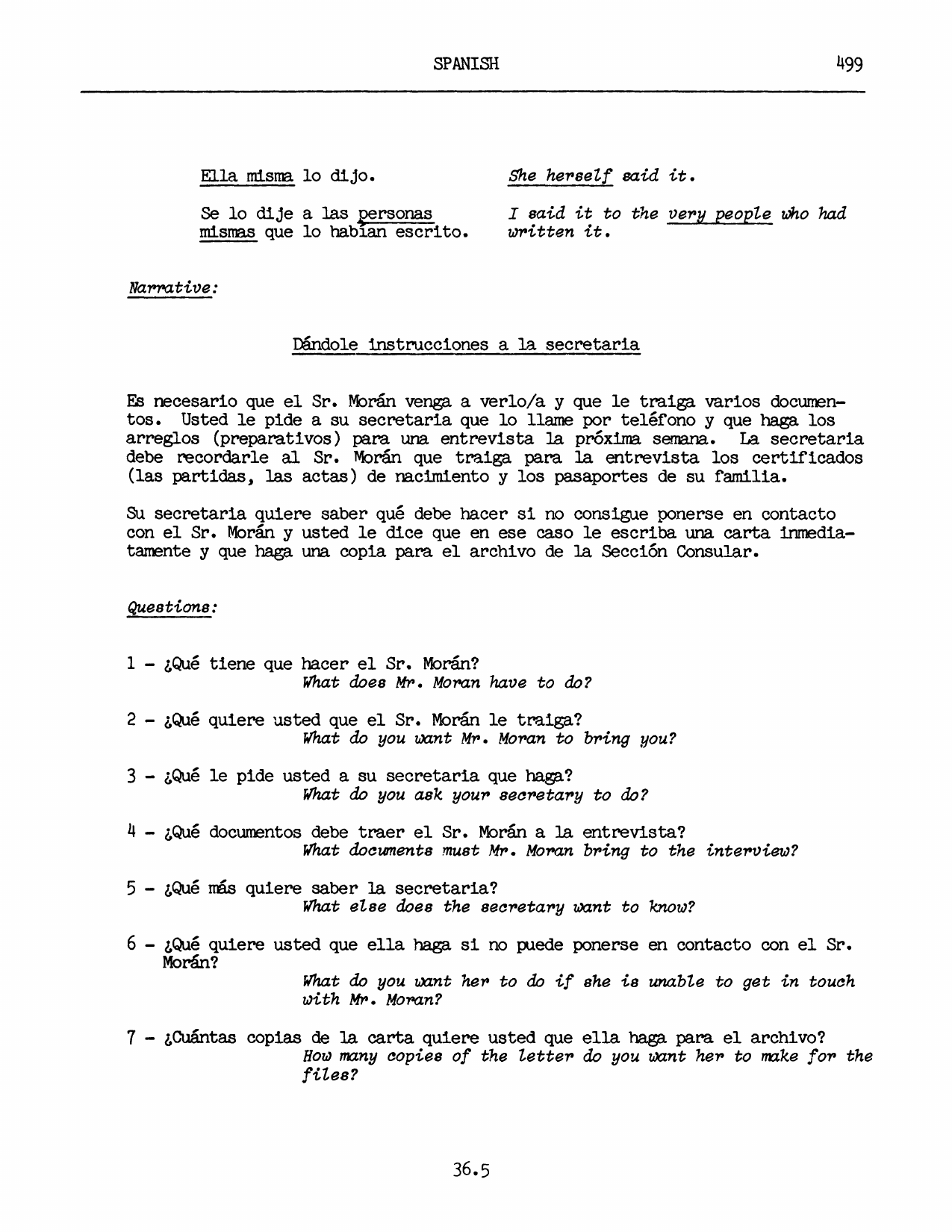
Vocabulary:
certificates
(que) haga los arreglos (los
preparativos )
(that she) make the arrangements
(subj.)
Vv. GETTING THE FEEL OF IT
Questions and Answers:
A. 1. ¿Dónde pongo el libro?
Póngalo en la silla, no lo ponga en la mesa.
No, no lo traiga el lunes, traigalo el martes.
3. ¿Le doy el ejercicio a la profesora ahora?
No, no se lo dé ahora, déselo más tarde.
q. ¿Traigo mi carro mañana?
No, no lo traiga mañana. Venga a la escuela conmigo en mi carro.
5. ¿Voy al restaurante (restorán) a las ocho?
No, no vaya a las ocho, vaya más temprano.
B. 1. ¿Usted quiere que yo le escriba una carta al Sr. Morán?
Sí, quiero que se la escriba ahora mismo.
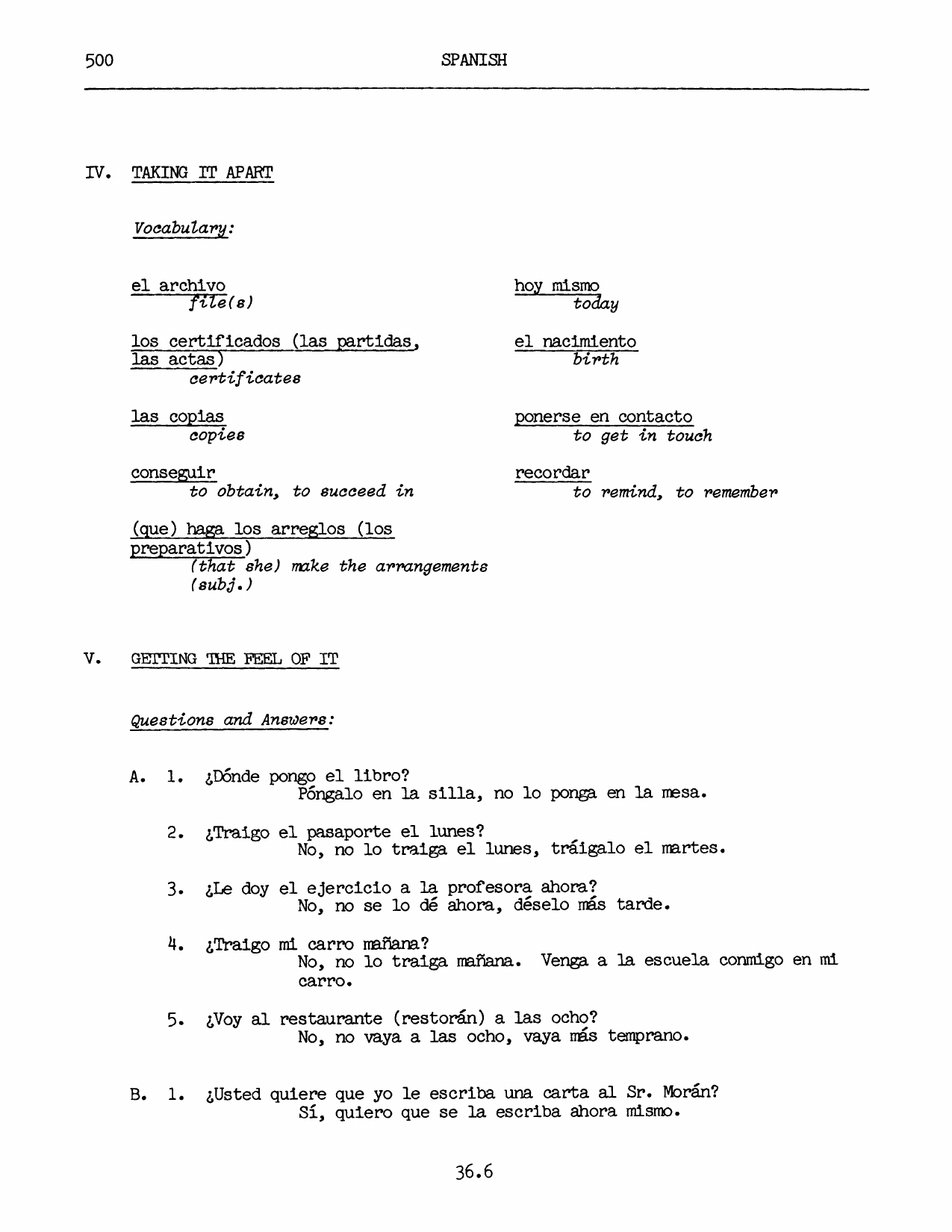
2. ¿Ustedes quieren que yo les haga las preguntas en inglés?
No, queremos que nos las haga en español.
3. ¿Qué quiere usted que lea para mañana?
Quiero que lea la página editorial.
4, ¿Usted quiere que traduzca la historia?
Sí, quiero que la traduzca del español al inglés.
5. ¿A qué hora quiere que vengamos mañana?
Quiero que vengan a la misma hora que vinieron ayer.
Sr. Sánchez, hay un señor que quiere hablar con usted.
Muy bien, por favor dígale que entre.
26 Tengo que salir temprano porque ml esposa no se siente bien.
Muy bien Don José. Lo siento, que se mejore pronto.
3. ¿Cuántas copias quiere que María luisa haga de esta carta?
Que haga por lo menos cinco copias.
4, ¿Está José en su oficina?
Sí, si está.
Que pase por mi oficina antes de irse.
5. La sala de clase es muy pequeña y hay demasiados estudiantes.
Que vayan al cuarto 115.
Le aconsejo que vaya a la playa para divertirse.
26 ¿Cómo puedo aprender más español?
Le sugiero que estudie más.
3. ¿Qué película me recomienda?
Le recomiendo que vea la del Teatro Nacional.
4, Doctor, tengo mucha tos, ¿qué hago?
Sr. Jones, le suglero que deje de fumar.
De ¿Dónde puedo conocer a personas de mi edad en esta cuidad?
Le sugiero que se haga socio del Club Internacional.
E. l. ¿Qué hago para mañana?
Lo que usted quiera.
26 ¿Hay alguien aquí que hable alemán?
No, aquí no hay nadie que hable alemán.
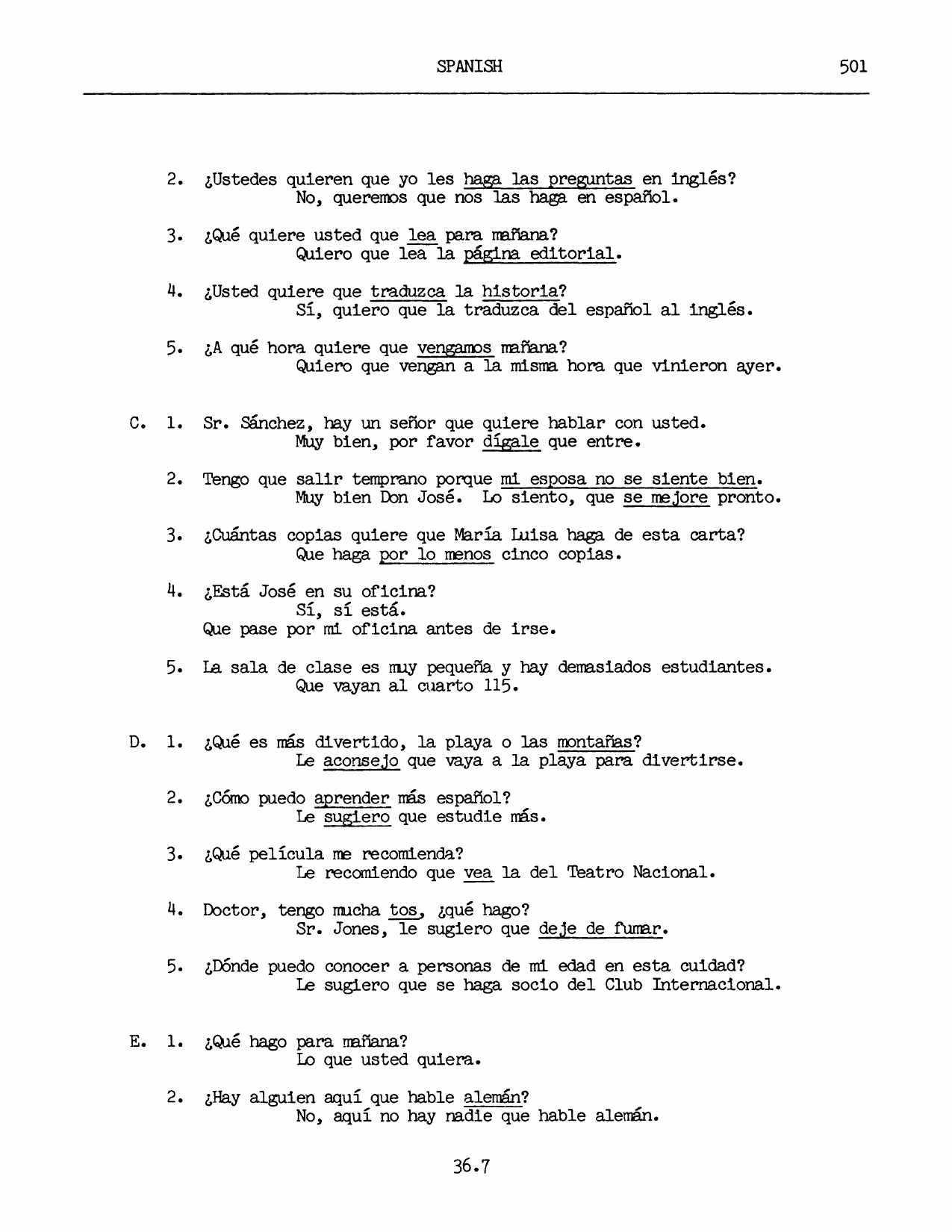
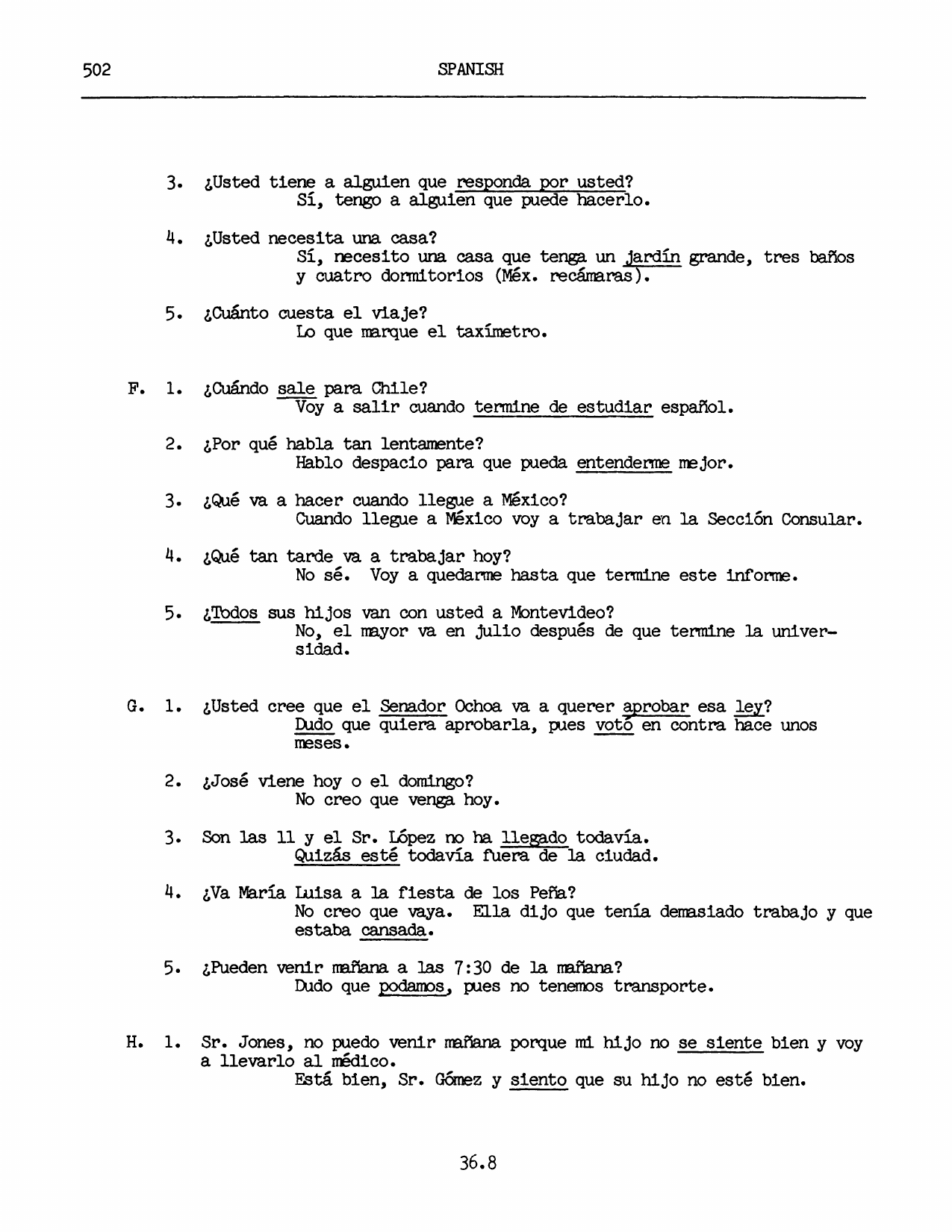
3. ¿Usted tiene a alguien que responda por usted?
Sí, tengo a alguien que puede hacerlo.
4. ¿Usted necesita una casa?
Sí, necesito una casa que tenga un jardín grande, tres baños y cuatro dormitorios (Méx. recámaras).
5. ¿Cuánto cuesta el viaje?
Lo que marque el taxímetro.
F. 1. ¿Cuándo sale para Chile?
Voy a salir cuando termine de estudiar español.
2. ¿Por qué habla tan lentamente?
Hablo despacio para que pueda entenderme mejor.
3. ¿Qué va a hacer cuando llegue a México?
Cuando llegue a México voy a trabajar en la Sección Consular.
4, ¿Qué tan tarde va a trabajar hoy?
No sé. Voy a quedarme hasta que termine este informe.
5. ¿Todos sus hijos van con usted a Montevideo?
No, el mayor va en julio después de que termine la univer-sidad.
G. 1. ¿Usted cree que el Senador Ochoa va a querer aprobar esa ley?
Dudo que quiera aprobarla, pues votó en contra hace unos meses.
2. ¿José viene hoy o el domingo?
No creo que venga hoy.
3. Son las 11 y el Sr. López no ha llegado todavía.
Quizás esté todavía fuera de la ciudad.
4, ¿Va María Luisa a la fiesta de los Peña?
No creo que vaya. Ella dijo que tenía demasiado trabajo y que estaba cansada.
5. ¿Pueden venir mañana a las 7:30 de la mañana?
Dudo que podamos, pues no tenemos transporte.
H. 1. Sr. Jones, no puedo venir mañana porque mi hijo no se siente bien y voy
a llevarlo al médico.
Está bien, Sr. Gómez y siento que su hijo no esté bien.
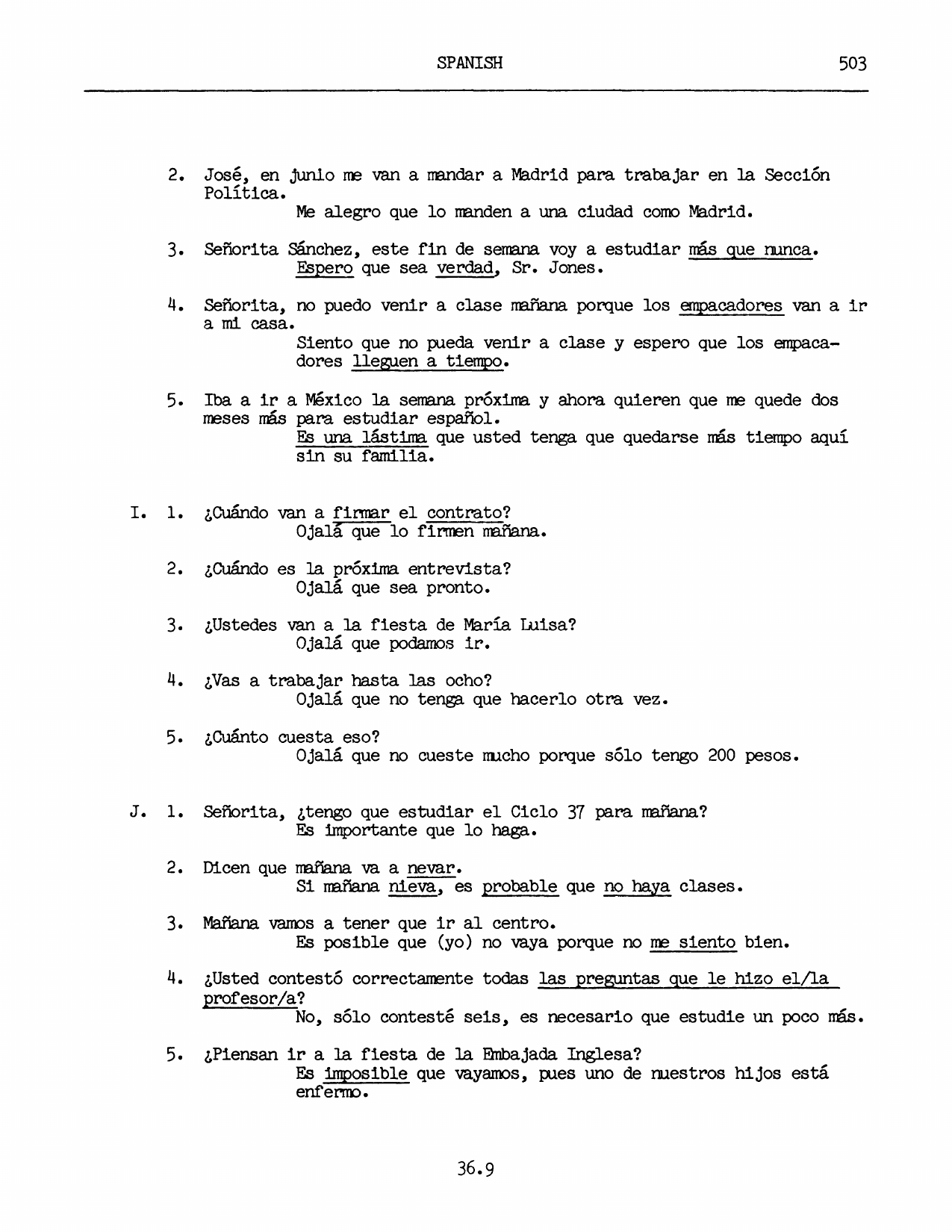
2. José, en junio me van a mandar a Madrid para trabajar en la Sección
Política.
Me alegro que lo manden a una cludad como Madrid.
3. Señorita Sánchez, este fin de semana voy a estudiar más que nunca.
Espero que sea verdad, Sr. Jones.
4, Señorita, no puedo venir a clase mañana porque los empacadores van a ir
a mi casa.
Siento que no pueda venir a clase y espero que los empaca-dores lleguen a tiempo.
5. Iba a ir a México la semana próxima y ahora quieren que me quede dos
meses más para estudiar español.
Es una lástima que usted tenga que quedarse más tiempo aquí sin su familia.
¿Cuándo van a firmar el contrato?
Ojalá que lo firmen mañana.
2. ¿Cuándo es la próxima entrevista?
Ojalá que sea pronto.
3. ¿Ustedes van a la fiesta de María Luisa?
Ojalá que podamos ir.
4, ¿Vas a trabajar hasta las ocho?
Ojalá que no tenga que hacerlo otra vez.
5. ¿Cuánto cuesta eso?
Ojalá que no cueste mucho porque sólo tengo 200 pesos.
l. Señorita, ¿tengo que estudiar el Ciclo 37 para mañana?
Es importante que lo haga.
2. Dicen que mañana va a nevar.
Si mañana nieva, es probable que no haya clases.
3. Mañana vamos a tener que ir al centro.
Es posible que (yo) no vaya porque no me siento bien.
4, ¿Usted contestó correctamente todas las preguntas que le hizo el/la
profesor/a?
No, sólo contesté seis, es necesario que estudie un poco más.
5. ¿Piensan ir a la fiesta de la Embajada Inglesa?
Es imposible que vayamos, pues uno de nuestros hijos está enfermo.
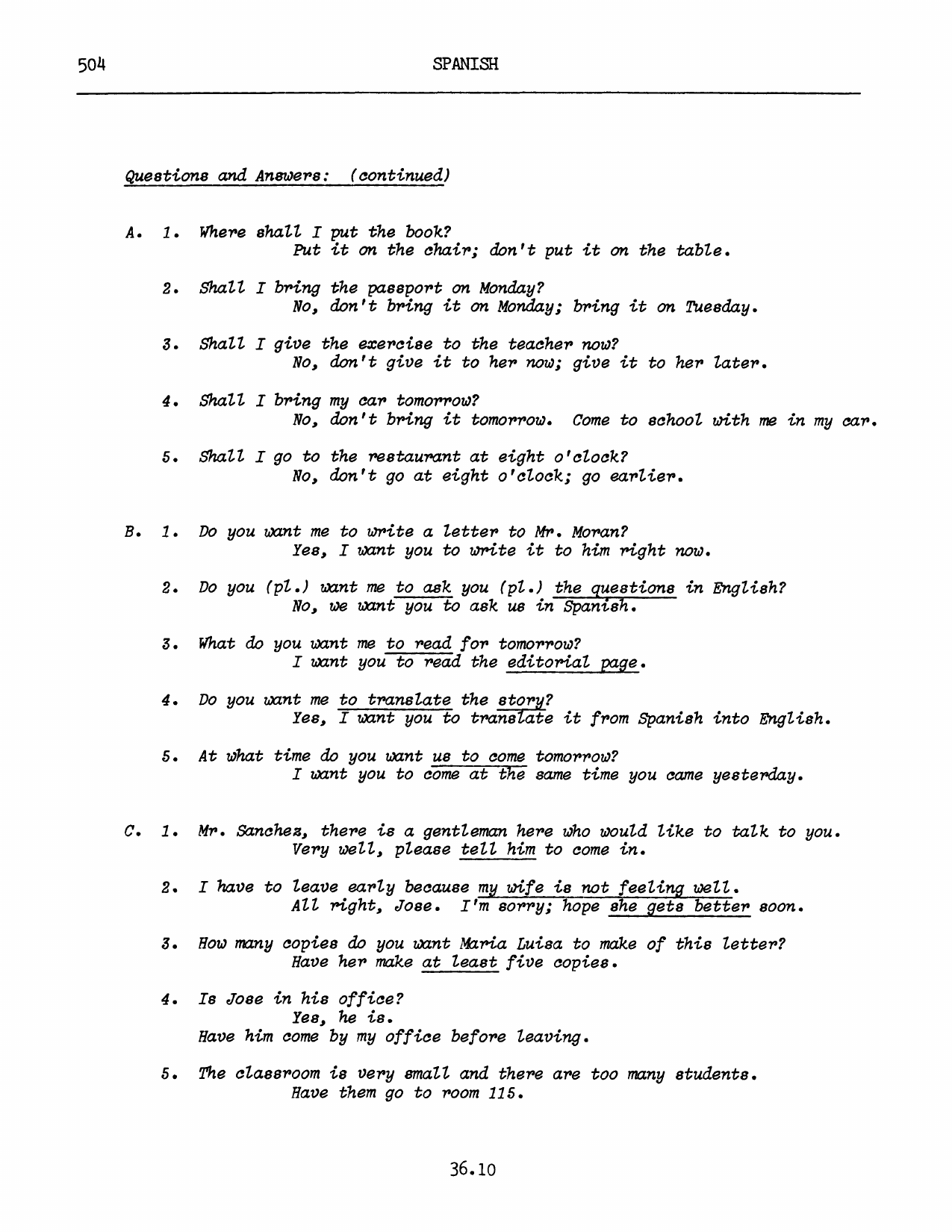
Questions and Answers: (continued)
A. 1. Where shall I put the book?
Put tt on the chair; don't put it on the table.
2. Shall I bring the passport on Monday?
No, don't bring it on Monday; bring it on Tuesday.
3. Shall I give the exercise to the teacher now?
No, don't give it to her now; give it to her later.
4. Shall I bring my car tomorrow?
No, don't bring it tomorrow. Come to school with me in my car.
5. Shall I go to the restaurant at eight o'clock?
No, don't go at eight o'clock; go earlier.
B. 1. Do you want me to write a letter to Mr. Moran?
Yes, I want you to write it to him right now.
2. Do you (pl.) want me to ask you (pl.) the questions in English?
No, we want you to ask ue in Spantsh.
3. What do you want me to read for tomorrow?
I want you to read the editorial page.
4. Do you want me to translate the story?
Yes, I want you to translate it from Spanish into English.
5. At what time do you want ue to come tomorrow?
I want you to come at the same time you came yesterday.
C. 1. Mr. Sanchez, there is a gentleman here who would like to talk to you.
Very well, please tell him to come in.
2. I have to leave early because my wife is not feeling well.
All right, Jose. I'm sorry; hope she gets better soon.
3. How many copies do you want Maria Luisa to make of this letter?
Have her make at least five copies.
4. Is Jose in his office?
Yes, he te.
Have him come by my office before leaving.
5. The classroom is very small and there are too many students.
Have them go to room 115.
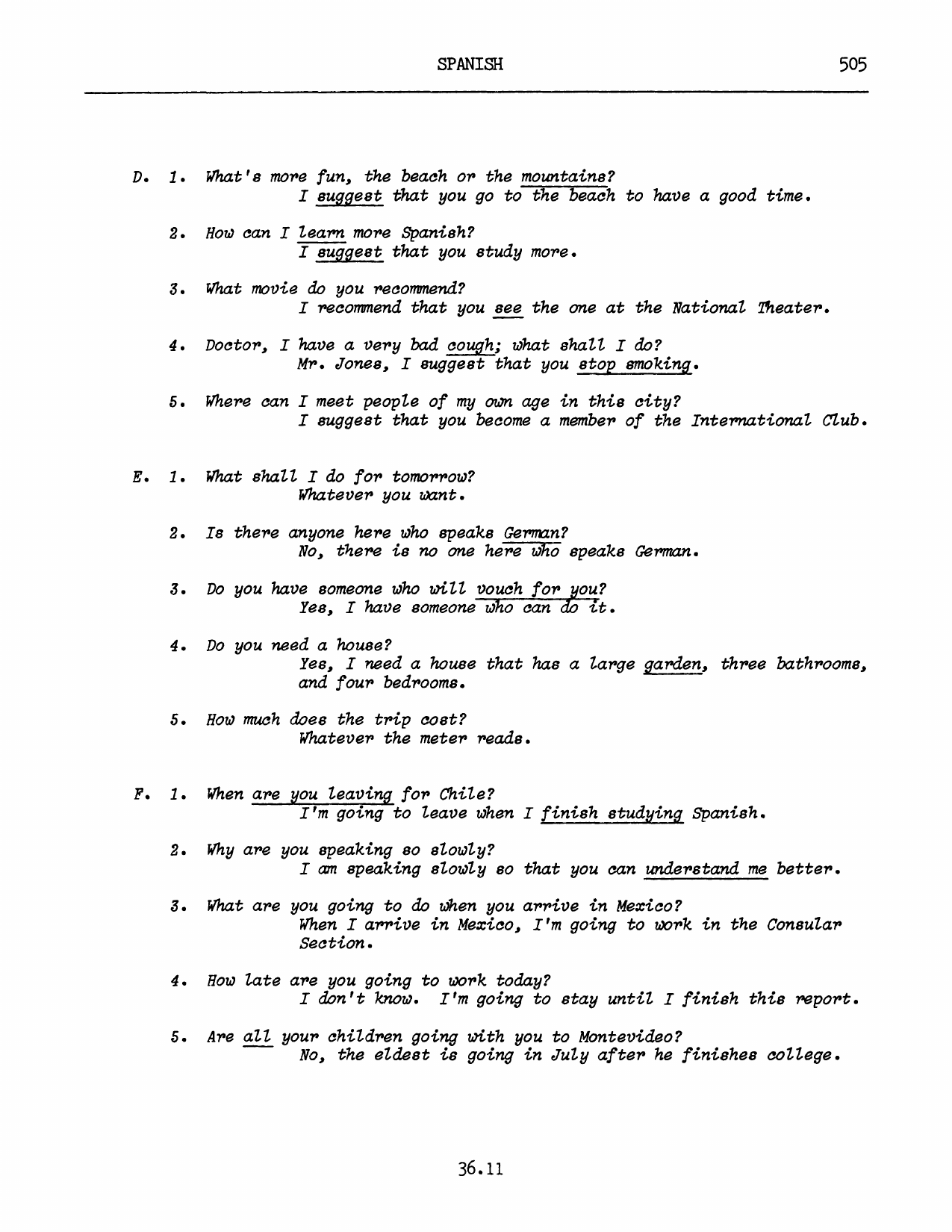
D. 1. What's more fun, the beach or the mountains?
I suggest that you go to the beach to have a good time.
2. How can I learn more Spanish?
I suggest that you study more.
3. What movie do you recommend?
I recommend that you see the one at the National Theater.
4. Doctor, I have a very bad cough; what shall I do?
Mr. Jones, I suggest that you stop smoking.
Se Where can I meet people of my own age in this city?
I suggest that you become a member of the International Club.
E. 1. What shall I do for tomorrow?
Whatever you want.
2. Is there anyone here who speaks German?
No, there ts no one here who speaks German.
3. Do you have someone who will vouch for you?
Yes, I have someone who can # tte
4. Do you need a house?
Yes, I need a house that has a large garden, three bathrooms, and four bedrooms.
be How much does the trip cost?
Whatever the meter reads.
F, 1. When are you leaving for Chile?
I'm going to leave when I finish studying Spanish.
2. Why are you speaking so slowly?
I am speaking slowly so that you can understand me better.
3. What are you going to do when you arrive in Mexico?
When I arrive in Mexico, I'm going to work in the Consular Section.
4. How late are you going to work today?
I don't know. I'm going to stay until I finish this report.
Se. Are all your children going with you to Montevideo?
No, the eldest te going in July after he finishes college.
G. 1. Do you think that Senator Ochoa is going to want to ratify that law?
I doubt that he will want to ratify it because he voted — against it a few months ago.
2. Is Jose coming today or on Sunday?
I don't think he'll come today.
3. It's 11 o'clock and Mr. Lopez hasn't arrived yet.
Perhaps he is still out of town.
4. Is Maria Luisa going to the Peñas' party?
I don't think she's going. She said that she had too much work and that she was tired.
5. Can you (pl.) come tomorrow at 7:30 a.m.?
I doubt that we will be able to because we don't have any transportation.
H. 1. Mr. Jones, I won't be able to come tomorrow because my son is not
feeling well and I am going to take him to the doctor.
All right, Mr. Gomez, and I am sorry that your son is not well.
2. dose, in June they are going to send me to Madrid to work in the
Political Section.
I'm glad they are sending you to a city like Madrid.
3. Miss Sanchez, this weekend I am going to study more than ever.
I hope that's true, Mr. Jones.
4. Miss, I won't be able to come to class tomorrow because the packers are
coming to my house.
I'm sorry you can't come to class and I hope the packers arrive on time.
5. I was going to go to Mexico next week and now they want me to stay two
more months to study Spanish.
It's a shame you have to stay here longer without your family.
I. 1. When are they going to sign the contract?
I hope they sign it tomorrow.
2. When te the next interview?
I hope it's soon.
3. Are you (pl.) going to Maria Luisa's party?
I hope we can go.
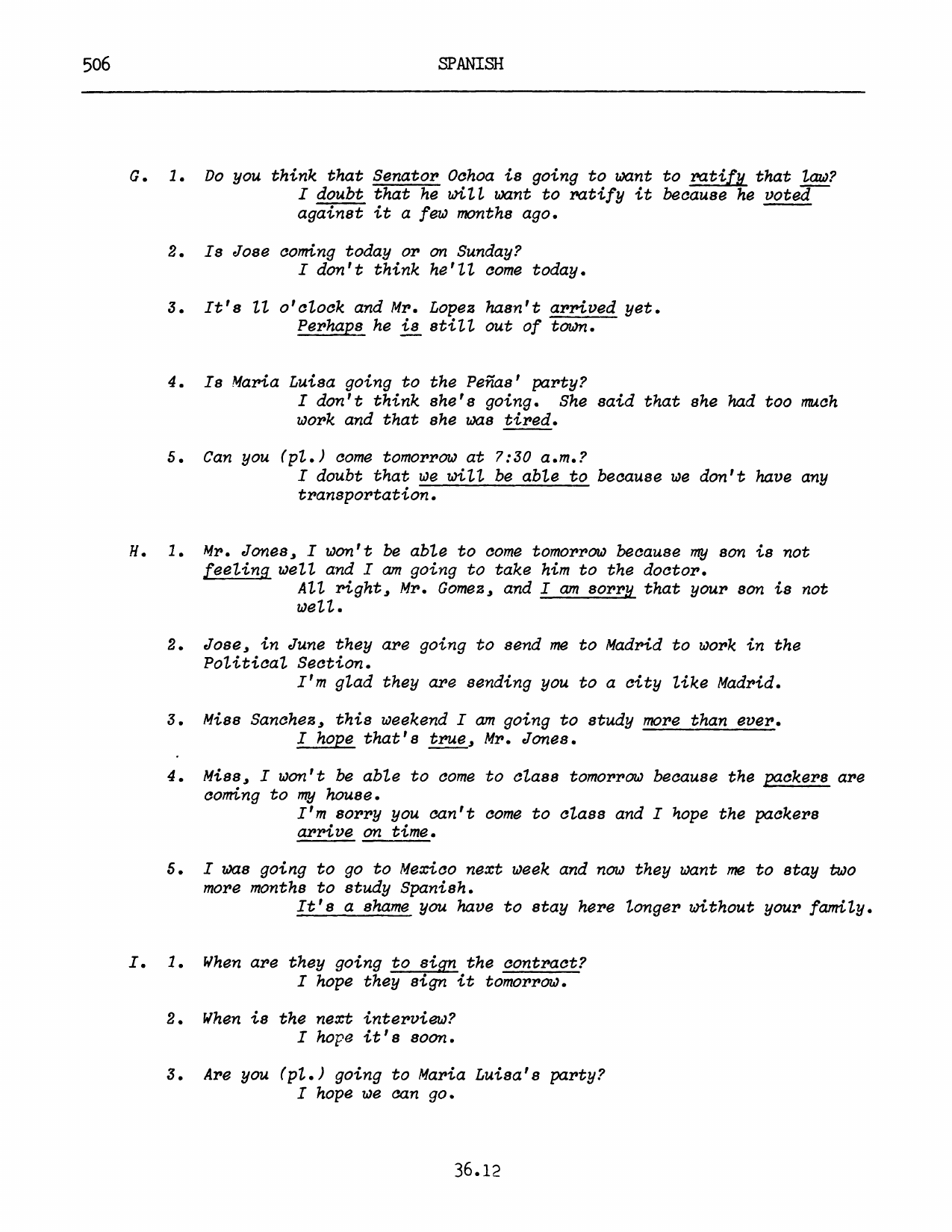
4. Are you (familiar) going to work until eight o'clock?
I hope I don't have to do it again.
5. How much does that cost?
I hope it doesn't cost much because I have only 200 pesos.
J. 1. Miss, do I have to study Cycle 37 for tomorrow?
It's important that you do it.
2. They say it's going to snow tomorrow.
If it snows tomorrow, there probably won't be any classes.
3. Tomorrow we'll have to go downtown.
It's possible that I won't be going because I don't feel well.
4. Did you correctly answer all the questions the teacher asked you?
No, I answered only six; I have (1t's necessary for me) to study a little more.
5. Are you (pl.) planning on going to the party at the British Embassy?
It's impossible for us to go because one of our children is ill.
VI. PUTTING IT TOGETHER
Variants:
A. A — Patricia, por favor llame por teléfono al Sr. Morán y dígale que quiero
verlo,
N - ¿Cuándo quiere que venga?
A — La semana que viene (que entra). Dígale que traiga los documentos de
su familia.
l. A — Patricia, por favor llame por teléfono al Sr. Morán y
dígale que venga.
N - ¿Cuándo quiere que venga?
A - Mañana a las 2:00 de la tarde. Dígale que traiga su pasa-
porte.
2. A - Patricia, por favor llame por teléfono al Sr. Morán y
dígale que tengo que (debo) verlo.
N - ¿Cuándo quiere que venga?
A - El martes a las 10:00 de la mañana. Dígale que traiga su
certificado (partida, acta) de nacimiento.
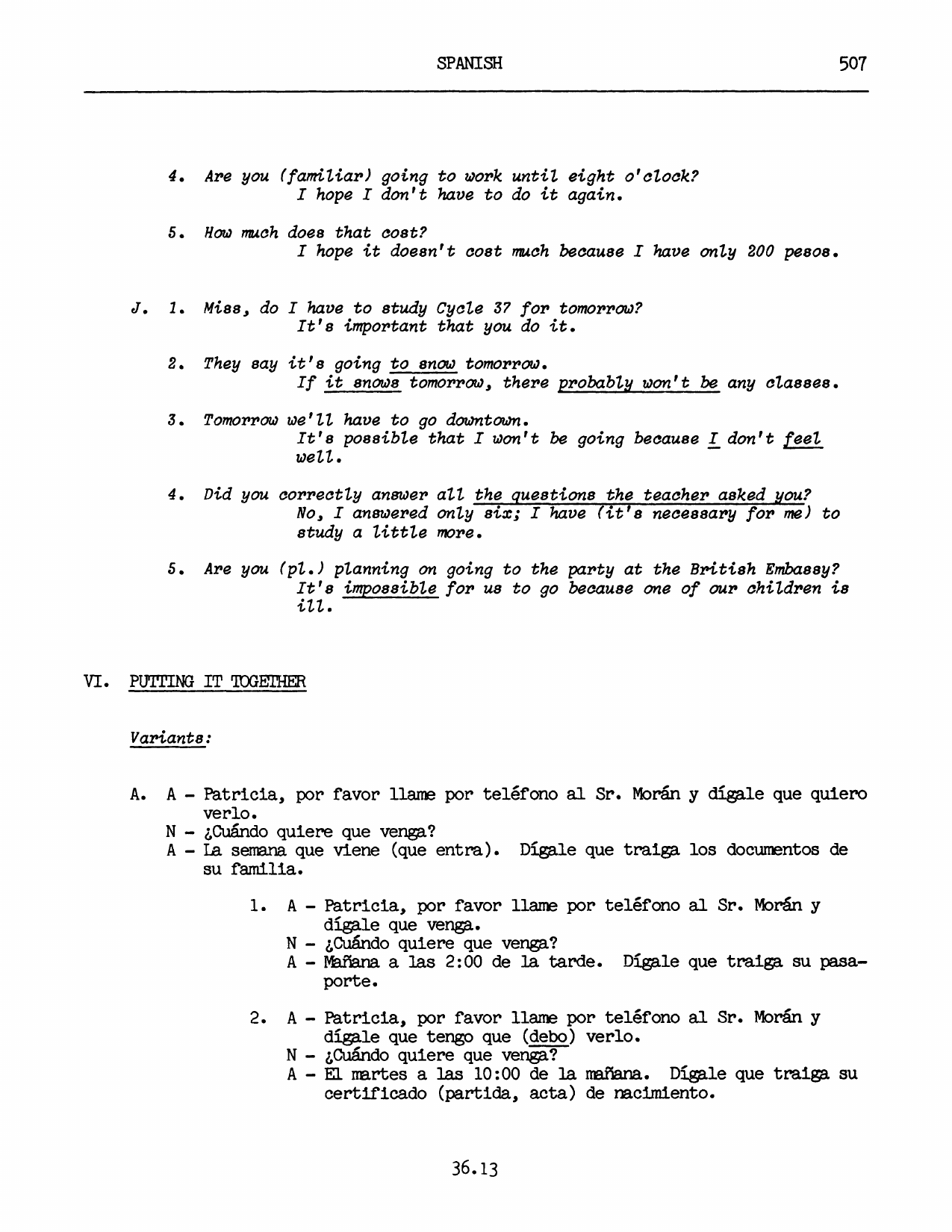
3. A- Patricia, por favor llame al Sr. Morán y haga una cita con
él.
N — ¿Cuándo quiere que venga?
A - El viernes por la tarde. Dígale que traiga el certificado
de buena conducta y su certificado de trabajo.
4, A - Patricia, por favor llame por teléfono al Sr. Morán y
dígale que necesito hablar con él.
N - ¿Cuándo quiere que venga?
A - Hoy, si es posible. Dígale que traiga su certificado
(acta, partida) de matrimonio.
5. A - Patricia, por favor llame por teléfono al Sr. Morán y
dígale que el Embajador quiere hablar con él.
N - ¿Cuándo quiere que venga?
A - El jueves después de la 1:00 de la tarde. Dígale que pase
por mi oficina para que así subamos a ver al Embajador juntos.
B. N- ¿Cuáles documentos?
A - Los certificados (las partidas, las actas) de nacimiento y los
pasaportes.
1 — Los documentos que no trajo la semana pasada.
2 - El certificado de buena conducta.
3 - Un certificado de salud firmado por un médico aprobado por la
Emba jada.
4 —~ Su certificado (partida, acta) de matrimonio.
5 - Su licencia para manejar (conducir).
C. N- ¿Y si no consigo hablar con é1?
A - En ese caso, mándele una carta hoy mismo.
1 - ¿Y si no lo encuentro?
2 - ¿Y si está fuera de la ciudad?
3 - ¿Y si no puede venir?
Y —- ¿Y si está en un viaje de negocios?
5 - ¿Y si no puedo comunicarme con él?
D. N- ¿Usted quiere una copia de la carta?
A — No, pero haga una para nuestro archivo.
1 = No, pero déle una al vicecónsul.
2 - No, pero haga una para el archivo (el expediente) del Sr.
Morán.
3 - Si, déme una, por favor.
4 ~ No, pero mándele una al Sr. Smith de la Sección Administrativa. 5 - Si, por favor. Déme una a mí y mándele otra al Sr. Gómez.
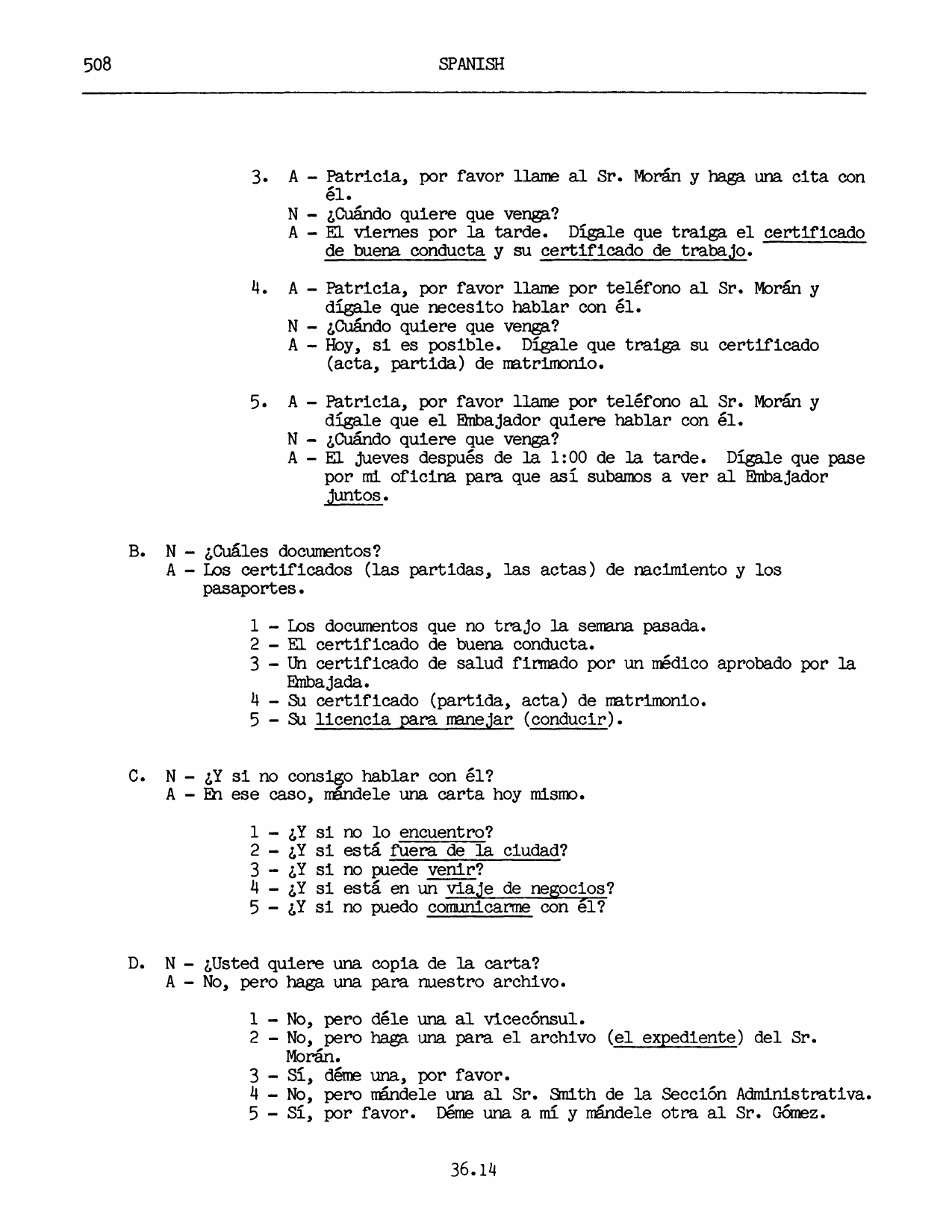
Variants: (continued)
A. A - Patricia, please call Mr. Moran and tell him that I would like to see
him.
N - When would you like him to come?
A - Next week. Tell him to bring his family's documents.
1. A - Patricia, please call Mr. Moran and tell him to come.
N - When would you like him to come?
A - Tomorrow at 2:00 p.m. Tell him to bring hia passport.
2. A - Patricia, please call Mr. Moran and tell him that I mst
see him.
N - When would you like him to come?
A - Tuesday at 10:00 a.m. Tell him to bring his birth
certificate.
3. A - Patricia, please call Mr. Moran and make an appointment
with him.
N - When would you like him to come?
A - Friday afternoon. Tell him to bring a certificate of good
conduct and proof of employment.
4. A - Patricia, please call Mr. Moran and tell him that I need
to speak with him.
N - When would you like him to come?
A - Today if possible. Tell him to bring his marriage
certificate.
5. A - Patricia, please call Mr. Moran and tell him that the
Ambassador wants to speak with him.
N - When would you like him to come?
A - Thursday after 1:00 p.m. Tell him to come by my office so
that we can go up to see the Ambassador together.
B. W - Which documents?
A - Birth certificates and passports.
1 - The documents he didn't bring last week.
2 - The certificate of good conduct.
3 - A health certificate signed by a physician (who has been)
approved by the Embassy.
4 - His marriage certificate.
5 - His driver's license.
C. N- And tf I am not able to reach him?
A - In that case, send hima letter today.
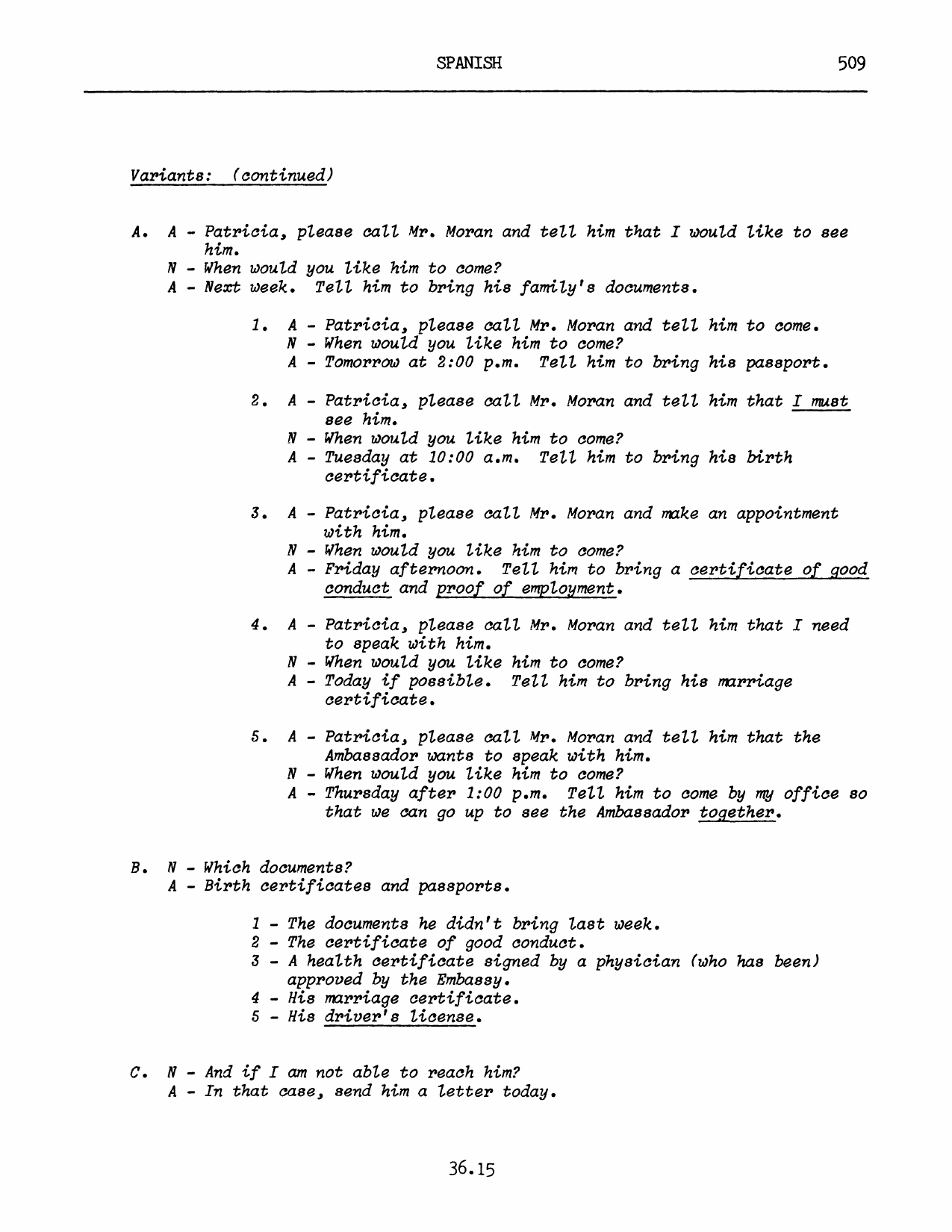
1 - And if I don't find him?
2 - And if he is out of town?
3 - And if he can't come?
4 - And if he is on a business trip?
5 - And if I can't get in touch with him?
D. N- Do you want a copy of the letter?
A - No, but make one for our files.
1 - No, but give one to the Vice-consul.
2 - No, but make one for Mr. Moran's file.
3 - Yes, give me one, please.
4 - No, but send one to Mr. Smith of the Administrative Section. 5 - Yes, please. Give one to me and send another one to
Mr. Gomez.
VII. MAKING IT WORK
VIII. USING IT
Let's pretend that you are in the Consular Section and your teacher wants to get a visa in order to travel to the United States. Ask him/her the usual questions:
a. Full name.
b. Nationality - when and where he/she was born.
C. Place where he/she lives - or permanent address.
d. Marital status. If married, how many children under 21?
e. Present occupation or profession - salary.
f. Has he/she been in the United States before? Where? For how long? g- Purpose of the trip. How long is he/she planning to stay? Where will
he/she be staying and with whom?
h. When does he/she intend to travel to the United States? Does he/she intend
to work or to study in the United States?
ti. Does he/she have any relatives in the United States?
If you are satisfied with the answers, make the arrangements for another interview in two weeks and ask him/her to bring the following documents: birth certificate, passport, health certificate, police certificate of good conduct, and his/her bank statement.