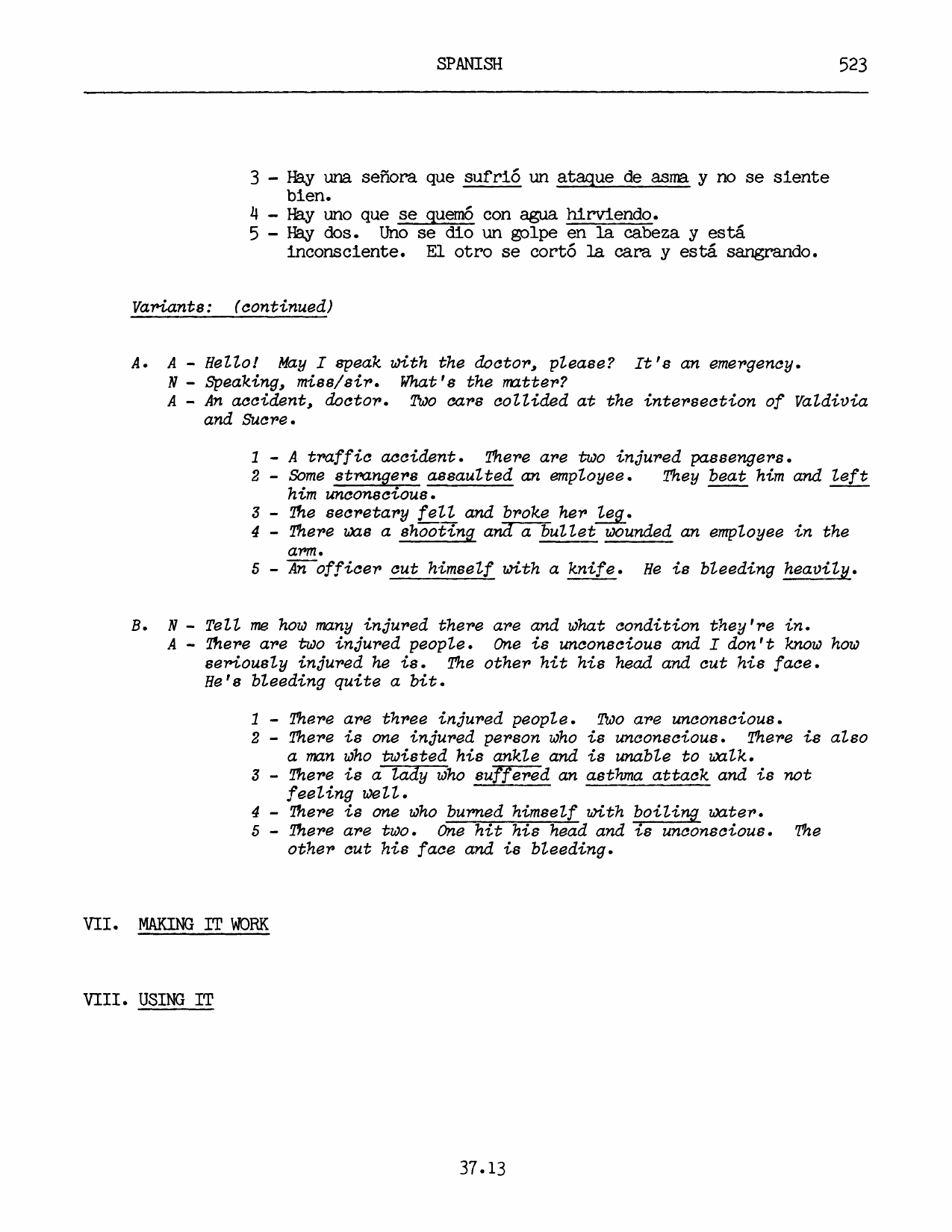
CYCLE 37
GETTING THINGS
An Emergency
==
This Cycle will give you more practice in successfully getting your point
across in stressful situations or emergencies, where time is of the essence.
This page has a drawing, chart, or fill-in layout — original page
I. SETTING THE SCENE
You have just witnessed an accident. After calling the police, you call for an ambulance.
II. HEARING IT
ITI. SEEING IT
Dialoque No. 1: (Short Version)
Llamando a la ambulancia
A - ¡Aló! Con el Doctor, por favor. Es una emergencia.
N - Con él habla, señorita/señor. ¿Qué pasa?
A = Un accidente, Doctor. Dos carros (coches, autos) chocaron en la esquina de
Valdivia y Sucre.
N = Dígame cuántos heridos hay y cómo están.
A - Hay dos heridos. Uno está inconsciente y no sé si está grave. El otro se
dio un golpe en la cabeza y se cortó la cara. Está sangrando bastante.
N - Quédese con ellos y que no se mievan. Yo llego enseguida.
A - Lo esperamos, Doctor. Apúrese, por favor.
N - Sí, sí. Ahora salgo y estoy ahí en tres minutos.
Dialogue No. 1: (Short Version - continued)
Calling an ambulance
A - Hello! May I speak with the doctor, please? It's an emergency. N - Speaking, miss/air. What's the matter?
A - An accident, doctor. Two cars collided at the intersection of Valdivia and
Sucre.
WN - Tell me how many injured there are and what condition they're in. A - There are two injured people. One ts unconscious and I don't know how
seriously injured he ts. The other hit his head and cut his face. He's bleeding quite a bit.
N - Stay with them and see that they don't move. I'11l arrive shortly. A - We'll be waiting for you, doctor. Please hurry.
N - Yes, yes. I'm leaving now and I'll be there in three minutes. Dialogue No. 2: (Long Verston)
Llamando a la ambulancia
A - ¡A1ó! Comuniqueme con el médico de turno, por favor. ¡Es urgente! N — Con él habla, señorita/señor. Soy el doctor Méndez. Dígame, ¿qué pasa? A - Ha habido un accidente de tráfico (tránsito) en la esquina de Valdivia y
Sucre. ¿Puede venir con la ambulancia?
N - Sí, enseguida. Dígame cuántos heridos hay y en qué estado están. A - Hay dos heridos. Uno está inconsciente y no está sangrando. N = ¿Y el otro?
A - El otro se dio un golpe en la cabeza y se cortó la cara y las manos con
pedazos de vidrio quebrado (roto).
N - ¿Está sangrando mucho?
A - Si, ha perdido mucha sangre y necesita atención inmediata.
N - ¿Ya llegó la Policía?
A - Todavía no, pero viene en camino.
N —- Bueno, tape al que está inconsciente y que el otro no se mueva. A - Sí, Doctor. Apúrese, por favor.
N - Sí, salgo ahora mismo y estoy allá en tres minutos.
Dialogue No. 2: (Long Version - continued)
Calling an ambulance
A - Hello! Please put me through to the doctor on duty. It's urgent! N - Speaking, miss/sir. I'm Doctor Mendez. Tell me, what's the matter? A - There's been a traffic accident at the corner of Valdivia and Sucre. Can
you come with an ambulance?
N - Yes, right away. Tell me how many injured there are and what condition
they're tn.
A - There are two injured people. One is unconscious and ts not bleeding. N - And the other one?
A - The other hit his head and cut his face and hands with (pieces of) broken
glass.
WN - Is he bleeding much?
A - Yes, he's lost a great deal of blood and needs immediate attention. N - Have the police arrived?
A - Not yet, but they're on their way.
N - Good. Cover the one who is unconscious and see that the other doesn't
move »
A - Yes, doctor. Please hurry.
N - Yes, I'm leaving right now and will be there in three minutes.
Language Notes
l. Up until now you have been using a form called the present subjunctive
in such constructions as Quiero que (vaya), Que se diviertan, Cuando llegue a México voy a trabajar en la Sección Consular, Dudo que venga hoy, and Es importante que estudie. These constructions require the use of another form, called the past
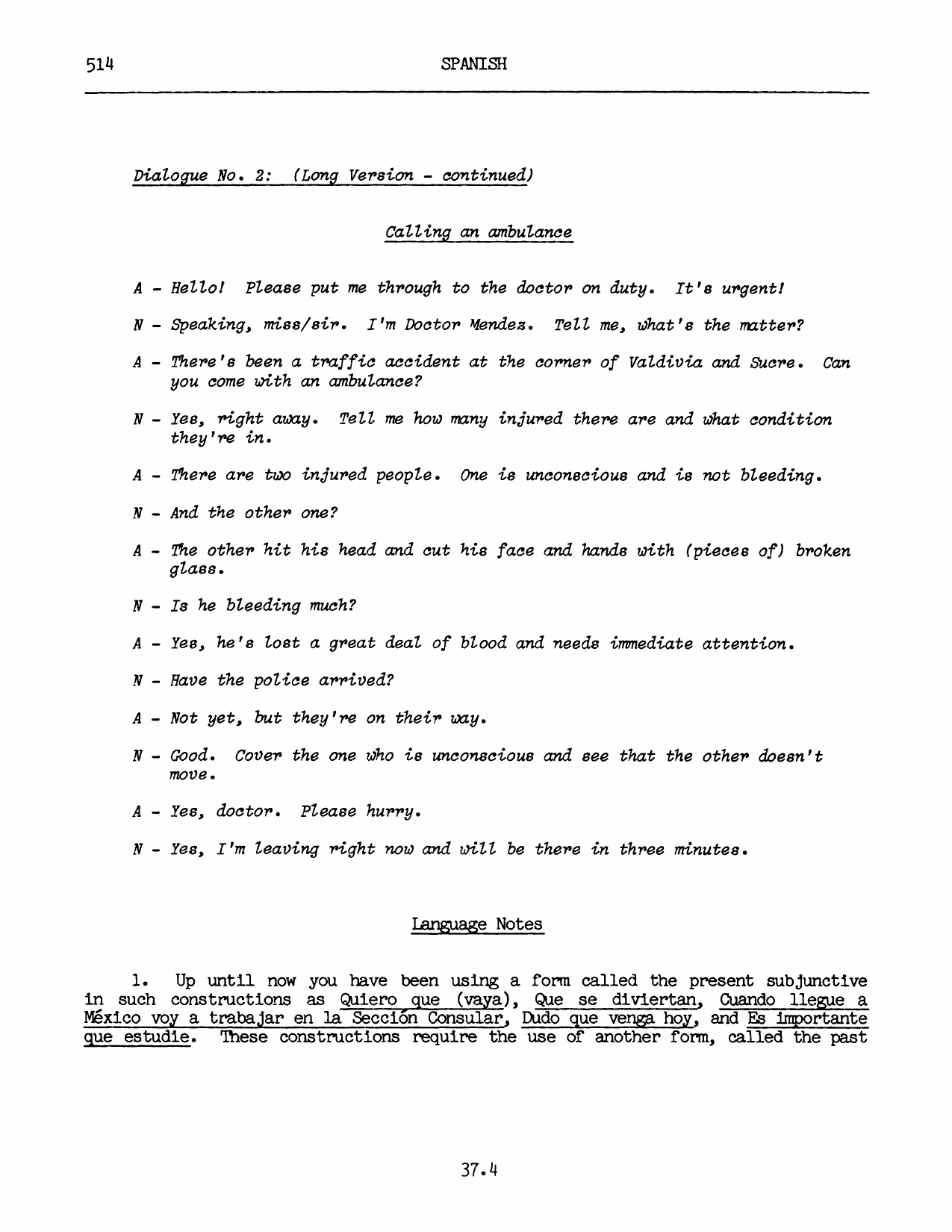
subjunctive, when the verb in the main clause is in a form of the past tense. For example,
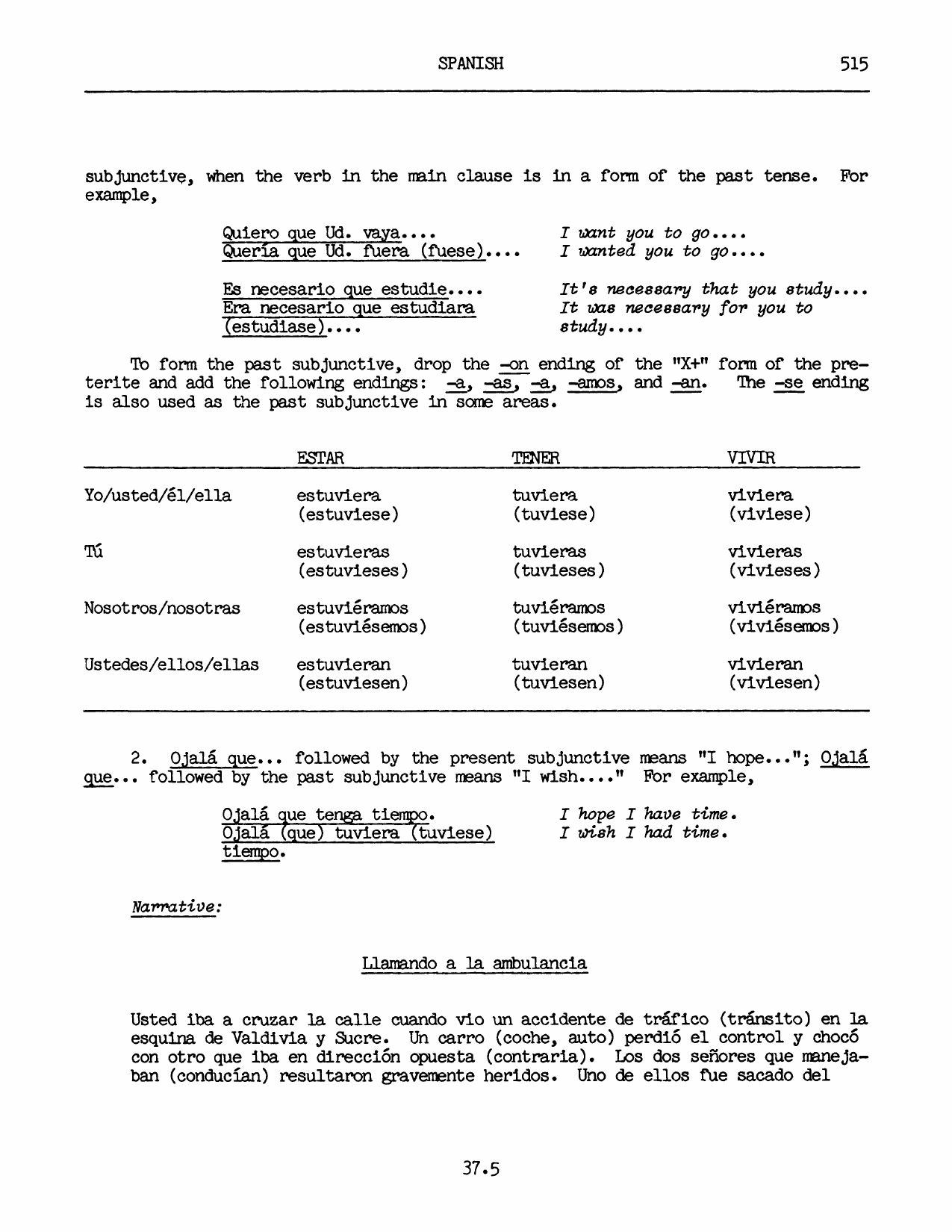
To form the past subjunctive, drop the -on ending of the "X+" form of the pre-
terite and add the following endings: -a, -as, -a, -amos, and -an. The -se ending is also used as the past subjunctive in some areas.
2. Ojalá que... followed by the present subjunctive means "I hope..."; Ojalá
que... followed by the past subjunctive means "I wish...." For example,
tiempo.
Narrative:
Llamando a la ambulancia
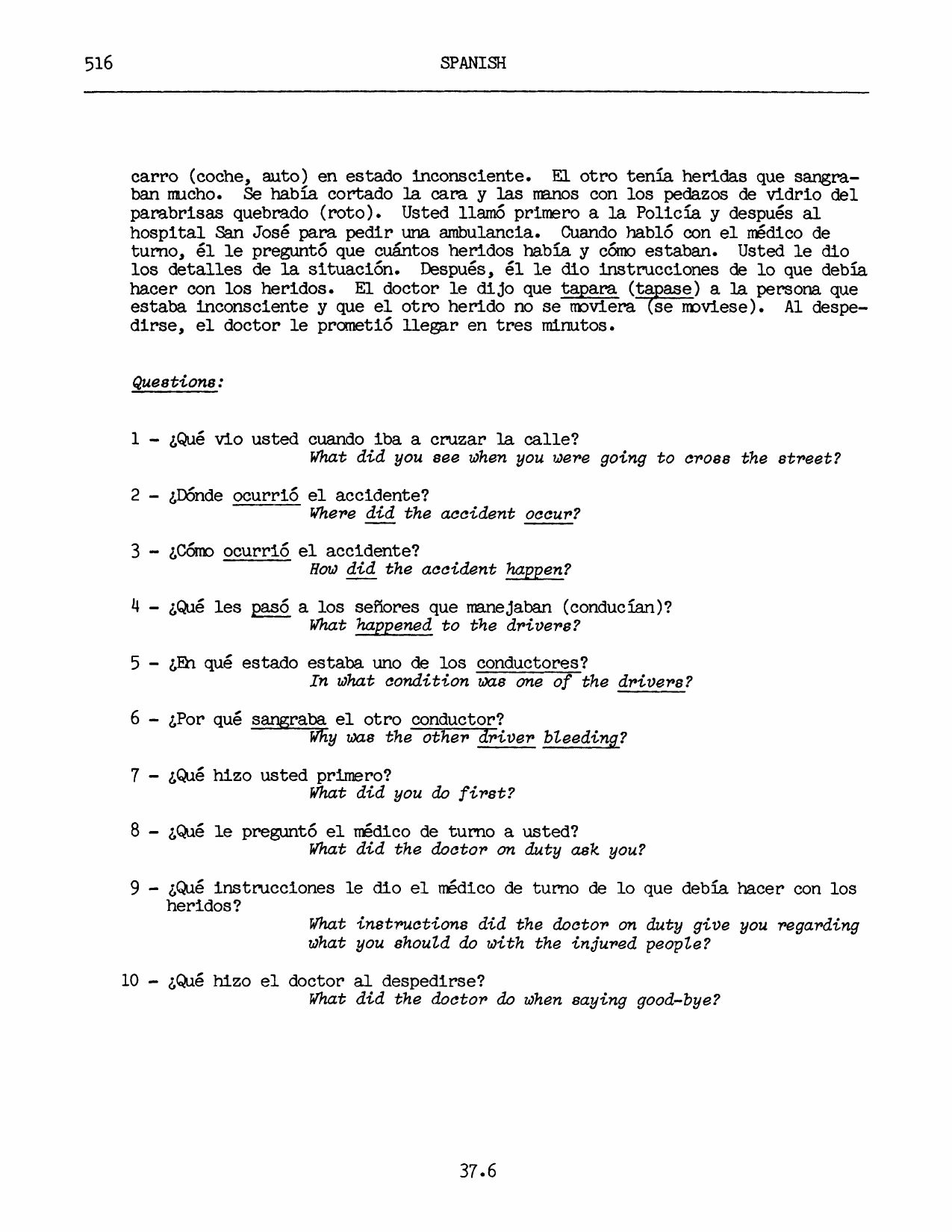
Usted iba a cruzar la calle cuando vio un accidente de tráfico (tránsito) en la esquina de Valdivia y Sucre. Un carro (coche, auto) perdió el control y chocó con otro que iba en dirección opuesta (contraria). Los dos señores que maneja-ban (conducían) resultaron gravemente heridos. Uno de ellos fue sacado del
carro (coche, auto) en estado inconsciente. El otro tenía heridas que sangra-ban micho. Se había cortado la cara y las manos con los pedazos de vidrio del parabrisas quebrado (roto). Usted llamó primero a la Policía y después al hospital San José para pedir una ambulancia. Cuando habló con el médico de turno, él le preguntó que cuántos heridos había y cómo estaban. Usted le dio los detalles de la situación. Después, él le dio instrucciones de lo que debía hacer con los heridos. El doctor le dijo que tapara (tapase) a la persona que estaba inconsciente y que el otro herido no se moviera (se moviese). Al despe-dirse, el doctor le prometió llegar en tres minutos.
Questions:
1 - ¿Qué vio usted cuando iba a cruzar la calle?
What did you see when you were going to cross the street?
2 - ¿Dónde ocurrió el accidente?
Where did the accident occur?
3 = ¿Cómo ocurrió el accidente?
How did the accident happen?
4 - ¿Qué les pasó a los señores que manejaban (conducían)?
What happened to the drivers?
5 - ¿En qué estado estaba uno de los conductores?
In what condition was one of the drivers?
Why was the other driver bleeding?
7 - ¿Qué hizo usted primero?
What did you do first?
8 - ¿Qué le preguntó el médico de turno a usted?
What did the doctor on duty ask you?
9 = ¿Qué instrucciones le dio el médico de turno de lo que debía hacer con los
heridos?
What instructions did the doctor on duty give you regarding what you should do with the injured people?
10 - ¿Qué hizo el doctor al despedirse?
What did the doctor do when saying good-bye?
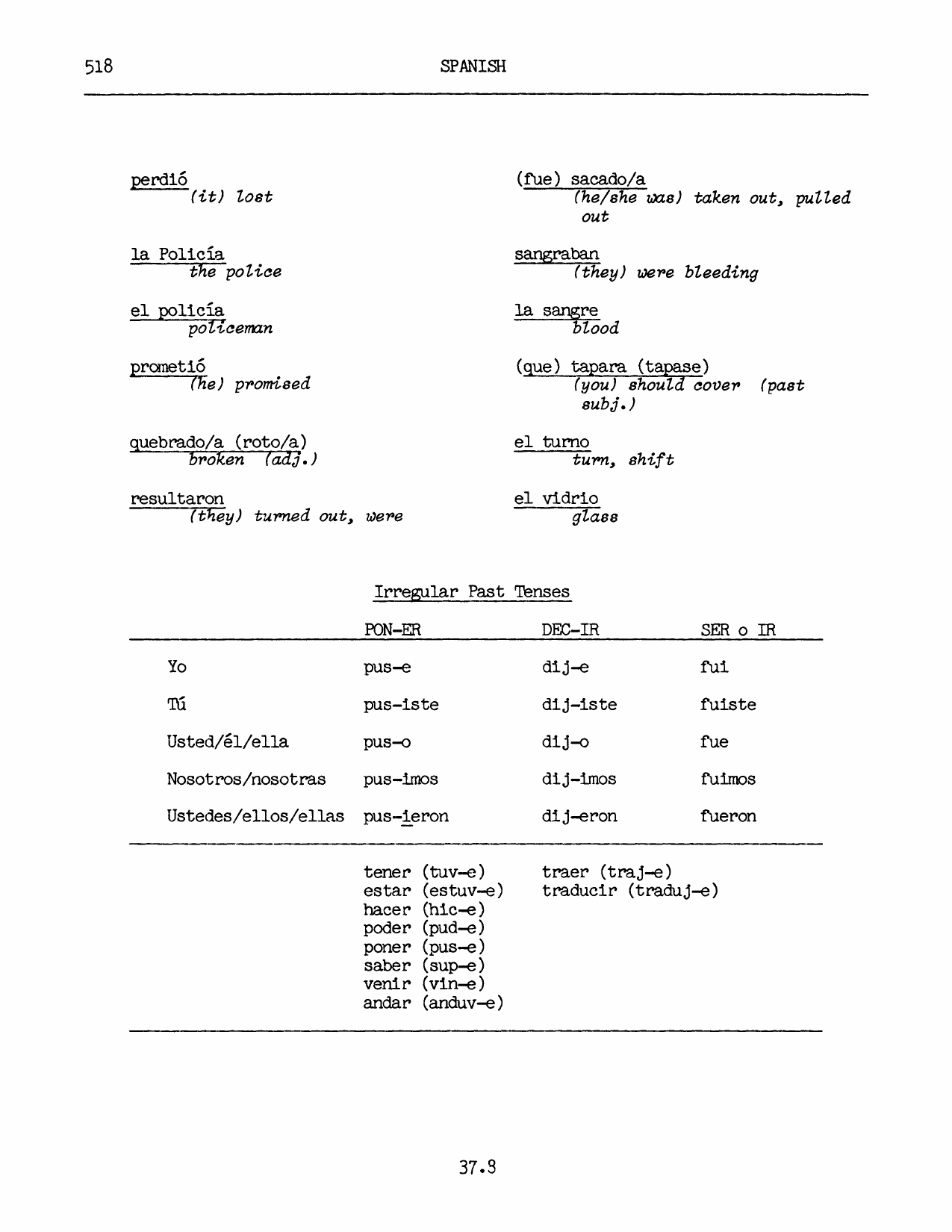
IV. TAKING IT APART
Vocabulary:
(past subj.)
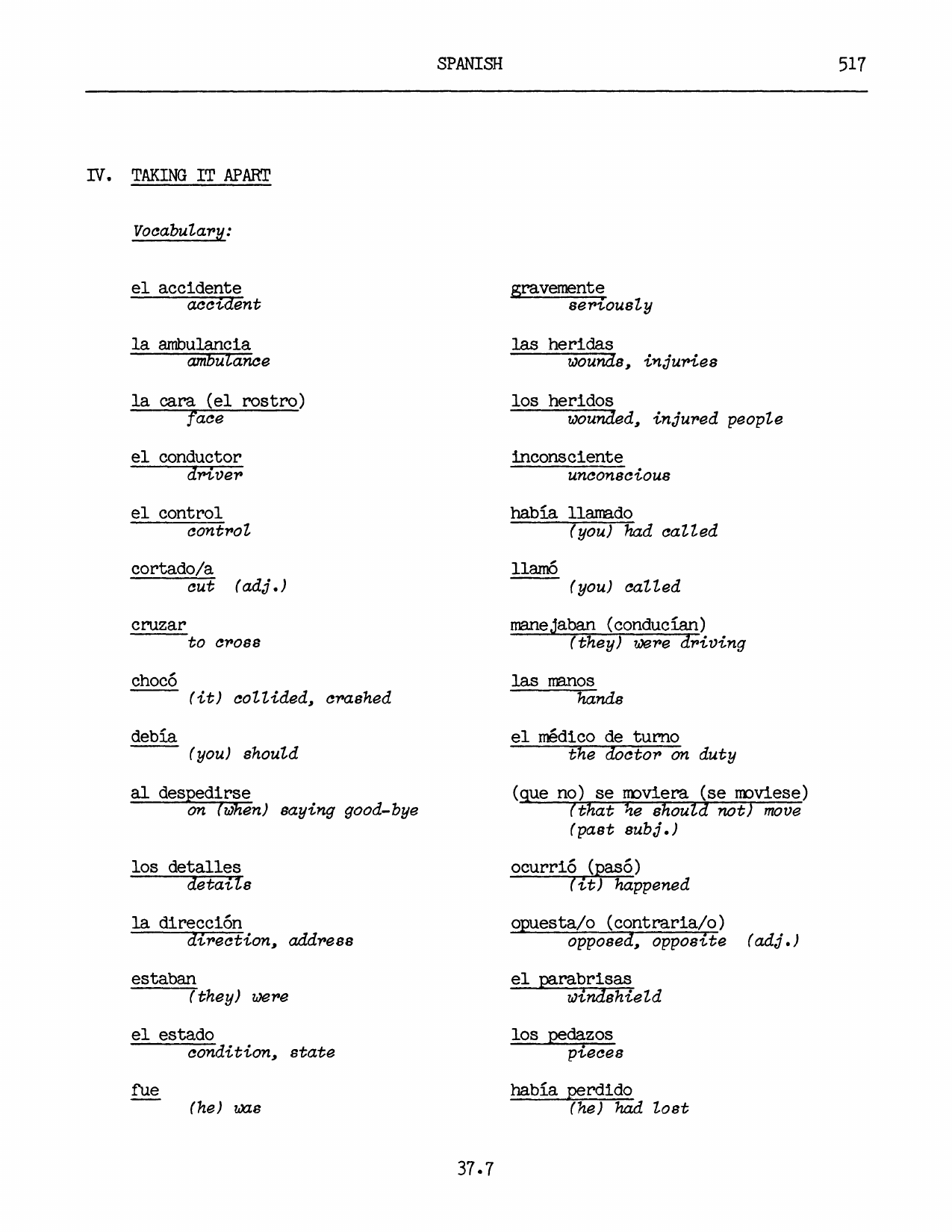
out
subj.)
Irregular Past Tenses
hacer (hic-e)
poder (pud-e)
poner (puse)
saber (sup-e)
venir (vine)
andar (anduv-e)
V. GETTING THE FEEL OF IT
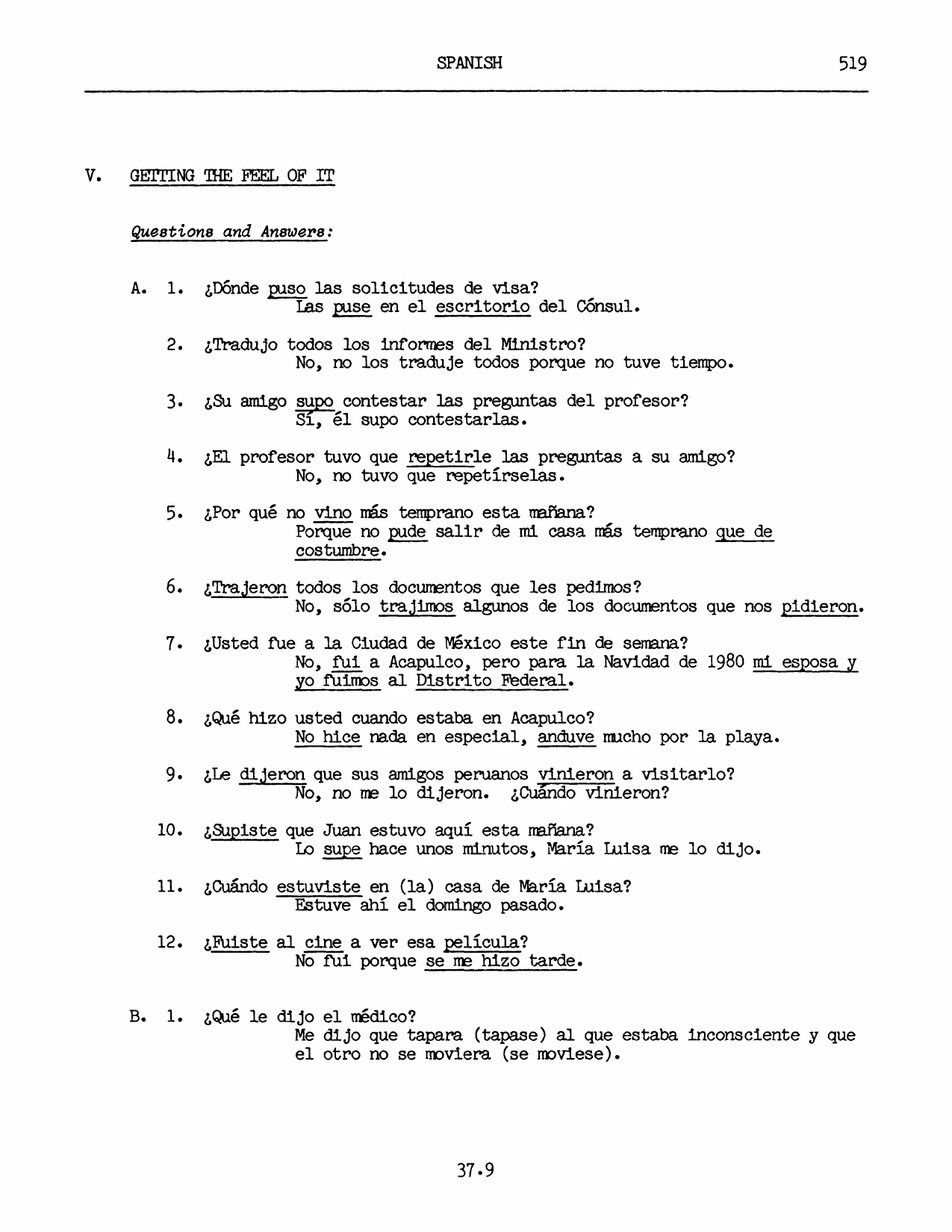
Questions and Answers:
A. 1. ¿Dónde puso las solicitudes de visa?
Las puse en el escritorio del Cónsul.
2. ¿Tradujo todos los informes del Ministro?
No, no los traduje todos porque no tuve tiempo.
3. ¿Su amigo supo contestar las preguntas del profesor?
Si, él supo contestarlas.
4. ¿El profesor tuvo que repetirle las preguntas a su amigo?
No, no tuvo que repetírselas.
5. ¿Por qué no vino más temprano esta mañana?
Porque no pude salir de mi casa más temprano que de costumbre.
6. ¿Trajeron todos los documentos que les pedimos?
No, sólo trajimos algunos de los documentos que nos pidieron.
7. ¿Usted fue a la Ciudad de México este fin de semana?
No, fui a Acapulco, pero para la Navidad de 1980 mi esposa y yo fuimos al Distrito Federal.
8. ¿Qué hizo usted cuando estaba en Acapulco?
No hice nada en especial, anduve mucho por la playa.
9. ¿Le dijeron que sus amigos peruanos vinieron a visitarlo?
No, no me lo dijeron. ¿Cuándo vinieron?
10. ¿Supiste que Juan estuvo aquí esta mañana?
Lo supe hace unos minutos, María Luisa me lo dijo.
11. ¿Cuándo estuviste en (la) casa de María Luisa?
Estuve ahí el domingo pasado.
12. ¿Fuiste al cine a ver esa película?
No fui porque se me hizo tarde.
B. 1. ¿Qué le dijo el médico?
Me dijo que tapara (tapase) al que estaba inconsciente y que el otro no se moviera (se moviese).
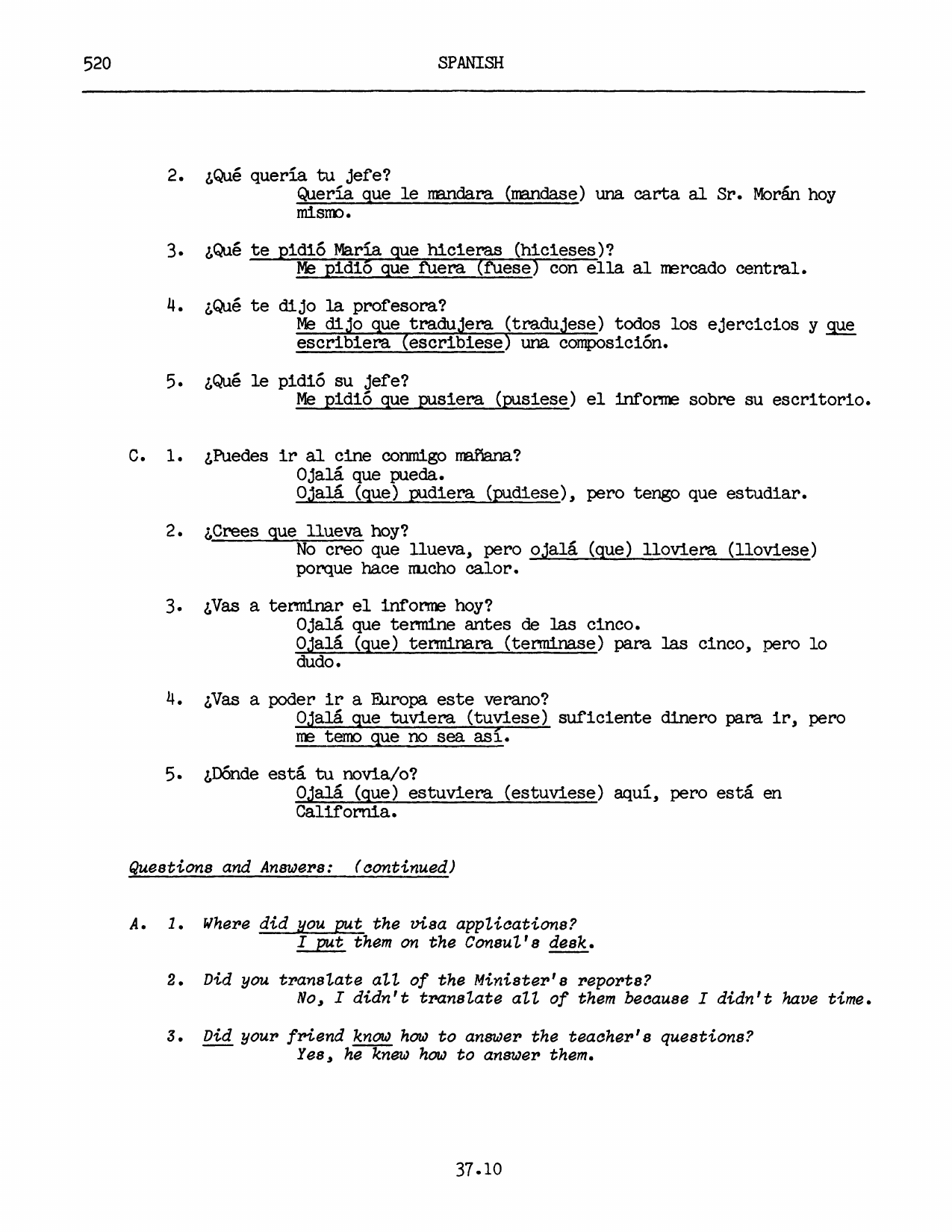
2. ¿Qué quería tu jefe?
Quería que le mandara (mandase) una carta al Sr. Morán hoy mismo.
3. ¿Qué te pidió María que hicieras (hicieses)?
Me pidió que fuera (fuese) con ella al mercado central.
4. ¿Qué te dijo la profesora?
Me dijo que tradujera (tradujese) todos los ejercicios y que escribiera (escribiese) una composición.
5. ¿Qué le pidió su jefe?
Me pidió que pusiera (pusiese) el informe sobre su escritorio.
C. 1. ¿Puedes ir al cine conmigo mañana?
Ojalá que pueda.
Ojalá (que) pudiera (pudiese), pero tengo que estudiar.
2. ¿Crees que llueva hoy?
No creo que llueva, pero ojalá (que) lloviera (lloviese) porque hace mucho calor.
3. ¿Vas a terminar el informe hoy?
Ojalá que termine antes de las cinco.
Ojalá (que) terminara (terminase) para las cinco, pero lo dudo.
4, ¿Vas a poder ir a Europa este verano?
Ojalá que tuviera (tuviese) suficiente dinero para ir, pero me temo que no sea así.
5. ¿Dónde está tu novia/o?
Ojalá (que) estuviera (estuviese) aquí, pero está en California.
Questions and Answers: (continued)
A. 1. Where did you put the visa applications?
I put them on the Consul's desk.
2. Did you translate all of the Minister's reports?
No, I didn't translate all of them because I didn't have time.
3. Did your friend know how to answer the teacher's questions?
Yes, he knew how to answer them.
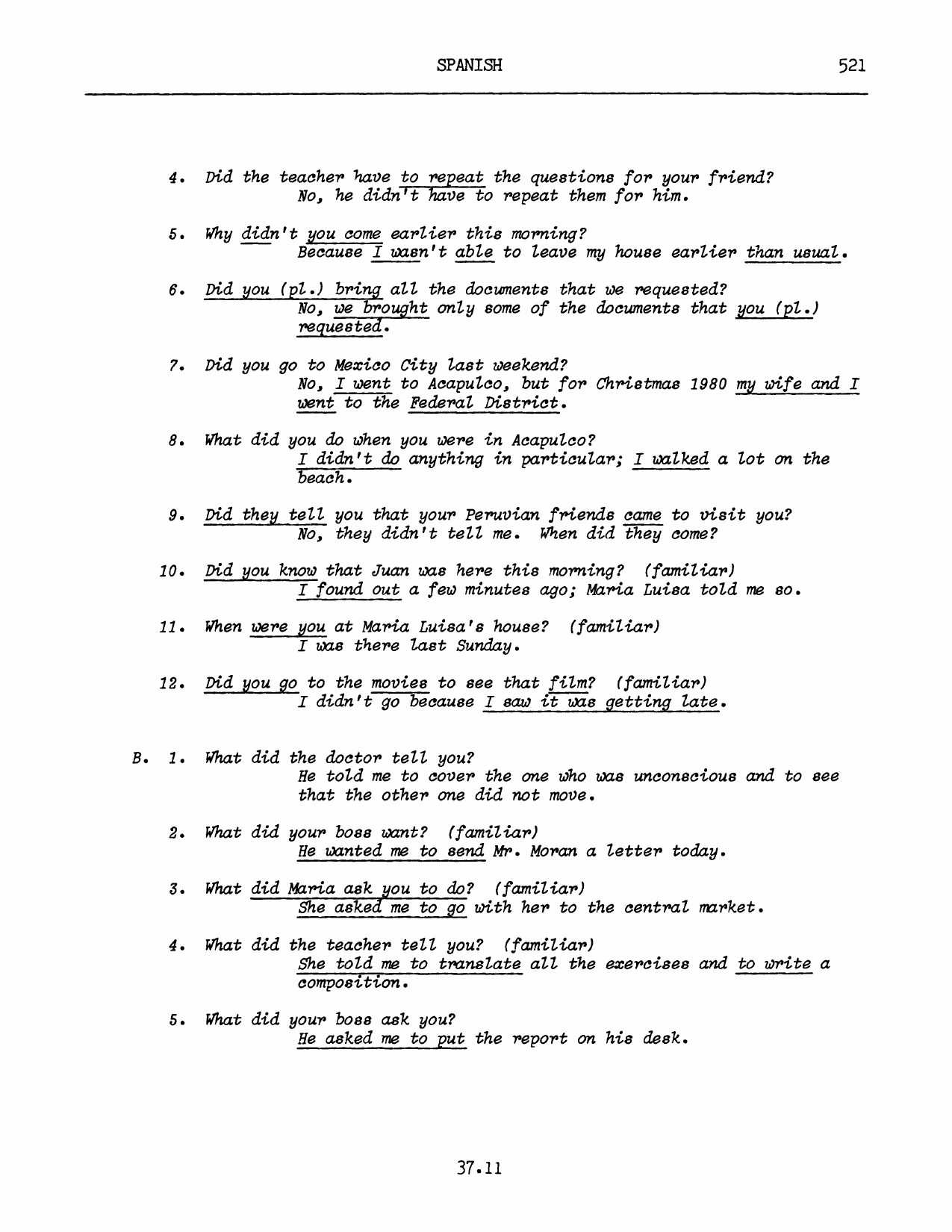
4. Did the teacher have to repeat the questions for your friend?
No, he didn't have to repeat them for him.
5. Why didn't you come earlier this morning?
Because I wasn't able to leave my house earlier than usual.
6. Did you (pl.) bring all the documents that we requested?
No, we brought only some of the documents that you (pl.) requested.
7. Did you go to Mexico City last weekend?
No, I went to Acapulco, but for Christmas 1980 my wife and I went to the Federal District.
8. What did you do when you were in Acapulco?
I didn't do anything in particular; I walked a lot on the each.
9. Did they tell you that your Peruvian friends came to visit you?
No, they didn't tell me. When did they come?
10. Did you know that Juan was here this morning? (familiar)
I found out a few minutes ago; Maria Luisa told me so.
11. When were you at Maria Luisa's house? (familiar)
I was there last Sunday.
12. Did you go to the movies to see that film? (familiar)
I didn't go because I saw it was getting late.
B. 1. What did the doctor tell you?
He told me to cover the one who was unconscious and to see that the other one did not move.
2. What did your bose want? (familiar)
He wanted me to send Mr. Moran a letter today.
3. What did Maria ask you to do? (familiar)
She asked me to go with her to the central market.
4. What did the teacher tell you? (familiar)
She told me to translate all the exercises and to write a composition.
5. What did your boss ask you?
He asked me to put the report on his desk.
C. 1. Can you go to the movies with me tomorrow? (familiar)
I hope I can.
I wish I could, but I have to study.
2. Do you think it will rain today? (familiar)
IT don't think it will rain, but I wish it would rain because it's very hot.
3. Are you going to finish the report today? (familiar)
I hope I finish before five o'clock.
I wish I could finish by five o'clock, but I doubt it.
4. Are you going to be able to go to Europe this summer? (familiar)
I wish I had enough money to go, but I'm afraid that it's not 80.
5. Where ts your girlfriend/boyfriend? (familiar)
I wish she/he were here, but she/he is in California.
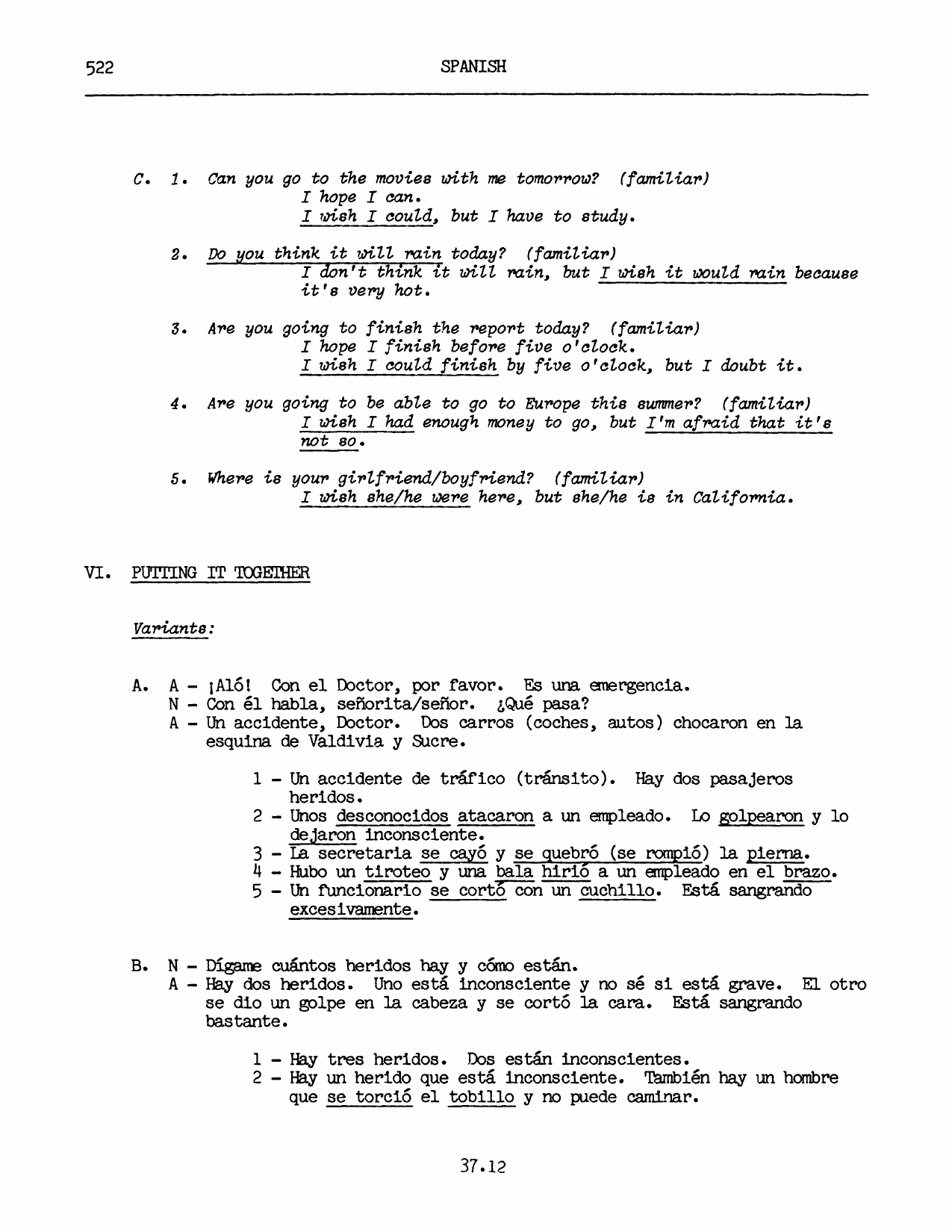
VI. PUTTING IT TOGETHER
Variants:
A. A — ¡A1ó! Con el Doctor, por favor. Es una emergencia.
N - Con él habla, señorita/señor. ¿Qué pasa?
A - Un accidente, Doctor. Dos carros (coches, autos) chocaron en la
esquina de Valdivia y Sucre.
1 - Un accidente de tráfico (tránsito). Hay dos pasajeros
heridos.
2 - Unos desconocidos atacaron a un empleado. Lo golpearon y lo
dejaron inconsciente.
3 - La secretaria se cayó y se quebró (se rompió) la pierna. 4 - Hubo un tiroteo y una bala hirió a un empleado en el brazo. 5 - Un funcionario se cortó con un cuchillo. Está sangrando
excesivamente.
B. N — Dígame cuántos heridos hay y cómo están.
A — Hay dos heridos. Uno está inconsciente y no sé si está grave. El otro
se dio un golpe en la cabeza y se cortó la cara. Está sangrando bastante.
1 - Hay tres heridos. Dos están inconscientes.
2 - Hay un herido que está inconsciente. También hay un hombre
que se torció el tobillo y no puede caminar.
3 - Hay una señora que sufrió un ataque de asma y no se siente
bien.
4 - Hay uno que se quemó con agua hirviendo.
5 - Hay dos. Uno se dio un golpe en la cabeza y está
inconsciente. El otro se cortó la cara y está sangrando.
Variante: (continued)
A. A - Hello! May I speak with the doctor, please? It's an emergency.
N - Speaking, miss/sir. What's the matter?
A - An accident, doctor. Two cars collided at the intersection of Valdivia
and Sucre.
1 - A traffic accident. There are two injured passengers. 2 - Some strangers assaulted an employee. They beat him and left
him unconscious.
3 - The secretary fell and broke her leg.
4 - There was a shooting and a bullet wounded an employee in the
arm.
5 - An officer cut himself with a knife. He is bleeding heavily.
B. N- Tell me how many injured there are and what condition they're in.
A - There are two injured people. One ts unconscious and I don't know how
seriously injured he is. The other hit his head and cut his face. He's bleeding quite a bit.
1 - There are three injured people. Two are unconscious. 2 - There is one injured person who is unconscious. There ts also
a man who twisted his ankle and is unable to walk.
3 - There is a lady who suffered an asthma attack and te not
feeling well.
4 - There te one who burned himself with boiling water. 5 - There are two. One hit his head and ls unconscious. The
other cut hts face and ts bleeding.
VII. MAKING IT WORK
VIII. USING IT