CYCLE 38
GETTING THINGS
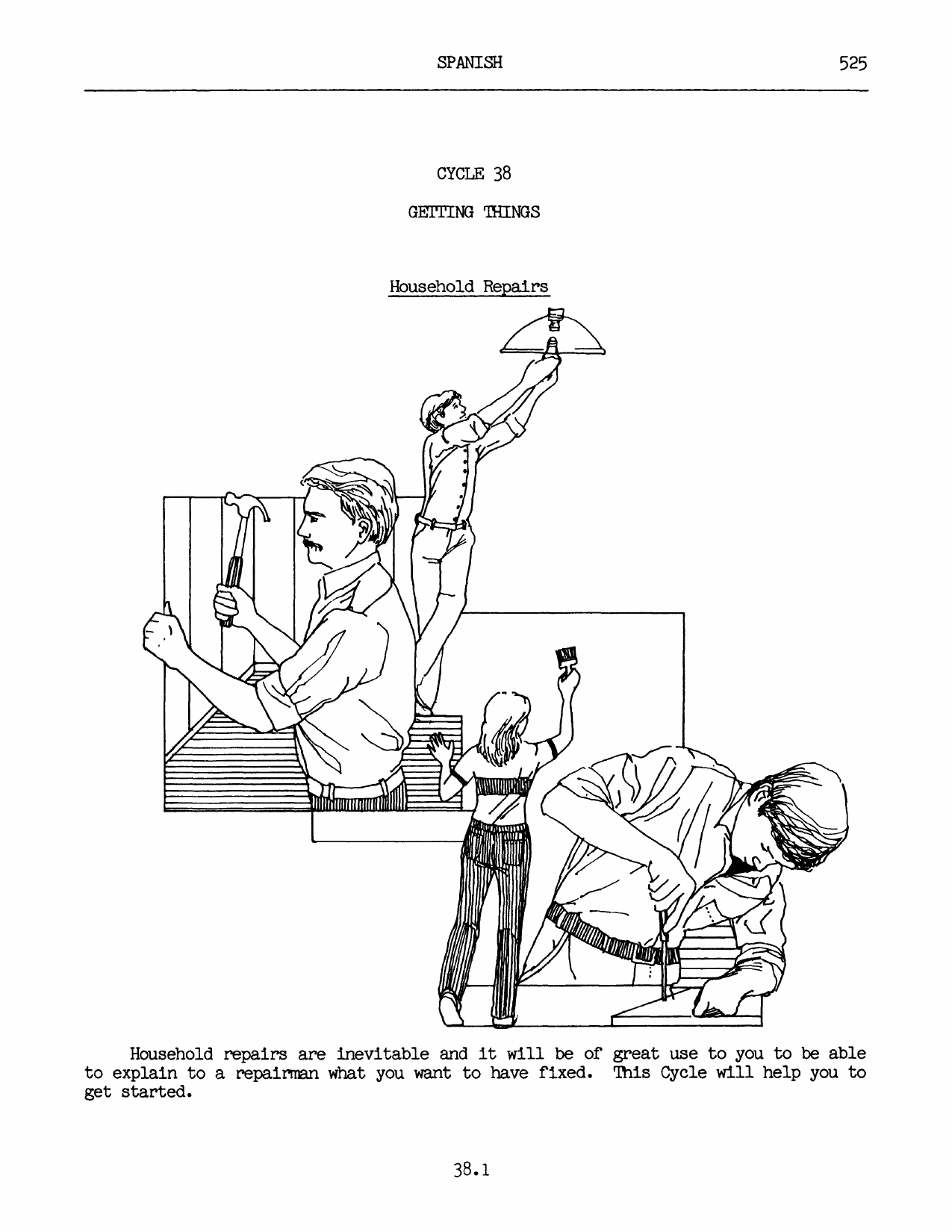
Household Repairs
Household repairs are inevitable and it will be of great use to you to be able
to explain to a repairman what you want to have fixed. This Cycle will help you to get started.
This page has a drawing, chart, or fill-in layout — original page
I. SETTING THE SCENE (A)
Yesterday you had to call an electrician so that he could fix an electrical problem at your house. You are now telling a friend what happened.
IT. HEARING IT (A)
III. SEEING IT (A)
Dialogue No. 1:
Reparaciones caseras (A)
N - ¿Por qué no fue usted a la reunión de ayer? Pasamos un rato muy agradable. A - Es que tuvimos una avería (falla) eléctrica en casa. A la hora que iba a
salir se fundieron los fusibles (plomos) y fue necesario que llamáramos (llamásemos) a un electricista.
N - ¿Un electricista? Eso es algo difícil de encontrar en estos días. A = Entonces tuvimos suerte porque no tardó mucho en llegar.
N - Y, ¿qué pasó exactamente? ¿Se produjo (hubo) un cortocircuito? A - Sí. Betty, mi esposa, estaba planchando y parece que el cordón de la
plancha estaba estropeado porque de pronto empezó a echar chispas.
N - ¿Se asustó su esposa?
A — Pues no, pero para evitar estos problemas ha decidido no planchar más mis
camisas. ¿Qué le parece?
N - Muy inteligente de su parte.
A — De paso, mi esposa le pidió al electricista que nos cambiara (cambiase)
unos enchufes que se habían estropeado y que ya no servían.
Dialogue No. 1: (continued)
Household repairs (A)
(1) N - Why didn't you come to the get-together yesterday? We had a very
enjoyable time.
(2)(3) A - The reason was that we had a problem with the electricity at home.
When I was about to leave, the fuses blew and we had to call an electrician.
N - An electrician? That's something that's not easy to get ahold of
these days.
A - Then we were in luck because it didn't take him long to get there. N - (And) what exactly happened? Was there a short circuit? A - Yes. My wife, Betty, was ironing and apparently the cord to the iron
was damaged, because all of a sudden it began to throw off sparks.
WN - Was your wife frightened?
A - Well, no, but in order to avoid problems like these, she has decided
not to tron my shirts anymore. What do you think of that?
N - Very clever on her part.
(4)(3) A - Since the electrician was already there, my wife also asked him to
change some plugs that had been damaged and no longer worked.
I. SETTING THE SCENE (B)
You had to call the plumber to come and unclog the bathtub. You are now telling your neighbor what happened.
II. HEARING IT (B)
III. SEEING IT (B)
Dialogue No. 2:
Reparaciones caseras (B)
A - Hola, Catalina. ¿Cómo te ha ido?
N - Bastante bien, gracias. Y a ti, ¿cómo te va? ¿Qué pasó ayer que no
viniste por aquí para que charláramos (charlásemos) un rato? Te echamos de menos, mi madre y yo.
A = ¡Ay! {No me lo recuerdes! Tuve un problema con el baño y pasé todo el día
pendiente del plomero (fontanero).
N — ¡No me digas! ¿Qué es lo que pasó?
A — La bañera (la tina o tina de baño) se tapó (se atascó) y no se podía usar. N - ¡Qué fastidio! ¿Ya la arreglaron (compusieron)?
A —- Sí. Le llevó (le tomó) bastante tiempo pero por fin la dejó bien. N - ¿Te cobró mucho?
A - Me cobró $500 (pesos). No sé si es mucho, aunque también arregló (compuso)
una llave (un grifo, una canilla) que goteaba.
N — Bueno, entonces no es caro. Es un precio razonable.
Dialogue No. 2: (continued)
Household repairs (B)
(5) A - Hi, Catalina. How have you been? (familiar)
(6) N - Pretty well, thanks. And how are things with you? What happened
yesterday that you didn't come by so that we could chat for a while? My mother and I missed you. (familiar)
(7) A - Oh! Don't remind me! I had a problem with the bathroom and I spent
all day keeping an eye on the plumber. (familiar)
(8) N - Really!? What happened? (familiar)
A - The bathtub got stopped up and it couldn't be used.
(9) N - What a nuisance! Have they fixed it yet?
(10) A - Yes. It took him quite a while, but he finally fixed it.
N - Did he charge you a lot? (familiar)
A - He charged me $500 (pesos). I don't know if that's a lot, although he
also fixed a leaky faucet.
(11) N - Well, that's not too much, then. That's a reasonable price.
Language Notes
l. pasar un rato
This expression, meaning "to spend some time," has the force of "to have
2. Es que
At the beginning of a sentence, es que often means "the reason is/was
that. ee tt
3. Notice the use of the past subjunctive in constructions such as fue nece-
sario que llamáramos (llamásemos) and le pidió que nos cambiara (cambiase) where the verb in the main clause is in a past tense. (See Language Note 1 of Cycle 37.)
4, de paso
Sometimes translated as "in passing" or "incidentally," this expression is
often used in sentences that convey the idea of something being done because someone happened to be in a given area.
5» ¿Cómo le/te va? and ¿Cómo le/te ha 1do?
translation of either one may be an expression such as:
How are you?
How have you been?
How are things with you?
How have things been going with you?
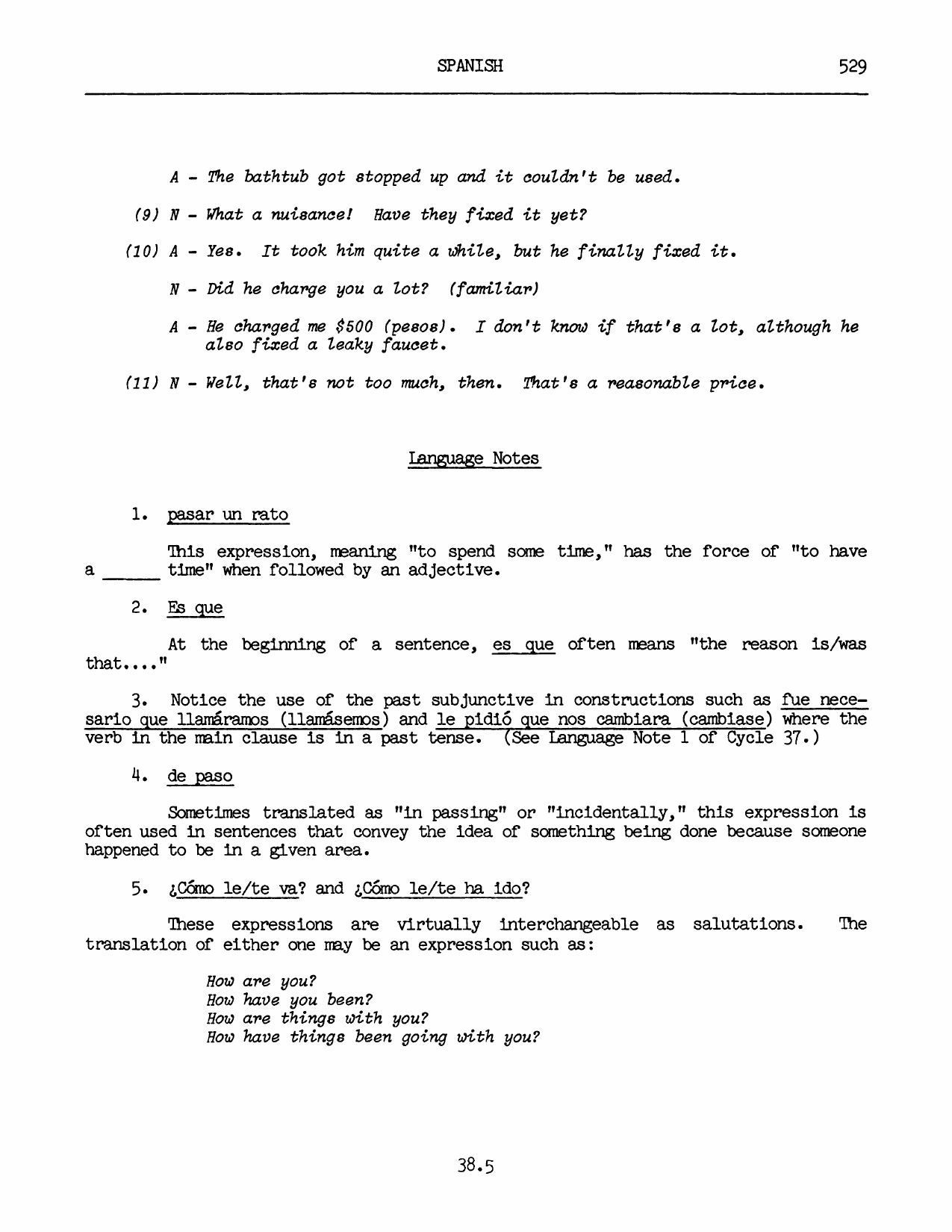
6. para que
The phrase para que followed by the subjunctive has the force of "in order
that" or "so that." Thus:
Yo se lo diré para que lo sepa. I'll tell him so that he'll
know (it).
This phrase may be used, as in the dialogue, to indicate that one is
"watching over someone" or "keeping an eye on someone."
8. ¡No me diga/s!
Literally "Don't tell me!," this expression is used to express surprise;
hence the translation, "Really!?"
9. ya
The word ya used in an affirmative question followed by a past tense form
like arreglaron has the force of "Have/Has...yet?" Thus:
Notice that "not...yet," however, is expressed by no...todavia.
10. la dejó bien
Since está bien may be used to indicate that something is in working order
or usable, la/lo/las/los dejó bien may be used to indicate that someone left some-thing in working order or in good condition.
11. Notice that Spanish does not use the word eso here, even though the English
translation contains tne word "that."
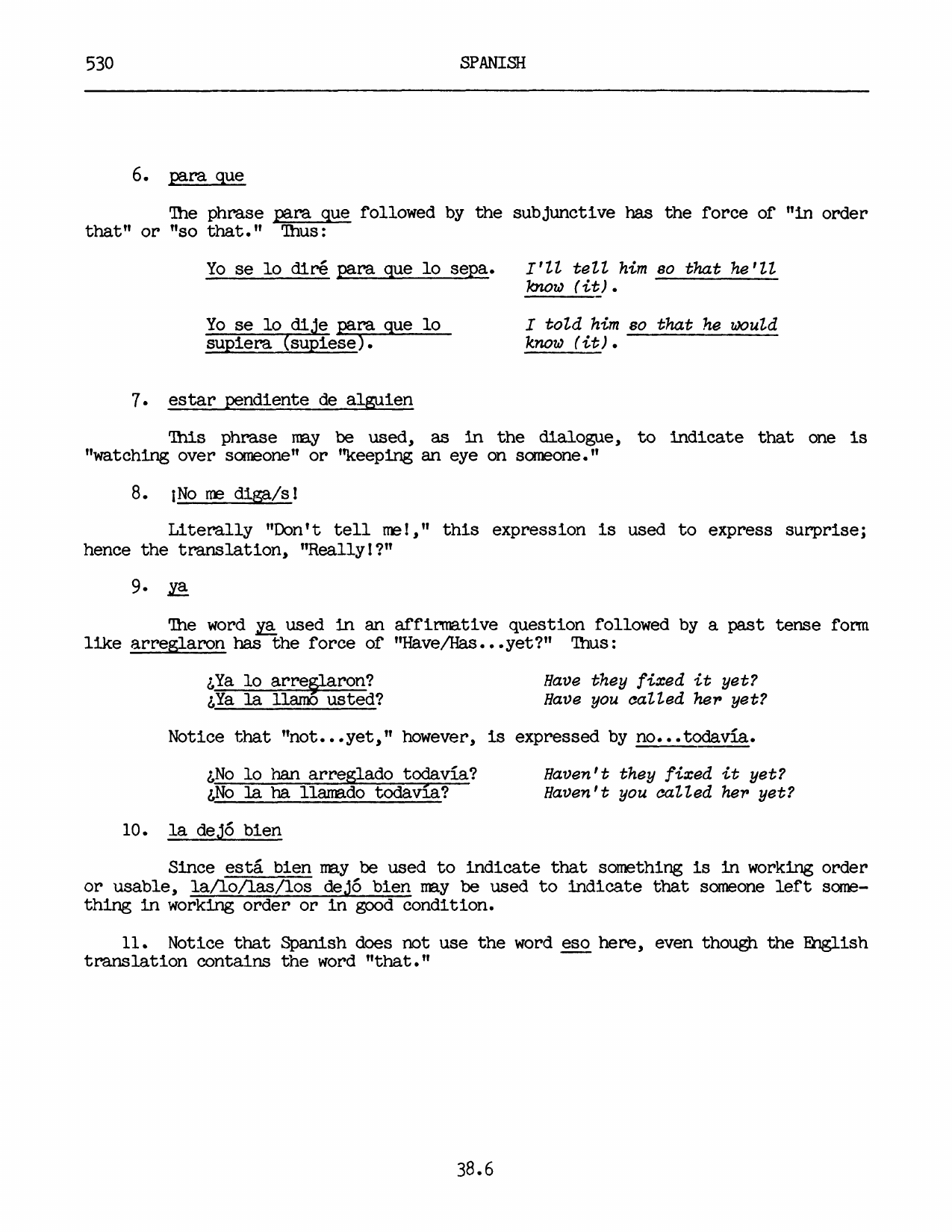
Narrative No. 1:
Reparaciones caseras (A)
Ayer usted no pudo asistir a una reunión a causa de una avería (falla) eléctrica en su casa. A la hora que iba a salir se fundieron los fusibles (plomos) y fue necesario que llamaran (llamasen) a un electricista. Afortunadamente el electricista no tardó mucho en llegar. Parece ser que se produjo (hubo) un cortocircuito al estar planchando su esposa unas camisas. Aparentemente el cordón de la plancha estaba estropeado porque de pronto empezó a echar chispas. Su esposa no se asustó, pero para evitar esta clase de problemas en el futuro ella decidió no planchar más sus camisas. De paso, su esposa le pidió al electricista que cambiara (cambiase) unos enchufes que se habían estropeado y que ya no servían.
Questions:
1 = ¿Por qué no pudo asistir usted a una reunión ayer?
Why couldn't you attend a get-together yesterday?
2 = ¿Qué pasó cuando usted estaba para salir?
What happened when you were about to leave?
3 - ¿Qué fue necesario que ustedes hicieran (hiciesen)?
What did you (pl.) have to do?
4 - Afortunadamente, ¿qué pasó?
Fortunately, what happened?
5 - ¿Qué hacía su esposa cuando se produjo el cortocircuito?
What was your wife doing when the short circuit occurred?
6 - ¿Aparentemente cuál fue la causa de que se produjera (se produjese) el
cortocircuito?
What was the apparent cause of the short circuit?
7 - ¿Qué decidió su esposa y por qué?
What did your wife decide and why?
8 - De paso, ¿qué le pidió su esposa al electricista que hiciera (hiclese)?
Since he was already there, what did your wife ask the electrician to do?
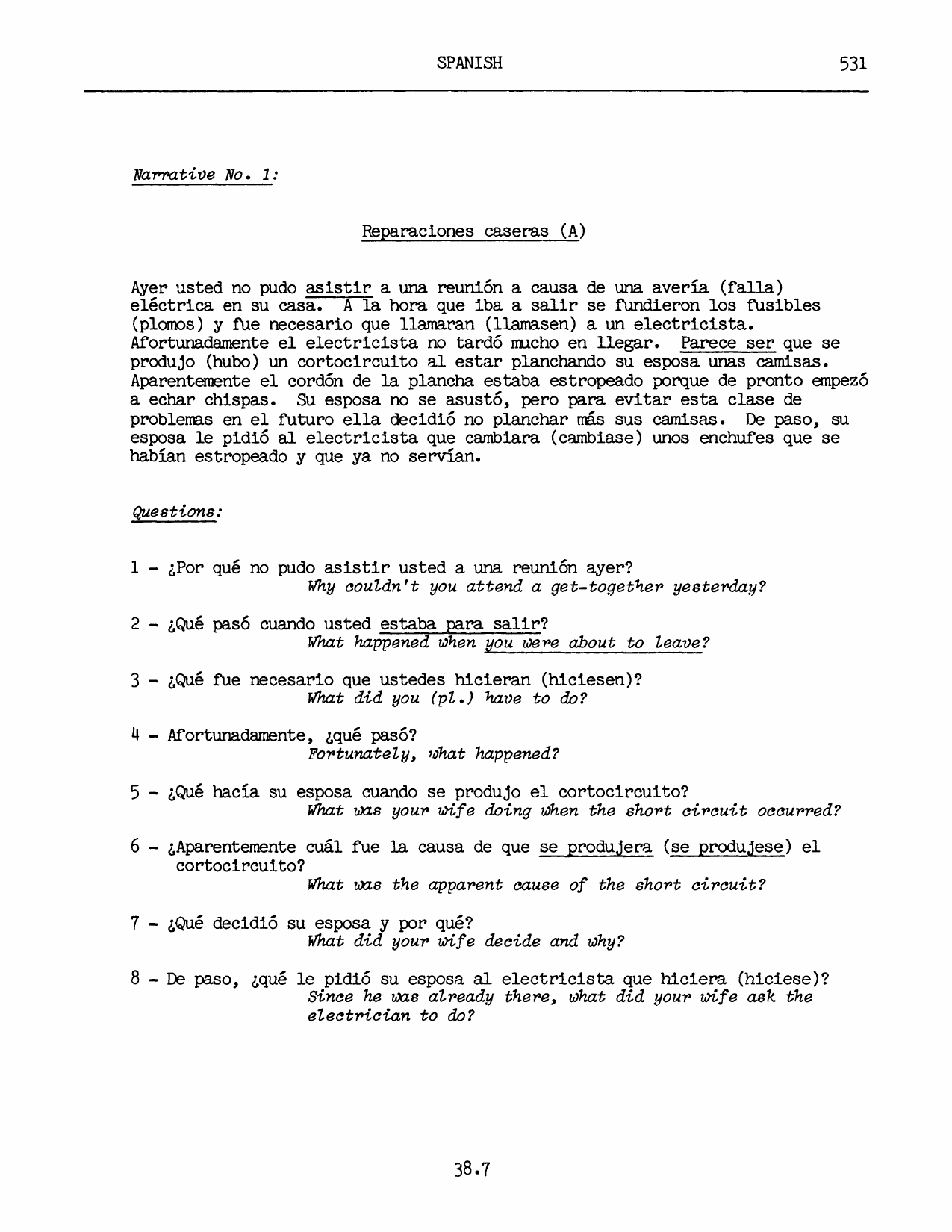
Narrative No. 2:
Reparaciones caseras (B)
Usted se encontró a su vecina al salir de su apartamento y ella le preguntó que qué le había pasado ayer porque no había ido a visitarla para charlar un rato. Ella agregó que tanto ella como su madre la habían echado de menos. Usted le contó que había tenido un problema con el baño y que había pasado todo el día pendiente del plomero (fontanero). Usted le explicó a su vecina que la bañera (la tina o la tina de baño) se había tapado (atascado) y que no se podía usar y que a pesar de que al plomero (fontanero) le había llevado bastante tiempo arreglarla (componerla), al fin la había dejado bien. Su vecina le preguntó si el plomero (fontanero) le había cobrado mucho y usted le respondió que no sabía si $500 pesos era mucho, aunque también había arreglado (compuesto) una llave (un grifo, una canilla) que goteaba. Su vecina le aseguró que entonces no era caro, que era un precio razonable.
Questions:
1 = ¿A quién se encontró usted al salir de su apartamento?
Whom did you meet as you were leaving your apartment?
2 - ¿Qué le preguntó su vecina?
What did your neighbor ask you?
3 - ¿Qué más dijo ella?
What else did she say?
4 — ¿Qué le contó usted a ella?
What did you tell her?
5 - ¿Qué le explicó usted a ella con respecto a la bañera (la tina o la tina de
6- Al fin, ¿cómo dejó el plomero (el fontanero) la bañera (la tina o la tina
7 - ¿Qué le preguntó su vecina?
What did your neighbor ask you?
8 — ¿Qué le respondió usted a ella?
What did you answer her?
9 - ¿Qué le aseguró ella?
What did she assure you?
IV. ‘TAKING IT APART
Vocabulary:
Dialogue No. 1
that
there were
(we) spent some time
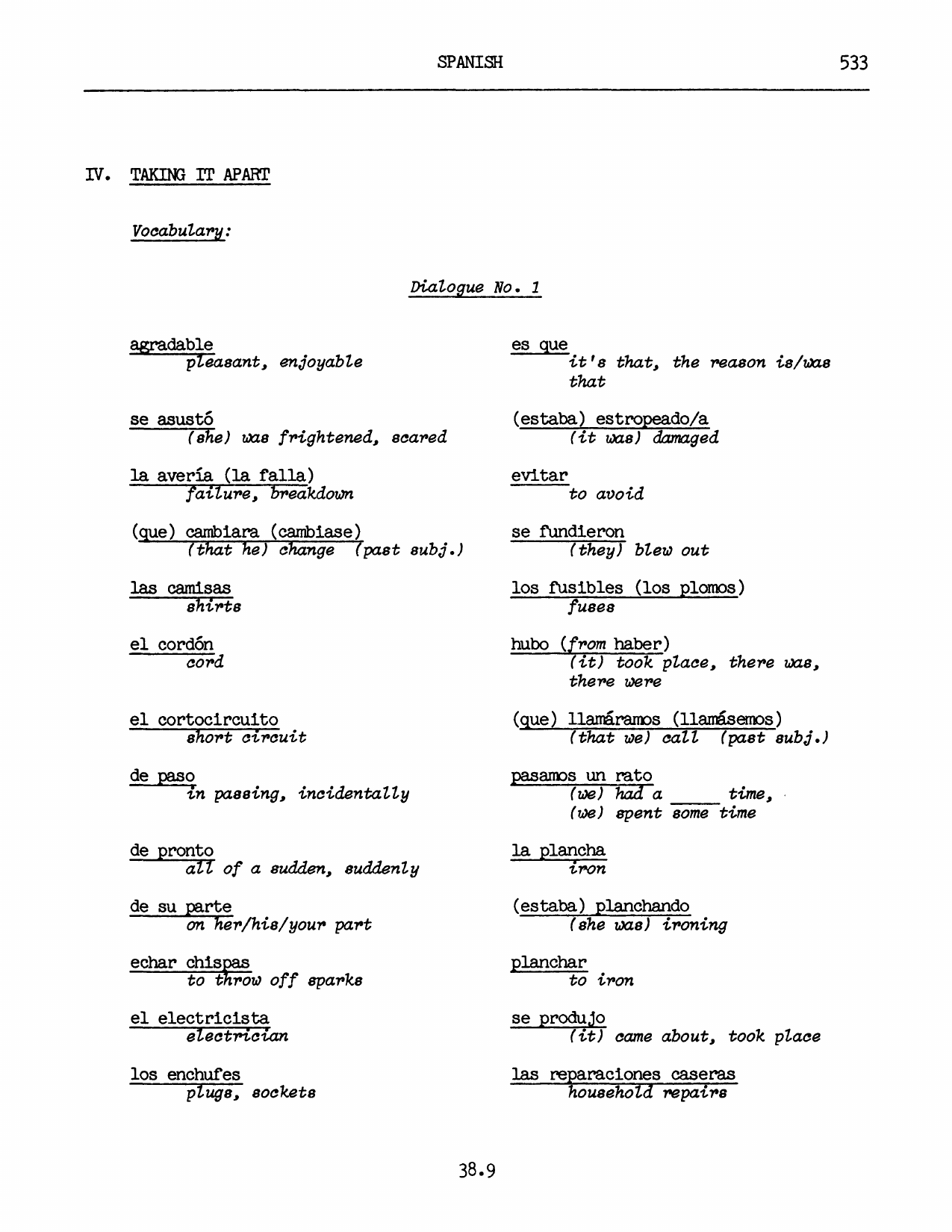
functioned
no tardó mucho
(he) didn't take long, didn't
delay
Narrative No. 1
subj.)
occur (past subj.)
Dialogue No. 2
(past subj.)
something)
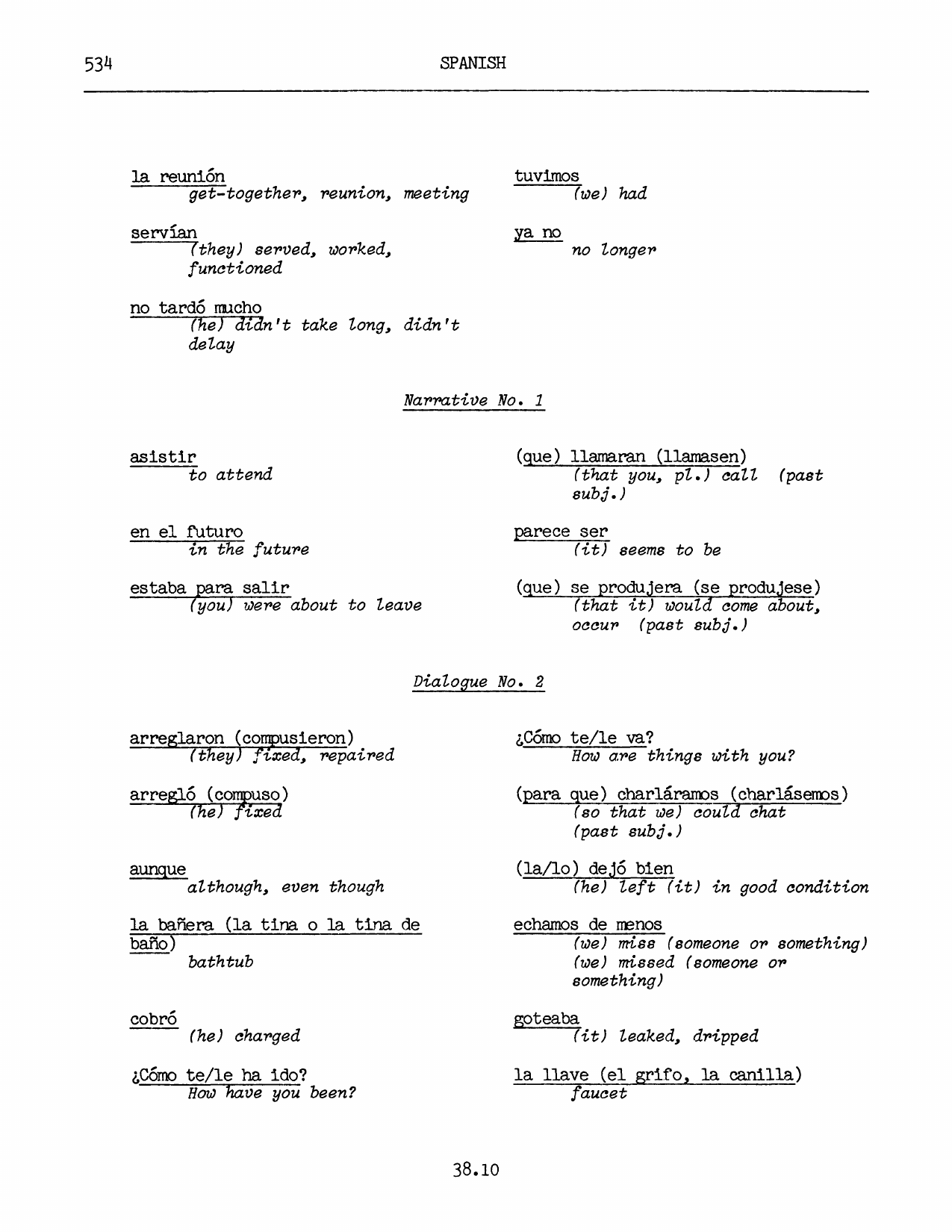
on, Looking out for
r fin
finally
Narrative No. 2
something)
v. GETTING THE FEEL OF IT
Questions and Answers:
A. 1. ¿Por qué no vino usted ayer?
No vine porque me fue imposible venir. Tuvimos un contra-tiempo en casa.
(Tú, ustedes, ellos, él, usted y María)
B. 1. ¿Se asustó su esposa/o?
No, no se asustó mucho.
(Usted, ellos, tú, ustedes, ella)
C. 1. ¿Arregló (compuso) usted mismo/a el enchufe?
No, no lo arreglé (compuse) yo mismo/a. Le pedí al electri-cista que lo arreglara/arreglase (compusiera/compusiese).
(Ustedes, tú, él, ellos, ella)
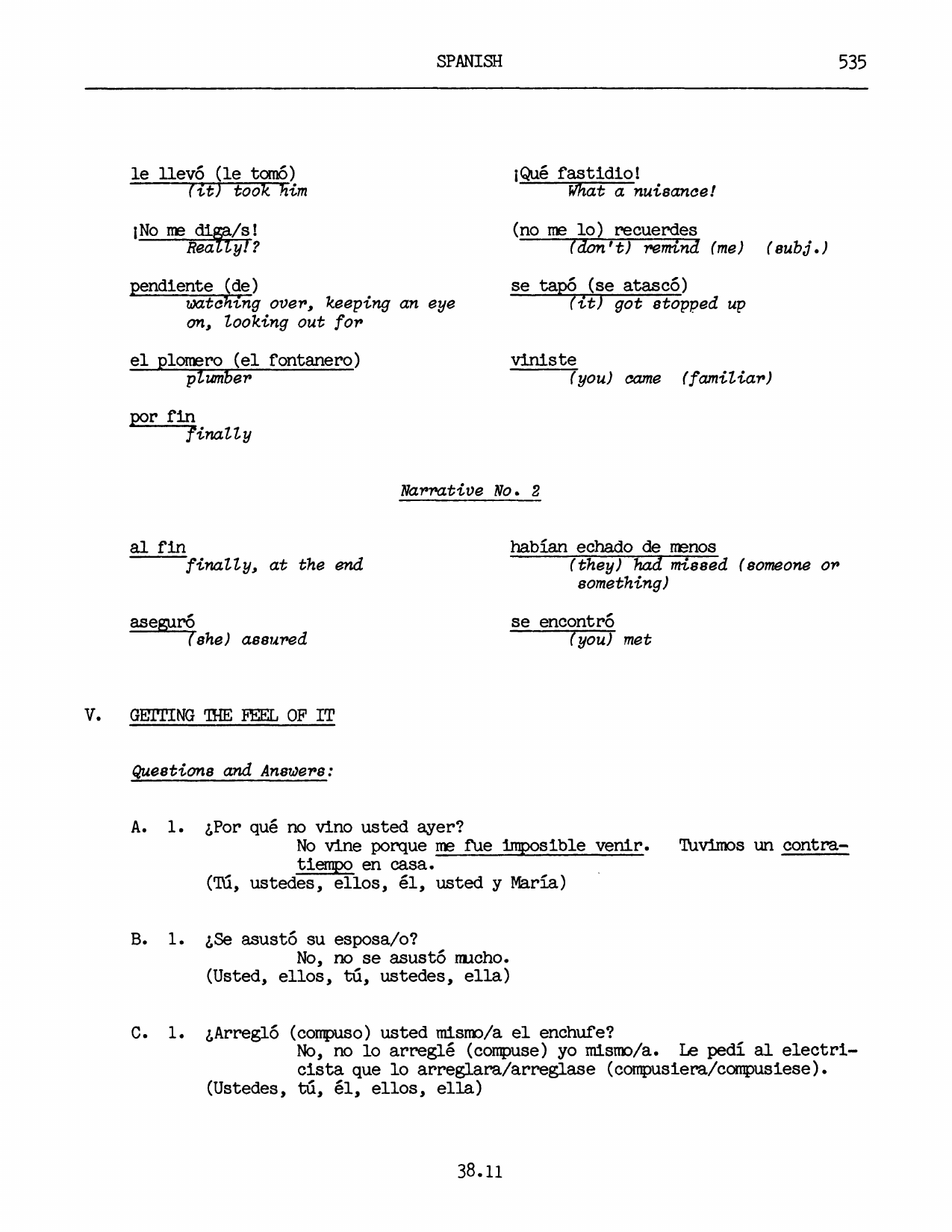
D. 1. ¿Qué otra cosa quería usted que hiciera (hiciese) el electricista?
a. Quería que cambiara (cambiase) un enchufe.
b. Quería que compusiera (compusiese) un interruptor. C. Quería que instalara (instalase) la lavadora y la secadora. d. Quería que revisara (revisase) la instalación eléctrica. €. Quería que reparara (reparase) la calefacción.
E. 1. ¿Para qué llamó usted al plomero (fontanero)?
a. Para que viniera (viniese) a destapar (desatascar) el
lavabo.
b. Para que arreglara (arreglase) el inodoro (excusado,
escusado).
c. Para que instalara (instalase) una cocina (Méx. estufa)
de gas.
d. Para que destapara (destapase) el fregadero. e. Para que compusiera (compusiese) la ducha (Méx. regadera).
F. 1. ¿Qué fue necesario que usted hiciera (hiciese)?
a. Fue necesario que llamara (llamase) a un electricista. b. Fue necesario que me quedara (quedase) en casa hasta que
terminara (terminase) el plomero de arreglar (componer) el lavabo.
c. Fue necesario que esperara (esperase) un buen rato hasta
que el mecánico arreglara (arreglase) mi carro (coche, auto).
d. Fue necesario que comprara (comprase) un refrigerador (una
refrigeradora, una nevera) nuevo/a.
e. Fue necesario que llevara (llevase) mi carro (coche, auto)
al taller para que lo arreglaran (arreglasen).
Questions and Answers: (continued)
A. 1. Why didn't you come yesterday?
I didn't come because it was impossible for me to come. We had a mishap at home.
(You (familiar), you (pl.), they, he, you and Maria)
B. 1. Was your wife/husband frightened?
No, she/he wasn't frightened very much.
(You, they, you (familiar), you (pl.), she)
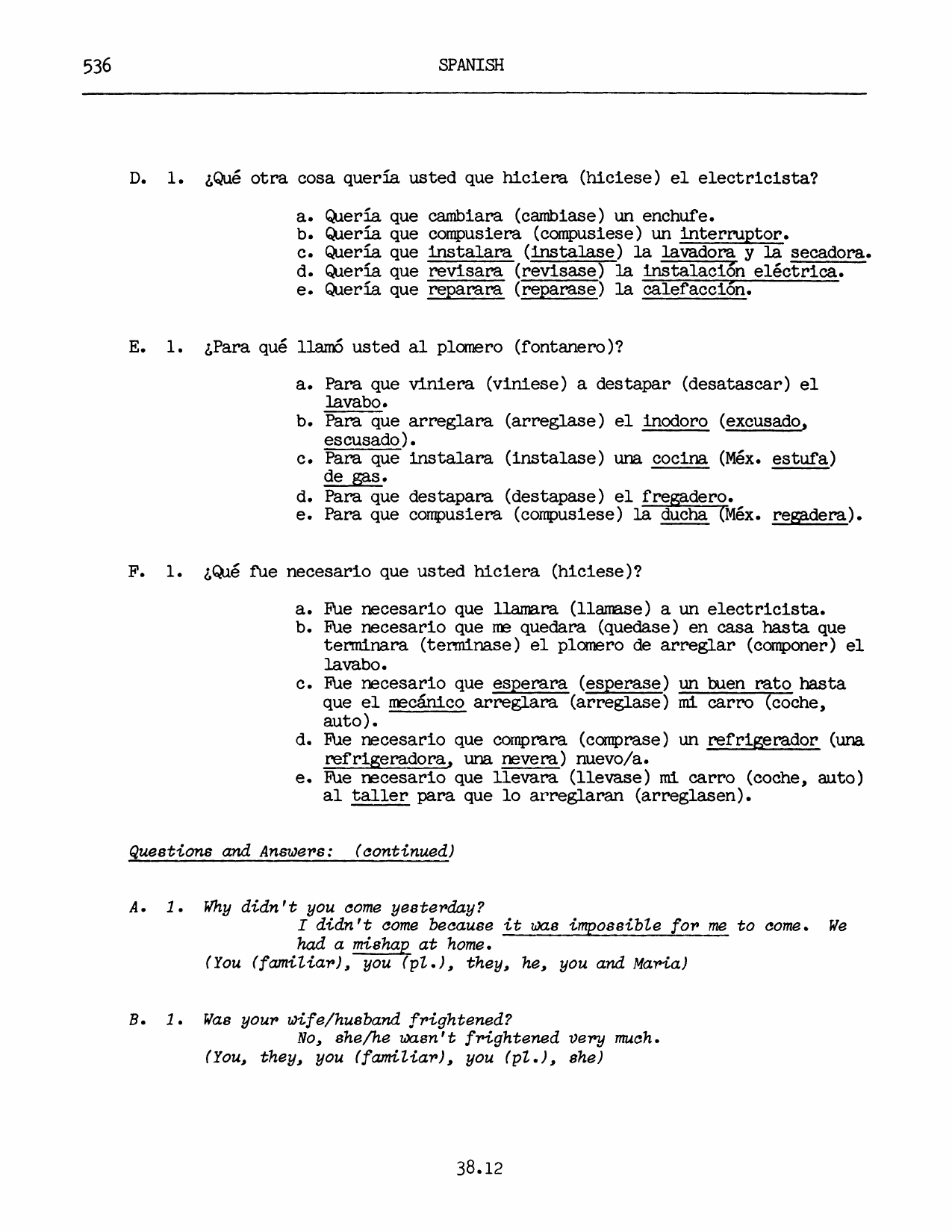
C. 1. Did you fix the plug yourself?
No, I didn't fix it myself. I asked the electrician to fix it.
(You (pl.), you (familiar), he, they, she)
D. 1. What else did you want the electrician to do?
a. I wanted him to change a plug.
b. I wanted him to fix a switch.
c. I wanted him to install the washer and dryer. d. I wanted him to check the electrical wiring. e. I wanted him to repair the heating system.
E. 1. Why did you call the plumber?
a. So that he would come to unstop the bathroom sink. b. So that he would fix the toilet.
c. So that he would install a gas stove.
d. So that he would unstop the kitchen sink.
e. So that he would fix the shover.
F. 1. What did you have to do?
a. I had to call an electrician.
b. I had to stay home until the plumber had finished fixing
the sink.
e. I had to wait quite a while until the mechanic fixed my
d. I had to buy a new refrigerator.
e. I had to take my car to the shop so that they could fix it.
VI. PUTTING_IT TOGETHER
Variante:
Dialogue No. 1
A. N- ¿Por qué no fue usted a la reunión de ayer? Pasamos un rato my
agradable.
A - Es que tuvimos una avería (falla) eléctrica en casa. A la hora que iba
a salir se fundieron los fusibles (plomos) y fue necesario que llamáramos (llamásemos) a un electricista.
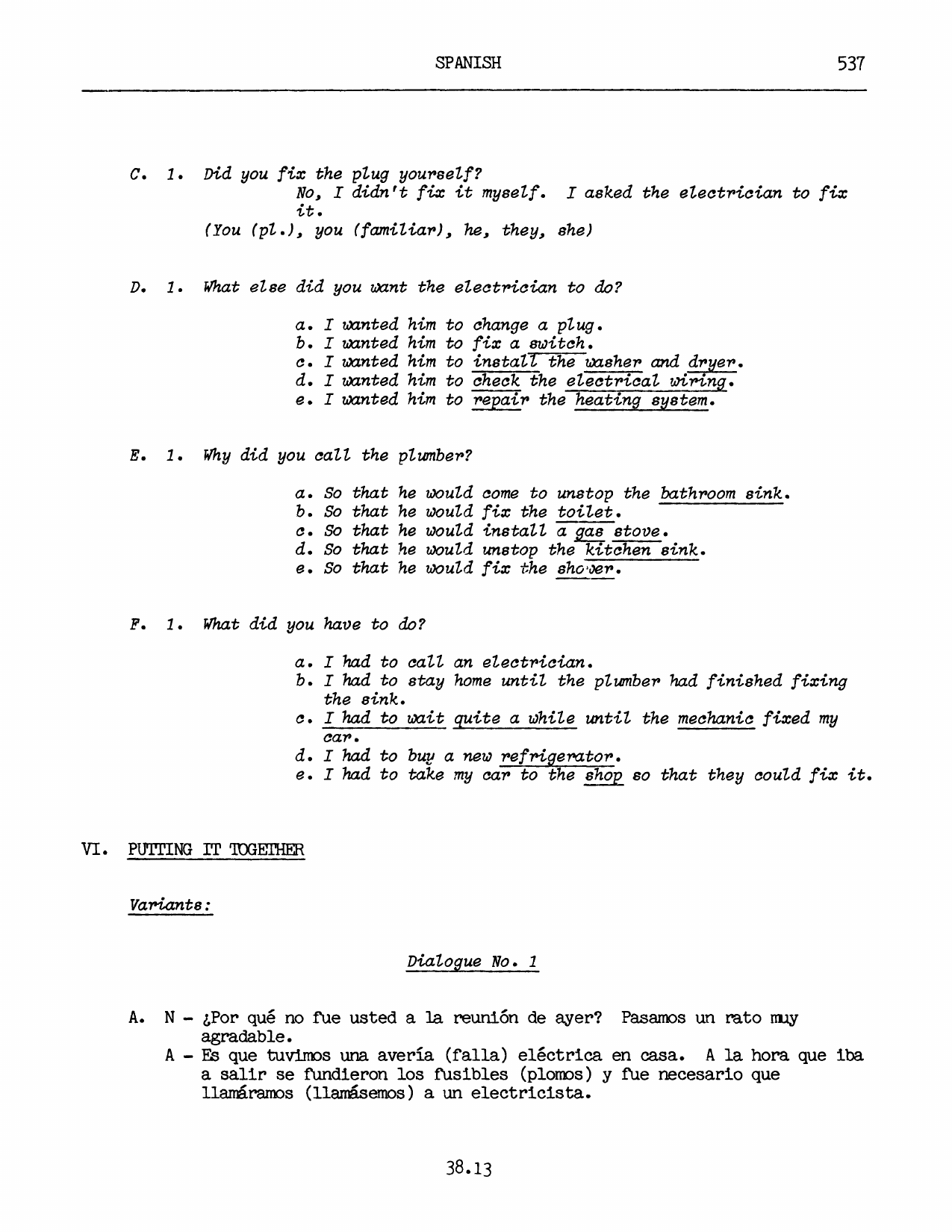
1 - Porque no pude. Cuando iba a salir se fue la luz. 2 - Siento mucho habérmela perdido pero es que tuvimos un contra-
tiempo en casa.
3 - No me fue posible ir porque a esa hora vino el electricista
para hacer unas reparaciones.
4 — Sentí mucho no haber podido ir pero tenía muchas cosas que
hacer y se me hizo tarde.
5 - Tenía tantas cosas que hacer que me fue imposible ir.
B. N- Y, ¿qué pasó exactamente? ¿Se produjo (hubo) un cortocircuito?
A - Sí. Betty, mi esposa, estaba planchando y parece que el cordón de la
plancha estaba estropeado porque de pronto empezó a echar chispas.
1 - Sí. Yo me estaba afeitando (rasurando) y parece que mi
máquina de afeitar (rasurar) estaba estropeada porque de pronto se fue la luz.
2 — No precisamente. Subió mucho el voltaje y se fundieron los
fusibles (plomos).
3 - No. Lo que pasó fue que hubo un apagón en muestro vecindario
(barrio) y no tuvimos electricidad por más de una hora.
4 - Sí. Parece que uno de los interruptores tenía un corto porque
al encender la luz de la sala se apagaron todas las luces de la casa.
5 - Sí. Parece que uno de nuestros aparatos eléctricos tenía un
desperfecto que lo produjo.
Dialogue No. 2
C. N- ¿Qué pasó ayer que no viniste por aquí para que charláramos (charla-
semos) un rato? Te echamos de menos, mi madre y yo.
A —- ¡Ay! ¡No me lo recuerdes! Tuve un problema con el baño y pasé todo el
día pendiente del plomero (fontanero).
1 —- ¡Ay! ¡No me lo recuerdes! Se me quedaron las llaves
adentro de la casa y tuve que llamar al cerrajero para que me abriera (abriese) la puerta.
2 - jAy! ¡No me lo recuerdes! Pasé todo el día esperando al
plomero para que destapara (destapase) un caño.
3 - ¡Ay! ¡No me lo recuerdes! Se me descompuso la lavadora
y pasé todo el día esperando al mecánico para que viniera (viniese) a componerla.
4 — ¡Ay! ¡No me lo recuerdes! Tuvimos una fuga de gas y
tuve que llamar a la compañía de gas para que vinieran (viniesen) a arreglar el desperfecto.
5 - ¡Ay! ¡No me lo recuerdes! Se me descompuso el auto
(coche, carro) y tuve que llevarlo al taller para que lo repararan (reparasen) lo antes posible.
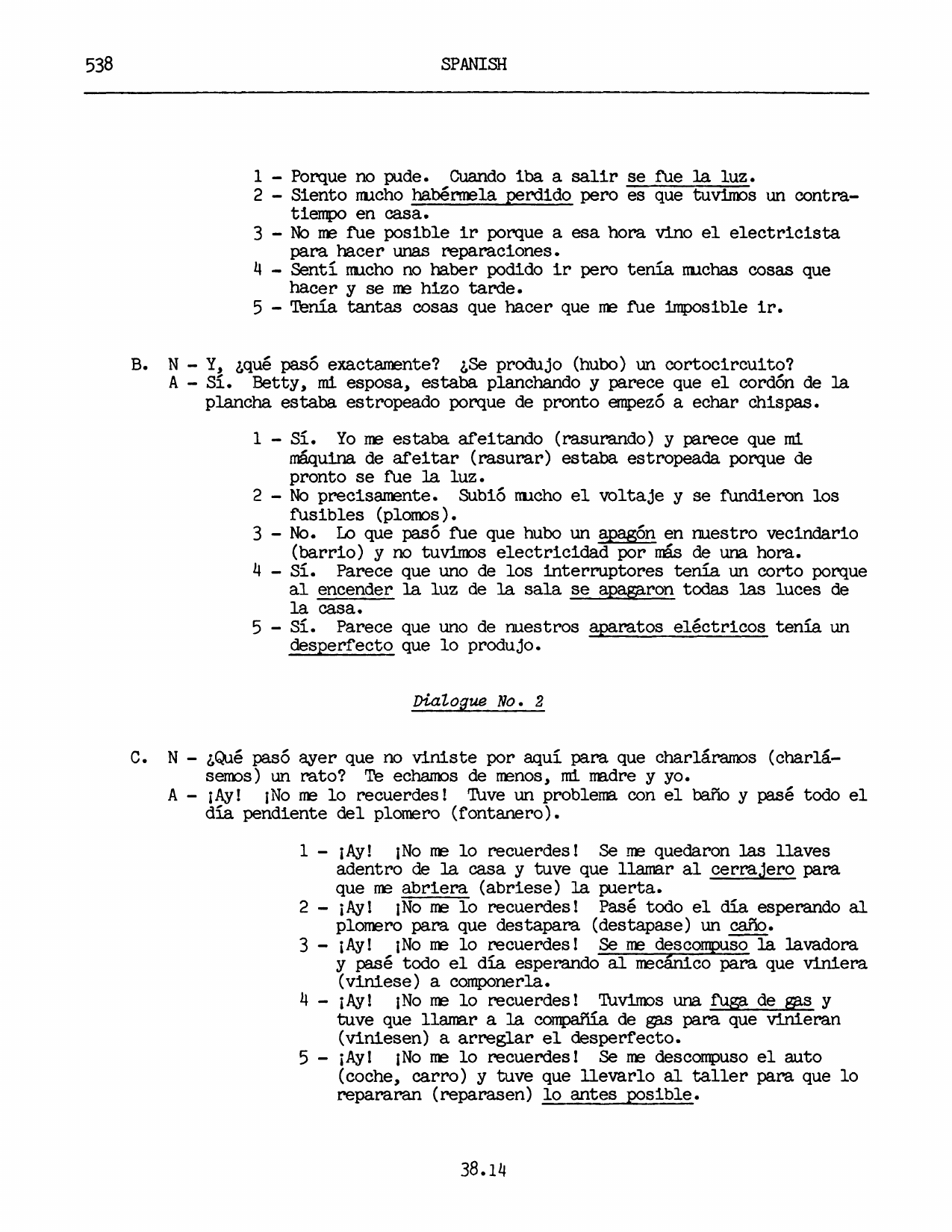
D. N- ¿Te cobró mucho?
A - Me cobró $500 (pesos). No sé si es mucho, aunque también arregló
(compuso) una llave (un grifo, una canilla) que goteaba.
1 - Me cobró $1.600 (pesos). No sé si es mucho, aunque tam-
bién me hizo el favor de cambiar una cerradura (chapa) que ya no servía.
2 - Me cobró $700 (pesos). No sé si es mucho, aunque también
destapó el lavabo.
3 - Me cobró $1.200 (pesos). No sé si es mucho, aunque tam
bién revisó la secadora.
4 — No me cobró nada, afortunadamente.
5 - Todavía no sé en cuánto me va a salir porque todavía no
me han entregado el auto (coche, carro). Mañana me darán las malas noticias.
Variants: (continued)
Dialogue No. 1
A. WN - Why didn't you come to the get-together yesterday? We had a very
enjoyable time.
A - The reason was that we had a problem with the electricity at home.
When I was about to leave, the fuses blew and we had to call an electrician.
1 - Because I couldn't. When I was about to leave, the
2 - I'm very sorry to have missed it but the reason was that
we had a mishap at home.
3 - It was not possible for me to come because at that time
the electrician came over to do some repairs.
4 - I was very sorry not to have been able to come but I had
many things to do and I saw it was getting late.
5 - I had so many things to do that it was impossible for me
to come.
B. W - And what exactly happened? Was there a short ctreuit?
A - Yes. My wife, Betty, was troning and apparently the cord to the iron
was damaged, because all of a sudden it began to throw off sparks.
1 - Yes. I was shaving and apparently my shaver was damaged,
because all of a sudden the lights went out.
2 - Not exactly. The voltage shot up and the fuses blew. 3 - No. What happened was that there was a blackout in our
neighborhood and we were without power for more than an hour.
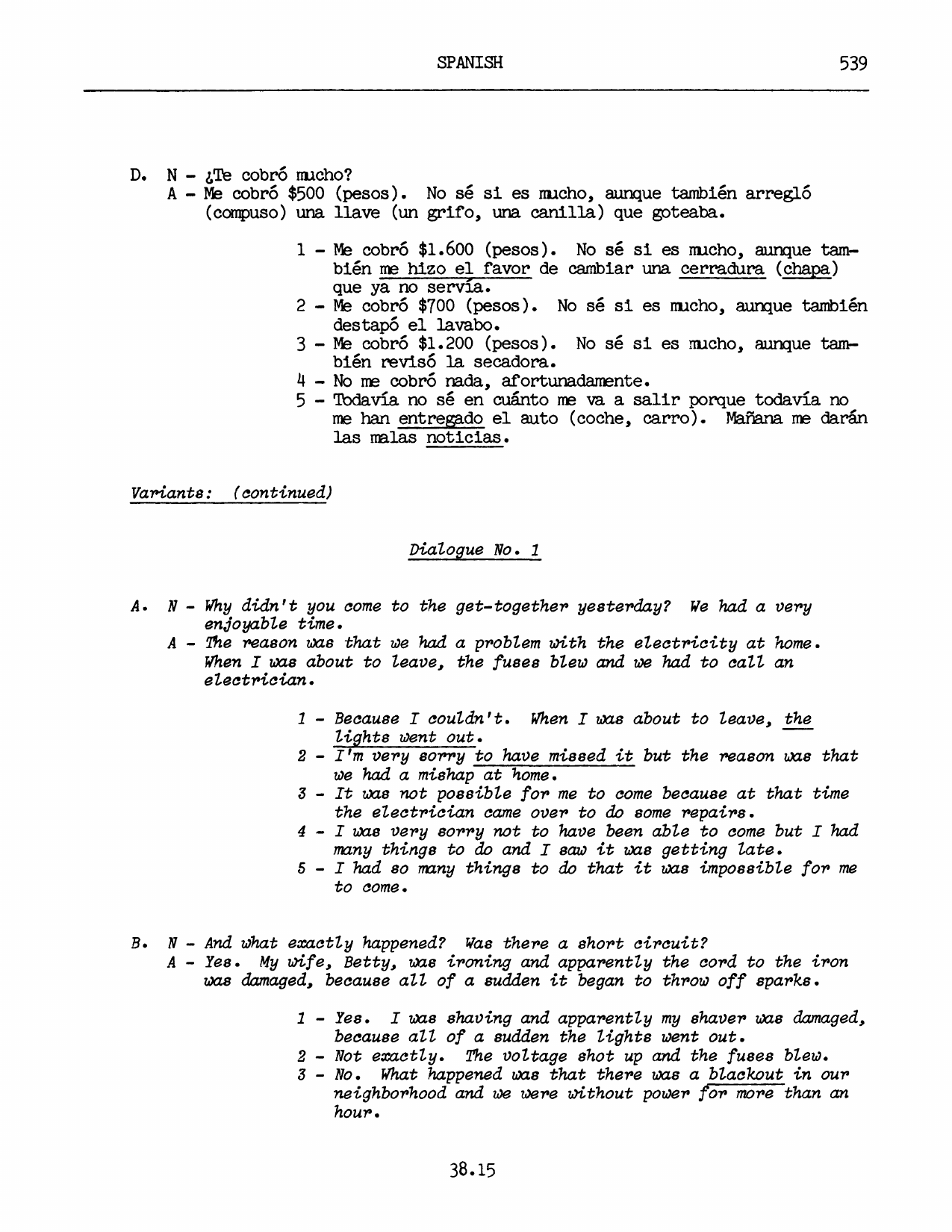
4 - Yes. Apparently one of the light switches had a short in
tt, because on turning the living room lights on, all the
5 - Yes. Apparently one of our electrical appliances had a
defect that caused it.
Dialogue No. 2
C. N - What happened yesterday that you didn't come by so that we could chat
for a while? My mother and I missed you. (familiar)
A - Oh! Don't remind me! I had a problem with the bathroom and I spent
all day keeping an eye on the plumber. (familiar)
1 - Oh! Don't remind me! I left the keys inside the house
and I had to call the Locksmith to open the door for me. (familiar)
2 - Oh! Don't remind me! I spent all day waiting for the
plumber to come to unstop a drainpipe. (familiar)
3 - Oh! Don't remind me! My washer broke down and I spent
all day waiting for the mechanic to come to repair it. (famitiar)
4 - Oh! Don't remind me! We had a gas leak and I had to
call the gas company so that they would come to fix the problem. (familiar)
5 - Oh! Don't remind me! My car broke down and I had to
take it to the shop so that they would fix it as soon as possible.
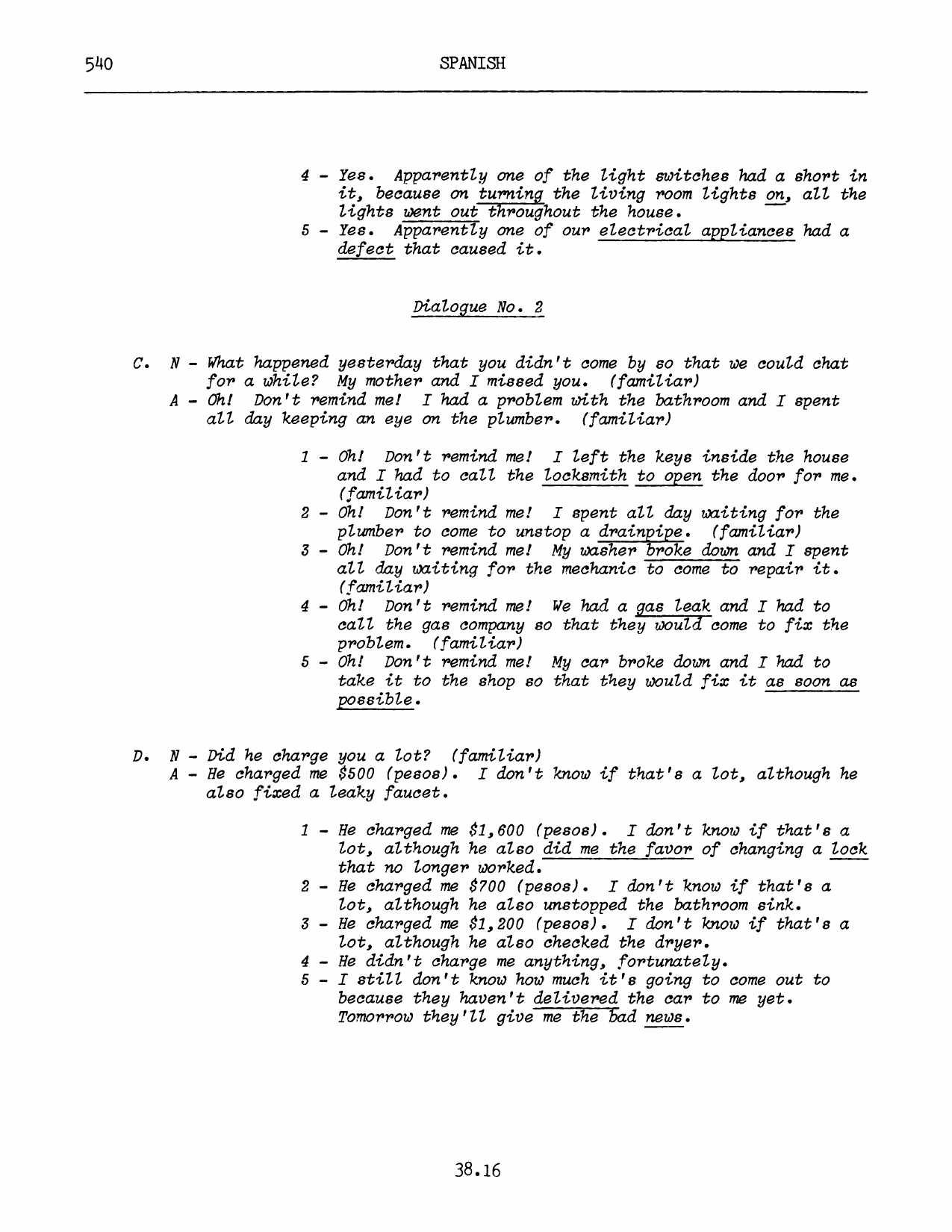
D. W = Did he charge you a lot? (familiar)
A - He charged me $500 (pesos). I don't know if that's a lot, although he
also fixed a leaky faucet.
1 - He charged me $1,600 (pesos). I don't know if that's a
lot, although he also did me the favor of changing a Lock that no longer worked.
2 - He charged me $700 (pesos). I don't know 1f that's a
lot, although he also unstopped the bathroom sink.
3 - He charged me $1,200 (pesos). I don't know if that's a
lot, although he also checked the dryer.
4 - He didn't charge me anything, fortunately. 5 - I still don't know how much it's going to come out to
because they haven't delivered the car to me yet. Tomorrow they'll give me the bad news.
VII. MAKING IT WORK
VIII. USING IT